„Saya/Kami* akui bahawa telah membaca
karya ini dan pada pandangan saya/kami* karya ini
adalah memadai dari segi skop dan kualiti untuk tujuan penganugerahan
Ijazah Sarjana Muda Pengurusan Teknologi (Inovasi Teknologi)‟
Tandatangan : ………..
Nama Penyelia : ……….. Tarikh : ………..
Tandatangan : ………
Nama Penilai : ……… Tarikh : ………
CONSUMER PERCEPTION AND ACCEPTANCE TOWARDS
WIMAX (WORLDWIDE INTEROPERABILITY FOR MICROWAVE ACCESS) WIRELESS CONNECTION IN MELAKA
TEO SOO WAH
Laporan ini dikemukakan sebagai memenuhi sebahagian daripada syarat penganugerahan Ijazah Sarjana Muda Pengurusan Teknologi (Inovasi Teknologi)
Fakulti Pengurusan Teknologi Dan Teknousahawan Universiti Teknikal Malaysia Melaka
“Saya akui laporan ini adalah hasil kerja saya sendiri kecuali ringkasan dan petikan yang tiap-tiap satunya saya telah jelaskan sumbernya”
Tandatangan :……… Nama : Teo Soo Wah
DEDICATION
ACKNOWLEDGEMENT
I was deeply grateful and wish to express my warm and sincere thanks to my supervisor Madam Azrina Binti Othman for her guidance and encouragement given throughout undergo this final year project. Her wide knowledge and enthusiasm help
have been of great value to me. Besides that, I would like to thanks to Dr. Amirrudin Bin Ahamat for his usefulness comment and advice.
ABSTRAK
Keperluan kepada sambungan Internet tanpa wayar semakin meningkat di Malaysia. Pada masa kini, teknologi yang baru telah dicipta secara agresif dalam pasaran. Oleh itu, sambungan Internet tanpa wayar kepada generasi keempat telah dicipta untuk meningkatkan gaya hidup dan kemudahan pengguna. WiMAX (Worldwide Interoperability for Microwave Access) adalah sambungan Internet tanpa wayar generasi keempat yang terlibat dalam kategori MAN (Metropolitan Area Network). Walaupun WiMAX sambungan Internet tanpa wayar telah wujud di Malaysia tetapi tingkah laku membeli masih dianggap tidak stabil. Tujuan kajian ini adalah untuk mengkaji persepsi and penerimaan pengguna terhadap WiMAX sambungan Internet tanpa wayar di Melaka. Kajian ini akan memberi tumpuan kepada tiga kategori iaitu generasi Baby Boomers, generasi X dan generasi Y bagi mengenal pasti tahap penerimaan mereka terhadap penggunaan WiMAX. Ini adalah satu penyelidikan deskriptif dan menggunakan tinjauan mengumpul data primer. Dalam kajian ini, kaedah kuantitatif dijalankan untuk mengumpul data yang berkaitan dari pengguna Internet. Selain itu, penyelidik akan mengedarkan 150 soal selidik kepada responden yang tinggal di Melaka. Data yang dikumpul telah dianalisa dengan menggunakan sistem SPPSS 20.0. Hasil kajian menunjukkan persepsi dan penerimaan pengguna yang mempunyai hubungan positif terhadap WiMAX. Hasil kajian ini membuktikan bahawa Model Penerimaan Teknologi (TAM) dan persepsi kualiti adalah faktor yang boleh menpengaruhi pengguna Internet. Kesimpulannya, WiMAX sambungan Internet tanpa wayar boleh mengembangkan secara agresif di Melaka kerana pengguna Internet mempunyai persepsi yang baik dan mereka dapat menerima teknologi yang baru.
ABSTRACT
The requirements for the wireless connection are gradually increase in Malaysia. New technology was aggressively created to the market. Therefore, fourth generation wireless connection was developed to improve consumer‟s lifestyle and convenience them. WiMAX (Worldwide Interoperability for Microwave Access) is the fourth generation wireless connection which included in the categories of wireless MAN (Metropolitan Area Network). WiMAX wireless connection was exists in Malaysia but the buying behavior still consider unstable. The purpose of this study was to investigate the consumer perception and acceptance on the WiMAX wireless connection in Melaka. This study focused on three categories of consumer which was Baby Boomers generation, Generation X and Generation Y in order to identify their acceptance level for the WiMAX wireless connection. This was a descriptive research and using survey strategy to collect primary data. In the study, quantitative method was conducted to collect the relevance data from the Internet users. Furthermore, researcher was distributed 150 questionnaire surveys to the consumers who live in Melaka. Data collected is analysed by using the SPSS 20.0. The results show the consumer perception and acceptance had positive relationship towards the WiMAX wireless connection. This study proved that Technology Acceptance Model (TAM) and perceived quality can be efficiency influence the consumer. As a conclusion, WiMAX wireless connection can spread aggressively in the Melaka since the consumers had good perception and willingness to accept this new technology.
vii
TABLE OF CONTENTS
CHAPTER TITLES NO. OF
PAGE
DECLARATION ii
DEDICATION iii
ACKNOWLEDGEMENT iv
ABSTRAK v
ABSTRACT vi
TABLE OF CONTENTS vii-x
LIST OF TABLES xi-xii
LIST OF FIGURES xiii
LIST OF ABBREVIATIONS xiv
LIST OF SYMBOLS xv
LIST OF APPENDICES xvi
CHAPTER 1 INTRODUCTION
1.1 Background of Study 1-2
1.2 Problem Statements 2
1.3 Research Questions 3
1.4 Research Objectives 3
1.5 Scope and Limitation of Study 3-4
1.6 Important of Study 4
viii
CHAPTER 2 LITERATURE REVIEW
2.1 Introduction 5
2.2 Internet in Malaysia 5-6
2.2.1 Trends of Internet Users 6-8
2.3 Overview of WiMAX Wireless Connection 8 2.3.1 Market of WiMAX Wireless Connection
in Malaysia 9
2.3.2 Benefits of WiMAX Wireless Connection 9-10 2.4 Element of Consumer Perception 10-11 2.5 Elements of Consumer Acceptance 11-13 2.6 Moderating Variable for Younger People and
Elder‟ People 13
2.7 Theoretical Framework 14
2.8 Hypothesis 15
2.9 Summary 16
CHAPTER 3 RESEARCH METHOD
3.1 Introduction 17
3.2 Research Design 17-18
3.3 Methodological Choice 18-19
3.4 Primary and Secondary Data Sources 19
3.5 Location of Research 20
3.6 Method of Primary Data Collection 20-21
3.7 Sampling Design 21
3.8 Questionnaire Design 21-22
3.9 Data Analysis Method 22
3.10 Validity, Reliability and Generalisability 22
3.10.1 Construct Validity 22
3.10.2 Internal Validity 23
ix
3.10.4 Reliability 23-24
3.11 Summary 24
CHAPTER 4 DATA ANALYSIS
4.1 Introduction 25
4.2 Descriptive Analysis 26
4.2.1 Respondent Demographic Analysis 26
4.2.1.1 Gender 26
4.2.1.2 Age 27
4.2.1.3 Income Level 28
4.2.1.4 Education Level
29
4.2.1.5 Occupation 30
4.2.1.6 Number of Access Internet a Week 31 4.2.1.7 The User of WiMAX
Wireless Connection 32 4.2.1.8 Type of WiMAX User
33
4.2.1.9 Experience For Using Wireless
Broadband 34
4.2.1.10 Know or Do Not Know WiMAX
Wireless Connection 35 4.2.1.11 Favorite Wireless Broadband
36
4.2.2 Research Question
37
4.2.2.1 Consumer Perception 37-38 4.2.2.2 Consumer Acceptance
38-41
4.3 Scale Measurement (Reliability) 42
4.4 Inferential Analysis 43
4.4.1 Pearson Correlation Analysis 43-44 4.4.2 Multiple Regression Analysis 44-46
4.4.3 Hypothesis Testing 47-51
x
CHAPTER 5 DISCUSSION, CONCLUSION AND IMPLICATION
5.1 Introduction 53
5.2 Summary of Statistical Analysis 53
5.2.1 Descriptive Analysis 54
5.2.2 Scale Measurement (Reliability Test) 55
5.2.3 Inferential Analysis 55
5.2.3.1 Pearson Correlation Analysis 55 5.2.3.2 Multiple Regression Analysis 55-56
5.3 Implication of Study 56-57
5.4 Discussion of Major Findings 57-61
5.5 Limitation of Study 62
5.6 Recommendation for Future Research 63
5.7 Conclusion 64
5.8 Summary 65
References 66-68
xi
LIST OF TABLES
NO. TITLE NO. OF
PAGES 4.1 Statistic Analysis of Respondents by Gender 26 4.2 Statistic Analysis of Respondents by Age 27 4.3 Statistic Analysis of Respondents by Income Level 28 4.4 Statistic Analysis of Respondents by Education Level 29 4.5 Statistic Analysis of Respondents by Occupation 30 4.6 Statistic Analysis of Respondents by Number of Access
Internet a Week 31
4.7 Statistic Analysis of Respondents by the User of WiMAX 32 4.8 Statistic Analysis of Respondents by Type of WiMAX
User 33
4.9 Statistic Analysis of Respondents by Experience for
Using Wireless Broadband 34
4.10 Statistic Analysis of Respondents by Know or Do Not
Know about WiMAX Wireless Connection 35
4.11 Statistic Analysis of Respondents by Favorite Wireless
Broadband 36
4.12 Summary of Consumer Perception 37
4.13 Summary of Perceived Usefulness 38
4.14 Summary of Perceived Ease of Use 40
xii
4.15 Reliability Result 42
4.16 Results of Pearson Correlation Analysis 43
4.17 Multiple Regression Analysis 44
4.18 ANOVA table 45
4.19 Coefficients 46
4.20 Result of Simple Linear Regression Analysis for
Perceived Ease of Use 47
4.21 Result of Simple Linear Regression Analysis for
Perceived Usefulness 49
4.22 Result of Simple Linear Regression Analysis for
xiii
LIST OF FIGURES
No. Title No. of Pages
2.1 Global Internet users and penetration rate from year 1995
until 2009 7
2.2 Internet users in Malaysia 7
2.3 WiMAX Subscribers in Developed and Emerging Markets
9
xiv
LIST OF ABBREVIATIONS
ATM Automated Teller Machine
CP Perceived Quality
CAE Perceived Ease of Use CAU Perceived Usefulness CDM Cash Deposit Machine
DV Dependent Variable
IP Internet Protocol IV Independent Variable
JARING Joint Advanced Integrated Networking
MAN Metropolitan Area Network
MCMC Malaysian Communications and Multimedia Commission
MIMOS Malaysian Institute of Microelectronic Systems
P1 Packet 1 Network
QOS Quality of Service
SPSS Statistical Package for Social Science
TAM Technology Acceptance Model TRA Theory of Reasoned Action
WiMAX Worldwide Interoperability for Microwave Access
xv
LIST OF SYMBOL
H0 Null Hypothesis
xvi
LIST OF APPENDICES
NO. TITLE NO. OF PAGE
A Gantt Chart for PSM 1 69
B Gantt Chart for PSM 2 69
1
CHAPTER 1
INTRODUCTION
1.1 Background of study
Nowadays, wireless connectivity is increasingly pervasive and persuasive for enabling the true mobility. Most of the consumers rely on the network to absorb knowledge or connecting with people. Development of the network not only attracts younger people but also elder‟s people. Sometime, the elder‟s people utilize network to communicate with their child who are study in oversea. Previously, Wi-Fi access is typically highly contended and has poor upload speeds between the router and the internet (Burak, 2003). Seen there are large population are using the Internet and the Wi-Fi access cannot meet the requirement of the consumer, thus, firms have opportunity to create Worldwide Interoperability for Microwave Access (WiMAX) wireless connection.
2
The first licensee of WiMAX wireless connection is Packet 1 Network (P1) and following by YTL Corporation (YES), Asiaspace commercially and Redtone International. P1 and YES make heavily promotion in urban area liked Kuala Lumpur and Johor Bahru. However, they are not widely promoted in Melaka.
Malaysia Government was aggressively spread the WiMAX wireless connection in year 2008. According to the report of Strategy Analytics (2008), Malaysian government has aggressive plans to grow broadband penetration to 75% of households in Malaysia by 2010; therefore, WiMAX wireless connection is the choice to help meet its goals. Thus, this study is to investigate the perception and acceptance of the WiMAX wireless connection users in Melaka.
1.2 Problem Statements
WiMAX wireless connection still considered a new technology and there was lack of research towards this new technology. WiMAX wireless connection was exists for a long time in Melaka but still not all consumers know about this wireless connection.
Some of the consumers cannot differentiate the differences between Wi-Fi and WiMAX wireless connection. Therefore, the uncertainty would resist consumer to use the WiMAX wireless connection.
3
1.3 Research Questions
The research questions of this study as below:
1.3.1 Who are the users of WiMAX wireless connections in Melaka?
1.3.2 What is the consumer perception towards WiMAX wireless connection in Melaka?
1.3.3 How is the acceptance level of WiMAX wireless connection in Melaka?
1.4 Research Objectives
The objectives were to investigate the acceptance and perception of the consumer towards the WiMAX wireless connection in Melaka. The objectives of this study can be constructed as below:
1.4.1 To identify the users of WiMAX wireless connection in Melaka.
1.4.2 To investigate the consumer perception of WiMAX wireless connection in Melaka.
1.4.3 To examine the acceptability of the consumer for WiMAX wireless connection in Melaka.
1.5 Scope and Limitation of Study
The scope of this research is to investigate the consumer perception and acceptance for the WiMAX wireless connection in Melaka. This study was conducted in Melaka to examine the acceptability and perception of the consumer towards the WiMAX wireless connection.
4
WiMAX wireless connection. Respondents divided into three categories which were Baby Boomers generation (above 49 years old), Generation X (37 years old until 48 years old) and Generation Y (19 years old until 36 years old)
There were some limitations in this study. Firstly, this study focused only in Melaka area with specific location choose for examine consumer perception and acceptance of WiMAX wireless connection. Secondly, the researcher assuming the respondents answers with logical and honestly.
1.6 Important of Study
This study was intended to find out about consumer perception and acceptance towards the WiMAX wireless connection. This study was beneficial to the consumer to provide a better understanding of WiMAX wireless connection. Understanding of the consumer could be influence their perception. Hence, indirectly improve consumer buying behaviour for the WiMAX wireless connection.
Besides that, firms should obtain the consumer perception to improve their performance such as promotion strategy. Thus, firms should promote WiMAX wireless connection in Melaka aggressively.
The data of this study could provide to the government agencies such as Malaysian Communications and Multimedia Commission (MCMC) to improve their awareness of the facility for the WiMAX wireless connection in Malaysia.
1.7 Summary
5
CHAPTER 2
LITERATURE REVIEW
2.1 Introduction
This chapter discussed about the Internet in Malaysia and overview of WiMAX wireless connection. The element of the consumer perception would be mention, included the perceive quality. The elements of the consumer acceptance also would be mention which included the unfilled needs and wants, personalities and driving force. Introduce of the Internet in Malaysia would be discuss in section 2.2 and 2.2.1 whereas the overview of WiMAX wireless connection would mention on section 2.3. To clearly explain for the WiMAX wireless connection, market and benefit of WiMAX wireless connection would explain on section 2.3.1 and 2.3.2. To make a clear scenario, element of consumer perception would be discuss in section 2.4 while section 2.5 would explain about the elements of consumer acceptance. Follow by section 2.6 and 2.7 which is the moderating variable for younger people and elder‟s people and theoretical framework. Hypothesis would be mention on section 2.8. Lastly, summary would be presented in section 2.9.
2.2 Internet in Malaysia
6
subsequent launching of Joint Advanced Integrated Networking (JARING) as the main Internet Service Provider (Salman, 2013). The year 1995 was considered the beginning of the Internet age in Malaysia. The growth in the number of Internet hosts in Malaysia began around 1996 (Salman, 2013).
Malaysia government had earlier begun formulating a national strategy for telecommunications, including the Internet. There were several important documents and strategies in the Malaysia national information policy. One of them is Malaysia‟s Vision 2020 launched in 1991 by Dr Mahathir, the then Prime Minister (Salman, 2013). Dr Mahathir set the Vision 2020 to motivate the country go in the future and outlined the goal to become a developed nation come 2020. National strategy for telecommunications is one of the driving forces to achieve the Vision 2020.
Internet was becoming popular in Malaysia because it is a place where people share their ideas, build communities, shape the future democratically, and promote a new way of doing business (Paynter, 2001). People can stimulate the ideas or trigger innovation by refer previous technologies through the Internet.
2.2.1 Trends of Internet Users
7
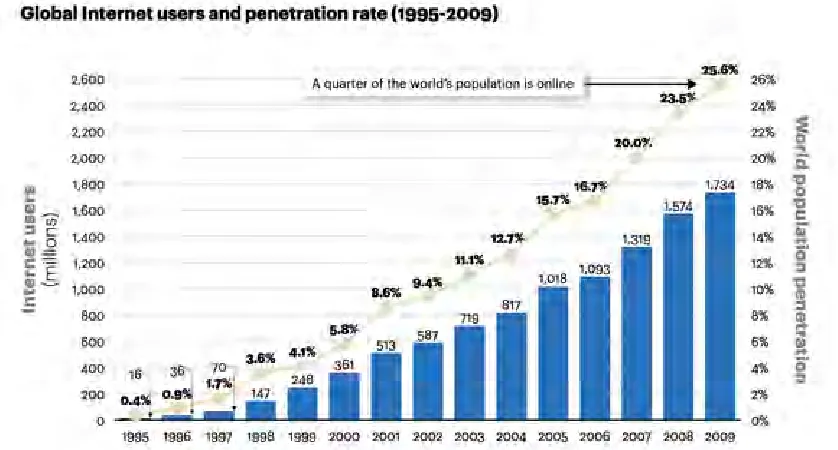
Figure 2.1 Global Internet users and penetration rate from year 1995 until 2009 (Source: Nielsen, ITU; A.T. Kearney analysis)
Based on the Figure 2.2 as below, the graph indicated the trends of Internet users in Malaysia from year 2002 until 2010. Trends show the Internet users in Malaysia had a great potential to growth after year 2010. Besides that, began from year 2002 Internet users were gradually increased until year 2010. The Internet user in Malaysia was last reported at 15989772.57 in 2010, according to a World Bank report published in 2012.
[image:24.596.133.500.513.668.2]