•
•
COMMISSION OF THE EUROPEAN COMMUNITIES
Information Di rectorote-Generole B-1 040 BRUSSELS Rue de Ia Loi 200 Tel. 350040
Subscription: ext. 5120 Inquiries: ext. 2590 Telex COMEURBRU 21877
%
~
f
DR
r:1
fl
T% 0
~
I
COOPERATION AND DEVEWPMENTE E C M 0 R 0 C C 0 121/76
The agreement signed in Rabat on 27.4.76 marks a significant
step forward in the relations between Morocco and the European
Community. The numerous problems to be solved led to long and
sometimes difficult negotiations. This did not however, undermine the willingness of the Moroccans and Europeans to strengthen the
existing links in order finally to succeed in concluding a cooperation agreement,
As the EEC/Morocco agreement contains financial provisions, it cannot enter into force until after ratification by the national parliaments.
In the meantime the trade prov1s1ons of the agreement will come
into force on 1 July 1976 as both sides hav~ concluded an interim
agreement enabling the advanced implementation of these provisions,
So the hopes born at the time of the first EEC/Morocco agreement in 1969 were finally realised, The latter agreement was the first
to be concluded between the EEC and a ~1editerranean country.
It thus opens the way for a vast cooperation policy between both sides of the Mediterranean, with the Maghreb countries as with the Machrak (Egypt, Jordan, Lebanon and Syria). It is also the
first marker in the Community's policy with respect to the Mediterranean area which was launched in November 1972.
This cooperation takes note of the interdependence which exists
between the countries in the region each of ~hom wants to make it a
zone of peace and prosperity. It comes at a time when the Euro-Arab dialogue is beginning to take shape and will thus complete the picture in an opportune manner.
216/X/76
-2-It constitu~es, in other respects, an essential pillar in cooperation
between Europe and developing countries in the same way as the Convention of Lome which brings together the Nine Member States of the EEC and
forty six African, Caribbean and Pacific States.
It finally serves as an example for the negotiations currently going on in the framework of International Economic Cooperation between the
industrialised countries of the northern hemisphere and the developing countries of the southern hemisphere (North- South Dialogue).
THE 1969 AGREEr.1ENT : A POINT OF DEPARTURE
Since 1963,discussions between Morocco and the Community have aimed at concluding a cooperation agreement, The negotiations have from the start run up against two types of problems.
It should be remembered that at this time, Europe was just finding its feet, particularly in so far as the agricultural sector was
concerned. It is well kno\'rithat the process of setting up the
common agricultural market was both long and difficult and that problems had periodically cropped up in the management of this
Community pol icy~ .
For a number of products in the agricultural sector~ whi.ch on the
trade level are of major interest to Moroccan exports, there i.s no
commo·n organisation of the market. As a result the Community authorities could not make any offer to Rabat for the products in question, as
these would not be valid for all the Member States of the EEC.
This of course reduced, a priori, the scope of the envisaged agreement. Some of the Member States which have good relations with Morocco were also hesistant about establ i.shi,ng a cooperation framework with this country whri:ch would have finanCial repercussions.
Essentially for these reasons, the negotiations between Rabat and the Six only succeeded in February 1969, the date on which the first EEC/ Morocco agreement was signed in the Moroccan capital, A complementary protocol to this agreement was signed in March 1973 in Brussels, to adapt it to the new dimensions of the· Community which has since January 1 1973, included an additional three Member States: Denmark Ireland and the United Kingdom.
The 1969 agreement only co~ered the trade aspects, the aim being to
establish a free trade area, So this arrangement was far from meeting the initial wishes of the Moroccan government which was demanding the conclusion of a global agreement covering three main aspects: the greatest possible preferential trade arrangements, financial cooperation, technical assistance, including provisions
in favour of Moroccan workers employed in the EEC. As this type of
agreement seemed premature, in view of the level of integration in Europe, the Moroccan authorities finally accepted the idea of negotiating a partial type of trade agreement, The merit of this
mo~e was to start the cooperation prvcess and to show confidence
-3-The first .agreemen~ was .therefore. negpt.iated .with the a.if11•.of,:givingi ::
concrete expression :to a political. commitment ·,expressing :.rec-iproca;l confidence in. the future. of mutual relations·. . . : . . . ' ' . - . · : -,-,, .·:'- , .... , , . . .. · .... • : . ·'; ...
I , ' '·
The 1969 agreeine.nt .. made .th.e following prOvisions for i~·p·o~t~·:· ~f
•:: .. ..
,·y·Moroccan. :goods .into the Community , :. · . '·. -, , ;: ;· : . ··. ·: , ,
For i ndu~t'ri
al:
'~~ocJ-u~fs t~~A~l i'mi' nation of ~~stoms• ·~'~ti.e's ·-'~nd'~~.·;; '. ::; ·_: ":
quantitive restrictions with the exception of articles made_outof cork and a special safeguard clause for refined petroleum products;
- For agricultural products a whole range of fruit and vegetables.··
were excluded notably /ruit.juices.and wines, For the rest·.of ., .
the products concessions of varying degrees were inc 1 uded (tariff--'· reductions ranging from 50 - 80%., some being subject to special
conditions mi.nimum import price, export tax, calendar limitation~),
These provisions aimed at avoiding jeopardising the func;tioning·.of· the common organisation of the markets and at protectingproduct-s considered.as sensitive in the EEC.
For its part Morocco. has subscribed to a commitment to guarantee. a . ,
certain level of liberation of its imports from the Community, This
provision has led the Moroccan authorities to open a cel1
t?in. number of
quotas for produ~ts originating in the EEC. .
... ··
THE 1976 AGREEMENT : A COMPLETELY DIFFERENT DIMENSION
The confidence which prevailed in 1969 took concrete form in:.January 1976 in Brussels with the conclusion of a real cooperation agreement,
The negotiations which be9an in July 1973 ended with. the con~lusion
of an agreement_which covered all the aspects Morocco had wanted~.
This is far from negligible when one considers that the EEC_i$ the, first trade partner of Morocco.
It provides first of all for the extension of free access to the .Community market for products originating from Morocco which are covered _by the.·.· European Coal and Steel Community (ECSC).
The new agreement also provides for a more flexible regime for·cork products and refined petroleum products, As of 31 December 1979, these products will be able to freely enter the EEC.
In the agricultural sector, the Nine significantly improved th~ir
concessions for products coming from Morocco, notably as far
as tinned vegetab 1 es, fruit juices, fishery products and wi l')e are ... ·
concerned,
Bl't this is not the main point about the agreement between the EE~
~nrl Morocco. It should be emphasised that, unlike the 1969 aqreement
which 1-:as valid- for.5 years the new agreement has been sign~d-for. an·.,
unlimited period of,time. .c
. ;. ;
It also includes.an ·important section on financial and technical
coope•-;;"t,i:)i1 l"h~ch bqth"sides consider will,,in the-future,_ consd:tute .•
-
4-It contains moreover provisions concerning Moroccan workers employed in the EEC. This has the merit of making the social advantages of Moroccan workers applicable throughout the Community, whereas previously there were different systems in the Member States.
On the institutional level, the new agreement establishes a Council of Ministers which is responsible for managing the agreement and for facilitating cooperation and contacts between the European Parliament and the National Assembly in Morocco.
-.:C.ontri bute to the --e.conomi c ·and soci a 1 deve 1 Ol!!ent of ·Morocco---..
i . ~' . .. - - ...
11The Community shall participate, within the framework of financial and
technical cooperation, in the financing of. measures such.'.as to contribute to the economic and social development of Morocco11
•
Such is the wording of the first article of the protocol dealing with financial and technical cooperation between Morocco and the EEC. The intention can appear ambitious when compared with the sums allocated to the State to finance development actions. The Nine are granting Morocco a financial envelope of 130 million units of account (about 715
million dirhams) over a five year period, divided up as follows: -56 million u.a. (308 million dirhams) in .the form of loans from
the European Investment Bank (EIBl accorded from its own resources at normal conditions of the financial market;
- 58 million u.a. (319 million dirhams) in the form of loans on special terms: for a period of 40 years with a grace period of· 10 years and a rate of interest of 1%.
- 16 million u.a. ( 88 million dirhams) in the form of grants;
these subsidies could serve as interest rebates (as a general rule 2%} for loans accorded by the EIB.
These sums, although modest, are of prime importance to the spirit between the two partners as they should have a spill -over effect on other
external financings in favour of development projects in Morocco. The agreement also expressly provides for the co - financing of these operations:
11 Aid contributed by the Community for the execution of certain
projects may, with the agreement of Morocco take the form of co-financing in which, in particular, credit and development bo.dies and institutions of Morocco, of t~ember States or of Third States or international finance organisations would take part11
,
So the cooperation section of the EEC /Morocco agreement would obviously favour joint action betwen the Nine and Morocco but also with the participation of other countries notably with the oil exporting countries.
Moreover to enable the participation of foreign fir.ms in the economic and social development of Morocco~ the government of Rabat adopted
in September 1973 a code of investment which covers export, industrial, mining, tourism, maritime equipment, fishing and
; )
-Morocco or be companies in which at least 50% of the capital is
f4oroccan. In order to benefit from the code ordinary industrial
investments must exceed 25,000 dollars {about 125,000 dirhams} and
a convention must be concluded with the Moroccan State for sums
exceeding 7 mi 11 ion do 11 a rs ( 35 mi 11 ion dirhams
L
A tot a 1 exemptionof tax on professional profit for a period of 70 years is written
into the code in favour of new industrial investment~.
Existing industrial investments not benefittinq from equipment,
premiums can also claim this exemption,
-In order to achieve the cooperation referred to in the EEC/Morocco agreement account is taken of the following :
-The objectives and priorities of Morocco's development plans and programmes;
- The importance of schemes into which different operations are integrated and of promoting regional cooperation between
Morocco and other states (this of course concerns in the first place the other Maghreb countries}.
As far as the objectives of this cooperation are concerned, the actions of the EEC must be complementary to the efforts of t1orocco to
diversify the structure of its economy, notably in the framework of the industrialisation and modernisation of the agricultural sector of
the country. It must also promote industrial cooperation enabling
Community participation in the realisation of industrial development programmes, the organisation of contacts between firms on both sides and the acquisition on favourable terms of patents by Morocco,
The new agreement also provides for cooperation in the scientific field and the fishing sector,
Finally it contains provisions which aim at favouring the participation of t4oroccan firms in the execution of work financed by Communit'/
funds. Provision is made for an accelerated procedure for issuing
invitations to tender involvir.g shorter time limits for the submission of tenders for work contracts which could be mainly of interest to these firms.
This procedure can be applied to tenders where the cost involved
is less than 1 million units of account (5.5 million dirhams)
A. single territory'·for Moroccan workers
The new agreement enables Moroccan workers employed in the EEC not to be discriminated against in so far as working conditions or remunerations
are concerned, in comparison to European workers. They must also haye
the same social advantages in all the nine Member States of the Community. They will benefit from all periods of insurance , employment or
residence completed in the Nine in so far as pensions and annuities in respect of old age, death and invalidity, and also medical care for their families resident in the territory of the EEC, are
-6-This 11globalisation11
certainly constitutesthe most positive aspect
of the provisions concerning ~1oroccan Labour employed in Europe. It
also applies to family allowances for Moroccan workers whose families are resident in the Community. They are also allowed to freely transfer to Morocco pensions, annuities in respect of old age, death and work accidents, illness and invalidity,
Annexed to the agreement is an exchange of letters between the two parties on the subject of Moroccan workers. In these documents the Community authorities commit themselves to an exchange of views on the possibility of examining improvements to the conditions of life and work of Moroccans residing in the EEC.
These improvements could concern notably socio - cultural problems which confront Moroccan workers.
These provisions are of particular importance when one considers that
about 200,000 Moroccan workers are employed in the Community;
130,000 in France, 30,000 in Belgium, 16,400 in Germany, 9,500 in
the Netherlands and 2,000 in the United Kingdom,
Increase Moroccan exports to the EEC
For raw materials and industrial products including ECSC products the Nine accord Moroccan exports free access into the Community market
meaning exemption of customs duties and quantitative restrictions,
As far as agricultural imports from Morocco are concerned, they benefit from a substantially improved regime. The tariff concessions offered
by the Community cover between 80 and 90% of Moroccan exports of
agricultural products whereas the 1969 agreement only covered 50%.
Moreover Morocco can continue to benefit from privileged access in the French market for products not covered and for some products covered by the agreement. ;This is a temporary measure enabling Moroccan exporters to apportion their sales better between the Member States.
These sales are at present essentially made on the French market and concern notably fruit and vegetables. The cumulated advantages thus
accorded should end in the opinion of the EEC, on 1 January 1979.
The desire of the Community authorities to increase the volume of Moroccan exports on the European market is clearly expressed in Article 8 of the agreement:
"in the field of trade, the object of the Agreement is to promote trade between the contracting parties, taking account of their
respective level of development and of the necessity to ensure a better balance in their trade, with a view to increasing the rate of growth of Morocco's trade and improving the conditions of access for its products on the Community market."
The attainment of this objective is a necessity for Morocco which
-7-To do this, it is obliged to buy its capital goods from abroad, a large part of which are supplied by the Member States of the Corrnnunity.
The new a~reement should enable first of all the stabilisation and
then the increase of agricultural exports of Morocco to the EEC.
These have often been subject to significant fluctuations from one year to the next.
It should also increase the export of industrial products to the
Community markets. In 1969 these accounted for 7,4% of total Moroccan
sales to the EEC and this percentage increased to 20.8% in 1974,
as the follawing table indicates :
External trade of Morocco with the EEC (1969 - 1974)
1969 1971
% 1000 %
1972 1973 1974
ua Up ua 0
Ou ua
0 0
1000 1000 % 100 % 1000
Imports 335287 390179 376999 493007 751136
Exports 378287 100 399756 100 483152 100 572905 100 869225
Agricultural
products 238690 63.1 227369 56.9 262259 54.-: 348145 60,8 308687
Raw materia 1 s 111768 29.5 106449 26,6 120781 25.C 145130 25.3 379362
Industria 1
products 28064 7.4 6594C 16. ~ 100112 201 I 79629 13,9 181176
Balance 43235 9577 106153 79898 118039
Source : Statistical• Office of the European Communities
1 ua = 1,20 dollars
Community exports to Morocco (3% of the total sales of the EEC) benefit
from most favoured nation treatment, Provision is made for some
exceptions in favour of other developing countries notably in the
framework of the economic integration of the Maghreb. In other words
Morocco can accord advantages to developing countries without according them to . the EEC.
0 0
%
35.5 43,6
20.2
Moreover the agreement does not include the immediate obligation of reciprocity on the part of Morocco. This-country commits itself to consolidating
the existing regime, but at the same time preserves its right to
reinforce its customs protection in the light of its industrialisation and economic development. But free trade is still the objective
of the agreement: measures are envisaged as the gap between the levels of development is progressively reduced,
Industrial products : only two exceptions
There are two exceptions to the Community•s concessions to r1oroccan
exports of industrial products. Until 31 December 1979, EEC imports
of refined petroleum products and of cork from Morocco will be subject
to an annual ceiling system which will be increased by 5% for the
-8-Within these ceilings these products will enter free of customs duties. Above these thresholds the EEC reserves the right to reimpose customs duties written into the Common Customs Tariff (CCT).
As of 1 January 1980, this type of restriction will be abandoned and
refined petroleum products and cork products will be able to enter the Community freely, at of course zero duty.
Import arrangements in the EEC for refined petroleum products and cork
from Morocco unt1l 31 December 1979.
Refined petroleum
products (1)
Natural cork
Articles of natural cork Agglomerated cork
Zero duty on the following volumes
(in tons)
175,000
50
600 2,000
Above these volumes CCT duty
2 to 17.5% depending
on the category of products
8%
16% 16%
(1) Moroccan production of these products is currently of the order
of 2 million tons
It should be noted that exports of non agricultural products account on
average for 40% of total Moroccan sales abroad. This is essentially due
to the export of raw materials, notably phosphates.
For these products the Community absorbs nearly half of Moroccan
exports. In 1974 it also bought about 350 million dollars of Moroccan
phosphates (nearly 9 million tons). For this category of products, no customs duty is written into the CCT.
The interest of the agreement is also linked to the progressive
industrialisation of Morocco and in particular to efforts accomplished
and the EEC will participate in these - to deve 1 op the means of
processi~g raw materials on the spot.
~grif~l!~r9!_prQ9~f~~-~-~-PriYi!~9~9_r~gi~~
It is for this reason that the Community•s concessions for Moroccan exports of agricultural products are so important.
The advantages offered by the EEC to Morocco constitute a complementary
means of development. Representing nearly 60% of total exports1Moroccan
exports of agricultural products benefit from a privileged access regime in comparison to other Third countries (with the exception of Algeria and Tunisia which are on the same footing). Despite the sensitivity of some products in terms of production patterns in cert3in regions of the
Community, the new agreement provides for tariff concessions of between
80 and 90% for Moroccan products exported to the Community market.
•·
'
I . •' ' .. ··
-9-of additional prov1s1ons (quotas - import calendars - respect -9-of rules provided for in the common organisation of the market, safeguard clauses destined to safeguard the interests of Community producers in the case of disturbances on the market.)
It is clear that it is in the interest of both sides, to improve the market in agricultural products in such a way that neither the Moroccan
nor the EEC producers suffer. This cooperation should therefore manage
to set up a certain complementarity between the ~oroccan and Community
production.
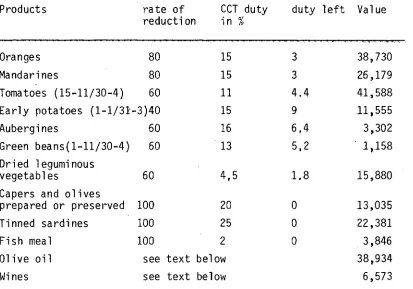
Below are the concessions granted to Morocco for its main export products giving the quantities sent to the EEC in 1974 (in brackets are given the period in which the tariff reduction is applicable:)
Products rate of CCT duty duty left Value
reduction in %
Oranges 80 15 3 38,730
Mandarines 80 15 3 26,179
Tomatoes (15-11/30-4) 60 11 4.4 41 '588
Early potatoes (1-1/31-3)40 15 9 11,555
Aubergines 60 16 6,4 3,302
Green beans(1-11/30-4) 60 13 5,2 1,158
Dried leguminous
vegetables 60 4,5 1,8 15,880
Capers and olives
prepared or preserved 100 20 0 13,035
Tinned sardines 100 25 0 22,381
Fish meal 100 2 0 3,846
Olive oi 1 see text below 38,934
Wines see text below 6,573
1 u.a, = about 1. 20 dollars
Source : Statistical Office of the European Communities
The Community has granted substantial concessions on two important products namely wines and olive oil,
Table wines will benefit from a tariff reduction of 80% with the obligation to respect the reference price (minimum import price). This concession is far from negligible when one considers that Morocco is in a
position to export between 300,000 and 400,000 hectolitres a year to the Community market.
·. ' -~
·· ... . ·.-,. .··: ..
. ':.'''
--. '.
· ... • , .. 1
[image:9.594.80.493.267.556.2]
-10-For quality wines the EEC will open a tariff quota of 50,000 hectolitres at zero duty.
As far as olive oil is concerned the Community grants r~oroccan
exporters a commercial advantage in the form of a reduction of the
levy of 0.5u.a. per 100 kg. (1 u,a. = about 1.20 dollars) and an
economic advantage consisting of an additional reduction of 20 u,a. oer 100 kg on condition that the Moroccan authorities apply an export tax of the equivalent amount; this reduction of the levy is composed of a fixed component of 10 u.a. and a variablecomponent of 10 u.a. which is periodically revisable in relation to developments on the
international market in o1ive oil.
Joint management
In order to implement the prov1s1ons of the new Rabat agreement and in order to appraise the results, a Council of Ministers assisted by a committee at ambassadorial level and where required, specialised
committees have been created.
The Council has the decision making power to realise the objectives fixed. by this agreement. Both sides are conmitted to taking adequate measures to implement the decisions taken by this joint body.
It can moreover formulate recommendations to assure the good working of the agreement.
It is composed of representatives of the EEC Council and Commission on the one hand and representatives of the Moroccan government on the other. As a general rule it meets once a year.
The committee is also composed of representatives of both sides and can meet when necessary to ensure the smooth running of the agreement.
Provision has been made for two meetings to take place to examine the
results of the agreement and improvements which could be made to it:
the first will take place after 1978 and the second after 1983.
The combination of the various instruments of development within the framework of a contractual type of relationship between equal partners, ensured of a sufficiently long future and relying upon a permanent dialogue are all combined in the declaration in the
preamble: "The partners resolved to establish a new model for relations between developed and developing States compatible with the
aspirations of the international community towards a more just and more balanced economic order."
Reproduction authorised, with or without indication of origin