RESEARCH NOTE
An enChIP system for the analysis
of bacterial genome functions
Toshitsugu Fujita
1,2, Miyuki Yuno
2and Hodaka Fujii
1,2*Abstract
Objective: The engineered DNA-binding molecule-mediated chromatin immunoprecipitation (enChIP) technology enables purification of specific genomic regions interacting with their associated molecules. In enChIP, the locus to be purified is first tagged with engineered DNA-binding molecules. An example of such engineered DNA-binding molecules to tag the locus of interest is the clustered regularly interspaced short palindromic repeats (CRISPR) system, consisting of a catalytically-inactive form of Cas9 (dCas9) and guide RNA (gRNA). Subsequently, the tagged locus is subjected to affinity purification for identification of interacting molecules. In our previous studies, we developed enChIP systems for analysis of mammalian genome functions. Here, we developed an enChIP system to analyze bac-terial genome functions.
Results: We generated a plasmid inducibly expressing Streptococcus pyogenes dCas9 fused to a 3xFLAG-tag (3xFLAG-dCas9) in bacteria. Inducible expression of 3xFLAG-dCas9 in Escherichia coli was confirmed by immunoblot analysis. We were able to purify specific genomic regions of E. coli preserving their molecular interactions. The system is poten-tially useful for analysis of interactions between specific genomic regions and their associated molecules in bacterial cells to understand genome functions such as transcription, DNA repair, and DNA recombination.
Keywords: enChIP, dCas9, ChIP, Chromatin immunoprecipitation, CRISPR, Bacteria
© The Author(s) 2018. This article is distributed under the terms of the Creative Commons Attribution 4.0 International License (http://creat iveco mmons .org/licen ses/by/4.0/), which permits unrestricted use, distribution, and reproduction in any medium, provided you give appropriate credit to the original author(s) and the source, provide a link to the Creative Commons license, and indicate if changes were made. The Creative Commons Public Domain Dedication waiver (http://creat iveco mmons .org/ publi cdoma in/zero/1.0/) applies to the data made available in this article, unless otherwise stated.
Introduction
To understand the regulatory mechanisms underlying genome functions such as transcription, it is essential to identify the molecules associated with a genomic region of interest in vivo. The engineered DNA-binding mole-cule-mediated chromatin immunoprecipitation (enChIP) technology we developed recently, enables specific isola-tion of genomic regions of interest interacting with their associated molecules [1, 2]. Examples of such engineered DNA-binding molecules to tag the locus of interest are transcription activator-like proteins [3] and the clus-tered regularly interspaced short palindromic repeats (CRISPR) system [4, 5] consisting of a catalytically-inac-tive form of Cas9 (dCas9) and guide RNA (gRNA). Sub-sequently, the tagged locus is affinity-purified to identify
interacting molecules. A locus of interest can be tagged in the cell by expressing engineered DNA-binding mole-cules [1, 2, 6–9] (in-cell enChIP) or in vitro using recom-binant or synthetic engineered DNA-binding molecules [10, 11] (in vitro enChIP). After purification of the locus of interest, mass spectrometry (MS), RNA sequencing, and next-generation sequencing (NGS) can be used to identify proteins [1, 2, 6], RNAs [7], and genomic regions [9, 11] binding to the locus in a non-biased manner.
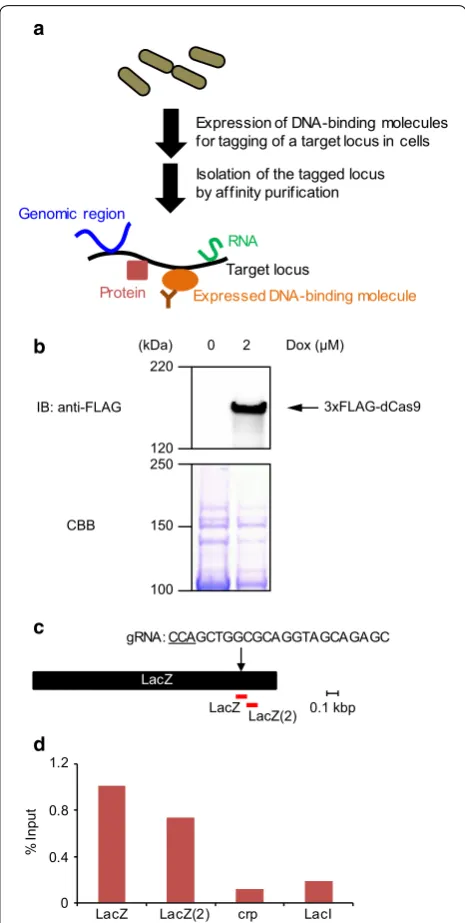
Previously, we developed enChIP systems for analy-sis of mammalian genome functions. Here, we report development of an in-cell enChIP system for bacterial cells (Fig. 1a). The system consists of plasmids express-ing Streptococcus pyogenes dCas9 fused to a 3xFLAG-tag (3xFLAG-dCas9) and gRNA in bacteria. The developed enChIP system isolated target genomic regions from Escherichia coli. The system might enable identification of molecules associated with a specific genomic region in bacteria, and thus help to elucidate their genome functions.
Open Access
*Correspondence: [email protected]
1 Department of Biochemistry and Genome Biology, Hirosaki University Graduate School of Medicine, 5 Zaifu-cho, Hirosaki, Aomori 036-8562, Japan
Main text
Materials and methods
Plasmids
To construct the doxycycline (Dox)-inducible 3xFLAG-dCas9 expression plasmid 3xFLAG-3xFLAG-dCas9/p-bacteria (Addgene #64325), pdCas9-bacteria (Addgene #44249) [12] was digested with BglII and BstZ17I and treated with bacterial alkaline phosphatase (E. coli C75) (2120A, Takara-Bio). The double-strand DNA (dsDNA) con-taining the coding sequence of the 3xFLAG-tag and the N-terminal portion of dCas9 (agatctaaagaggagaaaggatc-tATG GAC TAC AAA GAC CAT GAC GGT GAT TAT AAA GAT CAT GAC ATC GAT TAC AAG GAT GAC GAT GAC
AAG CTC ATG GAT AAG AAA TAC TCA ATA GGC TTA
GCT ATC GGC ACA AAT AGC GTC GGA TGG GCG GTG ATC ACT GAT GAA TAT AAG GTT CCG TCT AAA AAG TTC AAG GTT CTG GGA AAT ACA GAC CGC CAC AGT ATC AAA AAA AAT CTT ATA GGG GCT CTT TTA TTT GAC AGT GGA GAG ACA GCG GAA GCG ACT CGT CTC AAA CGG ACA GCT CGT AGA AGGTA TAC ) (underlined: 3xFLAG-tag; italic: dCas9) was synthesized (Invitrogen) and digested with BglII and BstZ17I. The cleaved pdCas9-bacteria and the synthetic DNA fragment were purified by agarose gel electrophoresis and ligated.
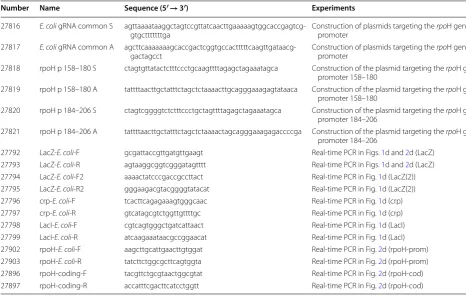
To construct vectors for expression of gRNAs, pgRNA-bacteria (Addgene #44251) [12] was digested with SpeI and HindIII and treated with bacterial alkaline phos-phatase (E. coli C75). The dsDNA for targeting the lacZ gene (ACT AGT GCT CTG CTA CCT GCG CCA GCGTT TTA GAG CTA GAA ATA GCA AGT TAA AAT AAG GCT AGT CCG TTA TCA ACT TGA AAA AGT GGC ACC GAG TCG GTG CTT TTT TTG AAG CTT ) (underlined: the tar-get sequences) was synthesized (Invitrogen) and digested with SpeI and HindIII. The cleaved pgRNA-bacteria and the synthetic DNA fragment were purified by agarose gel electrophoresis and ligated. For construction of gRNAs targeting the promoter region of the rpoH gene, oligode-oxyribonucleotides (Table 1) were synthesized, annealed, and phosphorylated. Combination of oligodeoxyribo-nucleotides was; E. coli gRNA common: 27816 + 27817; rpoH p 158–180: 27818 + 27819; rpoH p 184–206: 27820 + 27821. The annealed dsDNAs were subjected to ligation reactions with the SpeI and HindIII-digested pgRNA-bacteria plasmid.
E. coli strains
DH5α (9057, Takara-Bio) was transformed with 3xFLAG-dCas9/p-bacteria alone or together with gRNA expression plasmids, and transformed bacte-ria were selected with chloramphenicol (Cam) (25 µg/ ml) for 3xFLAG-dCas9/p-bacteria alone or a combina-tion of Cam (25 µg/ml) and ampicillin (Amp) (50 µg/ml) b
c
220
120 250
150
100 (kDa)
IB: anti-FLAG
CBB
3xFLAG-dCas9 Dox (µM)
0 2
LacZ
gRNA: CCAGCTGGCGCAGGTAGCAGAGC
0 0.4 0.8 1.2
LacZ LacZ(2) crp LacI
%I
nput
LacZ
d
LacZ(2) 0.1 kbp
Expression of DNA-binding molecules for tagging of a target locus in cells
Isolation of the tagged locus by affinity purification
Protein
RNA
Expressed DNA-binding molecule
Genomic region
Target locus
a
[image:2.595.57.290.86.548.2]for 3xFLAG-dCas9/p-bacteria plus gRNA expression plasmid.
Confirmation of inducible expression of 3xFLAG‑dCas9
DH5α transformed with 3xFLAG-dCas9/p-bacteria was cultured in 2 ml of LB media containing Cam (25 µg/ml) at 37 °C overnight with shaking. One hundred microliters of the culture liquid was mixed with 900 µl of LB media containing Cam (25 µg/ml) and incubated for 1 h with shaking. Subsequently, Dox (2 µM) was added to the cul-ture media for induction of expression of 3xFLAG-dCas9. After incubation with shaking for 4 h, 400 µl of the cul-ture liquid was centrifuged at 5000 rpm for 1 min, and the bacterial pellets were suspended in 100 µl of 4× SDS buffer. After boiling at 100 °C for 5 min, 10 µl of the sam-ple was subjected to SDS-PAGE with a 5–20% gradient gel followed by immunoblot analysis with anti-FLAG M2 antibody (Ab) (F1804, Sigma-Aldrich).
enChIP‑real‑time PCR
DH5α cells transformed with 3xFLAG-dCas9/p-bacte-ria alone or together with a gRNA expression plasmid were cultured in 5 ml of LB media containing Cam
(25 µg/ml) (3xFLAG-dCas9/p-bacteria) or Cam (25 µg/ ml) plus Amp (50 µg/ml) (3xFLAG-dCas9/p-bacteria and a gRNA expression plasmid) overnight at 37 °C with shaking. The bacterial culture was added to 100 ml of LB media containing the same antibiotics and cul-tured at 37 °C with shaking. When OD600 of the culture media reached 0.5, Dox (2 µM) was added for induction of 3xFLAG-dCas9 expression. After incubation at 37 °C for 4.5 h with shaking, the bacterial cells were fixed with 1% formaldehyde at 37 °C for 5 min and neutral-ized with glycine at room temperature for 10 min. After centrifugation, the cell pellets were suspended in 800 µl of modified lysis buffer 3 [10 mM Tris, pH 8.0, 1 mM EDTA, 0.5 mM EGTA, 150 mM NaCl, 0.1% sodium deoxycholate, 0.1% SDS, and 1 × protease inhibitors (Complete-Mini, EDTA-free, 11836170001, Roche)], and DNA was fragmented by sonication using Ultra-sonic disruptor UD-201 (TOMY SEIKO) with condi-tions: Output, 3; Duty, 100% (continuous); Time, Free; 6 cycles of sonication for 10 s and cooling on ice for 20 s (the average length of chromatin fragments was 1 kbp). The sonicated chromatin was subjected to enChIP-real-time PCR analysis as described previously [1, 2]. Prim-ers used in the analysis are shown in Table 1.
Table 1 Oligodeoxyribonucleotides used in this study
Number Name Sequence (5′→ 3′) Experiments
27816 E. coli gRNA common S
agttaaaataaggctagtccgttatcaacttgaaaaagtggcaccgagtcg-gtgctttttttga Construction of plasmids targeting the promoter rpoH gene 27817 E. coli gRNA common A
agcttcaaaaaaagcaccgactcggtgccactttttcaagttgataacg-gactagcct Construction of plasmids targeting the promoter rpoH gene 27818 rpoH p 158–180 S ctagtgttatactctttccctgcaagttttagagctagaaatagca Construction of the plasmid targeting the rpoH gene
promoter 158–180
27819 rpoH p 158–180 A tattttaacttgctatttctagctctaaaacttgcagggaaagagtataaca Construction of the plasmid targeting the rpoH gene promoter 158–180
27820 rpoH p 184–206 S ctagtcggggtctctttccctgctagttttagagctagaaatagca Construction of the plasmid targeting the rpoH gene promoter 184–206
27821 rpoH p 184–206 A tattttaacttgctatttctagctctaaaactagcagggaaagagaccccga Construction of the plasmid targeting the rpoH gene promoter 184–206
[image:3.595.56.523.101.397.2]Results and discussion
An enChIP system for the locus‑specific biochemical analysis of bacterial genome functions
To analyze the locus-specific functions of the rial genome biochemically, we constructed a bacte-rial expression plasmid (3xFLAG-dCas9/p-bacteria (Addgene #64325)) encoding S. pyogenes dCas9 fused with the 3xFLAG-tag. The E. coli DH5α strain was transformed with 3xFLAG-dCas9/p-bacteria, and inducible expression of 3xFLAG-dCas9 by Dox was confirmed by immunoblot analysis with anti-FLAG Ab (Fig. 1b).
Next, for enChIP analysis, we designed a gRNA target-ing the codtarget-ing region of the lacZ gene (Fig. 1c). We trans-formed DH5α with 3xFLAG-dCas9/p-bacteria together with a gRNA expression plasmid targeting the lacZ gene in the DH5α genome. Four hours after the addi-tion of Dox (2 µM), cells were crosslinked with formal-dehyde and subjected to sonication for fragmentation of chromatin DNA. Next, chromatin complexes containing 3xFLAG-dCas9/gRNA were immunoprecipitated with anti-FLAG Ab, and DNA was purified. Real-time PCR showed enrichment of the lacZ gene (Fig. 1c, d). The per-centage of input of negative control genomic regions (the crp and lacI genes) was markedly lower than that of the lacZ gene (Fig. 1d). These results showed that the bacte-rial enChIP system can specifically and efficiently isolate target genomic regions.
enChIP analysis of an endogenous gene promoter
Next, we targeted the promoter region of an endogenous gene, rpoH, which encodes RNA polymerase sigma (32) factor [13]. This gene is a single operon gene and one of the essential genes of E. coli [Profiling of E. coli Chromo-some (PEC): https ://shige n.lab.nig.ac.jp/ecoli /pec/]. First, we designed two gRNAs targeting the promoter region of the rpoH gene (Fig. 2a). Next, we transformed DH5α with 3xFLAG-dCas9/p-bacteria alone or together with one of two gRNA expression plasmids targeting the promoter region. After enChIP, real-time PCR showed that the pro-moter region of the rpoH gene was specifically enriched only in the immunoprecipitants prepared from DH5α cells transformed with both 3xFLAG-dCas9/p-bacteria and either one of two gRNA expression plasmids, but not from those transformed with 3xFLAG-dCas9/p-bacteria alone (Fig. 2b, c). The percentage of input of negative control genomic regions (the coding region of the rpoH gene or the lacZ gene) was markedly lower than that of the rpoH promoter region (Fig. 2b, c). These results confirmed that the bacterial enChIP system can specifi-cally and efficiently isolate endogenous target genomic regions.
Conclusions
In this study, we developed an enChIP system for analy-sis of bacterial genomes. This system enables efficient isolation of specific genomic regions from the E. coli genome while preserving their chromatin structures, and potentially contributes to the understanding of bacterial genome functions such as transcription and DNA repair.
Limitations
Further studies might be necessary to assess the utility of this system combined with MS and NGS to identify molecules associated with the target genomic regions in bacteria.
Abbreviations
enChIP: engineered DNA-binding molecule-mediated chromatin immunopre-cipitation; CRISPR: clustered regularly interspaced short palindromic repeats; dCas9: a catalytically-inactive form of Cas9; gRNA: guide RNA; NLS: nuclear
a
b
rpoH
gRNAs
0 0.4 0.8 1.2
rpoH-prom rpoH-cod LacZ 3xFLAG-dCas9
3xFLAG-dCas9/gRNA_158-180 3xFLAG-dCas9/gRNA_184-206
c
% Input
0.1 kbp rpoH-prom rpoH-cod
[image:4.595.307.538.84.375.2]•fast, convenient online submission
•
thorough peer review by experienced researchers in your field
• rapid publication on acceptance
• support for research data, including large and complex data types
•
gold Open Access which fosters wider collaboration and increased citations maximum visibility for your research: over 100M website views per year
•
At BMC, research is always in progress.
Learn more biomedcentral.com/submissions
Ready to submit your research? Choose BMC and benefit from:
localization signal; MS: mass spectrometry; NGS: next-generation sequencing; Cam: chloramphenicol; Amp: ampicillin; Ab: antibody.
Authors’ contributions
HF conceived the idea of development of an enChIP system for analysis of bacterial genome functions and constructed expression plasmids. TF and HF designed and performed experiments and wrote the manuscript. MY per-formed experiments. HF directed and supervised the study. All authors read and approved the final manuscript.
Author details
1 Department of Biochemistry and Genome Biology, Hirosaki University Gradu-ate School of Medicine, 5 Zaifu-cho, Hirosaki, Aomori 036-8562, Japan. 2 Chro-matin Biochemistry Research Group, Combined Program on Microbiology and Immunology, Research Institute for Microbial Diseases, Osaka University, 3-1 Yamadaoka, Suita, Osaka 565-0871, Japan.
Acknowledgements
We thank Stanley Qi for pdCas9-bacteria (Addgene #44249) and pgRNA-bacteria (Addgene #44251).
Competing interests
TF. and H.F. have patents on enChIP (Patent name: Method for isolating specific genomic region using molecule binding specifically to endogenous DNA sequence; Patent number: Japan 5,954,808; Patent application number: WO2014/125668). T.F. and H.F. are founders of Epigeneron, Inc.
Availability of data and materials
All data generated or analyzed during the current study are included in this published article.
Consent for publication
Not applicable.
Ethics approval and consent to participate
Not applicable.
Funding
This work was supported by the Takeda Science Foundation (T.F.), Grant-in-Aid for Scientific Research (C) (#15K06895) (T.F.), and Grant-in-Aid for Scientific Research (B) (#15H04329) (T.F., H.F.), ‘Transcription Cycle’ (#15H01354) (H.F.) from the Ministry of Education, Culture, Sports, Science and Technology of Japan.
Publisher’s note
Springer Nature remains neutral with regard to jurisdictional claims in pub-lished maps and institutional affiliations.
Received: 19 April 2018 Accepted: 5 June 2018
References
1. Fujita T, Fujii H. Efficient isolation of specific genomic regions and iden-tification of associated proteins by engineered DNA-binding molecule-mediated chromatin immunoprecipitation (enChIP) using CRISPR. Biochem Biophys Res Commun. 2013;439:132–6.
2. Fujita T, Asano Y, Ohtsuka J, Takada Y, Saito K, Ohki R, Fujii H. Identifica-tion of telomere-associated molecules by engineered DNA-binding molecule-mediated chromatin immunoprecipitation (enChIP). Sci Rep. 2013;3:3171.
3. Bogdanove AJ, Voytas DF. TAL effectors: customizable proteins for DNA targeting. Science. 2011;333:1843–6.
4. Harrison MM, Jenkins BV, O’Connor-Giles KM, Wildonger J. A CRISPR view of development. Genes Dev. 2014;28:1859–72.
5. Wright AV, Nuñez JK, Doudna JA. Biology and applications of CRISPR systems: harnessing nature’s toolbox for genome engineering. Cell. 2016;164:29–44.
6. Fujita T, Fujii H. Identification of proteins interacting with genomic regions of interest in vivo using engineered DNA-binding molecule-mediated chromatin immunoprecipitation (enChIP). Bio Protoc. 2014;4:e1124.
7. Fujita T, Yuno M, Okuzaki D, Ohki R, Fujii H. Identification of non-coding RNAs associated with telomeres using a combination of enChIP and RNA sequencing. PLoS ONE. 2015;10:e0123387.
8. Fujita T, Yuno M, Fujii H. Allele-specific locus binding and genome editing by CRISPR at the p16INK4a locus. Sci Rep. 2016;6:30485.
9. Fujita T, Yuno M, Suzuki Y, Sugano S, Fujii H. Identification of physical interactions between genomic regions by enChIP-Seq. Genes Cells. 2017;22:506–20.
10. Fujita T, Yuno M, Fujii H. Efficient sequence-specific isolation of DNA frag-ments and chromatin by in vitro enChIP technology using recombinant CRISPR ribonucleoproteins. Genes Cells. 2016;21:370–7.
11. Fujita T, Kitaura F, Yuno M, Suzuki Y, Sugano S, Fujii H. Locus-specific ChIP combined with NGS analysis reveals genomic regulatory regions that physically interact with the Pax5 promoter in a chicken B cell line. DNA Res. 2017;24:537–48.
12. Qi LS, Larson MH, Gilbert LA, Doudna JA, Weissman JS, Arkin AP, Lim WA. Repurposing CRISPR as an RNA-guided platform for sequence-specific control of gene expression. Cell. 2013;152:1173–83.