SHORT REPORT
Identification and characterization
of thirty novel microsatellite DNA markers
from the Chinese mitten crab
Eriocheir
sinensis
expressed sequence tags
Jingjing Li
1,2, Xuyun Geng
2, Limei Chen
3and Jinsheng Sun
1,2*Abstract
Background: The Chinese mitten crab Eriocheir sinensis is an economically important decapod crustacean in China. Despite a widespread distribution and production in China, the resources of E. sinensis have experienced a dramatic decline in the past decades. Here we describe a new set of novel polymorphic microsatellite loci to facilitate the inves-tigation of genetic structure and artificial breeding.
Results: In this study, a set of 30 novel polymorphic microsatellite markers for E. sinensis was developed from EST databases. The number of alleles per locus ranged from three to twenty. The observed and expected heterozygosities ranged from 0.047 to 0.932 and from 0.047 to 0.935, respectively.
Conclusions: These informative microsatellite markers will be useful in studies of genetics, genomics and marker-assisted selection breeding in E. sinensis.
Keywords: Microsatellites, EST, Chinese mitten crab, Eriocheir sinensis
© 2016 Li et al. This article is distributed under the terms of the Creative Commons Attribution 4.0 International License (http:// creativecommons.org/licenses/by/4.0/), which permits unrestricted use, distribution, and reproduction in any medium, provided you give appropriate credit to the original author(s) and the source, provide a link to the Creative Commons license, and indicate if changes were made. The Creative Commons Public Domain Dedication waiver (http://creativecommons.org/publicdomain/ zero/1.0/) applies to the data made available in this article, unless otherwise stated.
Findings Background
The Chinese mitten crab Eriocheir sinensis is one of the most economically important aquaculture species in China [1] due to its taste and nutritious value, with a native range extending from the coastal estuaries of Korea in the north to the Fujian province of China in the south. However, the wild populations of E. sinensis have experienced a dramatic decline in the past decades due to overfishing and water pollution [2]. In China, the basic production technology of mitten crab populations has had a long history, with the conventional selective breeding programs based on phenotypic assessment. At present, the yield of E. sinensis is almost completely from artificial breeding. Unfortunately, like many other
cultured species, the aquaculture performance of E.
sinensis has declined significantly. In order to protect
genetic diversity and prevent population degradation, understanding population genetic structure and genetic connectivity among populations and making a genetic linkage map are necessary.
Microsatellite markers provide a powerful tool in genome researches due to their wide distribution, codominant inheritance and high polymorphism. To date, approximately 83 microsatellite markers have been developed and applied for E. sinensis [3–8]. Although the number of described loci is relatively high, much more works is still needed because of the large diploid chromo-some number of E. sinensis (2n = 146) [9]. In this study,
we describe a new set of 30 EST-derived microsatellite markers which would aid in characterizing population structure, genetic diversity and constructing linkage map
in E. sinensis.
Open Access
*Correspondence: [email protected]
1 Tianjin Key Laboratory for Animal and Plant Resistance, College of Life
Sciences, Tianjin Normal University, 393 Binshuixi Rd, Xiqing District, Tianjin 300387, China
Experimental section
A total of 17067 E. sinensis ESTs obtained from the Gen-Bank database (2013) were screened using SSRIT pro-gram [10] that was designed to find regions containing microsatellites. The parameters were set for detection of di-, tri- and tetranuclotide motifs with a minimum of six repeats, respectively. Eighty-five microsatellite loci were selected for microsatellite marker optimization. Primers flanking microsatellite were designed using the PRIMER PREMIER 5.0 program.
Sixty cultured E. sinensis individuals were randomly captured from Xieyuan Fishing Company in Qili-hai region in Tianjin City, China. Genomic DNA was extracted from the leg muscles using a modified phe-nol-chloroform protocol [11]. Polymerase chain reac-tion (PCR) amplificareac-tions were performed in 10-μL
volumes containing 0.25 U Taq DNA polymerase
(Takara), 1× PCR buffer, 0.2 mM dNTP mix, 1 μM of
each primer set, 1.5 mM MgCl2 and about 100 ng tem-plate DNA. The PCR profiles for all loci were an initial denaturing at 94 °C for 3 min, followed by 35 cycles of 1 min at 94 °C, 1 min at the annealing temperatures listed in Table 1, and 1 min at 72 °C, with a final exten-sion step of 5 min at 72 °C on a MJ Research PTC-200 DNA Engine (Peltier Thermal Cycler). Amplification products were resolved via 6 % denaturing polyacryla-mide gel, and visualized by silver-staining. A 10-bp DNA ladder (Invitrogen) was used as a reference marker for allele size determination. The calculations of observed and expected heterozygosities were estimated with the program MICROSATELLITE ANALYSER software [12]. Tests for linkage disequilibrium and deviations from Hardy–Weinberg equilibrium (HWE) were performed using GENEPOP 4.2 [13, 14].
Results and discussion
Of the 85 potential microsatellite markers, forty-four loci were successfully amplified with the expected
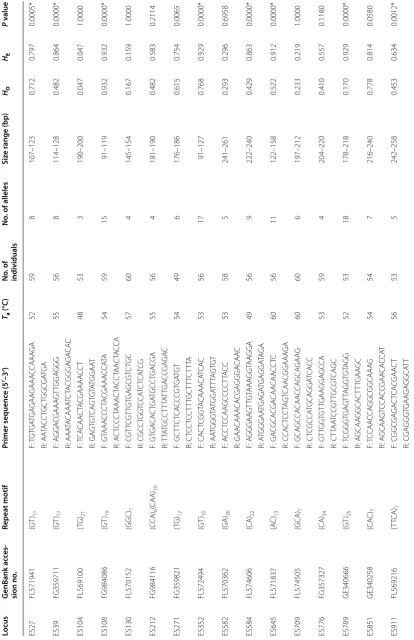
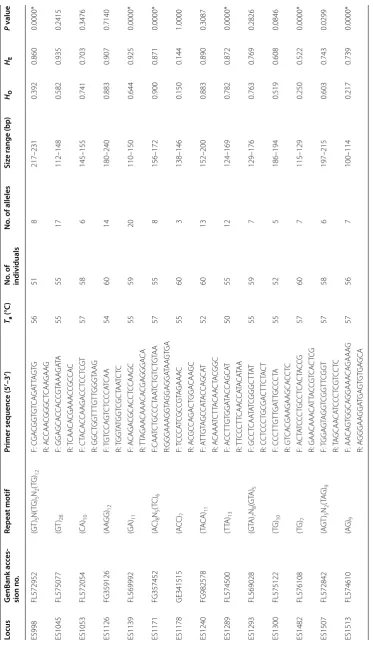
products. Thirty of them revealed polymorphism among the tested 60 individuals of E. sinensis. The number of alleles at each locus ranged from three to twenty with an average of 8.767 alleles per locus (Table 1). Observed heterozygosities ranged from 0.047 to 0.932 with an average of 0.527, while expected heterozygosities ranged from 0.047 to 0.935 with an average of 0.693. The mean number of alleles per locus, HO and HE demonstrated a relatively high genetic diversity within crab individuals. This was similar to reports from studies in other loca-tions [3, 4, 6, 8]. Fourteen of the 30 loci significantly deviated from the Hardy–Weinberg equilibrium after Bonferroni correction. This might be due to the limited sample size, and/or the presence of null alleles at these loci. The high polymorphism of the loci suggests that they would be useful tool in studies of population struc-ture, genetic diversity and the construction of genetic map for E. sinensis.
Conclusions
A set of 30 novel hypervariable microsatellite loci in
E. sinensis was reported in this study. All the
charac-terized microsatellite markers are suited for assessing the genetic diversity and the population structure, and also facilitate marker-assisted selection breeding of E.
sinensis.
Ethics statement
Every effort was made to minimize animal pain, suffering and distress and to reduce the number of animal used. Sampling of the crabs was approved by Tianjin Diseases Prevention and Control Center of Aquatic Animals.
Availability of the supporting data
Table 1 C har ac teriza
tion of 30 EST
-SSRs in the C
[image:3.595.98.513.89.730.2]Table 1 c on tinued Locus G enB ank ac ces -sion no . Repea t motif Primer sequenc e (5 ′ –3 ′ ) Ta (°C ) No . of individuals No . of alleles Siz e r ange (bp ) HO HE P v alue ES998 FL572952 (G T)5 N( TG) 5 N2 (TG )12 F: C GA CGGT GT CA GA TT A GT G 56 51 8 217–231 0.392 0.860 0.0000* R: A CCAA CGGGC TCAA GAA G ES1045 FL575077 (G T)28 F: GGA GCA CCA CC GT AAA GA TA 55 55 17 112–148 0.582 0.935 0.2415 R: T CAA CA CGAAA CC GC CA C ES1053 FL572054 (CA) 10 F: C TA CA CCAA GA CC TC C TC GT 57 58 6 145–155 0.741 0.703 0.3476 R: GGC TGGT TT GT TGGGT AA G ES1126 FG359126 (AA GG) 12 F: T GT CCA GT C TC CCA TCAA 54 60 14 180–240 0.883 0.907 0.7140 R: T GGT AT GGT CGC TAA TC TC ES1139 FL569992 (GA) 11 F: A CA GA CGCA CC TC CAA GC 55 59 20 110–150 0.644 0.925 0.0000* R: T TA GAA CAAA CA CGA GGGA CA ES1171 FG357452 (AC )8 N5 (TC )6 F:CAA TC TGC CC TAA TC TGT C TGT AA 57 55 8 156–172 0.900 0.871 0.0000* R:GGGAAA GGT A GGA GGA TAA GT GA ES1178 GE341515 (A CC )7 F: T CC CA TC GC CGT A GAAA C 55 60 3 138–146 0.150 0.144 1.0000 R: A CGC CA GA C TGGA CAA GC ES1240 FG982578 (T A CA) 11 F: A TT GT A GC CA TA CCA GCA T 52 60 13 152–200 0.883 0.890 0.3087 R: A CAAA TC TT A CAA C TA CGGC ES1289 FL574500 (T TA )13 F: A CC TT GT GGA TA CCA GCA T 50 55 12 124–169 0.782 0.872 0.0000* R: T TC CC TT CAA CCA TA CA TAA ES1293 FL569028 (GT A)7 N8 (GT A)5 F: GC C TCAA TA TC GGGC TT AT 55 59 7 129–176 0.763 0.769 0.2826 R: C CT CC CT G CG A CT TCT A CT ES1300 FL575122 (TG )10 F: CCC TT G TT G AT TG CCC TA 55 52 5 186–194 0.519 0.608 0.0846 R: GT CA CGAA GAA GCA CC TC ES1482 FL576108 (TG )7 F: A C TA TCCC TG CC TC A C TA CCG 57 60 7 115–129 0.250 0.522 0.0000* R: GAA CAAA CA TT A CC GT CA C TC G ES1507 FL572842 (AG T)5 N2 (TA G )9 F: T GGA GT A GGT CGGT TC GGT 57 58 6 197–215 0.603 0.743 0.0299 R: T A GCAA CA TC CC TC GT CC TC ES1513 FL574610 (AG )9 F: AA CA GT GGCA GGAAA CA GAAA G 57 56 7 100–114 0.217 0.739 0.0000* R: A GGGAA GGA TGA GT GT GA GCA Ta annealing t emper atur e, HO obser ved het er oz ygosit y, HE e xpec ted het er oz ygosit y * Sig nifican t depar tur e ( P < 0.05) fr om e xpec ted Har dy –W einber g equilibr ium c onditions af ter c or rec tion f
or multiple t
ests (
k
=
[image:4.595.111.485.85.732.2]• We accept pre-submission inquiries
• Our selector tool helps you to find the most relevant journal
• We provide round the clock customer support
• Convenient online submission
• Thorough peer review
• Inclusion in PubMed and all major indexing services
• Maximum visibility for your research
Submit your manuscript at www.biomedcentral.com/submit
Submit your next manuscript to BioMed Central
and we will help you at every step:
Authors’ contributions
JS was responsible for the design of this study, supervision of the work and contributed to the interpretation of results. JL performed field sampling, data analysis and marker validation, and drafted the manuscript. XG coordinated field sampling and was responsible for the implementation of the study. LC contributed to analysis of sequences. All authors read and approved the final manuscript.
Author details
1 Tianjin Key Laboratory for Animal and Plant Resistance, College of Life
Sciences, Tianjin Normal University, 393 Binshuixi Rd, Xiqing District,
Tian-jin 300387, China. 2 Tianjin Diseases Prevention and Control Center of Aquatic
Animals, 442 Jiefangnan Rd, Hexi District, Tianjin 300221, China. 3 Tianjin Key
Laboratory of Aqua-Ecology and Aquaculture, Fisheries Science Department, Tianjin Agricultural University, 22 Jinjing Rd, Xiqing District, Tianjin 300384, China.
Acknowledgements
This work was supported by Grants of the National High-Tech Research and Development Program of China (863 programs, 2012AA10A401), National Key Technology R&D Program (2012BAD26B04-05), Tianjin Technical Supporting Program of Tianjin (12ZCDZNC05500) and Research and Extension Projects of Tianjin Fishery Bureau (J2013-21) (J2013-7).
Competing interests
The authors declare that they have no competing interests. Received: 17 September 2015 Accepted: 3 February 2016
References
1. Zhang SY, Fu HT, Qiao H, Sun SM. Research progresson geneticsand
breeding of Eriocheir sinensis. Chin Agric Sci Bull. 2013;29:39–45.
2. Li SF. The problem and measures of Eriocheir sinensis industry. Sci Fish
Farm. 2006;6:1–2.
3. Hanfling B, Weetman D. Characterization of microsatellite loci for the
Chinese mitten crab, Eriocheir sinensis. Mol Ecol Notes. 2003;3:15–7.
4. Chang YM, Liang LQ, Li SW, Ma HT, He JG, Sun XW. A set of new
micros-atellite loci isolated from Chinese mitten crab, Eriocheir sinensis. Mol Ecol
Notes. 2006;6:1237–9.
5. Zhu ZY, Shi YH, Le GW. Isolation and characterization of polymorphic
microsatellites from Chinese mitten crab, Eriocheir sinensis. Mol Ecol
Notes. 2006;6:838–9.
6. Mao RX, Zhao YY, Liu FJ, Jia ZY, Hou N, Chang YM, Lu CY, Liang LQ, Sun XW. Development and characterization of new microsatellite loci from
Chinese mitten crab (Eriocheir sinensis). Conserv Genet. 2009;10:1117–9.
7. Gao XG, Li HJ, Li YF, Sui LJ, Zhu B, Liang Y, Liu WD, He CB. Sixteen polymor-phic simple sequence repeat markers from expressed sequence tags of
the Chinese mitten crab Eriocheir sinensis. Int J Mol Sci. 2010;11:3035–8.
8. Xiong LW, Wang Q, Qiu GF. Large-scale isolation of microsatellites from
Chinese mitten crab Eriocheir sinensis via a solexa genomic survey. Int J
Mol Sci. 2012;13:16333–45.
9. Du NS, Lai W, Xue LZ. The chromosomes of the Chinese mitten-handed
crab, Eriocheir sinensis (Crustacea, Decapoda). Zool Res. 1986;7:293–6.
10. Temnykh S, DeClerck G, Lukashova A, Lipovich L, Cartinhour S, McCouch S. Computational and experimental analysis of microsatellites in rice
(Oryza sativa L.): frequency, length variation, transposon associations, and
genetic marker potential. Genome Res. 2001;11:1441–52.
11. Li Q, Park C, Kijima A. Isolation and characterization of microsatellite loci in
the Pacific abalone, Haliotis discus hannai. J Shellfish Res. 2002;21:811–5.
12. Dieringer D, Schlötterer C. Microsatellite analyser (MSA): a platform inde-pendent analysis tool for large microsatellite data sets. Mol Ecol Notes. 2003;3:167–9.
13. Raymond M, Rousset F. GENEPOP (version 1.2): population genetics software for exact tests and ecumenicism. J Heredity. 1995;86:248–9. 14. Rousset F. Genepop’007: a complete reimplementation of the Genepop