R E S E A R C H A R T I C L E
Open Access
Development of a novel diagnostic system for a
telepsychiatric application: a pilot validation study
Savita Malhotra
*, Subho Chakrabarti, Ruchita Shah, Aarzoo Gupta, Anurati Mehta, B Nithya, Vineet Kumar
and Minali Sharma
Abstract
Background:A net-based, decision support system for diagnostic assessment and management of psychiatric disorders, developed as part of a telepsychiatry service, which aims to deliver mental health care to underserved population of remote areas in India is described. This paper presents the development and preliminary results of diagnostic validation of the application, intended for use among adult patients. The bilingual (English and Hindi) diagnostic tool consists of a core diagnostic section comprising a screening sub-module and criteria-based diagnostic sub-modules for 18 adult psychiatric disorders, and additional sections covering background information. The diagnostic tool of the application was examined among 100 consecutive consenting adult outpatients, by comparing it with detailed semi-structured clinical assessments led by a consultant psychiatrist, on accuracy of diagnoses generated, and examining the feasibility of its use.
Results:The screening sub-module had high sensitivity and high specificity, low positive predictive values, but high negative predictive values for most disorders. For the diagnostic sub-modules, there was moderate (kappa = 0.4-0.6), to substantial agreement (kappa > 0.6) between diagnoses generated by the tool and consultants’diagnoses, for all the disorders except dysthymia. Sensitivity was high barring a few disorders. Specificity was high for all the disorders, positive predictive values were acceptable to high for most disorders, and negative predictive values were consistently high. Completion rate was 100%; average time taken was five minutes for screening alone, and 30 minutes for complete assessment with screening and criteria-based evaluation. A majority of the patients, their relatives, and interviewers were satisfied with the interview.
Conclusions:The preliminary results indicated that despite some limitations, the new diagnostic system was reasonably comprehensive, time-efficient and feasible, with an acceptable level of diagnostic accuracy. Hence, it appeared to be suitable for use as a telepsychiatric application.
Keywords:Telepsychiatry application, Adult psychiatric disorders, Diagnostic accuracy, Feasibility
Background
Mental disorders are highly prevalent and equally dis-abling in India as in the rest of the world [1,2], and as in other low-income countries, most people suffering from mental disorders continue to receive inadequate treat-ment [3]. Existing discrepancies between resources and need, urban and rural services, and primary, secondary and tertiary care, lead to what has been referred to as the ‘mental health gap’[4]. Efforts are already underway
in India to reduce the ‘mental health gap’ under the
aegis of the National Mental Health Programme [5] by strengthening existing resources, developing new ones and enhancing manpower [4,6]. However, these measures are highly resource intensive, and a long gestation period is expected before they begin to take effect. Telepsychia-try, the use of information and communication technolo-gies to provide or support clinical psychiatric care from a distance, has been proposed as an alternative strategy [7]. Telepsychiatric programmes, which are being increasingly used in developed nations usually follow different ap-proaches such as direct patient management though video-conferencing, consultation models, or collaborative-care models [8,9]. However, in developing countries like India, such models are difficult to implement, because of
* Correspondence:[email protected]
Department of Psychiatry, Postgraduate Institute of Medical Education and Research (PGIMER), Chandigarh 160012, India
resource and manpower constraints. Instead, a newer ap-proach involving development of software packages with codified medical knowledge and logical decision support systems to aid assessment, diagnosis and management of psychiatric disorders could be a logical alternative [10]. With the broader aims of codifying medical knowledge, and providing an internet-based decision support system for diagnosis and treatment of psychiatric disorders, a pilot telepsychiatric project is underway at the department of psychiatry of the Postgraduate Institute of Medical Education and Research (PGIMER), Chandigarh, India. The department is the nodal centre of this service, with three peripheral sites located in the adjoining hill states of north-India. Right from its onset, this telepsychiatric project has followed a different model of training and enabling non-specialist (i.e., general physicians and para-professionals) personnel at remote sites to diagnose and treat mental illnesses on their own, with minimal consul-tation, supervision, or direct care from the nodal centre. To suit the needs of what has been construed by the authors as‘tele-enabling’model, in contrast to the existing
‘tele-consultation’ models, a computerised diagnostic and treatment application had to be constructed. For this purpose, a logically linked computerised decision support system for diagnosis and management of common psychi-atric disorders in adults, and in children and adolescents, has been developed as a part of this project. This internet-based application is envisaged to enable non-specialists accessing it at remote areas to independently provide care. This requires 8 to 10 hours of training over two weeks, conducted through video-conferencing by the nodal centre. The software application has two separate decision support systems one for adults, and one for children and adolescents. In each case, the diagnostic system is logically linked to the pharmacological and psychological interven-tion modules taking into account the diagnosis, age, and medical illnesses. All the components of the decision system have been developed based on expert knowledge and guidelines, clinical experience and expertise; and utilize mainly ICD-10 [11] criteria.
For the diagnostic part of the application, the require-ment was for a brief, but a comprehensive interview, which would generate reliable diagnoses and be simple to use. Two diagnostic interviews fulfilled these require-ments; the well-validated Mini-International Neuropsychi-atric Interview (MINI) [12], and a comparatively newer computerized clinical assessment tool, the Global Mental
Health Assessment Tool–Primary Care Version
(GMHAT-PC) [13]. Both the MINI [12] and the GMHAT-PC [13,14] take about 15 to16 minutes for each assessment, while the time taken by other structured interviews ranges from 45 to 180 minutes [12]. However, because of copyright issues, none of these brief interviews could be used. Moreover, both instruments did not include
many common disorders such as delirium, dementia, adjustment, somatoform and dissociative disorders, neu-rasthenia or sexual dysfunctions [12,13]. Therefore, it was decided to develop an entirely new and indigenous diagnostic tool, in keeping with the aims of the tele-psychiatry project described earlier.
This paper describes the development of a new diag-nostic system for this net-based application. Apart from development, this initial pilot study also focuses on the accuracy of diagnoses generated by the tool, in compari-son to more detailed semi-structured clinical assessments by teams led by consultant psychiatrists. Additionally, preliminary data on feasibility of use of this new diagnostic tool is also presented.
Methods
Basic approach and format of the diagnostic tool
The new net-based diagnostic tool was designed to consist of a comprehensive psychiatric clinical interview, albeit with a more focused and systematic approach. A balance between an objective criteria-based diagnostic exercise and conducting the interview in a conversa-tional style was considered crucial, with the aim of repli-cating the routine clinical interview situation, where there is a greater need (as opposed to research settings) to establish a therapeutic relationship with the patient right from the onset of assessment. Moreover, the tool was primarily intended for use by non-specialists (i.e., general physicians and para-professionals) in remote-care settings. In keeping with these objectives, a struc-tured format in simple language, easily understood by both patients and interviewers was adopted. It was de-cided that the diagnostic tool should cover both com-mon and severe mental disorders. To meet the dual objectives of a comprehensive screening and a focused evaluation, a scheme of initial screening of patients for all disorders included in the tool, followed by a detailed assessment for specific disorders was incorporated. The interview was also segregated into ‘core’and ‘additional’ sections to reduce the time required for the entire diag-nostic interview to about half an hour. Diagnoses were based primarily on ICD 10 criteria, both from the Clinical Diagnostic Guidelines [11] and the Diagnostic Criteria for Research [15]. In certain parts (e.g. the diagnosis of deli-rium or dementia), DSM IV [16] criteria were used.
The content and structure of the diagnostic tool
substance dependence and mental retardation. It mainly assesses for current symptoms, except for symptoms of mood disorders, where both current and past symptoms are elicited. To avoid multiple diagnoses, it includes a diagnostic hierarchy by giving precedence to diagnostic categories appearing first in the ICD10 manuals.
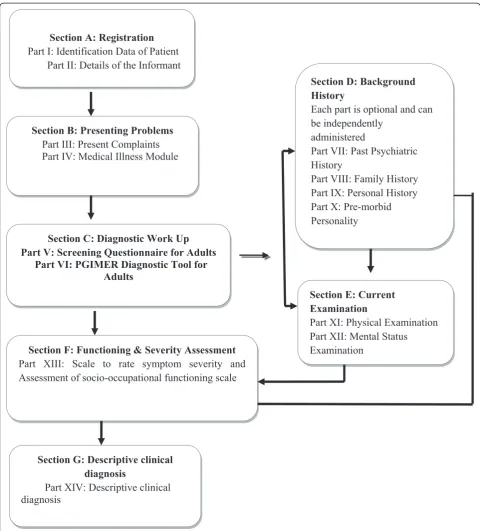
The diagnostic exercise follows a stepwise approach to reach the final descriptive clinical diagnosis (see Figure 1). Firstly, the identification details, socio-demographic pro-file, presenting complaints and precipitating events are elicited and recorded. This is followed by the ‘core’ diag-nostic assessment, which includes initial screening for all disorders, followed by detailed criteria-based questions for specific disorders endorsed positive on screening. The screening sub-module contains a total of 18 questions per-taining to the 18 disorders, and acts as the first gateway to the entire diagnostic exercise. Depending upon the posi-tive responses on screening, the detailed diagnostic sub-modules open in an order based on an inbuilt hierarchy. In each diagnostic sub-module, there is a second-level en-quiry about the primary or typical symptoms of that dis-order, which proceeds with items pertaining to the other criteria only if the specified threshold is met at the second-level enquiry. Alternatively, it skips the remaining part of that module and moves to the next sub-module as indicated in the first screening. This‘core’ diag-nostic assessment is sufficient to generate a psychiatric diagnosis, but can be further supplemented by ‘additional’ sections on past, family, personal, developmental, medical and treatment history details, and physical and mental status examinations, whenever required. In addition, separate scales have been developed to assess symptom severity (on a five-point scale) and socio-occupational functioning (on a visual analogue scale) at the end of diagnostic work-up.
The diagnostic algorithm for the screening and diag-nostic sub-modules consists of three main components, namely the question item with its serial number; the
‘rater’s rule’for the rater to apply; and the‘decision rule’ for computer automation (see Figure 2). Each question item is based on the official classificatory systems, but is more descriptive, uses culturally relevant idioms and examples, and is simple to comprehend. For every ques-tion item in the screening and diagnostic sub-modules, a
‘rater’s rule’ has been framed in a ‘yes/no’ format. The rater’s rule specifies how the interviewer should rate an item as present or absent, based on the intent of the question, the duration and persistence of symptoms, and the distress or dysfunction caused by the symptoms. Thus, it incorporates a threshold for symptoms. For example, in the sub-module for mania, the response to the question about ‘feeling high or unusually happy’ is considered positive only if the said behaviour‘lasts for a period of at least 4 days’, as mentioned in the ‘rater’s rule’. There is also a provision for recording information,
which is considered significant by the interviewer, but is not captured in the categorical‘yes/no’format. The third component, the ‘decision rule’is an automated rule that governs the flow of the diagnostic algorithm, as it de-fines how this ‘yes’ or ‘no’ response will influence the diagnostic decision tree. The ‘decision rules’ have been built based on the diagnostic thresholds set by standard-ized classification systems, as well as socio-cultural norms, duration of symptoms, possibility of self-limiting symptoms, and dysfunction caused by symptoms. The
‘decision rules’ also incorporate hierarchical rules for skipping certain modules if a specific diagnosis is made, even though those modules are indicated by the screen-ing (for example, if a diagnosis of schizophrenia is made, the module for anxiety disorders would not open, even if indicated by screening).
Examining the diagnostic accuracy and feasibility of use of the diagnostic tool
The diagnostic accuracy and feasibility of the tool was examined for the English, as well as local language (Hindi) versions of the diagnostic tool as applicable to patients, at the department of psychiatry of PGIMER, the nodal centre, after receiving approval from the‘
Insti-tution Ethics Committee’ of Post-Graduate Institute of
Medical Education and Research (PGIMER), Chandigarh, India. For this purpose, consecutive outpatients aged more than 18 years, who gave written informed consent, were assessed using the new diagnostic tool. Interviews with the diagnostic tool were for the most part
con-ducted by four psychologists who had Master’s level
training in psychology, but had limited experience in diagnosis and assessment of patients. They were all trained by psychiatrists in the use of the diagnostic tool. Patients were randomly allocated to undertake the tool-based assessment followed by consultant’s evaluation, or vice versa. Clinical assessments were undertaken in the department by team of a trainee psychiatrist and a consultant psychiatrist. These detailed semi-structured assessments also used ICD10 diagnostic criteria and generated ICD10 diagnoses. The interviewers using the new diagnostic tool were blind to the consultant’s diag-nosis, and the consultant psychiatrist was blind to the diagnostic tool based assessment. Demographic data, ratings on screening and diagnostic modules, diagnoses
generated by the tool and the consultants’ diagnoses
Section G: Descriptive clinical diagnosis
Part XIV: Descriptive clinical diagnosis
Section B: Presenting Problems
Part III: Present Complaints Part IV: Medical Illness Module
Section C: Diagnostic Work Up Part V: Screening Questionnaire for Adults
Part VI: PGIMER Diagnostic Tool for Adults
Section D: Background History
Each part is optional and can be independently
administered
Part VII: Past Psychiatric History
Part VIII: Family History Part IX: Personal History Part X: Pre-morbid Personality
Section A: Registration
Part I: Identification Data of Patient Part II: Details of the Informant
Section F: Functioning & Severity Assessment
Part XIII: Scale to rate symptom severity and Assessment of socio-occupational functioning scale
Section E: Current Examination
[image:4.595.57.538.87.619.2]Part XI: Physical Examination Part XII: Mental Status Examination
Data analysis
Statistical analysis was carried out using the Statistical Package for Social Sciences-version fifteen [17]. Apart from descriptive analyses, paired t-tests were conducted to compare the mean number of diagnosis generated by the two interviews. Analyses were carried out both for the broad ICD 10 diagnostic categories, as well as some individual categories belonging to mood and neurotic disorders. Sensitivity, specificity, positive and negative predictive values were computed for the screening and the diagnostic sub-modules of the tool, compared to the consultant’s diagnosis. Additionally, kappa coefficients were computed to assess agreement between the diagno-ses generated by the diagnostic sub-modules and the consultant’s diagnosis.
Results
Over a period of 6 months a total of 107 persons were included in the study; seven of these had to be excluded, because a clear diagnosis could not be made after the consultant’s evaluation. About half of these patients (n = 54) were assessed on the diagnostic tool first, while the
remaining patients underwent consultants’ evaluation
prior to assessment with the tool.
Demographic profile of participants
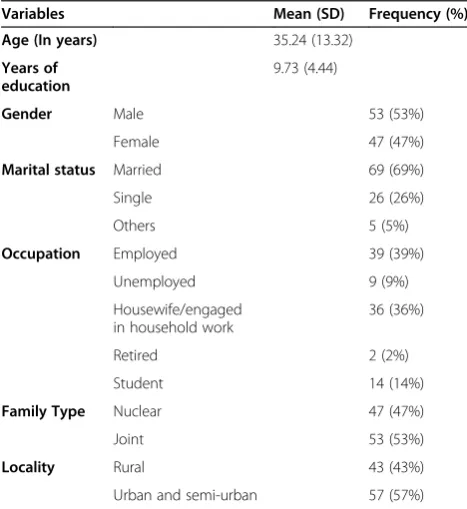
Table 1 depicts the demographic profile of the 100 pa-tients included in the study.
Patients were middle-aged, with more men than women constituting the study sample. They were mostly educated, married, either employed or engaged in household work, and mainly came from urban or semi-urban areas. This corresponded to the usual profile of attendees at this centre.
S.No. Item Decision Rule
Q1 Has he been feeling so high or excited or unusually
happy that he got into trouble with others or other people thought he was not his usual self?
For how long did it last?
Rate the item as Yes, if feeling high or excited or unusually happy for a period of at least 4 days
Yes/No
Go To Q 2
Q2 Has he been feeling so irritable that he had arguments or
fights?
For how long did it last?
Rate the item as Yes, if feeling irritable for a period of at least 4 days Yes/No
If Q1 or Q2 or Both
Are Yes Go To Section B
If Q1 And Q2 Both
Are No Go To Section E
(Mania- Past)
Figure 2Sample of the software requirement specifications to build the core diagnostic support system.The core diagnostic support system contains diagnostic algorithms for the screening and diagnostic sub-modules. These algorithms consist of three main components, namely the question item with its serial number; the‘rater’s rule’for the rater to apply; and the‘decision rule’for computer automation. Each question item is based on the official classificatory systems, but is more descriptive, uses culturally relevant idioms and examples, and is simple to comprehend. For every question item in the screening and diagnostic sub-modules, a‘rater’s rule’has been framed in a‘yes/no’format. The rater’s rule specifies how the interviewer should rate an item as present or absent, based on the intent of the question, the duration and persistence of symptoms, and the distress or dysfunction caused by the symptoms. Thus, it incorporates a threshold for symptoms. The third component, the
[image:5.595.304.538.477.732.2]‘decision rule’is an automated rule that governs the flow of the diagnostic algorithm, as it defines how this‘yes’or‘no’response will influence the diagnostic decision tree. The‘decision rules’have been built based on the diagnostic thresholds set by standardized classification systems, as well as socio-cultural norms, duration of symptoms, possibility of self-limiting symptoms, and dysfunction caused by symptoms.
Table 1 Demographic details of participants (N = 100)
Variables Mean (SD) Frequency (%)
Age (In years) 35.24 (13.32)
Years of education
9.73 (4.44)
Gender Male 53 (53%)
Female 47 (47%)
Marital status Married 69 (69%)
Single 26 (26%)
Others 5 (5%)
Occupation Employed 39 (39%)
Unemployed 9 (9%)
Housewife/engaged in household work
36 (36%)
Retired 2 (2%)
Student 14 (14%)
Family Type Nuclear 47 (47%)
Joint 53 (53%)
Locality Rural 43 (43%)
Diagnostic profile of participants
The mean number of total diagnoses made by the diagnos-tic sub-modules of the tool was 1.38 (SD 0.82), and that made by the consultant’s evaluation was 1.23 (SD 0.48). No significant difference was found between the mean numbers of diagnoses between the two methods of assess-ment. Organic disorders were diagnosed in 2% of the pa-tients, alcohol use disorder in 4%, substance use disorders in 6%, psychoses in 18%, mood disorders (bipolar disorder,
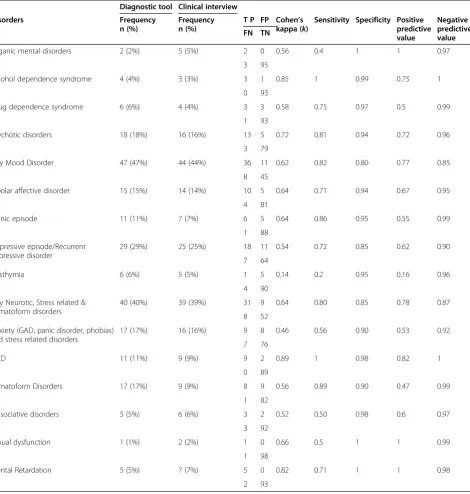
[image:6.595.66.537.240.735.2]major depression, dysthymia) in 47%, neurotic, stress related and somatoform disorders in 40%, disorders of sex-ual functioning in 1%, and mental retardation in 5% by the diagnostic tool. No diagnosis could be reached by the tool in four patients, and consultants’ diagnoses for these pa-tients were somatoform disorder, anxiety disorder, organic mood disorder and psychosis respectively. The frequencies of diagnoses in each category made by the diagnostic tool and by the consultant’s evaluation are included in Table 2.
Table 2 Frequency of diagnoses and agreement between diagnoses made by diagnostic sub-module and the clinical interview
Diagnostic tool Clinical interview
Disorders Frequency
n (%)
Frequency n (%)
T P FP Cohen’s
kappa (k)
Sensitivity Specificity Positive predictive value
Negative predictive value
FN TN
Organic mental disorders 2 (2%) 5 (5%) 2 0 0.56 0.4 1 1 0.97
3 95
Alcohol dependence syndrome 4 (4%) 3 (3%) 3 1 0.85 1 0.99 0.75 1
0 93
Drug dependence syndrome 6 (6%) 4 (4%) 3 3 0.58 0.75 0.97 0.5 0.99
1 93
Psychotic disorders 18 (18%) 16 (16%) 13 5 0.72 0.81 0.94 0.72 0.96
3 79
Any Mood Disorder 47 (47%) 44 (44%) 36 11 0.62 0.82 0.80 0.77 0.85
8 45
Bipolar affective disorder 15 (15%) 14 (14%) 10 5 0.64 0.71 0.94 0.67 0.95
4 81
Manic episode 11 (11%) 7 (7%) 6 5 0.64 0.86 0.95 0.55 0.99
1 88
Depressive episode/Recurrent depressive disorder
29 (29%) 25 (25%) 18 11 0.54 0.72 0.85 0.62 0.90
7 64
Dysthymia 6 (6%) 5 (5%) 1 5 0.14 0.2 0.95 0.16 0.96
4 90
Any Neurotic, Stress related & Somatoform disorders
40 (40%) 39 (39%) 31 9 0.64 0.80 0.85 0.78 0.87
8 52
Anxiety (GAD, panic disorder, phobias) and stress related disorders
17 (17%) 16 (16%) 9 8 0.46 0.56 0.90 0.53 0.92
7 76
OCD 11 (11%) 9 (9%) 9 2 0.89 1 0.98 0.82 1
0 89
Somatoform Disorders 17 (17%) 9 (9%) 8 9 0.56 0.89 0.90 0.47 0.99
1 82
Dissociative disorders 5 (5%) 6 (6%) 3 2 0.52 0.50 0.98 0.6 0.97
3 92
Sexual dysfunction 1 (1%) 2 (2%) 1 0 0.66 0.5 1 1 0.99
1 98
Mental Retardation 5 (5%) 7 (7%) 5 0 0.82 0.71 1 1 0.98
Agreement between the diagnostic tool and consultants’ diagnoses
a. Screening sub-module of the diagnostic tool
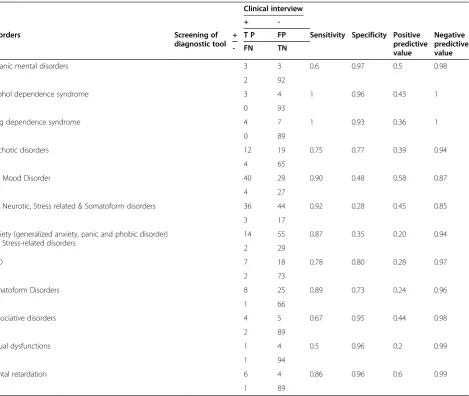
Table 3 depicts the sensitivity, specificity, positive pre-dictive value and negative prepre-dictive values of the screening sub-module of the diagnostic tool, compared
to the diagnoses obtained following the consultant’s
evaluation.
The results show that the sensitivity of screening part of the tool was high for most disorders except organic brain disorders (60%) and sexual dysfunctions (50%). This was because of the small number of patients in these categories, and the high false negative rates ob-tained in both these categories. The specificity of screen-ing was also high for most of the disorders, apart from the broad category of mood disorders (48%) and the category of neurotic and stress-related disorders (28%), where it was mainly compromised by low specificity of the diagnoses of generalized anxiety, panic, phobic and
stress-related disorders. In all these categories, low spe-cificity appeared to result from the relatively low rates of true negative cases. Positive predictive values were low for almost all disorders, except mood disorder and men-tal retardation. This was a reflection of the high rates of false positive diagnoses in most categories. On the other hand, negative predictive values were consistently high because of the high rates of true negative cases in most categories.
b. Diagnostic sub-modules of the diagnostic tool
Table 2 depicts the Cohen’s kappa values, sensitivity, specificity, and positive and negative predictive values of the diagnostic sub-modules of the tool, compared to consultants’diagnoses.
[image:7.595.69.539.337.733.2]Cohen’kappa values revealed substantial (>0.6) to near perfect agreement for alcohol dependence, psychosis, mood disorders (broad category), bipolar disorder, hypo-mania/mania (current), unipolar and bipolar depression
Table 3 Sensitivity, specificity, positive and negative predictive values of screening sub-module of the diagnostic tool
Clinical interview
+
-Disorders Screening of
diagnostic tool
+ T P FP Sensitivity Specificity Positive
predictive value
Negative predictive value
- FN TN
Organic mental disorders 3 3 0.6 0.97 0.5 0.98
2 92
Alcohol dependence syndrome 3 4 1 0.96 0.43 1
0 93
Drug dependence syndrome 4 7 1 0.93 0.36 1
0 89
Psychotic disorders 12 19 0.75 0.77 0.39 0.94
4 65
Any Mood Disorder 40 29 0.90 0.48 0.58 0.87
4 27
Any Neurotic, Stress related & Somatoform disorders 36 44 0.92 0.28 0.45 0.85
3 17
Anxiety (generalized anxiety, panic and phobic disorder) and Stress-related disorders
14 55 0.87 0.35 0.20 0.94
2 29
OCD 7 18 0.78 0.80 0.28 0.97
2 73
Somatoform Disorders 8 25 0.89 0.73 0.24 0.96
1 66
Dissociative disorders 4 5 0.67 0.95 0.44 0.98
2 89
Sexual dysfunctions 1 4 0.5 0.96 0.2 0.99
1 94
Mental retardation 6 4 0.86 0.96 0.6 0.99
(current), neurotic, stress related and somatoform disor-ders, obsessive compulsive disorder, sexual dysfunction and mental retardation. There moderate agreement (0.4 -0.6) for organic disorders, drug dependence, anxiety and stress-related disorders, and somatoform and dissociative disorders. Low agreement was seen for dysthymia (0.14) alone. Sensitivity of diagnoses was high, apart from dys-thymia (20%), organic disorders (40%), generalized anxiety, panic, phobic, and stress-related disorders (46%), sexual dysfunctions (50%) dissociative disorders (52%) and soma-toform disorders (54%). Low sensitivities were primarily due to the high rates of false negative cases. Unlike the screening section of the tool, specificity was high for all the disorders, and positive predictive values were accept-able to high for most disorders, except dysthymia (0.16) and dissociative disorders (0.47). Thus, the numbers of false positive diagnoses were reduced after applying the diagnostic modules. Similar to the screening sub-module, negative predictive values were consistently, high because of the high rates of true negative cases.
c. Discordance analysis
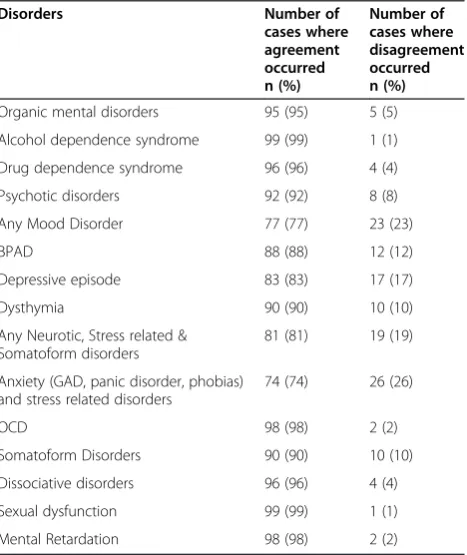
The number of discordant cases in each diagnostic cat-egory is shown in Table 4. The maximum number of dis-cordant cases was seen in mood disorders, and neurotic, stress -related and somatoform disorders. Most of dis-cordance between tool-based and clinical diagnoses was accounted for by the two broad categories of unipolar and
bipolar depression (current), and anxiety (generalized anx-iety disorder, panic disorder, phobias) and stress-related disorders. Eight discordant cases in the category of current depression were diagnosed by consultants as having dys-thymia or a neurotic disorder. Eleven out of 15 discordant cases in the category of anxiety (generalized anxiety disorder, panic disorder, phobias) and stress related dis-orders were diagnosed by consultants as having another neurotic and stress-related disorder or depression.
Duration of assessment using the new diagnostic tool Details regarding the duration of assessment by the new tool are shown in Table 5. The time taken for assess-ment by the‘core’diagnostic tool was about 30 minutes, and that for screening alone was about five minutes.
Feasibility of use of the new diagnostic tool
Results regarding feasibility of use are also are depicted in Table 5.
All the participants completed the entire interview. A majority of the patients, their relatives and the persons conducting the assessment were satisfied with the inter-view, especially with the language used and the style of questioning, as well the extent to which the presenting complaints were addressed by the interview.
Discussion
Assessing and detecting psychiatric disorders in general health care settings, particularly in developing countries like India, is a highly challenging task [18]. Several stra-tegies including training of general health workers or physicians have been proposed [18], and tried in the Na-tional Mental Health Programme [5], but these strategies have numerous problems such as inadequate training, short-lived gains of the limited training received, lack of motivation of personnel, and lack of support by psychia-trists. It is, therefore, necessary to look for additional al-ternatives, which do not rely on presence of psychiatrist for every patient, and yet can deliver specialized care in the most effective manner. The net-based tool for diag-nosing and treating psychiatric disorders in adults devel-oped as part of this project is envisaged to fulfil many of these needs. The advantages of the tool are that: it is based on standardized classificatory systems; it is struc-tured, fully automated, with an in-built logical support system for diagnosis management: it has facilities for real-time and post-interview monitoring and support, when-ever required. These features not only enhance the performance of the tool, but also empower the interviewer to carry out the process of diagnosis satisfactorily.
[image:8.595.58.292.455.733.2]The primary focus of the current paper was to describe the development of the tool, and present the pre-liminary findings regarding the performance of the tool as a screening and a diagnostic instrument, which would
Table 4 Frequency of concordant and discordant cases in each diagnostic category
Disorders Number of
cases where agreement occurred n (%)
Number of cases where disagreement occurred n (%)
Organic mental disorders 95 (95) 5 (5)
Alcohol dependence syndrome 99 (99) 1 (1)
Drug dependence syndrome 96 (96) 4 (4)
Psychotic disorders 92 (92) 8 (8)
Any Mood Disorder 77 (77) 23 (23)
BPAD 88 (88) 12 (12)
Depressive episode 83 (83) 17 (17)
Dysthymia 90 (90) 10 (10)
Any Neurotic, Stress related & Somatoform disorders
81 (81) 19 (19)
Anxiety (GAD, panic disorder, phobias) and stress related disorders
74 (74) 26 (26)
OCD 98 (98) 2 (2)
Somatoform Disorders 90 (90) 10 (10)
Dissociative disorders 96 (96) 4 (4)
Sexual dysfunction 99 (99) 1 (1)
justify its use as a part of the telepsychiatric application. Existing validated interviews such as the MINI could not be used, mainly because of issues regarding copyright. Therefore, an entirely new diagnostic tool had to be con-structed. Being a pilot and proof-of-concept study of this new diagnostic tool, certain limitations were inherent in its design. Firstly, though the sample size was adequate based on targeted kappa values, a much larger sample would eventually be required to test the diagnostic ac-curacy of the entire tool. The numbers involved for many diagnostic categories were small. Therefore, the agreement between diagnoses generated by the tool and consultants’ diagnoses were tested for the broad catego-ries in case of neurotic disorders, and not individual disor-ders. Secondly, the comparison was carried out with detailed semi-structured assessments made by a team headed by a consultant psychiatrist. Ideally, another struc-tured interview could have been used for comparison, as it has been noted that reliability of open-form clinical inter-views is comparatively low [19], though it can be improved by using diagnostic criteria [20], as is the case in our clinical setting. Other studies have also relied on consul-tants’ diagnoses in the absence of a structured interview comparison, or even otherwise [21,22]. Finally, at this initial stage only a pre-computerised version of the diagnostic tool could be tested. The aim was again to gather as much data and experience with what was an
entirely new diagnostic interview, before going in for online activation and testing. The results of this study need to be viewed in the light of these limitations.
Screening instruments for psychiatric disorders should include commonly encountered disorders and have high sensitivity for detection of these disorders, owing to their disabling consequences [23]. The screening sub-module of the diagnostic tool fulfilled both these criteria, as it included a broad range of commonly prevalent disorders and, with certain exceptions, had a high sensitivity for detecting these disorders. Sensitivity was low for organic disorders, because some of these were labelled as ‘ func-tional’psychiatric disorders, a fallacy that has been com-monly noted earlier [24]. Low sensitivity in case of sexual dysfunctions was due to the inability to detect one patient, presumably because of the sensitive nature of the subject [25]. The specificity of screening was high for most disorders as well, except for the broad category of mood disorders and neurotic and stress-related disorders, where it was mainly compromised by low spe-cificity of the diagnoses of generalized anxiety, panic, phobic and stress-related disorders. Low specificity of
screening instruments for the milder psychiatric
[image:9.595.51.533.100.396.2]disorders, particularly anxiety disorders, is common with other screening tools as well [26]. Positive predictive values were also low for most disorders, which indicate a high rate of false positive diagnoses. This is another
Table 5 Results of the feasibility analysis of the diagnostic tool
Interviewee/informants Interviewer
Frequency N = 100 Frequency N = 100
Time taken for diagnostic assessment Mean - 30.69 (SD 10.87) minutes; Median - 29.5 minutes; Range: 10–60 minutes
Time taken for screening alone Mean - 4.85 (SD 0.86) minutes; Median - 5 minutes; Range: 3–8 minutes
Completion rate 100%
Overall satisfaction Very dissatisfied 0 0
Dissatisfied 9 14
Satisfied 57 66
Very satisfied 34 20
Comprehensibility of language Very difficult 0 0
Difficult 9 11
Easy 70 65
Very easy 21 24
Style of questioning Very difficult 1 6
Difficult 13 17
Easy 62 54
Very easy 24 23
Extent to which presenting complaints were addressed Very dissatisfied 2 4
Dissatisfied 8 10
Satisfied 65 58
problem that has been noted for psychiatric screening tools [27,28]. However, a substantial number of patients with false positive results meet diagnostic criteria for other mental disorders, and the burden of follow-up assessments for patients with positive screens is usually not too high. Hence, it has been suggested that erring on the side of sensitivity is preferable for instruments screening for psychiatric disorders [29]. Finally, the con-sistently high negative predictive values indicated that the screening module was correctly identifying all those without a psychiatric disorder who would not require any further psychiatric intervention.
Although the mean number of diagnoses generated by the diagnostic sub-modules of the tool was somewhat higher than the clinical evaluation, this difference was not significant. This finding was unlike that seen with structured interviews; for example, the Composite Inter-national Diagnostic Interview-Auto (CIDI-Auto) gene-rates a mean number of 2.53 diagnoses per patient [30]. While this may be useful in research interviews, it might present problems for routine clinical evaluation. In this regard, the inbuilt hierarchies and exclusion rules of the diagnostic tool reduced the chances of multiple diagnoses, thereby simplifying the entire process for the interviewer.
The kappa values indicated moderate (0.4-0.6) to high (>0.6) agreement between the two assessments for all disorders, except dysthymia. Moreover, sensitivity of the detailed diagnostic sub-modules was high apart from dysthymia, organic disorders, generalized anxiety, panic, phobic and stress-related disorders, sexual dysfunctions, and dissociative and somatoform disorders. Unlike the screening module, specificity was high for all the dis-orders and positive predictive values were acceptable to high for most disorders, except dysthymia and dissocia-tive disorders, while negadissocia-tive predicdissocia-tive values continued to remain high for all disorders. Discordance analysis revealed that for common mental disorders including depression, dysthymia, and anxiety and stress-related disorders, a large number of cases were classified inter-changeably, which might explain the comparatively low level of agreement seen with these disorders. Overall, considering the kappa values, sensitivity and the pro-portion of discordant diagnoses, the diagnostic tool performed relatively poorly for the minor or common mental disorders. Similarly, with other diagnostic inter-views such as the NIMH-Diagnostic Interview Schedule (DIS), the CIDI, or the MINI, agreement for dysthymia, anxiety disorders and somatoform disorders has usually been found to be lower when compared to clinical diag-nosis, as clinicians regarded other diagnoses as domin-ant, and did not diagnose anxiety disorders separately though they agreed on the presence of symptoms [12,22,31]. Nevertheless, these results suggested that
refinement of diagnostic criteria were needed to improve this aspect of the diagnostic tool.
Finally, the feasibility analysis demonstrated that the instrument was easy to administer and was rated highly both by the interviewer and the interviewee. In the new tool a lot of emphasis has been placed on flexibility of interviewing and establishing a therapeutic relationship with the patient, without compromising on the objecti-vity of assessment. The feasibility analysis suggested that these features of the tool helped it recreate the clinical situation to a large extent. All this was achieved in a time of about 30 minutes, which was about a-third of that required for detailed clinical evaluations. Only the MINI [12] and the GMHAT/PC [14] take less time. Moreover, the time taken for using the screening sub-module was about five minutes, which was in keeping with the suggestion that screening time should not be more than about five minutes if an instrument is to be widely adopted [12].
Therefore, despite some methodological limitations and concerns about certain parts of the new diagnostic tool, the findings of this preliminary study suggested that it could prove suitable for use as a part of an online tele-psychiatric application. Efforts are already underway to further enhance the accuracy of the online version of the diagnostic tool, to test its validity at the primary and se-condary care levels with larger samples, and to validate it against other structured interviews such as the MINI.
Conclusions
The development of a fully structured and automated diagnostic system for adult psychiatric disorders is described. Preliminary results suggested that despite some limitations, diagnoses generated by the tool had an acceptable level of accuracy, and the tool appeared to be feasible to use. Therefore, it seemed to be suitable for use as a part of an online telepsychiatric application meant for diagnosis and management of adult psy-chiatric disorders.
Abbreviations
ICD 10:International Classification of Diseases–Tenth Revision; DSM IV: Diagnostic and Statistical Manual of Mental Disorders–Fourth Edition; SCID: Structured Clinical Interview for DSM IV disorders; MINI: Mini-International Neuropsychiatric Interview; CIDI: Composite International Diagnostic Interview; GMHAT-PC: Global Mental Health Assessment Tool–Primary Care Version; DIS: The NIMH-Diagnostic Interview Schedule.
Competing interests
We have applied for patent relating to the content of the manuscript.
Authors’contributions
drafting of the manuscript. Aarzoo and AM participated in content designing, data collection, data analysis and interpretation and manuscript preparation. BN participated in content designing. VK participated in content designing, data analysis and interpretation, and drafting of the manuscript. MS participated in data collection, analysis and interpretation. All authors have read and approved the final manuscript.
Acknowledgement
The authors gratefully acknowledge the financial support received from Department of Science & Technology, Government of India, New Delhi, India’to carry out the project‘Development and Implementation of a Model Telepsychiatry Application for Delivering Mental Healthcare in Remote Areas (using a medical knowledge-based decision support system)’.
Received: 14 March 2014 Accepted: 31 July 2014 Published: 9 August 2014
References
1. Reddy MV, Chandrasekar CR:Prevalence of mental and behavioural disorders in India: A metaanalysis.Indian J Psychiatr1998,40:149–157. 2. Ganguli HC:Epidemiological finding on prevalence of mental disorders
in India.Indian J Psychiatr2000,42:14–20.
3. World Health Organization:Mental Health Atlas-2011.[http://www.who.int/ mental_health/publications/mental_health_atlas_2011/en/index.html] 4. Thirunavukarasu M:Closing the treatment gap.Indian J Psychiatr2011,
53(3):199–201.
5. Ministry of Health and Family Welfare, Government of India:National Mental Health Programme for India.[http://mohfw.nic.in/WriteReadData/l892s/ 9903463892NMHP%20detail.pdf]
6. Nagaraja D, Murthy P:Mental Health Care and Human Rights.India: National Human Rights Commission, New Delhi and National Institute of Mental Health and Neuro Sciences, Bangalore; 2008.
7. American Psychiatric Association:Telepsychiatry via Videoconferencing.
[http://www.telepsychiatry.com/apa.pdf]
8. Hilty DM, Marks SL, Urness D, Yellowlees PM, Nesbitt TS:Clinical and educational telepsychiatry applications: a review.Can J Psychiatry2004, 49:12–23.
9. Shore JH:Telepsychiatry: videoconferencing in the delivery of psychiatric care.Am J Psychiatry2013,170:256–262.
10. Sharan P, Malhotra S:Telepsychiatry: The Bridge across the Access Gap in Child and Adolescent Mental Health.J Indian Assoc Child Adolesc Ment Health2007,3:18–20.
11. World Health Organization:The ICD-10 Classification of Mental and Behavioural Disorders. Clinical descriptions and diagnostic guidelines.
Geneva: World Health Organization; 1992.
12. Sheehan DV, Lecrubier Y, Sheehan KH, Amorim P, Janavs J, Weiller E, Hergueta T, Baker R, Dunbar GC:The Mini-International Neuropsychiatric Interview (M.I.N.I.): the development and validation of a structured diagnostic psychiatric interview for DSM-IV and ICD-10.J Clin Psychiatry
1998,59:22–33.
13. Sharma VK, Lepping P, Cummins AGP, Copeland JRM, Parhee R, Mottram P: The Global Mental Health Assessment Tool - Primary Care Version (GMHAT/PC). Development, reliability and validity.World Psychiatr2004, 3(2):115–119.
14. Sharma VK, Jagawat S, Midha A, Jain A, Tambi A, Mangwani LK, Sharma B, Dubey P, Satija V, Copeland JR, Lepping P, Lane S, Krishna M, Pangaria A: The Global Mental Health Assessment Tool-validation in Hindi: A validity and feasibility study.Indian J Psychiatr2010,52(4):316–319. 15. World Health Organization:The ICD-10 Classification of Mental and
Behavioural Disorders. Diagnostic criteria for research.Geneva: World Health Organization; 1993.
16. American Psychiatric Association:Diagnostic and Statistical Manual Of Mental Health Disorders (4th Ed).Washington DC: American Psychiatric Association; 1994.
17. Statistical Package for Social Sciences, version fifteen (SPSS-15) SPSS Inc..
Chicago, IL, USA.
18. Murthy RS, Wig NN:Psychiatric diagnosis and classification in developing countries. InPsychiatric diagnosis and classification.Edited by Maj M, Gaebel W, Lopez-Ibor JJ, Sartorius N. UK: John, Wiley & Sons Ltd; 2002:249–279. 19. Spitzer RL, Fleiss JL:A re-analysis of the reliability of psychiatric diagnosis.
Br J Psychiatry1974,125:341–347.
20. Aboraya A, Rankin E, France C, El-Missiry A, John C:The reliability of psychiatric diagnosis revisited: The clinician’s guide to improve the reliability of psychiatric diagnosis.Psychiatry2006,3(1):41–50. 21. Krishna M, Lepping P, Sharma VK, Copeland JRM, Lockwood L, Williams M:
Epidemiological and clinical use of GMHAT-PC (Global Mental Health assessment tool–primary care) in cardiac patients.Clin Pract Epidemiol Ment Health2009,5:7. doi:10.1186/1745-0179-5-7.
22. Wittchen HU, Essau CA, Rief W, Fichter MM:Assessment of somatoform disorders and comorbidity pattern with the CIDI-findings in psychosomatic inpatients.Int J Meth Psych Res1993,3(2):87–100. 23. Broadhead WE, Leon AC, Weissman MM, Barrett JE, Blacklow RS, Gilbert TT,
Keller MB, Olfson M, Higgins MS:Development and validation of the SDSS-PC screen for multiple mental disorders in primary care.
Arch Fam Med1995,4:211–219.
24. Arciniegas DB:New-Onset Bipolar Disorder in Late Life: A Case of Mistaken Identity.Am J Psychiatry2006,163:198–203.
25. Catania JA, Binson D, Canchola J, Pollack LM, Hauck W, Coates TJ: Effects of interviewer gender, interviewer choice, and item wording on responses to questions concerning sexual behavior.Public Opin Quart
1996,60:345–375.
26. Donker T, van Straten A, Marks I, Cuijpers P:A Brief Web-Based Screening Questionnaire for Common Mental Disorders: Development and Validation.J Med Internet Res2009,11(3):e19. doi:10.2196/jmir.1134. 27. Leon AC, Portera L, Olfson M, Weissman MM, Kathol RG, Farber L, Sheehan
DV, Pleil AM:False Positive Results: A Challenge for Psychiatric Screening in Primary Care.Am J Psychiatry1997,154:1462–1464.
28. Nease DE, Malouin JM:Depression screening: a practical strategy.
J Fam Practice2003,52(2):118–126.
29. Leon AC, Portera L, Olfson M, Kathol R, Farber L, Lowell KN, Sheehan DV: Diagnostic Errors of Primary Care Screens for Depression and Panic Disorder.The Int J Psychiatr Med1999,29(1):1–11.
30. Peters L, Andrews G:Procedural validity of the computerized version of the Composite International Diagnostic Interview (CIDI-Auto) in the anxiety disorders.Psychol Med1995,25(6):1269–1280.
31. Wittchen HU:Reliability and Validity Studies Of The WHO Composite International Diagnostic Interview (CIDI): A Critical Review.J Psychiatr Res
1994,28(I):57–84. doi:10.1186/1756-0500-7-508
Cite this article as:Malhotraet al.:Development of a novel diagnostic system for a telepsychiatric application: a pilot validation study.BMC Research Notes20147:508.
Submit your next manuscript to BioMed Central and take full advantage of:
• Convenient online submission
• Thorough peer review
• No space constraints or color figure charges
• Immediate publication on acceptance
• Inclusion in PubMed, CAS, Scopus and Google Scholar
• Research which is freely available for redistribution