A STUDY AND DEVELOPMENT OF LOW COST MICROWAVE ABSORBER
MOHD AZIZI BIN ALI SABERI
This report is submitted in partial of the requirement for award of Bachelor of Electronic Engineering (Telecommunication Electronic) With Honours
Faculty of Electronic and Computer Engineering Universiti Teknikal Malaysia Melaka.
“I hereby declare that this report is the result of my work except for quoted as cited in references”
Signature : ………
Author : ………
“I hereby declare that I have read this report and in my opinion this report is sufficient in terms of the scope and quality for award of Bachelor of Electronic Engineering
(Telecommunication Electronics) With Honours.”
Signature : ………
Supervisor’s Name : ………
ACKNOWLEDGEMENT
First of all, endless thanks to the Almighty ALLAH S.W.T, the source of my life, wisdom and hope for giving me the strength and patience to pursue this project.
My warmest appreciation especially is to my supervisor, Mr Imran Bin Mohd Ibrahim for his caring and cooperation towards his protégé. He is very keen in facilitating me during project execution. Also special gratitude for the kindness spending his precious time in supervising me even he was very busy. For that, thank you very much.
I would like to express my sincere appreciation to Mr. Mohammad Zoinol Abidin Bin Abdul Aziz that help me so much in completing this project and also to all lectures for their help and providing me with many positive remarks, which inspired me in becoming a well-rounded engineer. Deeply thanks for giving me the knowledge as well as guidance throughout project accomplishment and this knowledge is valuable in work field as a competence engineer.
My special thanks to panels Miss Nurmala Irdawaty and Pn Zahariah Manap for accessing my performance throughout the presentations.
ABSTRACT
In modern times, telecommunication typically involves the use of electronic transmitters such as the telephone, television, radio or computer. Nowadays communication system becomes more sophisticated that involved high frequency to deliver information. Hence a lot of tool was invented to perform the task. Then the equipment has to test before widely used. The test must be done perfectly without interference from the external wave or reflected wave from surrounding objects. Therefore the wave absorber invented to overcome this problem. But nowadays, all the chambers for high frequency measurement have use expensive base and material as well like ferrite or semi conductor elements and it is high in cost. This microwave absorber based on low cost material to overcome the problem in term of money matter. The absorber will absorb the electromagnetic wave energy to produce the null reflectivity environment for interior and free wave from exterior. The purpose of the testing that done in the chamber is to obstruct the external source from the environment and to avoid the measurement is influence by uncorrelated noise such as heat or rain. The testing can be perform in the field or open space but the result taken not as better as testing result in
ABSTRAK
CONTENT
CHAPTER ITEM PAGE
PROJECT TITLE i
STATEMENT OF VERIFICATION ii
DEDICATION v
ACKNOWLEDGEMENT vi
ABSTRACT vii
ABSTRAK viii
CONTENT ix
LIST OF TABLE xii
LIST OF FIGURE xiii
1 INTRODUCTION
1.1 Introduction 1
1.2 Problem Statement 3
1.3 Project Objectives 3
1.4 Scope of Project 3
1.41 1st Part 4
1.42 2nd part 4
1.43 3rd part 4
2 LITERATURE REVIEW
2.1 Introduction to the Microwave Absorber 5
2.2 Absorber Shape 8
2.2.1 Pyramidal Shape 8
2.2.2 Flat Shape 8
2.2.3 Wedges Shape 9
2.3 Type of Absorber 9
2.3.1 Ferrite Base 9
2.3.2 Carbon Base 10
2.3.3 Hybrid 11
2.4 Types of Absorber 11
2.4.1 Resin and Semi-Conductor Material 11
2.4.2 Foam and Semi-Conductor Material 12
2.5 Methods of Measurement 12
2.5.2 Time Domain Reflectivity Measurement 15
2.5.2.1 TDRM of Large areas of RAM 15
2.5.2.2 TDR of RAM tiles 19
2.5.3 Enclosed Flared Waveguide Measurement 24
2.5.3.1 Low Frequency Coaxial Reflectometer 27
2.6 Simulation Tool 30
3 PROJECT METHODOLOGY
3.1 Introduction 32
3.2 Project Description 35
4 SIMULATION, FABRICATION
4.1 Introduction 38
4.2 Simulation 39
4.3 Absorber Construction 40
5 MEASUREMENT SET UP
5.1 Measurement Setup 43
5.2 Measurement Process 46
6 Result
6.1 Result 48
7 Discussion
7.1 The Arch Method 52
7.2 The Pyramidal Shape 53
7.3 Recommendations 54
7.3.1 The Absorber 54 7.3.2 The Measurement Set-up 54
8 Conclusion
8.1 Conclusion 55
Reference 54
LIST OF TABLE
No. TITLE PAGE
1.1 Microwave Frequency Bands 6
5.1 Reading for Commercial Absorber, Carbon Base Absorber, reflector and simulation result
50
LIST OF FIGURE
No. TITLE PAGE
2.1 Arch Method Setup Measurement 13
2.2 Time Domain Reflectivity Measurement 17 2.3 Example of received waveform of a transmitted short pulse 17 2.4 Example of received waveform after the subtraction process 18 2.5 Typical TEM horn antenna used to measured absorber
reflectivity
19 2.6 Time Domain Reflectivity measurement of RAM tiles 21 2.7 Ferrite tile/urethane hybrid RF absorber structure 22 2.8 Reflection Coefficient of ferrite tile only 22 2.9 Reflection coefficient of ferrite/urethane of Figure 2.7 23 2.10 Flared waveguide measurement procedure test setup 26 2.11 Low-frequency Coaxial Reflectometer 27
2.12 Square Coaxial 28
2.13 Thin Wire Coaxial 28
2.14 Stripline 29
3.0 Project Methodology 34
4.1 Microwave Absorber in Simulation Design 39
4.2 Foam before cut 40
4.3 The foam in the mould 41
4.4 The foam was cut 41
4.5 The pyramidal shape foam 42
4.6 Low cost microwave absorber 42
5.1 UBP Synthesized Signal Generator SG 2100 43
5.2 Spectrum Analyzer R3132 44
CHAPTER I
INTRODUCTION
1.1 Project Introduction
Nowadays, most of the devices around us were electronic implementation, from the simple device to the complex one. While designing the new electronic devices, the designer always relies on the specifications and requirements to produce a new product. One of the requirements is the customer safety.
Once the device is an electronic implementation, the device could be having attenuation on frequencies. So, before the device was marketed, it has to undergo many tests in the laboratory. One of the purposes of the test is, to determine the reliability of the product when the product was in various frequencies area. Some of product might be failed when through this area.
automotive. Basically, the anechoic chamber has 2 types; which are fully anechoic and semi anechoic chamber. The fully anechoic chamber is fully covered with absorber while the semi anechoic chamber is fully covered on upper part of chamber.
The absorber that used in anechoic chamber is currently was made from semi conductor materials. Sometime, size for 1 meter length with 1metre width on 1 meter high will cost around MYR19000. This is extremely high for constructing a fully anechoic chamber. The anechoic chamber did not have certain length of size, but it has to be wide enough for future purposes. From the problem that appeared, this project will come out a solution with Low Cost Microwave Absorber.
Microwave absorber or frequently called RF absorber already implemented in our surrounding. The applications that commonly known by implement microwave absorber are microwave oven, the microwave absorber use to prevent the wave instead of radiated to outside, and indirectly harm the people around. In military, the microwave absorber is frequently use in aircraft manufacturing. It is functioning as to prevent the aircraft from get detected by enemy radar. Another application that widely use for all over the world is Anechoic Chamber. The purpose of the anechoic chamber is to test any object that regard to the frequency and wave as explained previously.
In generally, simple name for microwave absorber is Radar Absorber. It used to absorb any signal wave or radar wave that emitted on its surface. This Low Cost microwave absorber was involved frequency range from 1GHz – 10GHz. The main material that uses in manufacturing of pyramidal type RF absorber is semi-conductor material.
semi-conductor. It make the absorber absorbs and the matched the incoming frequency. So, when there have matching network, there is no reflection on the system. Beside, the material is low in cost as well.
Normally, in the market nowadays, the absorber was constructed by using foamed plastic polymers or commonly known as sponge as it base. The polymers were used because it is ease to shape regard to size and design required. Then, the absorber was painted with liquid that added by semi-conductor material on surface top of it. Semi-conductor are use because of it have good conductivity. This project was still use the pyramidal shape because of its optimum in absorption but, in term of the novelty, it is using the low cost material.
1.2 Problem Statement
The problem statement of this project is the existed microwave absorber was high in cost. Most of the price may reach around MYR 500 per feet2. To construct an anechoic chamber for microwave, it will cost around 2million. The problem on cost of absorbers was cause on the material that used.
1.3 Objective Project
1.4 Scope of work
Scopes of work for this project were divided into 3. All 3 parts have explained as follow:
1.4.1 Project Identification
The first part was regard on research for absorber. There are 4 steps have to be done. The first step is to collect information regarding to the absorber from existed research previously. Secondly is to understand basic of the absorber with cautiously based on title that given include do some analysis on the information. After that, to identify the shape of absorber that will be constructs and last one is to do some calculation regarding to the absorber size.
1.4.2 Project Construction
This second part is absorber’s construction phase. In this period, the activities that involved are constructing the mould of absorber. Then, do cut the absorber base into pyramidal shape. After that, do prepare the absorber coat paint and lastly, do paint the absorber with the semi-conductor material. Another addition construction phase is to prepare the stand for absorber measurement purposed.
1.4.3 Measurement of Project
CHAPTER II
LITERATURE REVIEW
2.1 Introduction to Microwave Absorber
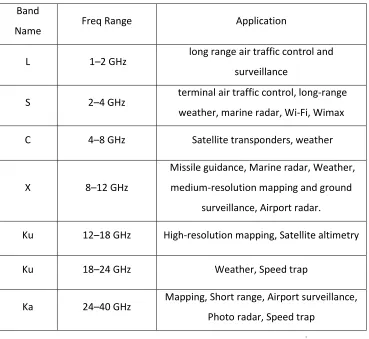
Table 1.1 Microwave Frequency Bands
Band
Name Freq Range Application
L 1–2 GHz long range air traffic control and surveillance
S 2–4 GHz terminal air traffic control, long-range weather, marine radar, Wi-Fi, Wimax C 4–8 GHz Satellite transponders, weather
X 8–12 GHz
Missile guidance, Marine radar, Weather, medium-resolution mapping and ground
surveillance, Airport radar.
Ku 12–18 GHz High-resolution mapping, Satellite altimetry
Ku 18–24 GHz Weather, Speed trap
Ka 24–40 GHz Mapping, Short range, Airport surveillance, Photo radar, Speed trap
Each of band name given, were regard to the size of the wavelength itself. For this project, the range of frequencies that focused was on 1 – 10 GHz.
In using frequency implementation equipment, users tend to avoid from directly emitted with strong frequency, if they know what will cause them for a long term period. Take an example, household equipment such as microwave oven, the users don’t want the frequency of microwave oven radiated to surrounding and harm the family members around. The concept was same as in military, but not on health but for war purposes. The pilots do not want the enemy radar tracking their fleeting aircraft while doing reconnaissance routine and attacking sortie. Base on that problem, the researcher has done much study to generate something useful to absorb the radiated frequencies and reflected or unnecessary incoming frequency. It is named as Microwave absorber or Radar absorber.
An anechoic chamber is a room that shielded space that design to obstruct the external incoming electromagnetic signal or sound. Basically, the Anechoic chamber was used in rational of absorbing acoustic echoes that caused by wave reflection in the room or covered space, but more recently anechoic chambers have also been used to provide a shielded environment for radio frequency (RF) and microwaves. An RF anechoic chamber is designed to restrain the echoes of electromagnetic wave energy: reflected electromagnetic waves, from the internal surfaces. Both types of chamber are constructed with echo restraint features and with effective isolation from the acoustic or RF noise present in the external environment.
frequency range of the radio or microwave signals used. Radio frequency interference (RFI) is the unwanted reception of radio signals. Radio frequency interference sources include lightning, electrical equipment, fluorescent lighting, cell phones, and transmitting equipment from radio stations. RFI testing helps determine which frequencies affect particular electronic systems and provide clues to mitigating the risks to communication devices or developing measures to counter the interference.
2.2 Absorber shape.
There have a few types of absorber shape. Each of shape have own rate absorption
2.2.1 Pyramidal Shape
Commonly, there have 2 shapes of RF absorber, where most of the materials of the absorber were made using flat thin piece from foam absorber type and covered around by carbon dust or light solid in pyramidal shape. Both of it are various multilayer types and foam for single layer are used in this type of product. Individual cone is divided to some feet of length on their base. The unit will be able to install in RF or anechoic chamber.
The pyramidal shape has much more surface area rather than other surface with the same dimension of length and width.
2.2.2 Flat Shape.
impregnated foam. By using a front layer with a small loss tangent, a center layer with a median loss tangent, and a bottom layer with a large loss, an electric taper is achieved that yields a material with an average reflection coefficient of -20 dB over a wide frequency range.[7]
2.2.3 Wedge Shape
Low-density rigid polystyrene foam is used to encapsulate a standard pyramidal or wedge absorber. A thin sheet of semi-rigid polyvinyl chloride foam is adhered to the top to provide a walking surface, which is smooth and impervious to water, and dirt. The Walkway Absorber fabricated in this manner will support up to 90.7 kg per .3 meter (200 pounds per square foot) and is durable and easily maintained. Reflections will occur at any foam surface, the magnitude of the reflection being dependent on the density of the material. [7]
2.3 Types of Absorber
There are many types of absorber. The types was depend on semi-conductor material. Each of material give different rate of absorption. Commonly, the Microwave absorber that existed in the market nowadays is using ferrite base type.
2.3.1 Ferrite Base
Ferrites are a form of sintered iron and other metallic oxides having a cubic crystal structure. While some ferrites did have similar Km and Ke over a narrow frequency range, it turned out that both the real and imaginary parts of Ke and Km varied so rapidly with frequency that their utilization as absorbers was limited. Subsequent development of a much wider range of ferrite compositions gave rise to absorber types which are commonly used today. Ferrite-based absorbers offer the remarkable feature of being able to provide reflection reductions of 10 to 25 dB in the 30 to 1000 MHz range with a thickness of only about a quarter of an inch. Since ferrite is inorganic, it cannot burn, has good outgassing properties, can be operated to elevated temperatures, and is capable of dissipating incident power by as much as 20 watts per square inch. Pure ferrite absorbers are employed primarily to create anechoic chambers and absorbing antenna caps for use at frequencies from 30 through 1000 MHz. [12]
2.3.2 Carbon Base
Activated carbon, also called activated charcoal or activated coal, is a form of carbon that has been processed to make it extremely porous and thus to have a very large surface area available for adsorption or chemical reactions. The word activated in the name is sometimes substituted by active. Due to its high degree of micro-porosity, just one gram of activated carbon has a surface area of approximately 500 m² (or about 2 tennis courts), as determined typically by nitrogen gas adsorption. Sufficient activation for useful applications may come solely from the high surface area, though further chemical treatment often enhances the adsorbing properties of the material. Activated carbon is usually derived from charcoal.