Behaviour, Performance and Search Experience
Mateusz Dubiel
University of Strathclyde Glasgow, Scotland, UK [email protected]
Martin Halvey
University of Strathclyde Glasgow, Scotland, UK [email protected]
Leif Azzopardi
University of Strathclyde Glasgow, Scotland, UK
Sylvain Daronnat
University of Strathclyde Glasgow, Scotland, UK [email protected]
ABSTRACT
Voice based search systems currently do not support natural con-versational interaction. Consequently, people tend to limit their use of voice search to simple navigational tasks, as more complex search tasks require more sophisticated dialogue modelling. In this paper, we explore how people’s search behaviour, performance and perception of usability change when interacting with a conversa-tional search system which supports natural language interaction, as opposed to a voice based search system which does not. Previous research has demonstrated that a voice based search system’s inabil-ity to preserve contextual information leads to user’s dissatisfaction and discourages further usage. We conducted an interactive study comparing a simulated conversational search system against a slot-based voice search system. We hypothesise that the conversational system, with its ability to preserve and maintain conversational state, will lead to greater satisfaction. Our results indicate that participants prefer the conversational system over current voice based system, the conversational search system leads to signifi-cantly faster search task completion times, and signifisignifi-cantly greater usability.
KEYWORDS
Conversational Search; Dialogue-Systems; Voice Interfaces
ACM Reference Format:
Mateusz Dubiel, Martin Halvey, Leif Azzopardi, and Sylvain Daronnat. 2018. Investigating How Conversational Search Agents Affect User’s Behaviour, Performance and Search Experience. InProceedings of ACM SIGIR CAIR Workshop (CAIR’18).ACM, New York, NY, USA, Article 4,8pages.https:
//doi.org/xx.xxx/xxx_x
Permission to make digital or hard copies of part or all of this work for personal or classroom use is granted without fee provided that copies are not made or distributed for profit or commercial advantage and that copies bear this notice and the full citation on the first page. Copyrights for third-party components of this work must be honored. For all other uses, contact the owner/author(s).
CAIR’18, July 2018, Ann Arbour, Michigan USA
© 2018 Copyright held by the owner/author(s). ACM ISBN xxx-xxxx-xx-xxx/xx/xx...$15.00
https://doi.org/xx.xxx/xxx_x
1
INTRODUCTION
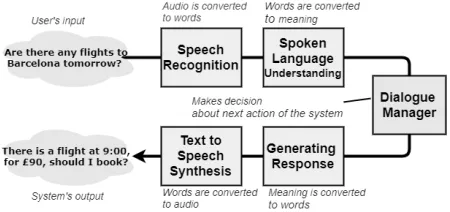
Systems that support voice search (illustrated in Figure1) are be-coming increasingly more popular and widespread1. However, due
to technical limitations, current voice based systems often lack the capacity to maintain a conversation. Examples of some of the most popular systems that support voice search include: Microsoft Cor-tana, Google Now and Apple Siri. These state of the art systems provide limited: (1) state tracking (i.e. estimating user’s goal in a conversation), (2) anaphora resolution (i.e. resolving references to earlier items in conversation), and (3) have problems with clarifying user’s intent. All of these issues currently make interaction through voice both an unnatural and tedious activity in many cases (cf. [10,26,31,33]). However, Cook et al. [8] and Lison and Meena [24] suggest that voice based interaction could be efficiently used for a range of well defined information retrieval tasks, if conversation with a system is sufficiently natural.
In this paper we aim to explore how a "conversational" search agent (CSA), an agent that preserves the context of the dialogue and
maintains state, affects user’s behaviour, performance and perceived system usability when compared to a current state of the art voice based search system (VSS) which does not. Based on [8,24] we
hypothesise thatCSAwill:
H1 : lead to faster task completion and better performance H2 : be more usable and less cognitively taxing
H3 : lead to a more positive search experience
To examine our hypotheses we conducted a Wizard of Oz (WOZ) study [11] in which we simulateCSAand (VSS).VSSuses a
slot-filling architecture, which requires users to provide information to fill in slots that are assigned with semantic class labels [30], simulating current state of the art approaches. While, the hypothe-sisedCSAhas context awareness and memory of past interactions.
Contrary toVSSwhich requires intent to be provided upfront in a
pre-defined way (i.e. providing slots as prompted by the system), the
CSAallows for information to be provided in a free-form natural
language over several turns. Participants were asked to complete simulated leisure search tasks using bothCSAand (VSS).
Perfor-mance, and perceived usability were measured using conversation logs as well as standard usability Brooke et al. [5] and task load questionnaires [14].
Figure 1: Architecture of a Voice Search System. In current study all of the elements of both simulated systems (i.e. VSS and CSA ) with the exception of ’Text to Speech Synthesis’ module are simulated by the Wizard (the lead researcher).
Our findings indicate that a more natural, human-like dialogue with users not only leads to the hypothesised benefits, but also re-sults in distinct search behaviour and interaction. We show that the conversational search agent (CSA) is significantly more usable than
the state of the art voice search system and offers a more positive user experience which is manifested in more positive sentiment and use of simple, and more understandable language.
2
RELATED WORK
Given the recent improvements in Automatic Speech Recognition (ASR) which is considered to have reached a ’human-like’ perfor-mance [43] - and Synthetic Speech (SS) which is almost indistin-guishable from human speech [21] [41] - the focus of research in the field of artificial intelligence has switched to Natural Language Understanding (NLU) and Dialogue Management (DM) components of voice search systems. However, regardless of the technological improvements, voice search systems still struggle with tasks that re-quire multiple conversational turns which leads to users dissatisfac-tion and infrequent use (cf. [19][20],[18][26], [10]). The challenges of voice interaction have recently captured the attention of the IR community and have led to discussion on the nature of human-like conversational search and issues that need to be addressed before robust conversational search agents can be developed cf. [17].
Theory of Conversational Search: Radlinski and Craswell [32]
defined a conversational search agent as a system for retrieving information, where there is a mixed initiative between the user and the agent, and the agent’s actions are selected in response to the user’s needs within the context of the conversation (considering short and long term knowledge). Radlinski and Craswell further outlined five properties a conversational search agent should pos-sess - of which they highlighted that such a system needs to ’have memory to maintain state’. Given that current voice systems lack memory of past interactions and struggle to maintain conversa-tional state (cf. [33]), in this paper we consider the importance of these properties within a conversational agent.
Trippas et al. [38] proposed a search framework for a spoken con-versational search system and highlighted the cognitive challenges that a user faces when dealing with such an agent. In the more recent work, Trippaset alexpand their framework by analysing
behaviour of pairs of human participants engaging in collaborative search [16]. In contrast to that work, our study aims to analyse behaviour interacting with a simulated search system. In our study, via use of interactive search experiment, we explore how the work-load associated with using the different systems impacts on task completion rates and participant’s perception of system usability.
Interactive Conversational Search Studies:Another line of
research on conversational search addresses the problem of de-signing an efficient and user-friendly search system. Lee et al. [22] focused on system’s personality and discoverability of its affor-dances. In a Wizard of Oz study, Leeet alevaluated an early proto-type of a conversational search system. Lee’s experiment involved two participants (one who simulated the search system and the other that conducted the search). The focus of the study was on understanding how to ascertain the participants’ needs, so that they can be applied in the development of such systems. Similarly, Trippas et al. [39] carried out a study aimed at investigating mixed initiative conversational behaviour for information search in an acoustic setting (e.g. voice only). The study involved 13 participants who completed a series of tasks with different levels of complexity. Trippaset alfound that an increase in task complexity was linked to more queries being issued by participants.
Vtyurina et al. [40] explored what search experience would look like if a truly conversational system existed. In Vtyurinaet al’s study, 21 participants who used a text-based interface, were asked to complete 3 different search scenarios; one scenario carried out with an existing commercial system, one with a human "expert", and another one with a "wizard" simulating the system. The results indicated that participants did not mind using a voice based search system as long as it was usable.
In the research presented in this paper, in a lab study, 22 par-ticipants complete a series of complex search tasks by interacting with two simulated search systems. To make the simulation more realistic the feedback is provided via synthetic voice.
Conversational System Design:Thomas et al. [37] explored
the role of style in conversation seeking tasks. Their study, based on the analysis of recordings of interactions of strangers working on assigned tasks, shows that people tend to align their conversational style with intermediaries. In this study, we focus on the impact of different interaction styles i.e. free-form dialogue (offered by conversational agent) and constrained interaction (offered by slot-based voice system) on participant’s behaviour.
performance and perceived usability of the conversational search agent.
In this paper, we evaluate a system that presents participants with results in a free-form natural-language dialogue and measure to which extent its performance varies from the slot-based voice system.
3
METHOD
In order to explore how user’s behaviour, performance and search experience change when interacting with a conversational search agent (CSA) when compared to a voice based search system (VSS) ; we conducted a user study where participants undertook four simulated leisure tasks (described later in the current section). A Wizard of Oz (WOZ) [11] setup was used to compare and contrast the agent and the state of the art system. This setup has been previously used in several related papers [39,42] and is often used when evaluating natural language based interfaces (cf. [27]).
Our motivation for choosing the WOZ framework was based on its ability to simulate a humanlike ’conversational system’ -a technology which does not currently exist - -and test its imp-act on participant’s performance and behaviour. The merit of using WOZ framework is that it enables us to "acquire causal knowl-edge through controlled variation" cf. [9] - hence why we used WOZ setup to test our main hypothesis i.e.’conversational search is more usable and useful than currently available slot-based voice interfaces’ in a controlled lab environment.
Experimental Setup:The experimental setup is
diagrammat-ically presented in Figure2. A within-subjects experiment was designed involving two systems: (i) a voice based search system (VSS) and (ii) asimulatedconversational search agent (CSA), where
participants completed two search tasks per system.
To reduce any priming effects, a Latin Square design[23] was applied to rotate the order in which search tasks and systems were presented to the participants. The experiment was conducted in a controlled lab environment (a quiet office, with a comfortable chair and desk). Each system was simulated using a mock-up setup, where the experimenter controlled the responses of the search systems. Dependent variables used in the study are: participants’ perception of system usability (measured with SUS questionnaire [5]), work load (measured with NASA TLX questionnaire [14]), task completion times, number of conversational turns, length of conversational turns, number of repetition requests, and savings per booking made; while our independent variables were the two voice search systems, i.e.VSSandCSA. We chose our dependent
variables to provide data to test our research hypotheses, i.e.(H1):
Using conversational search agent lead to quicker task completion and better performance than the baseline voice system; (H2):
Us-ing conversational search agent is less cognitively taxUs-ing than the baseline system ; (H3): Using conversational search agent leads to
more positive search experience then the baseline system. Before the experiment, participants were briefed about the struc-ture and purpose of the study, and provided informed consent to participate. Ethics approval for the experiment was granted by the Department of Computer and Information Sciences, University of Strathclyde (application no.611). During the experiment, partici-pants were instructed to complete four search tasks (described in
more detail in current section). Participants were informed that neitherVSSnorCSAprovide any visual feedback and that the
interaction will be exclusively voice-based. The wizard (the experi-menter in control of the systems) was using a computer to initiate search tasks and switch between the systems once tasks were com-pleted. Participants were informed that their interactions with the system would be recorded.
Participants:Participants were recruited via social media,
uni-versity mailing lists and flyers posted at a campus of two major UK universities (i.e. University of Strathclyde and University of Glasgow). The study inclusion criteria were that participants were at least years 18 years old, native English speakers and should have no hearing impairment. We decided to focus on native Eng-lish speakers to limit the potential impact of language competence (native/non-native) on participants’ ability to understand the syn-thetic voice with a local accent2that was used in the study. In total,
22 participants took part in the study. There were 9 females and 13 males. The age of participants ranged from 18 to 65 years (M = 28.67, SD = 9.9, Med = 28). The majority of participants (N = 15/22) has used a voice search system at least once before. On average participants who reported to use voice search have been doing so for 2 years (SD= 1.5). All participants were given a 10GBP shopping voucher for taking part in the experiment. The average completion time of the experiment was 35 minutes.
Simulated Leisure Tasks:We used simulated leisure tasks as
they provide participants with information need that requires com-pleting several steps in order to be satisfied. This is in contrast with simple factoid queries, frequently carried out by users [12], that can be resolved with a single query (e.g. ’What is the population of Chile?’). Our premise behind using simulated tasks was to provide a background context that our participants could easily relate to (in our study we apply Borlund’s approach [4] into a leisure context to create our tasks).
Our leisure tasks required participants to find information about date of departure, destination and cost of a flight. Furthermore, our leisure tasks offer a possibility to measure task completion success (i.e. Was the the cheapest flight within the specified time booked?) and to assess participant’s performance by looking at objective factors (i.e. task completion time, number of conversational turns, duration of conversational turn and number of words spoken.). This is important, since the focus of our investigation is on comparing two different modes of interaction, namely ’conversational search’ which involves active participation of user and the system, and voice based search in which information needs to be provided upfront. (see Figure4for sample conversations).
Participants were asked to complete four casual leisure search scenarios - 2 for theVSSand 2 for theCSA. The simulated leisure
tasks were based on the evaluation model proposed by Borlund [4]. The model relies on using plausible, real-life, search scenarios that participants can easily relate to. In our study, the task for each of the search scenarios was based on leisure activities, e.g. to book a series of one-way flights to travel around Europe. The place of departure was always fixed. In order to provide participants with search intent, participants were given each search scenario which contained four pieces of key information, namely: (1) place of departure, (2) date
Figure 2: Illustration of Experimental Stages. The experiment consisted of three main stages: (1) Pre-experiment Briefing, (2) Voice Interaction Tasks and (3) Post-experiment interview. At Stage (1) participants were informed about what will happen during the experiment and asked to fill in a demographics questionnaire. Stage (2) consisted of two search sessions (one with system VSS and one with CSA); each session consisted of two search tasks and was followed by completing NASA TLX [14] and SUS [5] questionnaires. In order to reduce priming effects, for each participant the sequence of tasks was altered using a Latin Square Design [23]. Finally, during the last stage (3), participants were invited to take part in a post-experiment interview and were thanked for their participation.
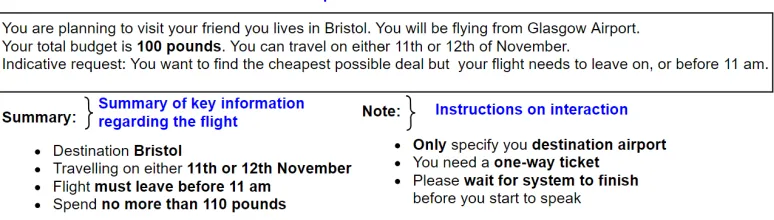
of departure, (3) budget and (4) preferences. An example search scenario is shown in Figure3.
Participants were instructed not to interrupt the system, and speak only when the system finished its turn. Every search task began with a pre-recorded prompt that welcomed participants and asked them to submit their search query. The task was consid-ered completed once a participant found and reserved a flight that matched the search criteria provided to them in simulated search scenarios.
Search Systems:Two search systems were used in the study.
The state of the art voice based search system (VSS), was based on
a “slot-filling” architecture which represents the current state of the art. TheVSSsystem was designed based on the design
recommen-dations outlined in [28]. At the beginning of each interactionVSS
system provided participants with a welcome message and presents them with its functionalities. Participants were asked to provide their search criteria, namely “destination airport”, “date of travel”, and “available budget”. (Note: the departure airport was always fixed). TheVSSsystem also provided an example to help them
formulate their query: ’‘For example, you can say I’m travelling to London on the 2nd of December and my budget is 100 pounds”. The conversational search agent (CSA) started with a brief greeting:
Hello, how can I help you?’ after which participant was supposed to provide their search query. It should be noted that for comparative purposes, interaction time was measured from the moment that participant started to speak after they were greeted by the system. Interaction withCSAsystem was not constrained in any way and
participants were free to provide information in any order and the system would ask them follow up questions to clarify their intent. Whereas theVSSsystem could only process a query once all of the
requested information was provided.
The prompts used in both of the systems were prepared in ac-cordance with the guidelines outlined in [7]. The prompts were made to resemble a natural spoken discourse by, use of appropriate cohesive devices (pronouns and discourse markers), adhering to the principles of information structure (providing new informa-tion at the end of the utterance, and applying Grice’s ’Cooperative Principle’ [13] (making assumptions about inferences that users will draw from the prompts). During the interaction the Wizard
(the lead researcher) played pre-recorded prompts using a GUI. For any unexpected participant responses a live-speech synthesis tool provided by Cereproc Ltd. [2] was used.
Interaction Design:BothVSSandCSAsystems were operated
by a Wizard (the lead researcher). The behaviour ofVSSsystem
was designed to resemble a system that is based on a slot-filling architecture which requires participant to provide the required in-formation in a structured way so that their query can be processed. As opposed toVSS,CSAwas designed to imitate an unscripted,
natural human-human conversation. The characteristics of natural human-human conversation used to simulateVSSwere based on
features outlined in [3] i.e. ’ability to parse and non-fully-sentential grammar of spoken language’, ’resolution of anaphora and ellip-sis’,’keeping state of dialogue’,’ability to resolve hesitations, false starts and repairs’ and ’ability to infer information from conversa-tional context. We also implemented use of relative questions to clarify participant’s intent (e.g. ’Do you have a budget in mind?’) This is similar to the approach adopted in [6].
Figure4shows an example of interaction of participant andVSS.
The system begins with introducing itself to the participant and informs them how to use it. Contrary toVSS,CSAdoes not follow
any strict interaction script, instead, it initiates the conversation with a question.
Logs:Participants’ interactions with each of the systems (i.e.VSS
andCSA) were recorded, and then analysed to extract a series of
objective measures including: task completion time, task completion success (i.e. whether a flight was booked meeting all the specified criteria), number of question-response pairs (i.e. conversational dyads), the average length of participant’s turn (i.e. number of words spoken), number of options explored by participants (to determine if the cheapest flight was chosen), and vocabulary used by participants (to evaluate participant’s sentiment towards the system).
Sentiment Analysis:"Vader" [15] sentiment analysis module
Figure 3: Simulated Search Situation 1. Participants are provided with a printed description of a simulated task situation which contains background information (top), a summary of search criteria (bottom left) and note on how to interact with the system (bottom right). The most important details are provided in bold. Participants can consult the description anytime during search task.
Figure 4: Transcript of recording of search tasks carried out using VSS (left) and CSA (right). VSS first ’introduces itself and explains how to make a reservation; participant is informed how to provide the information to fill the required slots (under-lined). CSA allows for a free-form conversation without imposing rules on how participant should ask questions, or provide information. Note: Introduction time is not included in task completion time.
"neutral" and "compound" scores. The compound score: is a nor-malised, weighted composite score that is useful for giving a single measure of sentiment for a specific utterance.
4
RESULTS
When reporting results, unless stated otherwise, we used the Wilcoxon Signed Ranked test as most of our data was not normally distributed. The object of our comparison are the two systemsVSSandCSA.
Where appropriate we also report some differences between tasks within the system.
4.1
Search Behaviour and Performance
Search Behaviour:Table1provides high level summary statistics
of the interactions with each of the systems for each search ses-sion. We report the number of dyads (adjacent conversational turns between user and the system), the total number of words uttered by a user, the number of words per turn and per user, along with the total turn duration in seconds, and turn duration per user in seconds.
We observed that participants onVSSinteracted fewer times,
with 155 dyads (i.e. pairs of conversational exchanges between the
system and participant) when compared to theCSA, with 180 dyads
in total. While there was no significant differences (p = .0219) in terms of dyads, the number of words spoken by participants was significantly different (p<.001), where on average, 18.87 words per turn were spoken onVSSwhile only 10.48 per turn onCSA. This
suggests that theCSAled to more natural dialogue (i.e. shorter and
more frequent conversational turns cf.[34] ), while onVSS
partici-pants had to repeat themselves more and provide more context (as the system did not maintain conversational state).
PerformanceIn terms of success and performance, Table2
reports how participants spent the budgets allocated to them for each of the scenarios and how successful they were in choosing the best available flight. When it came to exploring best available flight options, the majority of participants made more savings with
CSAwhile speaking less. When interacting withCSA, participants
asked for fewer repetitions. ForVSSwe observed that each time
that there was a request for repetition, participants did not proceed to explore different search options, effectively missing out on the cheapest flights.
Task Completion Times:OnVSSthe tasks completion time
was 215 seconds on average, while onCSAthe task completion
Table 1: Dialogue statistics for both systems.’**’ - signifies p<.01
Dyads** (Total)
Participants’ Words (Total)
Words Per Turn
**
Words
Per User Turn Duration (s)Total Users’ Turn DurationPer User (s)
VSS First Attempt 84 1656 19.71 78.85 664 31.62
VSS Second Attempt 71 1269 17.87 60.43 499 23.76
VSS Total 155 2925 18.87 139.29 1163 55.38
CSA First Attempt 95 1067 11.23 50.8 399 19
CSA Second Attempt 85 820 9.64 39 258 12.28
[image:6.612.56.294.267.368.2]CSA Total 180 1887 10.48 89.86 657 31.28
Table 2: Savings Made. Note: The maximum amount possible to spend is not equal to total budget available to participant. The best outcomes are provided in bold.
Available
Budget MoneySpent
Participants who Chose Cheapest Option
Possible Savings Missed
VSS 1 2310 2210 13/21 2953
VSS 2 2520 1800 9/21 120
VSS Total 4830 4010 22/42 315
CSA 1 2520 1710 20/21 30
CSA 2 2100 1695 18/21 15
CSA Total 4620 3405 38/42 45
time was found to be significantly different for both systems (p = .00012). When it comes to change in completion times between the first (T1) and the second task (T2) - forVSS, there was a significant
drop in time taken to complete T2 from 136 to 117 seconds on average (p = .012), however forCSAwhile the time to complete fell
from 64 to 52 seconds, there was no significant difference (p=.046). As presented in Figure5, participants took longer to familiarise themselves with the baseline system, VSS, and to explore its func-tions. Conversational system, CSA, however, was more straightfor-ward to use and did not curtail participants’ interaction.VSSalso
outperformedCSAin terms of average task accuracy.
Figure 5: Task completion times and booking accuracy for VSS and CSA for first (T1) and second attempt (T2).
4.2
Workload and System Usability
To examine whether the workload associated with using the dif-ferent systems we compared the results from the NASA TLX ques-tionnaire in Table3. The results show that theCSAled to lower
cognitive workload thanVSSfor all six aspects under
investiga-tion (i.e. ’mental demand’, ’physical demand’, ’temporal demand’, ’performance’, ’effort’ and ’frustration’).
Overall, every participant found theCSAsystem less taxing
to use than theVSSsystem. The median NASA TLX score for the
baseline system, (VSS), was 29.5 as compared with 14 for the
conver-sational agent (CSA). Note, the lower the score the less demanding
in terms of workload the system is. There was a statistically sig-nificant difference (p<.001) in overall perception of both systems. On the level of individual dimensions, significant differences were found for "mental demand" (p = .0002), "performance"4(p = .025),
the "effort" required (p = .00032), and "frustration" (p = .037). It appears that participants on theVSShad to more closely
monitor and keep track of their state and the state of the system. This made it increasingly difficult for participants to make direct comparisons between search results i.e. comparing search results by changing a given search aspect (e.g. ’Show me flights next day’, ’Show me some cheaper flights’ etc.). On the other hand,CSA
system allowed participants to use search commands such as ’find the cheapest option’ or ’I want a flight like this but it needs to leave earlier’. This ’memory’ feature ofCSAsystem significantly reduced
the number of items that participants had to memorise, which we attribute to lower mental demand and lower effort.
Table4reports SUS scores for each system, where forVSSthe
median was 81.25 whereas forCSAthe median was 92.5. This
difference was statistically significant (p = .003). Note, the higher the score the more usable the system. The score achieved by CSA corresponds to approximately top 5th percentile of SUS scores5, whereas VSS falls into the top 30th - 25th percentile bracket.
Taken together, the results from the NASA TLX and SUS suggest that participants foundCSAmore usable than theVSS.
4.3
Sentiment Towards the System
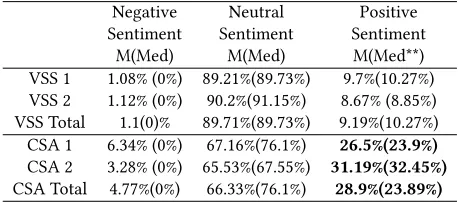
Table5presents information regarding participants’ attitude to-wards the systemsVSSandCSA. Sentiment analysis carried on
transcripts of participants interactions with the systems, indicates that, on average, participants displayed more positive sentiment
[image:6.612.69.292.523.658.2]Table 3: Comparison of workload indexes for VSS and CSA systems. The scores are measured on a 0-100 scale, the lower score the better. ’*’ - indicates p<0.05, ’**’ - indicates p<0.01. Note for the ’performance score’ has been inverted for comparison purposes. The best results are provided in bold.
Mental** Physical* Temporal Performance* Effort** Frustration* Overall Score** VSS Med/IQRM/SD 32.72/19.827.5/32.5 10.45/11.845/6.25 22.5/16.4617.5/11.25 22.5/22.3515/25 37.27/24.7730/37.5 22.50/26.2529.55/25.21 30.73/17.4329.5/18
CSA Med/IQRM/SD 15.68/13.2110/21.25 6.81/3.295/5 18.18/13.9312.5/21.25 12.27/10.995/10 15.9/13.4212.5/15 16.59/17.6810/13.75 17.27/10.9514/12.5
Table 4: SUS Scores, ’**’ - signifies p<.01.
Mean SD Std Error Median** Q1 Q3 IQR VSS 73.29 21.59 4.6 81.25 61.87 87.5 25.67
CSA 87.5 17.08 3.64 92.5 83.12 100 16.88
towardsCSA. There is a statistically significant difference in
pos-itive sentiment between each of the systems both on the level of individual tasks, i.e. VSS1 vs. CSA1, (p = .001) VSS2 and CSA2 (p = .0001) as well as overall (p < .0001). For the above comparisons, Bonferroni adjustedalphawas .0083.
Table 5: Participants’ Sentiment Towards the System. Note: Sentiment scores are ratios for proportions of participant utterances that fall into particular sentiment category, i.e. ’positive’,’negative’ or ’neutral’. All of the categories sum up to 1. ’**’ indicates p<.01. The best outcome is provided in bold.
Negative Sentiment
M(Med)
Neutral Sentiment
M(Med)
Positive Sentiment M(Med**) VSS 1 1.08% (0%) 89.21%(89.73%) 9.7%(10.27%) VSS 2 1.12% (0%) 90.2%(91.15%) 8.67% (8.85%) VSS Total 1.1(0)% 89.71%(89.73%) 9.19%(10.27%) CSA 1 6.34% (0%) 67.16%(76.1%) 26.5%(23.9%)
CSA 2 3.28% (0%) 65.53%(67.55%) 31.19%(32.45%)
CSA Total 4.77%(0%) 66.33%(76.1%) 28.9%(23.89%)
4.4
Post-study Interview
After completing interactive tasks, participants were asked to com-ment on their experience and indicate which system they preferred. The majority of participants (18/22) indicatedCSAas their
pre-ferred system. Justifying their choice ofCSA, participants
men-tioned that: it was natural to use, helped them to accomplish their tasks easily, and help to clarify their intent easily. For example,
P4said:’It required less listening and it did not speak that much so there was not that much information for me to remember.’,whileP10
commented:’[It was] much more natural. As a result of that it just feels less stressful. You can achieve what you need to do in less time compared to the second system [VSS].’, andP15pointed out that: ’It [CSA] was much more easy to use, I found it much more intuitive.
I did not have to remember any details to get the best result’.
Participants who choseVSSsaid that they preferred command
and control task of interaction offered by that system and found it more predicable to to use. For instance,P12commented :’I liked how it [VSS] was predictable. When I learned how to ask a question. I knew exactly what to do. Whereas, with the second one [CSA] I was worried that not understand what I was asking.’
5
DISCUSSION
Based on experimental results obtained in our study we can make the following observations. Firstly, with respect to our(H1): ’Using CSAleads to lower completion times and better performance than
using (VSS)’ - we observe (as discussed in Section4.1) that the CSAdid enable participants to: complete their search tasks quicker,
choose the best available options, and effectively, save money. We regards to hypothesis -(H2):CSAis more usable and less
cog-nitively taxing thenVSS- from the NASA TLX and SUS scores
(presented in the Section4.2) we saw that this was also the case. For our last hypothesis(H3): UsingCSAleads to more positive
user experience than usingVSS- we also observed from sentiment
analysis, reported accounts and questionnaire data that participants had a more positive experience with theCSA.
In the results we observe that participants could improve their performance withVSSwith more practice (see Figure5).
How-ever, adaptability comes at the price of accuracy. We observe that participants’ performance onVSSis inferior (slower and less
ac-curate) than when interacting with conversational agent which allows them to perform search tasks quicker and more accurately. To examine these trade-offs and differences in behaviour longitu-dinal studies examining prolonged exposure to both theVSSand CSAstyles of interaction are required. However until workingCSA
style interfaces are available, a WOZ study, like the one used in this paper, provides the best possibilities to examine these trade-offs.
Another observation is that while interacting withCSAour
participants used more positive language and displayed more cour-teous attitude towards the agent then when speaking to the baseline system. We observed that while interacting withCSAparticipants
[image:7.612.59.288.425.526.2]During our experiment, we observed that a more dynamic con-versational style, i.e. conversation with more frequent and shorter turns led to better accuracy and performance of participants (as discussed in Section4.1). Drawing on principles of pragmatics in human-human communications where meeting is ’negotiated’ as the effect of active interaction between interlocutors [29], we sug-gest that in order to improve search experience a conversational agent should be more inquisitive and focus on clarifying user’s intent rather than merely retrieving the required key words.
6
CONCLUSIONS
Our findings provide empirical evidence that suggests that, overall, conversational search systems are more user friendly and efficient than the current state of the art-systems based on slot-filling. Our proposed conversational agent offers interaction experience that resembles human-human conversations: it is less constrained to use, leads to lower cognitive workload, encourages use of natural language, and incites positive sentiment. All these merits suggest, that, in the future, development of conversational agents should focus on making them more responsive and less reliant on a fixed interaction protocol to ensure the best user’s experience when searching for information.
REFERENCES
[1] Layla El Asri, Hannes Schulz, Shikhar Sharma, Jeremie Zumer, Justin Har-ris, Emery Fine, Rahul Mehrotra, and Kaheer Suleman. 2017. Frames: A Cor-pus for Adding Memory to Goal-Oriented Dialogue Systems. arXiv preprint arXiv:1704.00057(2017).
[2] Matthew P Aylett and Christopher J Pidcock. 2007. The cerevoice characterful speech synthesiser sdk. InIVA. 413–414.
[3] Markus M Berg. 2014.Modelling of Natural Dialogues in the Context of Speech-based Information and Control Systems. AKA.
[4] Pia Borlund. 2003. The IIR evaluation model: a framework for evaluation of interactive information retrieval systems.Information Research. An International Electronic Journal8, 3 (2003).
[5] John Brooke et al. 1996. SUS-A quick and dirty usability scale.Usability evaluation in industry189, 194 (1996), 4–7.
[6] Konstantina Christakopoulou, Filip Radlinski, and Katja Hofmann. 2016. Towards Conversational Recommender Systems.. InKDD. 815–824.
[7] Michael H Cohen, Michael Harris Cohen, James P Giangola, and Jennifer Balogh. 2004.Voice user interface design. Chapter 10.
[8] Malcolm J Cook, Charles Cranmer, Robert Finan, Andy Sapeluk, and Carol-Ann Milton. 2017. 15 Memory load and task interference: hidden usability issues in speech interfaces.EPCE: Volume 1: Transportation Systems(2017).
[9] Benjamin R Cowan et al. 2014. Understanding speech and language interactions in HCI: The importance of theory-based human-human dialogue research. In
Designing speech and language interactions workshop, ACM conference on human factors in computing systems, CHI.
[10] Benjamin R Cowan, Nadia Pantidi, David Coyle, Kellie Morrissey, Peter Clarke, Sara Al-Shehri, David Earley, and Natasha Bandeira. 2017. What can i help you with?: infrequent users’ experiences of intelligent personal assistants. In
Proceedings of the 19th International Conference on Human-Computer Interaction with Mobile Devices and Services. ACM, 43.
[11] Nils Dahlbäck, Arne Jönsson, and Lars Ahrenberg. 1993. Wizard of Oz studies: why and how.Knowledge-based systems6, 4 (1993), 258–266.
[12] Mateusz Dubiel. 2018. Towards Human-Like Conversational Search Systems.
CHIIR ’18: 2018 Conference on Human Information Interaction & Retrieval(2018).
[13] Grice et al. 1975. Logic and conversation.1975(1975), 41–58.
[14] Sandra G Hart and Lowell E Staveland. 1988. Development of NASA-TLX (Task Load Index).Advances in psychology52 (1988), 139–183.
[15] Clayton J Hutto and Eric Gilbert. 2014. Vader: A parsimonious rule-based model for sentiment analysis of social media text. InEighth international AAAI conference on weblogs and social media.
[16] Lawrence Cavedon Hideo Joho Johanne R. Trippas, Damiano Spina and Mark Sanderson. 2018. Informing the Design of Spoken Conversational Search.CHIIR ’18: 2018 Conference on Human Information Interaction & Retrieval(2018). [17] Hideo Joho, Lawrence Cavedon, Jaime Arguello, Milad Shokouhi, and Filip
Radlin-ski. 2017. First International Workshop on Conversational Approaches to Infor-mation Retrieval (CAIR’17). InProceedings of the 40th International ACM SIGIR
Conference on Research and Development in Information Retrieval. ACM, 1423– 1424.
[18] Julia Kiseleva and Maarten de Rijke. 2017. Evaluating Personal Assistants on Mobile devices.arXiv preprint arXiv:1706.04524(2017).
[19] Julia Kiseleva, Kyle Williams, Ahmed Hassan Awadallah, Aidan C Crook, Imed Zitouni, and Tasos Anastasakos. 2016. Predicting user satisfaction with intelli-gent assistants. InProceedings of the 39th International ACM SIGIR conference on Research and Development in Information Retrieval. ACM, 45–54.
[20] Julia Kiseleva, Kyle Williams, Jiepu Jiang, Ahmed Hassan Awadallah, Aidan C Crook, Imed Zitouni, and Tasos Anastasakos. 2016. Understanding user satisfac-tion with intelligent assistants. InProceedings of the 2016 ACM on Conference on Human Information Interaction and Retrieval. ACM, 121–130.
[21] Nicole Kobie. 2018. Google’s new voice is as good as your own. (2018). [22] Sang-su Lee, Jaemyung Lee, and Kun-pyo Lee. 2017. Designing Intelligent
As-sistant through User Participations. InProceedings of the 2017 Conference on Designing Interactive Systems. ACM, 173–177.
[23] Everet Franklin Lindquist. 1953. Design and analysis of experiments in psychol-ogy and education. (1953).
[24] Pierre Lison and Raveesh Meena. 2014. Spoken dialogue systems: the new frontier in human-computer interaction.XRDS: Crossroads, The ACM Magazine for Students21, 1 (2014), 46–51.
[25] Edward Loper and Steven Bird. 2002. NLTK: The natural language toolkit. In Pro-ceedings of the ACL-02 Workshop on Effective tools and methodologies for teaching natural language processing and computational linguistics-Volume 1. Association for Computational Linguistics, 63–70.
[26] Ewa Luger and Abigail Sellen. 2016. Like having a really bad PA: the gulf between user expectation and experience of conversational agents. InProceedings of the 2016 CHI Conference on Human Factors in Computing Systems. ACM, 5286–5297.
[27] Michael McTear, Zoraida Callejas, and David Griol. 2016. Evaluating the conver-sational interface. InThe Conversational Interface. Springer, 379–402.
[28] Ditte Mortensen. 2017. How to Design Voice User Interfaces.Interaction Design Foundation(2017).
[29] Yuko Nakahama, Andrea Tyler, and LEO LIER. 2001. Negotiation of meaning in conversational and information gap activities: A comparative discourse analysis.
TESOL quarterly35, 3 (2001), 377–405.
[30] Roberto Pieraccini, Evelyne Tzoukermann, Zakhar Gorelov, J-L Gauvain, Esther Levin, C-H Lee, and Jay G Wilpon. 1992. A speech understanding system based on statistical representation of semantics. InAcoustics, Speech, and Signal Processing, 1992. ICASSP-92., 1992 IEEE International Conference on, Vol. 1. IEEE, 193–196. [31] Martin Porcheron, Joel E Fischer, and Sarah Sharples. 2016. ’Do animals have
accents?’: talking with agents in multi-party conversation. (2016).
[32] Filip Radlinski and Nick Craswell. 2017. A theoretical framework for conversa-tional search. InProceedings of the 2017 Conference on Conference Human Infor-mation Interaction and Retrieval. ACM, 117–126.
[33] Stuart Reeves. 2017. Some conversational challenges of talking with machines. (2017).
[34] Harvey Sacks, Emanuel A Schegloff, and Gail Jefferson. 1978. A simplest sys-tematics for the organization of turn taking for conversation. InStudies in the organization of conversational interaction. Elsevier, 7–55.
[35] Jeff Sauro. 2011. Measuring usability with the system usability scale (SUS). (2011). [36] Hannes Schulz, Jeremie Zumer, Layla El Asri, and Shikhar Sharma. 2017. A
Frame Tracking Model for Memory-Enhanced Dialogue Systems.arXiv preprint arXiv:1706.01690(2017).
[37] Paul Thomas, Mary Czerwinski, Daniel McDuff, Nick Craswell, and Gloria Mark. 2018. Style and Alignment in Information-Seeking Conversation. InProceedings of the 2018 Conference on Human Information Interaction&Retrieval. ACM, 42–51.
[38] Johanne R Trippas. 2015. Spoken conversational search: Information retrieval over a speech-only communication channel. InProceedings of the 38th International ACM SIGIR Conference. ACM, 1067–1067.
[39] Johanne R Trippas, Damiano Spina, Lawrence Cavedon, and Mark Sanderson. 2017. How do people interact in conversational speech-only search tasks: A preliminary analysis. InProceedings of the 2017 Conference on Conference Human Information Interaction and Retrieval. ACM, 325–328.
[40] Alexandra Vtyurina, Denis Savenkov, Eugene Agichtein, and Charles LA Clarke. 2017. Exploring Conversational Search With Humans, Assistants, and Wizards. InProceedings of the 2017 CHI Conference Extended Abstracts on Human Factors in Computing Systems. ACM, 2187–2193.
[41] Yuxuan Wang, RJ Skerry-Ryan, Daisy Stanton, Yonghui Wu, Ron J Weiss, Navdeep Jaitly, Zongheng Yang, Ying Xiao, Zhifeng Chen, Samy Bengio, et al. 2017. Tacotron: A Fully End-to-End Text-To-Speech Synthesis Model.arXiv preprint arXiv:1703.10135(2017).
[42] Maria Wolters, Kallirroi Georgila, Johanna D Moore, Robert H Logie, Sarah E MacPherson, and Matthew Watson. 2009. Reducing working memory load in spoken dialogue systems.Interacting with Computers21, 4 (2009), 276–287.