Compact radiation sources based on laser-driven plasma waves
D.A. Jaroszynski
1,*, M.P. Anania
1,2, C. Aniculaesei
1,3, G. Battaglia
1, E. Brunetti
1, S. Chen
1, S.
Cipic-cia
1,4, B. Ersfeld
1, D. Reboredo Gil
1, D.W. Grant
1, P. Grant
1, M.S. Hur
5,
L.I. Inigo Gamiz
1, T. Kang
5,
K. Kokurewicz
1, A. Kornaszewski
1, W. Li
1, A. Maitrallain
1, G.G. Manahan
1, A. Noble
1, L.R. Reid
1,
M. Shahzad
1, R. Spesyvtsev
1, A. Subiel
1,6, M.P. Tooley
1, G. Vieux
1, S.M. Wiggins
1, G.H. Welsh
1,
S.R. Yoffe
1, X. Yang
1,71
University of Strathclyde, Glasgow G4 0NG, Scotland, UK,
2INFN, Frascati, Italy,
3Center for
Rel-ativistic Laser Science, IBS, Gwangju 61005, Rep. of Korea.
4Diamond Light Source, Oxfordshire
OX11 0DE,
5School of Natural Science, UNIST, Ulsan, 689-798, Rep. of Korea,
6National Physical
Laboratory, Teddington, Middlesex, TW11 0LW, UK,
7Capital Normal University, and Beijing
Ad-vanced Innovation Center for Imaging Technology, Beijing, China
*
[email protected]
ABSTRACT
Here we explore ways of transforming laser radiation into incoherent and coherent electromagnetic radiation using laser-driven plasma waves. We present several examples based on the laser wakefield accelerator (LWFA) and show that the electron beam and radiation from the LWFA has several unique characteristics compared with conventional devices. We show that the energy spread can be much smaller than 1% at 130-150 MeV. This makes LWFAs useful tools for scientists undertaking time resolved probing of matter subject to stimuli. They also make excellent imaging tools. We present ex-perimental evidence that ultra-short XUV pulses, as short as 30 fs, are produced directly from an undulator driven by a LWFA, due to the electron bunches having a duration of a few femtoseconds. By extending the electron energy to 1 GeV, and for 1-2 fs duration pulses of 2 nm radiation peak powers of several MW per pC can be produced. The increased charge at higher electron energies will increase the peak power to GW levels, making the LWFA driven synchrotron an extremely useful source with a spectral range extending into the water window. With the reduction in size afforded by using LWFA driven radiation sources, and with the predicted advances in laser stability and repletion rate, ultra-short pulse radiation sources should become more affordable and widely used, which could change the way science is done.
Plasma, laser wakefield accelerators, free-electron lasers, high power lasers, radiation sources, femtosecond XUV radiation
1.
INTRODUCTION
is governed by the longitudinal spectral density of the electron bunches. The radia-tion becomes coherent when the bunch is shorter than the wavelength of the emitted radiation, or when a periodic density modulation develops, as in the free-electron laser (FEL)15 and ion channel laser (ICL)16. In this case bunching occurs at the radi-ation wavelength due to the ponderomotive force, which leads to coherent enhance-ment and efficient emission.
2.
THE LASER WAKEFIELD ACCELERATOR
In the LWFA, electrons are accelerated to high energies by the field of the evacuated plasma “bubble” created by the combination of the ponderomotive force of the laser pulse and the restoring Coulomb force of the ions. In the “bubble regime” electrons form a high density sheath around the bubble, from which electrons are injected when their axial velocity exceeds that of the bubble. When the laser power exceeds the critical power for relativistic self-focussing, the pulse compresses and increases in intensity. This leads to variations in the bubble geometry and velocity, resulting in injection of sheath electrons, which are then accelerated until dephasing. The shortest duration and highest quality bunches are produced close to threshold for self-injection14 and, when the perturbations to the bubble velocity/geometry are very
brief. In this case, femtosecond5 to attosecond6 duration electron bunches (see Fig. 1) can be injected into the LWFA bubble.
3.
LWFA EXPERIMENTS
Experiments have been carried out on the ALPHA beamline7,10, where ≈1 J, 30-40 fs, 800 nm laser pulses are focused to a 25 m spot (1/e2 radius) to give an initial intensity of 1.3×10¹⁸ W/cm2 in a He jet, which results in ionisation of the gas to produce plasma with a density of 1-3 × 1019 cm-3. The normalised vector potential of the laser is
0 e 0.8
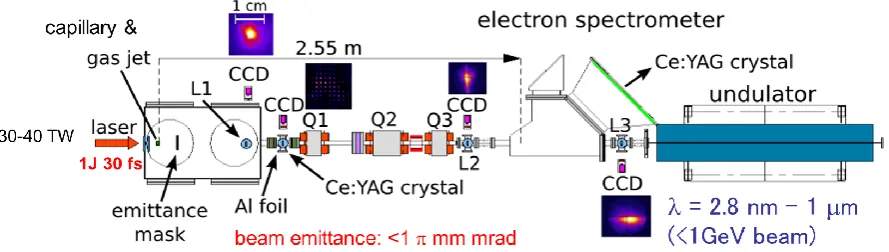
[image:2.595.405.536.73.253.2]a eA m c , where A is the laser vector potential, 𝑚𝑒 the electron mass, 𝑒 the electron charge and 𝑐 the speed of light. The power is sufficient to trigger relativistic self-focussing, which leads to self-guiding over the full extent of the plasma medium. The main layout of the experiments presented here is shown in Figure 2. Electron spectra are measured using an imaging spectrometer placed 2.6 m from the LWFA gas jet. Two sets of quadrupole triplets act as a beam transport system. The first (permanent) magnet triplet is situated close to the gas jet (not shown) to collimate the electron beam, and a second (electro-) magnet triplet, Q1-Q3, acts a focusing lens. This is either used to match the beta function to the undulator or optimise beam transport for the electron spectrometer. The undulator is placed 3.5 m from the LWFA gas jet. When the electron beam is transported through the undulator a small permanent magnet dipole (not shown), with a resolution of around 3% at 150 MeV, is used to measure the electron spectra after the undulator. An XUV spectrometer and X-ray CCD camera are used to measure the undulator radiation spectra and determine the number of photons emitted.
Figure 2. Layout of the ALPHA-X beamline showing the LWFA, quadrupole magnets, dipole spectrometer and 100 period undulator.
In addition to the ALPHA-X measurements we have used 3.5 J pulses from the RAL Gemini laser with a 4 cm pre-formed plasma channel waveguide7 to produce GeV energy range electron beams11. When
0 1
a relativistic self-focussing in-creases the intensity and produces a plasma bubble LWFA structure that accelerates electron bunches to energies in the range of 50 MeV to GeV, depending on the plasma density. The LWFA beams are very stable when the laser and plasma are stable (see Fig. 5). The highest quality electron beams are produced close to the threshold for self-injection. Electrons
attosecond
bunch
[image:2.595.61.506.490.616.2]that are not injected into the bubble are emitted at 45 degrees as high charge, 100s fs duration, MeV energy bunches with a distinct correlation between energy and angle of emission, as shown in Fig. 3, which shows that the slice energy spread can be less than 10%.8
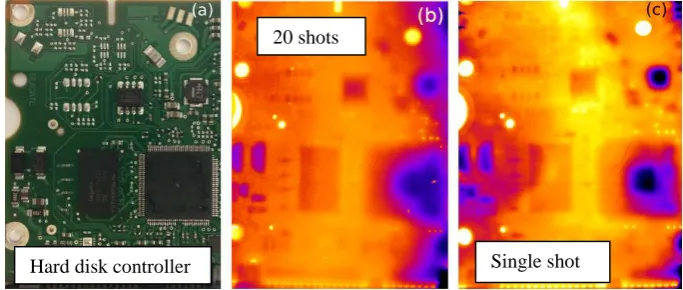
These 10s nC beams are quite divergent and therefore use-ful for imaging macroscopic objects8, as shown in Figure 4. The beams are also efficient emitters of THz radiation when passed through a thin metal foil or the plasma boundary9. Pulses of THz radiation with an energy in ex-cess of several mJ are emitted with high efficiency using a very simple set up that requires little alignment9.
Electron beam energy spectra are measured using an im-aging dipole magnet spectrometer and the beam is trans-ported to an undulator using sets of quadrupole magnets.
Beams with an emittance of 1 π mm mrad17, energies of 80-300 MeV1,2,4,11, and percent level energy spreads2,4,18, low divergences (0.5-2 mrad)18, peak currents >1 kA and fs bunch duration5 have been measured on the ALPHA-X beamline (Figure 2). Theoretical studies (Figure 1) show that attosecond bunches can be produced by perturbing the plasma density to briefly trigger injection6.
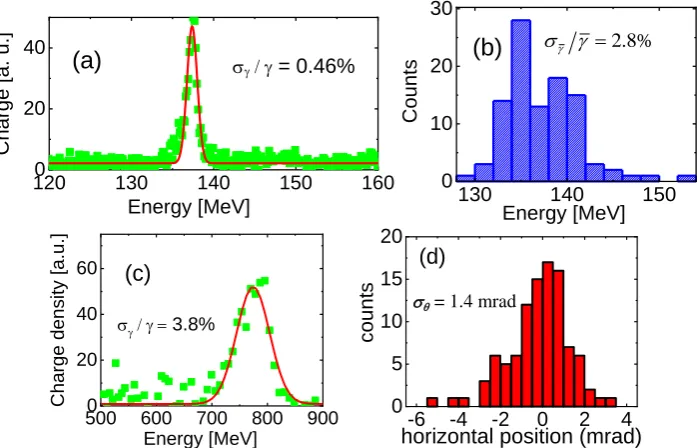
The smallest energy spread measured for 140 MeV energy beams are around 0.46% (not de-convoluted for the spectrom-eter resolution of 0.1%), as shown in Figure 5(a). Moreover, the shot-to-shot mean energy variation is below 3%, as shown in Figure 5 (b), making it possible to undertake experiments in a similar way to using a conventional accelerator. The beam
[image:3.595.300.531.77.217.2]divergence at 150 MeV is 1 mrad, for low charge beams (1-2 pC)17, and the pointing stability around the same value, as shown in Figure 5 (d). This has enabled an experimental demonstration of undulator radiation using the ALPHA-X7 LWFA. Around 95% of the charge is transmitted through the 6 mm diameter undulator vacuum chamber, as described below. Although good stability and beam quality of beams in the range of 100-150 MeV can be achieved, it is important to explore whether high quality and stable electron beams can be produced at higher energies. As a first step in this direction we have undertaken experiments using the Rutherford Appleton Laboratory, RAL, Gemini Ti:sapphire laser using 3.5 J, 50 fs laser pulses and a 4 cm pre-formed plasma capillary waveguide, where we measured mean energies up to 800 MeV and energy spreads of around 4% (as shown in Figure 5 (c)) close to the spectrometer resolution limit (3%), indicating that much lower energy spreads are produced11. In these experiments we also observed how the plasma bubble acts as a very strong wiggler, producing plasma wiggler (betatron) radiation out to the millionth harmonic, by resonantly multiplying the 1.5 eV laser photons to the gamma-ray spectral region (7 MeV) 11.
Figure 3: Measured energy-angle correlation for wide angle nC elec-tron bunches that are not trapped in the bubble.
Slice energy spread < 10%
Hard disk controller
20 shots
Single shot
[image:3.595.129.471.354.499.2]1200 130 140 150 160 20 40 Charge [ a. u.] Energy [MeV]
(a)
sg / g = 0.46%130 140 150
0 10 20 30
(b)
Counts Energy [MeV]5000 600 700 800 900 20 40 60
(c)
Charge de nsity [a.u.] Energy [MeV]sg / g 3.8%
-6 -4 -2 0 2 4
0 5 10 15 20
(d)
counts [image:4.595.124.473.73.297.2]horizontal position (mrad)
sq= 1.4 mradFigure 5: (a) Low energy e-beam energy spectrum with s gg / 0.46% from ALPHA-X, (d) corresponding shot-to-shot variation of the mean energy, (c) high energy spectrum of a LWFA driven by 3.5 J, 800 nm laser in a capillary plasma waveguide (measured at Gemini, Rutherford Appleton Laboratory, RAL,), (d) pointing angle distribution (1.4 mrad rms) for a 130 MeV beam.
4.
LWFA DRIVEN UNDULATOR EXPERIMENTS
The LWFA has excellent pointing stability (Figure 5(d)) when the laser performance is optimised. To demonstrate its suitability as a driver of a synchrotron source, the beam is focussed through an undulator with a deflection parameter au =
0.38, number of periodsNu 100 and periodicity, u 1.5 cm, as shown in Figure 2. 30 fs pulses of XUV radiation are produced using 120-150 MeV beams, as shown in Fig. 6, which demonstrates the feasibility of a compact, ultra-short pulse XUV synchrotron source13. The next stage in these investigations is to increase the energy to 1 GeV and optimise the beam transport to preserve the ultra-short bunch duration in the undulator and investigate FEL operation. This requires a good quality, high peak current beam, which we believe is possible by simply optimising the LWFA and beam transport system.
In these experiments the LWFA is optimised to produce electron bunches of around 150 MeV with charge per bunch of several pC, to ensure the best quality electron beams with a bunch duration of 1-2 fs at source. The undulator radiation spectra for a well optimised beam transport system is measured using a high resolution, imaging XUV spectrometer. The
expected wavelength of the emitted undulator radiation is
2 2 2
2 1 95 nm
2 2
u au
g q
g
, where u is the undulator
wavelength, g E mc2, E is the electron energy, q is the divergence half-angle. The natural undulator spectral width for a mono-energetic electron beam that is properly matched to the undulator has a typical sync2 function shape with a
relative spectral width of s 1Nu 1%, when the central cone angle
1
0.33 mrad u
N
q g . The smallest
spectral widths are measured for observation angles less than 0.33 mrad. The electron energy is maintained around 150 MeV and electron beam and XUV radiation spectra are measured simultaneously (as shown in Figure 6(a) and 6(b)). For a finite energy spread and electron beam divergence (or collection angle for the XUV spectrometer), q, the measured
undulator spectrum broadens to:
1/ 2
2 2 2 2 2
.
/ meas 2 / ( ) 1 /Nu
g q
s s g s g . Figure 6(b) shows a typical measured
XUV spectrum with a width of s / meas.2%. The measured electron spectra had a width of s gg/ 3.6%and a central energy of 140 MeV. The mean electron beam energy determined from the undulator radiation spectrum,
2
2 2 2
.
1 154 MeV
2 2
u u
meas
a
E mc g q
, is 10% higher than that of the dipole magnet measurements (Figure 6(a)), 2.8%
g
which indicates a small misalignment. Furthermore, the undulator spectrum (Figure 6(b)) can be used to estimate the upper
limit of the electron beam energy spread
1/ 2
2 2 2 2 2
.
/ 0.5 / ( ) 1 / u
meas N
g q
s g s s g
, which is 0.85%, neglecting
an-gular spread, and 0.7%, including the broadening due to divergence (q 0.33 mrad). These measurements compare well with the energy spectra shown in Figure 5(a), demonstrating that a high quality electron beam is produced using the LWFA. Moreover, this is much smaller than the energy spectra measured using the low resolution dipole spectrometer. Its
resolu-tion can be readily estimated as
1/ 2
2 2
/ / / 3.5%
dipole undulator
g g g
s g s g s g
, which confirms that these direct
meas-urements are resolution limited. It also emphasises the usefulness of the undulator for non-destructive measmeas-urements of the electron energy spread, when the divergence and pointing variations are small (see Figure 5).
The total number of 88 nm photons emitted from the undulator for a 2 pC electron bunch is around 3×10⁶, measured in the central cone defined by the spectrometer slit, in a 30 fs pulse length of (equal to the number of undulator periods). Increas-ing the electron beam energy to 1 GeV would result in emission of a pulse of 2 nm photons with a duration equal to that of the electron bunch, i.e. 1-2 fs, assuming an ideal transport system. At higher energies the LWFA produces higher charge electron bunches (up to 100 pC), with the consequence that between 108 and 109 photons will be produced per pulse. The peak power of this femtosecond ultra-short XUV pulse would be 10 MW to 1 GW. With the development of future high efficiency 1 kHz lasers and increasing the electron energy to 3 GeV, the photon rate would be extended to 1013 photons/s.
120 140 160 180
0.0 0.1 0.2
Energy (MeV)
Cha
rge/unit ene
rgy [a.u.] sg / g = 3.6% (a)
50 100 150 200
0 2x10⁵
4x10⁵
6x10⁵
photon
s/nm
wavelength [nm]
2.5 x 10⁶ photons
5 x 10⁶ photons
s/ 2%
[image:5.595.124.455.304.426.2](c)
Figure 6 The measured LWFA electron beam energy spread using a low resolution (3%) spectrometer placed after the undulator. LWFA undulator radiation for different electron beam energies. (a) 100 period 30 fs pulse at 88 nm with s / 2%, which gives
/ 0.8%
g
s g , (b) peak at 137 nm showing angular broadened and relatively poor beam transport.
5.
LWFA DRIVEN ION CHANNEL LASER
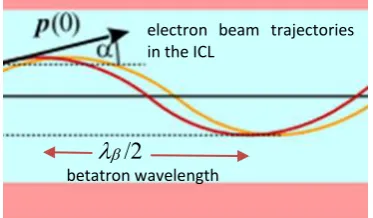
The ion-channel laser16 is an ultra-compact alternative to the FEL, with the magnetic wiggler replaced by the electrostatic forces of the ion channel, which behaves as an effective compact wiggler. This can be formed by an ultra-short laser pulse or a relativistic bunch of charged particles in plasma. In the ICL, the undulation period depends on the ion density, electron energy and oscillation amplitude, in contrast with the FEL, where it is fixed by the magnet spacing and periodicity (Fig. 7). Amplification in the ICL is analogous to that of an FEL, and is described by scaled FEL-like equations governing the dynamics of the radiation and electron beam16. This suggests the
feasibil-ity of a compact coherent radiation source for XUV wavelengths, where the gain parameter ρ can be as high as 0.03, which would give amplifica-tion for LWFA electron bunches for realistic energies and emittances16. With g = 300, 1% energy spread, 1 mm mrad emittance and high bunch density nb = 1020 cm-3 from the LWFA, and a betatron amplitude of r =
10 m, the ICL gain parameter = 0.0216. For these parameters the beta-tron wavelength p 2g (equivalent to the undulator period,u) for
a background plasma density of 1.8×1019 cm-3 is ≈ 200 m, which gives a gain length of 1.7 mm, and a total saturation length of 3.5 cm 16. This is a very compact coherent XUV source.
/2
electron beam trajectories in the ICL
[image:5.595.355.542.576.685.2]6.
CONCLUSIONS
We have explored several unique radiation sources based on laser-plasma interactions, some operational and some sug-gested. These can be quite intense and efficient sources, producing very short duration pulses, down to a single cycle and 100 attosecond duration. Furthermore, with the same laser, a very useful compendium of radiation sources for applications that require tunable ultra-short pulses for pump-probe time resolved studies can be assembled.
ACKNOWLEDGEMENTS
We acknowledge support of the U.K. EPSRC (grant no. EP/J018171/1, EP/J500094/1 & EP/N028694/1), the LASERLAB-EUROPE (grant no. 654148), EuPRAXIA (grant no. 653782), and the Extreme Light Infrastructure (ELI) Project.
Data associated with this paper is available at: http://dx.doi.org/10.15129/b27073ee-e029-4f6b-ae92-1574c2799e5f
REFERENCES
[1] Mangles, S. P. D. et al., "Monoenergetic beams of relativistic electrons from intense laser-plasma interactions," Nature 431 (7008), 535-538 (2004).
[2] Wiggins, S. M. et al., "High quality electron beams from a laser wakefield accelerator," Plasma Physics and Controlled Fusion 52 (12), (2010).
[3] Wiggins, S. M. et al., "High Quality Electron Beams from a Laser Wakefield Accelerator," 2010 Conference on Lasers and Electro-Optics (CLEO) and Quantum Electronics and Laser Science Conference (QELS) (2010). [4] Welsh, G. H. et al., "High resolution electron beam measurements on the ALPHA-X laser-plasma wakefield
accelerator," Journal of Plasma Physics 78 393-399 (2012).
[5] Islam, M. R. et al., "Near-threshold electron injection in the laser–plasma wakefield accelerator leading to femtosecond bunches," New Journal of Physics 17 (9), (2015).
[6] Tooley, M. P. et al., "Towards Attosecond High-Energy Electron Bunches: Controlling Self-Injection in Laser-Wakefield Accelerators Through Plasma-Density Modulation," Physical Review Letters 119 (4), (2017). [7] Jaroszynski, D. A. et al., "Radiation sources based on laser-plasma interactions," Philosophical Transactions of
the Royal Society a-Mathematical Physical and Engineering Sciences 364 (1840), 689-710 (2006).
[8] Yang, X. et al., "Three electron beams from a laser-plasma wakefield accelerator and the energy apportioning question," Scientific Reports 7 (2017).
[9] Yang, X., Brunetti, E. & Jaroszynski, D. A., "High-energy coherent terahertz radiation emitted by wide-angle electron beams from a laser-wakefield accelerator," New Journal of Physics 20 (2018).
[10] Jaroszynski, D. A. & Vieux, G., "Coherent radiation sources based on laser plasma accelerators," in 10th Workshop on Advanced Accelerator Concepts C. E. Clayton & P. Muggli, Eds., pp. 902-913, Mandalay Beach, Ca (2002).
[11] Cipiccia, S. et al., "Gamma-rays from harmonically resonant betatron oscillations in a plasma wake," Nature Physics 7 (11), 867-871 (2011).
[12] Schlenvoigt, H. P. et al., "A compact synchrotron radiation source driven by a laser-plasma wakefield accelerator," Nature Physics 4 (2), 130-133 (2008).
[13] Anania, M. P. et al., "An ultrashort pulse ultra-violet radiation undulator source driven by a laser plasma wakefield accelerator," Applied Physics Letters 104 (26), (2014).
[14] Islam, M. R. et al., "Near-threshold electron injection in the laser-plasma wakefield accelerator leading to femtosecond bunches," New Journal of Physics 17 (2015).
[15] Jaroszynski, D. A., Bakker, R. J., Vandermeer, A. F. G., Oepts, D. & Vanamersfoort, P. W., "Coherent startup of an infrared free-electron laser," Physical Review Letters 71 (23), 3798-3801 (1993).
[16] Ersfeld, B. et al., "The ion channel free-electron laser with varying betatron amplitude," New Journal of Physics
16 (9), (2014).
[17] Brunetti, E. et al., "Low Emittance, High Brilliance Relativistic Electron Beams from a Laser-Plasma Accelerator," Physical Review Letters 105 (21), (2010).