World Maritime University
The Maritime Commons: Digital Repository of the World
Maritime University
World Maritime University Dissertations Dissertations
2000
The regulation of international shipping : systematic
issues facing states in the administration of
maritime affairs and the eradication of substandard
shipping
George S. Reynolds
World Maritime University
Follow this and additional works at:http://commons.wmu.se/all_dissertations
Part of theAdmiralty Commons
This Dissertation is brought to you courtesy of Maritime Commons. Open Access items may be downloaded for non-commercial, fair use academic
Recommended Citation
Reynolds, George S., "The regulation of international shipping : systematic issues facing states in the administration of maritime affairs and the eradication of substandard shipping" (2000).World Maritime University Dissertations. 84.
WORLD MARITIME UNIVERSITY
Malmö, Sweden
THE REGULATION OF INTERNATIONAL
SHIPPING
Systemic Issues Facing States in the
Administration of Maritime Affairs and the Eradication of
Substandard Shipping
By
GEORGE S. REYNOLDS
Jamaica
A dissertation submitted to the World Maritime University in partial fulfilment of the requirements for the award of the degree of
MASTER OF SCIENCE
in
MARITIME ADMINISTRATION AND ENVIRONMENTAL PROTECTION
2000
I certify that all the material in this dissertation that is not my own work has been identified and that no material is included for which a degree has previously been conferred on me.
The contents of this dissertation reflect my own personal views, and are not necessarily endorsed by the University.
……… (Signature)
……… (Date)
Supervised by:
Dr. Proshanto K. Mukherjee
Professor of Maritime Administration and Environmental Protection
World Maritime University
Assessor:
Dr. Moira L. McConnell
Professor of Maritime Affairs
World Maritime University
Co-assessor:
Professor Theodore J. Sampson
Former Professor of General Maritime Administration and Marine Environmental Protection
ACKNOWLEDGEMENTS
This dissertation was developed as part of my studies at the World Maritime University. These studies would not have been possible without the kind support of a number of people and organizations, to which I am most grateful.
First of all, I am grateful to the Lord, God, for giving me the opportunity and courage to apply for and to survive the course of studies at the World Maritime University, and also for the support and guidance given throughout the application and acceptance processes and my studies. My special thanks to Rear Admiral Peter Brady and Major General John Simmonds, successive Chiefs of Staff of the Jamaica Defence Force, who encouraged and approved my application and attendance at the World Maritime University.
I wish to express my profound gratitude and sincere thanks to the Tokyo Foundation for the invaluable sponsorship provided to facilitate my studies. My sincere thanks must also be extended to my Faculty Professor and dissertation supervisor, Professor P. K. Mukherjee, the members of the Maritime Administration and Environmental Protection Faculty, and the Staff of the WMU Library. Their imparted knowledge, guidance and advice were instrumental in overcoming many of the difficulties encountered, not only in the preparation of this dissertation, but also throughout my course of studies. Thank you all very much.
ABSTRACT
Title of Dissertation: The Regulation of International Shipping: Systemic Issues Facing States in the Administration of Maritime Affairs and the Eradication of Substandard Shipping.
Degree: MSc
This dissertation is a study of the regulation of international shipping examining the historic, current and evolving issues and dilemmas related to such regulation.
A brief review of the evolution of international shipping and the regulatory regime is undertaken, namely as regards the increasing dependency of States on international trade and the resultant dilemma arising out of their regulatory obligations.
The process of administration of national maritime affairs is examined in relation to the duties, responsibilities and obligations of States, the formulation of maritime strategies, and the inherent dilemmas often facing maritime administrators.
The issue of the cost implications of shipping regulation, in terms of compliance and non-compliance, is analyzed from the perspectives of the various industry interests.
The international quality assurance mechanisms and control regimes, to which ships are subjected, are examined from the various industry viewpoints. Inherent problems and issues hindering the eradication of substandard shipping are discussed and courses of action to resolve them are proffered.
International co-operative efforts in the regulation of shipping and issues regarding the international standard setting process are examined for their utility and objectivity.
A number of interviews were conducted with key personnel in various sectors of the maritime industry to obtain their perspectives on these issues, so that a balanced evaluation could be done, and feasible solutions to the issues and dilemmas identified.
The concluding chapter evaluates the findings of the research on the regulation of international shipping and outlines a number of recommendations of general application.
TABLE OF CONTENTS
Declaration i
Acknowledgements iii
Abstract iv
Table of Contents v
List of Tables vii
Explanation of Terms viii
List of Abbreviations ix
1. Introduction 1
2. The evolution of maritime transport
2.1 Early history 3
2.2 Maritime expansion and influence 3
2.3 Maritime power and economic development 4
2.4 International shipping 4
2.5 Maritime transportation in the 20th century 5
2.6 Manning 6
2.7 Projections for the 21st century 6
2.8 The regulatory dilemma 7
3. The regulatory regime of maritime transport
3.1 Maritime law 8
3.2 Strategic evolution 8
3.3 Safety and environmental protection concerns 10
3.4 Regulation in the 20th century 11
3.5 The broad concept of maritime regulation today 13
4. The administration of maritime affairs
4.1 National interests 15
4.2 Rights and obligations of States 15
4.3 The doctrine of State responsibility 16
4.4 National maritime strategy 17
4.5 The elements of maritime administration 17
4.6 The administrative issues 18
4.6.1 States 18
4.6.2 Maritime administrators 20
4.7 The need for effective maritime administration 20
5. The cost of shipping regulation
5.1 General attitudes towards regulations 22
5.2 The economics of maritime regulations 22
5.4 Insurance 24
5.5 The industry perspective 24
5.6 The cost of compliance 26
5.7 The cost of non-compliance 28
5.8 Cost-effectiveness and returns 29
6. Substandard ships, control regimes and related issues
6.1 Substandard ships 30
6.2 Control of international shipping: a quality assurance tool 31 6.3 Credibility, transparency and accountability 33
6.4 Towards quality shipping 34
6.5 Shipbuilding issues 35
6.6 Ship-owners 37
6.7 Flag States 39
6.8 Manning and social issues 43
6.9 Classification societies 45
6.10 Insurers, shippers and charterers 47
6.11 Port States 48
6.12 Coastal States 51
6.13 Assessments of maritime administrations 55
6.14 Concerns regarding subjectivity 55
7. International co-operation
7.1 General 57
7.2 The ILO 59
7.3 The IMO 61
7.3.1 Organizational philosophy 61
7.3.2 Management strategies 64
8. Conclusions and Recommendations: managing for quality
8.1 Traditional issues 67
8.2 Current issues 68
8.3 Managing for quality: the way forward 69
Bibliography 71
Appendices
Appendix 1 World tonnage by main country groups, tonnage distribution and
ownership of major open registry fleets, and world tonnage by ownership 80 Appendix 2 Chronological development of key international maritime legislation
in the 20th century 82
Appendix 3 Maritime strategy and planning framework 86 Appendix 4 Maritime administration: scope and responsibilities 87
LIST OF TABLES
Table 5.1 Indicative safety and environmental protection cost rise by ship type 27
Table 5.2 Benefits derived from the implementation of a quality assurance scheme 29
EXPLANATION OF TERMS
Issue A point in question, or any matter arising as a consequence
thereof; that which is in dispute or at variance between
contending parties, the decision of which is of special, public or international importance.
Dilemma A situation in which a choice has to be made between two or
more equally undesirable alternatives; a state of indecision between alternatives; a difficult or problematic situation.
Coastal State A State that possesses a coastline, maritime areas of jurisdiction
and maritime interests therein.
Port State A State in whose ports or at whose offshore terminals foreign
ships routinely call.
Flag State A State that maintains a register of ships and has ships
registered accordingly; the State in which a ship is registered and whose flag the said ship is authorized to fly; the State of nationality of the ship.
Control Mechanisms and activities intended to exert control over, to
regulate and to check and verify the administration and conditions of ships engaged in international trade.
Coastal State Control The series of legislative measures and preventive, preparedness
and response mechanisms which coastal States may implement in order to protect their maritime interests against the hazards of substandard shipping and maritime casualties.
Port State Control A system of harmonized inspection and administrative
procedures which port State authorities may employ in order to verify the validity of foreign ships’ certificates and documentation and that the conditions of such ships are in conformity with the certificates and international rules and standards.
Flag State Control The system employed by flag Administrations to ensure that
LIST OF ABBREVIATIONS
BIMCO Baltic and International Maritime Council
CARICOM Caribbean Community
CDI Chemical Distribution Institute
CLC 92 1992 Protocol to the International Convention on Civil Liability for Oil Pollution Damage, 1969
COLREG 72 Convention on the International Regulations for Preventing Collisions at Sea, 1972
EEZ Exclusive Economic Zone
EQUASIS European Quality Shipping Information System
EU European Union
FSI Flag State Implementation
IACS International Association of Classification Societies ICS International Chamber of Shipping
ILO International Labour Organization IMB International Maritime Bureau
IMCO Inter-Governmental Maritime Consultative Organization IMO International Maritime Organization
ISF International Shipping Federation
ISM Code International Management Code for the Safe Operation of Ships and for Pollution Prevention
ITF International Transport Workers Federation
JMI Jamaica Maritime Institute
LLMC 76 Convention on Limitation of Liability for Maritime Claims, 1976 MARPOL 73/78 International Convention for the Prevention of Pollution from Ships
1973, as modified by the Protocol of 1978 relating thereto
MOU Memorandum of Understanding
OCIMF Oil Companies International Maritime Forum
OECD Organization for Economic Cooperation and Development
SIRE Ship Inspection Report Exchange database
SIRENAC Systeme d’Information RElatif aux Navires Controles; Paris MOU database on PSC inspections
SOLAS 74 International Convention for the Safety of Life at Sea, 1974
STCW 78 International Convention on the Standards of Training, Certification and Watchkeeping for Seafarers, 1978
STCW 95 International Convention on the Standards of Training, Certification and Watchkeeping for Seafarers, 1978, as amended in 1995
UN United Nations
CHAPTER 1
INTRODUCTION
The regulation of international shipping has been characterized by controversial issues for as long as ships have been operating. The primary basis for such issues has been the perceived effect of regulation on the economic viability of international shipping. The various entities within this industry each have their own interests to protect. As such, their attitudes and conduct are governed by how they perceive regulation in relation to these interests. Notwithstanding, regulation is the key means of ensuring global quality in international shipping, namely maritime safety, marine environmental protection and the eradication of substandard shipping. In order to understand the fundamental issues concerning the regulation of international shipping, an examination of these various perspectives is therefore essential.
The regulation of shipping implies additional costs to the ship owners: to what extent are they willing to compromize profitability as against observing safety and pollution obligations? Flag State Implementation and Control, when properly administered, raises the question of cost to ship owners: to what extent are flag States willing to implement and enforce rules and standards and risk losing their ship-owning clientele to other, less compliant flag States? How can the international maritime community hold them to their obligations for quality shipping? How can key industry interests be made to uphold their responsibility for quality shipping?
Is the current organization and operating principles of the international regulatory body, the IMO, conducive to the effective participation of all Member States? Do all Member States, and in particular States Parties to the various conventions, have the resources and capacity to give full and complete effect to the conventions? Is there enough emphasis placed on objective management strategies within the IMO? What are the implications of these issues and how can they be resolved or mitigated? How can Member States improve their ability to fully implement the conventions?
CHAPTER 2
THE EVOLUTION OF MARITIME TRANSPORT
2.1
Early History
From the beginning of time, the ease and speed with which people have been able to move around have been powerful influences on their conditions of living. Transportation, being the movement of persons and goods from place to place, and the various means by which such movement is accomplished, has thus been a key index in civilization, facilitating the exchange of goods and services throughout history. Among the chief landmarks in the history of transportation have been the evolving modes of water transport. This is hardly surprising given that approximately 75% of the earth’s surface is covered by water and the fact that the majority of the world’s population have traditionally lived within coastal regions.
Transportation by water was undoubtedly among man’s earliest and best means of extending his range of activities, broadening his horizons, improving his living standards and finding ways and means of moving himself and his materials. Movement by water thus proved to be a viable transportation mode. The evolution of water transportation progressively expanded the extent of voyages. Transportation on inland waters and rivers progressively gave way to oceanic voyages and the discovery of new lands (Davies, 1984, pp.663-664).
Ocean trade was thus almost inevitable. From man’s restless spirit, his search for power and wealth and a need to exchange goods served as the driving forces in his conquest of the oceans (Marshall, 1989, p.12). The greater accuracy and safety of navigation offered by constant innovations in maritime transportation continuously underpinned the development of new sea routes. A recurrent theme thus emerged. Those who possessed prowess in navigation and shipbuilding skills held the key to being able to undertake long ocean voyages and discover new lands and opportunities (Kemp, 1982, p.6).
2.2
Maritime Expansion and Influence
traditionally encouraged maritime expansion and influence over neighbouring seas, and subsequently this extended to the major oceans (Jourdin, 1993, p.101). As oceanic trade prospects increased, larger and faster vessels were developed, with major advances coming in the wake of the industrial revolution. There was also the concurrent development of new types of ships to transport a variety of novel goods, as well as improvements in facilities at ports and harbours to accommodate the greatly increasing size and variety of ships that were being built (Davies, 1984, p.666).
2.3
Maritime Power and Economic Development
The commercial use of the oceans to expand trade has been synonymous with national development and has come to represent the foremost means of international trade today. Despite maritime transportation being fraught with numerous dangers, it has traditionally been a more viable and strategic alternative to that of land. This feature has thus underscored the influence of maritime commerce upon the wealth and strength of States throughout history. Control of the seas and the trading routes was thus necessary in order to secure a share of the benefits of international maritime trade. States therefore relentlessly pursued such control, whether through the exclusion of other States, by peaceful legislative methods of monopoly or prohibitive regulations, or by direct violence (Mahan, 1957, pp.22-23).
The importance of international shipping to the economic development of States has thus been a major factor in their national priority-setting and decision-making processes. Maritime power then, has been the key to economic development, with the harnessing of this relationship giving rise to the traditional maritime States (Gold, 1981, pp.9-10). As such, efforts to regulate international shipping have had to compete against these economic and development factors. This has come to represent one of the major dilemmas facing Maritime Administrations today.
2.4
International Shipping
in volume being moved by sea, accounting for some 40 % in value, maritime transport has obviously become more critical to national economies today than when those economies were less exposed internationally (Ma, 1999, p.19). Adam Smith, in the Wealth of Nations, considered international shipping to be the catalyst of economic development. It was cheap transport that could open wider markets and facilitate trade efficiency and economic development (Stopford, 1988, p.3).
2.5
Maritime Transportation in the 20
thCentury
The 20th century has been characterized by a pattern of continuous development and economy in shipping, namely through technological progress in ship construction and port handling facilities. Commercial and operating practices in international shipping have also undergone major adjustments, notably the emergence of open ship registries and the shift away from traditional registries to these more commercially attractive ones. The business of ship registries has been very controversial and open registries, often referred to as ‘flags of convenience’, are now an integral feature of the shipping industry. In particular, more ships have been registered under open registries, with non-traditional maritime States such as Panama, Liberia and the Bahamas accounting for large percentages of the world’s total tonnage. Beneficial ownership, however, continues to reside in the hands of nationals and business entities of traditional maritime States. Appendix 1 illustrates the current status of international shipping in relation to tonnage distribution and beneficial ownership.
become increasingly complex. Support services to ships have had to be commensurately upgraded. And, the interface between maritime transport and other modes of transport has grown considerably; multi-modal transport arrangements now form an integral part of the movement of goods across continents and oceans.
2.6
Manning
Notwithstanding all of these advances, however, the seafaring profession has not necessarily enjoyed similar growth. The increased attractiveness of shore-based careers and a general lack of promotion and viability have resulted in a reduction in the number of persons becoming officers or remaining in sea-going jobs for long periods. Coupled with an estimated 30% failure rate during training, the overall situation has been causing much concern through the industry. According to the joint Baltic and International Maritime Council/International Shipping Federation (BIMCO/ISF) 2000 Manpower Update, the world fleet is currently 16,000 officers short of its optimum requirement, albeit that there is a surplus of some 224,000 ratings. This implies a 4% shortfall in the required number of officers. The number of ships in the world fleet is expected to grow by 1% per annum, whilst recruitment and outflow are expected to remain at existing levels. As such, the report predicts that by 2010 there will be a shortage of some 46,000 officers, representing 12% of the optimum requirement (Institute for Employment Research, 2000, pp.1-8). Such a development is clearly adverse for the industry and as such, speedy rationalization of the problem and the implementation of short and long-term solutions must be undertaken as a matter of priority.
2.7
Projections for the 21
stCentury
2.8
The Regulatory Dilemma
From the earliest chapters of the history of shipping, authoritative control, whether local, national, regional or international has been integrally linked to shipping. Today, each State views shipping from its own national perspective in order to identify and capitalize on any advantages open to it (Farthing and Brownrigg, 1997, pp.81-82). Broadly speaking, the regulation of shipping falls under the categories of commercial and economic regulation, and technical and liability regulation.
Generally, commercial and economic regulations have the effect of eroding to some extent, free competition in terms of price, cargo availability and the ability to trade and the freedom of choice, thus causing distortions in the marketplace. Similarly, technical and liability regulations, laying down standards for compliance, penalties for non-compliance and associated liabilities, have an impact on the commercial and economic aspects of shipping (Farthing, 1987, pp.22-31). Compliance thus has a price, as does non-compliance.
From the ship-owner’s perspective, the cost of compliance is often weighed against profitability and the cost of non-compliance. Most adopt a position of general compliance. However, an indiscriminate few choose to operate either on the border or outside the regulatory threshold, invariably evidenced by substandard ships. These few show little or no regard for regulatory requirements and pose major threats to life, property and the environment.
CHAPTER 3
THE REGULATORY REGIME OF MARITIME TRANSPORT
3.1
Maritime Law
The term maritime law has often been defined as “the body of rules, concepts and legal practices governing certain centrally important concerns of the business of carrying goods and passengers by water.” Generally, it is used to denote any legal matters pertaining to the sea: the laws of the sea (Young, 1982, p.11). However, a distinction has been mooted regarding the term law of the sea, which is considered to be the international public law dealing with the legal rights of States regarding the multifarious use of the oceans and its resources. As such, an emerging and more appropriate perception of maritime law is that it refers to “the entire body of laws, rules, legal concepts and processes that relate to the use of marine resources, ocean commerce and navigation” (Mukherjee, 2000, pp.1-3)
3.2
Strategic Evolution
• The treatment of shipwrecked sailors;
• Court jurisdictional powers relating to maritime matters;
• Rules regarding blockades and piracy;
• The settlement of disputes relating to maritime contracts;
• The role of prize courts;
• Insurance;
• Salvage;
• The carriage of goods by sea;
• The concept of unmolested navigation; and
• The use of warships to protect maritime commerce.
However, whilst there was considerable influence and acceptance of these legal elements among most littoral States at the time, they were widely viewed by individuals within such States as “foreign elements” and often times not readily understood nor accepted. As a result, States invariably created “a competitive law substitute” that was more homogenous with their national law; national maritime law thus emerged (Livanos and Halpin, 1978, p.12). Today, such governmental involvement in various aspects of shipping has become an inescapable tradition. The Rhodian Code in particular, governing maritime commerce and navigation, was the first comprehensive maritime code as such, providing for exclusive jurisdiction over national and adjacent seas, perpetuating freedom for national commerce and trade and a restriction on that of other States. This has become a common concept, in fact a recurring theme and dilemma throughout the history of maritime affairs; freedom of the seas construed as national freedom at the expense of other States. The disparate application of this concept subsequently led, in much later years, to the now well known pronouncements (Mare Liberum) of the Dutch philosopher, Hugo Grotius (1583-1645), who contended that no State had any legal entitlement to proprietary rights over the seas (Farthing and Brownrigg, 1997, pp.2-7).
innocent passage through such “territorial seas” (Anand, 1983, pp.131-137). This further influenced the need to establish fishing boundaries, or as Smith (1980, p.20) suggests, “to maintain a part of the liberty or freedom of the seas that had been historically guaranteed, and subsequently to maintain national wealth and power.”
Similarly, the impact of colonialism on the global spread of early maritime law cannot be ignored (Young, 1982, p.12). According to Anand (1983, p.1), modern law of the sea, like other rules of international law, is largely a product of European or Western Christian civilization, a product of the European mind and European beliefs, and based on European States’ practices. This factor has generally given rise to a fundamental premise and discomfort among maritime States today.
3.3
Safety and Environmental Protection Concerns
History has repeatedly shown that man’s use of the sea has given rise to numerous issues that have had major impacts on international relations. Among the more commonly known issues are those relating to boundary disputes, fisheries conflicts, and freedom of navigation and access to trade. Invariably these have been given greater prominence because they have been treated as critical factors on the foreign policy agendas of the maritime powers. Less publicized, but equally important, have been those issues relating to rules and standards for safety and pollution prevention, which have oftentimes become “highly politicized when linked with other policy areas” (Barston and Birnie, 1980, pp.1-2).
that regulatory efforts to control shipping, particularly safety, have been traditionally regarded as a hindrance to free trade and economic viability (Boisson, 1999, pp.45-48).
Increased desire for profitability consequently facilitated the scope for greater compromize of safety standards. This has become a constant dilemma in international shipping and remains a primary consideration in the issue of shipping economics versus regulation (Farthing, 1993, p.25). Regrettably, concerns for safety only began to come to the fore in the wake of maritime disasters, spurring changes in the individual and collective behaviour of those engaged in maritime activities (Boisson, 1999, p.49). Coupled with this, the relatively new issues of marine environmental degradation did not attract much concern, with pollution of the oceans from ships remaining largely unregulated (Farthing, 1993, p.30).
This view of indifference was not confined to the industry players however, as governments were equally short sighted. At the International Maritime Conference in Washington D.C. in 1889, the general view of the 27 participating maritime States was that while the adoption of international maritime safety practices and the establishment of a permanent maritime commission might be desirable, they were not then feasible. This was due to their lack of uniformity on maritime views and their nationalistic concerns about loss of sovereignty over maritime matters (Farthing, 1993, pp.27-28).
3.4
Regulation in the 20
thCentury
The regulation of international shipping during the 20th century has followed a somewhat haphazard path and is attributable to a number of factors. Firstly there was the spill-over of controversies and issues among the traditional maritime powers from the 1800’s regarding:
• The use and freedom of the seas;
• Economic viability and the impact of safety regulation;
• Nationalistic concerns regarding sovereignty and general political short-sightedness
vis-a-vis the development of cohesive international maritime policy.
gain throughout the century, has been constrained by these factors. Overall, the approach has been reactive, rather than pro-active, driven mainly by those maritime States that were in one way or another affected by particular events. Generally speaking, several factors incited the maritime powers to subsequently embark on the “internationalization of maritime law” (Boisson, 1999, pp.52-53) namely:
• Problems of the high seas: In order to prevent anarchy and dangerous situations for maritime navigation, it was prudent to set conditions for exercising the freedom of the high seas;
• Foreign ships in port: The regulatory and administrative diversity of national conditions for the control of ships in port resulted in considerable uncertainty, with vessels often having to meet contradictory safety conditions. Additionally, navigational and seaworthiness certificates had no international validity;
• Regulation of competition: In light of fierce international competition and repeated disasters, the maritime powers became increasingly convinced that economic rivalries could endanger safety and have an adverse effect on the reputation of the industry. The maritime powers concluded that international standards for ships would have great utility in enhancing safety, and prevent less scrupulous States from obtaining a competitive edge through deliberately indulgent legislation; most importantly, such standards would not penalize States adopting strict regulation; and
• Repeated accidents and disasters, namely the Titanic disaster of 1912.
As a result, the maritime powers established various processes for co-operation in their drive to achieve safe and efficient maritime transport, primarily:
• Uniformity and harmonization of local regulations through bilateral arrangements;
• International conferences to establish universal rules; and
• Inter-governmental organizations to eventually oversee the formalization and adoption of international instruments.
The catastrophic nature of the 1912 Titanic disaster had an enormous impact on public opinion and accelerated the international co-operative efforts to implement collective safety policies. The first International Convention on Safety of Life at Sea was adopted in 1914; its purpose was to codify the various technical solutions, designed to reduce maritime accidents, into a uniform set of international rules.
Organization (IMO), so renamed in 1982. The general objective of IMCO was to oversee the technical aspects of international shipping, including safety and pollution prevention, namely by (United Nations, 1995, p.293) providing machinery for co-operation and the exchange of information among governments. Sadly, the Convention did not enter into force until 1958, when it was ratified by 21 States. The 10-year gap was attributable to widespread differences about the role of the organization. Since then, the IMO has facilitated the adoption and entry into force of numerous conventions aimed at regulating the various technical and legal aspects of shipping (see Appendix 2).
Concurrently, in the aftermath of World War II, new developments concerning the law of the sea emerged. Many coastal States, concerned about their security, proposed that the territorial sea be extended. The situation was compounded by the coincidental emergence of newly independent ex-colonies that expressed the desire to obtain exclusive access to coastal marine resources. The result was increasing disparity in claims concerning the extent of territorial seas. This anomalous situation gave rise to friction and confrontation between various governments (Britton, 1986, pp.74-80), forcing the world community to introduce some degree of control. Starting in 1958, three international conferences have been held, under the auspices of the United Nations (UN), to address the emerging issues concerning the law of the sea. The current United Nations Convention on the Law of the Sea, 1982 (UNCLOS) consolidates the disparate views on maritime jurisdiction and the use of the seas with sovereign and institutional responsibilities for maritime safety and pollution prevention. Congruence and rationalization of jurisdictional issues and responsibility for technical shipping issues have been effected under the auspices of coastal, port and flag States, and a “competent international organization”, this being the IMO.
3.5
The Broad Concept of Maritime Regulation Today
The regulation of international shipping today falls under three broad categories: technical, economic and social. The technical aspects focus primarily on maritime safety and marine pollution prevention. The economic aspects invariably concern regulation “according to specific economic principles, such as fair competition (anti-trust), protection of national fleets,” and the carriage of goods by sea, while the social regulations establish frameworks for the working conditions of seafarers. Maritime regulations can be further subdivided (Ma, 1999, p.161) into:
• Those established by professional bodies within the industry, such as classification societies, to regulate professional conduct and technical standards;
• Those established by government agencies to regulate domestic maritime activities and to give effect to international obligations;
• Those that are purely of a national nature; and
• Those that are international in application and established by governments through appropriate international organizations, such as the IMO or the ILO.
Maritime law determines the scope, content and application of shipping regulations. As such, shipping regulations must be considered against the basis of the following maritime law concepts (Stopford, 1988, pp.152-153):
• Ship registration confers nationality on a ship and brings it within the regime of the national law of the flag State;
• The national law of the flag State governs the ship-owning entity, whether an individual or a body corporate, and the ship. This covers such issues as company law, taxation and applicable maritime laws;
• The laws of the State in whose territorial waters or port a ship is currently located or operating are applicable to the ship throughout the duration of its stay therein; and
CHAPTER 4
THE ADMINISTRATION OF MARITIME AFFAIRS
4.1 National Interests
The term ‘national interest’ has traditionally been used as a “rationale for State action” and is intricately linked to the various policy objectives of States. Broadly speaking, a national interest is a stake or issue, usually political, legal, economic or military, which has a major impact on the survival and well being of a State and its nationals. National interests then, are the basis on which a State establishes its national objectives and develops its national strategy and policies for the attainment of those objectives. They determine the manner in which a State administers its maritime affairs and its subsequent conduct and functioning in the international arena (Nuechterlein, 1995, pp.106-114).
4.2
Rights and Obligations of States
Customary international law is binding on all States and is one of the primary material sources of public international law. One of the main concepts of customary international law is that all independent States, being members of the international community, enjoy certain rights, powers and privileges, whilst having certain correlative duties and obligations. These rights and correlative duties are the essence of their independence. The recognition of a State by other States, as such, depends on the belief that the government thereof has the ability to effectively handle its given power, fulfil the customary duties of a State and effectively participate in the international community (Boixell, 1998, pp.8-24).
Invariably, States become faced with the dilemma of balancing their conduct between their national interests and their international duties and obligations. The critical importance of both sets of considerations makes the task immeasurably difficult, particularly in the maritime arena where international commonality is most pronounced. Careful strategizing is therefore crucial to the effectiveness of a State’s management of its maritime affairs.
convention, it becomes obligated to uphold the provisions of the convention, and can be bound by other States Parties so to do. Similarly, the State can bind other States Parties to uphold the convention provisions provided that it, the State, has given full and complete effect to the convention. Giving such full and complete effect to the convention means implementation; incorporating the provisions into national legislation and giving it the force of law within its jurisdiction. Suffice to say, nevertheless, the other States Parties can still bind the particular State to the provisions of the convention even if it has not implemented the provisions into its national legislation. It is thus prudent that States Parties to international conventions effect implementation as a matter of priority.
4.3
The Doctrine of State Responsibility
The doctrine of State responsibility denotes the condition under which a State is legally obligated to make appropriate amends following conduct that constitutes a breach of any of its international obligations with respect to other States. Such conduct extends to acts or omissions committed by organs of the State acting in an official capacity as in the Caire case, or private entities within the State as in the Trail Smelter Arbitration. It represents “the consequence of, and the sanction against, non-performance by States of their international obligations (Smith, 1988, pp.5-34). But the doctrine cannot be logically restricted to solely making amends; it must cater to the prevention of breaches. Smith (1988, p.83) refers to the principle of good neighbourliness, espoused in the UN Declaration on Principles of International Law Concerning Friendly Relations and Co-operation Among States. The declaration encourages States “to take due account of the interests and well-being of the rest of the world, in social, economic and commercial matters”. For example, international opinion has become increasingly supportive of the obligation of preventing trans-boundary pollution which, speculatively, may become applicable to ship source marine pollution.
administration of its maritime affairs and the observance of its international maritime obligations.
4.4
National Maritime Strategy
Strategy is the “art of employing all elements of the power of a State, or States, to accomplish the objectives of a State or an alliance in peace or war.” Strategy involves the use and close integration of economic, political, cultural, social, moral, spiritual and psychological power. There is no clear-cut line of demarcation between military, economic and political matters. All are inextricably linked and each component strategy must be based on the realities of the other components (Burke, 1997). The national maritime strategy of a State, therefore, will inevitably incorporate political, economic and naval components into an all-encompassing approach to the attainment and retention of sea-power. Strategy is therefore a consolidation of a host of international and domestic issues and differing points of view, and is best achieved by utilizing a planning framework, such as that depicted in Appendix 3 (Lloyd, 1995, pp.1-3).
It is clear to see that there is an irrevocable international component to national maritime strategy, with alliances, mutual support of friendly nations and the utilization of international institutions being means towards the realization of national maritime objectives. As such, States that choose a uni-lateral approach face an increasingly difficult future, especially if they do not possess the economic and maritime capacity to support uni-lateralism.
4.5
The Elements of Maritime Administration
Maritime administration is a function of public administration, which, broadly speaking, concerns those policy making, regulatory and service provision functions of government that collectively contribute to ensuring that national interests are effectively protected. The process involves support and advice to the political leadership concerning policy and programme development and delivery of the requisite implementation activities.
multi-modal transport demand and capacity and infrastructure needs. This involves, inter alia, providing public support, facilities and transport services; ensuring the economy, efficiency, accessibility and adequacy of transport services; and policy-making, safety regulation, environmental protection and economic regulation.
Within this broad band of transport management considerations is the government’s responsibility for effective maritime transport management and maritime administration. With increased international focus on issues such as sustainable development and integrated maritime management practices, governments must ensure that they implement appropriate maritime strategies for ensuring the quality of the marine environment, maritime safety and maritime security, along with prudent economic management of these functional areas. The primary activities of maritime administrators will therefore focus on maritime policy formulation, implementation of maritime legislation and the provision of marine services. Accordingly, these activities will come under the scope of international shipping; domestic shipping; specialized marine activities catering primarily to fishing vessels and pleasure craft; support services to shipping and the maritime industry; and the maritime dimensions of multi-modal transport. The overall roles and the scope of activities and responsibilities, which are integral to effective maritime administration, are depicted in Appendix 4 (Hodgson, 1999).
4.6
The Administrative Issues
Current issues in maritime administration are best examined from the perspectives of both States in general and actual administrators. Regardless of the perspective, however, there are recurring elements that perpetuate throughout the entire scope of the administration of maritime affairs.
4.6.1
States
in order to protect or advance their national interests. The global ramifications of modern sea use, however, dictate that ethics and morals must therefore be prime considerations in the determination of national interests and objectives, the formulation of maritime strategies and policies and States’ maritime practices (Nuechterlein, 1995, pp.107-108).
This represents an international responsibility on the part of States and is akin to the ‘social responsibilities’ of companies to the society in which they operate. Such social responsibilities have emanated largely from society’s increasing consciousness of its responsibility to future generations. International responsibility in this regard is no different. Therefore, whilst companies “should not pursue their immediate profit objectives at the expense of the longer term interests of the society”, States should likewise seek to act in the best long-term interests of the international community. The need for such international responsibility is starkly evident in the maritime arena, where an international commonality exists among all States. States, like companies, should therefore be “attempting to minimize any adverse effects of their actions, rather than adhering to the lowest acceptable standard” (Cadbury, 1991, pp. 49-50).
4.6.2
Maritime Administrators
Maritime administrators, being advisers to their governments, have to justify proposed strategies and policies on the one hand and implement those that the government mandates them so to do, on the other hand. It is not uncommon therefore, that proposed strategies and policies are not accepted in full, but rather are modified or rejected in light of other national interests and objectives. Similarly, it is not uncommon for maritime administrators to have to implement and execute mandated strategies and policies that they do not consider to be in the best maritime interests of the State. This inescapable subjection to political control and decision-making can therefore present somewhat of a dilemma for maritime administrators when faced with such situations.
Given the vast dependence of States on international trade and shipping, effective maritime strategy influences a wide range of governmental policies and practices. Governments therefore place great reliance on the informed proposals of maritime administrators, rather than incessantly ‘politicizing’ their efforts. Maritime administration, therefore, cannot be considered mutually exclusive from all other aspects of the public sector. Rather, maritime administration is integral to and mutually supportive of the entire realm of public sector management because of the impacts, direct or indirect, that accrue from the State’s dependency on its effectiveness. Similarly, the manner in which a State’s maritime affairs are administered has major implications for its neighbours and the international community.
4.7
The Need for Effective Maritime Administration
beyond cost. The prevention of such casualties is therefore best achieved through effective maritime administration, as demonstrated by the United Kingdom. Whereas total losses of their ships in 1894 was 195, with 1,245 deaths, the implementation of the 1894 Merchant Shipping Act resulted, ten years later, in a reduction to 107 ship losses and 485 deaths. Gradual introduction of more stringent safety requirements continually yielded positive results, with losses declining to 11 ships and 14 lives by 1971 (Drewry Shipping Consultants, 1998, p.3). The maritime safety record of individual flag States is therefore a reflection of their effectiveness in regulating and controlling their merchant fleets and administering their maritime affairs. It must also be borne in mind that the overall number and capacity of passenger ships has increased immensely in recent times. Long sea voyages are minor in comparison to the number of coastal and short international voyages on which countless thousands of passengers commute by ferry each day. The impact of any one casualty can be disastrous. The Dona Paz disaster in 1987 in the Philippines (4,386 lives lost) and the Estonia in 1994 (912 lives lost) (Hooke, 1997, p.173, p.199) are reflective of the magnitude of modern maritime casualties. Similarly, the grounding of the Exxon Valdez in 1989, wherein 258,000 barrels of crude oil were spilled, exemplifies the catastrophic nature of environmental degradation and the costs of counter-measures associated with large-scale ship source pollution. Damages were estimated at US $25 million for the vessel; US $3.4 million for the lost cargo; and US $ 1.85 billion for the clean-up operations (National Transportation Safety Board, 1999, p.v).
CHAPTER 5
THE COST OF SHIPPING REGULATION
5.1
General Attitudes Towards Regulations
Many people with vested interests in international shipping consider maritime regulations to be an intervention into and a hindrance to the development of shipping activities. Undoubtedly, maritime regulations have a cost implication, particularly for ship-owners and shipping companies. Regulations are considered by maritime administrators, on the other hand, to be necessary and “ in the general interest of the shipping community”. Given that there is a general attitude of apathy towards the regulation of shipping, few regulations have “ever been implemented in a straight-forward manner.” Questions of over-regulation, as against under-regulation, the cost burden associated with regulation and the disparate regard paid to maritime regulations necessitate an understanding of their cost implications (Ma, 1999, pp.166).
5.2
The Economics of Maritime Regulations
not quite as clear-cut. Unscrupulous ship-owners and substandard ships abound. As such, governments and maritime administrators must analyze and address a number of issues. Firstly, how to discourage unscrupulous ship-owners against non-compliance and the maintenance of unsafe and environmentally unfriendly practices; and secondly, how to offer incentives and alternatives to compliant ship-owners who observe quality ship-management practices. The answer (Ma, 1999, p.171) lies in the following approaches:
• Imposing administrative costs for consistent non-observance of prescribed standards;
• Imposing punitive and corrective costs i.e., fines and compensation for economic breaches of applicable rules and standards; and
• Applying preventive costs to establish support infrastructure, such as shore-based reception facilities for ship generated waste, or to require additional assurances against possible economic breaches. These are often beneficial, being invariably below the punitive or corrective costs and the additional benefits that accrue from the actual preventive measure.
Cost benefit analysis is thus becoming an increasingly important means of avoiding economic futility and widespread apathy towards maritime regulations.
5.3
The Governmental Perspective
Governmental involvement in shipping covers three main aspects: political, economic and social. Such involvement, whether at the national or international level, is focused on protecting national maritime interests. The natural tendency of all States is to look at shipping from their own national perspectives and to identify means of gaining maximum advantage (Farthing and Brownrigg, 1997, p.82). Naturally then, national regulations often aim to protect and promote the viability of the national merchant marine on the one hand, and also to regulate national and foreign ships’ operations so as to assure maximum safety and minimal pollution. Accordingly, governments have to establish the necessary support infrastructure, enact appropriate maritime legislation and provide marine services to shipping in general.
Governments are cognizant of this and accordingly, they employ various financial methods to effect quality assurance. Flexibility and prudence in the development, implementation and enforcement of optimized maritime regulations are universal requirements. Concurrently, governments utilize a combination of financial and legislative deterrents, incentives and cost-recovery schemes. These, respectively, protect their interests from imprudent ship operations, encourage ship-owners to act prudently, and offset the costs of service provision. Administrative, punitive and corrective costs serve as deterrents. Favourable taxation and dues regimes offered to prudent and compliant ship-owners serve as incentives. And specific fees, levied against ships calling at ports and offshore facilities, serve to offset the costs of providing services such as pilots, navigational aids and waste reception facilities. In order to achieve optimized regulation and shipping activity, due cognizance has to be given, therefore, to the cost burdens imposed on ship-owners, as well as to competitive flag and port regimes of other States.
5.4
Insurance
Quality assurance in shipping operations is also the forte of the marine insurance industry. Substandard ships and imprudent ship operations cost the industry a substantial amount, particularly Protection and Indemnity (P&I) Clubs. The staggering value of modern ships, reflected in collision liability costs, coupled with the various liability regimes for pollution damage, mandate caution on the part of insurers. This is illustrated in the UK P&I Club’s analysis of major claims for the period 1987-1992. There were 1,971 P&I claims made on this Club, the value of which was US $989 million. Of these, 94 claims individually cost in excess of US $1.6 million, with collision and pollution claims accounting for 17% and 14% respectively (UK P&I Club, 1993, pp.6-7). More recent analysis of claims for the period 1987-1997 reveals that major claims, whilst constituting only 2% in number, represent 72% of the total value of all claims made (UK P&I Club, 2000, p.2).
5.5
The Industry Perspective
barely be covered, the temptation to disregard ship maintenance and regulatory requirements is then increased. Accordingly, a regulatory regime that is unrealistic and not based on careful analysis of all the issues involved will fail to secure industry-wide compliance. Such an uninformed regulatory regime will inevitably be viewed as intervening in the operation of shipping, leading to clashes and regulatory chaos.
Major criticism has been levelled by the industry against regulatory regimes and uni-lateral State action that are reactionary and merely politically inspired. Reactionary measures driven by political undertones invariably impose restrictive and financial burdens on the industry. The industry argues that such measures, apart from being burdensome, do not necessarily address the particular problem and, particularly in the case of uni-lateral action, leads to disparity among States. With shipping being an international activity, the additional financial and other burdens, which arise because of the non-uniformity of regulations across State and regional boundaries, can be very discouraging. This is particularly exemplified by the US Oil Pollution Act 1990 (OPA 90), which was enacted in the wake of the Exxon Valdez disaster in Alaska in 1989. According to Farthing and Brownrigg (1997, pp.208-209):
“This legislation, which pays scant regard to IMO conventions, has had a major impact on shipping, with some shipping companies no longer prepared to take the risks involved in trading in the US. No one quarrels with its aims, only the methods employed. The cost to the shipping community in time and energy has been immense and it is, so far as the shipping industry is concerned, a monument to unacceptable uni-lateralism.”
Herald of Free Enterprise disaster, of a more definitive and internationally applicable quality management framework, the International Safety Management Code (ISM Code).
The industry perspective then, is very important. Prudent and effective maritime regulations cannot be developed in isolation from the shipping industry; their concerns and viability must be reflected otherwise there will be regulatory chaos, lack of confidence and widespread non-compliance (Farthing and Brownrigg, 1997, pp.200-224).
5.6
The Cost of Compliance
The costs associated with the regulation of international shipping can be quite high, particularly those related to assuring safety, efficiency and environmental protection within a quality-based shipping operation (Drewry Shipping Consultants, 1998, p.10). Maritime regulatory costs, i.e. the costs of quality in international shipping, can be divided into:
• Preventive and appraisal costs: expenditure related to design, review, training, audits, quality planning, prevention activities and equipment, quality measures and qualification, test and inspection activities and equipment; and
• Failure costs: expenditure related to design changes, client rejects, re-deliveries, fault finding, insurance warranty, and commission losses.
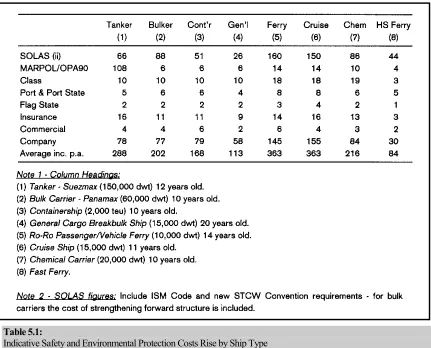
international conventions, rules and standards. According to Ma (1999, p.179), implementation of the ISM Code in some shipping companies may be as high as US $400,000, with annual recurrent costs thereafter of approximately US $25,000. Actual cost levels will depend on the extent of the existing quality systems at the time of implementation and the method of implementation. Table 5.1 shows the estimated cost increase associated with various international conventions for different ship types.
Table 5.1:
Indicative Safety and Environmental Protection Costs Rise by Ship Type
(Average annual recurring costs plus annualized capital costs over period 1998-2002)
Source: Drewry Shipping Consultants Limited, 1998.
expected to grow to approximately 12% by 2010. Concurrently, with serious concern being expressed about human error contribution to approximately 80% of all maritime casualties, the IMO amended the International Convention on the Standards of Training, Certification and Watch-keeping for Seafarers 1978 (STCW 78). The 1995 amendment (STCW 95) calls for higher standards of competence and quality assurance mechanisms for maritime training and seafarer certification. As such, given the existing shortage of competent officers and the renewed demand for higher quality throughout the shipping industry, manning costs will inevitably rise. It is estimated that such increases would be 5% in 1999, with a 6 – 8% increase, over the next five years, for officers on more specialized ships (Drewry Shipping Consultants, 1998, p.12-13).
Similarly, the issue of pollution prevention regulations and their cost implications are worth an examination. Firstly, the OPA 90 requirement that only double-hull tankers may trade in the US, when first introduced, witnessed a price differential of some US $10m over single-hull newbuildings. This price differential has steadily decreased as the construction of double-hull tankers has become more common and their design reconfigured. However, extra maintenance and safety assurance costs for individual ships amount to approximately US $500,000 annually. In addition, depending on condition and previous standards of maintenance, extra costs to cover enhanced surveys and consequential work may amount to US $300,000 – $500,000 annually (Drewry Shipping Consultants, 1998, p.70).
5.7
The Cost of Non-Compliance
can either be specific to an international convention, as for instance under the International Convention on Civil Liability for Oil Pollution Damage, 1992 (CLC 92), or global as recognized under the Convention on the Limitation of Liability for Maritime Claims, 1976 (LLMC 76). Unscrupulous ship-owners are fully conversant with the applicable international rules and standards, the regimes for limitation of liability and the control and legislative criteria in the areas where their ships operate. They conduct their own cost-benefit analyses and structure their ships operations so that they effect minimum compliance with minimum expenditure. If and when they are subsequently held accountable for the substandard conditions of their ships, they would have already derived enough financial benefit from the ships to either cover the costs of non-compliance or simply abandon the ships.
5.8
Cost-Effectiveness and Returns
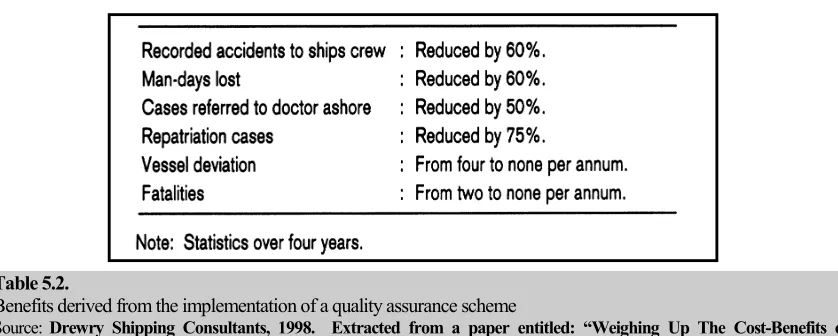
Maritime regulatory efforts must cater to these problems. Internationally accepted rules and standards must be applied uniformly world-wide to avoid geographic loopholes, and the associated quality costs must not create an unrealistic regulatory regime. Costs for non-compliance must be sufficiently high to act as useful deterrents, while useful and effective incentives must be provided for compliant ship-owners. And lastly, maritime administrators must provide the impetus for ship-owners to implement quality assurance mechanisms into their operations, highlighting the benefits to be derived from the introduction of quality systems. Such benefits are shown in Table5.2.
Table 5.2.
Benefits derived from the implementation of a quality assurance scheme
CHAPTER 6
SUBSTANDARD SHIPS, CONTROL REGIMES AND
RELATED ISSUES
6.1
Substandard Ships
Various internationally accepted rules and standards govern the construction, equipping, crewing and operation of ships engaged in international trade. The industry however, continues to be plagued by substandard shipping practices, namely non-compliance with the applicable rules and standards. IMO Resolution A.787 (19), Procedures on Port State Control, advocates that a ship is regarded as being substandard if its hull, machinery, equipment, crew or operational safety is “substantially below the standards required by the relevant conventions” or the safe manning document. It further states that:
“If these evident factors as a whole or individually make the ship un-seaworthy and put at risk the ship or the life of persons onboard, or present an unreasonable threat of harm to the marine environment if it were allowed to proceed to sea, it should be regarded as a substandard ship.”
The internationally accepted standards represent the highest practicable standards that can reasonably be imposed on the shipping industry. However, they are the minimum acceptable standards vis-à-vis maritime safety and marine pollution prevention. As such, substandard ships pose various dangers to those onboard, to other vessels and users of the sea, to people and property ashore and to the marine environment. Unfortunately, such dangers often materialize in maritime casualties, the list of which is well known. In order to understand the phenomenon of substandard ships then, the following remarks (O’Neil, 2000) should be considered:
“We have a duty to ask ourselves why is it, when our conventions have been ratified by so many countries, that ships still sink and oil spills still happen? Why do some fleets have an accident rate that is a hundred times worse than others? How can that be, when the countries concerned have all ratified the same conventions? The answer of course, is that accepting a convention is one thing, but implementing it is another matter. Accident rates are different because implementation varies from country to country.”
supervising compliance (Grey, 1999, p.1). It is an unfortunate reality, however, that certain ship-owners and flag States, for various reasons, fail to fulfil their commitments contained in international legal instruments. Not all ship-owners or flag States are “equally careful and strict in fulfilling their obligations,” with “some flag States lacking the resources or material capacity to oversee the safety of individual ships. This creates the conditions for the appearance and persistence of substandard ships” (Boisson, 1999, p.413). Subsequently, some ships are sailing the world’s seas in unsafe conditions, threatening the lives of those onboard, as well as the marine environment (Paris MOU on Port State Control, 1996, p.3). The issue of substandard ships, and by extension, their unscrupulous owners and operators, raises a number of questions, namely:
• How do ships become substandard?
• How do substandard ships obtain or retain certification to operate?
• Why do the unscrupulous ship-owners prevail?
• Why do some flag States accommodate substandard ships on their registers?
• How do substandard ships and unscrupulous ship-owners persistently evade the gauntlet of existing control regimes?
The proliferation of substandard ships, and the growing catastrophic risks they pose, make control of international shipping an increasing necessity, resulting in the various control regimes that exist today.
6.2
Control of International Shipping: a Quality Assurance Tool
protection of the marine environment are assured (IMO Resolution A.787 (19)). Control is thus a quality assurance term used in relation to maritime safety, marine pollution prevention and the eradication of substandard ships. Accordingly, the various parties that are linked to or affected by shipping operations have a role to play in exercising actual control in one way or another. These parties are:
• During the design, construction and equipping of the ship:
• The shipbuilder;
• The classification society; and
• The ship-owner.
• Throughout the operational life of the ship:
• The ship-owner;
• The flag State;
• The classification society;
• The insurers;
• The charterers, shippers and cargo owners;
• Port States; and
• Coastal States.
• During the navigation of the ship:
• The master, officers and crew.
In considering control as a whole, quality assurance starts with the ship’s design process; each successive level effectively acts as an added assurance. In order to achieve a meaningful quality assurance system, the parties at each level have to fulfil their obligations, making it a total approach, otherwise the effectiveness of the system will be compromized (Boisson, 1999, p.195). This view is well supported throughout the industry and within the various governments. Safety in shipping, “has long been regarded as primarily a matter for the owner, the flag State and the classification society; this still remains the case, but there are others who can play an important part in buttressing safety” (Farthing, 1998, p.52). British Shipping Minister, Glenda Jackson (1998, p.1), referred to this approach as “a chain of responsibility”. She stressed that:
community of purpose; what is needed now is a community of action. There is a growing recognition that the principal need now is not to develop more standards, but to implement those already in existence.”
6.3
Credibility, Transparency and Accountability
In the maritime industry, the credibility of quality assurance practices has frequently been questioned, particularly in the aftermath of maritime casualties. Chief concerns have invariably focused on their adequacy and their ability to mandate transparency and accountability. Quality practices underpin quality in shipping; this in turn depends on at least three factors. “First, it requires a collective effort, to ensure consistency and uniformity. Second, it must be based on best practice or a willingness to go that extra mile. And last, but not least, it requires transparency, or an undertaking to do everything in the open” (De Bievre, 1999, p.16).
Transparency and accountability are the cornerstones of information management, a key component in the control of shipping. Effective management of information on the conditions of ships is the means by which the various control activities and regimes can be blended into a competent whole. Quality shipping requires quality performance and quality interaction from the many parties involved, namely through quality partnerships. By embracing transparency, such partnerships can be more effective in improving the quality of shipping (Card, 1999). Information technology has had a marked, albeit positive, effect on the management of information relating to ships’ conditions. A proliferation of databases, established by various industry interests, currently operate in relative isolation from each other. These include:
• The Ship Inspection Report Exchange (SIRE) databank operated by the Oil Companies International Maritime Forum (OCIMF);
• The Ship Inspection System database established by the chemical industry and administered by the Chemical Distribution Institute (CDI);
• The SIRENAC database utilized by the Paris MOU on Port State Control;
• The Maritime Fraud and Suspect Practices database maintained by the International Maritime Bureau (IMB);
• The ship classification databases maintained and shared by the member societies of the International Association of Classification Societies (IACS); and
The current drawback to these database applications, however, is that their utilization is more or less restricted to member organizations (Boisson, 1999, pp.436-437). The databases, coupled with on-line access, are nevertheless contributing to an improved environment of information sharing and transparency, albeit at less than optimum potential. While the outlook for improved knowledge of ships’ conditions is thus bright on the one hand, however, there should be a cautious approach. The utility of database applications will depend upon what data is made available and its accessibility and transparency (Making the difference with data, 2000, p.7). Information must be reliable, relevant and up-to-date, multi-sourced and actionable, reflecting “clearly defined yardsticks by which to judge the degree of adherence” to applicable rules and standards. If there is a lack of coherence, precision and openness, the targeting of substandard ships will be compromized (Farthing, 1998, pp.51-52). The success of any information sharing initiative depends on the willingness and objectivity of the participants, and the accuracy of interpretation, analysis and editing. These factors determine whether the information will be meaningful to the end users. The correct conclusions can only be derived by way of correct interpretation. Only then will the information be uniform, coherent, precise and directly related to the end use for which it was conceived (Making the difference with data, 2000, p.7).