CRAFTING EFFECTIVE PROBLEMS FOR PROBLEM-BASED LEARNING KENG-NEO LYNDA WEE1, YIH CHYN MEGAN ALEXANDRIA KEK1, HENG CHYE MATTHEW SIM1
1. Diploma in Marketing, Temasek Business School, Temasek Polytechnic
Abstract
Educators in higher education are constantly rethinking about how they can better prepare their graduates for their professional career. The medical faculty at McMaster University pioneered Problem-based Learning (PBL) in the 1960s as an innovative approach to make learning more relevant and effective. Since then, PBL approach in education has had proven success in many fields of studies, most notably in the areas of medicine, architecture, nursing and construction management.
PBL. This paper aims to describe the role of effective problem for reaping the full benefits of Authentic PBL and to posit the principles of designing effective problem.
Introduction
According to Barrows and Tamblyn (1980), “problem-based learning (PBL) is the learning that results from the process of working toward the understanding or resolution of a problem”. Students learn by doing and utilize their problem-solving skills. Through PBL, students develop hypothetical-deductive reasoning skills by acquiring relevant data, synthesizing the data and testing them through acquiring additional data (Wilkerson & Gijselaers, 1996). The end result is an independent student capable of life-long learning.
The opposite of PBL is when learning is teacher-centered and subject-driven. According to Knowles (1975), what is required of the students in this teacher-centered learning method is that the students learn the material presented to them by their lecturer. They are expected to reproduce it as accurately as possible on demand. In this education method, students adopt “just-in-case” learning by covering all possible contents that they may be assessed on. Such learning is stressful as students cram as much contents in a limited time. Learning becomes superficial. Knowing the contents does not translate to the ability to use this knowledge.
The authors of this paper adopted PBL as an education philosophy. This is a strategic approach to innovate teaching. PBL drives curriculum design, delivery and assessment. PBL engages the students, taps on their diversity in prior knowledge and promotes inquiry-based learning. The PBL rationale and philosophy are consistent with today’s continuously changing economic landscape. The challenge today is not just about supplying content and technical knowledge, but it is about being able to produce a new
breed of employees who can create and manage the vast knowledge in the dynamic economy (Kek & Wee, 2000). In PBL, students are self-directed and become motivated and active learners. They practise “just-in-time” learning by seeking relevant knowledge to solve the problem at hand.
If PBL is the way to go in promoting relevant and effective learning, an immediate and critical step is to craft effective problems. This paper looks at the role of effective problem in reaping the full benefits of authentic PBL and proposes principles in designing effective problems that work. A problem crafted by the authors for a marketing undergraduate class is used as a case study to illustrate the principles of designing good problems.
The Role Of Effective Problems In PBL
In any PBL curriculum, the problems form the stimulus for learning. The problems encountered by students in a PBL curriculum provide both the starting point for learning and forms the key unit for structuring relevant curriculum content is well documented (Barrows & Tamblyn, 1980; Davis & Harden, 1999; Dolmans, Snellen-Balen-dong, Wolhagen & van der Vleuten, 1997). A problem represents the challenges that the students will face in their professional practice when they graduate. The problem provides the motivation and thrust for learning. It is from the problem at the onset, that students engage in inquiry-based learning, realize the limits of their existing knowledge and what they need to learn – from problem identification, filtering symptoms from the roots of the problem, hypothesizing the possible causes and effects, seeking relevant
knowledge and generating possible solutions. The problem should allow the students to integrate across the various disciplines.
Hence, being able to craft good problems is a skill that educators must have for successful PBL curricula. Albanese and Mitchell (1993) suggested that it is difficult to get the most out of the PBL if the two essentials of students’ learning are not factored in the implementation namely: the role of tutors and the format of the problem.
Essential Values Of PBL And Its Implications On Problem Design
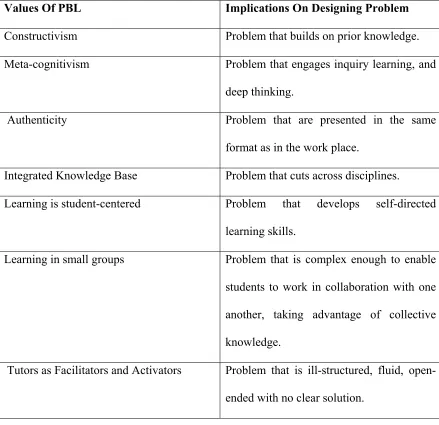
The principles in designing problems proposed by the authors are based on the essential values of PBL. In Table 1, the authors share their belief and definition of authentic PBL and its implications on problem design. Authentic PBL mirrors the demand of the work place. It requires students to perform the same activities in the learning environment as they would in the workplace. Hence, the problems must also be authentic. Crafting problem based on isolated expertise or subject matters without regard to how they relate to the real work demand will undermine the benefits of PBL.
The essential values of PBL that serve as a foothold to crafting effective problems are constructivism, meta-cognitivism, authenticity, integrated knowledge base, student-centeredness, learning in small groups, and tutors as facilitators or activators. The essential values of PBL are:
1. Constructivism
Learning is a constructive process where students build new knowledge upon prior knowledge. It is not a receptive process where learning is just an act of filling up a student’s mind with information. Such learning can only allow a student to store the knowledge in memory and to pull them out when needed, like a filing cabinet. However, reality extends beyond the filing cabinet analogy. It is full of discovery, exploration and updating. Modern cognitive psychology describes learning as a constructive process where the human memory is associative in structure. Knowledge is structured in associated networks of concepts and nodes. As learning occurs, new information is collected and coupled to existing knowledge networks. New information can then be easily retrieved to solve problems, and to apply in context. New information is acquired through self-directed learning. Students are expected to learn about the world based on their own research and study. Students determine their “knowns” and “unknowns”. They seek knowledge to address their “unknowns”. They engage in collaborative learning in their small groups to work on the problems.
Hence, designing a problem that has obvious solution is not effective. A student is not allowed to build any new knowledge or information. The obvious solution defeats the purpose of running a PBL process. The student will not be able to develop his reasoning and self-directed learning skills. This situation occurs when the problem looks like an instruction on what needs to be done, or appears like the title of a chapter, or contains only one way of resolving a problem.
2. Meta-cognitivism
Learning in PBL encourages meta-cognitive skills among students. Bruer (1993) argues that learning is quicker when students possess self-monitoring skills generally referred to as meta-cognition. PBL is a learning and teaching philosophy that fully develops a student’s ability at the meta-cognitive level. Successful problem solving is not only dependent on the possession of an extensive body of knowledge, but also on the use of problem solving methods to accomplish the goals (Gijselaers, 1996). Few problems in everyday life or professional practices present themselves with all the relevant information that is needed to understand the problems well to make accurate decisions; more information is always needed. Some of the needed information is obtained by investigating the problem, making observations, conducting primary and secondary research, asking questions, probing and investigating. For a student to determine what needs to be investigated or what questions to be asked requires much reflection, thought and deliberation. Such thoughts, reflections and deliberations are described as meta-cognition (Barrows, 1992). Meta-meta-cognition is viewed as an essential element of skill learning: goal-setting (What am I going to do?), strategy selection (How am I going to do it?), and goal evaluation (Did it work?) (Gijselaers, 1996).
Problems that do not present opportunities for the students to perform inquiry learning are not effective in a PBL curriculum. Only when a student is confronted with a abstract, uncertain, puzzling situation or problem, will he ask himself such questions as: What am I going to do? How am I going to do it? Did it work?
3. Authenticity
Problems form the organizing focus and stimulus for learning. Barrows (1996) posited that in PBL for medicine, the problems represent the challenge that students will face in practice and provide the relevance and motivation for learning. The problem format has to present the problem in the same way that it occurs in the real world. For example, a medical problem has only the patient presenting complaints or describing his symptoms. Applying this principle outside the medicine domain, problems presented must closely mirror that of the real world that students will face when they graduate.
If the problems are authentic, mirroring the demands of the real world, they can stimulate the students in learning the different contexts that they will face in their professional careers. Problems should represent the challenges that students will face in their professional careers.
In short, problems should mirror the working world demands. The problems should allow students to integrate information from the many disciplines when solving the problems, like in the real world. Problems should not promote the isolation of disciplines as this is not realistic.
Research by Libshitz and Bar-Ilan (1996) had indicated that the ability to diagnose or recognize problems is directly related to the success or failure of developing solutions (Cooper & Loe, 2000). Likewise, familiarity with the context of the problem (i.e. recognition) also greatly enhances the ability to solve the problems (Price & Driscoll, 1997) in (Cooper & Loe, 2000).
4. Integrated Knowledge Base
An authentic PBL curriculum integrates all relevant disciplines or knowledge. It promotes integration of disciplines and unites subjects in a traditional learning setting. This is because real work problems cut across disciplines and blurs the lines between subjects.
A problem that is designed well acts as an impetus for learning, and fosters the acquisition of both disciplinary knowledge and problem-solving skills. A good problem cuts across different disciplines or subjects. If a problem is anchored inside one subject, it artificially sets the environment for problem solving and the problem becomes subject-driven. In a real world, a graduate will not be provided with subject-based problems to solve. Educators must start by identifying common yet high impact problems that their graduates must be able to recognize and solve. The subjects are then assigned to these problems.
5. Learning Is Student-Centered
Students must assume responsibility for their own learning. They identify what they need to know and determine where and how to acquire the information to solve the problem. They are not provided with solutions or information on where and how to get it. They need to research and study on their own. They learn to take on responsibility for their own work performances similar to what they will do when they graduate and enter the work place.
Problems must be interesting and challenging to motivate the students to solve them. Motivation helps to sustain their interest in this self-directed learning approach. Students determine their learning agenda and seek out the “unknowns” needed to solve the problem. Students come with prior knowledge that will be activated and built on when they learn their “unknowns”. Learning is self-directed.
6. Learning in Small Groups
In today’s knowledge-based economy, the ability to work in teams is essential. PBL is most beneficial when learning is carried out in small learning groups. This is because the development of communication skills, self-directed learning, team work and cognitive reasoning are best learned through small learning group. Active involvement, inherent in all small group learning, nurtures skills that enable graduates of professional programs to be well prepared for entering the workforce (Davis and Harden, 1999). Small group learning is able to put students at the core of a learning experience by providing a framework to inquire, source for information, analyze, synthesize and evaluate
information. Small group learning allows discussion and debate over whether the new knowledge acquired is relevant and appropriate to the problem at hand. Hence, problems must be complex enough for students to build on each other’s knowledge and diverse capabilities, and to appreciate the need to work collaboratively to maximize learning.
7. Tutors as Facilitators and Activators
In PBL, educators are facilitators and not content-providers. In PBL, the problem serves as a stimulus to learning. The triggering of prior knowledge through small group discussions is a key variable in PBL. A tutor must find the balance between allowing students to discuss the issues and facilitating to ensure that the key learning issues are met. Without this balance, a passive or overly aggressive, interfering tutor will violate the constructivism approach of understanding and the development of students’ meta-cognitive skills.
The goal of the tutor is not to feed facts and information, but to nurture reason. Hence, he need not be a content expert. One important goal of authentic PBL is to improve reasoning or problem solving skills of students. Preferably, the ideal PBL tutor must move beyond being a facilitator to be an activator. According to Mayo and Donnelly (1995), the difference in terms, although subtle is extremely important. To facilitate means to help, to make something easy or easier. As pleasing as the concept of facilitating may be, that is guiding students through discovery; Mayo and Donnelly (1995) insist that it fails to capture the dynamics of PBL. The authors agree with them. The activator is more active in nature, when compared with the facilitator. Activator causes students to engage in active student learning by motivating students and challenging them with non-directive questions at the meta-cognitive level. With time, when the groups are more familiar with PBL, the students would take over PBL sessions themselves. Here, the tutor would provide support. Over time, tutors fade away and become observers, staying attentive and alert to the student group processing and discussion from the side.
As mentioned above, the problems undertaken by students should reflect the real world, and as such are ill-structured, and open-ended with no clear solutions. Tutors work as facilitators and activators in their students’ learning journey in solving the problems. They should not give out answers. The ultimate goal is to make students more independent learners.
Table 1: Essential Values of PBL & Implications on Designing Effective Problem
Values Of PBL Implications On Designing Problem
Constructivism Problem that builds on prior knowledge. Meta-cognitivism Problem that engages inquiry learning, and
deep thinking.
Authenticity Problem that are presented in the same format as in the work place.
Integrated Knowledge Base Problem that cuts across disciplines.
Learning is student-centered Problem that develops self-directed learning skills.
Learning in small groups Problem that is complex enough to enable students to work in collaboration with one another, taking advantage of collective knowledge.
Tutors as Facilitators and Activators Problem that is ill-structured, fluid, open-ended with no clear solution.
Principles in Designing Effective Problems
As a problem is the stimulus in learning in PBL, crafting the problem is both critical and challenging. It is a painstaking process and few theory-based guidelines are available in the literature on how to construct a good problem (Gijselaers, 1995). Hence, Gijselaers argues that this makes it difficult to develop principles for effective problem design. He approached this issue by asking instead the opposite question: what features of problem design may reduce the potential of problem-based learning? Gijselaers suggested the following based on his experiences at the University of Limburg:
1. Ineffective problem descriptions include questions that are substitute for student-generated learning issues.
2. The titles of ineffective problems are similar to titles of textbook chapters. 3. An ineffective problem does not result in motivation for self-study.
In fact, most educators in PBL use their own intuition as a basis from which to design problems for their curricula. Most recently, Dolmans et al (1997) have provided seven principles of effective case design in PBL curriculum.
In this paper, the authors propose four principles for crafting good, effective problems based on the essential values of PBL and implications on problem design laid out previously:
Principle 1: Mirror Real Work Place - Start with the End in Mind
Problems designed for students in an education environment should mirror those that the students will encounter in the work place when they graduate. This will make them real work ready. Authentic PBL requires the student to go through the same activities during learning that are valued in the real world (Barrows, 2000). Hence, educators should craft problems that will help their students attain the exit outcomes expected of graduates (Spady, 1994). To prepare students for their professional practice, educators should detail the likely exit outcomes that the students should be able to perform in their professional careers. Exit outcomes are the skills and knowledge, valued by employers, that students should have when they graduate.
These exit outcomes form the focus for all staff members and students to master during the course of study. Using a design down approach, exit outcomes are translated to problem outcomes (Spady, 1994). Educators craft problems such that students will achieve the problem outcomes by solving the problems. Achieving these problem outcomes would lead to achieving the exit outcomes. These problem and exit outcomes serve as benchmarks for assessing the students’ performance. Effective problems must always be crafted with the end in mind for maximum benefits to future employers and maximum positive impact on society.
Educators prepare the students for the world of change. Students should be able to hit the road running when they graduate. With these in mind, educators need to craft problems that mirror the real world challenges.
Students are more motivated by real-life problems compared with “ivory-tower” problems. Many of the traditional problems in lecture-based teaching are designed to test the understanding of theories and application without direct relevance to the real world. Problems should be as current as possible.
Principle 2: Constructivism - Problems Must Build on Prior Knowledge
PBL is a powerful philosophy that empowers the students to take charge of their learning agenda. For PBL to be effective, students must be motivated to solve these problems. The problems must be written in an interesting format that challenges the students. Problems should not be disguises of instructions. Educators should always check to see if their problems are motivating enough to solve from the students’ perspective. Problems should provide sufficient opportunities for students to conduct research and study on their own, and to build on their prior knowledge. Prior knowledge is engaged as the student is exposed to a range of diverse situations, promoting the transfer of knowledge to the unique situations presented in the problems.
Principle 3: Meta-cognitivism – Produce Reflective Students by Setting Challenging Problems
Problems should present students the opportunities to reflect and deliberate and should be thought provoking enough, in order to be effective in a PBL curriculum. The problems must be unfamiliar, unusual, new or complex enough for the students to engage their
meta-cognitive level to discover and uncover, to reflect and review, to deliberate and explore, while directing them to the decision path they believe is valid.
Principle 4: Integrate Knowledge Base - Promote Multi-Disciplinary Mindset
Students who study in subject mode tend to see subject expertise as a cluster of neatly divided silos. This way of learning promotes subject arrogance. Students may understand the underpinning knowledge within each discipline but may encounter difficulties in trying to integrate the various disciplines. If a problem is crafted based on a subject only, the students will suffer from a myopic mindset.
Problems in the real work place cut across traditional subjects. The problem presented in PBL must be multi-disciplinary in nature.
Case Study on Writing Problem based on a Marketing Education Curriculum
Adopting a customer-focused orientation, the Diploma in Marketing (DM) at Temasek Business School, Temasek Polytechnic, explored the outcome-based education model in order to reinvent its marketing curriculum. An outcome-based approach to education means clearly focusing and organizing everything in an educational system around what is essential for all students to be able to do successfully at the end of their learning experiences (Spady, 1994). Armed with substantial funding from the Enterprise Challenge, Prime Minister’s Office (Singapore) in November 2000, the Diploma in Marketing (DM) piloted a project to transform marketing education using authentic PBL in July 2001. The first step taken by DM was to determine the exit outcomes that the
marketing graduates should be able to demonstrate upon completion of their studies. The exit outcomes refer to the skills and knowledge that are essential for all the students to demonstrate upon graduation.
The engine that drives DM’s outcome-based education is authentic PBL. The DM’s outcome-based authentic PBL model enables students to achieve the exit outcomes through solving problems that best reflects the real world. The learning process is carried out in small groups. It allows students to develop inquiry skills, reasoning skills, team skills and self-directed learning skills.
Exit Outcomes
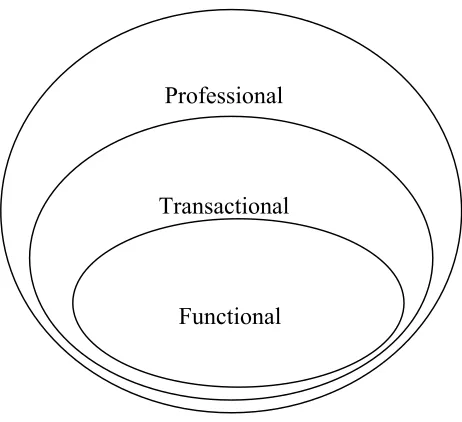
[image:17.612.194.425.473.684.2]The DM’s exit outcomes in Figure 1 are reflected in three levels namely the Functional, Transactional, and Professional (Wee and Kek, 2001).
Figure 1: Three Levels of Exit Outcomes
Professional
Transactional
Functional
Functional outcomes refer to the acquisition of an integrated marketing knowledge that is gathered from solving marketing problems that a marketing graduate is likely to
encounter in the work place. The graduate should be competent in performing the typical marketing problems found in the work place.
Transactional outcomes refer to the approach adopted by the graduate to perform his tasks. The graduate should be competent to problem solve effectively and efficiently. The graduate should be competent to engage in group brainstorming, participate in active discussion, learn from peers, give and accept constructive feedback about self and peers.
Professional outcomes refer to the personal skills and qualities that are desired and necessary of a professional marketer and for his self-development. The graduate should be able to determine what he needs to learn in an efficient and effective manner that becomes habitual. The graduate should be professional and display high standard of conduct and practices of the discipline.
Table 2 illustrates the design of a marketing problem based on the proposed four principles in designing effective problems. The table also acts as a ‘check-list or guide’ for those wanting to pilot PBL and to design problems.
Effectiveness of Problem
DM followed the principles of effective problem design when it implemented its small group PBL pilot project in July 2001. At the end of the semester, a survey and focus
group study were conducted to assess the design of the problem. Early evidence showed that the problems, developed based on the authors’ principles of effective problem design, were positive. The desired exit outcomes of DM were achieved.
In the focus group study on students at the end of PBL, students found that the problem was abstract and challenging. It enabled them to do inquiry learning. Students reported that they had to ‘discover’ or ‘explore’ the various learning areas (subjects) and apply them to the problem.
In the problem fit survey, the results were encouraging. 92.3% of the students agreed that they had acquired new knowledge, 92.3% of the students agreed that they had developed reasoning skills, 84.6% of the students agreed that they had developed problem-solving skills and 86.1% of the students agreed that they had developed their team-work skills.
Table 2: Problem Design Sample
Level of Problem Description Principles At
Work
Problem Memo
To: PR executive
From: PR Director, ABC PR Agency
Date: 2 July 2001
The agency just received an invite to pitch for an account for Hotel 81. The Board
of Management of Hotel 81 has received negative publicity in last week’s papers.
The Hotel 81 management is not very happy and is concerned about its image.
You have been asked to submit a PR proposal and pitch to the Board of
Management of Hotel 81 on 15 September 2001.
P1
Authenticity
Prior Knowledge Marketing Tools, Customer Psychology, Marketing Intelligence, Marketing Environment, Customer Communications, Customer Relationship Management,
Technologies in Marketing
P2
Constructivism
Integrated
Knowledge Base +
Prior Knowledge
(P2)
Learning Issues How to conduct PR research
How to use SPSS and other relevant research tool
How to segment and target the groups to communicate with
How to do situational and competitive analysis
How to develop a strategy
How to write a plan based on research conducted
How to do a pitch presentation to win the account
P3
Meta-cognitivism
Time Needed for Problem
10 weeks Level of Difficulty Difficult
Notes: P1: Authenticate Real Work Demands P3: Meta-cognitivism
P2: Constructivism P4: Integrated Knowledge
Conclusion
Problems drive learning in a PBL curriculum. Hence, it is essential that problems reflect the exit outcomes that are mapped out in the curriculum. We should adopt a “the whole is greater than the sum of parts” mindset. Problems should be viewed in a holistic manner crossing the boundaries of many subjects rather than written to cater to isolated subjects. Problems should be industry-driven and not subject-driven. A database of problems that mirror real world demands, with different levels of difficulties, serves as a rich resource base for learning.
Educators should craft effective problems that motivate their students and prepare students for the real world. Educators should ensure that their students achieve the desired exit outcomes after they have solved the problems. This is a critical success factor of PBL.
The authors propose that the quality of problems should be reviewed regularly. The authors like to propose the sharing of such reviewed problems among educators through a dedicated PBL problem case clearing-house be set up in the Asia Pacific region. This database of problems will serve to jumpstart new PBL users in their PBL journeys with these tried-and-tested problems that worked in learning environments.
the integration of knowledge and bring the “work place” into the classroom for tertiary education.
For PBL to be successful and the benefits of PBL to be fully realized, dialogue sessions between faculty and industry are essential. The anchoring of learning in PBL is on the authentic nature of the problem. Through working closely with the industry, real or authentic problems can be developed and presented to students. Further research is needed to determine the effects of good problems on students’ performances in the industry, after they graduate. Good and effective PBL problems are critical in stimulating students’ skills in self-directed learning, reasoning, team work and the acquisition of knowledge.
REFERENCES
Albanese, M. A. and Mitchell, S. (1993). Problem-Based Learning: A Review of Literature on Its Outcomes and Implementation Issues. Academic Medicine, 68 (1), 52-81.
Barrows, H.S. (1996). Problem-based learning in medicine and beyond: A brief overview. Bringing problem-based learning to higher education: Theory and practice. San Francisco: Jossey-Bass Inc.
Barrows, H.S. & Tamblyn, R.N. (1980). Problem-based learning: An approach to medical education. New York: Springer.
Barrows, H. S. (2000). Problem-based learning Applied to Medical Education. Springfield, Illinois.
Bruer, J. T. (1993). Schools for Thought: A Science of Learning in the Classroom. Cambridge, MA: MIT Press.
Cooper, M. J. & Loe, T. W. (2000). Using the Theory of Constraints’ Thinking Processes to Improve Problem-Solving Skills in Marketing. Journal of Marketing Education, August Issue, 137-146.
Davis, M. H. & Harden, R. M. (1999). AMEE Medical Education Guide No. 15: Problem-based learning: A Practical Guide. Medical Teacher, 21 (2), 130-140.
Dolmans, D. H., Snellen-Balendong, H., Wolhagen, I. H. & van der Vleuten, C. P. (1997). Seven Principles of Effective Case Design for a Problem-based Curriculum. Medical Teacher, 19. 185-189.
Gijselaers, W.H. (1995). Perspective on PBL. In W.H. Gijselaers; D.T. Tempelaar; P.K. Keizer; J.M. Blommaert; E.M. Bernard; H. Kasper (Eds.), Educational Innovations in Economics and Business Administration. Boston, MA: Kluwer Academic Publishers. Kek, Y. C. & Wee, K. N. L. (2000). Triumphs and Trials of Using Problem-based Learning in Marketing Communications Education: Perspectives from Educators and Students. Paper accepted at 9th World Advertising Education Conference, October 2000, Miami, USA.
Knowles, M. (1975). Self-directed Learning: A Guide for Students and Teachers. New York: Associated Press.
Libshitz, R. & Bar-Ilan, O. (1996). How problems are solved: Reconsidering the phase theorem. Organisational Behaviour and Human Decision Processes, 65 (1), 48-60.
Mayo, W. P. and Donnelly, M. B. (1995), “the Characteristics of The Ideal Problem-based Learning Tutor in Clinical Medicine”, Evaluation and the Health Professions, June, Vol. 18, Issue 2, pp. 124 – 136
Ng, L.B.D., Wee, K. N. L, Kek, Y. C., & Ng-Tang, L. M. (2000). Migrating From a Subject-centered to a Domain-based Problem-based Learning in a Marketing Curriculum. Paper accepted at 2nd Asia Pacific Conference in Problem-Based Learning 2000, December 2000, Singapore.
Price, E.A. & Driscoll, M.P. (1997). An inquiry into the spontaneous transfer of problem solving skills. Comtemporary Educational Psychology, 22, 472-494.
Spady, W G. (1994), Outcome-based education: Critical issues and answers. Arlington, VA: American Association of School Administrators.
Wilkerson, L. & Gijselaers, W.H. (1996). Editors’ notes. Bringing problem-based learning to higher education: Theory and practice, San Francisco: Jossey-Bass Inc.
Wee, K. N. & Kek, Y. C. (2001). Marketing Curriculum: A New Face in the New Economy. Paper accepted at Annual Marketing Conference, July 2001, Cardiff, Wales, UK.