1
Iterative Decoding of JPEG Coded Images
with Channel Coding
Wei Xiang
, Steven S. Pietrobon
and S. Adrian Barbulescu
Ý
Institute for Telecommunications Research University of South Australia, SA 5095, Australia
E-mail:[email protected]
Small World Communications
6 First Avenue, Payneham South SA 5070, Australia
E-mail:[email protected]
Abstract— In this paper we investigate iterative decoding of
JPEG coded images combined with channel coding over noisy channels. JPEG images use Huffman codes as the variable length coding scheme. These Huffman codes can be represented by an irregular trellis structure proposed by Balakirsky (1997). State transition probabilities can be derived from the irregular trellis and can be used as a priori information to help iterative decoding between channel and source APP decoders. Due to the poor dis-tance property of original JPEG DC Huffman code, we proposed a symmetric RVLC with free distance
which can
dramat-ically improve the system performance when iterative decoding is performed.
I. INTRODUCTION
There has been increasing demand on multimedia services over fixed and wireless channels over the last decade. Robust image or video transmission systems are critical to such multi-media services. Shannon’s classical separation theorem states that we can optimise the end-to-end system design by sepa-rately optimising the source codec pair and the channel codec pair [1]. In the past, this has been used as a justification for doing separate source and channel coding. However, this result holds true only in the limit of infinite source code dimension and infinite channel code block length. For practical systems, a joint source-channel coding (JSCC) design may reduce distor-tion, as well as complexity and delay.
In JSCC design, the rate-distortion (R-D) method [2] is an analytic approach towards optimal bit rate allocation between source and channel encoders. Several JSCC approaches have been proposed for reliable transmission of still images [3] [4]. Previous research work has concentrated on an optimal joint source-channel rate allocation strategy, which was computa-tionally expensive to be adopted in practical systems. How-ever, these methods do not perform well enough for low channel signal-to-noise ratios (SNRs), although they provide excellent results for moderately distorted channels.
On the other hand, joint source-channel decoding (JSCD) [5] is another approach to combat channel noise by exploiting the residual redundancy of the source encoder at the receiver side.
This work was carried out in part with support from the Commonwealth of Australia through the Cooperative Research Centre for Satellite Systems.
The source redundancy can be utilised as a priori information of the source statistics to help decoding.
To further exploit the “turbo” principle [6] to joint source-channel decoding, Bauer and Hagenauer proposed an itera-tive source-channel decoding approach for variable lengh coded sources [7] [8]. By modifying the variable length source de-coder to an APP dede-coder, the approach allows soft extrinsic in-formation exchange between the channel APP decoder and the source VLC APP decoder. Their approach yields superior re-sults compared to separate source and channel decoding. The fact that variable length codes can be represented with an irreg-ular trellis structure [9] makes iterative source-channel decod-ing possible.
In many international image/video standards like JPEG [10] and MPEG4 [11], variable length codes (VLCs) such as Huff-man codes are used as the entropy compression scheme. Due to the error propagation property of VLCs, the variable length coded signals are very prone to channel noise. Even a single bit error could destroy the whole coded bit-stream if there are no other error resilient schemes adopted. Inspired by Bauer and Hagenauer’s work, we applied iterative source-channel decod-ing to JPEG coded images with channel coddecod-ing. In [12], a
pri-ori bit probabilities are derived from the tree representation of
Huffman codes and incorporated to help turbo decoding. In this paper, we show how the state transition probability (STP) can be derived from the trellis representation of VLCs. We develop a general formula to compute STPs for a given VLC-trellis. The STP serves as a built-in source of a priori information to help the iterative source-channel receiver.
In this paper, we studied iterative source-channel decoding applied to JPEG coded images. We start with Section II to de-rive the state transition probabilities based on the VLC-trellis of Huffman codes. In Section III, we formulise the APP decoding of Huffman codes and show how the STP can be incorporated into the MAP algorithm. Section IV discusses the issues of designing RVLCs with large free distance which is critical for iterative decoding. In Section V, iterative decoding of JPEG coded images with channel coding is addressed. Section VI presents simulation results. Finally, Section VII is dedicated to conclusions and future work.
II. STATETRANSITIONPROBABILITIES OFVLC-TRELLIS
A variable length coded sequence can be regarded as a se-quence of bits instead of concatenated variable length code-words. Thus, the variable length coded sequence can be repre-sented by a simple but effective trellis structure proposed in [9]. As shown in [8], a bit-level soft-in/soft-out (SISO) decoding module for VLCs was derived by applying the BCJR algo-rithm [14] to such a VLC-trellis. Therefore, an a posteriori probability (APP) VLC source decoder can be implemented to generate soft outputs and exchange extrinsic information be-tween the source VLC APP decoder and channel APP decoder. For a variable length coded sequence, the symbol or code-word probabilities are usually assumed to be known. In [12], a
priori bit probabilities were derived directly from the tree
rep-resentation of Huffman codes using the symbol probabilities of the codes. The a priori bit probabilities were used in a joint source-channel decoding process. In contrast to their approach, we proposed a method to derive the state transition probabilities (STP) based on the bit-level trellis representation of variable length codes. In the next section, we show how the STP can be incorporated into the maxium a posteriori (MAP) algorithm to improve system performance.
As a comparison, we chose as an example the Huffman code in [12] to demonstrate how to derive the state transi-tion probabilities from the trellis. The variable length code
and the corresponding codeword
probabilities are
.
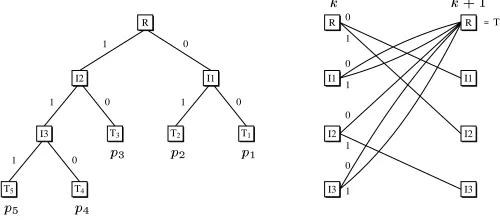
Fig. 1 shows the tree representation and the bit-level trellis of the variable length code. The nodes in the tree are subdivided
into a root-node (R), internal nodes (I) and terminal nodes (T). We can treat the VLC-trellis as an irregular trellis in compari-son to the trellis of a recursive systematic convolutional (RSC) code. The trellis of an RSC code has nice systematic properties. Each state has two paths emanating and two paths merging with the same probabilities. In contrast to the systematic trellis of an RSC code, each state in the VLC-trellis might have an arbitrary number of emanating or merging paths or even have parallel paths emanating and merging between states. Moreover, differ-ent paths might emanate or merge to a state with differdiffer-ent prob-abilities from each other because the codeword probprob-abilities of VLCs are in general different. We can utilise the codeword probabilities of VLCs to derive the state transition probabili-ties which are used as a priori information to facilitate iterative source-channel decoding.
1 0
1 0
1 0
1 0
0 1
0 1
0
1 0
1
=Ti
R
I1 I2
I3 T3 T2 T1
R R
I1 I1
I2 I2
I3 I3
T5 T4
Fig. 1. Tree representation and VLC-trellis with parallel transitions.
Letbe the probability,the state,the time instance and
the input bit of a VLC-trellis. For an arbitary irregular trellis,
we define the state transition probabilities between two adjacent
states as
. For instance in Fig. 1, the STP
from internal node I2 to the root node R can be written as
(1)
The STP from internal node I2 to the I3 can be written as
(2)
As we can see, there are two paths emanating from the I2 node, merging to the R node and the I3 node, respectively. In contrast to a regular RSC trellis in which each path has equal probability, the two paths have different probabilities. This is because variable length codes are constructed in such a way that the more frequent codewords have shorter code length. There-fore, some paths have priority over the other for an irregular VLC-trellis. The STP contains this priority information which can be used as a priori information by the source APP decoder. Note that there are parallel transition paths which merge at the same state if the different codewords of a variable length code have the same length. In the case of parallel transition paths, the two paths are distinguished by the input bit . Thus the STP can be associated with an input bit
and becomes
. The principle of calculating
the STP still applies. For instance in Fig. 1, there are two par-allel paths from internal node I1 to the root node R. They are distinguished by an input bit 0 or 1. The STP from I1 to R associated with the input bit 0 is
(3)
The STP from internal node I1 to the R associated with the input bit 1 is
(4)
For a generic trellis, we formulise the state transition proba-bilities between two adjacent states associated with an input bit
as
¾
¾
(5)
where
are all the forward nodes indices connected to
with the input bit and
are all the forward nodes
in-dices connected to
. For example, I1 is connected to
with
input bit 0, so.
,
and
are connected to
I2, so.
[image:2.595.42.292.598.709.2]III. APP DECODING OFVLCS
For the purpose of iterative source-channel decoding, we need a source decoder that produces soft outputs. The soft out-put Viterbi algorithm or the BCJR algorithm can be applied to the VLC-trellis to decode variable length codes. In [12] a mod-ified Viterbi algorithm was derived. The a priori probabilities of Huffman codes were used to improve the performance of the Viterbi algorithm. The variable length coded sequence can be treated as a sequence of bits instead of a concatenation of code-words [8]. In [7], bit-MAP decoding was developed to compute the a posteriori probabilities of bits of the variable length coded sequence.
Similar to the algorithm in [7] and following the conventions in [15], we modified the BCJR algorithm for the soft decoding of the VLC-trellis.
Denote by
and
the data bit and received symbol at time . We define the log-likelihood ratio (LLR),
associated with
each decoded bit as ¼ ¼ ¼ ¼ (6) where
is the a posteriori probability (APP) of
the data bit .
The joint probability in (6) is defined as follows
¼ ¼ ¼ ¼ Æ (7)
The foward state metric
can be recursively caluculated as follows: ¼ ¼ Æ ¼ (8)
Similarly we can derive the recursive reserve state metric as follows ¼ ¼ Æ ¼ (9)
Using Bayes’ rule, the branch metric Æ
¼
can be ex-pressed as Æ ¼ ¼ ¼ (10)
For an AWGN channel with zero mean and variance
(10) becomes Æ ¼ ¼ (11) where
is a constant and
. The last term in (11) is the STP which can be obtained from the VLC-trellis from (5). Note that the recursive calculation of both the forward state
metric
and reverse state metric
use the same STP.
IV. REVERSIBLEVLC CONSTRUCTION FORJPEG
HUFFMANCODES
The JPEG [10] still image compression standard has proved
to be a success story in source coding techniques. The
JPEG standard consists of three core components, i.e., two-dimension discrete cosine transform (2D-DCT), scalar quanti-sation and variable length entropy coding. In this study, Huff-man codes [16] are used as the entropy coding scheme.
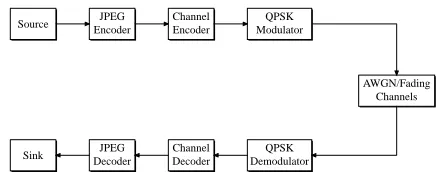
We consider JPEG coded image communication systems with rate 1/2 channel coding. The conventional “separate” com-munication system is shown in Fig. 2. The transmitter consists of a JPEG source encoder and a channel encoder. The receiver performs the separate source and channel decoding, i.e., no in-formation exchange between the JPEG source decoder and the channel decoder. Previous work has revealed that unequal error protection (UEP) can improve the system performance [17].
JPEG Encoder Channel Encoder QPSK Modulator AWGN/Fading Channels JPEG Decoder Channel Decoder QPSK Demodulator Source Sink
Fig. 2. Conventional JPEG communication system
Denote a sequence of -ary i.i.d. source symbols by
with probability density function
. Let a variable length codemap a sequence
of symbols into a binary sequence
of length. Consider the whole sequenceas one particular
codeword of a code, whose codewords are all possible
com-binations of codewordsof the VLCwith total length.
The error-correcting capability of a VLC is dominated by the free distance metric
which is defined in [8] as
(12) where
is the Hamming distance between two
codewords
and
in.
Due to the nonlinearity of code, direct evaluation of
is relatively complicated. However, one simpler VLC distance
metric called minimum block distance
can be utilised to
re-duce the evaluation complexity of free distance
[18]. The
minimum block distance
[image:3.595.319.539.395.487.2]Hamming distance between two codewords with equal length
of
(13)
As derived in [18], the relationship between and
for
Huffman codes and RVLs is
(14)
Relationship (14) can be understood in a way that all RVLCs
which do not have equal-length codewords have
.
Moreover, for an RVLC containing codewords of equal length,
is a sufficient condition for
.
As far as soft decoding of VLCs is concerned, RVLCs with large
usually have better performance in terms of symbol
er-ror rate. Therefore, free distance
is a critical design criterion
one has to take into consideration to construct an RVLC from an existing Huffman code. In this paper, we consider constructing RVLCs for JPEG Huffman codes.
Fore a gray JPEG coded image, there are two Huffman code tables. There is a 12-entry Huffman table for the DC luminance component, while there is a 162-entry Huffman table for the AC luminance component [10]. As will be showed in Section VI, the original JPEG Huffman codes do not give good performance
since they have
. Due the their poor distance property,
the convergence behaviour of JPEG Huffman codes, which is important for the iterative source-channel decoding, are bad. Using the criterion provided by (14), we can construct RVLs
with
from existing JPEG Huffman codes. In Table I, we
constructed a symmetric RVLC
for the JPEG Huffman code
for the luminance DC component. Note the probability
dis-tribution of DC symbols in Table I was obtained by training
on “Lena” and “Goldhill” images. Code
has
at the
expense of slightly increased average length. Moreover, code
is symmetric. This means that it has the nice property of
needing only one code table for both forward and backward de-coding which is an advantage from the viewpoint of memory usage and simplicity [20].
TABLE I
ORIGINALJPEG HUFFMANCODE FORLUMINANCEDC COMPONENT
VERSUS APROPOSEDSYMMETRICRLVCWITH
DC Occurrence JPEG Lumin. DC Sym. RVLC
Symbol Probability Huffman Code
with
0 0.371745 00 00 1 0.071615 010 111 2 0.102214 011 010 3 0.147135 100 101 4 0.132812 101 0110 5 0.124349 110 1001 6 0.049479 1110 11011 7 0.000651 11110 01110 8 0 111110 10001 9 0 1111110 011110 10 0 11111110 100001 11 0 111111110 110011 Average codeword length 2.6790 2.9857
V. ITERATIVEDECODING OFJPEG CODEDIMAGES
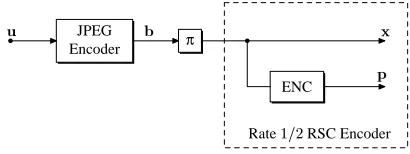
In this paper we examine iterative decoding of JPEG coded image communication systems. The receiver implements itera-tive decoding between the Huffman APP decoder and the chan-nel decoder. Two transmission schemes were studied. The first scheme is a conventional serial concatenated system. The trans-mitter consists of a JPEG source encoder and an RSC chan-nel encoder as illustrated in Fig. 3. They are separated by a pseudo-random interleaver. We denote the image pixel
vec-tor to the JPEG encoder by
, the
bit-stream out of the JPEG encoder by
, the
information bit sequence and parity bit sequence out of the
rateRSC channel encoder by
and
, respectively.
JPEG
Encoder π
ENC
RateRSC Encoder
Fig. 3. Transmitter of a serial concatenated system.
The coded bit-stream is sent through an additive white Gaus-sian noise (AWGN) or Rayleigh fading channel. On the receiver side, we denote the received noisy version ofandbyand
, respectively. The iterative receiver of the serial concatenated
system is depicted in Fig. 4. It consists of an inner channel APP decoder and an outer Huffman APP decoder.
At the first decoding iteration, the input to the channel APP decoder is the soft output of the noisy channel
. The
chan-nel decoder computes the APPof the information bits
. We denote the extrinsic output of the channel and source
APP decoders by
and
. The log-likelihood ratio of the
inner channel decoder is
, where
is the a priori information from the extrinsic output of the soft Huffman decoder which is set to 0 at the initial iteration.
refers to the extrinsic output of the channel APP decoder. Sub-tracting the a priori term from
,
are fed into
the outer Huffman soft decoder. The soft output of the Huffman
APP decoder is
. Subtracting the soft
input from the soft output for the outer source decoder, the ex-trinsic information
of the Huffman APP decoder is passed
to the channel APP decoder as a priori information. At the final iteration, the hard output of the iterative receiver is switched to
the JPEG decoder to perform normal JPEG decoding.is the
estimated output of the image pixel vector.
VI. SIMULATIONRESULTS
In this section we present our simulation results on the
per-formance of both the original Huffman DC code
and the
proposed symmetric RVLC
. We transmitted 1024
differen-tial pulse code modulation (DPCM) coded DC symbols from
“Lena” 256256 image over the AWGN channel. The coded
[image:4.595.327.532.234.311.2]Channel APP Decoder
Huffman APP Decoder
JPEG Source Decoder
Σ
Σ
S
Fig. 4. Iterative receiver of serial concatenated system.
Huffman code
was 1/2. Due to the slightly increased
aver-age length of RVLC
, we punctured the coded bitstream so
that the overall coding rate was also 1/2 to ensure fair compari-son.
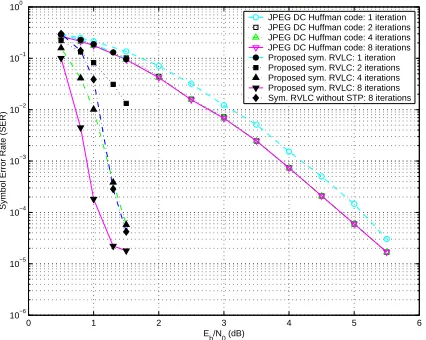
Simulation results are presented in Fig. 5. Note the sym-bol error rate (SER) is measured in terms of the Levenshtein distance which is more appropriate than the measurement of a simple symbol comparison [8]. As can be seen, iterative
decod-ing usdecod-ing the proposed symmetric RVLC
remarkably
out-performs the one using the original JPEG Huffman code
.
A maximum coding gain of 3 dB is obtained. In the final pa-per, we shall present the results for the more complicated JPEG luminance AC Huffman code.
0 1 2 3 4 5 6
10−6
10−5 10−4
10−3
10−2 10−1
100
E
b/N0 (dB)
Symbol Error Rate (SER)
[image:5.595.40.288.51.174.2]JPEG DC Huffman code: 1 iteration JPEG DC Huffman code: 2 iterations JPEG DC Huffman code: 4 iterations JPEG DC Huffman code: 8 iterations Proposed sym. RVLC: 1 iteration Proposed sym. RVLC: 2 iterations Proposed sym. RVLC: 4 iterations Proposed sym. RVLC: 8 iterations Sym. RVLC without STP: 8 iterations
Fig. 5. Simulation results for iterative decoding using Huffman code and
proposed symmetric RVLC .
VII. CONCLUSIONS ANDFUTUREWORK
In this paper we studied iterative decoding of JPEG coded images with channel coding. Representing the VLCs with a bit-level trellis with possible parallel transitions, we showed the derivation of the state transition probabilities. The STPs can be used as a priori information to improve the APP decoding of VLCs.
We proposed a symmetric RVLC with
for the JPEG
luminance DC component. Compared to the original JPEG
Huffman code
, the proposed RVLC
has a significant
per-formance improvement when iterative decoding is performed.
Our future work will focus on reducing the decoding com-plexity of the JPEG image communication system where Huff-man AC code has a large number of states. Moreover, the meth-ods proposed in this paper can be extended to JPEG2000 [21] coded images which adopts arithmetic coding as the variable length coding scheme. A feasibility study on iterative decod-ing of JPEG2000 coded images will also be a subject of future research work.
REFERENCES
[1] C. E. Shannon, “A mathematical theory of communication,” Bell System
Technical Journal, vol. 27, pp. 379–423, 623–656, July, October 1948.
[2] A. Ortega and K. Ramchandran, “Rate-distortion methods for image and video compression,” IEEE Signal Processing Magazine, pp. 25–50, November 1998.
[3] P. G. Sherwood and K. Zeger, “Error protection for progressive image transmission over memoryless and fading channels,” IEEE Trans. on
Comm., vol. 46, no. 12, pp. 1555–1559, 1998.
[4] V. Chande and N. Farvardin, “Joint source-channel coding for progressive transmission of embedded source coders,” in Proc. IEEE Data
Compres-sion Conference, Snowbird, UT, USA, pp. 52–61, March 1999.
[5] J. Hagenauer, “Source-controlled channel decoding,” IEEE Transactions
on Communications, vol. 43, pp. 2449–2457, Sept. 1995.
[6] J. Hagenauer, “The Turbo principle: Tutorial introduction and state of the art,” in Proceedings of the International Symposium on Turbo Codes, Brest, France, pp. 1–11, September 1997.
[7] R. Bauer and J. Hagenauer, ““Turbo-FEC/VLC-Decoding” and its appli-cation to text compression,” in International Conference on Information
Sciences and Systems, Princeton University, March 2000.
[8] R. Bauer and J. Hagenauer, “On variable length codes for iterative source/channel decoding,” in Proc. IEEE Data Compression Conference
(DCC), Snowbird, USA, pp. 272–282, March 2001.
[9] V. B. Balakirsky, “Joint source-channel coding with variable length codes,” in Proceedings of IEEE ISIT, Ulm, Germany, 1997.
[10] ISO/IEC JTC1, Digital compression and coding of continuous-tone
stil-limages Part 1: requirements and guidelines. JPEG-9-R6 CD10918-1,
1991.
[11] ISO/IEC JTC1/SC29/WG11, MPEG-4 video verification model version
11.0: Coding of moving pictures and associated audio information.
Touradj Ebrahimi, 1998.
[12] L. Guivarch, J. Carlach, and P. Siohan, “Joint source-channel soft decod-ing of Huffman codes with turbo-codes,” in Proceeddecod-ings of DCC, Snow-bird, UT, 2000.
[13] K. Lakovic and J. Villasenor, “Parallel concatenated codes for iterative source-channel decoding,” in Proceedings of 39th Annual Allerton
Con-ference on Communications, Control and Computing, October 3-5 2001.
[14] L. R. Bahal, J. Cocke, F. Jelinek, and J. Raviv, “Optimal decoding of linear codes for minimizing symbol error rate,” IEEE Transactions on
Information Theory, pp. 284–287, March 1974.
[15] S. S. Pietrobon, “Implementation and performance of a Turbo/MAP de-coder,” Int. J. of Satellite Commun., vol. 16, pp. 23–46, Jan.-Feb. 1998. [16] D. A. Huffman, “A method for the construction of minimum redundancy
codes,” in Proceedings of the IRE, vol. 40, pp. 1098–1101, 1951. [17] W. Xiang, S. A. Barbulescu, and S. S. Pietrobon, “Unequal error
pro-tection applied to JPEG image transmission using turbo codes,” in
Proc. IEEE Information Theory Workshop (ITW’2001), Cairns, Australia,
pp. 64–66, Sept. 2001.
[18] K. Lakovic and J. Villasenor, “On design of error-correcting reversible variable length codes,” IEEE Communications Letters, vol. 6, pp. 337– 339, August 2002.
[19] V. Buttigieg and P. G. Farrell, “A maximum likelihood decoding algo-rithm for variable-length error-correcting codes,” in 5th Bangor Sym. on
Communications, Bangor, U.K., pp. 56–59, 1993.
[20] Y. Takishima, M. Wada, and H.Murakami, “Reversible variable length codes,” IEEE Transactions on Commumications, vol. 43, pp. 158–162, Feb.–Apr. 1995.
[21] ISO/IEC FDIS15444-1, Informaiton Technology - JPEG 2000 Image
[image:5.595.68.281.388.558.2]