1
Optical characterisation of a long period grating using liquid droplets on an
electrowetting-on-dielectric platform
A. Duduś
a, R. Blue
a, M. Konstantaki
b, S. Pissadakis
b, and D. Uttamchandani
aa
Department of Electronic and Electrical Engineering, University of Strathclyde, Glasgow, G1 1XW, UK.
bInstitute for Electronic Structure and Laser, Foundation for Research and Technology-Hellas,71 110 Heraklion, Greece.
Corresponding author:
[email protected]
. Tel +44 141 548 2211; Fax +44 141 548 2926.
This paper describes the use of digital electrowetting as a means of characterising and modifying the optical transmission properties of long period gratings (LPGs) fabricated in boron doped germanosilicate single mode fibres. An electrowetting based platform has been designed to move fluid droplets, of around 2 µL volume, along the main axis of the LPG fibre. The droplets make contact with the cladding over the grating region of the fibre. Optical measurements are presented illustrating the tuning of the optical resonance wavelength of an LPG as the droplet advances step-wise along the fibre cladding under electrowetting based actuation, and the increase of 53 % in the LPG tuning range achieved by side-polishing the grating section of the fibre.
1. Introduction:In recent years the technology of optofluidics, which
combines optics and microfluidics to yield new types of lightwave devices, has seen increasing integration with optical fibre technology to create “fibre-optofluidic” devices. The optical fibres used in conjunction with optofluidics can be either single mode or multimode. Fibre-optofluidic devices utilising single mode fibres (SMF) can be classified into “fibre-gap” devices or “continuous fibre” devices, and both types have found applications in optical communications or optical sensing.
Fibre-gap devices have input and output fibres which are optically aligned and where a gap is formed between the end-faces of the two fibres into which a functional optofluidic element can be inserted to modify the optical transmission characteristics. Broadband variable optical attenuators (VOAs) have been demonstrated using liquid to deflect light between two lensed fibres [1, 2], changing the reflectivity of an interface between two fibres [3], or simply pneumatically changing the dimensions of a highly absorbing liquid between two fibres [4].
Continuous fibre devices on the other hand use just one single unbroken length of fibre, and the optofluidic element interacts with the fibre to again modify the optical transmission. Examples of such devices include sensors where a ferrofluid is combined with an optical fibre to create a magnetometer [5]. Miao et al. [6] studied the temperature dependence of the optical transmission through a photonic crystal fibre filled with an iron oxide nanoparticle fluid. The higher thermo-optic coefficient of the fluid compared to that of silica allowed the creation of a tunable all-fibre device such as a gain equalization filter. An in-line fibre VOA with 25 dB range was demonstrated using a SMF polished on one side to within 1µm of the core and a layer of variable refractive index liquid crystal applied to the polished surface [7].
In this paper we present measurements of the optical transmission characteristics of an unbroken fibre-optofluidic device in which a fluid droplet interacts with light propagating in a single mode fibre incorporating a Long Period Grating (LPG). LPGs are continuous fibre type devices and have found applications in both the optical communication and optical sensing fields [8]. LPGs exhibit a periodic refractive index modulation in the fibre core, with periodicity of the order of a few hundreds of microns, which couple the fundamental core mode to discrete forward-propagating cladding modes. Hence an optical mode carried by the core can couple into a number of lossy co-propagating cladding modes and results in periodic wavelength dips in
the transmission spectrum. The cladding modes are confined due to the cladding-air boundary. The wavelengths at which resonant coupling from the core mode to the cladding modes occur are given by [9]:
(1)
where is the grating period in the core, and
are the effective index of the fundamental fibre core mode and mth cladding mode respectively. The wavelength selective loss is sensitive to changes in the external refractive index surrounding the fibre cladding as this modifies the phase-matched coupling conditions and causes a shift in the values of the resonance dips. LPGs have found applications in fibre optic sensing [10] and wavelength filters [11].
The sensitivity of the LPG transmission to the external medium has allowed researchers to tune the optical transmission characteristics of a fibre inscribed with an LPG by moving an external liquid along the surface of the LPG using microfluidic based actuation techniques such as electrowetting [12]. Hsieh et al. [13] employed dynamic tuning using electrowetting actuation of a 10 mm length plug of conducting liquid (sodium dichromate in water) upon a LPG to shift the resonance wavelength by 3 nm and form a dynamic all-fibre filter with no mechanical moving parts. Other researchers have used magnetic actuation by applying magnetic fields to move a continuous 28 mm length plug of magnetic fluid along the external surface of an LPG [14], leading to tuning of the LPG transmission resonance by over 7 nm.
2
achieved using a digital electrowetting platform to stepwise displace a small droplet of fluid along the cladding surface of the LPG fibre. Finally we describe the 53 % increase in wavelength shift achieved by side polishing the LPG region of the fibre then repeating the droplet experiment.
2. Experimental:
2.1. LPG fabrication: The LPGs used were inscribed in boron doped germanosilicate fibre (PS1250/1500-Fibrecore Ltd) with core diameter 6.6 µm, core refractive index 1.4508 and cladding refractive index 1.444. The beam of a KrF excimer laser was utilized, producing pulses of 34 ns duration at 248 nm. The laser fluence incident on the fibre was 250 mJ/cm2 per pulse, with a pulse repetition rate of 8 Hz. The fibres were exposed through an amplitude mask with a 407 μm period made from titanium foil. For an exposure time of around 150 seconds LPGs of 15 mm length were inscribed with an attenuation band observable in the 1510 nm-1570 nm region.
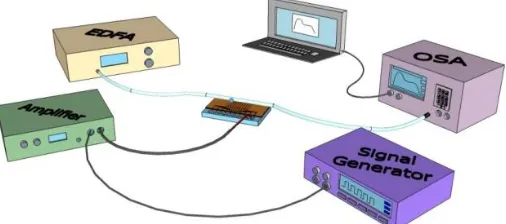
2.2. Characterisation of LPG fibre with bulk liquid overlay: A broadband erbium doped fibre amplifier (EDFA) was used to inject optical power into the LPG and an Agilent 86140B optical spectrum analyser (OSA) was used to monitor the optical output of the LPG (shown in Fig. 1). The LPG was first characterised in air and then fully immersed in solutions of different concentrations of glycerol in water to produce different external liquid refractive indices. The refractive indices of glycerol-water solutions at room temperature have been measured and tabulated in the literature [15]. For LPGs, the theoretical wavelength shift generated when the refractive index of the external medium surrounding the cladding of the LPG changes from
to is given by [16]:
(2)
where is the m-th root of the zeroth-order Bessel function of the first kind, and are the refractive index and the radius of the fibre
[image:2.612.48.301.551.663.2]cladding, respectively. The periodicity of the grating is given by and is the wavelength of light in a vacuum. Examination of (2) reveals the wavelength shift is inversely proportional to the radius of the fibre cladding and thus by reducing the cladding around the LPG it becomes possible to increase the wavelength shift attainable due to a deeper penetration of the evanescent field of the cladding modes into the external liquid producing a relatively higher change in effective index of these modes.
Fig. 1 Experimental setup for characterising optical output of a LPG fibre whose transmission is modified by actuating discrete liquid droplets along the external cladding surface
In previous work, Ji et al. [17] inscribed a LPG into tapered fibres of waist diameters 60 μm and 55 μm, with the smaller diameter fibre showing a greater sensitivity to external refractive index changes. Allsop et al. [18] fabricated a fibre taper with a waist radius of 25 μm into which a LPG was written and demonstrated an increased wavelength shift over a conventional LPG fibre. To our knowledge, side polishing a LPG has not been previously reported. In our electrowetting platform the liquid droplet only requires an interaction with one side of the fibre, therefore we investigated methods for increasing the wavelength shift achievable by side polishing the LPG region of the fibre. A side-polished fibre is more robust compared to a tapered fibre, while also allowing easy deposition of other overlaid materials that can modify the affinity of its surface to the electrowetting droplets used.
2.3. Side-polishing of LPG fibre: The grating region of the fibre was sequentially polished to reduce the thickness of the surrounding on one side of the grating and experimentally tested after each polishing stage. This was achieved by mounting the grating section of the fibre upon a 75 mm diameter polishing wheel and placing the fibre under tension by attaching 20 g weights to the fibre on either side of the wheel. The wheel was rotated at approximately 100 rpm and a solution of 9 µm aluminium oxide powder in water was applied to the surface of the wheel for a fixed period of time (10 minutes), followed by a water solution containing 0.5 µm cerium oxide powder for a further 5 minutes, and finally water only to remove residual powder. The LPG was then mounted on a metal frame, cleaned with isopropyl alcohol, and its optical transmission properties tested by immersing the grating section in glycerol-water solutions of different refractive indices. Subsequently, the fibre was replaced upon the polishing wheel and released from the frame to allow it to undergo further polishing. This polished fibre was then mounted on an electrowetting-on-dielectric (EWOD) platform and we investigated the performance of the polished LPG using discrete liquids droplets and compared this to an unpolished LPG.
3
Fig. 2 Illustration of electrowetting on dielectric (EWOD) platform with mounted LPG
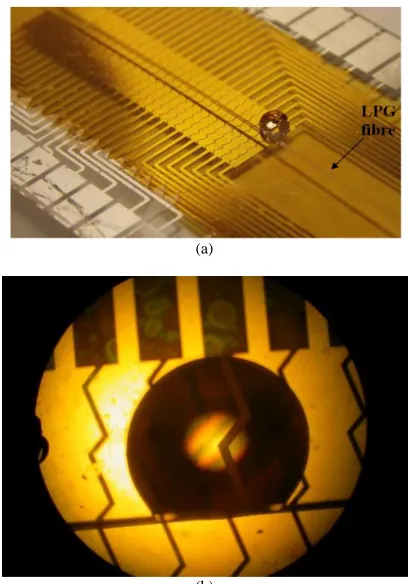
The electrowetting platform (illustrated in Fig. 2) consisted of photolithographically patterned aluminium microelectrodes passivated with a dielectric (1.5 μm of AZ-4562 photoresist) and a hydrophobic layer (100 nm of Teflon AF2400). The width of each electrode was 600 µm with a 70 µm inter-electrode spacing. The electrodes were in the form of a “zig-zag” as this enabled the droplet to overlap onto the adjacent electrode (Fig. 3a), which simplified the droplet transition along the array of electrodes [19]. A voltage was sequentially applied to individual electrodes along the array causing the droplet to move stepwise to the next active electrode along the surface of the LPG fibre. A square waveform of 10 volts amplitude at 1 kHz was supplied by a waveform generator (Agilent 3228A) and was subsequently amplified (A400, FLC Electronics) to 180 volts (see experimental layout in Fig. 1). The LPG fibre was placed on the top of the electrowetting platform with the fibre running across adjacent electrodes and the polished face perpendicular to the electrodes. The length of the electrode pattern was 20 mm, allowing a droplet to traverse along the entire grating region of the fibre. A droplet of 2 µl volume had an estimated contact length with the fibre of 1.26 mm (Fig. 3b). The LPG fibre was coated with a thin hydrophobic layer (Aquapel Glass Treatment) on top of the cladding that was found to prevent glycerine residue formation on the fibre surface.
(a)
(b)
Fig. 3 Photographs of fabricated electrowetting on dielectric (EWOD) platform
a Close up of liquid droplet in contact with a LPG optical fibre b Close up view of a 2 µL liquid droplet on zig-zag style electrodes
[image:3.612.340.544.40.332.2] [image:3.612.62.290.48.192.2]
4
1510 1520 1530 1540 1550 1560 1570
-16 -14 -12 -10 -8 -6 -4 -2 0
No
rmal
ise
d
transm
issi
on
(dB)
Wavelength (nm)
Fig. 4 Normalised transmission spectrum of an unperturbed LPG fibre
1.34 1.36 1.38 1.40 1.42 1.44 1.46
-12 -10 -8 -6 -4 -2 0
Wav
elen
gth sh
ift
(nm)
External refractive index
[image:4.612.328.554.58.219.2]polynomial fit experimental results theoretical results
Fig. 5 Wavelength shift induced by changing the refractive index of a continuous plug of liquid upon the LPG fibre grating section, together with the wavelength shift predicted from analytical equation
The LPG fibre was then serially side polished to obtain a reducing fibre cladding thickness on one side of the fibre and re-tested in different refractive index solutions. For the highest concentration of 87 % glycerine solution (refractive index of 1.454) the wavelength shift before polishing the LPG was 10.29 nm and after polishing was 15.75 nm (as tabulated in Table 1), corresponding to a maximum increase of 53 % in wavelength shift due to polishing. It was estimated that the thickness of the cladding had been reduced from 62.5 µm to approximately 15 µm at this stage. The polished LPG fibre could still be handled easily without risk of breakage. Further polishing from 15 µm to 3 µm one side cladding thickness did not increase the wavelength shift. Fig. 6 shows the resulting wavelength shift for the finally polished fibre in comparison to the unpolished fibre with different external refractive indices.
1.34 1.36 1.38 1.40 1.42 1.44 1.46
-16 -14 -12 -10 -8 -6 -4 -2 0
W
avel
eng
th
shi
ft
(nm)
Refractive index
untouched fiber polished fiber
Fig. 6 Wavelength shift for finally polished (one side polished cladding thickness 3um) and unpolished LPG grating sections fully immersed in liquid solutions
Table 1 Experimentally measured LPG wavelength shift for a constant external solution index versus one-side polished cladding thickness
Estimated cladding thickness (µm)
LPG resonance wavelength shift (nm)
62.5 10.29
47 11.55
31 12.95
15 15.75
3 14.56
The polished LPG fibre was then mounted on the EWOD platform for interrogation by a discrete droplet overlay. A droplet volume of 2 µL and refractive index 1.454 was translated along the length of the polished LPG. Fig. 7 shows the resulting wavelength shift of up to 7.02 nm at a distance of 9.5 mm from the start of the LPG grating region. Fig. 7 also shows the experimental wavelength shift for a droplet translated along an unpolished LPG placed on the same EWOD platform demonstrating a reduced wavelength shift in comparison to the polished LPG fibre. This is in general agreement with the prediction, following equation (2), that the wavelength shift is inversely related to the radius of the fibre cladding. The sudden drop in wavelength shift at 4 mm along the fibre length is not fully understood and could be due to non homogeneous polishing of the fibre because of the repeated remounting of the polished section of the fibre onto the polishing wheel after each set of experiments.
[image:4.612.55.259.58.215.2] [image:4.612.62.292.250.412.2] [image:4.612.319.549.338.419.2]
5
0 2 4 6 8 10 12 14 16
0 1 2 3 4 5 6 7 8
Wavelen
gth
shift
(n
m)
Distance (mm)
polished LPG unpolished LPG polynomial fit
Fig. 7 Observed wavelength shift achieved by translating a liquid droplet along the grating region of a polished and unpolished LPG by electrowetting actuation
4. Conclusion: We have shown that by reducing the fibre cladding on one side by polishing a LPG fibre we can achieve a 53 % greater wavelength shift to external refractive index changes without weakening the fibre. Subsequently, miniaturised liquid droplets (in contrast to continuous liquid plugs) can be employed as a method for either control of the optical transmission properties or to characterise LPGs (or similar evanescent wave optical devices). The use of low cost non-toxic materials during our experiments is a step forward, but has to be balanced by the upper limit of refractive index achievable in the liquid droplet, whilst still being translated using electrowetting technology. With experimentation we have found that droplets containing up to 92 % glycerine (which corresponds to a refractive index of 1.461) can be translated with our EWOD platform, and hence greater modification of fibre transmission properties could be achievable with discrete droplets.
5 References
[1] Reza, S.A., Riza, N.A.: ‘Variable fibre-optic attenuator using optofluidics’, Proc. SPIE, 2009, 7339, p. 73390C-1
[2] Xu, S., Ren, H., Sun, J., Wu, S.T.: ‘Polarization independent VOA based on dielectrically stretched liquid crystal droplet’, Opt.Express, 2012, 20, p. 17059
[3] Lapsley, M.I., Lin, S.C.S., Mao, X., Huang, T.J.: ‘An in-plane, variable optical attenuator using a fluid-based tunable reflective interface’, Appl. Phys. Lett., 2009, 95, p. 083507
[4] Hongbin, Y., Guangya, Z., Siong, C.F., Feiwen, L.: ‘A variable optical attenuator based on optofluidic technology’, J. Micromech. Microeng., 2008, 18, p. 115016
[5] Candiani, A., Konstantaki, M., Margulis, W., Pissadakis, S.: ‘Optofluidic magnetometer developed in a microstructured optical fibre’, Opt. Lett., 2012, 37, pp. 4467-4469
[6] Miao, Y., Liu, B., Zhang, K., Liu, Y., Zhang, H.: ‘Temperature tunability of photonic crystal fibre filled with Fe3O4 nanoparticle fluid’, Appl. Phys. Lett., 2011, 98, p. 021103
[7] Gu, C., Xu, Y., Liu, Y., Pan, J.J., Zhou, F., Dong, L., He, H.: ‘Fibre based devices for DWDM optical communication systems, Proc. SPIE, 2005, 5642, pp. 6-18
[8] Vengsarkar, A.M., Pedrazzani, J.R., Judkins, J.B., Lemaire, P.J., Bergano, N.S., Davidson, C.R.: ‘Long-period fibre-grating-based gain equalizers’, Opt. Lett., 1996, 21, pp. 336-338
[9] Erdogan, T.: ‘Fibre grating spectra’, J. Lightwave Technol., 1997,
15, pp. 1277-1294
[10] James, S.W., Tatam, R.P.: ‘Optical fibre long-period grating sensors: characteristics and application’, Meas. Sci. Technol., 2003, 14, pp. R49-R61
[11] Yan, J.H., Zhang, A.P., Shao, L. Y., He, S.: ‘Broadband WDM filter based on an improved long-period grating pair’, Proc. SPIE, 6019, 2005, pp. 492-499
[12] Lee, J., Moon, H., Fowler, J., Schoellhammer, T., Kim, C.J.: ‘Electrowetting and electrowetting-on-dielectric for microscale liquid handling’, Sens. Actuators A, 2002, 95, pp. 259-268
[13] Hsieh, J., Mach, P., Cattaneo, F., Yang, S., Krupenkine, T., Baldwin, K., Rogers, J.A.: ‘Tunable Microfluidic optical-fibre devices based on electrowetting pumps and plastic microchannels’, IEEE Photon. Tech. Lett., 2003,15, pp. 81-83
[14] Konstantaki, M., Candiani, A., Pissadakis, S.: ‘Optical fibre long period grating spectral actuators utilizing ferrofluids as outclading overlayers’, J. Eur. Opt. Soc. – Rapid Publications, 2011, 6, p. 11007. [15] Weast, R.C. (Ed): ‘CRC Handbook of Chemistry and Physics’, (CRC Press, Inc., 65th Edition, 1984)
[16] Jian, P.S., Smela, E.: ‘Modeling the performance of a long-period Bragg grating ambient-index sensor’2006, Smart Mater. Struct., 15, pp. 821-828
[17] Ji, W.B., Tjin, S.C., Lin, B., Ng, C.L: ‘Highly Sensitive Refractive Index Sensor Based on Adiabatically Tapered Microfiber Long Period Gratings’, Sensors 2013, 13, pp. 14055-14063
[18] Allsop, T., Floreani, F., Jedrzejewski, K.P., Marques, P.V.S., Romero, R., Webb, D.J., Bennion, I.: ‘Spectral Characteristics of Tapered LPG Device as a Sensing Element for Refractive Index and Temperature’, J. Lightwave Technol., 2006, 24, pp. 870-878
[image:5.612.62.297.50.219.2]