City, University of London Institutional Repository
Citation
:
Castro-Alvaredo, O., Fring, A. and Göhmann, F. (2002). On the absence of simultaneous reflection and transmission in integrable impurity systems. Physics Letters,This is the unspecified version of the paper.
This version of the publication may differ from the final published
version.
Permanent repository link: http://openaccess.city.ac.uk/729/
Link to published version
:
Copyright and reuse:
City Research Online aims to make research
outputs of City, University of London available to a wider audience.
Copyright and Moral Rights remain with the author(s) and/or copyright
holders. URLs from City Research Online may be freely distributed and
linked to.
City Research Online: http://openaccess.city.ac.uk/ [email protected]
arXiv:hep-th/0201142v3 1 Jun 2002
Berlin Sfb288 Preprint hep-th/0201142 2-nd revised version
On the absence of simultaneous reflection and transmission
in integrable impurity systems
O.A. Castro-Alvaredo
∗, A. Fring
∗and F. G¨ohmann
†∗Institut f¨ur Theoretische Physik, Freie Universit¨at Berlin,
Arnimallee 14, D-14195 Berlin, Germany
†Theoretische Physik I, Universit¨at Bayreuth, D-95440 Bayreuth, Germany
Abstract
We establish that the Yang-Baxter equations in the presence of an im-purity can in general only admit solutions of simultaneous transmission and reflection when the transmission and reflection amplitudes commute in the defect degrees of freedom with an additional exchange of the corresponding rapidities. In the absence of defect degrees of freedom we show in complete generality, that the only exceptions to this are theories which possess rapid-ity independent bulk scattering matrices. In particular bulk theories with diagonal scattering matrices, can only be the free Boson and Fermion, the Federbush model and their generalizations. These anyonic solutions do not admit the possibility of excited impurity states.
PACS numbers: 11.10Kk, 73.40.-c, 11.55.Ds, 05.30.-d, 11.30.Er
1
Introduction
Integrable quantum field theories in 1+1 space-time dimensions in the presence of a boundary have received a considerable amount of attention in recent years. One of the central aims is to find explicit solutions to the consistency equations in the presence of a boundary, which result as a consequence of factorizability, namely the Yang-Baxter equation [1, 2], the bootstrap equation [3] and also crossing [4, 5]. Explicit solutions are known for various theories, such as affine Toda field theories with real [6, 7, 8, 9] and purely imaginary coupling [10, 11], (in particular the sine-Gordon model [4, 12, 13, 14, 15] and its supersymmetric version [16, 17]), the Gross-Neveu model [18], N = 1 [19] and N = 2 [20] supersymmetric theories, the nonlinear sigma models [21, 22, 23] and theories with infinite resonance states [24]. Part of the motivation for this great interest is resultig from the fact that bound-aries play a natural role in string theory. In the context of condensed matter physics, boundaries allow for instance the description of non-trivial constrictions in quantum wires. In order to understand realistic materials, it is in addition further important to investigate the effects of impurities (defects, inhomogeneities). For this latter situation much less is known at present. Besides the purely reflecting case, which is equivalent to the aforementioned boundary problem, there exist some solutions for purely transmitting impurities [25]. However, hitherto only few examples are known for the situation of simultaneously occurring reflection and transmission [26, 27, 28]. All these examples studied so far are related either to the free Fermion or Boson.
2
Defect Yang-Baxter equations
Integrability is, as usual in this context, identified with the factorization of the n-particle scattering matrix into two-particles ones. Many of the properties, these two-particle scattering matrices have to satisfy, result from the exploitation of the associativity of the so-called Faddeev-Zamolodchikov (FZ) algebra [29]. This also holds in the presence of a boundary [1, 2, 3] or an impurity [26], which formally can be associated to an element of the algebra with zero rapidity. We briefly want to recall this derivation, by following largely [26], with the difference that we also allow additional degrees of freedom in the inhomogeneity, corresponding to possible excited impurity states, and pay attention to parity. The latter means in particular, that amplitudes may be different when particles hit the defect from the left or from the right, a property known for instance in the context of lattice integrable models, see e.g. [30]. Indicating particle types by Latin and degrees of freedom of the impurity by Greek letters, the “braiding” relations of creation operators Zi(θ) of a particle of type i with rapidity θ and defect operators Zα in the state α can be written as
Zi(θ1)Zj(θ2) = Sijkl(θ1−θ2)Zk(θ2)Zl(θ1), (1)
Zi(θ)Zα = Rjβiα(θ)Zj(−θ)Zβ+T jβ
iα(θ)ZβZj(θ), (2)
ZαZi(θ) = R˜jβiα(−θ)ZβZj(−θ) + ˜T jβ
iα(−θ)Zj(θ)Zβ. (3)
We employed Einstein’s sum convention, that is we assume sums over doubly oc-curring indices. The left/right reflection and transmission amplitudes are denoted by R/R˜ and T /T˜, respectively. We suppress the explicit mentioning of the depen-dence of Zα on the position in space and assume that it is included in α. For the treatment of a single defect this is not relevant anyhow, but it becomes of course important when considering multiple defects.
The algebra (1)-(3) can be used to derive various relations amongst the scatter-ing amplitudes. Usscatter-ing them twice leads to the constraints
Sijkl(θ)S mn
kl (−θ) = δ
m
i δ
n
j, (4)
Rjβiα(θ)Rkγjβ(−θ) +Tiαjβ(θ) ˜Tjβkγ(−θ) = δkiδ γ
α, (5)
Riαjβ(θ)Tjβkγ(−θ) +Tiαjβ(θ) ˜Rkγjβ(−θ) = 0. (6)
The same equations also hold after performing a parity transformation, that is for
R ↔R˜ and T ↔T˜ in (5)-(6).
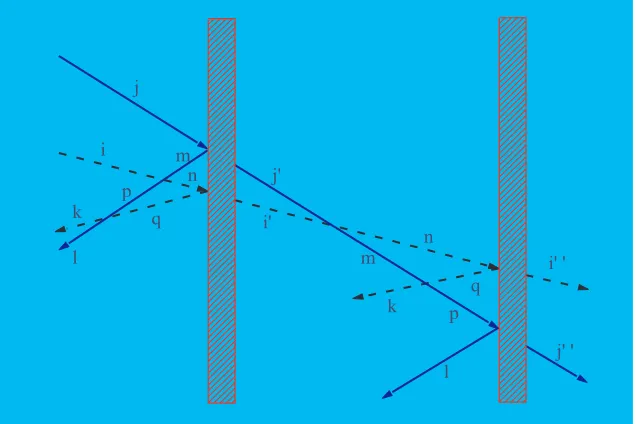
the left defect scattering process), we obtain the defect Yang-Baxter equations by reading off the coefficients from the linear independent asymptotic states of the form
Zi(−θ1)Zj(−θ2)Zα,Zi(−θ1)ZαZj(θ2), Zi(−θ2)ZαZj(θ1) and ZαZj(θ2)Zi(θ1) as
Sijkl(θ12)R
mβ
lα (θ1)S
np
km(ˆθ12)R
tγ
pβ(θ2) = R
lβ
jα(θ2)S
mp
il (ˆθ12)R
kγ
pβ(θ1)Smknt (θ12), (7)
Skl
ij(θ12)Rmβlα (θ1)Skmnp(ˆθ12)Tpβtγ(θ2) = Tjαtβ(θ2)Rnγiβ(θ1), (8)
Sijkl(θ12)T
mβ
lα (θ1)R
pγ
kβ(θ2) = R
lβ
jα(θ2)S
pn
il (ˆθ12)T
mγ
nβ (θ1), (9)
Skl
ij(θ12)T
mβ
lα (θ1)T
pγ
kβ(θ2) = T
lβ
jα(θ2)T
kγ
iβ (θ1)S
pm
kl (θ12). (10)
We abbreviated here the rapidity sum ˆθ12=θ1+θ2 and differenceθ12=θ1−θ2. In the absence of degrees of freedom in the impurity, the first relation (7) was originally obtained in [1, 2], whereas (8)-(10), apart from a few obvious typos in the indices, were first derived in [26]. A systematic investigation with the addition of degrees of freedom in the boundary for the purely reflecting case was initiated in [31]. Note that when multiplying the equation (9) byS(θ21) from the left, it becomes identical to equation (8) upon using the unitarity relation (4) and a subsequent exchange of
[image:5.612.139.457.386.598.2]θ1 and θ2. Thus, we only need to treat three independent equations.
Figure 1: Defect Yang-Baxter equations.
Zj(θ2)ZαZi(θ1) and ZαZj(−θ2)Zi(θ1) leads to
Rkβiα(θ1) ˜Rlγjβ(θ2) = Rkγiβ(θ1) ˜Rlβjα(θ2), (11) ˜
Rqγlβ(θ2)S
lp
kj(ˆθ12)T
kβ
iα (θ1) = S
qp
lk(θ12)T
lγ
iβ(θ1) ˜R
kβ
jα(θ2), (12)
Sst
lq(θ12)R
qγ
pβ(θ1)S
lp
ik(ˆθ12) ˜T
kβ
jα(θ2) = R
sβ
iα(θ1) ˜T
tγ
jβ(θ2), (13)
˜
Tlβqγ(θ2)S
lp
kj(ˆθ12)T
kβ
iα (θ1) = T
pγ
tβ(θ1)S
qt
ik(ˆθ12) ˜T
kβ
jα(θ2). (14)
Clearly the three sets of Yang-Baxter equations (7)-(10), (7)-(10) with R ↔R˜
and T ↔ T˜ and (11)-(14) are not equivalent. In the special case when R = 0 the equation (10) can be turned into (14) by means of the unitarity relation (5). On the other hand, whenT = 0 the equations (11) remain a non-trivial requirement which links the left and right reflection amplitude via the impurity degrees of freedom.
In order to achieve a more concise formulation, let us re-write the defect Yang-Baxter equations in tensor form in the bulk indices. Employing the usual convention (A⊗B)kl
ij =AkiBjl for the tensor product, the three non-equivalent equations in
(7)-(10) take on the form
S(θ12)[I⊗Rβα(θ1)]S(ˆθ12)[I⊗R
γ
β(θ2)] = [I⊗Rβα(θ2)]S(ˆθ12)[I⊗R
γ
β(θ1)]S(θ12), (15)
S(θ12)[I⊗Rβα(θ1)]S(ˆθ12)[I⊗T
γ
β(θ2)] =R
γ
β(θ1)⊗Tαβ(θ2), (16)
S(θ12)[Tαβ(θ2)⊗T
γ
β(θ1)] = [Tαβ(θ1)⊗T
γ
β(θ2)]S(θ12), (17)
whereas (11)-(14) can be equivalently written as
Rβ
α(θ1)⊗R˜
γ
β(θ2) = R
γ
β(θ1)⊗R˜βα(θ2), (18)
[Tαβ(θ2)⊗I]S(ˆθ12)[ ˜R
γ
β(θ1)⊗I]S(θ12) = T
γ
β(θ2)⊗R˜βα(θ1), (19)
[I⊗T˜β
α(θ2)]S(ˆθ12)[I⊗Rγβ(θ1)]S(θ12) = Rβα(θ1)⊗T˜βγ(θ2), (20)
[Tαβ(θ1)⊗I]S(ˆθ12)[ ˜T
γ
β(θ2)⊗I] = [I⊗T˜αβ(θ2)]S(ˆθ12)[I⊗T
γ
β(θ1)]. (21)
Making now the following assumption∗ on the product of R and T in the impurity
∗Similar conclusions can be drawn by presuming
˜ Tβ
α(θ1)⊗R˜γβ(θ2) = ˜Tβγ(θ1)⊗R˜βα(θ2)
from the Yang-Baxter equations (16) withT →T˜,R→R˜. Alternatively, assuming
Tβ
α(θ1)⊗R˜γβ(θ2) =Tβγ(θ1)⊗R˜βα(θ2)
or
˜ Tβ
α(θ1)⊗Rγβ(θ2) = ˜Tβγ(θ1)⊗Rβα(θ2)
degrees of freedom
Tβ
α(θ1)⊗Rβγ(θ2) =Tβγ(θ1)⊗Rβα(θ2). (22)
we can for instance eliminate T(θ) in (16). Taking thereafter θ2 = 0, we obtain
S(θ) I⊗Rβ
α(θ)
S(θ) =Rβ
α(θ)⊗I . (23)
Therefore it follows by relativistic invariance that the scattering matrix has to be rapidity independent, i.e. a constant matrix that is of the form
S(θ)=Pσ , (24) where P is a permutation operator and σ a constant matrix. One may of course reverse the argument and takeσto be a phase with propertiesσijσji= 1, substitute (24) back into (16) and deduce (22). Obviously similar conclusions can be reached when solving (16) for S(ˆθ12) or when considering (19), (20) in the same manner.
In summary: Apart from rapidity independent scattering matrices, simultaneous reflection and transmission in an integrable system with an impurity is always absent when there are no degrees of freedom in the defect. If there are degrees of freedom in the defect, reflection and transmission can only occur for non-diagonal bulk theories when (22) does not hold.
3
Defect bootstrap equations
Besides exploiting the associativity of the ZF-algebra in the above version, the presence of bound states in the bulk theory also leads to powerful constraints. Despite the fact that equation (24) already manifests that S is independent of the rapidity, let us exploit the associativity of the expression which reflects this situation
Za θ+iηb
ac+iε/2
Zb(θ−iηa
bc−iε/2) =iΓcabZc(θ)/ε , (25)
for ε→ 0. As conventional we denote here the three particle vertex on mass-shell by Γc
ab and the real fusing angles by η.
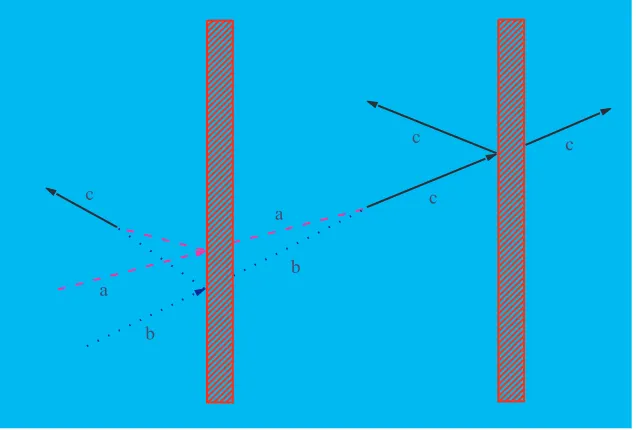
Commuting then in the manner as depicted in figure 2 leads to non-trivial con-straints for the defect scattering matrices. This means scattering the particles a
and b on the defect and fusing afterwards to particle cshould be equivalent to fus-ing first to particle c and scatter thereafter onto the defect. We end up with the following sets of equations
Ra θ+iηbac
Rb(θ−iηabc)Sab(2θ+iη b
ac−iη
a
bc) = Rc(θ), (26)
Ta θ+iηbac
Tb(θ−iηabc) = Tc(θ), (27) Ta θ+iηbac
Rb(θ−iηabc)Sab(θ+iη b
ac−iη
a
bc) = 0, (28)
Ra θ+iηbac
where we suppressed the explicit mentioning of the degrees of freedom of the impu-rity. Obviously we can derive the same equations also for R ↔R˜ andT ↔T˜. It is evident that the equations (26)-(29) only make sense when either T = 0 or R= 0, in which case the reflection bootstrap equation (26) (proposed first in [3]) and the transmission bootstrap (27) (proposed first in [25]) separately become meaning-ful. Hence, we have confirmed in an alternative way a statement which already followed from the previous section, namely: A bulk theory which possesses bound states associated with a diagonal scattering matrix does not allow simultaneously non-vanishing transmission and reflection through a defect. The argument leading to the equations (26)-(29) gives a slightly more intuitive understanding for the ex-clusion of this possibility, since it shows that one produces inevitably terms made up of particles on the left and on the right of the defect which can not be reconciled anymore such that (28) and (29) have to hold. Nonetheless, one should note that equation (24) is more restrictive since it also excludes theories which do not permit fusing at all, such as the sinh-Gordon model, etc.
Figure 2: Defect bootstrap equations.
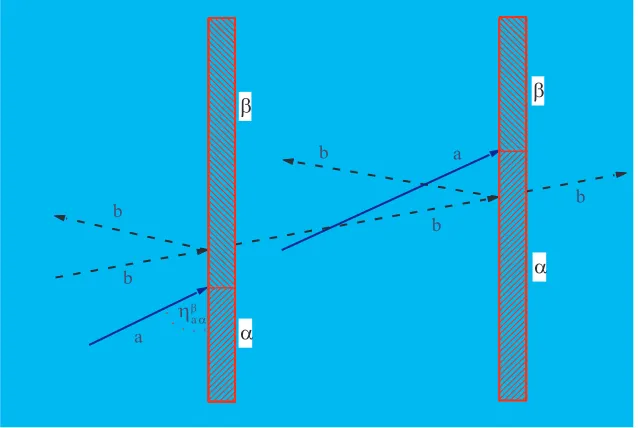
Let us now consider the possibility of impurity excitations and the related boot-strap equations. Having a particle of type a moving at rapidityiηβ
aα might change
the state of the defect from α toβ as
Za iηβaα
Zα →Zβ. (30)
the degrees of freedom of the impurity
Rbβ(θ) = Sab θ−iηβ aα
Sba θ+iηβ aα
Rbα(θ), (31)
Tbβ(θ) = Tbα(θ). (32)
[image:9.612.139.458.353.567.2]It follows trivially from (32) that whenever the transmission is non-vanishing there can not be any excited impurity states. In that case this is compatible with (31), since S is a constant phase which cancels due to the unitarity relation (4). On the other hand, whenever T(θ) is zero, equation (31) should be satisfied and can be used for the construction of new solutions for R(θ). The possible first order poles in R(θ), related to the fusing angles, have to be in the physical sheet, i.e., 0 < Imθ < π, and should be associated with a positive residue [6]. Using these criteria one may find non-trivial closures of the boundary bound state bootstrap equation [6, 9]. Reversing this statement means, of course, that in a consistent solution for R(θ) andT(θ) every pole inside the physical sheet should be related to a negative residue. Let us verify this with explicit examples.
Figure 3: Defect bound state bootstrap equations.
4
The free Fermion with a defect
We consider the complex free Fermion Lagrangian density LF F perturbed with a
defect D(¯ψ, ψ)
Here we denote as usual ¯ψ = ψ†γ0
, where γ0
is one of the gamma matrices, i.e., satisfying the Clifford algebra. For the defect D(¯ψ, ψ) =gψψ¯ the transmission and reflection amplitudes were computed [26, 28] to be
R(θ, B) = R¯(θ,−B) =− isinBcoshθ
sinhθ+isinB , (34)
T(θ, B) = T¯(θ,−B) = cosBsinhθ
sinhθ+isinB . (35)
Since Dirac Fermions are not self-conjugate, we have to distinguish particle and anti-particle. We denote the amplitudes related to the anti-particle by a “bar”. The coupling constant g is parameterized as sinB = −4g/(4 +g2
). For this example parity invariance is preserved, such that R = ˜R and T = ˜T. The fact that
Res
θ→−iBR(θ, B) = Resθ→−iBT(θ, B) =−θRes→iB
¯
R(θ, B) =− Res
θ→iB
¯
T(θ, B) = 2πsinB ,
(36) confirms our previous conclusion, which asserted that there can not be any excited impurity states once reflection and transmission occur simultaneously. Depending on the sign of B, the residues in (36) are either negative or the pole is beyond the physical sheet. Thus, this solution is consistent with regard to the above argumen-tation. This is in contradiction to the statements in [26], where it was argued that excited impurity states do exist.
As the second example we consider the defect D(¯ψ, ψ) =gψγ¯ 0
ψ for which the related transmission and reflection amplitudes follow from [28] as
R(θ, B) = R¯(θ, B) = −isinB
sinh(θ+iB), (37)
T(θ, B) = T¯(θ, B) = sinhθ
sinh(θ+iB). (38)
Also in this example parity invariance is preserved, and we haveR = ˜RandT = ˜T. We compute
Res
θ→−iBR(θ, B) = Resθ→−iBT(θ, B) = 2πsinB , (39)
such that the interpretation is the same as in the previous example and we confirm once more our general statement.
5
Conclusions
scattering matrices. Once T and R are taken simultaneously to be non-vanishing these theories do not admit the possibility of excited impurity bound states. For this to happen in complete generality (22) has to be violated.
Unfortunately so far our main results imply that for the treatment of non-trivial impurity systems one has to leave the realm of integrable systems. It would be in-teresting to construct T and R for some non-diagonal bulk theories, by means of (7)-(10) and (11)-(14) under the violation of (22). For the subset of diagonal bulk theories which remain integrable in this case, the restrictive power of the integrabil-ity framework fails, since apart from crossing and unitarintegrabil-ity we have no constraining equations at our disposal to determine the transmission and reflection amplitudes. It would be interesting to complete the picture for these anyonic theories and seek also solutions for the Federbush type models [32, 33].
Acknowledgments: O.A. C-A. and A.F. are grateful to the Deutsche Forschungs-gemeinschaft (Sfb288) for financial support.
References
[1] I.V. Cherednik, Theor. Math. Phys.61 (1984) 977.
[2] E.K. Sklyanin, J. Math. Phys. A21(1988) 2375.
[3] A. Fring and R. K¨oberle,Nucl. Phys. B421 (1994) 159.
[4] S. Ghoshal and A.B. Zamolodchikov,Int. J. of Mod. Phys.A9(1994) 3841;
Erratum-ibid. A9(1994) 4353.
[5] B-Y. Hou, K-J. Shi, W-L. Yang, Commun. Theor. Phys. 30(1998) 415.
[6] A. Fring and R. K¨oberle,Nucl. Phys.B419 [FS] (1994) 647;Int. J. Mod. Phys.A10
(1995) 739.
[7] R. Sasaki, proceedings of the international conference on the interface between physics and mathematics ed. W. Nahm and J-M. Shen, (World Scientific, 1993, p.201)
[8] E. Corrigan, P.E. Dorey, R.H. Rietdijk and R. Sasaki, Phys. Lett.B333 (1994) 81.
[9] V. Riva, Nucl. Phys.B604 (2001) 511.
[10] G.M. Gandenberger, Nucl. Phys.B542 (1999) 659.
[11] G.W. Delius and G.M. Gandenberger, Nucl. Phys.B554 (1999) 325.
[13] P. Mattsson and P. Dorey, J. Phys.A33(2000) 9065.
[14] Z. Bajnok, L. Palla and G. Takacs, Nucl. Phys.B614 (2001) 405.
[15] Z. Bajnok, L. Palla, G. Takacs and G.Z. Toth, The spectrum of boundary states in sine-Gordon model with integrable boundary conditions hep-th/0106070, accepted for publication in Nucl. Phys.B.
[16] T. Inami, S. Odake and Y-Z. Zhang, Phys. Lett. B359 (1995) 118.
[17] R.I. Nepomechie, Phys. Lett.B509 (2001) 183.
[18] A. De Martino and M. Moriconi, Phys. Lett.B451 (1999) 354.
[19] M. Moriconi and K. Schoutens, Nucl. Phys. B487 (1997) 756.
[20] R.I. Nepomechie, Phys. Lett.B516 (2001) 161;Phys. Lett. B516 (2001) 376.
[21] S. Ghoshal, Phys. Lett.B334 (1994) 363.
[22] M. Moriconi, Nucl. Phys.B619 (2001) 396.
[23] N.J. MacKay and B.J. Short, Boundary scattering, symmetric spaces and the prin-cipal chiral model on the half line, hep-th/0104212.
[24] P. Mosconi, G. Mussardo and V. Riva, Boundary Quantum Field Theories with Infinite Resonance States, hep-th/0107082
[25] R. Konik and A. LeClair, Nucl. Phys. B538 (1999) 587.
[26] G. Delfino, G. Mussardo and P. Simonetti,Phys. Lett.B328(1994) 123;Nucl. Phys. B432 (1994) 518.
[27] R. Konik and A. LeClair, Phys. Rev. B58(1998) 1872.
[28] O.A. Castro-Alvaredo and A. Fring,Unstable particles versus resonances in impurity systems, conductance in quantum wires, cond-mat/0112199.
[29] L.D. Faddeev, Sov. Sci. Rev. Math. Phys. C1(1980) 107; A.B. Zamolodchikov and
Al.B. Zamolodchikov, Ann. of Phys. 120(1979) 253.
[30] M. Kadar and A.N. Berker, Phys. Rev. Lett. 48(1982) 1552; D.A. Huse and M.E.
Fisher, Phys. Rev. B29(1984) 239.
[31] P.P. Kulish and E.K. Sklyanin, J. Math. Phys.A25 (1992) 5963.
[32] P. Federbush, Phys. Rev. 121 (1961) 1247;Prog. Theor. Phys. 26(1961) 148.