Project Document Cover Sheet
Project Information Project Acronym Work-with-IT
Project Title A Study into Evolution of Working Practices
Start Date 18/02/08 End Date 31/12/09
Lead Institution University of Strathclyde
Project Director Dr Diane McDonald
Project Manager & contact details
Dr Diane McDonald
Innovation Manager, Learning Services University of Strathclyde
155 George Street, Glasgow G61 4BN Email: [email protected]
Phone: 0141 548 3530
Partner Institutions None
Project Web URL http://www.work-with-it.org.uk
Programme Name (and number)
Changing staff roles, relationships & associated skills
Programme Manager Myles Danson (Formerly Andy Dyson/Craig Wentworth)
Document Name Document Title Work-with-IT Project Final Report
Reporting Period 18/02/08 – 31/12/09
Author(s) & project role
Diane McDonald, Principle Investigator /Project Manager Donna Cullen, Project Analyst
Date Filename Work-with-IT-finalreport–I-III
URL http://www.work-with-it.org.uk
Access Project and JISC internal ⌧ General dissemination
Document History
Version Date Comments
0.1 20/01/09 Interim draft final report
1 13/03/09 Final report (Phase I)
JISC Final Report
Title Page
Work-with-IT
JISC Study into Evolution of Working Practices
Final Report
Authors:
Dr Diane McDonald, University of Strathclyde
Donna Cullen, University of Strathclyde
Andrew Comrie, Kerson Associates
Archie MacDonald, University of Strathclyde
Contact Person:
Dr Diane McDonald ([email protected])
Date:
Acknowledgements
The Work-with-IT project was funded as part of the JISC ITT for a Study into Evolution of Working Practices commissioned by the JISC Organisational Support (JOS) Committee.
Firstly, the authors would like to acknowledge the contribution from Michael Coen of the University of Strathclyde who provided expert advice on undertaking impact analysis and the staff of the department of Learning Services also within Strathclyde who provided general advice and support.
Secondly, the project team would like to thank the workshop, case study and activity review participants for their contributions. Additionally, the team recognises the time and input of practitioners from a range of HE and FE institutions who provided feedback on the advice and guidance material developed as part of the project.
Thirdly, the project team acknowledges the invaluable support from other JISC projects, programmes and services. In particular, JISC Netskills, the JISC Roles and Competencies project and various participants involved in the earlier JISC Staff Information Skills Set Project were extremely helpful, as were the Scottish and Irish JISC Regional Support Centres.
Fourthly, the HEFCE-funded Flexible Working Project also provided useful insight into the overlap of technology and flexible working and an additional dissemination route for the Work-with-IT project.
Fifthly, the team would like to thank the informal project steering group made up of representatives from UCISA, SCONUL and AUA as well as JISC and FE representatives for their advice and guidance.
Executive Summary
Technology is increasingly being used to underpin business processes across teaching and learning, research, knowledge exchange and business support activities in both HE and FE. The introduction of technology has a significant impact on the working practices of staff, often requiring them to work in a radically different way. Change in any situation can be unsettling and problematic and, where not effectively managed, can lead to poor service or functionality and disenfranchised staff. These issues can have a direct impact on institutional effectiveness, reputation and the resulting student experience. The Work-with-IT project, based at the University of Strathclyde, sought to examine changes to working practices across HE and FE, the impact on staff roles and relationships and the new skills sets that are required to meet these changes.
The initial one-year project (phase I), commissioned in 2008, examined the effect of technology on working practices and staff attitudes and the resulting impact on staff roles and responsibilities. JISC then commissioned phase II of Work-with-IT in 2009 to examine changing staff roles and responsibilities from a wider perspective through exploration of the remaining PES(T)LE dimensions – political, economic, social, legal and environmental. Finally, since at the time of commissioning of phase I, the use of Web 2.0 technologies within FE and HE was still in its infancy and as a result it was too early to analyse the effect of Web 2.0 technologies on the evolution of working practices, a third and final phase was commissioned in October 2009 to investigate the effect that Web 2.0 technologies are having on the evolution of working practices and staff attitudes, and the resulting impact on staff roles and responsibilities across FE and HE.
As the Work-with-IT project was concerned with the impact of technology on staff, the overall methodological approach was based on that of complex socio-technical systems. Phase I explored the effect of technology on changing working practices and their impact on staff through desk research, consultative workshops and a series of ten case studies which explored innovative approaches to technology-enhanced working across a range of HE and FE institutions. The workshops were used to generate an overall picture of the types of changes that are occurring and the resultant impact on staff. The case studies, which were undertaken directly by the institutions and focused on personal experiences, produced a series of vignettes where individuals considered the impact of the change. This was complemented by an analysis of the impact of the technology-enhanced working practice on the institution and its staff development needs. The final step in phase I was the development of Advice and Guidance material aimed at staff development professionals and change managers within institutions. Phase II then used PESTLE and scenario exploration workshops to explore how working practices, staff roles and responsibilities might evolve over the next five years. The original case studies were also revisited to explore how they might evolve. In phase III, activity reviews were used to investigate the effect that Web 2.0 technologies are having on staff and their impact on roles and responsibilities.
technology-enhanced working practices are in general positive, with a prevailing view of technology as ‘enabling’ although dichotomous reactions to the same change were expressed by different individuals. Evolution of roles was also found with development of hybrid roles and local experts. Staff relationships are also undergoing significant change as individuals increasingly work in collaborative teams and participate in wider Communities of Practice. Significant changes to the skills required to work effectively in the new technology-enhanced environments can also be identified. These are broadly categorised into skills for coping with change, social and relationship skills, learning skills and IT-related skills.
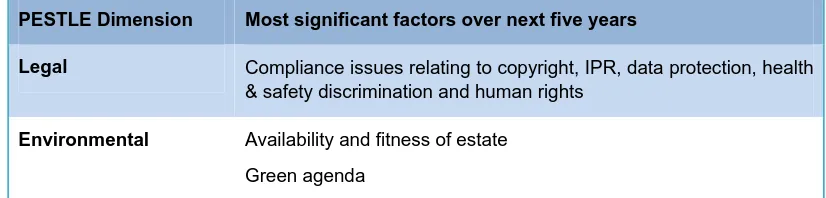
Look to the future, phase II identified a wide variety of factors are likely to affect the sector over the next five years. Economic factors are viewed as the most dominant overall with the current recession and resultant reduction in funding and increase in demand being the primary influences. From a political perspective, the potential change in government introduces a significant uncertainty as this may change government and funding council policies pertaining to funding, lifelong learning, research and knowledge exchange amongst others. Social factors, especially student and staff expectations and changing demographics, are also expected significantly to affect future HE and FE provision. From a technological perspective, new working practices will primarily be driven by the availability of technological solutions along with evolving Web 2.0 practices. Legal and regulatory compliance relating to copyright, IPR, data protection, health & safety discrimination and human rights will continue to impact working practices. Finally, availability and fitness of estate and the need to reduce carbon emissions are likely to be the most significant environmental factors. Over the next five years, these PESTLE factors are likely to lead to four general trends within the sector relating to institutional strategies and ethos– lean thinking, flexible learning, risk management and collaboration & sharing. Individual working practices will evolve depending on institutional strategies and ethos and the general working practices trends – life without borders, the electronic office, technology-enhanced delivery, digital students, and changing loci of control and relationships.
Finally, inexperienced staff can quickly get left behind potentially creating a novice-expert Web 2.0 divide.
The project concluded that, where the introduction of technology-enhanced working practices is well managed, it brings benefit to both institutions and the individual staff involved. Change is increasingly the norm and this will continue into the foreseeable future. Increased bottom-up adoption of Web 2.0 technologies is identified as potentially bringing significant change in the near future and may challenge existing processes, policies and cultures. There are however some key areas of concern.
Five key areas are identified where change is required if institutions are to effectively embrace and embed technology-enhanced working practices. (1) A more holistic approach needs to be adopted, where institutions ensure that organisational structures support timely revision and linkage to strategies, an understanding of the complexity of issues at the highest level and strategic leadership which empowers and encourages staff to evolve their working practices in line with strategy. (2) Human resources (HR) policies, procedures and practices need to be updated to effectively support and develop evolving staff roles. Without this, institutions will be unable to effectively capitalise on the opportunities afforded by emerging technologies or be sufficiently agile to respond to changing PESLE factors in a timely and effective manner. (3) While staff development is in general effective when it comes to ‘hard’ aspects such as how to use particular technologies, significant work is required to support development of ‘soft’ skills such as relationship management, boundary management, and understanding the potential and impact of technologies. (4) A more holistic approach to change management needs to be adopted which involves key institutional functions such as staff development, HR, IT services and change management from the outset of development projects. (5) Horizon scanning needs to be embedded in institutional processes and procedures if institutions are to be successful in the ever evolving environment.
Table of Contents
1 Background and Overview ... 9
1.1 Background ... 9
1.2 Aims and Objectives ... 11
1.3 The approach adopted ... 13
1.4 Scope and content of the report ... 14
2 Exploring technology-enhanced changes to working practices ... 16
2.1 Changes to technology-enhanced working practices ... 18
2.2 Changing roles and relationships ... 27
2.3 Skills requirements ... 30
3 The Phase I Case Studies ... 32
3.1 Digital Fluency – Sheffield Hallam University ... 35
3.2 eMentors – Oaklands College ... 36
3.3 Enhanced Vocational Training at Work – West Lothian College ... 37
3.4 e-Research – King’s College London ... 37
3.5 Location Independent Working (LIW) – Coventry University Enterprises Ltd. .. 38
3.6 Online Course Delivery in a Disperse Environment – UHI Millennium Institute 38 3.7 Paperless Admissions – Coventry University ... 39
3.8 Part-time Working & Technology – Open University ... 40
3.9 Knowledge Exchange across Rural Boarders – NationalRural Knowledge Exchange ... 40
3.10 Regional Management Information Systems ... 41
4 Advice and Guidance ... 42
4.1 Recommendations for Skills Development ... 42
4.1.1 Coping with change ... 44
4.1.2 Social and relationship skills ... 44
4.1.3 IT-Related Skills and Training ... 45
4.2 Effective practice recommendations ... 48
5 Exploring the evolution of technology-enhanced working practices ... 50
5.1 PES(T)LE factors ... 50
5.3 Reflections of the PESTLE analysis ... 69
6 The effect of Web 2.0 ... 74
6.1 Changing working practices ... 75
6.2 Changing roles, responsibilities and relationships ... 80
6.3 Skills and Competencies ... 84
6.4 Drivers and constraints ... 86
6.5 Potential future use and impact ... 90
6.6 Reflections on the effect of Web 2.0 technologies ... 92
7 Conclusions, implications and recommendations ... 98
7.1 Conclusions ... 99
7.1.1 Current trends in technology-enhanced working ... 99
7.1.2 Working in a Web 2.0 world ... 99
7.1.3 The future: drivers and institutional trends ... 100
7.1.4 Evolution of staff roles and responsibilities ... 100
7.1.5 Critical success factors ... 101
7.1.6 Key areas where change is required ... 101
7.1.7 Timeliness and relevance of the Work-with-IT study ... 102
7.2 Summary of main implications of the evolution of working practices ... 102
7.2.1 For Staff ... 102
7.2.2 For Institutions / Senior Management ... 103
7.2.3 For change managers ... 104
7.2.4 For staff developers and HR managers ... 105
7.3 Recommendations ... 106
7.3.1 Key areas where change is required ... 106
7.3.2 Areas of additional work ... 107
7.3.3 Embedding, support and dissemination ... 109
1
Background
and
Overview
1.1 Background
Over the past 20+ years technology has spread into almost every corner of life within HE and FE - from a computer on every desktop through virtual learning environments (VLEs), electronic databases and reference libraries to electronic admission, registration and fees payment. Despite the extent of this reach, the ever-increasing processor power, miniaturisation and frequency of new generations of software mean that technological change is increasingly the steady state of our working lives.
These new technologies offer the potential to enhance the delivery of the business functions of education, research, knowledge exchange, libraries and IT services and administration found within HE and FE1 through, for example, enhanced student-focussed services, sharing of global research resources, improved access to Intellectual Property Rights (IPR) and increased efficiency. The introduction of such technology-enhanced services and business processes significantly impacts upon the working practices of staff who deliver these services as their day-to-day working practices, internal relationships and indeed roles, may change. Unless these staff members are supported through the sometimes radical changes required of them, the effective exploitation of new technology-enhanced business processes and capabilities will not necessarily follow.
As the JISC infoNet Toolkit on Change Management [10] acknowledges, change within an organisation occurs within a complex system, driven by internal dynamics arising from the interaction between culture, processes and people. Add to this the influence of external environmental factors such as economic drivers, student numbers or legal requirements, and it makes change highly unpredictable and difficult to manage. Technological-driven change is no exception. Failure to appreciate that there are additional consequences for a new VLE or central institutional records management system, other than simply a change in processes and the need for skills updates, often leads to unpredicted issues such as loss of job satisfaction, lack of confidence or distrust in a now centrally provided information or service.
Given these significant changes and potential issues, the JISC Organisational Support (JOS) committee identified the need for more accurate and up to date information regarding changing staff roles, relationships and associated skills which have been brought about by these new technologies. In their ITT, JISC identified three key questions that need to be addressed in order to support institutions in their effective exploitation of new technology.
1. How has the adoption of new technologies and practices brought about changes within institutional workforces, and how have these changes affected staff attitudes towards their work and also the student experience?
1
2. How have staff roles, relationships and working practices adapted to accommodate these changes?
3. What new sets of skills are required in order to work in new ways that exploit the benefits (or overcome barriers) afforded by new technology environments?
Some relevant work had already been undertaken through previous JISC funded projects. The impact and effects associated with eLearning were perhaps most widely explored through JISC studies of the X4L, e-Learning Pedagogy and e-Learning Capital Programmes, which consider the effect on the student body and learning experiences (e.g. CAMEL Tangible benefits of e-Learning Project) and on academics (e.g. Reflections from SURF X4L). The studies and anecdotal evidence illustrate that, in addition to radically changing the learner experience and creating new roles such as Learning Technologists and Repository Managers, there have also been other significant effects on staff. For example, a member of staff’s role may change from expert to learner in relation to the technology involved in that role, leading to a perceived loss of face and reluctance to seek help, or the 24x7 availability of the web may lead to an expectation by students that out of hours replies and constant VLE access will be readily available, neither of which can be guaranteed given institutional resources and cultures.
Other areas relating to technology-enhanced change were less well understood. Anecdotal examples of the issues that have arisen in other business areas are briefly reviewed below to highlight the types of factors that the Work-with-IT study needed to consider in order to answer the study questions.
New technology affords changes to existing processes, often designed to increase efficiency or to tighten up on legal or regulatory requirements. For example, there is a move towards combining Human Resources (HR) and payroll databases to minimise data input and reconcile multiple data holdings, which results in staff from multiple departments being involved in the process flow. This has an impact beyond simply changing how HR data is accessed and processed; distrust may arise due to perceived cultural differences within departments. For example payroll staff, traditionally responsible for the input of personal payroll details, may not regard HR staff as being rigorous enough to ensure the provenance of the data. Further, the new workflow, although tightening up on lax administrative procedures, may result in a reduction in flexibility and discretion. For example, the allocation of computer accounts may also be tied to the HR database, so while a new member of staff may start immediately following formal acceptance of a job offer, a computer account cannot be allocated until all the necessary information is in the HR system and then picked up by IT staff. This can lead to frustration both for the new member of staff and the IT administrator who, despite being supplied with a letter of appointment, cannot actually allocate an account. Thus, in this example the implications of change extend beyond the staff directly involved in maintaining the HR database.
lowering the standards both of literature searches and the librarian’s service, which traditionally provided job satisfaction through the ‘hunt’ for materials and resources. However, for others new opportunities arise. The traditional role of catalogue librarian is changing, although it remains central and critical to the successful delivery of information services. For example, cataloguing (or application of metadata) is increasingly undertaken within new environments such as the institutional repository. Further, there is anecdotal evidence that the increasing technological environment is also leading to pastoral provision by librarians. For example, staff or students may approach librarians with information problems that are in fact indicative of serious issues arising from a lack of technology literacy. In such cases librarians may take on a duty of care, mediating and arranging academic support.
The JISC Location Independent Working Project provides one illustration of the time- and location-independent working arrangements that technology affords. While such working patterns may appear to offer considerable benefits in terms of improvement to work-life balance by removing long commutes, the gradual eroding of the distinction between work and non-work time due to constant availability may instead lead to increased stress. Further, institutional health and safety procedures must be extended to consider the home environment. While technology affords the opportunity for such flexible working, as the HFECE Flexible Employment Options Project [11] examines, the impact extends beyond individual staff, requiring institutions to examine staff employment and development, and associated policy implications.
Technology is also having an impact in unexpected areas. For example, to increase future efficiency, some organisations are digitally scanning all documents, creating new administrative assistant jobs – brand new roles. Staff with manual jobs increasingly have to order parts or manage their work allocation online. This almost mandatory requirement for information literacy skills is particularly disadvantageous to older workers, especially those returning to work after a career break.
Finally, the advent of Web 2.0 technologies potentially poses significant challenges. While such technologies allow individual staff and students to be innovative and agile, they circumvent traditional support structures. The impact on traditional IT roles as well as institutional support structures and quality control is potentially far reaching.
The preceding examples highlight that the support required for staff is more than just to facilitate development of information literacy2. Means of supporting staff in changing roles and relationships, in managing expectations and in change itself also needs to be addressed.
1.2 Aims and Objectives
The overall aim of the Work-with-IT project was to gather up to date information on changing staff roles, relationships and associated skills brought about by the impact of the adoption of
2
See the outputs of the JISC Staff Information Skills Set Project
new technologies within UK HE and FE. The focus was not on information skills or skills for harnessing technology per se, but rather on the impact that these new ways of working, arising from adopting ICT and technology-supported practices, are having on staff.
The project which ran from February 2008 until December 2009 consisted of three phases.
Phase I
The primary objective of Phase I was to explore the impact of technological change on working practices and roles in UK HE and FE and to investigate how individuals may need to adapt to fully exploit new business processes and capabilities. Specific Phase I objectives were:
• To assess the impact and effect that new ways of technology-enhanced working have had on staff in UK HE and FE institutions through:
o a series of facilitated consultation workshops with key stakeholders;
o focussed consultancy work to address issues arising from the consultation workshops;
• To develop a series of case studies based in UK HE and FE to illustrate new working practices, their impacts and staff development implications; this will provide a body of evidence on the effect and impact of changing working practices which will help inform future JISC work to support institutions in effectively managing changing roles and responsibilities;
• To provide advice and guidance for the UK HE and FE managers involved in staff development and/or change management, based on a synthesis of workshop and case study findings;
• To develop recommendations for new approaches to staff development strategies that take into account the new skills, competencies and relationships required to exploit the benefits that new technology-enhanced ways of working may provide.
Phase II
Technology is but just one of the PESTLE dimensions – Political, Economic, Social, Technological, Legal and Environmental – which affect institutions and their working practices.The aim of Phase II was therefore to gain an understanding of the broader context of change within which technology constitutes one dimension, eliciting information from wider scenarios (with a broader range of factors and influences) that drive the evolution of working practices and the changing nature of staff roles and responsibilities. Specific Phase II objectives were:
• To undertake desk research to identify key PESTLE factors and influences, and existing work relevant to HE and FE in this area;
• To revisit the Work-with-IT case studies to analyse their changing working practices and the impact on staff roles and responsibilities with respect to the PESTLE factors;
• To produce a report on changing staff roles and responsibilities within HE and FE.
Phase III
At the time of commissioning Phase I in early 2008, the use of Web 2.0 technologies within HE and FE was still in its infancy and, as a result, it was too early to analyse the effect of Web 2.0 technologies on the evolution of working practices. By mid 2009, there was significantly more experience within the sector. The aim of Phase III, commissioned in October 2009, was therefore to investigate the effect of Web 2.0 technologies on the evolution of working practices and staff attitudes, and the resulting impact on staff roles and responsibilities across HE and FE. Specific Phase III objectives were
• To undertake desk research to identify existing work relevant to HE and FE in this area; • To undertake a series of interviews with key stakeholders – projects, institutions and
relevant experts to explore (a) the impact that Web 2.0 technologies are having on working practices and staff roles and responsibilities across HE and FE and (b) how this might evolve in the short to medium term;
• To integrate the findings of the research into the overall Work-with-IT report on the evolution of working practices.
1.3 The approach adopted
As the Work-with-IT project was concerned with the impact of technology on staff, the overall methodological approach was based on that of complex socio-technical systems. Such an approach was required because, as discussed in subsection 1.1, change within educational institutions is complex in nature, where the impact of new technology combines with business drivers, culture and environmental factors in a non-linear manner, making the consequences of change potentially unpredictable and difficult to understand or plan for. By examining technology-enhanced changes from a socio-technical perspective, such interdependencies are made more explicit and different potential effects on staff can be examined.
The Work-with-IT project focussed on addressing the three key research questions:
1. How has the adoption of new technologies and practices brought about changes within institutional workforces, and how have these changes affected staff attitudes towards their work and also the student experience?
2. How have staff roles, relationships and working practices adapted to accommodate these changes?
The specific approach adopted varied in each phase.
Phase I consisted of four activities. Firstly, desk-based research was undertaken to (i) identify relevant resources and experts pertaining to technology-enhanced working practices and (ii) establish a wide network of contacts who could feed into the project and to whom the results would be disseminated. Web searches, word of mouth recommendations and telephone interviews provided useful background information and genuine insight into personal experiences across the sector. Secondly, workshops and consultation exercises were undertaken to explore the three key research questions. Participants were sought using the network of contacts developed within the orientation phase. Best effort was made to ensure participation across institutional types, roles and geographical coverage, while trying to ensure that key stakeholders and representatives of innovative examples of technology-enhanced working practices attended. Issues that arose were followed up by phone calls or email conversations with relevant individuals. The third activity consisted of ten in-depth case studies designed to draw out current practice and challenges associated with technology-enhanced working from a staff perspective. These case studies focused on the personal stories of individual staff and analysis of the institutional impact of the technology-enhanced changes. The final phase I activity was to develop advice and guidance material from the synthesis of workshop and case study findings. Peer review was used to ensure fitness for purpose.
In Phase II the original ten Work-with-IT case studies were revisited to help explore the non-technological PESTLE factors associated with changing working practices and how these factors might influence the evolution of working practices, staff roles and responsibilities. A two-pronged approach was adopted: (i) investigation of the role that PESTLE factors played in the evolution of innovative working practices within the case studies; and (ii) exploration of how PESTLE factors could potentially influence working practices and roles over the next five years. This was undertaken using a ‘scenarios’ workshop and a series of semi-structured interviews with the individual case studies.
In the final phase, desk research and a series of activity interviews with key stakeholders – projects, institutions and relevant experts – were conducted to explore the impact that Web 2.0 technologies are having on working practices and staff roles and responsibilities, the skills required to embrace changing working practices; and drivers for uptake of Web 2.0. As Web 2.0 technologies and their use are continuing to evolve, this was followed by an impact analysis which considered the potential uses and future impact of Web 2.0 technologies on HE and FE in the short to medium term.
As the project progressed through its various phases, the overall validity of findings was verified by distributing interim results for comment to participating practitioners and representatives of key stakeholder organisations.
1.4 Scope and content of the report
case studies, PESTLE investigation, activity reviews and ‘Technology-enhanced working: Advice and Guidance for Staff Development and Change Managers’ report, all published in detail on the project website http://www.work-with-it.org.uk. It is recommended that this more detailed material is also explored as this contains detailed examples and further supporting evidence for our conclusions regarding technology-enhanced changes to working practices and its impact on staff, roles and responsibilities.
2 Exploring
technology-enhanced
changes to working practices
The extent, pace and complexities associated with technology-enhanced changes to working practices can make understanding both the potential and the impact of such changes difficult. While the Work-with-IT project was primarily concerned with staff, the effect of the new working practices on staff derives not only from the technology itself but also from changing business aims and objectives. The project therefore used a three component framework – staff, technology and business drivers – to explore technology-enhanced changes to working practices from a socio-technical perspective.
The exploration phase consisted of desk-based research followed by two consultative workshops – one in Birmingham, the other in Glasgow, to ensure representative geographical coverage. Each workshop had 18 participants who were selected on the basis of role, institution and involvement with innovative working practices. This ensured a broad but well-focussed data sample. The workshops proved highly popular and successful, with both workshops being oversubscribed. However, difficulty was experienced in encouraging sufficient FE participation in the Birmingham event. As the emphasis of the workshops was on consultation and information gathering, a facilitated open approach was adopted. Further details of the approach used can be found in the workshop report [12].
While a third workshop had been initially anticipated, after discussion with the JISC programme manager, it was agreed that it would be more beneficial to JISC’s overall aims and objectives in the field of ‘Roles and Responsibilities’ if the project team were to participate in two other related JISC projects’ workshops to ensure that there was a sharing of emerging findings and a cross-fertilisation of ideas. The first was the ‘Roles Workshop’ of the JISC-funded ‘Roles and Competencies Landscape Study’ project [13]. This workshop was concerned with exploring the modelling of roles found in HE. The second workshop was a Scenario Planning Event on ‘Future Roles, Responsibilities & Working Practices in the Education Sector’ led by JISC Netskills [14]. The main objective of this latter workshop was to explore potential future scenarios and much of the baseline work was based on the findings from the two Work-with-IT consultation workshops.
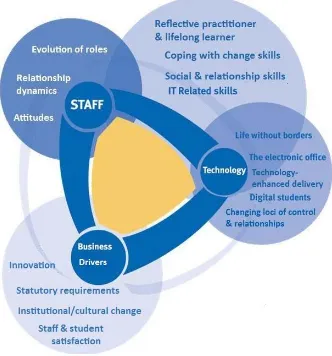
The desk research and workshops led to the synthesis of a more detailed framework for exploring technology-enhanced changes to working practices which is presented in Figure 1
Figure 1: Technology-enhanced changes to working practices framework
The circle to the right captures the key changes to technology-enhanced working practices that were identified. The top left circle represents the direct effects on staff and the top right circle represents the key skills demanded of effective technology-enhanced working. These three large circles then correspond to the three research questions relating to technology-enhanced working identified in section 1. The final large circle to the bottom left represents the business drivers considered in Phase I.
2.1 Changes to technology-enhanced working practices
The overall impression is that technology-driven change is increasingly becoming the norm. This constant change causes concern in three areas. Firstly, if change is ineffectively managed, a long-lasting effect on staff attitudes towards both the particular innovation and technology in general emerges. Secondly, the pace of change is of concern. Thirdly, there is a worry that technology is driving change without proper alignment with strategic business objectives. Two reasons can be identified for this mismatch with strategic business objectives. Firstly, technology may be inappropriately employed by managers to drive change. While as Duke et al’s [15] JISC study into the integration of technology into institutional strategies argues that technology can have a transformational role, the concern expressed by participants is that it is employed to drive change without a proper understanding of how this can actually be achieved. This links with Duke et al’s findings that lack of technology literacy within the Senior Management Team of an institution leads to a fundamental lack of understanding regarding how technology may be effectively employed to aid transformation or as a strategic enabler. Secondly, the increase in adoption of Web 2.0 technologies is driving change from the bottom-up. Good practice suggests that strategies should be cascaded so that there is an onus on individual staff and departments to ensure that their activities conform to a departmental business strategy, which is strongly aligned with that of the institution. However, such bottom-up approaches may conflict with institutional ICT strategies which have been developed to ensure cost effective core services and minimise duplication. If such problems are to be avoided then one solution might be to follow Duke et al’s advice that technology be fully integrated within individual business strategies rather than as a separate ICT strategy. Unfortunately, Duke et al find little evidence that this is happening in academia.
The need to look at technology holistically was highlighted. This does not simply imply adopting an enterprise architecture approach for strategic service developments; rather, how technology developments will affect working practices and staff attitudes and how this might necessitate changes in organisational structure, support and culture all need to be considered from the outset. This suggests that a fundamental review of how institutions view technology and staff is required. This is envisioned as a staff-focused perspective akin to the recent ‘changing the student experience’ initiatives.
Overall, workshop and case study participants reported a positive attitude to technology-enhanced working practices. As the case study examples below demonstrate there is a strong view that technology is enabling:
Paul Fairburn, Senior Bus. Development Manager, Location Independent Working, Coventry University Enterprises Ltd.
Location independent Working (LIW) has helped Paul to develop new external working relationships. For example, when initially working LIW, he had a base off-site at the NHS in Coventry, which enabled excellent networks to be established as his presence there helped clients develop a relationship of trust. Ultimately this led to the development and securing of research contracts for the University.
Charlotte Roueché, Professor, E-Research, King’s College London
“Completely transformed my way of teaching [...] and I think that was transforming the way I was thinking as well.”
Louise, Assessor, Enhancing Vocational Training, West Lothian College
Louise is able to utilise her time more effectively and is able to adapt her working practices to the needs of her candidates.
However, scepticism, concern over change itself, changing norms and expectations, frustration relating to the ability of either the technology itself or of the skills required to effectively use it, and increased stress regarding 24x7 contactability were all in evidence. Having an innovation champion in a department or extended team who is prepared to bring new technologies to the attention of staff by embedding them in a project or a business process of immediate concern (‘a burning platform’) may help reduce scepticism.
Interestingly, almost dichotomous reactions of staff within the same department to technology-driven changes were reported – ‘winners and losers’, ‘enabling and drowning’, ‘liberating and threatening’, ‘empowered and coerced’. While this may be down to personal outlook – ‘the pot half empty’ versus ‘the pot half full’ – appropriate change management and training could do much to reduce the negative impact. This should take into account the range of staff experience and attitudes, the aim being to help staff feel empowered rather than coerced.
(i) Life without borders3
One of the biggest impacts of new communication technologies is the dissolution of traditional work boundaries – for many, daily working life is no longer restricted to 9-5 office hours or to the physical campus.
The 24x7 communication network is viewed both positively and negatively. On the one hand, it offers more ‘student-focussed’ learning since it enables students to seek help as the need arises and also fits around the reality of students as part-time workers. While this flexibility is clearly advantageous, concerns were raised about its effect on students as independent learners. For example, lecturers report that students simply send an email requesting help rather than first spending time working on the problem themselves. This suggests that further thought needs to be put into pedagogical design to strongly encourage independent learners. For example, the Scottish Funding Council sponsored the REAP project which redesigned a first year psychology course to use a peer scaffolded design where monitored peer feedback supports large student numbers [16].
Academics also report a feeling of being pressurised to respond in real time. This arises not only from perceived student expectations of an ‘instant’ reply, but also, in some instances at least, from a department’s culture as some staff feel they have to be seen to be available out of hours by their peers. Techniques for minimising stress and developing positive and effective cultures will be required.
The encroachment on leisure time is not purely an academic problem. Some professional staff view 24x7 availability positively, enabling them to keep on top of their jobs while others manage such encroachment by not having a PC at home. Being able to establish a comfortable work-life balance is clearly an issue across different categories of staff, but how this is achieved needs to be tuned to individual needs.
Location independent working (LIW) is a more recent trend, which has developed, in part at least, in response to work-life balance issues, with space saving also being a significant driver. Coventry University, the Open University, UHI Millennium Institute and Telford College provide interesting insight in this area, although implementations and experiences vary in each case.
3
Case Study examples are illustrative of these particular trends however many also cut across all of the trends outlined.
Case Study Examples:
Location Independent Working: Coventry University Enterprises Ltd. http://ewds.strath.ac.uk/work-with-it/CaseStudies/LocationIndependentWorking.aspx
Part-Time Working & Technology: Open University
Successful LIW initiatives generally tend to provide work areas with a very high specification as an incentive to encourage staff to move from individual offices to ‘hot-desking’. While workshop participants reported that these spaces are viewed very positively, further discussion with the Scottish Funding Council-funded ‘Effective Spaces for Working in Higher and Further Education’ project [17] indicated significant negative feedback from staff in at least one institution. How the home office is financed and supported also varies. This in large measure depends on the size of the organisation. For example, while Coventry University Enterprises Ltd.provides initial off-site support visits, such service approaches simply cannot be scaled to organisations like the OU who employ 8000 part-time tutors working from home. However, this can lead to frustration and a feeling of unfair treatment for the individual members of staff involved.
The extent of LIW varies. Some institutions and organisations allow staff to be on site only for specific meetings or course delivery, while others insist on 2-3 days per week. Interestingly, examples are found across all categories of staff. For example, despite the common perception that administrative staff must be office bound, at Coventry University Enterprises Ltd. some PAs work at home, reportedly without causing dissatisfaction amongst the staff they support. On the other hand, there is anecdotal evidence that administrative staff are not permitted to work from home due to lack of trust. This leads to a significant level of dissatisfaction as the administrative staff involved claim to be more productive at home due to the ability to avoid interruptions to carry out mundane tasks like ad hoc photocopying for academics.
While staff generally report an improved work-life balance, a perceived increased pressure to respond immediately is often felt, as staff do not want those in the office to think they are ‘slacking’. However, as the case study vignettes illustrate this disappears over time as staff on campus and at home become more comfortable with the working practice. Better initial management of the introduction of working from home to bring everyone on board could minimise the period of adjustment. Training on appropriate tools and working practices will also help reduce the misuse of email and will empower people to have the confidence to act independently. It is also suggested that the lack of instant access to others leads to better time management and encourages reflective practice.
(ii) The electronic office
Technology has completely changed the way traditional ‘office’ functions are carried out. To a large extent much of the traditional role of office administration has disappeared, with
Case Study Examples:
Paperless Admissions: Coventry University
http://ewds.strath.ac.uk/work-with-it/CaseStudies/PaperlessAdmissions.aspx
Regional Management Information Systems: North West Regional College
individual members of staff responsible for their own letter writing, photocopying, meeting scheduling and student administration. This has led to a reduction in traditional central administrative staff roles and a realignment of duties within departments where administrative staff are asked to take on more complex tasks as more basic administrative functions are carried out by managers and academics.
While the freedom from reliance on others could be viewed as liberating and enabling personal control, in general, administrative, academic and professional staff do not view this change in a positive light. For academic and professional staff self-service administration is viewed as an intrusion, increasing time pressure and information overload. While better time and information management skills could go some way to addressing this, there is still a fundamental issue as to whether some of the redistributed administrative tasks makes for efficient use of academic and professional staff’s time. There is also a worry concerning duplication of effort, with departmental and central administrative staff potentially carrying out similar tasks.
For administrative staff, these changes are equally problematic as they increase tension with other staff. For example, administrative staff may be viewed as unhelpful when they try to implement departmental policies of self-service administration. The changes also lead to a feeling by some that administrative jobs are at risk and create a worry about reallocation of duties and changes in roles. For example, administrative staff are being asked to move out of their comfort zone, taking on new tasks which often require up-skilling. Even where training support is provided, up-skilling as opposed to re-skilling is in some cases viewed as too pressurised while in other cases it is seen as a welcome opportunity. These changes in working practices are often not formalised, leading to uncertainty of the value of a role or of the tasks involved.
There appears to be evidence that a counter-trend is emerging, moving student administration tasks back to administrative staff.
The ‘paperless’ office is another significant technology-driven change. At its most basic this constitutes electronic memos and online service requests. While this has been advocated for several years within the academic sector and in business, whether it has actually been achieved is debatable. For example, some staff print out their emails before reading. So while technology has provided a means to change working practice, this may still be circumvented by some users, preferring to maintain old ways of working. Staff Intranets are a key development in the paperless office movement. The availability of online resources enables a more flexible, distributed workforce. However the ease of access and update of electronically available information has reduced shelf-life, illustrating the dangers involved in retaining pre-technology working practices such as use of paper copies.
and contented staff has been the inclusion of appropriate staff development and motivation from the outset.
The Coventry case sparked an interesting discussion regarding the ethics of fully automated admissions and the extent to which there should be human involvement in the decision process relating to applicants’ education opportunities. In this case, whilst many traditionally manual clerical/admin activities (e.g. sorting forms into categories) have been automated, Coventry still feels that it is important to have a human-being assess applications and make final decisions.
Information overload is also a significant issue, leading to staff feeling pressurised.
This delegation of basic IT functions to individual desktops is having a knock-on effect on IT professionals, who may feel devalued as other staff become more “enabled” or “digitally fluent”. An increased expectation upon staff to respond promptly to user needs and requests and to explain their decisions is leading to a pressurised feeling which is compounded by a worry that in time they will no longer be seen as "specialists".
(iii) Technology Enhanced Delivery
In recent years technology has had significant impact on how learning is delivered and supported.
A new push towards technology-enhanced learning is in evidence. Despite the rhetoric regarding pedagogy-led as opposed to technology-led learning, there is disquiet regarding theexpectation that VLEs or other innovative technology be used. Even in older institutions such as the Universities of Manchester and Edinburgh, which have previously marketed themselves through academic reputation, technology-based delivery is now seen as essential to competing effectively for the student market. These strategic moves often result in a tension between centralised and decentralised provision and support.
Strategies, it was suggested, often do not keep abreast of technological implementations causing much frustration. For example, strategies may emphasise research to the apparent detriment of technology-enhanced learning. And while the use of a VLE is often viewed as almost compulsory, staff are still assessed on old measures such as face-to-face contact hours. Academics also feel frustrated and under-valued that management does not
Case Study Examples:
e-Research, King’s College London
http://ewds.strath.ac.uk/work-with-it/CaseStudies/EResearch.aspx
On-line course delivery in a dispersed environment, UHI Millennium Institute
recognise the increased time needed to develop online learning. Similarly, there is a feeling that research is often valued more than technology-enhanced learning innovation.
That said, academics in general feel very positive and enthusiastic about the benefits technology brings to the student learning experience. For example, technology can enable team- and problem-based learning, provide high quality resources from a global repository and actively engage students. Thus, technology may be viewed as a tool for improving the value of teaching and learning and as a means of raising the professionalism of ‘teaching’.
Global information availability has radically changed library services. A reduction in demand for traditional librarian information-seeking skills has led to a feeling of down-skilling. On the other hand, many librarians are extending their skills and are now actively involved in teaching information skills within the classroom. As discussed in section 1, anecdotal evidence suggests that this, on occasion, extends to the provision of pastoral care and acting as a trusted intermediary between student and academic.
Global information availability has also reduced the need to visit the library. However, adaptation of library spaces such as the Saltire Centre at Glasgow Caledonian University to act as a one-stop shop for students which combines services with noisy team-working and extensive PC provision has led to a reversal of the trend. Additionally, emerging services where the library delivers high quality information resources directly to the desktop through either VLEs or specialised search engines are viewed as exciting opportunities to improve the quality of learning materials by both academics and librarians alike.
Poor change management is at the heart of many technology issues. For example, the perceived institutional management tactic of using technology to drive change4 is questioned by some staff. At best, this negative perception illustrates a failure to fully convey the benefits of the change to staff. Badly planned technological roll-outs are particularly problematic. They not only affect the business process they are designed to support, but have a knock-on effect on other technology roll-outs as staff lose confidence in technology or in their institution’s ability to implement it effectively. These negative associations with technology become entrenched and may be very difficult to disperse. Workshop participants felt that academia could learn much from the business world’s more rigorous stakeholder consultation and product-testing regimes.
The Digital Fluency programme at Sheffield Hallam University (see case studies) is attempting to develop a greater partnership in managing technological change using task teams made up of representatives from all areas of the university. In this programme staff are encouraged to share their experiences and to work together in task teams to achieve a greater understanding of the effects of strategic technological decisions on staff and students.
Even apparently successful implementations still leave staff with a feeling of being exposed to risk when the services they support are time-critical. Academics in particular worry about
4
using technology to deliver teaching. There is a general feeling that the risk is reducing as more integrated technological solutions are being fitted into lecture theatres and classrooms. However, when things do go wrong, there is often inadequate real time back-up from central IT services.
Rapid technological change as opposed to specific technological solutions was identified as the new norm. This makes effective change management and the development of flexibility and a lifelong learning ethos for staff as well as students all the more important. The idea of embedding specific technologies is questioned as this may lead to structure and strategy ‘freezing’. A strategy of encouraging exploration of technology rather than embedding specific technologies might offer a better way forward.
(iv) Digital students
The arrival of ‘digital’ students is also viewed as a major factor in technology-driven change. While there is a feeling that some institutional staff may be ‘digital immigrants’ as opposed to ‘digital natives’, it is important to emphasise staff pedagogic skills and professionalism. While digital students may be highly competent with technology, they are not necessarily competent independent learners and therefore there is still much traditional pedagogical work to be done. It was felt that emphasising the importance of pedagogical skills is a way of boosting staff who perhaps feel exposed as a result of less familiarity with rapidly changing digital technology.
It was also stressed that competency does not equate to good practice. To become effective learners, students need to be supported in overcoming bad habits such as a reliance on unsubstantiated information or poor netiquette. The lack of critical information retrieval skills is particularly problematic and needs to be addressed. Embedding the development of information literacy within subject teaching or practical work is therefore recommended.
Prevailing assumptions about student expectations were also challenged. Despite their apparent reliance on technology in their everyday lives, students are still keen to retain face-to-face links with academics. Whether personal online support or face-face-to-face contact is required is queried. For example, the Open University is tackling this need by creating personal online support spaces for students.
There is evidence to show that prospective students are using social networks to find out what a particular university is like before deciding which course/institution to study at. So,
Case Study Examples:
E-Mentors: Leveraging Digital Native Students: Oaklands College
http://ewds.strath.ac.uk/work-with-it/CaseStudies/EMentorsDigitalNativeStudents.aspx
Enhancing Vocational Training at Work: West Lothian College
while it is suggested that student expectations of technology-enhanced learning should be better capitalised upon, it will be impossible to fully control information flows.
(v) Changing loci of control and relationships
‘Changing loci of relationships andcontrol’ captures the move away from traditional working relationships to one of collaboration and individually-led innovation.
Technology has also greatly increased the opportunity for collaboration. Within the research arena this is viewed as highly positive, enabling academics to connect with fellow researchers and data around the world. Key to this attitude is the absence of a feeling of coercion that often exists within teaching and learning. Technology is viewed as relieving pressure rather than adding to it.
Technology is also increasing the ability to collaborate externally in other areas. The ‘National Rural Knowledge Exchange’ is a collaboration of 14 universities and colleges which would not have been achievable without technology. Here, technology offers new and innovative opportunities for a radically new way of working. For example, social networking tools offer the potential for business intelligence and knowledge exchange. However innovative use is often restricted by academics’ perception that it is at odds with the traditional ethos for ‘scholarly communication’. The physical isolation in such consortia also presents team building and collegiality difficulties as well as problems providing effective technical support.
Further use of such technologies is moving from a simple dissemination or limited communication tool to a more social and participatory phase where staff and students can adopt new technology-enhanced working practices without recourse to traditional institutional infrastructures or service provision. For example, Web 2.0 facilities such as YouTube for content sharing or online social networks are increasingly being used, by academics and students alike, to support learning. As the Knowledge Exchange Across Regional Borders case study illustrates, such technologies are also being used to build knowledge-sharing Communities of Practice which cut across traditional institutional boundaries.
These facilities are generally provided by external organisations and are therefore outside institutional support structures. As the JISC-funded study of the Use of Web 2.0 technologies
Case Study Example:
Knowledge Exchange across Rural Borders: National Rural Knowledge Exchange
http://ewds.strath.ac.uk/work-with-it/CaseStudies/KnowledgeExchangeacrossruralborders.aspx
Digital fluency: Sheffield Hallam University
for content creation for learning and teaching in Higher Education [18] highlights, such services offer the opportunity to catalyse change, enabling greater student independence, encouraging collaboration and offering new methods of delivery of social constructivist based learning. However, there are significant implications for ownership of material, preservation, teaching and assessment methods, support and skills needs and training.
Further, the new digital environments created by Web 2.0 have blurred the boundaries between core literacies; information literacy, IT competencies, online interaction skills and critical thinking ability which underpin the academic experience. We therefore need to develop an approach that helps staff and students make sense of this complexity. Traditional ways of organising the agencies that have supported the development of these literacies become less useful. The Digital Fluency Initiative at Sheffield Hallam University is creating opportunities for librarians, IT specialists, learning technologists and student support advisers to work in new collaborative teams to produce new learning resources, support and consultancy services.
Technology is also viewed as a potential enabler for the redesign of working teams based on functional services. This is happening to some degree within administrative functions. However the potential for redesign of academic teams to encourage collaboration between academics, learning technologists, learning support and administration is suggested as a way of spanning silos and improving services – teaching and learning in this case.
2.2 Changing roles and relationships
a) Evolution of Roles
Both integration and differentiation of staff roles and relationships are in evidence.
Hybrid roles which span traditional job functions are emerging - learning technologists, community of practice facilitators, digital librarians, repository managers and e-Researchers being prime examples. The most immediately recognisable is that of the learning technologist, which spans the gap between pedagogical and IT experts. Within collaborative working, intermediaries or facilitators are hybrid roles increasingly assigned to connect staff with differing skill sets or at remote locations.
The hybrid role is potentially an area of significant expansion. Excellent communication skills as well as an understanding of the various specialisms that the hybrid role spans are critical for success.
The e-Research case study, based at King’s College London provides useful background and insight into the evolution and impact of hybrid roles. Here, the newness of such roles present clear career development challenges:
Torsten Reimer, Development Manager, E-Research, King’s College London
The shift in emphasis from historical research to ICT in Torsten's career development has also reduced pressures. While still mainly a historian, Torsten was expected to actually fill both the roles of the historical researcher and the digital humanities developer. While other PhD students were employed for projects that were at least related to their historical research, Torsten had to balance two sometimes very different activities. While he could have pursued a PhD focussed on digital research, he did not yet want to give up more conventional historical research. Torsten also felt that demonstrating the skills of a historical researcher through his PhD was important in a context that did not yet accept e-Research as on a par with ‘real academic research’. Luckily, this situation is changing and Torsten welcomes an increasing acceptance of Digital Humanities and e-Research in academia.
Local experts, on the other hand, have much more informal roles which emerge as a result of individual capabilities and circumstances. Such roles may come to be expected and relied upon, often through an unwritten psychological contract. This may lead to a mismatch between official job specifications,performance monitoring and everyday practice. The Paperless Admissions case study at Coventry University demonstrates this informal evolution of roles:
Kully Johal, Recruitment & Admission’s Co-ordinator, Paperless Admissions, Coventry University
As Kully’s role has evolved she explains that expectations on her have also evolved, particularly in the sense that BES admissions staff have, to some degree, come to depend on her as the “font of all knowledge” regarding the new system.
Perceived role ‘slippage’, where the tasks traditionally associated with one role have now moved along the process chain, is also identified as a significant issue - academics taking on student administration responsibilities is a prime example - although the slippage may be bidirectional, as evidenced by administration staff taking on a plagiarism detection role. This slippage is also very much in evidence in institutional libraries where librarians report becoming increasingly involved not only in classroom delivery of IT skills but also in pastoral care and academic related advice.
The role slippage is very much driven by technological capabilities rather than holistic analysis of the long term effects on business processes and services. Investigation of what level of slippage is appropriate in a given context is required.
b) Relationship dynamics
Two trends in collaboration can be identified. The first is collaborative teams, where different roles come together to deliver a specific business function – the academic team of academic, learning technologist, teaching assistant and administrator being a prime example. The Digital Fluency and e-Mentor’s case studies provide examples of this:
Juliun Ryan, e-Learning Support Adviser, Digital Fluency, Sheffield Hallam University
As an E-learning Support Adviser, Juliun Ryan’s role focuses upon the development and support of technology enabled learning[…] His role facilitates support for all those working or studying within this community, but he predominantly finds himself collaborating with academic staff to offer innovative learning opportunities for diverse cohorts of learners.
Mark Dawe, College Principal, eMentor’s, Oaklands College
“One of the more innovative initiatives that has really grown and developed is the eMentor system. eMentors are learners with the appropriate skills and confidence to proactively work with their tutors to develop and enhance the use of eLearning. We realised that we had a fantastic resource in our student cohort (there are over 3,000 16 to 18 year olds) and many of them have the knowledge and understanding of what technology can do and what they want in a learning environment. This program is successful because of widespread support from the tutors who allowed their eMentor to share the responsibility of managing the IT and contributing to the eLearning for the class. This approach to learning has widespread benefits as the tutors and learners are involved in a more collaborative construction of the learning which fosters a deeper understanding of the work as topics are discussed and explored by students who are active participants in their learning.”
The second relationship trend is Communities of Practice where individual practitioners with a common area of interest come together for mutual support and problem-solving. The communities are informal and organic as opposed to more formal collaborative teams.
Fiona, Manager, Women in Rural Enterprise (WiRE), Knowledge Exchange, National Rural
“….technology is a great enabler of small rural businesses and women are great networkers, the two go very well together, just slightly hampered by money, capacity and experience….…Anything major, it’s really hard because [the network providers] control everything. You can’t add a new printer because it’s on the network. We can’t merge with Groupwise until they tell us we can….”
These negative power dynamics illustrate the tension between formal and informal support structures.
2.3 Skills requirements
As the case studies clearly illustrate, new working practices demand new skills sets. Four groups of skill sets were identified as essential for staff and senior management if institutions are to work in new ways that exploit the benefits afforded by new technologies. These are briefly summarised below. For further information on the skills and how their development might best be supported see the Work-with-IT Advice and Guidance Documentation [19].
(i) Coping with change
The ability of staff to cope with change, on the one hand, and of middle and senior management to successfully implement change on the other is viewed as critical. This should include, but not be limited to: adaptability and flexibility, lifelong learning, project management and change management. It is also felt that line managers could inadvertently act as a barrier by failing to build in training and exploration time for staff. Thus additional team management skills and checks to ensure that they are applied in practice are required.
(ii) Social and relationship skills
Technology-enhanced working brings together different groups of people in an artificial world where common social signals are missing. Staff working in such an environment need enhanced relationship skills for the virtual world. Difficulties in bonding in cross-functional and often virtual teams are a particular issue. Additionally, staff need support to develop appropriate skills such as empathy and motivation. Team building exercises are also recommended.
The blurring of professional and personal digital presence also requires that traditional professional and netiquette skills be extended to all aspects of digital interaction and that staff are aware of the potential reach and persistence of blogs and other participatory forms
of technology and how personal posts may be deemed professionally damaging. Constant online connectivity means that staff need strategies to set and reinforce boundaries if they are to work effectively without unnecessary interruption or guilt – digital assertiveness skills to manage the trend towards ’life without boundaries’ are required.
(iii) Learning Skills
Skills to help staff become reflective and innovative practitioners are also required. These are precisely the skills that academics strive to embed in their students - reflection, critical thinking and the ability to think outside the box within a constructivist framework.
(iv) IT Related skills
Basic ‘hard’ IT skills such as proficiency with desktop applications are increasingly viewed as essential. Information management skills are also required if staff and students are to make effective use of the vast array of information resources available.