DEVELOPMENT OF AN ASSESSMENT FRAMEWORK FOR SUPPLY/DEMAND
COORDINATION MECHANISMS BASED ON SYSTEMS ENGINEERING APPROACH
M. H. SYED, P. CROLLA, G. M. BURT J.K. KOK
University of Strathclyde, UK TNO, The Netherlands
[email protected] [email protected]
ABSTRACT
Supply/Demand coordination mechanisms (SDCM) are perceptibly gaining importance due to the increasing set of constraints being imposed on the operation of power system. However, the potential of such mechanisms have not been fully analyzed. Moreover, the regulatory restrictions on the Distribution Network Operators (DNO) restrict their practical implementation. In this paper, an assessment framework for SDCM is developed. To provide an unambiguous assessment framework, a systems engineering approach has been adopted. Further, the developed framework is used to assess PowerMatcher: a well discussed SDCM in literature.
INTRODUCTION
The inefficiencies in the traditional power network and the rising prices of electricity, regulated by state owned or state controlled utilities (monopolies), propelled the liberalization of electricity market. Generating power close to local load centres, often referred to as distributed generation (DG), helped to address the issues of power quality, power supply reliability and inefficiencies in power transmission and distribution [1]. Further advancements in technology paved a path for the development and establishment of liberalized electricity markets.
The liberalized electricity markets, although successful, were soon challenged by the growing constraints on the operation of the power system. The proliferation of DG’s into the electricity network led to the emergence of “Prosumers” (Producer + Consumer) as a new class of actor within the energy market. Such participants increasingly add to the dynamics of the power system. The combined effect of many small scale prosumers with large numbers of intermittent renewable energy resources (RES) like wind and solar creates a more complicated power balancing scenario, where generators may not always be able or willing to absorb necessary dispatch variation.
The operation of the ageing traditional distribution networks at or near their capacity limits adds significant and challenging constraints on the system. Regulatory and business drivers are at the same time demanding more efficient utilization of the power system infrastructure. To provide a solution to these challenges, new supply demand coordination mechanisms (SDCM) are attracting attention and are being trialled in the field [2]-[5]. These hold the potential to not only support extended energy market operation, but also to provide dynamic system services (DSS). However, their practical implementation at scale is currently quite
limited owing to a number of issues including unproven solutions, a lack of performance standards and regulatory restrictions imposed on distribution network operators (DNO) [6]. Wide deployment of such mechanisms will require an assessment framework to rigorously ascertain their ability to support the grid’s integrity and greater renewables hosting. The lack of a standardized framework curtails adoption of such coordination solutions, and should be remedied.
This paper aims to bridge the gap by providing a first attempt at developing a framework to assess SDCM. An important criterion for development of an assessment framework of any system is the identification of what the system is supposed to do. In this paper, first, the requirements of a SDCM from a systems engineering perspective are derived by development of a SDCM business model. An analysis of the SDCM business model is presented by identifying the main actors and processes in the domain. The interactions among the various entities of the system are modelled using Unified Modelling Language (UML) use case diagrams. Using the use case diagrams and the iterative requirements engineering process, the baseline requirements set for the SDCM is derived. Second, based on the requirements, performance metrics for SDCM have been defined. The third part of the paper presents a case study of a well discussed SDCM in literature, PowerMatcher [7]-[11]. The performance of PowerMatcher is analysed against the requirements and performance metrics developed in the paper. Such an assessment elicits the implications at different levels of implementation of SDCM. Further, it identifies the areas of future research to add on to their credibility towards successful development, management, and large scale deployment.
SDCM BUSINESS MODEL
Actors and Goals Identification
The electricity market is a complex system of systems. The main actors involved in an electricity market are producer, transmission system operator (TSO), DNO, supplier, consumer and prosumer.
A producer generates electricity from a variety of energy sources including nuclear, conventional and renewable.
A TSO is responsible for the operation, maintenance and development of the transmission grid in a given area and its interconnections with other networks. A DNO is responsible for operation, maintenance and development of the distribution network in a given area and the interconnections with the transmission network. A Supplier sells electricity to its consumers. A producer and supplier can be same entity but it is not always the case. A supplier, more often, acts as a customer by buying electricity in the whole sale market and then as a supplier by selling it for a profit, as and when required.
Consumer refers to any entity that purchases electricity for its own use. They are often sub classified as residential, commercial and industrial.
Prosumer refers to any entity that has its own generation sources locally and feeds in (sells) excess power when available and purchases (consumes) when in deficit.
The goals of each actor involved in an electricity market have been obtained by an extensive literature review. The top level goals for the development of a SDCM have been extracted and presented in Figure 1.
Context Model
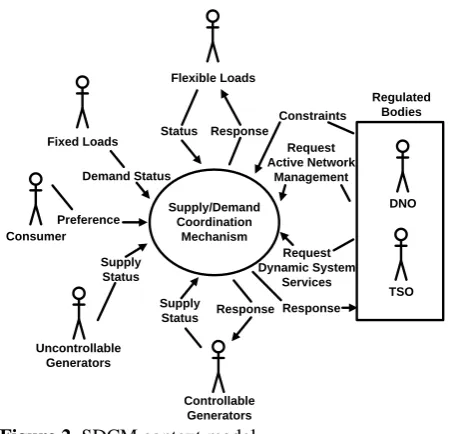
A context model helps to identify the boundaries of a system (SDCM) by capturing its interactions with the adjacent systems. The context model of a SDCM is presented in Figure 2. The generation facilities, in the context model, have been modelled as controllable (diesel and thermal) and uncontrollable (wind turbines
Consumer
Producer
DNO
TSO
Supplier
S
u
p
p
ly
/D
e
m
a
n
d
C
o
o
rd
in
a
ti
o
n
M
e
c
h
a
n
is
m
Green Energy
Secure Power Supply
Cost Reductions
Provide active network management
support
Provide dynamic system services
support Maintain demand and
supply balance
Provide low-cost balancing power
Defer network reinforcement Support integration of
RES
[image:2.595.312.539.97.314.2]Increase utilization of intermittent RES
Figure 1. SDCM top level goals.
Consumer
Uncontrollable Generators
Controllable Generators
TSO Fixed Loads
Flexible Loads
DNO Supply/Demand
Coordination Mechanism Status Response
Regulated Bodies
Demand Status
Supply
Status Response Response Request Active Network
Management
Request Dynamic System
Services Supply
Status
Constraints
[image:2.595.61.273.557.743.2]Preference
Figure 2. SDCM context model.
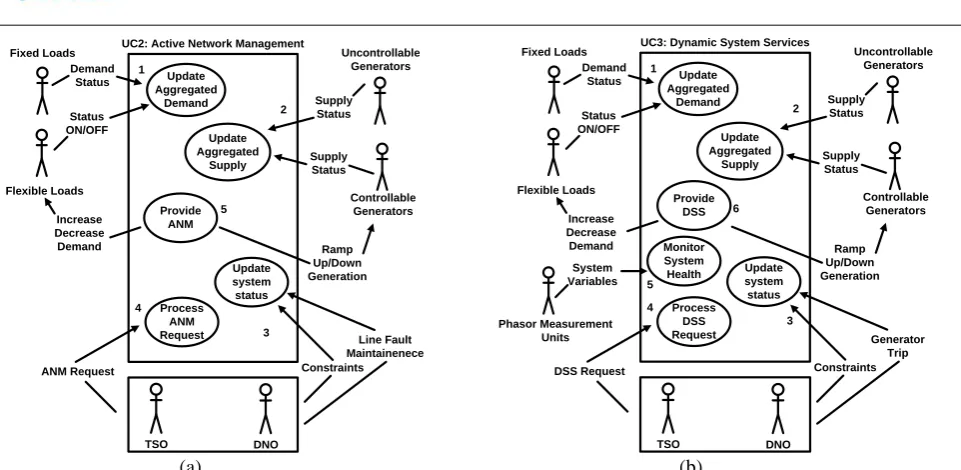
and PV plants) generators. The loads at the consumers end have been modelled as fixed (must run) and flexible (modern day loads that provide a much better control and comfort, e.g., electric vehicles, buffered heating and cooling systems). Further, the consumer preference has also been included in the modelling. The TSO and DNO have been clubbed in as regulated bodies. Although they have been modelled as one regulated body, their interaction with the SDCM can be independent. SDCM is a complex system that involves several interactions with adjacent systems. The types of interactions may also depend upon the chosen technological approach (or concept) of SDCM. As the aim is to develop a universal assessment framework, the interactions identified are generic and not dependent upon the technology (or concept) chosen for SCDM. Three key use cases have been presented in detail. Use Case 1: The first use case identified for SDCM is to maintain the balance between demand and supply in a power system (as shown in Figure 3). The inputs required by SDCM are the status of demand and supply. The SDCM aggregates the total demand and supply in the system. The output from the SDCM is the response in order to achieve its goal, i.e. to maintain the balance. Depending upon the system, the SDCM can either request for an increase/decrease in consumption by the
Uncontrollable Generators Fixed Loads
Demand Status
Status ON/OFF
Aggregate Demand
Controllable Generators Supply Status
Supply Status
Increase Decrease
Demand Ramp
Up/Down Generation Flexible Loads
Aggregate Supply
Maintain Balance
UC1: Demand/Supply Balance
1
2
3
[image:2.595.316.525.627.746.2]Uncontrollable Generators Fixed Loads
Demand Status
Status ON/OFF
Update Aggregated
Demand
Controllable Generators Supply Status
Supply Status
Increase Decrease
Demand Ramp
Up/Down Generation Flexible Loads
Update Aggregated
Supply
Provide ANM
UC2: Active Network Management
1
2
5
Update system status Process
ANM Request
TSO DNO
Line Fault Maintainenece Constraints ANM Request
3 4
Uncontrollable Generators Fixed Loads
Demand Status
Status ON/OFF
Update Aggregated
Demand
Controllable Generators Supply Status
Supply Status
Increase Decrease
Demand Ramp
Up/Down Generation Flexible Loads
Update Aggregated
Supply
Provide DSS
UC3: Dynamic System Services
1
2
6
Update system status Process
DSS Request
TSO DNO
Generator Trip Constraints DSS Request
3 4
Monitor System Health
Phasor Measurement Units
System Variables 5
[image:3.595.57.538.82.317.2](a) (b)
Figure 4. SDCM (a) use case 2:Active Network Management (ANM); (b) use case 3: Dynamic System Services (DSS). loads or to ramp up/down the generation.
Use Case 2: The second use case identified for SDCM is to provide active network management (ANM). ANM is important to avoid congestion of a network. For a better understanding, two scenarios have been developed and explained. First, consider a portion of a network with total load of 10 MVA being supplied by two lines rated at 8 MVA each. Due to a fault in one of the lines, the line has been isolated for maintenance. The regulated bodies request SDCM to provide ANM by supplying the constraints as input (as shown in Figure 4 (a)). The goal of SDCM is to provide ANM by reducing the consumption of this portion of the network within the line capacity constraint. Second, with the deployment of modern loads in the network, of considerable capacity like electric vehicles (EV), the capacity limit of presently installed infrastructure (e.g. transformers) will be exceeded. The regulated bodies request SDCM to provide ANM. The goal of SDCM is to prioritize the charging of EV in a way as to maintain within the constraints submitted by the regulated bodies. Use Case 3: The third use case identified for SDCMis to provide DSS. DSS refers to any service that is necessary to support the transmission of power to maintain reliable operation of the interconnected grid. In case of a large disturbance in a system, e.g. a generator trip, the regulated bodies request the SDCM to provide DSS support (as shown in Figure 4 (b)). The goal of SDCM in this case is to reduce the consumption to prevent the system from a cascading failure. DSS include, but are not limited to, providing voltage control, frequency control, black start capabilities, and emergency control actions.
Assumptions
The development of the SDCM business model is based on two assumptions [12]. First, there will always be sufficient capacity of flexible load or the ability to vary
the generation in the system. Second, there will be a smart metering infrastructure in place that would allow deployment of SDCM.
SDCM REQUIREMENTS SPECIFICATION
AND METRIC DEVELOPMENT
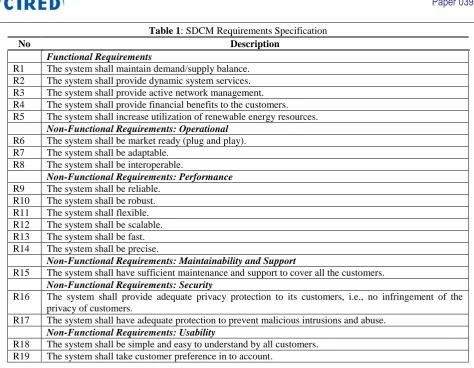
Each interaction identified in a context model can be further developed into a number of use cases. Analysis of the individual use cases leads to the derivation of a requirements set. The SDCM functional and non-functional requirements, after a thorough analysis of presented use cases and iterative requirements engineering process, have been derived and presented in Table 1. As mentioned earlier, the requirements presented are generic and not dependent upon the technology (or concept) chosen for SDCM. It should be noted that “the system” in Table 1 refers to SDCM. In simple words, requirements present what the system shall be able to do (or what capabilities the system shall have). However, no suggestions are offered on how or to what extent the capabilities can be realized. By combining a rationale with a requirement, considering the environment of the system under development, a metric is defined. Due to limitation in space, a few metrics have been explained in detail. It is worthy to mention that the metrics developed are for the model under study.
Supply/demand balance: SDCM should maintain a balance between demand and supply by mitigating the imbalances in the portfolio caused due to error in forecasting demand or generation.
DSS support: SDCM should provide ancillary system services, e.g. frequency control, voltage regulation and large scale disturbance management.
Table 1: SDCM Requirements Specification
No Description
Functional Requirements
R1 The system shall maintain demand/supply balance. R2 The system shall provide dynamic system services. R3 The system shall provide active network management. R4 The system shall provide financial benefits to the customers. R5 The system shall increase utilization of renewable energy resources.
Non-Functional Requirements: Operational
R6 The system shall be market ready (plug and play). R7 The system shall be adaptable.
R8 The system shall be interoperable.
Non-Functional Requirements: Performance
R9 The system shall be reliable. R10 The system shall be robust. R11 The system shall flexible. R12 The system shall be scalable. R13 The system shall be fast. R14 The system shall be precise.
Non-Functional Requirements: Maintainability and Support
R15 The system shall have sufficient maintenance and support to cover all the customers.
Non-Functional Requirements: Security
R16 The system shall provide adequate privacy protection to its customers, i.e., no infringement of the privacy of customers.
R17 The system shall have adequate protection to prevent malicious intrusions and abuse.
Non-Functional Requirements: Usability
R18 The system shall be simple and easy to understand by all customers. R19 The system shall take customer preference in to account.
RES integration: SDCM should increase the utilization of RES and reduce grey energy usage.
Adaptability: SDCM is adaptable if it can adapt in accordance with the regulatory restrictions of the markets around the world.
Interoperability: A particular SDCM is interoperable if it can participate and function in a market with other SDCMs.
Reliability: SDCM is reliable if it can function as and when required. In other words, functioning in a power network with a reliability of 99.99%, SDCM shall have an up time of 99.99%.
Robustness: SDCM is robust if it can continue to provide some or all of its services under abnormal circumstance, e.g. communication failure.
Flexibility: SDCM is flexible if it can incorporate generation units and loads of all sizes and types. Scalability: SDCM is scalable if it can support all customers of a projected market with the capability of expansion without further or minimal re-engineering. Latency: As SDCM is expected to provide dynamic system service support, a fast response time is crucial. Customer satisfaction: A SDCM gains customer satisfaction if it is simple and understandable by all customers and takes their preference into consideration. Further, SDCM should provide financial benefits to the customers.
CASE STUDY: POWERMATCHER
PowerMatcher (PM) is a multi-agent based system coordinating a cluster of devices producing or consuming electricity. The interest of each device in a cluster is represented by a device agent. Multi-agent system framework enables implementation of complex, distributed, scalable and open ICT systems where multiple software agents interact and negotiate to reach a system goal.
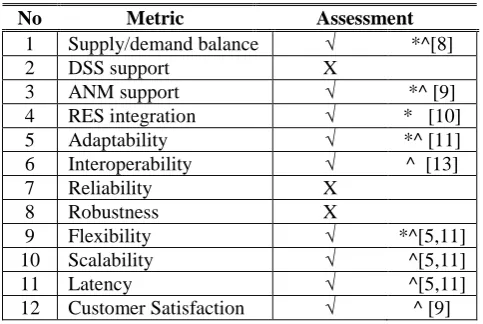
robustness have been identified as areas of further development and research for PM. Satisfying a single metric might involve a series of tests. The identification and development of tests to satisfy a metric is out of the scope of this paper and has not been discussed further.
Table 2: PowerMatcher Assessment
No Metric Assessment
1 Supply/demand balance √ *^[8]
2 DSS support X
3 ANM support √ *^ [9]
4 RES integration √ * [10]
5 Adaptability √ *^ [11]
6 Interoperability √ ^ [13]
7 Reliability X
8 Robustness X
9 Flexibility √ *^[5,11]
10 Scalability √ ^[5,11]
11 Latency √ ^[5,11]
12 Customer Satisfaction √ ^ [9] *validated by simulation, ^validated by field trial An explanation for selected entries from table 2 has been presented.
DSS Support: Only limited experience with PowerMatcher delivering dynamic system services are available. Some laboratory work on frequency stabilization has been done [14].
Adaptability: PM has been designed as a generic SDCM and field operated in different countries and in different use cases each having specific regulatory restrictions.
Reliability: PM reliably operated in a number of field situations. However, its reliability has not been thoroughly investigated in a full-scale setting.
Robustness: Most experiences with PM have been gained under normal operational circumstances. The system is robust for minor communication problems one can expect. However, robustness has not been tested under severe circumstances.
Customer Satisfaction: In a number of field trials, heating systems were operated as part of a response, without infringing the thermal comfort of the users.
CONCLUSION AND FUTURE WORK
In this paper, a SDCM business model has been presented. By iterative requirements engineering process a set of requirements has been derived and metrics have been developed. Further, the developed framework has been used to assess PM, an existing SDCM. The contribution of this paper is to open up a series of stepping stones towards the wide scale deployment of SDCM. Such an analysis helps to explore the potential of each SDCM available in the market and to identify areas of future development. Furthermore, such an assessment framework lays a basis for the development of standardized tests/test-beds for practical implementation and assessment of SDCM. The future work involves the refinement of the presented metrics by developing fit-criterion tests for
SDCM. The end result sought is the seamless integration and deployment of SDCM towards realization of a more reliable and secure power grid. ACKNOWLEDGEMENT
The work in this paper has partially been financed by TNO under the ETP Program "Adaptive Multi-Sensor Networks".
REFERENCES
[1] P. Chiradeja, 2005 "Benefit of Distributed Generation: A Line Loss Reduction Analysis", Proc. of IEEE PES
Transmission and Distribution Conference and
Exhibition: Asia and Pacific, 1-5.
[2] Y. Li, B. L. Ng, M. Trayer, L. Liu, 2012, "Automated Residential Demand Response: Algorithmic Implications of Pricing Models", IEEE Trans. onSmart
Grid, vol.3, no.4, 1712-1721.
[3] M.C. Vlot, J.D. Knigge, J.G. Slootweg, 2013, "Economical Regulation Power Through Load Shifting With Smart Energy Appliances", IEEE Trans. on Smart
Grid,vol.4, no.3, 1705-1712.
[4] N. Taheri, R. Entriken, Y. Ye, 2013, "A Dynamic Algorithm for Facilitated Charging of Plug-In Electric Vehicles", IEEE Trans. on Smart Grid, vol.4,1772-1779. [5] J.K. Kok, B. Roossien, P. MacDougall, O. van Pruissen, G. Venekamp, R. Kamphuis, J. Laarakkers, C. Warmer, 2012, "Dynamic pricing by scalable energy management systems – field experiences and simulation results using PowerMatcher”, Proc. of IEEE PES General Meeting.
[6] A. Ipakchi, 2012, "Issues, challenges and opportunities for utilization of demand-side resources in support of power system operations," Proc. of IEEE PES ISGT. [7] B. Roossien, A. van den Noort, I.G. Kamphuis, F.W.
Bliek, M. Eijgelaar and J. de Wit, 2011, "Balancing wind power fluctuations with a domestic virtual power plant in Europe’s first smart grid", Proc. of IEEE PowerTech.
[8] C. Warmer, M. Hommelberg, B. Roossien, J.K. Kok and J.W. Turkstra, 2007, "A field test using agents for coordination of residential micro-chp", Proc. of IEEE
14th International conference on Intelligent System
Applications to Power Systems.
[9] B. Roossien, M. Hommelberg, C. Warmer, K. Kok, J.W. Turkstra, 2008, "Virtual power plant field experiment using 10 micro-CHP units at consumer premises", Proc.
of IET- CIRED Seminar: SmartGrids for Distribution.
[10] P. MacDougall, C. Warmer and J.K. Kok, 2011, "Raising the accommodation ceiling for wind power by intelligent response of demand and distributed generation", Proc. ofInternational Workshop on Large-Scale Integration of Wind Power into Power Systems.
[11] J.K. Kok, 2013, "The PowerMatcher: Smart Coordination for the Smart Electricity Grid", TNO, The Netherlands, 241-250.
[12] Energy UK, 2012, "Smart demand response: A discussion paper".
[13] EcoGrid.EU, 2013, “EcoGrid EU ICT Implementation”, project presentation. On-line available at:
http://www.eu-ecogrid.net/images/140123_ICT_imple mentation.pdf.