Scalable Data Analytics: Parallel
Computing Reborn
Vrije Universiteit
Amsterdam
September 24 2014
Geoffrey Fox
http://www.infomall.org
School of Informatics and Computing Digital Science Center
Data Science Masters Features
• Fully approved by University; expected to be approved by State October 2014
• Blended online and residential
• Department of Information and Library Science, Division of
Informatics and Division of Computer Science in the Department of Informatics and Computer Science, School of Informatics and Computing and the Department of Statistics, College of Arts and Science, IUB
• 30 credits (10 conventional courses)
• Basic (general) Masters degree plus tracks
– Currently only track is “Computational and Analytic Data Science ” but
will label courses “decision-maker” or “technical”
– Other tracks can be proposed and approved by campus, data science
faculty, data science curriculum committee
Background of the School
• The School of Informatics was established in 2000 as first of its kind in the United States.
• Computer Science was established in 1971 and became part of the school in 2005.
• Library and Information Science was established in 1951 and became part of the school in 2013.
• Now named the School of Informatics and Computing.
McKinsey Institute on Big Data Jobs
• There will be a shortage of talent necessary for organizations to take
advantage of big data. By 2018, the United States alone could face a
shortage of 140,000 to 190,000 people with deep analytical skills as well as
1.5 million managers and analysts with the know-how to use the analysis
of big data to make effective decisions.
• At SOIC, Informatics/ILS aimed at 1.5 million jobs. Computer Science covers
the 140,000 to 190,000http://www.mckinsey.com/mgi/publications/big_data/index.asp. 4
Abstract
• We review Big Data applications and the emerging source software model -- often associated with Apache projects like Hadoop.
• We propose a software model HPC-ABDS (High Performance Computing -- Apache Big Data Stack) with some 150 software projects divided into 17 layers including one devoted to
communication.
• The goal is the sustainability and pervasive advantages of Apache and the performance of HPC. R and Mahout are popular cloud analytics libraries but they miss many good algorithms and are typically slow.
• We describe an activity SPIDAL (Scalable Parallel Interoperable Data Analytics Library) that aims to produce a high performance data analytics library with its deployment as "Data Analytics as a Service" on top of HPC-ABDS.
Thank you NSF
• 3 yr. XPS: FULL: DSD: Collaborative Research: Rapid Prototyping HPC Environment for Deep Learning IU, Tennessee (Dongarra), Stanford (Ng)
• “Rapid Python Deep Learning Infrastructure” (RaPyDLI) Builds optimized
Multicore/GPU/Xeon Phi kernels (best exascale dataflow) with Python front end for general deep learning problems with ImageNet exemplar. Leverage Caffe from UCB.
• 5 yr. Datanet: CIF21 DIBBs: Middleware and High Performance Analytics Libraries for Scalable Data Science IU, Rutgers (Jha), Virginia Tech
(Marathe), Kansas (CReSIS), Emory (Wang), Arizona State(Beckstein), Utah(Cheatham)
• HPC-ABDS: Cloud-HPC interoperable software performance of HPC (High Performance Computing) and the rich functionality of the commodity
Apache Big Data Stack.
Analytics and the DIKW Pipeline
• Data goes through a pipeline
Raw data Data Information Knowledge Wisdom
Decisions
• Each link enabled by a filter which is “business logic” or “analytics”
• We are interested in filters that involve “sophisticated analytics” which require non trivial parallel algorithms
– Improve state of art in both algorithm quality and (parallel)
performance
• Design and Build SPIDAL (Scalable Parallel Interoperable Data Analytics Library)
More Analytics Knowledge
Information
Analytics Information
Database
SS SS SS
SS SS SS SS
Portal
Another Cloud
Raw Data Data Information Knowledge Wisdom Decisions
SS SS Another Service SS Another
Grid SS SS
SS SS SS SS SS SS SS Fusi onfor Discovery/ Decisions Storage Cloud Compute Cloud
SS SS SS
SS Filter Cloud Filter Cloud Filter Cloud Discovery Cloud Discovery Cloud Filter Cloud Filter Cloud Filter Cloud SS Filter Cloud Filter Cloud Filter Cloud Filter Cloud Distributed Grid Hadoop Cluster SS
SS: Sensor or Data Interchange
Service
Workflow
Strategy to Build SPIDAL
•
Analyze Big Data applications to identify analytics
needed and generate benchmark applications
•
Analyze existing analytics libraries (in practice limit to
some application domains) – catalog library members
available and performance
–
Mahout
low performance,
R
largely sequential and missing
key algorithms,
MLlib
just starting
•
Identify big data computer architectures
•
Identify software model to allow interoperability and
performance
•
Design or identify new or existing algorithm including
parallel implementation
Use Case
Template
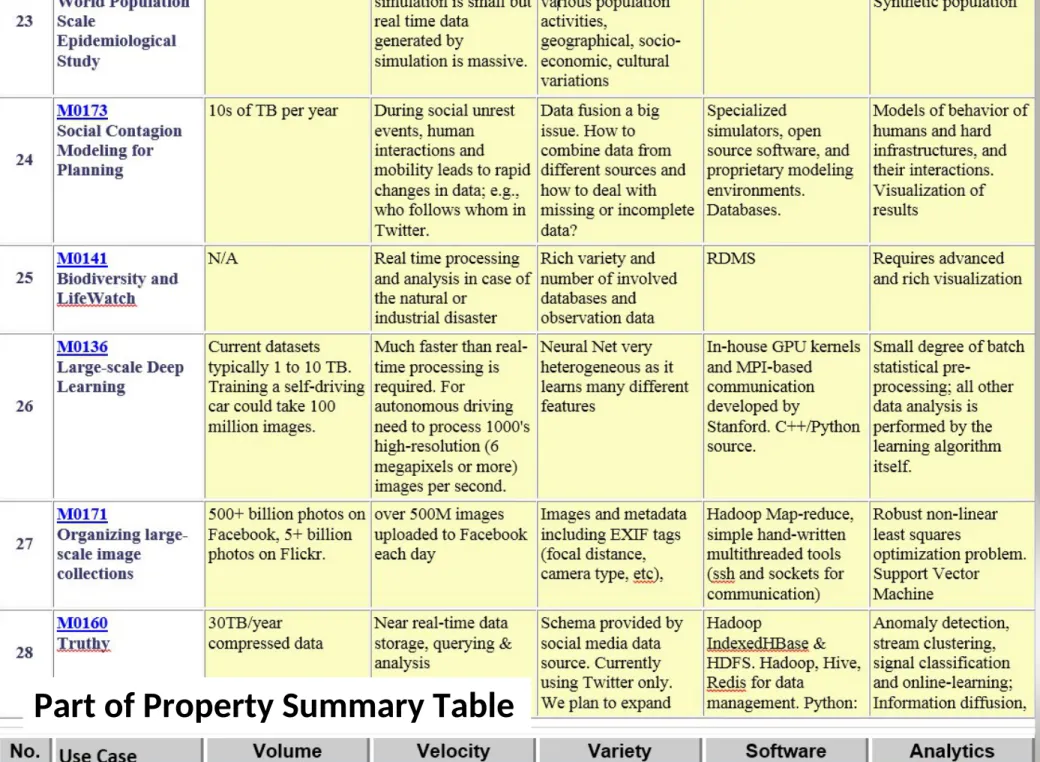
• 26 fields completed for 51
areas
• Government Operation: 4
• Commercial: 8
• Defense: 3
• Healthcare and Life Sciences: 10
• Deep Learning and Social Media: 6
• The Ecosystem for Research: 4
• Astronomy and Physics: 5
• Earth, Environmental and Polar Science: 10
• Energy: 1
51 Detailed Use Cases:
Contributed July-September 2013
Covers goals, data features such as 3 V’s, software,
hardware
• http://bigdatawg.nist.gov/usecases.php
• https://bigdatacoursespring2014.appspot.com/course (Section 5)
• Government Operation(4): National Archives and Records Administration, Census Bureau
• Commercial(8): Finance in Cloud, Cloud Backup, Mendeley (Citations), Netflix, Web Search, Digital Materials, Cargo shipping (as in UPS)
• Defense(3): Sensors, Image surveillance, Situation Assessment
• Healthcare and Life Sciences(10): Medical records, Graph and Probabilistic analysis, Pathology, Bioimaging, Genomics, Epidemiology, People Activity models, Biodiversity
• Deep Learning and Social Media(6): Driving Car, Geolocate images/cameras, Twitter, Crowd Sourcing, Network Science, NIST benchmark datasets
• The Ecosystem for Research(4): Metadata, Collaboration, Language Translation, Light source experiments
• Astronomy and Physics(5): Sky Surveys including comparison to simulation, Large Hadron Collider at CERN, Belle Accelerator II in Japan
• Earth, Environmental and Polar Science(10): Radar Scattering in Atmosphere, Earthquake, Ocean, Earth Observation, Ice sheet Radar scattering, Earth radar mapping, Climate
simulation datasets, Atmospheric turbulence identification, Subsurface Biogeochemistry (microbes to watersheds), AmeriFlux and FLUXNET gas sensors
• Energy(1): Smart grid
12
Table 4: Characteristics of 6 Distributed Applications Application
Example Execution Unit Communication Coordination Execution Environment Montage Multiple sequential and
parallel executable Files Dataflow(DAG) Dynamic processcreation, execution
NEKTAR Multiple concurrent
parallel executables Stream based Dataflow Co-scheduling, datastreaming, async. I/O
Replica-Exchange Multiple seq. andparallel executables Pub/sub Dataflow andevents Decoupledcoordination and messaging
Climate Prediction (generation)
Multiple seq. & parallel
executables Files andmessages Master-Worker, events
@Home (BOINC)
Climate Prediction (analysis)
Multiple seq. & parallel
executables messagesFiles and Dataflow Dynamics processcreation, workflow execution
SCOOP Multiple Executable Files and
messages Dataflow Preemptive scheduling,reservations
Coupled
Fusion Multiple executable Stream-based Dataflow Co-scheduling, datastreaming, async I/O
13
Big Data Features
Would like to capture “essence
of these use cases”
“small” kernels, mini-apps
Or Classify applications into patterns
Do it from HPC background
not database
viewpoint
e.g. focus on cases with detailed analytics
Section 5 of my class
https://bigdatacoursespring2014.appspot.com/preview
classifies
HPC Benchmark Classics
•
Linpack
or HPL: Parallel LU factorization for solution of
linear equations
•
NPB
version 1: Mainly classic HPC solver kernels
–
MG: Multigrid
–
CG: Conjugate Gradient
–
FT: Fast Fourier Transform
–
IS: Integer sort
–
EP: Embarrassingly Parallel
–
BT: Block Tridiagonal
–
SP: Scalar Pentadiagonal
13 Berkeley Dwarfs
•
Dense Linear Algebra
•
Sparse Linear Algebra
•
Spectral Methods
•
N-Body Methods
•
Structured Grids
•
Unstructured Grids
•
MapReduce
•
Combinational Logic
•
Graph Traversal
•
Dynamic Programming
•
Backtrack and Branch-and-Bound
•
Graphical Models
•
Finite State Machines
First 6 of these correspond to Colella’s original.
Monte Carlo dropped.
N-body methods are a subset of Particle in Colella.
Note a little inconsistent in that MapReduce is a programming model and spectral method is a numerical method.
51 Use Cases: What is Parallelism Over?
• People: either the users (but see below) or subjects of application and often both
• Decision makers like researchers or doctors (users of application)
• Items such as Images, EMR, Sequences below; observations or contents of online store
– Imagesor “Electronic Information nuggets”
– EMR: Electronic Medical Records (often similar to people parallelism)
– Protein or Gene Sequences;
– Material properties, Manufactured Object specifications, etc., in custom dataset – Modelled entities like vehicles and people
• Sensors – Internet of Things
• Events such as detected anomalies in telescope or credit card data or atmosphere
• (Complex) Nodes in RDF Graph
• Simple nodes as in a learning network
• Tweets, Blogs, Documents, Web Pages, etc.
– And characters/words in them
• Files or data to be backed up, moved or assigned metadata
• Particles/cells/mesh points as in parallel simulations
Features of 51 Use Cases I
• PP (26) Pleasingly Parallel or Map Only
• MR (18) Classic MapReduce MR (add MRStat below for full count)
• MRStat (7) Simple version of MR where key computations are
simple reduction as found in statistical averages such as histograms and averages
• MRIter (23) Iterative MapReduce or MPI (Spark, Twister)
• Graph (9) Complex graph data structure needed in analysis
• Fusion (11) Integrate diverse data to aid discovery/decision making; could involve sophisticated algorithms or could just be a portal
• Streaming (41) Some data comes in incrementally and is processed this way
• Classify (30) Classification: divide data into categories
Features of 51 Use Cases II
• CF (4) Collaborative Filtering for recommender engines
• LML (36) Local Machine Learning (Independent for each parallel entity)
• GML (23) Global Machine Learning: Deep Learning, Clustering, LDA, PLSI, MDS,
– Large Scale Optimizations as in Variational Bayes, MCMC, Lifted Belief
Propagation, Stochastic Gradient Descent, L-BFGS, Levenberg-Marquardt . Can call EGO or Exascale Global Optimization with scalable parallel algorithm
• Workflow (51) Universal
• GIS (16) Geotagged data and often displayed in ESRI, Microsoft Virtual Earth, Google Earth, GeoServer etc.
• HPC (5) Classic large-scale simulation of cosmos, materials, etc. generating (visualization) data
Global Machine Learning aka EGO –
Exascale Global Optimization
• Typically maximum likelihood or 2 with a sum over the N data items – documents, sequences, items to be sold, images etc. and often links (point-pairs). Usually it’s a sum of positive numbers as in least squares
• Covering clustering/community detection, mixture models, topic determination, Multidimensional scaling, (Deep) Learning
Networks
• PageRank is “just” parallel linear algebra
• Note many Mahout algorithms are sequential – partly as MapReduce limited; partly because parallelism unclear
– MLLib (Spark based) better
• SVM and Hidden Markov Models do not use large scale parallelization in practice?
• Detailed papers on particular parallel graph algorithms
Big Data Ogres
•
Facets I:
These features (
PP, MR, MRStat, MRIter,
Graph, Fusion, Streaming, Classify, S/Q, CF, LML,
GML, Workflow, GIS, HPC, Agents
) plus some broad
features familiar from past like
BSP
(Bulk
Synchronous Processing),
SPMD
,
iterative
?,
irregular
?,
dynamic
?,
communication/compute
,
I-O/compute
,
Data abstraction
(array, key-value…)
•
Facets II:
Data source and access (see later)
4 Forms of MapReduce
(1) Map Only MapReduce(2) Classic (3) Iterative Map Reduceor Map-Collective Map-Communication(4) Point to Point or
Input map reduce Input map reduce Iterations Input Output map Local Graph
PP MR MRStat MRIter Graph, HPC
BLAST Analysis Local Machine Learning
Pleasingly Parallel
High Energy Physics (HEP) Histograms Distributed search Recommender Engines
Expectation maximization Clustering e.g. K-means Linear Algebra,
PageRank
Classic MPI
PDE Solvers and Particle Dynamics Graph Problems MapReduce and Iterative Extensions (Spark, Twister) MPI, Giraph
Integrated Systems such as Hadoop + Harp with Compute and Communication model separated
Useful Set of Analytics Architectures
•
Pleasingly Parallel:
including
local machine learning
as in
parallel over images and apply image processing to each image
- Hadoop could be used but many other HTC, Many task tools
•
Classic MapReduce
including search, collaborative filtering and
motif finding implemented using Hadoop etc.
•
Map-Collective
or Iterative MapReduce
using Collective
Communication (clustering) – Hadoop with Harp, Spark …..
•
Map-Communication
or Iterative Giraph:
(MapReduce) with
point-to-point communication (most graph algorithms such as
maximum clique, connected component, finding diameter,
community detection)
– Vary in difficulty of finding partitioning (classic parallel load balancing)
•
Large and Shared memory:
thread-based
(event driven) graph
algorithms (shortest path, Betweenness centrality) and Large
memory applications
HPC-ABDS
Integrating High Performance Computing with
Apache Big Data Stack
HPC ABDS SYSTEM (Middleware)
150 Software Projects
System Abstraction/Standards Data Format and Storage
HPC Yarn for Resource management
Horizontally scalable parallel programming model Collective and Point to Point Communication
Support for iteration (in memory processing)
Application Abstractions/Standards
Graphs, Networks, Images, Geospatial ..
Scalable Parallel Interoperable Data Analytics Library (SPIDAL)
High performance Mahout, R, Matlab …..
High Performance Applications
HPC ABDS
Maybe a Big Data Initiative would include
• We don’t need 266 software packages so can choose e.g.
• Workflow: IPython, Pegasus or Kepler (replaced by tools like Tez?)
• Data Analytics: Mahout, R, ImageJ, Scalapack
• High level Programming: Hive, Pig
• Parallel Programming model: Hadoop, Spark, Giraph (Twister4Azure, Harp), MPI; Storm, Kapfka or RabbitMQ (Sensors)
• In-memory: Memcached
• Data Management: Hbase, MongoDB, MySQL or Derby
• Distributed Coordination: Zookeeper
• Cluster Management: Yarn, Slurm
• File Systems: HDFS, Lustre
• DevOps: Cloudmesh, Chef, Puppet, Docker, Cobbler
• IaaS: Amazon, Azure, OpenStack, Libcloud
Govt.
Operations CommercialDefense Healthcare,Life Science Learning,Deep
Social Media
Research
Ecosystems Astronomy,
Physics Earth, Env., Polar Science Energy (Inter)disciplinary Workflow Analytics Libraries Native ABDS SQL-engines, Storm, Impala, Hive, Shark Native HPC
MPI Map Only, PP HPC-ABDS MapReduce
Many Task ClassicMapReduce MapCollective Map – Point toPoint, Graph
MIddleware for Data-Intensive Analytics and Science (MIDAS) API
Communication
(MPI, RDMA, Hadoop Shuffle/Reduce, HARP Collectives, Giraph point-to-point)
Data Systems and Abstractions
(In-Memory; HBase, Object Stores, other NoSQL stores, Spatial, SQL, Files)
Higher-Level Workload
Management (Tez, Llama) Workload Management(Pilots, Condor) SchedulingFramework specific(e.g. YARN)
External Data Access
(Virtual Filesystem, GridFTP, SRM, SSH) (YARN, Mesos, SLURM, Torque, SGE)Cluster Resource Manager
Compute, Storage and Data Resources (Nodes, Cores, Lustre, HDFS)
Community & Examples SPIDAL Programming & Runtime Models MIDAS Resource Fabric
Infra structure
IaaS
Ø Software Defined
Computing (virtual Clusters)
Ø Hypervisor, Bare Metal
Ø Operating System
Platform
PaaS
Ø Cloud e.g. MapReduce
Ø HPC e.g. PETSc, SAGA
Ø Computer Science e.g. Compiler tools, Sensor nets, Monitors
Software-Defined Distributed
System (SDDS) as a Service includes
Network
NaaS
Ø Software Defined Networks
Ø OpenFlow GENI
Software
(Application Or Usage)
SaaS
Ø CS Research Use e.g. test new compiler or storage model
Ø Class Usages e.g. run GPU & multicore
Ø Applications
FutureGrid uses SDDS-aaS Tools Ø Provisioning
Ø Image Management Ø IaaS Interoperability Ø NaaS, IaaS tools Ø Expt management Ø Dynamic IaaS NaaS Ø DevOps
CloudMesh is a
SDDSaaS tool that uses Dynamic Provisioning and Image Management to provide custom
environments for general target systems
Involves (1) creating, (2) deploying, and (3) provisioning
of one or more images in a set of machines on demand
Iterative MapReduce
Implementing HPC-ABDS
Harp Design
Parallelism Model Architecture
Shuffle M M M M
Optimal Communication M M M M
R R
Collective or Map-Communication Model MapReduce Model
YARN
MapReduce V2
Harp
MapReduce Applications
Map-Collective or Map-Communication
Applications
Application
Framework
Features of Harp Hadoop Plugin
•
Hadoop Plugin (on Hadoop 1.2.1 and Hadoop
2.2.0)
•
Hierarchical data abstraction on arrays, key-values
and graphs for easy programming expressiveness.
•
Collective communication model to support
various communication operations on the data
abstractions (will extend to Point to Point)
•
Caching with buffer management for memory
allocation required from computation and
communication
•
BSP style parallelism
WDA SMACOF MDS (Multidimensional
Scaling) using Harp on IU Big Red 2
Parallel Efficiency: on 100-300K sequences
Conjugate Gradient (dominant time) and Matrix Multiplication
Number of Nodes
0 20 40 60 80 100 120 140
Pa ra lle lE ffi cie nc y 0.00 0.20 0.40 0.60 0.80 1.00 1.20
100K points 200K points 300K points
Best available
MDS (much
better than
that in R)
Java
Harp (Hadoop
plugin)
Increasing Communication Identical Computation
Mahout and Hadoop MR – Slow due to MapReduce
Python slow as Scripting; MPI fastest
Spark Iterative MapReduce, non optimal communication
Data Source and Style Facet
of Ogres I
• (i) SQL or NoSQL: NoSQL includes Document, Column, Key-value, Graph, Triple store
• (ii) Other Enterprise data systems: 10 examples from NIST integrate SQL/NoSQL
• (iii) Set of Files: as managed in iRODS and extremely common in scientific research
• (iv) File, Object, Block and Data-parallel (HDFS) raw storage: Separated from computing?
• (v) Internet of Things: 24 to 50 Billion devices on Internet by 2020
• (vi) Streaming: Incremental update of datasets with new algorithms to achieve real-time response (G7)
• (vii) HPC simulations: generate major (visualization) output that often needs to be mined
Data Source and Style Facet
of Ogres II
•
Before data gets to compute system, there is often an
initial data gathering phase
which is characterized by a
block size and timing
. Block size varies from month
(Remote Sensing, Seismic) to day (genomic) to seconds or
lower (Real time control, streaming)
•
There are
storage/compute system styles:
Shared,
Dedicated, Permanent, Transient
•
Other characteristics are needed for permanent
auxiliary/comparison datasets a
nd these could be
interdisciplinary, implying nontrivial data
movement/replication
10 Generic Data Processing Styles
1) Multiple users performing interactive queries and updates on a database with basic availability and eventual consistency (BASE = (Basically Available, Soft state, Eventual consistency) as opposed to ACID = (Atomicity, Consistency, Isolation, Durability) )
2) Perform real time analytics on data source streams and notify users when specified events occur
3) Move data from external data sources into a highly horizontally scalable data store, transform it using highly horizontally scalable processing (e.g. Map-Reduce), and return it to the horizontally scalable data store (ELT Extract Load Transform)
4) Perform batch analytics on the data in a highly horizontally scalable data store using highly horizontally scalable processing (e.g MapReduce) with a user-friendly interface (e.g. SQL like)
5) Perform interactive analytics on data in analytics-optimized database
6) Visualize data extracted from horizontally scalable Big Data store
7) Move data from a highly horizontally scalable data store into a traditional Enterprise Data Warehouse (EDW)
8) Extract, process, and move data from data stores to archives
9) Combine data from Cloud databases and on premise data stores for analytics, data mining, and/or machine learning
2. Perform real time analytics on data source streams and
notify users when specified events occur
Storm, Kafka, Hbase, Zookeeper
Streaming Data
Streaming Data
Streaming Data
Posted Data Identified Events
Filter Identifying Events
Repository
Specify filter
Archive
Post Selected Events
Fetch
5. Perform interactive analytics on data in
analytics-optimized data system
Hadoop, Spark, Giraph, Pig …
Data Storage: HDFS, Hbase
Data, Streaming, Batch …..
5A. Perform interactive analytics on
observational scientific data
Grid or Many Task Software, Hadoop, Spark, Giraph, Pig …
Data Storage: HDFS, Hbase, File Collection (Lustre)
Streaming Twitter data for Social Networking
Science Analysis Code, Mahout, R
Transport batch of data to primary analysis data system
Record Scientific Data in “field”
Local Accumulate
and initial computing Direct Transfer
Machine Learning in Network Science, Imaging in Computer
Vision, Pathology, Polar Science, Biomolecular Simulations
46
Algorithm Applications Features Status Parallelism Graph Analytics
Community detection Social networks, webgraph
Graph .
P-DM GML-GrC
Subgraph/motif finding Webgraph, biological/social networks P-DM GML-GrB
Finding diameter Social networks, webgraph P-DM GML-GrB
Clustering coefficient Social networks P-DM GML-GrC
Page rank Webgraph P-DM GML-GrC
Maximal cliques Social networks, webgraph P-DM GML-GrB
Connected component Social networks, webgraph P-DM GML-GrB
Betweenness centrality Social networks
Graph, Non-metric, static
P-Shm
GML-GRA
Shortest path Social networks, webgraph P-Shm
Spatial Queries and Analytics Spatial relationship based
queries
GIS/social networks/pathology
informatics Geometric
P-DM PP
Distance based queries P-DM PP
Spatial clustering Seq GML
Spatial modeling Seq PP
GML Global (parallel) ML
Some specialized data analytics in
SPIDAL
•
aa
47
Algorithm Applications Features Status Parallelism
Core Image Processing Image preprocessing
Computer vision/pathology informatics
Metric Space Point Sets, Neighborhood sets & Image
features
P-DM PP
Object detection &
segmentation P-DM PP
Image/object feature
computation P-DM PP
3D image registration Seq PP
Object matching
Geometric Todo PP
3D feature extraction Todo PP
Deep Learning
Learning Network, Stochastic Gradient Descent
Image Understanding,
Language Translation, Voice
Recognition, Car driving Connections inartificial neural net P-DM GML
PP Pleasingly Parallel (Local ML)
Seq Sequential Available
GRA Good distributed algorithm needed
Todo No prototype Available
P-DM Distributed memory Available
Some Core Machine Learning Building Blocks
48
Algorithm Applications Features Status //ism
DA Vector Clustering Accurate Clusters Vectors P-DM GML
DA Non metric Clustering Accurate Clusters, Biology, Web Non metric, O(N2) P-DM GML
Kmeans; Basic, Fuzzy and Elkan Fast Clustering Vectors P-DM GML
L e v e n b e r g - M a r q u a r d t
Optimization Non-linear Gauss-Newton, usein MDS Least Squares P-DM GML
SMACOF Dimension Reduction DA- MDS with general weights LeastO(N2) Squares, P-DM GML
Vector Dimension Reduction DA-GTM and Others Vectors P-DM GML
TFIDF Search Find nearest neighbors indocument corpus
Bag of “words” (image features)
P-DM PP
All-pairs similarity search Find pairs of documents withTFIDF distance below a
threshold Todo GML
Support Vector Machine SVM Learn and Classify Vectors Seq GML
Random Forest Learn and Classify Vectors P-DM PP
Gibbs sampling (MCMC) Solve global inference problems Graph Todo GML
Latent Dirichlet Allocation LDA with Gibbs sampling or Var.
Bayes Topic models (Latent factors) Bag of “words” P-DM GML Singular Value Decomposition
SVD Dimension Reduction and PCA Vectors Seq GML
Remarks on GML Parallelism
•
All use parallelism over data points
– Entities to cluster or search or map to Euclidean space
•
Except deep learning which has parallelism over pixel
plane in neurons not over items in training set
– as need to look at small numbers of data items at a time in Stochastic Gradient Descent
•
Maximum Likelihood or
2both lead to structure like
•
Minimize sum
items=1N (Positive nonlinear function ofunknown parameters for item i)
•
All solved iteratively with (clever) first or second order
approximation to shift in objective function
– Sometimes steepest descent direction; sometimes Newton
– Have classic Expectation Maximization structure
Structure of Parameters
•
Note learning networks have huge number of
parameters (11 billion in Stanford work) so that
inconceivable to look at second derivative
•
Clustering and MDS have lots of parameters but can
be practical to look at second derivative and use
Newton’s method to minimize
•
Parameters are determined in distributed fashion but
are typically needed globally
–
MPI use broadcast and “AllCollectives”
–
AI community: use parameter server and access as needed
Robustness from Deterministic Annealing
• Deterministic annealing smears objective function and avoids local
minima and being much faster than simulated annealing
• Clustering
– Vectors: Rose (Gurewitz and Fox) 1990
– Clusters with fixed sizes and no tails (Proteomics team at Broad)
– No Vectors: Hofmann and Buhmann (Just use pairwise distances)
• Dimension Reduction for visualization and analysis
– Vectors: GTM Generative Topographic Mapping
– No vectors SMACOF: Multidimensional Scaling) MDS (Just use
pairwise distances)
• Can apply to HMM & general mixture models (less study)
– Gaussian Mixture Models
– Probabilistic Latent Semantic Analysis with Deterministic
Some Important Cases
• Need to cover non vector semimetric and vector spaces for clustering and dimension reduction (N points in space)
• Vector spaces have Euclidean distance and scalar products
– Algorithms can be O(N) and these are best for clustering but for MDS O(N) methods may not be best as obvious objective function O(N2)
•
MDS Minimizes Stress
(X) =
i<j=1Nweight(
i,j
) (
(
i
,
j
) - d(Xi
,
Xj))
2• Semimetric spaces just have pairwise distances defined between points in space (i, j)
• Note matrix solvers all use conjugate gradient – converges in 5-200 iterations – a big gain for matrix with a million rows. This removes factor of N in time complexity
• Ratio of #clusters to #points important; new ideas if ratio >~ 0.1
More Efficient Parallelism
•
The canonical model is correct at start but each point does not
really contribute to each cluster as damped exponentially by
exp( -
(X
i- Y(
k
))
2/T )
•
For Proteomics problem, on average
only 6.45 clusters
needed
per point if require
(X
i- Y(
k
))
2/T ≤ ~40 (as exp(-40) small)
•
So only need to keep nearby clusters for each point
•
As
average number of Clusters ~ 20,000
, this gives a factor of
~3000 improvement
•
Further communication is no longer all global; it has nearest
neighbor components and calculated by
parallelism over
clusters
•
Claim that ~all O(N
2) machine learning algorithms can be done
in O(N)logN using ideas as in fast multipole (Barnes Hut) for
particle dynamics
– ~0 use in practice
54 Use Barnes Hut
OctTree, originally developed to make O(N2) astrophysics
55
OctTree for 100K
sample of Fungi
Some Futures
•
Always run MDS. Gives insight into data
– Leads to a data browser as GIS gives for spatial data
•
Claim is algorithm change gave as much performance
increase as hardware change in simulations. Will this
happen in analytics?
– Today is like parallel computing 30 years ago with regular meshs. We will learn how to adapt methods automatically to give
“multigrid” and “fast multipole” like algorithms
•
Need to start developing the libraries that support Big Data
– Understand architectures issues
– Have coupled batch and streaming versions
– Develop much better algorithms
•
Please join
SPIDAL (Scalable Parallel Interoperable Data
Analytics Library
) community
The brownish triangles are stray peaks outside any cluster.
The colored hexagons are peaks inside clusters with the white
hexagons being determined cluster center
58
“Divergent” Data
Sample
23 True Sequences
59
CDhit UClust
Divergent Data Set UClust (Cuts 0.65 to 0.95) DAPWC 0.65 0.75 0.85 0.95
Total # of clusters
23 4 10 36 91
Total # of clusters uniquely identified 23 0 0 13 16
(i.e. one original cluster goes to 1 uclust cluster )
Total # of shared clusters with significant sharing 0 4 10 5 0 (one uclust cluster goes to > 1 real cluster)
Total # of uclust clusters that are just part of a real cluster 0 4 10 17(11) 72(62) (numbers in brackets only have one member)
Total # of real clusters that are 1 uclust cluster 0 14 9 5 0 but uclust cluster is spread over multiple real clusters
Total # of real clusters that
have 0 9 14 5 7
significant contribution from > 1 uclust cluster
Protein Universe Browser for COG Sequences with a
few illustrative biologically identified clusters
Heatmap of biology distance
(Needleman-Wunsch) vs 3D Euclidean Distances
Java Grande
•
We once tried to encourage use of Java in HPC with Java
Grande Forum but Fortran, C and C++ remain central HPC
languages.
– Not helped by .com and Sun collapse in 2000-2005
•
The pure Java CartaBlanca, a 2005 R&D100 award-winning
project, was an early successful example of HPC use of Java in a
simulation tool for non-linear physics on unstructured grids.
•
Of course Java is a major language in ABDS and as data analysis
and simulation are naturally linked, should consider broader
use of Java
•
Using Habanero Java (from Rice University) for Threads and
mpiJava or FastMPJ for MPI, gathering collection of high
performance parallel Java analytics
– Converted from C# and sequential Java faster than sequential C#
Performance of MPI Kernel Operations
Pure Java as in FastMPJ slower than Java
Lessons / Insights
• Proposed classification of Big Data applications with features and kernels for analytics
• Integrate (don’t compete) HPC with “Commodity Big data”
(Google to Amazon to Enterprise Data Analytics)
– i.e. improve Mahout; don’t compete with it
– Use Hadoop plug-ins rather than replacing Hadoop
• Enhanced Apache Big Data Stack HPC-ABDS has ~140 members
with HPC opportunities at Resource management, Data/File, Streaming, Programming, monitoring, workflow layers.
• Data intensive algorithms do not have the well developed high performance libraries familiar from HPC
• Global Machine Learning or (Exascale Global Optimization) particularly challenging
• Develop SPIDAL (Scalable Parallel Interoperable Data Analytics Library)