Ames Laboratory ISC Technical Reports Ames Laboratory
6-1955
The use of chelating agents in the separation of the
rare earth elements by ion-exchange methods
E. J. Wheelwright
Iowa State CollegeF. H. Spedding
Iowa State CollegeFollow this and additional works at:http://lib.dr.iastate.edu/ameslab_iscreports Part of theChemistry Commons
This Report is brought to you for free and open access by the Ames Laboratory at Iowa State University Digital Repository. It has been accepted for inclusion in Ames Laboratory ISC Technical Reports by an authorized administrator of Iowa State University Digital Repository. For more information, please [email protected].
Recommended Citation
Wheelwright, E. J. and Spedding, F. H., "The use of chelating agents in the separation of the rare earth elements by ion-exchange methods" (1955).Ames Laboratory ISC Technical Reports. 101.
Abstract
The research described in this thesis was undertaken in order to accomplish two main objectives. The first was to measure the stability of the complexes formed by each of the trivalent rare earth cations with
ethylenediaminetetraacetic acid, abbreviated EDTA, and with N-hydroxyethylethylenediaminetriacetic acid, abbreviated HEDTA. The second objective was to find methods for using the two chelating agents in conjunction with an ion-exchange resin for separating the rare earths.
Keywords Ames Laboratory Disciplines Chemistry
UNCLASSIFIED
Physical Scicuccs Heading Room
UNCLASSIFIED
ISC-637
Subject Category: CHEMISTRY
UNITED STATES ATOMIC ENERGY COMMISSION
THE USE OF CHELATING AGENTS IN THE
SEPARATION OF THE RARE EARTH ELEMENTS BY ION-EXCHANGE METHODS
By
E. J. Wheel wright F. H. Spedding
June 1955
Ames Laboratory Ames, Iowa
LEGAL NOTICE
This report was prepared as an account of Government sponsored work. Neither the United States, nor the Commission, nor any person acting on behalf of the Commission:
A. Makes any warranty or representation, express or implied, with respect to the ac-curacy, completeness, or usefulness of the information contained in this report, or that the use of any Information, apparatus, method, or process disclosed in this report may not in-fringe privately owned rights1 or
B. Assumes any liabilities with respect to the use of, or for damages resulting from the use of any information, apparatus, method, or process disclosed in this report.
As used in the above, "penon acting on behalf of the Commission" includes any em-ployee or contractor of the Commission to the extent that such emem-ployee or contractor prepares, handles or distributes, or provides access to, any information pursuant to his em-ployment or contract with the Commission.
This report has been reproduced directly from the best available copy.
Printed in USA, Price 50 cents. Available from the Office of Technical Services, Department of Commerce,
Wash-ington 25, D. C.
I "
ABSTRACT • • IN·rR 0 DUCT ION
. .
ISC-637 TABLE OF CONTENTS
.
.
.
.
. . .
. . . .
.
.
. . . .
.
. .
.
. .
.
.
MEASUREMENT OF THE STABILITY OF THE RARE EARTH COMPLEXSS WITH ETHYLENEDIAMINETETRAACETIC ACID AND WITH
N-HYDHOXYETHYL-i N-HYDHOXYETHYL-i N-HYDHOXYETHYL-i
iv 1
ETHYLENEDIAMINETRIACETIC ACID • • • • • • • • • • • • • • 2
Historical Review
.
.
. . .
. .
.
. . .
Derivation of the Experimental Methods Used toMeasure the Stability Constants • • • • Materials and Equipment
Experimental Procedures and Results Summary and Conclusions
SEPARATION OF THE RARE EARTHS BY ION-EXCHANGE METHODS
.
. .
Historical Review
.
.
. . .
.
. .
.
. . .
.
Use of EDTA as an Eluant •.
.
Separations Using HEDTA as an Eluant •
. . .
.
.
Summary and Conclusions • • • • • • • •2
17
31
35
56
57
57
65
75
80
THE USE OF CHELATING 1\G-ENTS IN THE SEP illATION OF THE
RARE EARTH ELEMENTS BY ION-EXCHANGE METf-IODS
by
E. ,J. Wheelwright and F. H. Spedding
AJSTRACT
'I'he research described in this thesis was undertaken in order
to accomplish two main objectives. The first was .to measure the
stability of the complexes formed by e<::lch of the trivalent rare earth cations with ethylenediamlnetetraacetic acid, abbreviated EDTA, and with N-hydroxyethylethylenediaminetriacetic acid,
abbreviated HEDTA. The second objective was to find methods for
using the two chelating agents in conjunction with an ion-exchange resin for separating the rare earths.
The stability constants of the complexes formed between the
rare earth metal ions and the anion of ~DTA have been measured at
a temperature of 20.0°C and an ionic strength of 0.10 by two
inde-pendent methods. The two methods are shown to supplement each
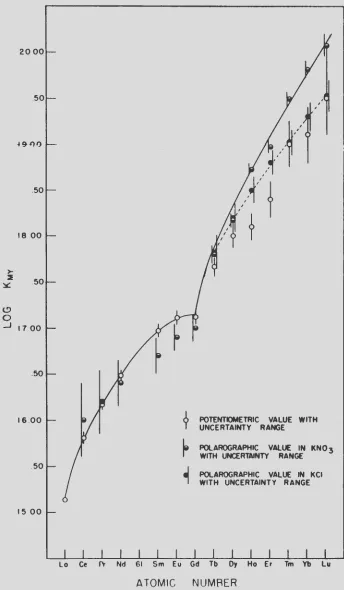
other, one being more accurate for the lighter rare earths and the second method more accurate for the heavy rare earths.
In the first method, the rare earth-EDTA stability constants
were calculated from measurements of the equilibrium constants of
reactions involving competition between SDTA. and a polyamine
chelating agent, tri&~inotriethylamine, for the rare earth ions
and copper ions. The equilibr-ium constants were calculated from pH measurements upon the various reaction mixtures.
The second method is based upon the fact that i t is possible
to measure the concentration of free uncornplexed copper II ions
in the presence oi' the copper complex, cuy-2, by polarographic
means. 'l"~'ne rare earth-EDTA stability constants were determined
by measuring the amount of copper II ions liberated when equal molar ar:1ounts of the copper-EDTA complex and a rare earth salt are ~ixed together.
The acid association constants of HEDTA were calculated from
pH titration curves obta.ined by potentiometrically titrating the
ISC-63
7
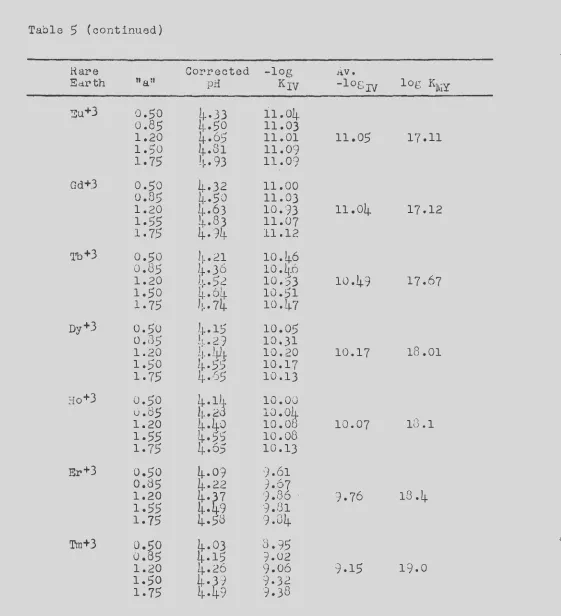
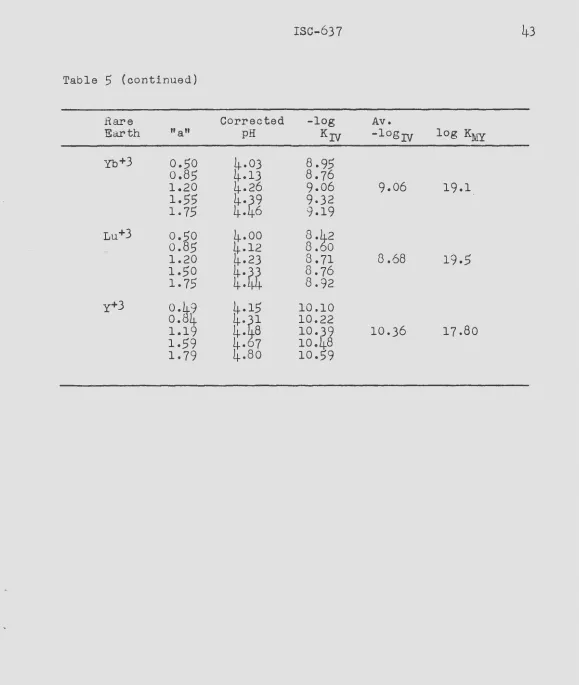
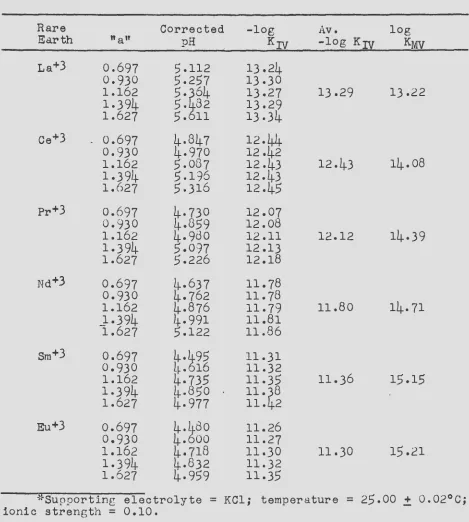
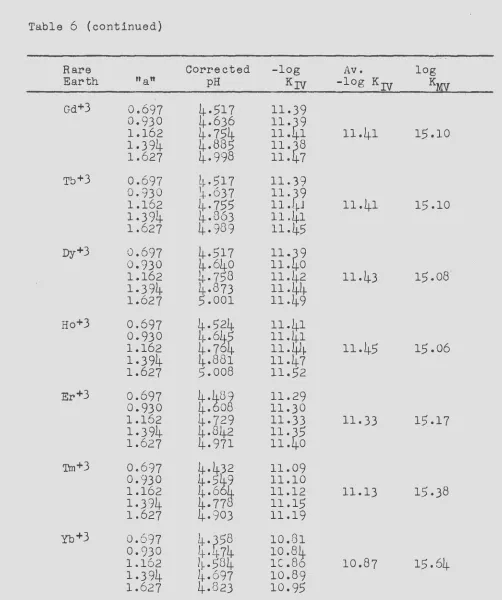
The stability constants of the complexes formed between tne rare earths and the anion of HEDTA were measured at a temperature of 25.0°C and an ionic strength of 0.10. The methods used were the same as those described for measuring the rare earth-EDTA stability constants. In this case, the potentiometric method is shown to give more accurate constants.
v
A rapid method for separating the individual rare earths into enriched fractions has been developed. The process consists of complexing part of the rare earths in a mixture -- those rare earths which form the more stable complexes -- with EDTA and sepa-rating the complexed rare earth ions from the uncomplexed ions by passing the mixture through an ion-exchange column in the ammonium cycle. The complexed ions pass through the resin bed, but the uncomplexed ions are adsorbed.
A method has been found for separating pure rare earths in macro quantities from rare earth mixtures. The method consists of
eluting a band of mixed rare earths, adsorbed on a cation-exchange resin, through a second cation-exchange resin bed in the copper II or iron III stateo Copper was found to be far superior to iron. The eluant consists
of
an ammonia-buffered solution of EDTA.The elution of a mixture of all of the rare earths down an ion-exchange bed with an ammonia-buffered solution of HEDTA indi-cated that this chelating agent is not as effective for separating the heavy rare earths as the EDTA-copper II system under the
THE USE OF' CHELATING AGENTS IN THE SEPARATION OF THE RARE EARTH ELEMEN'l'S BY ION-EXCHANGE ME'l'HODSl
by
E. J. Wheelwright and F.
H.
SpeddingINTRODUC'l'ION
The group of elements with atomic numbers
58
through71
are commonly known as the rare earths o Element 57, lanthanum, though not possessing a 4f electron, is the first element to have the rare earth like 5dl 6s2 outermost electronic configuration andconsequently is included in the rare earth family by most authors. Because of its trivalent character~ ionic size, chemical properties, and existence as a major constituent in many rare earth ores, the element yttrium is also included in many systematic studies of the rare earths. While most of the rare earths having odd atomic numbers are quite scarce, i t must be pointed out that many members of the series are sufficiently abundant to permit production in technical quanti ties if important uses develop. As a family, the rare earth elements account for 0. Ol7u of the igneous rock of the earth's crust o
At present, the createst demand for pure rare earth elements, other than lanthanumj) cerium, and perhaps neodymium, is for funda-mental scientific research. Since the rare earth atoms differ from each other essentially only by the number of electrons
con-tained in the shielded 4f subshell and the number of protons in the nucleus, their unique physical and chemical properties, such as ionic size, make t:hem valuable tools for testing many of the theories that have been proposed in physics and chemistry.
Even though these elements are relatively abundant in nature, they are usually found in quite low concentrations in their ores, and are always associated with each other. Their similar chemical properties make i t extremely difficult to isolate them individually
in pure form by classical physical chemical methods such as frac-tional crystallization and precipitation. In recent years, however, ion-exchange techniques have been applied with great success to
this separation problem, and all of the rare earths are now avail-able in kilogrrun quantities with a purity of
99.99%
or greater. lThis report is based on a Ph.D. thesis by E. ,J. Wheelwright2
ISC-63
7
The ion-exchange methods which have proven most successful involve the use of an organic chelating agent as the eluant. The successful separation of the rare earth elements by such a method depends for the·most part upon the differences in the
stability of the complexes formed between individual rare earth elements present in a given mixture and the chelating agent in the eluant o
The research described in this thesis was undertaken in order to accomplish two main objectives. The first objective was to measure carefully the stability of the complexes formed by each of the trivalent rare earth cations with
ethylenediamine-tetraacetic acid, abbreviated EDTA, and with N-hydroxyethylethylene-diaminetriacetic acid, abbreviated HEDTA; both of which are known to form quite stable metal chelates. Such a series of constants would provide both theoretical information concerning the in-fluence of the size of a cation upon its physical and chemical properties, and also would indicate the effectiveness of such a chelating agent in separating the individual rare earths by ion-exchange or other means. The second objective of this research was to find methods for using the two chelating agents in
con-junction with an ion-exchange resin for separating the rare earths.
MEASURENIENT OF THE STABJL I'I'Y OF THE RARE EARTH COMPLEXES
WITH ETHYLENEDIAMINETETRAACETIC ACID AND WITH
N-HYDROXYETHYLETHYLENEDIAMINETRIACETIC ACID
Historical Review
Methods used to detect the presence of metal chelates
When a metal ion combines with an electron donor, the re-sulting substance is said to be a metal complex, or coordination compound. If the molecule which combines with the metal contains two or more donor groups, one or more rings are formed. The
The chelating agent ethylenediaminetetraacetic acid, which
has the structural formula
HOOC - CH2 /CH2 - COOH
'-.... N-CH 2 - CH2 - N '-....
HOOC - CH2 / CH2 - COOH
was prepared first by Fick and Ulrich (2). These authors describe
a method in which ethylenediamine and hydrogen cyanide are reacted
with formaldehyde in aqueous solution at a pressure of one
atmos-phere and room temperature to give the tetranitrile, which can then be converted to EDTA or its tetra sodium salt by acidic or
basic hydrolysis.
N-Hydroxyethylethylenediarninetriacetic acid, with the structure
'
was first described by Chaberk and Bersworth (3) in 1953. These workers have not as yet published a description of the method used for the preparation of this compound. Only two papers have been published describing any of the chemistry of HEDTA.
There are a great many methods which various workers have used to show evidence for the existence of metal chelates. No
attempt will be made to review all of these, but a few which apply
to EDTA and HED'I'A complexes will be briefly described. This
section contains only those methods which have been used in a
qualitative manner. The methods which have been used to give a
quantitative measurement of the stability constants are described in a later section.
Tne isolation, purification, and chemical analysis of crys-talline compounds is a widely used method of indicating the presence of chelates. Britzinger, Thiele, and Miller
(4)
were able to isolate some lavender-colored crystals which a chemical analysis showed to be the tetrahydrate ofsodium-(ethylenedi-arninetetracetato)-cobaltate III. Stronp, evidence for a hexadentate chelate structure was obtained when dehydration of the lavender-colored crystals at l50°C removed all of the water but did not change the color of the crystals.
4
ISC-637in solution. For example, calcium carbonate will not precipitate
from a solution containing calcium ions when an excess of the
sodium salt of EDTA has been added. Oxalate will not precipitate
calcium from a calcium-EDTA complex in a solution whose pH is
above 10. Dimethylglyoxime will not precipitate nickel from the
nickel-EDTA complex in a solution of pH 6.5. Chaberek and
Bersworth (3) report that the iron III-II'HiDTA chelate is stabilized against hydrolysis to the extent that the chelate is completely stable against alkali hydroxide precipitation.
The color of chelate compounds is generally accepted as being so significant that colors are carefully described in reports of
chemical investigation of these substances. The intensification
of color is usually considered an indication that a chelate is
present. These color changes were str'ikingly illustrated during
the preparation of one of the solutions f'or this research. The
color of a copper II chloride solution changed from blue-green to a very deep blue upon the addi tlon of the disodium salt of ~DTA. Moeller and Brantley (5) have shown that essentially all of the
absorption bands in the neodymium spectrum are altered by the
presence of
EDTA,
the most striking effects occurring in the 5780l
region. Similar effects were also found in the spectra of
tri-positive gadolinium, holmium, and erbium.
The effective disappearance of ions in solution by the
forma-tion of metal chelates may be follow~d by electrical-conductance
measurements. Martell (6) used this method to follow the titration
of ethylenediaminetetraacetic acid with sodium hydroxide and with
calcium hydroxide. He found that with the sodium hydroxide
titra-tion, a simple minimum was found when the conductance was plotted
as a function of the equivalents of base added; indicating that a simple neutralization had taken place and that the metal ion was
not strongly chelated. The conductance curve for the titration
with calcium hydroxide paralleled the sodium hydroxide curve to the
minimum value of the latter. Once the mono-calcium diacid salt was
formed, further addition of calcium hydroxide did not increase the conductance until after the complete addition of a full mole of
calcium hydroxide. The calcium results were interpreted as
in-volving a simple neutralization reaction, followed by a chelation
reaction. The conductance remains practically constant during the
second reaction because the addition of calcium hydroxide results
in the replacement of one bivalent ion with another of practically
the same size.
It should be pointed out that an investigator might be in
error in assuming chelate formation on the basis of one or perhaps
two of the methods which have been described, as alternate
some cases. It is necessary, therefore, to enmasse as much independent evidence as possible before stating that the ex-istence of a chelate is proven.
Nature and structure of the metal complexes of EDTA
It is possible for the anion of EDTA to serve a-s a tetra-, penta-, or hexadentate chelating agent, depending upon the spe-cific metal ion involved. The hexadentate structure is shown as an octahedral configuration, utilizing both nitrogen atoms and all four carboxyl groups. In most chelates such a structure would involve a good deal of strain so an alternate structure, in which one of the carboxyl groups is displaced in the coordina-tion sphere by a water molecule or some other donor group, has been postulated. The literature indicates that either structure may exist, depending upon the specific ion i~volved and the
conditions of the solution •
. Pfeiffer and co-workers
(7,8,9)
have described the prepara-tion and some of the physical and chemical properties of compounds that are formed between EDTA and the alkaline earth elements and copper. At about the same time, Brintz inger and co-workers(4,10,11) conducted similar experiments with EDTA complexes of some of the heavy metals, some light rare earths, lithium, beryl-lium, thorium, and uranium. Both of these workers attempted to elucidate the nature or structure of the various compounds which they had prepared on the basis of physical properties, stability toward various precipitating agents, solubility, and color.
Brintzinger reported the preparation of the tetrahydrate of
sodium-( e'thylenediaminetetraceta to) -cobal tate III and found that the color of the deep lavender crystals was not altered by complete dehydration at 150°C. Such a color stability is good evidence
that EDTA serves as a hexadentate chelating agent and that water is not involved in the primary coordination structure.
6
ISC-637Perhaps the best evidence for the existence of a cobalt III complex in which EDTA is hexadentate has been found in the infra-red spectrum of some pentadentate and hexandentate species by
Busch and Bailor (12). They prepared the pentadentate complexes bromo-(ethylenediaminetetraacetato)-cobaltate III and
nitro-( e.thylenediaminetetraacetato) -cobal tate III. The hexadentate complex was prepared from the bromo complex by triturating with silver oxide. The infrared spectra for the pentadentate complexes exhibited two carbonyl bands. The stronger band was attributed to the presence of three coordinated carboxyl groups while the weaker band was associated with the free carbonyl group. Only one carbonyl band appeared in the infrared spectrum of the hex-adentate chelate, thus indicating the equivalence of the four coordinated carboxyl groups.
Klemm and Raddatz (14) measured the magnetic susceptibility of the nickel II-EDTA complex which Brintzinger and Hesse had prepared. Since the salt was not diamagnetic but exhibited para-magnetic properties of the smne order of magnitude as the
uncom-plexed nickel II ion, and since the salt was blue, these authors concluded that the complex was either tetrahedral or octahedral rather than the covalent planer type and was predominately ionic.
Two years later Klemm
(15)
published data on the magnetic properties of the EDTA complexes with iron III, cobalt III, and chromium III. The data on the chromium complex were inconclusive because the covalent and ionic complexes have the same susceptibility. The iron III complex was found to be ionic ru1d the cobalt complex was found to have covalent octahedral bonding.Work on the iron III complex of EDTA i ndicates clearly that in the case of the complex FeY-, where Y is used to indicate the various anionic species of EDTA, tb.ere is no free carboxyl group
present. Jones and Long (16) prepared the solid compound HFeY of
high purity and concluded from an analysis of C, H, N, and Fe that
there was no water in the coordination sphere of the acid. This
fact was confirmed by a titration of the acid with standard base. The authors point out that HFeY behaves exactly like a completely strong monobasic acid to pH 7• However, at a higher pH a second inflection occurs, accompanied by a color change due to the forma-tion of the deep orange Fe(OH)Y-2; indicating that Fe(OH)y-2 is probably pentadentate. This was pointed out earlier by Schwarzen-bach and Heller (17) who indicated that the iron III complex, Fe(OH)zy-3, as well as the iron II complexes, Fe(OH)y-3 and
sphere of the metal ion. Schwarzenbach and 3iedermann (18) report
the formation of hydroxo complexes with Al III and Cr III at high
pii values.
At the present time, no direct investigation of the st:ructure
of these various chelates using the techniques of electron or X-ray
diffraction has been reported. When such studies are ma.de, the
true nature and structure of the chelates will be better understood.
Methods which have been used to determine the stability constants
of the EDTA and HEDT,\ com· lexes
Potentiometric H • T'ne pH of a solution is dlways directly
affected by chelate formation because all chelating agents are
either acids or bases. Consequently, one of the most widely used
methods for the determination of chelate stability constants has
been the potentiometric measurement of the hydrogen ion
concentra-tion of a reaction mixture.
Method
A.
Schwarzenbach and his co-workers(19,20)
havedetermined the stability of the complexes that are formed between
the alkaline ear.th metal ions and EDTA. 'lbe process involved the
titration of EDTA with standard potassium hydroxide in the presence
of a fifteen-fold excess of an alkaline earth metal ion. The
titrations were carried out at a constant ionic strength in the
presence of
0.1 M
potassium chloride. The pH was measured fromthe potential of the hydrogen electrode versus the silver-silver
chloride electrode. In order to satisfactorily explain the
titra-tion results which were obtained in the presence of excess calcium
II, it was found necessary to assume the formation of complexes
between calcium II and two specific anionic species of EDTA
according to the equation:
(I)
and
0 (II)
The two desired stability constants were defined as follows:
8
ISC-637
and
(2)
Schwarzenbach proposed a graphical procedure for computing these stability constants from the total concentration of EDTA, total concentration of the specific alkaline earth present in solution, the amount of KOH added, and the pH of the solution. Martell and Calvin
(6)
have proposed an algebraic method which accomplishes the same objective.This method proved satisfactory for measuring complexes of low to intermediate stability. For very strong complexes, such as those formed with the rare earths (21), the equilibria in equa-tions I and II lie too far to the rigpt to permit accurate calcula-tion of the equilibrium concentracalcula-tions of the various ionic species from the pH measurementso
Method B. Vickery (22) used a modification of the above procedure to determine the rare earth-EDTA stability constants. The titrations were carried out at 20°C in a solution whose ionic strength was adjusted to a value of 0.10 with KCl. The solution pH was determined by a saturated calomel-glass electrode system. The constants were calculated from the pH titration curves by a modification of Bjerrum1s stepwise equilibrium theory. Vickery
has been criticized (21,23) for errors in this particular paper. He defined the stability constants by the equation
It has been pointed out by critics that complexes of the composi-tion MHY, containing a proton and a rare earth cation simultaneously, do not occur in the equilibrium mixtures. In spite of the obvious errors in the paper itself and the large experimental errors in-volved in determining the stability constants of very stable
complexes by direct methods, the constants reported by Vickery are of about the right order of magnitude indicating that equation (16) must have been important in his calculations.
Method
c.
The simple titration procedure described under method A has been considerably modified by Schwarzenbach and his..
involves ~he use of two chelating agents competing with each other
for possession of a heavy metal ion (M) and a second auxiliary
metal (rvie) which forms a very stable complex with one of the
chel ating agents but does not complex with the second chelating
ae-ent. Since this method was employed in the present research
to measure the r are earth complexes that are formed with EDTA and
with HEDTA, it is described in a l ater section •
PotentiomAtric (Redox). Two general types of non-pH p
otentio-metric methods have been used to determine chelate stability
constants. In one method, the oxidized or reduced form of a
cation is potentiometrically titrated with an oxidizing or
re-ducing titrant in the presence of an excess of the chelating agent.
The second method involves measuring the emf of a cell in which
the cell reaction can be directly related to the formation of the
desired chelate.
Method A. Schwarzenbach and Heller (17) made a study of the
oxidation-reduction equilibrium systems for the EDTA complexes of
iron II and iron III. The procedure involved the use of a gold electrode to follow the titration of iron II sulfate with iodine
in the presence of an excess of EDTA. All measurements were
conducted at 20°C in solutions whose ionic strength was maintained
at 0.10 with KCl. Various buffer systems were used in order to
extend the investigation to pli values ranging from 2.3 to
8
.4.By using a rather complex graphic and algebraic analysis of the
experimental data, Schwarzenbach and Heller were able to calculate the stability c9nstants for the normal iron II and iron III
complexes.:~ r,ey-2 and FeY-. They also calculated equilibrium
constants for the reactions by whi~h the various hydroxy complexes
are formed from F'eY- and from FeY- •
lVIethod I3. In a recent series of papers, Carnie and Martell
(27,28,29) have described a method for measuring the true ~hermo
dynamif equi l ibrium constants for the reactions betwe~n M+2 ( aq)
and Y-t+(aq) where M+2 is an alkaline earth ion and y-4- is, of
course1 the anion of EDTA. 'l'he experimental method consists of
measurin~ the hydrogen-ion activities in solutions consisting of
an alkaline earth metal ion, EDTA, and an inert supporting
electrolyte, under equilibrium and reversible cqnditions. This
was accomplished by measuring the emf of the cell.
Pt-H2,
~+(ml),
M+2(m2), Cl-(m3),Hnyn-~(mLL),
AgCl-Ag,~here
n may be varled from 0 to 2. The emf data lS Iaken for varlous
cell temperatures from 0 to 30°C and various concentrations of
m1, m2, m3, and m~. It is required that the ratio
10
ISC-637
employed to extrapolate the emf data to infinite dilution for each experimental temperature. The standard free energy change,
~F0, was calculated at each experimental temperature for the
reaction
M+2 ( aq) + y-14 ( aq) ~ rfi-2 ( aq)
from the extrapolated data. The extrapolation was made with the Debye-Hllckel limiting law and the values of ~H0, ~S0, and the thermodynamic equilibrium constants were calculated by the usual equations.
Polarographic. Two general methods for the determination of chelate stability constants are known in polarography. The first method evaluates the stability constant in terms of the displace-ment of the half-wave metal reduction potential that is produced by the addition of a chelating agent to the metal-ion solution.
This method can be applied only if the electrode process is re-versible and the equilibrium between the free metal ions and the complex is completely mobile. If, however, the rate of formation and dissociation of the complex is sufficiently low, then although the equilibrium in the vicinity of the electrode is disturbed by
the process, the restoration of the equilibrium does not proceed
at a sufficient rate to contribute to the wave height. In this case another method can be applied because the free and complexed ions almost always have different electro-deposition potentials
and thus give rise to separate waves. The height of each wave is proportional to the concentration of the wave-producing species
in the solution •
.Method A. ,-\.s was previously stated, the characteristic half-wave potential
(E1; 2 )
of a simple metal ion is shifted when the metal ion is complexed by a chelating agent. The magnitude of this shift varies with the concentration of the chelating agent. Thus, by measuring the shift of E1; 2 values as a function of the concentration of the chelating agent, it is possible to obtain information concerning the formula and stability of the metal chelate. If the oxidized form of the metal ion-is denoted by Ox, the reduced form by Red, the chelating agent by X, the co-ordination number of the oxidized form of the cation by p and the reduced form by q, the following equations and their respec-tive stability or equilibrium constants can be written:Ox+ pX~ Ox~
and
=
LOxXpJ
£"oxJLx.JP
=
LRedx
9J
LRedJLxJq
(3)
If equations
(3)
and(4)
are solved for £"ox_7 and ~RedJ and these values are substituted into the well-known Nernst equation, the following is obtained:(5)
Equation
(5)
can be simplified by remembering that the half-wave potential, E1/2, is the potential at which half of all of the oxidized form which reaches the electrode is reduced to the corre-sponding reduced form. Therefore, when:then
~OX.XpJ= LRed XqJ
and equation
(5)
reduces to El/2=
E0 +0.059
n
log KRed
Kox •
(6)
\
Equation
{6)
shows that the half-wave potential is a function of the ratio of the two stability constants, the number of groups co-ordinated to the oxidized and reduced ions, and the concentration of the complexing agent.Equation
{6)
can be modified in a variety of ways to give the desired results. If equation(6)
is differentiated with respect to log ~x_7, (p-q) values can be calculated from the slope of the straight line obtained by plotting measured values of E1/2 versus concentrations of X, expressed as logLX_7
,
.
The ratio kox/KRed can be calculated from equation(6)
by substituting the experiment-al vexperiment-alue of El/2 found atLX_7
=
1 and solving the equation.12 ISC-637
the special case, when the complex is reduced to the metal
amalgam at the mercury cathode, no reduced form of the complex exists, so equation
(6)
can be simplified to give equation (7).( 7)
Equation (7) gives the single stability constant directly in terms of the value of El/2 when the concentration of the uncomplexed chelate is unity. ·
Using a modification of this procedure and a streaming mercury
electrode, Koryta and Kassler
(30)
evaluated the nitrilotriaceticacid complexes of cadmium, zinc, and lead at various ionic
strengths. An attempt to mea·sure the ED'rA complexes of the same
metal cations failed because the constants were more stable than the upper limits of the polarograp~ic method that was used. In a later publication, Matyslca and Kdssler (31), using a slightly
different modification, eval~ated the formation constants of three mercury ED'TA complexes, Hgy-2, }lfl..aY-, and IIgCnY-3 at 20°C and an
ionic strength of
0.10.
Method B. The basic principle of this method was stated in the polarographic introduction. In a solution containing free ions and complexed ions, each species is reduced at the mercury
electrode at a different potential. n1us, each species wi l l con-tribute its own individual wave. The height of the wave, which
is a reflection of the electrode diffusion current, is a direct measure of the concentration of the species in the solution. The
polarograph serves merely as an analytical tool for measuring the concentrations of the reactants and uroducts of a chemical reaction. This method was used to measure the HEDTA and :SDTA complexes of
the rare earths in the present research. An exact description of the procedure and a derivation of all of the equations are presented
in a later section of this thesis.
The mechanism of the reaction between copper II and the
cad.rnium-EDTA complex was studied by Acl~ermann and Schwarzenbach ( 32)
using the above method. They found that the reaction proceeds simultaneously via four different reaction paths bro~ght about
through ~he collision of the copper II ion with CdY-2, CdHY-, .dY-3, an? H2y-2 which are all in permanent equilibrium with each other.
The EDTA complexes of titanium III and titanium DJ have been
studied by 3lumer and Kalthoff (33). They report that complexes
irreversible and dependent upon the solution pH. ·The authors
assumed such pH dependence to be caused by the formation of hydroxy complexes. A value for the stability constant of the TiY comple~ was calculated.
Pocsok and Maverick (34) found that the titanium III and titanium IV EDTA complexes yield well formed reversible polaro-graphic waves. Below pH 2 the half-wave potential is independent of pH and above
2.5
the dependence is linear. As the pH isin-creased, the waves become more irreversible, the diffusion currents are diminished, and the solution becomes colloidal. They found that the diffusion current of the wave is a direct measure of the concentration of the complex in the presence of either an excess of titanium or of EDTA. Measur.ements of the pH, total titanium, total EDTA, and the diffusion current indicate that TiY is reduced to TiY- below pH 2. The stability constants for the complexes TiY-, TiOY-2, and TiY were calculated from known total EDTA and titanium concentrations, and four acid dissociation constants of EDTA, and the diffusion current data.
A series of stability constant ratios have been evaluated by Bril and Krumholz
(35)
using a displacement method. They investi-gated the systems copper-EDTA with nickely lead, cadmium, and zinc; cadmium-EDTA with zinc; and lead-EDTA with zinc. From the polarographically measured equilibrium concentration of the metal M+2 and the known total analytical concentrations, an equilibrium constant can be calculated for equation (III).(III) This equilibrium constant is, of course, the ratio of the two individual chelate stability constants. All measurements were
carried out at 20°C and in solutions maintained at an ionic strength of 0.10 with KN0 3 • Actual thermodynamic constants were determined by extrapolating the data to infinite dilutions.
ISC-637
Spectrophotometric. The stability of the EDTA complex with iron III has been determined by Kalthoff and Auerback (38) from spectrophotometric measurements at four different wave lengths in the 370 to 400 millimicron region. Because of the great stability of the iron III chelate, it was found necessary to make the
measurements in 0.6 to l molar perchloric acid so as to suppress the ionization of H4Y and H
3
y- and prevent the reaction from going to completion with all iron in the form of a chelate. The concen-tration of the uncomplexed iron III was determined by the difference between the known total iron concentration and the spectrophoto-metrically determin~d equilibrium concentration of FeY-. The· concentration of y-~ was computed from the known total EDTA concen-tration, its four acid dissociation constants, and the pH. This data enabled the authors to calculate the desired constant from the equation
•
Because of the necessity of using highly acidic solutions, pH measurements and the calculated equilibrium concentration of y-4 were subject to considerable error. The error was, of course, carried over into the fincll stability constant calculations.
Martell and his co-workers (39,40) have employed a competition reaction method to determine the stability constants of several heavy metal-EDTA complexes. The experimental method consisted of reacting equal molar amounts of the complexing agent and two
cations. TI1us, assuming the usual l : l ratio, only half of the total number of metal ions are complexed. Depending upon the various buffers that were employed, the uncomplexed form of the metal either remained in solution or precipitated out as a solid phase. In some cases, several weeks of constant shaking were required to insure equilibrium with the solid phase. The individ-ual reactants and products were determined by spectrophotometric
analysis.
Only stability constant ratios could be determined by this method. Tiowever, if one of the constants was known independently,
then the other one could be calculated from the ratio. The results reported by the authors do not agree very well with the constants obtained by other people. Two possible sources of error are
•
Radioactive exchange. In an acid solution, the complex ion
~rr4-n, formed from a metal ion and the conjugate base of a weak acid, will undergo partial dissociation due to the formation of some undissociated free acid. If the ionization constants of the weak acids that are formed are known, the stability constant of the chelate complex can be calculated from the concentration of M+n ions present in an equilibrated ~JIYL~-n solution of known acidity. The M+4 concentration can be determined by use of a radioactive indicator. It is necessary that the exchange of the uncomplexed ions with the complexed ions take place slowly. This
is usually true for highly stable chelates.
In the procedure used by Cook and Long (41) to measure the stability of the nickel II-EDT A complex, N.~ +2 ions are added to an acidified and equilibr~ted solution of ~iY-2; prepared from nickel containing some Nib3. In such a mixture, the exchange
NiY-2 + Ni +2~ J.'Jiy-2 +
iH
+2takes place. Aliquots are removed from the resulting mixture at measured time intervals after mixing. The uncomplexed ions in the
various aliquots are immediately separated. from the complexed ions by a rapid hydroxide precipitation of the nickel II ions and the
specific activity is measured. The increase of the specific activity with time is a function of the moles of added Ni+2 and of that present as such in the original solution before mixing.
The fraction of exchange, x, in each aliquot is given by the ratio of the specific activity of the separated ions to that of the separated ions from an aliquot removed from the reaction mixture after equilibrium has been reached, i.e.,
Xt
=
St/~A
plot of log (1-xt) against time, extrapolated to zero time,gives the value of the instantaneous exchange, xo, the exchange due to mixing of the dissociated ·:f1a+2 ions from the complex with the inactive Ni+2 that are added.
If L NiYJ o represents the total of the complex ion in the original solution,
o<
the degree of fractional dissociation of the complex ion, A the total moles of nickel atoms in the original solution andB
the total moles of added nickel ions, the relation-ship between ~ andx
0
is given by the equationo(
=
xo B16 ISC-637
In the original equilibrated complex ion solution,
LNiJ
=
L"YJ
+LHYJ
+LH
2YJ
+LH3YJ
+
LH4YJ
=
LYJ
¢
where
¢
=
1 +f:'HJ
KHY +f:'HJ
2 :KH2Y +LHJ
RH 3Y +LHJ4
KH4Yand
LNiJ
= •Two other equations can also be written:
and
o<LNiYJo
¢
The term KA represents the second ionization constant of the weak
acid H2 NiY. It is necessary because the species HNiY- must be
considered. The above equations can be combined to give equation
(8) from which the desired constant can be obtained
Cook and Long reported a value of 1019 for the nickel II-EDTA
stability constapt. This value does not compare too favorably with
the value of 10lb.45 reported by Schwarzenbach and Freitag (26)
for the same complex. Using a similar procedure, Jones and Long
<L~2)
obtained a value of 1024 i'or the iron III-EDTA stabilitycon-stant. This is a little lower than the value of 1025 reported by
Schwarz enb ach and Biedermann (18).
Ion exchange. The ion-exchange method depends upon the fact
Fulda and Fritz (43) have determined the stability of the chelates formed between HEDTA and uranium VI, calcium II,
zirconium IV, thorium IV, and lanthanum III by an ion-exchange method.
A solution containing the metal ion and a known excess of chelating agent was intimately mixed with a known amount of cation-exchange resin for a period of three hours. At the end of the
equilibration period, the exchange constant (slope of the adsorption isotherm) for the metal with the resin was determined by analysis of the liquid phase for the metal by an appropriate method. In an exactly analogous manner, the exchange constant in the absence of a chelating agent was determined. Then the stability constant for the metal complex was calculated from the equation
.a..o_ -
1K-
-
A_
~T;.;...-v--.-
3.--J----
,
where
Ao
=
the distrl.bution constant when no chelating agent ispresen~ ~
=
the distribution constant when chelating agent is present.The experiments were carried out at room temperature and with solutions adjusted to an ionic strength of 0.1 with KCl. Since ~
and
Ao
were measured in two separate solutions, it was essential that the ionic strength of these solutions be adjusted to the same value.Derivation of the Experimental Methods Used to Measure the Stability Constants
The stability of the complexes formed between each of the rare earth cations and the anions of two separate polydentate organic chelating agents has been measured. These measurements have been accomplished by the use of two separate independent
experimental methods. Because of the similarity in the types of rare earth chelates formed by EDTA and HEDTA, it is found that the equations which describe the EDTA systems are directly applic-able to the HEDTA systems. Therefore, the two experimental methods
will be derived in terms of the EDTA systems. It should be remem-bered that the same equations, except for a change of one in the
18 ISC-63
7
The potentiometric method
If equal molar quantities of.the copper complex of
EDTA,
Na2CuY, a rare earth salt, MCl1, and, the trihydrochloride of ~'(3
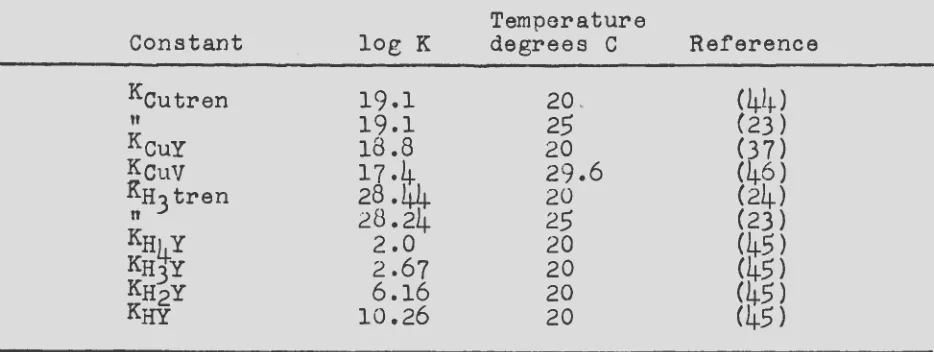
1 , {3" triaminotriethylamine, N(CH2-CH2-NH2)3, designated as "tren", are mixed together, the reaction shown below takes place (26).CuY-2 + H3tren+J + M+3~MY- + Cutren+2 + JH+ ( N)
If such a mixture is titrated with NaOH, three formula weights of the base are used in a buffer region between pH
4
and 5.5.The tri-(~-aminoethyl)-amine, "tren", is a strong triprotonic base with pK values of 10.29, 9-59, and 8.)6. These ionization
constants can be expressed as follows:
The amine, "tren 1, forms a very stable complex with the copper II
ion (44).
Kcutren
=
~Cutren_7
=
1019.1TcuJ~trenJ
(10)This stability constant was determined from the equilibriUm constant of reaction (V) which exhibits a buTfer action in the pH range 3.9 to
4.8.
(V)
Because of the greater proton affinitJT of the base "tren!' compared to the anion "Y", the complex Cutren+2 is less stable than the complex CuY-2 in a pH range below
8.5.
If NaOH is added to an equivalent mixture of Cuy-2 and HJ tren+3, a buffer region is ob-served in the pH range8.5
to 9.5 during which the copper exchanges from the "Y" to the "trenn. Such a reaction is expressed asfollows:
If a second cation capable of being complexed by the chelating
agent 11Y" is added during the neutralization, not only two, but
three hydrogen ions can be neutralized in a buffer region much
lower than than observed for reaction VI. If the second cation is a rare earth, the buffer region exists between pH 4 and
5.5
and the reaction is expressed by equation IV. The chemical
re-action expressed by equation IV is the basic rere-action involved in the potentiometric determination of the rare earth-EDTA sta-bility constants.
The equilibrium constant for reaction IV can be expressed as follows:
Kcutren KMY
-
i\ri3
tren KcuY{11)
The quantity "a" which will be used subsequently, denotes the number of equivalents of sodium hydroxide added to the reaction expressed by equation IV per mole of rare earth in the solution.
Before KIV can be calculated, the equilibrium concentration of five of the six concentration terms expressed in equation (11)
must be evaluated. The hydrogen ion concentration is measured
directly.
Five material balance equations can be written as follows:
~cuJt
=
c=
~Cutren_7 + ~CuY_7 + ~cu_7 (a)LMJt
=
c= LMYJ
+ £Mtren_7 +/:MJ
(b)~YJt = c = £cuyJ
+
~MYJ + £H4YJ+
£H
3YJ
+
LH2YJ
+·
LHYJ
+£yJ
(c)£tren_7t
=
c=
£cutrenJ + £MtrenJ + £H3
tren_7 (12)+ ~H2trenJ + ~HtrenJ + £tren_7 (d)
LHJt
= c {3-a)=
LHJ
+
3LH3
trenJ+
2LH2 trenJ+
LHtrenJ+
4LH4YJ +3LH3YJ
+2~H
2
YJ
+
LHYJ
(e)These five equations express the concentrations of all possible
20 ISC-637
will be demonstrated later, many of them are insignificantly small and can be neglected.
If equation
(9)
is solved for ~tren_7 and this valuesubsti-tuted into equation (10), the result can be expressed as
~cu_7
=
L:cutren~H_73 K~tren
Kcutren H3tren
which can be substituted into equation (12a) to give the following:
~cu_7t
=
c=
~CuY_7
+
~Cutren_7
+
~Cutren_7z:H_73 K~tren
Kcutren H3tren
or
where
f:cu_7t = c = ~CuYJ
+
o<f:cutren_7o(
=
1+
~H.:Z3
K'tren
/:H3tren Kcutren
(13)
( llt-)
The rare earth stability constants and the copper-EDTA constant can be expressed as follows:
and
KMtren
=
/:Mtren_7?;ii.)£.
.
t£
.
enJ
KMY
=
~MY_7
LMJLYJ
KcuY
=
L
CuY_7["cuJTyJ
When ecm,ation (15) is solved for /:Mtren_7, equation
(9)
for~tren_/, and the two results substituted into equation (l2b), the latter equation can be simplified to give:
/:M_7t
=
c=
~MY_7
+~M_7
+ KMtren~M_7LH3tren_7
.
KH3tren /:H_73
(15)
(16)
or
/:MJ
t
= c =/:M':lJ
+LMJ {
1 + 1 } ,g - 1 (18)
where
(19)
The acid association equilibria of
EDTA
can be expressed by four equations.These four e~uations and e~uation
(17)
can be solved for the quantitiesL
H4YJ, LH3Y_/, /:H 2YJ,LHYJ
and/:YJ.
LHYJ
=
KHYf:yJ£'n.J
(a)LH2YJ
= RH2Yf:yJ /:HJ2
LHJYJ
=
KHJY/:YJ f:n.J3
LH4YJ
= RH4Y/:YJf:n.J4
Upon substitution of these quantities into latter may be simplified to the following:
/:YJt
= c =/:MYJ
+f:cuYJ .
f
l + l +LHJ
KHY +LHJ
2KH2Y
+LHJ3
RHJI
+LHJ4
KHIIY}
l
f:cuJ
KcuYor
22 ISC-637
where
¢
=
1 +LHJ
KHY +!:HJ
2 RH2Y +LHJ3
KH3Y + LHJ4KH4Y· (22)The acid association equilibria of H3 tren can be expressed by three equations.
K = /:Htren_7
Htren
LHJZ*tren~
KH3tren
=
~~~~itren:J
The following expressions can be obtained from the above three equations and from equation (15).
/:MtrenJ =
~H3tren_7
KMtren (23)H .KH3tren
~tren_7
=L:H~en_7
(24)
LH
J RH3tren/:HtrenJ
=
LH),rimJ
(25)· z=H 2 KH2tren KH3tren
and
LH2trenJ
=
LH:7ren_7LH
KH3tren(26)
It will be noted that equations (23), (24), (25), and (26) express
the concentration of the various "tren" species in terms of known
constants, the single concentration /:H3 tren_7, and the hydrogen
ion concentration. Equation (12d) can, therefore, be simplified
or
LtrenJ
t
=
c=
LcutrenJ
+ /{
LH3
trenJ
+
LMJ {
e
1 1}
(27)
where
The three "tren" terms in equation (12e) can be combined by the use of equations (25) and (26) to the following simplified expression:
(28)
LHtrenJ + 2LH2trenJ + 3LH3trenJ
=
a
LH3trenJ (29)where
t = 3 +
1 + 2 (30)LHJ
2 KH 2 tren KH3tren~HJ
KH3trenBy the use of equations (17) and (20), the last four terms in equation (12e) can be simplified as follows:
LHYJ
+2LH2YJ
+3LH3YJ
+ 4LH4YJ=
KHYLHJLCuYJ
L"cuJ
KcuY+ 2
KH
2YLCuYJLHJ2
KcuY
TcuJ
+ 4 RH
4
Y £cuy_7£H_74KcuY
TcuJ
or
where
=
f:cuYJ
fJ
f:cuJ
KcuYISC~637
Then by combining equations (29) and (31) with equation (l2e) latter can be simplified to give the expression
/:HJt
=
c(3-a)=
/:HJ
+$
.CH3 trenJ +f:cuYJ
;tJ
f:cuJ
KcuY0
The five material balance equations, in a more usable form are grouped together below.
£"cuJt
=
c=
.CcuYJ
+ o<£cutrenJLMJt
=
c
=
[wrJ
+
LMJ
[1
+
9: 1
J
LYJ
t=
c=
.CMYJ
+.CcuYJ
f
l +¢
J
l
TcuJ
KcuYf:trenJt
= c =£cutrenJ
+
/J £H
3
trenJ
+
LMJ
[e
LHJt
=
cO-,af.
-;::
,
£HJ
+~["'H
3
trenJ+
LCuYJ
;0
.
.CcuJ
KcuY(a)
(o)
(c)
1 11
(d) (e)(31)
(32)
the
(33)
The coefficients in the above equations are defined in the following equations.
o(
=
1 +LHJ3
KH3tren LH3trenJ Kcutrene
=
l +LHJ3
KHJtren LH3trenJ KMtren(ia)
I=
LHJ
KHY +2LHJ2
KH2Y +3LH_73
KH y + 4£HJ4 KH4Y (d) 3'a
= 1 + 1 + 1LHJ3
RH3 trenLHJ2
KH 2 tren KH3tren+ 1 (e)
LHJ
KH3 tren~
= 1 + 2 + 3 (f)LHJ
2 KH2tren KH3trenTHJ
KH3tren
The equations (34a) to (34e) are very general, but they can be simplified considerably because of the experimental conditions
(such as the pH range and the magnitude of the various constants involved) encountered in the measurements of the rare earth com-plexes with both EDTA and HEDTA. Each equation will be discussed
individually.
(35)
Equation (34a) is valid if no complexes are formed in which both 11tren11 and "Y" are bound to the same copper ion. Since "tren" is tetradentate and "Y" is hexadentate, each is capable of indi-vidually satisfying the coordination number of copper and i t seems unlikely that mixed complexes would form.
In order to solve unambiguously equation (34b) i t would be necessary to know the stability constants of the possible complexes formed between the rare earths and "tren11 , as defined by equation
(15). These constants have not been measured. However, since
no one has been able to measure any very stable rare earth-ammonium type complexes, it seems very unlikely that any rare earth-tren complexes that might exist would be more stable than the Mst8en+2 or
8
Fgtren+2 complexes which have stability constants of 10 • and 10 • respectively. Because the constant KMtren can affect equa-tion (34b) only through 11811 , and because KMtren occurs in equation(35b) as a term in the denominator, the numerator of which contains the extre~ely large constant KH3 tren (see equation
9),
i t can be26
ISC-637Consequently, the expression is very nearly equal
to one and equation is reduced to two terms, and
LMJ.
Because of the pH range involved, there is very little, if
any, uncomplexed "Y". Consequently, the term
f
3
1
{ Tcu
KcuY}in equation (34c) was found to be insignif icantly small compared to unity. The right side of e~ation C34c), therefore, is
simpli-fied to two terms,
LMYJ
andL
CuYJ.
Equation (3)Ld) also can be simplified to two terms. The
"0
n term was shown by calculation of the experimental data to beessentially unity. This is that the terms L"H2 tren_7, LHtren_7,
and L"tren~ are so small that they can be neglected in t~e pH
range concerned. Since nerr is very large, the
termL~ ~
1!
is a}very small fraction. This makes the product term
LM_7{
le -
1 insignificantly small and reduces equation (34d) to the two terms LCutren_7 and LH3 tren_7.Because of the magni
tud~
o:ffJ
compared to the large value ofKcuY' the last term in equation (34e) is also very small. This can
be shown by evaluating the term directly from the experimental data. The term 11
S
n was found to equal three for all of the rareearth measurements. Thus, equation (34e) also reduces to two terms,
LH_7 and 3LH3tren_7.
It is now possible to write all of the material balance equations as they apply to the EDTA and HEDTA complexes of the rare earths.
LCuJt
=
c= LCuY_7
+ o<f:cutren_7 (a)LM_7t
=
c= LMY_7
+LM_7
(b)LY_7t =
c= LMY_7
+LCuY_7
(c) (36)L"tren_7t
=
c=
L"cutren_7 + LH3 tren_7 (d)~he reactants in equation IV were all initially present in
0.001 M concentrations. Consequently, the 11c11 term in equation
(36) had a value of 0.001. The experimental data consisted of
five 11a11 values and five corresponding pH values for each rare
earth constant measured. Since only one 11a11 value with its
cor-responding pH value is necessary to calculate a stability constant,
this method provides five checks on each constant determined. 1be
method of calculation is quite simple. From the known values of
11 c11 , the experimentally determined values of ''a" and
LHJ,
equa-tion (36e) is solved for the quantity ;-H3tren_?. This quantity
is then substituted into equation (35aT and II
ex
II is calculated.Then equations (36d), (36a), (36c), andj36bl are solved in that
order. The quantities z-MY~, £"cutren ,
L
HJ,
~CuYJ1LH
3 trenJ andLMJ
are substituted into equation (ll) and solvedfor Krv· Since the values of the constants Kcutren' RH 3 tren
and KcuY are known from previous measurements, the desired constant
Kl\1Y is readily obtained from equation (ll).
TL~e polarographic method
This method is based upon the fact that it is possible to
measure the concentration of free uncomplexed copper II ions in
the presence of the copper complex, CuY-2, by polarographic means.
If equal molar amounts of the disodium copper salt of
BDTA,
Na 2 CuY, and rare earth nitrate, M (NOJ) j , are allowed to
equili-brate, the rare earth ion competes Wltn the copper ion for the
complexing agent.
(VII)
In such a solution, two separate individual polarographic waves are
produced by the reduction of cu+2 and of CuY-2. The first of these
has the shape of a two-electron wave with El/2
=
-0.04 V vs. SCE(versus saturated calomel electrode). It is due to the reduction
of cu+2 to the metal at the surface of the mercury drop. The
second is due to the reduction of the complex CuY-2, its El/2 being
-0.32 V (for the copper
HEDTA
complex, the E1L2 occurs at ~out-0.2 V vs, SCE). Between the two waves the diffusion current, id,
remains constant and is proportional to the concentration of free
uncomplexed copper II present in the solution. Reference id values
were obtained for 100% uncomplexed copper and for 100% complexed
copper by obtaining polarograms of solutions containing Cuso4 and Na2CuY respectively. The percentage of uncomplexed copper was
calculated from a comparison of the id value for each of the rare
28 ISC-637
Since the reactants were initially present in equal molar quantities, i t is obvious from equation VII that
L"nJ
=
f:cuJ
and
£"cuYJ
=
f:MJ
=
c -f:cuJ
where "c" is the initial concentration of both reactants. The equilibrium constant for equation VII can be written as follows:
Kvii
=
L"cuJL"MYJ
LCuYJL"MJ
=
£"cuJ2(c -£"cuJ)2
Division of equation (16) by equation (17) gives
Kvii
therefore,
KMY
=
KLCuJ2
-
K (% Cu)2CuY /_(c- £"cuJ)2 - CuY (100 -
%
Cu)Z(3 7)
(38)
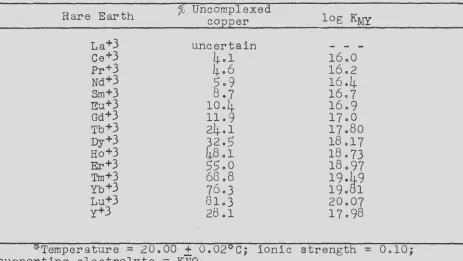
It is obvious that the stability constants for the rare earth complexes can be calculated by substituting the polarographically measured percentage of uncomplexed copper and the known stability
constant for the copper complex into equation (38).
Determination of the acid association constants of HEDTA
A knowledge of the acid association constants of a chelating agent is necessary before the stability of the complex formed between the chelating agent and a metal ion can be determined by the poten-tiometric method. The constants of EDTA have been determined by Schwarzenbach
(45)
at 20°C and an ionic strength of 0.10. Since the stability constants of the rare earths with EDTA were measured at 20°C and an ionic strength of 0.10, Schwarzenbach's values were used in the calculations.Values of the acid association constants of HEDTA have been reported in the literature (46), but they were measured at 29.6°C.
under the same conditions as were used to measure the rare
earth-HEDTA stability constants; namely, 25°C and a solution ionic .
strength of 0.10.
Determination of K1 and K2• ~he titration curve of HEDTA
with
standard
KOH!s
typicalo!
a dibasic acid of moderate strength,having two separate inflection points at ~
=
l and ~=
2, where ~ represents the fraction of the total replacable hydrogen that hasbeentitrated. The third inflection point is absent due to the
extensive hydrolysis of the trivalent anion. Because of the sepa-ration in the inflection points corresponding to K1 and K2 , the problem of determining these two constants is very similar to that for determining KA for a simple monobasic weak acid.
In the vicinity of~ = 0.5, only the species
n
3
v
and H2v-
needbe considered. Likewise, only the species H2
v-
and mr-2 need beconsidered in the resion around a
=
1.5. Therefore, the two acid association constants can be expressed asKl = LH3V
7
L"HJLH2vJ
=
(fraction untitrated) LHJ(fraction titrated)LH2VJ
__
(fraction unti trated)K2 =
~~~~----LHJLHV_7
£"r-rJ(fraction titrated)(39)
where "V" represents the anion of HEDTA. These two equations can
be simplified.
K
l -_ (1-a)
L
H
J
aUpon converting to logarithms,
log K1
=
-logLHJ
+ log (l - a) a=
-logLHJ
+ log (2 - a)(~ - l)
= (2 - a)
LHJ(g -
1)The first association constant, as defined by equation
(39),
can be calculated from a titration curve of HEDTA by substituting