Identifying the issues of team project work for distance
education students: a case study in Civil Engineering
Yan Zhuge
University of Southern Queensland, Brisbane, Australia [email protected]
Julie. E. Mills
University of South Australia, Adelaide, Australia [email protected]
Abstract: Project based learning has been introduced to a final year structural design course at the University of Southern Queensland (USQ) recently and one requirement associated with the project is teamwork. Unfortunately, teamwork is uncommon in the current engineering program at the USQ, mainly due to the fact that around 80% of its students are distance education students. When the design project was given to students at the beginning of the course, the idea of teamwork was welcome. Surprisingly, after the projects were submitted, it was found that most students chose to work individually. An evaluation was then conducted to explore why students chose not to work in teams, and particularly to determine the barriers that prevented it for distance education students. This paper will discuss the analysis of student feedback, compare the responses between distance education and on-campus students and explore potential means of overcoming these issues.
Introduction
It is well known nowadays that engineering students must have high levels of teamwork skills and this has been incorporated into the graduate qualities or attributes requirements of most universities. A student must learn not only the technical side of engineering, but also skills of listening and communicating, both verbally and in writing. The professional accreditation body in Australia (Engineers Australia), along with similar accrediting bodies internationally (e.g. ABET in the USA), emphasizes teamwork skills as a key competency expected of engineering graduates (Engineers Australia 2008; ABET 2009). Although many universities have recognised the need to assign group projects to develop these skills and have begun efforts to improve engineering curricula in this regard, students seldom receive any specific training on how to function collaboratively before such
assignments are given (Lingard 2010). More importantly, students do not learn much from
participating on dysfunctional teams and often develop negative views about the value of teamwork (Swan 1994).
Project based learning has been introduced to a final year structural design course at the University of Southern Queensland (USQ) recently and one requirement associated with the project is teamwork. Extensive evaluation of project work undertaken by both authors in the University of South Australia had demonstrated the benefits of the approach for both students and lecturers, so the model was also adopted at USQ when the first author relocated there. The University of Southern Queensland is one of Australia’s leading regional universities and is noted for excellence in distance education (Brodie & Porter 2004). There are approximately 3000 students enrolled in the Faculty of Engineering and Surveying programs and around 80% of these students are distance education students.
course, the idea of teamwork was welcomed by most students, even though many were unclear about the concept. Surprisingly, after the projects were submitted, it was found that most students chose to work individually. An evaluation was then conducted to explore why students chose not to work in teams, and particularly to determine the barriers that prevented it for distance education students. This paper will discuss the analysis results of student feedback, compare the responses between distance education and on-campus students, and explore potential means of overcoming these issues.
Background
The Faculty of Engineering and Surveying at the University of Southern Queensland introduced a series of Problem Based Learning (PBL)/Problem Solving courses as part of the curriculum since 2001 to assist in meeting the accreditation requirements for teamwork and problem solving (Aravinthan & Fahey 2004). There are four courses in the series, one course in each year of the program, and each has an emphasis on PBL and team-based approaches. The foundation course in first year has key learning objectives that include “developing teamwork skills, communication abilities using electronic media plus rapid learning and application of targeted technical skills” (Brodie & Porter 2004). In this series of courses, the students are required to work in a team of six to eight students. While on-campus student teams meet face to face, external teams have to rely on virtual meetings using the internet and Web (Brodie & Porter 2004).
Aravinthan & Fahey (2004) reported that the external student teams reported fewer problems than on-campus student teams, as they were more mature and better suited to teamwork. Unlike on-on-campus students, external students did not meet their fellow team members face-to-face. It was concluded that this therefore minimised their opportunity to form adverse judgement and opinions about their fellow team members.
It has been noted that in this series of courses, around 80% of the assessment was for team reports (Brodie & Porter 2004, Aravinthan & Fahey 2004) which meant it was compulsory for all students to work in teams, even if they may not have wished to do so. However, their analysis of outcomes also indicated that there was a high rate of non-participating members. For the Problem Solving 2 course, 70.5% and 60% of teams recorded at least one vote of non-participation against one of the team members in 2002 and 2003 respectively. The student evaluation indicated that most students viewed the courses favourably overall, but it was not clear what percentage of students were in favour of teamwork.
Course overview
Structural Design II is a final year design course at USQ that represents the end point of many other courses including: Engineering Statics, Stress Analysis, Structural Design I, Concrete Structures and Structural Analysis. The course aims to apply the knowledge and skills developed in these earlier courses to the design of some standard structural systems and buildings. There are three core units in
Structural Design II:
Structural analysis using computer software;
Advanced concrete design (including strut-and-tie-model); and Advanced steel design (including wind loads).
About 50 to 60 students enrol in this course annually and over 80% of them are studying externally. The steel design unit makes up 50% of the course and the design project was first introduced when the first author took over the course in 2009. In that year, the steel design project was individual and a teamwork approach was not introduced. In 2010, the first author attempted to introduce teamwork into the design project in order to reflect the requirement for graduates attributes such as:
The ability to contribute effectively as a member of a team; The ability to communicate effectively; and
Organisation and time management skills.
groups. The first author also had extensive experience of using small group projects in two other structural design related courses at UniSA. The group projects in all of these courses had always been noted by students in course evaluations as being one of the best aspects of the courses. Although an explicit problem solving series of courses is not used at UniSA, the students do undertake group projects in at least two or more courses in every year of the program, and hence it was felt that the preparation of students for structural design projects to be carried out in pairs in a final year course would be very similar at both universities.
In contrast to the Problem Solving courses at USQ where teamwork was compulsory, the steel design project in Structural Design II was arranged in such a way that students were encouraged to work in pairs, but students did have the option to choose to work individually if they prefer. However, if they chose to work individually then overall work required was certainly greater than 50% of a project done as a pair, even though some reduction in project tasks was allowed for an individual. When the design project was given to students at the beginning of the course, the idea of teamwork was welcomed and the first author was confident that most students would choose to work in teams, given their previous exposure to this in the Problem Solving courses and also because of the potential for reduced
workload. However, during the project consultation times with on-campus students, it was found that most of them did not intend to submit the project as part of a pair, even though some of them were actually working together to complete the project. Although students were encouraged to consult with others undertaking the project to share ideas about approaches to the design and solving problems in consultation, each pair was expected to submit a project that was their own independent work. Due to the nature of design and the number of different potential assumptions and decisions that can be made during the project it is extremely unlikely that any two pairs of students will develop identical
solutions to the project, and hence plagiarism is relatively straightforward to detect.
Course evaluation
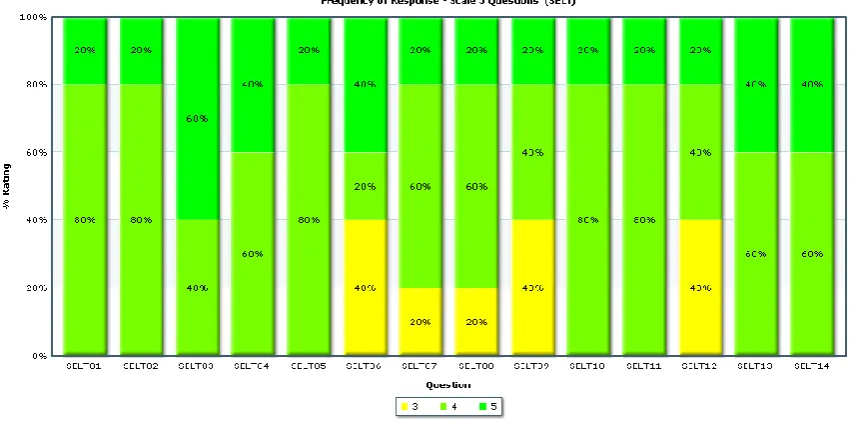
At the end of the course, Student Evaluation of the Courses (SEC) and Student Evaluation of Learning and Teaching (SELT) on-line surveys were conducted. The students were asked to rate how well they agreed with a number of statements regarding the course using a Likert scale of 1 to 5. A score of 5 means that the student strongly agreed with the statement whereas a score of 1 means that the student strongly disagreed with the statement. One of the major aims of the steel design project in Structural Design II was to promote Project Based Learning and therefore encourage students to develop critical thinking and independent learning skills, along with developing both their written and oral
[image:3.595.76.502.507.718.2]communication skills and teamwork skills (Zhuge & Mills 2009).
Figure 1: Student evaluation of teaching for Structural Design II, 2010
statements that are somewhat related to this aim: SELT04 (The staff member used teaching methods which were very effective in helping me to learn), SELT10 (as a result of this staff member’s teaching I have learned to apply principles from this course to new situations); SELT13 (The staff member was very effective in helping to develop knowledge, understanding and skills) and SELT 14 (As a result of this staff member’s teaching I have learned something which I consider valuable).
The choice for and against teamwork
After the design projects for Structural Design II were submitted, it was found that only one report of 15 submitted (6.7%) was produced by a pair of on-campus students, with all other reports being individual. This was despite the fact that the on-campus students did not have a problem with meeting physically to work on the project together. While marking the reports, the first author noticed that two pairs of students were apparently working together due the similarity of their reports. However, those students chose to submit individual reports and thus risk an accusation of plagiarism rather than submitting the work as a pair. After a meeting with the students, it was found out that the students assumed that they were allowed to work together as a pair, however, they were under the wrong impression that they were required to submit individual report. The students received the same mark in the end, but it is clearly indicated that some students, especially international students (they are all international students) are unclear of the concept of the team work. Further investigation indicated that those international students were new to USQ to undertake a course work Master program and
Structural Design II was one of the courses of the program. Therefore, one of the issues contributed to the failure of team work for on-campus students would be that the instructions and explanations for students were insufficient. In the future, the concept and advantage of team work should be
introduced before the project implementation. Some basic trainings on how to work collaboratively would also benefit.
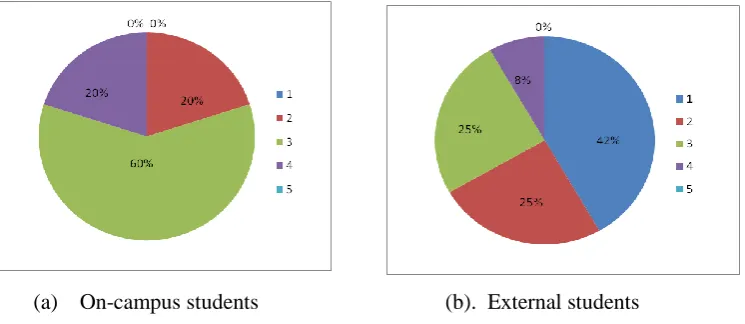
Surprisingly a higher percentage of external students chose to work in pairs with four of 26 (15.4 %) reports produced by pairs and no plagiarism being found. The authors were quite surprised with the results as the initial belief was that a large number of on-campus students would choose to work in teams and the number would be reduced for external students due to the difficulties of face to face communication. Two additional statements regarding teamwork in the design project were added to the standard evaluation instrument. For the first statement: “I like the idea of teamwork in steel design project”, an average score of 2 and 3 was received from external and on-campus students respectively. As indicated in Figure 2(b) for external students, 42% students strongly disagreed with the statement; only 8% of students agreed and no one strongly agreed. The on-campus students seemed slightly more in favour of the idea of teamwork (Figure 2(a)) since 60% of students were neutral (a score of 3), 20% of students agreed and no one strongly disagreed with the statement.
[image:4.595.123.496.531.693.2]
(a) On-campus students (b). External students
Figure 2: Students response to “I like the idea of team work”
Only one student commented on the statement “I like the idea of teamwork in steel design project” as follows: “It is nice to have the option, but difficult for external students to manage without meeting
Many students provided a written response to the second statement: “I chose to work individually in steel design project, because:” and the comments could be categorised as relating to three major issues (comments are from external students unless noted otherwise):
1. Knowledge issues: the belief that teamwork will reduce the understanding of the subject due to “shared work load”
You come to an understanding of all the content involved and not just your “area” of the assignment. (on-campus student)
I like to work individually as I gain a greater understanding.
It was going to be too hard to organise a partner as I had a very hard time getting up to speed with all the required knowledge and I felt like I would have possibly let them down. Also could have gone the other way.
It is a bit hard for external students to do that because the team work includes tossing around ideas, etc which is not quite possible on the net. I also found that I learned more doing it myself and also was a bit hesitant to have to rely on another student that I do not know and have no idea on how good her/his understanding of the subject is.
2. Partner issues
I wasted too much time looking for partners so I just did it myself (on-campus student). I have found in the past, that other students have taken advantage of my skills and
knowledge.
There is no one in my location that was doing the subject. I feel that it is very difficult to find someone to do group work with when you can not actually meet together, although we have done this in other subjects. I find it is much easier and a lot less hassles just to do it myself.
3. Flexible time management issues
It was more convenient for me. I have very little time available for organising meetings and dividing up tasks. The hours that I have available to study are either later at night or early morning due to work and family commitments, which may not suit a teammate. I also like to be responsible for my own marks and not depending on others to get a good grade.
Discussion
Although there was no SELT question that explicitly related to communication and teamwork skills, the written responses to the second additional question on the reasons for not choosing to undertake the design project in a team provide some interesting insights. It appears that even though the students have been given previous opportunities to develop their communication and teamwork skills in the earlier years Problem Solving series of courses, they chose not to apply such skills where the requirement for teamwork was not compulsory, regardless of whether they were on-campus or external students. For external students, the reasons for this could be easily identified as the difficulties of organising face to face contact or working together without it. These include the difficulty in developing relationships with team members you have never met; not living in the same areas and different time schedules. For on-campus students, the issues are not so clear. However, a majority of both groups of students believed that they would learn better with individual work.
be made more explicit and that the reality of project work in practice, particularly for large structural design projects, should be discussed when the project is introduced to the students in the course.
Some of the other student comments indicate that they may not have had a positive experience of teamwork in the past, since the value of learning through discussion with others and the management of teamwork so that all students gain some understanding of all areas of a project appear not to be understood. This, of course, may also relate to the learning styles of particular individuals being more reflective than active. Some students also implied that they believed that the assessment of past team projects had not always been reflective of the effort of all contributors. This is an issue that must always be addressed carefully in team projects through the use of things such as peer assessment and multiple assessment strategies (Mills, 2007).
Conclusions
Although teamwork and communication are critical and required skills that must be developed in engineering undergraduate programs, this is not easy to achieve. Project based learning, using group or small team projects, offers an excellent opportunity for students to develop such skills. Specific difficulties are faced by distance education students in participating in team projects, however the use of on-line communication technologies can overcome these.
The reluctance of students to adopt a small team option in preference to working individually for a final year design project in a university program and the reasons they gave for this choice have been explored in this paper. This preference was surprising in a situation where all students have previously been exposed to team projects in a number of courses during their program. Also surprising was that the choice to work as an individual was more common for on-campus students than for distance education students. This indicates that continual attention must be paid to both the processes and practices involved in the introduction and conduct of team projects to ensure that these skills are developed for all students, regardless of their location. It is also essential to ensure that students recognize that these skills are transferable from one course context to another and to ensure that team assessment processes are fair and transparent. Finally, the reason for requiring students to work in teams for projects need to be made explicit and placed in the industry context relevant to the task, in order to encourage students to commit to a team approach.
References
ABET (2009). Criteria for accrediting engineering programs. ABET, Inc. Baltimore.
Aravinthan, T. & Fahey, P. (2004). Evaluation of students performance in engineering problem solving course from a dual mode delivery, Proceedings of the 15th AaeE (pp. 239-248). Toowoomba, Australia.
Brodie, L.M. & Porter, M. A. (2004). Experience in engineering problem solving for on-campus and distance education students, Proceedings of the 15th AaeE (pp. 318-323). Toowoomba, Australia.
Engineers Australia (2008). Accreditation criteria summary. Accreditation management system document no. S02, Issued 30/08/08. Engineers Australia.
Lingard, R. W. (2010). Teaching and assessing teamwork skills in engineering and computer science. Journal of Systemics, Cybernetics and Informatics, 18(1), 34-37.
Mills, J.E. (2007). Multiple assessment strategies for capstone civil engineering class design project. Proceedings of the 2007 Australasian Conference for the Australasian Association for Engineering Education Melbourne, Australia.
Swan, B. R. (1994). A preliminary analysis of factors affecting engineering design team performance,
Proceedings of the 1994 American Society for Engineering Education annual conference (pp. 2572-2589). Edmonton, Canada.
Zhuge, Y. & Mills, J. E. (2009). Teaching Finite Element modelling at the undergraduate level: A PBL approach, Proceedings of the AaeE 2009. Adelaide, Australia.