A Methodology for the Design and
Implementation of a Functional Object Database
using Haskell
Linda Louise Dawson
(B.Sc. (Syd.), Grad Dip. (Eng. Dev.) (UNSW)
Thesis submitted in fulfilment
of the requirements of the degree of
Master of Science
Department of Computer Science
University of Tasmania
Declaration
Except where stated herein, this thesis contains no material which has been accepted for the award of any other degree or diploma in any
university. To the best of my knowledge and belief, this thesis contains no copy or paraphrase of material previously published or written by another person, except where due reference has been made in the text of the thesis.
Access to, and copying of, thesis
This thesis may be made available for loan and limited copying in accordance with the Copyright Act 1968.
Ab
stract
Semantic data modelling has been a traditional abstract way of
representing data and relationships between data for database systems. Recently database designers and developers have been looking to object oriented modelling methods which incorporate the modelling of behaviour as well as data and their relationships.
Databases can also be considered to be functional structures. All operations on databases are functional in that they return values.
Transaction and update operations return a new version of the database; queries return values contained in the database; and reports return values from the database in some strictly formatted form.
This thesis firstly develops an extended version of the Entity-Relationship model, called the Entity-Relationship-Object model (ERO model) that incorporates object oriented concepts including behaviour. Secondly, a methodology is defined for mapping this model directly to the functional. .
programminglanguage, Haskell, where all Entity and Relationship objects are implemented as abstract data types and all attributes and methods are implemented as functions.
Acknowledgements
I wish to express my gratitude to my supervisor, Dr Chris Keen, for his support and encouragement in the production of this thesis, particularly during the crucial initial and final stages.
I would also like to thank my colleagues in the Database Research Group for their support and, in particular, Simon Milton.
Table of Contents
Introduction
1
1.1 Overview
1
1.2 Aims
1
1.3 Definitions
2
1.4 Literature Summary
3
1.5 Chapter Overview
3
2 Background
5
2.1 Introduction
5
2.2 Semantic Data Models
5
2.3 Object Oriented Systems
13
2.4 Functional Systems
20
2.5 The Functional Programming Language Haskell 23
3 Data Model Design
31
3.1 Introduction
31
3.2 Analysis, Design and Implementation Methodology 31
3.3 An Entity-Relationship-Object Model
32
4 Implementation
42
4.1 Introduction
42
4.2 Conceptual Framework
42
4.3 The Haskell Environment
44
4.4 The Haskell Prototype
47
4.5 A Mapping Methodology for the Haskell Prototype 52
4.6 An Example
54
5 Discussion, Conclusions and Future Work
62
5.1 Advantages
62
5.2 Limitations
63
5.3 Future Work
66
Appendix
70
1 Introduction
1.1 Overview
This thesis investigates the design and implementation of an object-oriented database system in a functional programming language
environment. This involves two major areas of investigation. Firstly, the design of an object-oriented database being based on an object-oriented data model [Dobbie, 19911. Traditionally the design of databases has been based on semantic data models which capture the definition and meaning of data objects and the relationships between them. Object-oriented
modelling methods add behaviour to data models so that database users can manipulate data as well as store, retrieve and share data.
Secondly, the implementation is based on a functional programming environment since databases may be considered to be inherently functional structures in that all operations on databases return values. Transaction and update operations return a new version of the database; queries return values contained in the database; and reports return values from the database in some strictly formatted form. The system developed here deals with update operations and some reporting functions but not query facilities.
Although there are two development aspects addressed in this project, the overall methodology is based on Henderson-Sellers' [1992] general object-oriented software development methodology. Henderson-Sellers [1992] offers a general methodological framework that can variously incorporate functional or object-oriented analysis and object-oriented design together with object-oriented or imperative implementation environments. The methodology here uses object-oriented analysis, object-oriented design and a functional programming language implementation.
1.2 Aims
information about both data and its behaviour. This model should lend itself to direct implementation in a programming language that provides a high level of data abstraction, polymorphism and rich typing.
The second aim of this project is to investigate the properties of functional programming languages, using a standard accessible language, Haskell [Hudak, 19921, for the implementation of an object-oriented database.
There are several new ideas presented in this thesis. A new data model, the ERO model, has been developed which combines the characteristics of semantic data models and object data models and also provides a higher level of abstraction than either of these models by treating both entities and relationships as classes of the same polymorphic type. This model is also directly implementable in any language which offers polymorphism, data abstraction in the form of abstract data types (ADTs) and modularity.
This project provides a new variant of Henderson-Sellers' [1992] object-oriented development methodology. This new methodology is applicable to database development, incorporates the ERO model at the design stage and provides a methodology for mapping the ERO model directly to a functional programming language where all entities and relationships are implemented as abstract data types and all attributes and methods are implemented as functions.
The data abstraction, modularity and polymorphism provided in the models and their implementation allow for easy schema extension and modification. Lazy evaluation in the implementation allows for a simple form of persistent data store.
1.3 Definitions
Entity-Relationship (ER) models [Chen, 1976, Hansen and Hansen, 1992] provide semantic information about data objects, called
entities,
orcollections of data objects, called
entity classes,
and the relationshipsbetween them, called
relationships.
polymorphic collections of data objects, classes, and relationships between
them, called associations. OMT models also provide information about
the behaviour of objects as operations which are implemented as methods.
1.4 Literature Summary
The Entity-Relationship Model was first proposed by Chen [1976]. This model has been extended or enhanced by several authors including Elmasri, Weeldreyer and Hevner [1985], Elmasri and Navathe [1989] and Hansen and Hansen [1992]. Nijssen and Halpin [1989] have proposed a fact-oriented data modelling technique. Object data models and notations have been proposed by Rumbaugh et al [1991] and Henderson-Sellers [1992]. Object-oriented design methodologies have been proposed by Beck and Cunningham [1989], Boehm [1988], Booch [1986], Henderson-Sellers [1992] and Shlaer and Mellor [1989]. The characteristics of object-oriented databases have been defined by various authors including Atkinson et al [1990], Dobbie [1991] and Fong et al [1991]. Functional databases were proposed by Nikhil [1985] and the functional programming language, Haskell, has been developed, and is still being upgraded, by a group of several researchers. The most recent version is defined in the report on Version 1.2 in Hudak et al [1992].
1.5 Chapter Overview
Chapter 2 provides background in four major areas: semantic data
modelling with particular reference to Entity-Relationship models [Chen, 1976] and Extended-Entity-Relationship models [Hansen and Hansen, 1992, and Elmasri and Navathe, 1989]; object oriented systems including object models, object-oriented development methodologies and object-oriented database systems; functional systems including functional programming languages and functional databases; and the functional programming language, Haskell [Hudak et al, 1992] with particular reference to the implementation of object-oriented systems.
of Rumbaugh et al [1991] and Henderson-Sellers [1992]. This combination provides an ER model that incorporates behaviour for both entities and relationships.
Chapter 4 describes the implementation of an ERO model as a simple database system within a functional programming environment. The conceptual framework is described for mapping an ERO model to an integrated implementation system where every entity and relationship is treated as a class. Considerations for mapping this conceptual framework to a functional programming environment using the functional
programming language, Haskell are discussed and a specific Haskell prototype is described. A detailed example is shown providing specific program code within an implemented Haskell prototype.
2 Background
2.1 Introduction
This chapter provides background in four major areas. The first area is semantic data modelling with particular reference to Entity-Relationship models [Chen, 19761 and Extended-Entity-Relationship models [Hansen and Hansen, 1992, and Elmasri and Navathe, 1989]. The second area discussed is object oriented systems including object models, object-oriented development methodologies and object-object-oriented database systems. Thirdly, functional systems are discussed including functional programming languages and functional databases. Finally, there is a discussion of the functional programming language, Haskell [Hudak et al, 19921 with particular reference to the implementation of object-oriented systems.
The marriage of concepts and features from all these areas may be considered to be useful in addressing the problem that modern database systems suffer in that they lack the rich type systems, expressive power and data abstraction that is available in modern programming languages. Conversely, modern programming languages deal inadequately with the persistent (long lived) structured data that is required by modern
databases. This causes an unnecessary "semantic mismatch" [Nikhil 1985] between programming languages and databases. This mismatch needs to be overcome so that truly flexible and general database systems can be developed.
2.2 Semantic Data Models
Codd's [1970] relational data model provided a model that is independent of the details of the physical implementation. Since then a number of data models have been developed to extend Codd's original concept so that a model can more faithfully represent the
meaning
of the modelledAlthough there is no concensus on one particular model, Peckham and Maryanski [1988] present a survey of semantic data models whose "one unifying characteristic is that they attempt to provide more semantic content than the relational model.".
Peckham and Maryanski [1988] discuss four main characteristics that are represented in many of the semantic data models.
Generalisation and Specialisation -
Generalisations can be formed byconsidering a set of concepts and identifying common elements that characterise the set. For example, vehicles can be considered to be a
generalisation of cars, trucks and motorcycles. Specialisation is the inverse of generalisation and in the above example a car can be considered
a
specialisation of vehicle. "Generalisation is the means by which
differences among similar objects are ignored to form a higher order type in which the similarities are emphasised" [Peckham and Maryansld 19881. Generalisations can be considered to be "is-a" relationships i.e. a car is-a vehicle. Therefore, generalisation is a form of data abstraction that can be viewed as an inheritance relationship in the object oriented paradigm which provides a direct mapping of generalised relationships into a system's implementation.
Aggregation according to Peckham and Maryanski [1988] "... is the means
by which relationships between low-level types can be considered a high level type. The relational data model employs this concept by aggregating attributes to form a relation". Aggregation supports the representation of an abstraction from several smaller and simpler elements. In the simplest form this may correspond to the declaration of the components within a record but can also be seen to incorporate the concept of complex objects. Aggregation can be considered as a "has-a" relationship. For example, a person has-a name and a person has-a bank account.
Classification "... is a form of abstraction in which a collection of objects is
considered a higher level object class. Essentially it represents an is-instance-of relationship." [Peckham and Maryanski 1988]. Classification
Association
indicates that one abstraction serves as a container forinstances of other abstractions. It can be considered to represent set membership abstractions. For example, a car-person is-a member-of-the-set of people who drive cars.
Models surveyed by Peckham and Maryanski include SDM [Hammer and McLeod 1981] which organises a collection of entities into classes or types which specify member and class attributes, interclass connections and derivations rather than relationships between classes and the functional data model [Shipman 1981] which limits the constructs to entities and functions providing a direct language for data definition called DAPLEX. Nijssen and Halpin [1989] have proposed a conceptual schema design procedure (CSDP) as part of a methodology called NIAM (Nijssen's Information Analysis Methodology) which is also called fact-oriented modelling. NIAM provides a method for building a system design by starting with specific examples, a set of metaconcepts and a graphical notation and following a well-defined design procedure of nine steps.
In 1978 the ANSI/SPARC committee proposed a three level architecture for database systems consisting of external, conceptual and internal levels. The
external
level corresponds to the user's view of the data in theapplication domain. The
conceptual
level corresponds to a high level of logical design representing the meanings of entities or objects and the relationships between them. Theinternal
level corresponds to a physicalor implementable model of the database system. In an object oriented model these three levels represent application relationships between classes, class specification, and class implementations, respectively.
2.2.1 The Entity-Relationship Model
for the development of a new model that combines the features of semantic and object models.
The Entity-Relationship (ER) Model provides a simple diagrammatic notation for representing the essential details of entities or objects and the relationships between them. Its semantic modelling power comes from its simplicity and generality. There are no limitations placed on the types of entities or relationships that can be represented.
Entities
represent "things" identified in the domain that is beingmodelled. Entities can be physical or conceptual. For example, people, vehicles and books are physical entities and transactions, skills and bank accounts are conceptual entities. A set of entities with the same
characteristics is called an entity set or
entity class.
Arelationship
is alinking between two entities. For example, if an employee works in a particular department,
employee
anddepartment
can be consideredentities and
works in
is a relationship linking the two entities. Anattribute
is a named characteristic of an entity. The cardinality of arelationship between entity X and entity Y may be considered as the number of X's associated with a single Y and the number of Y's associated with each X. Cardinality can represent zero-to-many, one-to-many or many-to-many associations
2.2.2 Enhanced Entity Relationship Models
There have been several proposals for enhanced or extended entity-relationship models that incorporate additional semantic modelling concepts such as generalisation, classification and aggregation. Elmasri and Navathe [1989] propose an enhanced-ER or EER model based on an earlier Entity-Category-Relationship (ECR) model [Elmasri et al 1985]. The EER model incorporates the concepts of subclasses, superclasses,
specialisation, generalisation, categories and attribute inheritance.
Hansen and Hansen [1992] propose a model that incorporates standard ER notation (which models 'objects' rather than 'entities') plus specialisation and 'aggregate object sets'. There is no attempt to model behavior.
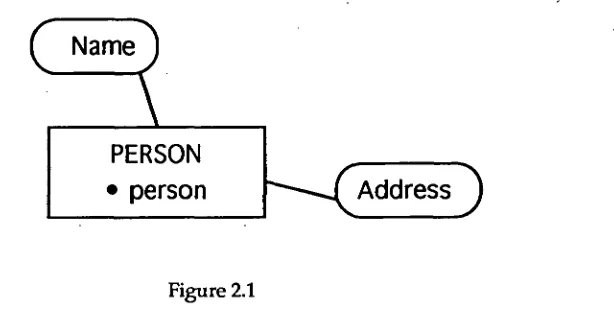
Object sets are represented as rectangles with the object set name inside it in upper case and an object instance can be represented as a point within the rectangle with its name in lower case. Attributes are represented as ellipses coming off a class rectangle. (see Figure 2.1)
Name
PERSON
[image:15.562.146.453.150.308.2]• person
Address )
Figure 2.1
The class PERSON contains an object called person. All objects of class person have the
attributes Name and Address.
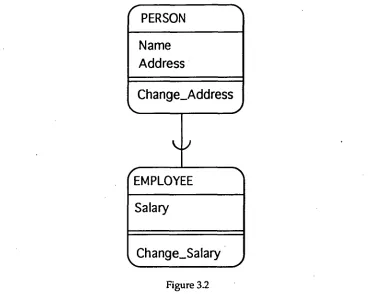
Specialisation-Generalisation or inheritance is represented as a U symbol (the same symbol is used by Elmasri and Navathe [1989]) where the open part of the U points to the super class (see Figure 2.2).
PERSON
[image:15.562.139.386.452.635.2]EMPLOYEE
Figure 22
An EMPLOYEE is a specialisation of PERSON.
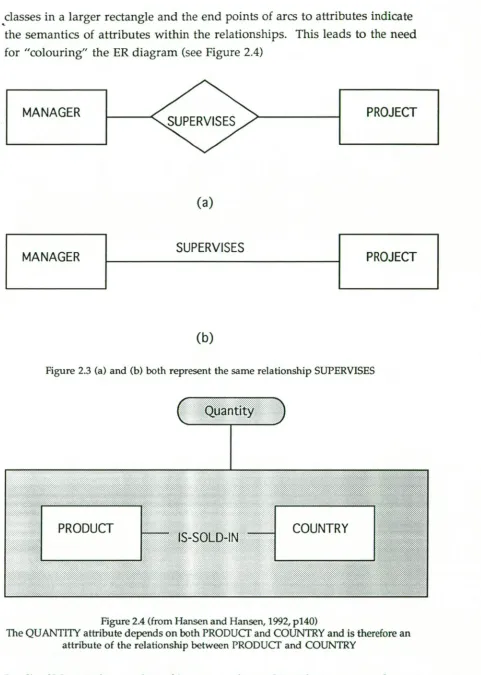
Hansen and Hansen [1992] view relationships that have their own
attributes as special object sets and define them as
aggregate object sets.
Auantity
classes in a larger rectangle and the end points of arcs to attributes indicate the semantics of attributes within the relationships. This leads to the need for "colouring" the ER diagram (see Figure 2.4)
MANAGER PROJECT
(a)
MANAGER SUPERVISES PROJECT
(b)
Figure 2.3 (a) and (b) both represent the same relationship SUPERVISES
Figure 2.4 (from Hansen and Hansen, 1992, p140)
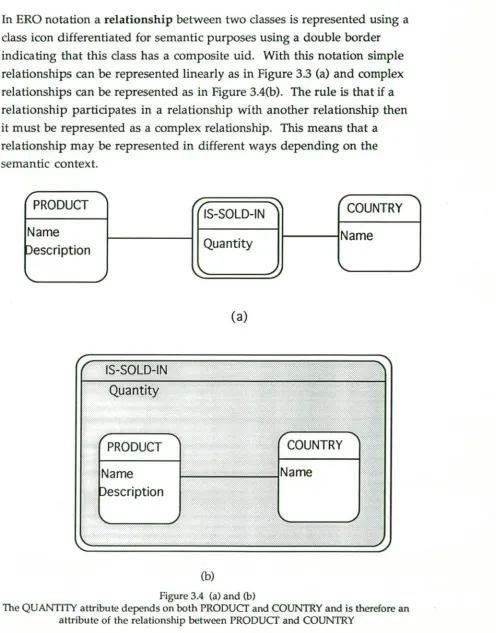
The QUANTITY attribute depends on both PRODUCT and COUNTRY and is therefore an attribute of the relationship between PRODUCT and COUNTRY
[image:16.562.43.524.57.732.2]"1" and "b" (indicating 'many') at the end of a relationship arc (see Figure 2.5)
IS-MARRIED-TO
HUSBAND WIFE
(a)
WORKS-IN
EMPLOYEE DEPARTMENT
(b)
TAKES
STUDENT COURSE
(c)
Figure 2.5
(a) A one-to-one relationship - a wife has one husband; a husband has one wife (b) An employee is in one department; a department has many employees
[image:17.565.43.482.61.626.2](c) A student takes many courses; a course has many students
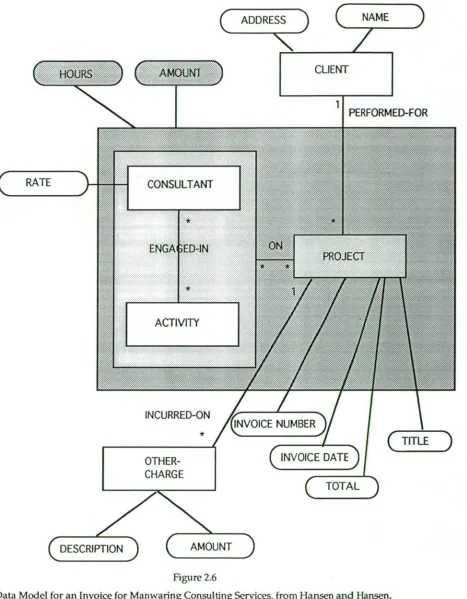
Figure 2.6 is an example of an EER model for a data model of an Invoice for Manwaring Consulting Services taken from Hansen and Hansen [1992] p 152. This model contains two relationships represented as aggregate object sets: ENGAGED-IN and ON which is a relationship between the entity PROJECT and the relationship ENGAGED-N. The use of
( ADDRESS NAME
CLIENT
PERFORMED-FOR
CONSULTANT
ENGAC ED-IN
ACTIVITY RATE
ON
PROJECT
INCURRED-ON
OTHER-CHARGE
INVOICE NUMBER
(INVOICE DATE
(TITLE )
TOTAL
[image:18.564.59.526.66.665.2](DESCRIPTION ) ( AMOUNT )
Figure 2.6
Data Model for an Invoice for Manwaring Consulting Services, from Hansen and Hansen, 1992.
model is suitable for modelling the entities and relationship for an invoice.
2.3 Object Oriented Systems
Although there seems to be no agreement as to exactly what constitutes an object-oriented system, a useful definition to adopt is Wegner [1987] in which a system which supports objects, classes and inheritance may be considered to be object-oriented. Object-oriented systems are based on decomposing problems to a set of objects in the problem domain. Classes encompass the concepts of data abstraction and polymorphism in that they provide a way of classifying objects in terms of behavioural and data
abstraction. Inheritance allows the use of existing definitions to be the basis of new definitions.
Therefore, data abstraction rather than procedural abstraction is the core concept in object-oriented software development. Instead of data being passed from one procedure to another, as in the procedural paradigm, flow of control is passed from one data abstraction to another.
The development of object-oriented systems is not just a modelling technique and/or programming style but is based on a software
development paradigm that incorporates object-oriented analysis (00A), object-oriented design (00D) and object-oriented programming (00P). Traditional software development life cycles tend to be linear and sequential, or top down, as in the waterfall model [Henderson-Sellers, 1992]. Some models provide for feedback from various stages of analysis, design and implementation as in the spiral model [Boehm, 1988] and the fountain model [Henderson-Sellers, 1992]. The object-oriented life cycle is not considered to be linear. Some analysis may be carried out before the design begins but parts of the analysis may proceed in parallel with the design and implementation of other parts of the system. Throughout the development cycle the concept of an object remains the same. Objects are identified, then modelled as classes and then refined and, if possible, reused in implementation.
and implementation. The choice of methodology depends on the
application environment. Methodologies proposed by Henderson-Sellers include: oriented analysis, oriented design and
Object-oriented implementation (000), Functional analysis, Object-Object-oriented design and Object-oriented implementation (F00) and Object-oriented analysis, Object-oriented design and Functional implementation (00F).
2.3.1 Object Models
Rumbaugh et al [1991] propose the Object Modelling Technique (OMT) which models information in three different forms: the Object Model, Functional Models and Dynamic Models but there is no linking between these models. Rumbaugh et al [1991] regard OMT as an "enhanced form of ER" although it is not presented as a object oriented database development tool but as a tool to assist in the design of relational databases.
The main characteristics of the OMT model are as follows:
An
object
is a distinct concept, abstraction or thing which has its ownunique identity and can be used to model things in the real world and "provide a basis for computer implementation" [p 21].
An
object class
(orclass)
"describes a group of objects with similarproperties (attributes), common behaviour (operations), common relationships to other objects, and common semantics" [p 22]. For example, Mary Smith is an object of class person.
An
object diagram
provides "... a formal graphic notation for modellingobjects, classes, and their relationships to one another" [p 23].
An
attribute
is a data value or property of every object in a class. Forexample, the object Mary Smith may have an attribute containing her address.
An
operation
is "... a function or transformation that may be applied to orby objects in a class." [p 251. A
polymorphic operation
is an operation thatan operation for a class. For example, there may be an operation for changing a person's address.
A
link
provides a physical connection between objects and anassociation
describes a group of links with common structure and semantics. For example, an employee may work in a department. "Work in" is an association between employees and departments.
Multiplicity
"...specifies how many instances of one class may relate to asingle instance of an associated class" [p 30]. For example, many employees may work in one department.
Generalisation
is a relationship between a general class, called thesuperclass
and more refined versions of it, calledsubclasses.
Each subclassis said to
inherit
the features (attributes and operations) of its superclass.For example, employee may be a subclass of person.
An
aggregation
is a strong association where an aggregate object comprises components which are objects. Rumbaugh et al [1991] describe this more abstractly as "[t]he aggregate is semantically an extended object that is treated as a unit in many operations, although physically it is made of several lesser objects" [p 57].Apart from the concept of modelling behaviour, the OMT concepts of objects, classes, object diagrams, associations, multiplicity, generalisation and aggregation can be considered to be approximately equivalent to the EER concepts of entities, entity classes, ER diagrams, relationships, cardinality, generalisation and aggregation respectively.
Salary Job Title
Change-Salary
Change-Job-Title Employee
Name Address
Dept Works-In
Name Address
Change-Address Change-Address
Figure 2.7(a)
An OMT model for Employees who works in Departments
1 Dept Employee
Figure 2.7 (b)
A structurally equivalent EER model for Employees working in Departments
[image:22.562.43.502.60.539.2] [image:22.562.44.450.63.270.2]Other object-oriented models include those of Shlaer and Mellor [1989] and Booth [1986]. These models are more complex. Booch diagrams require the user to learn a new syntax as specific as any programming language. Shlaer and Mellors's technique of capturing all information about the states of attributes and the transitions between states leads to extremely complex diagrams that may be difficult to read.
2.3.2 Object Oriented Databases
From the early
1970s until recently relational database systems have been the standard model for many commercial database systems. The main limitation of relational systems is that they only model data and the relationships between data not the behaviour of entities or objects in the model. Currently researchers are looking to object oriented data models as the next generation of database systems. [Atkinson et al 19901. Hansen and Hansen [1992] suggest that "object-oriented databases are the result of the convergence of two research disciplines: semantic data modelling and object-oriented languages. These disciplines developed independently but in recent years have begun to merge with important implications for database processing".Another limitation of relational database systems is that there is a "... need to translate data from a 'real world' abstract model to an 'implementable' physical model" [Dobbie 19911. This translation can take many forms and tends to become increasingly customised during development making modification and maintenance difficult while maintaining semantic integrity of the original model.
Database implementers need to perform more complex operations on stored data than retrieving it and sharing it so that more complex software systems can be built around database systems. This has been recognised for some time in software engineering and the building of large software
which must have a specific interface set up so that database records can be explicitly transformed into the data structures of that language. The customised nature of the interface and these programs makes the whole system difficult to modify and maintain particularly in terms of data integrity.
The object oriented paradigm for large software systems and now specifically databases, allows the high level design to flow through the development cycle without changing the basic elements. An object exists as a conceptual entity from the abstract model through to the actual implementation.
Although Codd [1970] gave a clear specification of relational systems and most researchers agree that there is no clear specification for object
oriented database systems [Dobbie 1991, Atkinson et al 1990] there is some agreement on the characteristics of object oriented database systems.
The final report of the Object-Oriented Database Task Group (00DBTG) organised by the ASC X3/SPARC Database Systems Study Group [Fong et al 1991] provides broad recommendations in the areas of Object
Information Management (OIM) which covers the general area of object management in programming languages, networks, design
methodologies, user interfaces etc and Object Data Management (ODM) which covers object models and database systems. Because of the breadth of this report the task group does not propose any new concepts or specific models but the part of the report most relevant to this project is that the report has marshalled existing generally accepted ideas into a reference model for ODM. The characteristics of the OODBTG reference model are similar to the necessary characteristics proposed by a number of
Atkinson et al [1990] differentiate between mandatory, optional and open characteristics as summarised below.
Mandatory
complex objects object identity encapsulation types or classes class hierarchies overloading overriding late binding computational completeness persistence secondary storage management concurrency recovery
ad hoc querying
Optional
multiple inheritance type checking type inference distribution design transactions versionsOpen
type systems programming paradigmsways of representing objects
Dobbie [1991] differentiates between object oriented features and database features as summarised below.
Object-Oriented Features
complex objects object identifiers encapsulation inheritance overloading overriding late binding Database Features persistencesecondary storage management concurrent users
authorisation mechanisms recovery procedures
efficient access methods schema modification
modification include 02 [Deux et al, 1990], Iris [Wilkinson et al, 1990], ONTOS [1989] and Gemstone [Bretl et al, 19901.
2.4 Functional Systems
2.4.1 Functional Programming Languages
Functional languages are programming languages in which computations are carried out entirely by the evaluation of expressions (functions) to produce values. Functions and values are treated as first class entities and functions can be recursive, higher order and polymorphic. Functional languages have no side effects or assignment statements. That is, whereas imperative languages '...are characterised as having an implicit state that is modified (i.e. side effected) by constructs (i.e. commands) in the source language.', declarative or applicative languages '...are characterised as having no implicit state, ...[and] ... state-oriented computations are
accomplished by carrying the state around explicitly rather than implicitly, and looping is accomplished via recursion rather than by sequencing' [Hudak, 1989].
Nikhil [1985] advocates using functional programming languages for developing functional databases because of their expressiveness, use of lazy evaluation, rich type systems and opportunities for optimisation using program transformation and parallelism.
Rich typing and polymorphism
This is the first step towards data abstraction in that a set of functions can
be defined to operate over a collection of things whatever type those
things may be.
Lazy evaluation
Lazy evaluation in functional programming languages is based on the
characteristic that functions need not be evaluated strictly, ie. each value, if
computed is computed only once and no value is computed unless it is
needed. The non strictness of functions means that a function that would
have been non terminating if it was strict can return a result if evaluated
lazily because it never attempts to evaluate its non terminating argument.
Hudak [1989] argues that lazy evaluation provides expressiveness in a
language as follows, "First, lazy evaluation frees a programmer from
concerns about evaluation order ... [and second provides] ... the ability to
compute with unbounded 'infinite' data structures".
Data Abstraction
Functional languages provide data abstraction as either algebraic data types
(user defined types in other languages) and abstract data types (ADTs)
which are implemented using the keywords "abstype ... with" in Miranda
and using modules in Haskell. An abstract data type defines a collection of
data and the valid set of operations on that collection where the actual
representation of the data structures and functions is hidden from other
modules using instances of that ADT.
2.4.2 Functional Databases
Nikhil [1985] suggests a new way of looking at database systems using a
functional approach. In this new view,
functional
databases are databases
:Types
Current databases are characterised by the inadequacies of their type
structures. Most databases support little more than scalar types and sets of
records. This limited typing can prove inadequate for many applications
involving large amounts of data. Nikhil suggests that rather than "[u]sing
a database sublanguage embedded in an existing programming language
[e.g. EQUEL in C, SQL in PL /11 due to the semantic mismatch between the
two" that "[w]e would like to explore the opposite evolutionary path: that
of beginning with a programming language, attaching great importance to
the expressive power and semantic elegance of the language while
gradually incorporating features normally found in databases".
Nikhil [1985] suggests that the type theory of a programming language
determines the domain of definable types for that programming language
in much the same way that a data model determines the domain of
definable types for a database. Therefore a database itself could be
considered the equivalent of a data structure in a programming language.
The natural way to retrieve information from or change a data structure is
to apply an operation or a function to it. If databases are considered in this
way then the natural way to query (retrieve information from) a data base
or update a database is to apply a function to the database.
Data Abstraction
Traditional data manipulation languages for databases have no facilities
for data abstraction. Most database operations are hard-coded and
application specific. If the long held tenet of "data independence" is to be
achieved in modern databases then data abstraction must be naturally
incorporated into database programming languages. Data independence
in the form of abstract data types is a feature of most high level
Updates and Queries
Queries and updates in current database systems are either done using a specific query/update language (e.g. SQL, QUEL) which are incompatible with programming languages, or using one of these database sublanguages embedded in some programming language.
A functional database approach would treat queries and updates in a different way. A query could be considered to be an expression to be evaluated within the database domain. The answer to the query is the value of the expression. An update could be considered to be the
application of a function to the current database and the result returned would be a new version of the database.
2.5 The Functional Programming Language Haskell
The language chosen as the basis for this project is the functional programming language Haskell. Haskell is a general purpose, purely functional programming language incorporating many of the features of other functional programming languages including higher order
functions, lazy evaluation, static polymorphic typing, user-defined data types, pattern matching and list comprehensions. In addition it also
includes a module system, a purely functional I/O system and a rich set of primitive datatypes, including lists, arrays, arbitrary and fixed precision integers and floating point numbers. The latest version of Haskell was released by Yale University in March 1992. The Haskell Committee (the group responsible for the design of Haskell) considers that "[Haskell] ...should be suitable for teaching, research, and applications, including building large systems." [Hudak et al, 1992]
Apart from lazy evaluation, strong typing and polymorphism, the features of particular interest to this project are type classes, modules, abstract data types, preludes and continuation style functional I/O.
Type
Classes
the new report "type classes", type classes were originally introduced to provide a clean, flexible method of dealing with overloading of arithmetic operators. Classes in Haskell serve a different purpose to classes in object oriented programming languages. They provide definitions of overloaded operations associated with a class or "...ad hoc polymorphism, better known as overloading" [Hudak and Fasel, 1992]. For example,
class Eq a where
(==) : : a -> a -> Bool
defines a class called Eq with a single operation == (equality) in the class. "Eq a is not a type expression, but rather it expresses a constraint on a type ... [the] declaration may be read 'a type
a
is an instance of the class Eq if there is an (overloaded) operation ==, of the appropriate type, defined on it' [Hudak and Fasel 1992]. Thus Haskell allows other functions to be defined within the context of Eq. For example,elem : : (Eq a) => a -> [a] -> Bool
"... expresses the fact that
elem
is not defined on all types, just those for which we know how to compare its elements for equality" [Hudak and Fasel, 1992]Although Haskell classes offer some measure of abstraction and
inheritance, since they are mainly used for overloading existing operators and functions where the emphasis is on the functions not data, a better abstraction for object-oriented classes is the ADT using modules. Indeed, Hudak and Fasel [1992] state "... modules provide the only way to build abstract data types (ADTs) in Haskell.".
Modules and Abstract Data Types
Modules are the basic building block of all Haskell programs. Yale Haskell allows modules to be separately compiled increasing efficiency and
allowing truly modular program development. "A module defines a collection of values, datatypes, type synonyms, classes etc.... and exports some of these resources, making them available to other modules"
in the development of ADTs using modules. Modules can also be used to implement inheritance (albeit a little crudely) since any resources that should be inherited by other modules can (and must) be exported explicitly. Modules are also important for continuation style I/O (see below) in that "A Haskell program is a collection of modules, one of
which, by convention, must be called Main and must export the value main. The value of the program is the value of the identifier main in
module Main, and main must have type Dialogue." [Hudak et al, 1992].
Preludes
Some special modules in Haskell are known as "preludes". Preludes can be considered to be library modules containing logically associated values and datatypes. Two special preludes, together called the "standard
prelude", PreludeCore and Prelude are part of the Haskell language
definition and are imported automatically into all Haskell programs. User defined preludes are also permitted.
Purely Functional I/O
The Haskell I/O system is purely functional and is based on lazy
evaluation and higher order functions. Haskell I/O provides two models: stream based I/O and continuation based I/O. Hudak [1989] states that these "... two seemingly very different solutions ...turn out to be exactly equivalent in terms of expressiveness". The Haskell Report actually defines continuation based I/O in terms of stream based I/O. A Haskell program communicates with the operating system via a stream of messages or a lazy list and the program maps a stream of responses to a stream of requests. The use of lazy evaluation means that a program need not look at the responses before it issues a request. So a Haskell program using I/O has the type:
type Dialogue = [Response] -> [Request]
• continuation
is fundamental to this method and is best explained byHudak and Fasel [1992] as follows:
"A continuation is basically a (possibly nullary) function that maps an 'intermediate value' (possibly empty) to 'the rest of the program.' In this way, continuations are used to explicitly manage 'flow of control', and thus we tend to define functions that, instead of returning with an answer, will apply a continuation (passed in as an argument) to the answer.".
A Haskell program can be thought of as communicating with the
operating system using continuations. To set up this communication the operating system expects a top-level identifier called "main" whose type is Dialogue. The flow of control in the program is maintained by cascading and/or recursive calls to functions of type Dialogue. That is, every function that interacts with user input must be of type Dialogue.
Developing Continuation-based I/O Implementations
The Haskell Report [Hudak et al, 1992] defines a program in the
continuation-based I/O model as "...a collection of
transactions.. .[which
capture]...the effect of each request/response pair" as defined in type Dialogue above. Transactions are built-in system functions. For the purpose of developing some examples we will deal with a subset of the available transaction functions defined as follows:
data Request =
file system requests: (file I/O)
readFile, String
I writeFile String String
channel system requests (standard I/O)
1 readChan String
I appendChan String String
data Response = Success I Str String I StrList [String]
1 Failure I0Error
"The response to a request is either Success, when no value is returned; Str s, when a string value s is returned; or Failure e, indicating failure with
I/O error e" [Hudak et al, 1992]. That is, a response can either be a success
continuation (SuccCont), a string continuation (StrCont) or a failure continuation (FailCont) defined by the following synonyms:
type SuccCont = Dialogue
type FailCont = I0Error -> Dialogue
type StrCont = String -> Dialogue
Note that all these possible returned values are of type Dialogue and so can be replaced by other functions of type Dialogue which in turn have continuations and so on. This provides the infrastructure for the cascading calls outlined above which are the core of CPS programming.
In order to construct some small examples we will use the following transaction functions (with their signatures):
done: :Dialogue
appendChan::String->String - >FailCont - >SuccCont - >Dialogue
readChan::String7>FailCont->SuccCont->Dialogue
readFile::String->FailCont->StrCont->Dialogue
and, by definition:
stdin = "stdin"
stdout = "stdout"
stderr = "stderr"
The function "appendChan" provides for writing a string to standard output; "readChan" allows for reading a single (infinite) string from standard input; and "readFile" allows for reading a named file as
a single
Continuation I/O is lazy and requires synchronisation. Synchronisation is
achieved by passing results back through anonymous, or lambda, variables
which can be used as input to other functions.
Examples
•
Since input is read lazily as an infinite string, a useful (supplied in
PreludeList) function is
lines
which breaks a string up into a list of strings
at newline characters.
A simple program that writes the string "Hello world" to standard output
is:
module PrintString where
main :: Dialogue
main = appendChan stdout "Hello world\n" abort done
The failure continuation is "abort" or abnormal termination and the
success continuation is "done" or normal termination.
A program-which-prompts-for-and-reads-a-string-from-standard input and
then prints "Hello <string>" is shown below. It replaces the success
continuation from the first example with another function.
module ReadAndPrintString where
main :: Dialogue
main = appendChan stdout "Enter your name" abort (
readChan stdin abort (\userinput ->
response (lines userinput)))
response (line:_) =
The string continuation for the "readChan" function reads whatever is
typed at the keyboard into the lambda variable "userinput" which is then
used in the function "response".
A program that prompts for a file name and the reads the contents of the
file is shown below.
module ReadAFile where
main :: Dialogue
main = appendChan stdout "Enter file name" abort (
readChan stdin abort (\userinput ->
response (lines userinput)))
response (line:_) = readFile line
(\ioerror ->
appendChan stdout ("cannot open" ++ line) abort done)
(\contents ->
appendChan stdout contents abort done)
Finally, a skeleton of a program that sets up an interactive menu is shown
below.
module MenuDemo where
import ...
main :: Dialogue
main = appendChan stdout "Welcome\n" abort (
readChan stdin abort (\userinput ->
processMenu (lines userinput)))
menu = "1. Do This \n" ++
"2. Do That \n" ++
"3. Do The Other\n\n" ++
processMenu [String] -> Dialogue
processMenu inp =
appendChan stdout menu abort
(case inp of (line:rest) ->
case line of
-> DoThis
"2" -> DoThat
"3" -> DoTheOther
-> appendChan stdout
"error - try again\n" abort
(processMenu rest))
DoThis
DoThat
DoTheOther
3 Data Model Design
3.1 Introduction
This chapter introduces a data model called the Entity-Relationship-Object Model. This model combines the extended ER models of Hansen and Hansen [1992] and Elmasri and Navathe [1989] and the object models of Rumbaugh et al [1991] and Henderson-Sellers [1992]. This combination provides an ER model that incorporates behaviour for both entities and relationships. Entities and relationships are treated as classes which - inherit methods for addition, deletion and retrieval from the generic
superclass. Instances of each of these classes are known as entity-objects (E/Os) and relationship-objects (R/Os) respectively. The only difference between them is that a relationship-object provides a link between two objects (E/O or R/O) participating in that relationship.
3.2 Analysis, Design and Implementation Methodology
Object-oriented methodologies are relevant to this design and
implementation since they provide a high level of continuity due to objects being the same from one phase to the next. The development methodology used here is based on Henderson-Sellers [1992] 0-0-F (Object-oriented analysis, Object-(Object-oriented design, Functional implementation) methodology which provides a good framework for the design and implementation of an object database in a functional programming language. The term "functional implementation" as used by Henderson-Sellers [1992] means implementation in one of the available procedural languages such as Cobol, Ada, Pascal etc. For this project the 0-0-F methodology is modified to incorporate the ERO model in design and to provide for implementation in the functional language Haskell.
Henderson-Sellers' [1992] 0-0-F methodology has seven steps:
1. Object-oriented decomposition in analysis 2. Analysis/identification of objects
3. Identify object interactions
6. Reevaluate set of objects with respect to constraints of procedural language
7. Code objects into procedural language.
The first three steps in this methodology involve Object Oriented Analysis, an area not addressed in this thesis. It is assumed that the designer/implementer is sufficiently experienced to be able to identify appropriate objects, classes, relationships, associations and generalisations.
Steps 4 to 7 represent the design phase which may be considered to be specific to a particular application area. This thesis develops specific methodologies for the implementation of an object database within a functional language environment and replaces steps 4 to 7 with:
4. Analysis merges to design. Produce an ERO model.
5. In a functional language provide a library that implements a polymorphic superclass and its default methods within a suitable interactive interface.
6. Map the classes directly from the ERO model to the functional
programming language as abstract data types which inherit the generic superclass.
7. Link all the components of the system that have been provided in steps 5 and 6 into an integrated database system.
The consequence of this modified methodology is that it provides a single, integrated methodology incorporating the ERO model and maintains the continuity from design to implementation by mapping an ERO model directly into Haskell. An implementation methodology for the new steps 5, 6 and 7 is presented in detail in chapter 4.
3.3 An Entity-Relationship-Object Model
maintaining semantic integrity. It is based on a combination of the ER model and the OMT model.
The ER model [Chen, 1976] can be considered to be one of the most useful of the current semantic data models. Firstly, it provides support at both the external and conceptual modelling levels by identifying and describing entities that represent the user's view of data in some application domain. Secondly, the ER model can provide the mapping of this view to actual data structures at the internal modelling level.
The OMT model [Rumbaugh et al, 19911 has many of the same
characteristics as the ER model, together with the facility for modelling behaviour as operations that may be applied to, or by, objects in a class.
If we take the level of abstraction in these models a step further, we can consider all components in the model, both entities/objects and
relationships/associations, as classes. The OMT model allows for this in special cases but not all cases.
The ERO model has three major characteristics. Firstly, it represents both entities and relationships as classes of the same polymorphic type. The only difference between entity instances, called entity-objects or E/Os and relationship instances, called relationship-objects or R/Os, is that the unique identifier (uid) for an E/O is system generated and the uid for an RIO is a composite uid made up of the uids of the E/Os participating in the relationship. All relationships in the ERO model are binary
relationships although n-ary relationships can be modelled as binary relationships as discussed in 3.3.3. If the same two E/Os participate in two different relationships the composite uids in each of the relationships can be distinguished as unique by virtue of the specific RIO to which they belong.
Thirdly, the ERO model has been developed specifically for the functional implementation methodology_ set out in 3.2, above, so operations, or methods implemented as functions, cannot have side-effects.
The Entity-Relationship-Object (ERO) model incorporates notations from both object oriented models and Extended-Entity-Relationship (EER)
models. It provides icons based on object oriented models for representing objects and/or classes (or 0/Cs as Henderson-Sellers [1992] calls them). EER notation is used for representing generalisation/specialisation, cardinalities of relationships and aggregations.
All objects in the ERO model inherit the default methods for add, delete and retrieve from the polymorphic superclass. Consequently it is not necessary to represent these methods explicitly in the model.
3.3.1 Entity-Objects and Entity-Object Classes
The icons for entity-objects (E/Os) are based on Rumbaugh et al [1991] and Henderson-Sellers [1992]. E/O classes are represented as rounded
rectangles with the class name inside it in upper case and attributes listed under a single line within the rectangle (see Figure 3.1). Any methods associated with the class are listed under the attributes below a double line.
/ PERSON
Name Address
Change_Address
Figure 3.1
All entity-objects of class PERSON have the attributes Name and Address and the method
Change_Address.
3.3.2 Generalisation
(see Figure 3.2). When referring to inheritance the generalised class will be called a superclass and the specialised class will be called a subdass.
PERSON
Name Address
Change_Address 1
EMPLOYEE
Salary
[image:41.561.65.435.120.414.2]Change_Salary
Figure 3.2
PERSON is the superclass and EMPLOYEE is the subclass which inherits the attributes Name and Address and the method Change_Address.
3.3.3 Relationships
Although all relationships in the ERO model are binary relationships, n-ary relationships can be modelled as combinations of binn-ary relationships as discussed below. A relationship-object in the ERO model is like a link
in the OMT model in that it is the "...physical or conceptual connection between object instances." [Rumbaugh et al, 1991]. The difference is that in the ERO model the objects instances can be other relationship-objects not just entity-objects. This leads to the concept of two types of relationships in the ERO model.
Simple relationships in the ERO model are relationships that do not
Complex relationships, involve relationships between relationships as well as entities and should be represented in a closed, coloured notation similar to Hansen and Hansen's [1991] extended ER models.
In ERO notation a relationship between two classes is represented using a class icon differentiated for semantic purposes using a double border indicating that this class has a composite uid. With this notation simple relationships can be represented linearly as in Figure 3.3 (a) and complex relationships can be represented as in Figure 3.4(b). The rule is that if a relationship participates in a relationship with another relationship then it must be represented as a complex relationship. This means that a relationship may be represented in different ways depending on the semantic context.
r -
■
PRODUCT
Name Description
}
'IS-SOLD-IN
Quantity
■
r ■
COUNTRY
Name
(a)
(b)
Figure 3.4 (a) and (b)
[image:42.562.46.542.124.757.2]Language
Project
Person
The ERO model only provides for binary relationships. However, higher order, or n-ary, relationships can be represented as nested binary
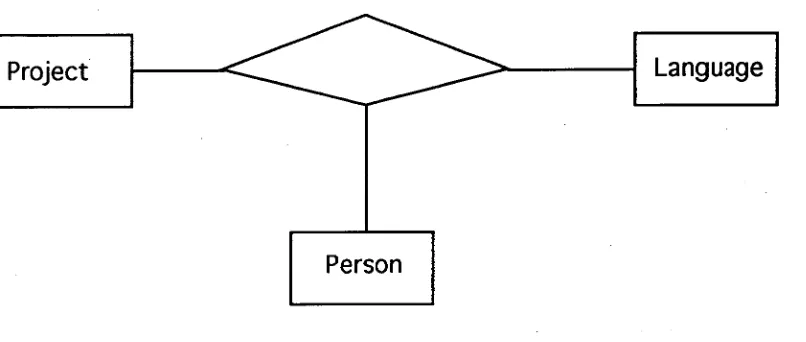
[image:43.559.57.460.299.470.2]relationships. Rumbaugh et al [1991] state that "Associations may be binary ternary, or higher order... .We have encountered a few general ternary and few, if any, of order four or more. Higher order associations ... should be avoided if possible." An OMT example of a ternary relationship is given in Rumbaugh et al [1991], page 28-29 which is said to be "... an atomic unit and cannot be subdivided into binary associations without losing information...[since]...a programmer may know a language and work on a project, but might not use the language on the project". This example is reproduced in Figure 3.5
Figure 3.5 OMT Example of a ternary relationship [Rumbaugh et al, 19911
The diamond in the OMT example is the OMT symbol for general ternary and n-ary associations. Rumbaugh et al [1991] choose not to name the association or links in this example since "...association names are optional and a matter of modelling judgement ... [and]... are often left unnamed when they can be easily identified by their classes.". If the purpose of data modelling is to provide semantically complete
information about some application domain then it should be considered dangerous to leave components of the model unlabelled. The ERO model does not allow any unnamed entities or relationships.
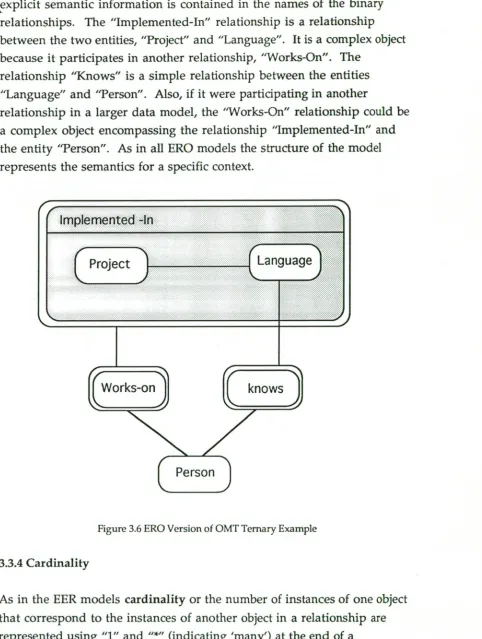
The ERO model can represent the ternary relationship from Figure 3.5 with an overhead of three binary relationships as in Figure 3.6.
Implemented -In
Project Language
explicit semantic information is contained in the names of the binary relationships. The "Implemented-In" relationship is a relationship between the two entities, "Project" and "Language". It is a complex object because it participates in another relationship, "Works-On". The
relationship "Knows" is a simple relationship between the entities "Language" and 'Person". Also, if it were participating in another
[image:44.558.42.524.70.709.2]relationship in a larger data model, the "Works-On" relationship could be a complex object encompassing the relationship "Implemented-In" and the entity "Person". As in all ERO models the structure of the model represents the semantics for a specific context.
Figure 3.6 ERO Version of OMT Ternary Example
3.3.4 Cardinality
CWIFE IS-MARRIED-TO 1 "HUSBAND
(a)
(b)
(c) Figure 3.7
(a) A one-to-one relationship - a wife has one husband; a husband has one wife (b) An employee works in one department; a department has many employees
(c) A student takes many courses; a course has many students
3.3.5 ERO Version of Hansen and Hansen's EER Example
Figure 3.8 is an ERO version of Hansen and Hansen's [1991] Manwaring Consulting Services Invoice model previously shown in Figure 2.6.
[image:45.562.44.496.53.528.2]CCLIENT
9
Name Address
((PERFORMED-FOR ))
ON Hours Amount
ENGAGED-IN
1
Title
Invoice Number Invoice Date Total \
\.
t
INCURRED * 11
CLIENT and PROJECT and does not participate in any other relationship and so is modelled as a simple linear relationship.
i
OTHER_CHARGEDescription Amount
[image:46.562.45.541.52.749.2]\ }
Salary
Job Title
Employee 'N
\.Change-Address}
Change-Salary Change-Job-Title
Name Address
[Note that a semantic inconsistency in Hansen and Hansen's [1991] original model has been corrected and there is now a Name attribute for the CLIENT entity and a Name attribute for the ACTIVITY entity.]
No matter how many levels of relationships there are within a complex relationship, the polymorphic nature of all classes means that every class has only one uid and for relationships that uid is a composite of only two other uids. For example, the ENGAGED-IN relationship has a composite uid from CONSULTANT and ACTIVITY and the ON relationship has a composite uid made up of the uids from ENGAGED-IN and PROJECT although the uid for ENGAGED-IN is itself a composite uid.
3.3.6 ERO Version of Rumbaugh's OMT Example
[image:47.560.39.555.58.768.2]The example in Figure 3.9 is an ERO equivalent to the OMT model in Figure 2.7. If it is presumed that the relationship Works—In is part of a larger data model where it participates in another relationship it can be modelled as a complex object which imports the entity-objects Employee
and
Department.4 Implementation
4.1 Introduction
This chapter describes the implementation of an ERO model as a simple database system in a functional programming environment. Firstly, the conceptual framework is described for mapping an ERO model to an integrated implementation system where every entity and relationship is treated as a class. Secondly, considerations for mapping this conceptual framework to a functional programming environment using the functional programming language Haskell are discussed. Thirdly, a specific Haskell prototype is described and finally, a detailed example is shown providing specific program code within an implemented Haskell prototype.
4.2 Conceptual Framework
Conceptually in this implementation every component of the simple database system is considered to be an object. The main module imports all the components and thus links all the components together to form a database system.
4.2.1 The Database Subset
A database system usually includes facilities for creation and deletion of the database; update facilities for adding, deleting and modifying records; reporting facilities and query facilities. This implementation deals with the update operations: create, insert and delete plus operations for retrieving and displaying the current value of a class or object.
4.2.2 The User Interface
4.2.3 A Generic Superclass
This implementation adopts the view of Cardelli and Mitchell [1989] that "Object-oriented programming is based on record structures (called
objects)
intended as named collections of values
(attributes)
and functions(methods).
Collections of objects formclasses.
Asubclass
relation isdefined on classes with the intention that methods work 'appropriately' on all members belonging to the subclasses of a given class ... we are interested here in more powerful type systems that smoothly incorporate
parametric polymorphism."
Objects in a database system can be considered to be tuples or records of
key, value
pairs where thekey
is a unique identifier for an object and thevalue
is the rest of the record. Using data abstraction the concept of "therest of the record" can be extrapolated to include both attributes and methods. The implementation is based on the concept of a superclass which implements classes as collections of objects and objects as key, value pairs. This superclass is inherited by all classes in the system and provides the default methods for the addition, deletion or retrieval of any object in a class. Since this implementation is a prototype capable of further
development the key (or unique identifier) is system generated but is visible to the user so that the user can access objects directly by their keys. A query interface, which could be a development added later, would not make use of visible keys.
4.2.4 Persistent Data
Like all database systems this implementation provides for persistent or long-lived stored data. This data is stored in ASCII files and has to be mapped onto the executing program in object or class form.
This is a functional implementation, so operations, or methods
4.2.5 An Abstract Implementation Scheme
The implementation is based on the mapping of the ERO model directly to program code in the prototype. The basic rules are as follows:
1.There should be a modularised abstract data type (ADT) to represent each class, entity or relationship, in the specific ERO model. Each ADT should contain definitions of all that class's attributes and methods. Each class should inherit the superclass and in the case of relationships also import any participating entities in that relationship since
relationships provide the links between entities.
2. There should be a main module that imports all the components of the database thus linking all the components together.
3. A file for persistent data should be initialised for each class defined in 1.
4.3 The Haskell Environment
The power of functional languages lies in their characteristics of
polymorphism, strong typing, lack of side effects and lazy evaluation. This implementation relies on these characteristics.
4.3.1 The Polymorphic Superclass
Haskell allows the implementer to define polymorphic types that can be applied to any arguments of other valid types. For example, [a] refers to a list of "things" where those things can be numbers, characters, strings or any other valid things including user defined types.
The superclass that is inherited by all classes in this implementation must necessarily be polymorphic so that it can be applied to any class, whether it be entity or relationship. The implementation provides the superclass as an ADT called Collection Of which sets up an abstract type for a collection of key,value pairs.
insertions, deletions, traversals, retrievals etc. The overriding consideration for any ordered collection of data like a database is the efficiency of searching. Insertion depends on finding the correct place to insert a new record; deletion requires finding the correct record and all retrievals of information involve a search.
For this application the simplest, and possibly the most intuitive, data structure is a list of pairs or an association list. In Haskell a list is a dynamic data structure that can grow during execution as opposed to an array that requires its maximum size to be set at compile time. An association list is easy to implement and provides 0(n) operations for insert, delete and retrieve based on a linear search algorithm.
A more efficient data structure, especially for large data sets, is a binary search tree which, if maintained as a balanced tree, provides 0(logn) operations for insert, delete and retrieve based on a binary search algorithm.
The prototype provides the user with a choice of either an association list or a binary search tree but can use any polymorphic data structure that maintains a collection of key,value pairs and obeys the interface syntax.
Both data structures were implemented for testing purposes and to demonstrate that the specific implementation of the superclass is completely transparent to the rest of the program.
4.3.2
The Database Prelude
The implementation requires various utility or library functions
![Figure 2.6 is an example of an EER model for a data model of an Invoice for Manwaring Consulting Services taken from Hansen and Hansen [1992] entity PROJECT and the relationship ENGAGED-N](https://thumb-us.123doks.com/thumbv2/123dok_us/8472458.340628/17.565.43.482.61.626/invoice-manwaring-consulting-services-hansen-project-relationship-engaged.webp)