UNIVERSITI TEKNIKAL MALAYSIA MELAKA
OPTIMIZATION ON THE NANOPARTICLE STABILITY IN
LIQUID PHASED CONDITION BY USING TAGUCHI
ANALYSIS
This report is submitted in accordance with the requirement of the Universiti Teknikal Malaysia Melaka (UTeM) for the Bachelor of Mechanical Engineering
Technology (Maintenance Technology) with Honours.
By
AIMANEZMIR BIN OTHMAN B071410070
920319-04-5393
DECLARATION
I hereby, declared this report entitled “Optimization on the Nanoparticle Stability in Liquid Phased Condition by Using Taguchi Analysis” is the results of my own research except as cited in references.
Signature :
APPROVAL
This report is submitted to the Faculty of Engineering Technology of UTeM as a partial fulfillment of the requirements for the degree of Bachelor of Mechanical Engineering Technology (Maintenance Technology) with Honours. The member of the supervisory is as follow:
ABSTRAK
Peningkatan masalah aplikasi nanofluid adalah kerana nanopartikel yang lebih cenderung untuk menggumpal. Struktur penggumpalan ini memberi kesan terhadap keadaan cecair nano dan prestasi pemindahan haba berkenaan. Penumpuan dan pemendapan adalah fenomena kritikal yang memberi kesan pada kestabilan nanofluid. Objektif kajian ini adalah untuk mengkaji kesan perbezaan penggunaan agen surfaktan dan masa yang ditetapkan terhadap kestabilan nanopartikel (SAE 15W 40). Dalam kajian ini, minyak-nano telah disediakan dengan menyelerakkan nanopartikel dengan komposisi yang optimum iaitu 0.5 graphite vol.% 70 nm , Al2O3
dan ZrO2 dalam minyak enjin konvensional gred (SAE 15W 40) menggunakan
ABSTRACT
The problem arises from the application of nanofluid is that the nanoparticles tend to agglomerate. The agglomeration gives impacts to the properties of nanofluid and the heat transfer performance. Agglomeration and sedimentation are the critical phenomena that affect the stability of nanofluid. The aim of the study is to investigate the effect of different surfactant agents and homogenize time on the stability of nanoparticle (SAE 15W 40). In this study, the nano-oil was prepared by dispersing the nanoparticles with an optimal composition of 0.5 vol.% 70 nm graphite, Al2O3and ZrO2 in conventional engine oil (SAE 15W 40) grade by using
DEDICATIONS
To my beloved parents, Othman Bin Hamza and Fauziah Binti Gani. To my respected supervisor, Dr. Muhammad Ilman Hakimi Chua Bin Abdullah.
ACKNOWLEDGEMENTS
TABLE OF CONTENT
CONTENT PAGES
ABSTRAK i
ABSTRACT ii
DEDICATION iii
ACKNOWLEDGEMENT iv
TABLE OF CONTENT v
LIST OF TABLES viii
LIST OF FIGURES x
LIST OF ABBREVIATIONS, SYMBOL AND NOMENCULTURE xii
CHAPTER 1: INTRODUCTION
1.1 Introduction 1
1.2 Problem Statement 3
1.3 Objective 4
1.4 Scope of Work 4
CHAPTER 2: LITERATURE REVIEW
2.1 Introduction 5
2.4 Nanoparticle as Additive 19 2.4.1 Size of Nanoparticle 20 2.4.2 Physical and Chemical Properties 20 2.5 Surfactant Agents For Nanofluid Stability 22 2.5.1 Effect of Surfactant on Nanoprticle Stability 23 2.5.2 Thermal conductivity 23
CHAPTER 3: METHODOLOGY
3.1 Introduction 26
3.2 Design of Experiment (DOE) 28 3.2.1 Taguchi Method 28 3.2.1.1 L9Orthoganal array 29
3.3 Material Selection 30 3.3.1 Engine oil (SAE 15W 40) 30
3.3.2 Nanoparticle 31
3.3.2.1 Graphite 32
3.3.2.2 Alumina, (Al2O3) 33
3.3.2.3 Zirconia, (ZrO2) 35
3.3.3 Surfactant Agents 36
3.3.3.1 SDBS Salt 37
3.3.3.2 Olice Acid 37 3.3.3.3 Sodium Chloride 38 3.4 Sample Preparation 39 3.4.1 Sample Composition 40
3.4.3 Sample Setup 42
3.4.3 Ultrasonic Homogenizer 43
3.5 Testing 43
3.5.1 UV-Vis Spectrometer 44 3.5.2 Sedimentation Photograph Capturing Method 45
3.5.3 Verification 45
CHAPTER 4: RESULT AND DISCUSSION
4.2 Analysis of the S/N Ratio 46 4.3 Quantitative Analysis 49
4.3.1 Analysis Of Nanoparticle Stability Of Graphite With Different Surfactant Agent
49
4.3.2 Analysis Of Nanoparticle Stability Of Alumina With
Different Surfactant Agent 51 4.3.3 Analysis Of Nanoparticle Stability Of Zirconia With
Different Surfactant Agent 53 4.4 Qualitative Analysis 56
4.4.1 Effect Of Difference Surfactant Agent And Time On The
Graphite Nanoparticle Stability 56 4.4.2 Effect Of Difference Surfactant Agent And Time On The
Alumina Nanoparticle Stability 58 4.4.3 Effect Of Difference Surfactant Agent And Time On The
Zirconia Nanoparticle Stability 60 4.5 Effect of Surfactant Agent on Stability Performance. 62
4.5.1 Stability of Graphite Nanoparticle with Oleic Acid,
SDBS and Sodium Chloride 62 4.5.2 Stability of Graphite Nanoparticle with Oleic Acid,
SDBS and Sodium Chloride 64 4.5.3 Stability of Graphite Nanoparticle with Oleic Acid,
SDBS and Sodium Chloride 66
CHAPTER 5: CONCLUSION AND RECOMMENDATION
5.1 Conclusion 69
5.2 Recommendation 70
REFERENCES 71
LIST OF TABLES
TABLE TITLE PAGES
2.1 Characteristics of common solid lubricants 7 2.2 List of test greases 9 2.3 American Petroleum Institute (API) categories for base oils 11 2.4 Several type of vegetable-based lubricants developed for
industry applications
12
2.5 Comparative analysis of properties of vegetable oils 13 2.6 Physical characteristics of the PAO 15 2.7 List of type of surfactant 22 2.8 Thermal conductivities of various solids and liquids. 24
3.1 Three parameter and three level 29 3.2 Design Of Experiment with L9Orthogonal arrays 30
3.3 Lubricating properties of SAE 15W-40 31 3.4 Physical properties of graphite nanoparticle 33 3.5 Physical properties of Alumina, Al2O3nanoparticles 35
3.6 Physical properties of Zirconia, ZrO2nanoparticles 36
3.7 Physical properties of Oleic Acid 38 3.8 Physical properties of sodium chloride 39 3.9 The composition of nanoparticle 41 3.10 The composition of surfactant agent 41 3.11 The sampling setup for 100ml nano-oil 42 3.12 The features of Probe 43
4.1 UV Absorbance of Graphite with different Surfactant Agent 49 4.2 UV Absorbance of Alumina with different Surfactant Agen 52 4.3 UV Absorbance of Zirconia with different Surfactant Agen 54 4.4 Picture of SAE 15W 40 on Graphite with three different
Surfactant Agent
[image:11.595.125.503.146.741.2]4.5 Picture of SAE 15W 40 on Graphite with three different
Surfactant Agent 59
4.6 Picture of SAE 15W 40 on Graphite with three different
LIST OF FIGURES
FIGURE TITLE PAGES
2.1 Crystal structure of graphite 6 2.2 Molecular structure of poly alpha olefins 14 2.3 Temperature change in oil’s viscosity 18 2.4 Schematics images of bimetal nanoparticle 20 2.5 Typical group of nanoparticle 21
3.1 Process to produce nano-oil 26 3.2 Flow chart of process 27 3.3 Crystal structure of Graphite 32 3.4 Crystal Structure of Alumina, Al2O3 34 3.5 Crystal Structure of Zirconia, ZrO2 35
3.6 Steric Mechanism 36
3.7 Structure formula of SDBS salt 37 3.8 Structure of Oleic acid 38 3.9 Crystal Structure of Sodium Chloride 39 3.10 Schematic diagram for sample preparation by using
Ultrasonic Homogenize
42
3.11 UV-Vis spectrometer 45
4.1 Main effect plot for S/N ratio’s effect on nanoparticle
stability 47
4.2 Graph of SAE 15W 40 for Stability of Graphite
Nanoparticle with Oleic Acid, SDBS and Sodium Chloride 50 4.3 Graph of SAE 15W 40 for Stability of Alumina
Nanoparticle with Oleic Acid, SDBS and Sodium Chloride 53 4.4 Graph of SAE 15W 40 for Stability of Zirconia
[image:13.595.127.502.139.741.2]Nanoparticle with Oleic Acid, SDBS and Sodium Chloride 4.6 Picture and graph of SAE 15W 40 for Stability of Alumina
Nanoparticle with Oleic Acid, SDBS and Sodium Chloride 65 4.7 Picture and graph of SAE 15W 40 for Stability of Zirconia
LIST OF SYMBOL AND ABBREVIATIONS
% - Percent Al2O3 - Alumina
API - Petroleum American Institute
ASTM - American Society Testing and Material Au - Gold
COF - Coefficient of Friction CNT - Carbon Nanotubes CuO - Copper Oxide
° C - Degree Celcius
DOE - Design Of Experiment DOF - Degree Of Freedom
g - Gram
g/cm3 - Gram per Cubic Metre
hBN - Hexagonal Boron Nitride HCl - Hydrochloric Acid KOH - Potassium Hydroxide NaCl - Sodium Chloride NaOH - Sodium Hydroxide
mg - Miligram ml - Mililiter mm - Milimeter
MoS2 - Molybdenum Dissulfide
MSDS - Material Specific Data Sheet nm - Nanometer
PAO - Polyalphaolefins PTFE - Polytetrafluorocthylene
SAE - Society Automotive Engineers SDS - Sodium dodecyl sulfate
SN - Signal Noise
TBN - Total Based Number TiO2 - Titanium Dioxide
UV - Ultra Violet Vol.% - Volume Percent
CHAPTER 1
INTRODUCTION
1.1 Introduction
Nanoparticles as an additive in lubricants are found to give better performance in tribological properties and increment of heat transfer. Lubricants are the substances utilized to decrease the effect of friction between the two moving sliding surfaces. Generally, lubricants can be classified based on their physical states such as a solid lubricant, semi-solid lubricant, and liquid lubricant. Utilizing nanoparticles as an added substance in fluids to expand thermal performance of fluids has already began in 1990s. The lubricant is vital in any industry because it helps to reduce the frictional resistance, wear, surface deformation, provide protection against corrosion, and also improve the efficiency of engine component. Besides, lubricant with nanoparticle enhanced the load-carrying capacity, friction reduction properties and anti-wear. Kong et al., (2017) found that the mechanism of lubricant may be accessible when nanoparticles were utilized as additives in lubricant such as polishing effect, rolling of nanospheres, self-repairing effect and tribochemcial.
nanofluids from the heat transfer takes place on the particle surface. The number of atoms existing on the nanoparticles surface is bigger compared with the interior. In addition, the nanoparticle may reduce erosion and clog due the smaller size which contributed to the stability of the nanoparticles (Das et al., 2007; Ramakoteswaa et al., 2014).
Generally, one of the fundamental prerequisites of nanofluid features is the long term stability generated through nanoparticles dispersion. The stability of nanofluid is crucial to ensure the nanofluid is in good condition. Yu and Xie (2012) stated that the stability was indicated by those particles which do not aggregate at a significant rate. The nanoparticle aggregation rate is determined by the frequency of collision caused by the probability of cohesion during the collision and Brownian motion. Nanoparticles tend to aggregate because of the high surface region and surface movement (Kong et al., 2017). Nanofluids stability is determined through the amount of van der Waals forces and electrostatic repulsion force between nanoparticles dispersed living in nanofluids. When the electrostatic repulsion force is greater than the forces of attraction then the stability will be achieved. According to Amiruddin et al., (2015), the repulsion force from the repel of particles forms van der Waals which leads to agglomeration and this is when stabilization has been reached through the permeation of stable particle on the surface of the pigment. In order to increase the repulsion force between nanoparticles, two mechanisms are used like steric mechanism and electrostatic mechanism. Nevertheless, the field of this study focuses only on the steric mechanism.
high-temperature applications. In addition, a homogenizer is utilized in this investigation as a mechanism to stabilize the nanofluids with surfactant agents. The intermolecular interactions between particles can be disrupted by sonication while the agglomeration in the nanofluid can be decreased by homogenization processes. In this research, the effect of difference surfactant agents and homogenize time on the nanoparticle stability (SAE 15W 40) were optimized to investigate the nanoparticle stability parameter in liquid phased condition.
1.2 Problem Statement
The problem arises when nanoparticles tend to agglomerate from a nanofluid application in advanced lubricant. Sukarno, (2017) found that the agglomeration gives impacts to the properties of nanofluid and the heat transfer performance. Amiruddin et al., (2015) shows that the molecules on the pigment surface are stabilized through the absorption reaction, it will prevent repulsive forces of different particles from approaching close sufficient for the appealing van der Waals forces to bring about agglomeration. Proportionality of the Van der Waals forces acting on nanoparticles is higher than microparticles compared to another force. The agglomerates framed could have various sizes and configurations and it can change every time. Hence, it will be difficult to control the agglomeration effects to the stability of nanofluid.
the high surface energy of nanoparticles which is causes coagulation of tiny particles produce huge aggregation. To overcome the sedimentation and agglomeration, the surfactant agent must be added into the lubricant to rectify the particle surface properties.
1.3 Objective
i. To optimize on the nanoparticle stability parameter in liquid phased condition. ii. To investigate the effect of difference surfactant agents and homogenize time.
1.4 Scope
i. Optimizing on the nanoparticle stability parameter in liquid phased condition by using Taguchi method.
CHAPTER 2
LITERATURE REVIEW
2.1 Introduction
Lubrication plays a major role in successful many potential applications like an automotive industry. Nowadays, a lubricant is improved with nanoparticles alternative of oil soluble additives to enhance the tribological properties. A mixture both of additives and dispersion agent can give stability to the oil phase. Lubricants with additives have better tribological properties such as increase resistance to friction, better anti-wear characteristics, improved load carrying capacity and the ability to absorb heat better (Prabu et al., 2016). The stability of nanofluids is essential to give a better performance in their applications. Hence, the surfactant is a better mechanism to stabilize the nanofluids. This formula is crucial in developing a new lubricant.
2.2 Classification of Modern Lubricant
2.2.1 Latest Solid Lubricant
Solid lubricants are thought to be any solid material that has the ability to decrease friction and interactions of mechanical between surfaces in relative motion opposed to the action of a load (Rudnick, 2009). A solid lubricant has superior features, such as good heat resistance, high chemical stability, and high-pressure resistance. Solid lubricants are commonly utilized as a dry film or an added substance in a liquid to give improved lubrication to a wide range of applications. Solid lubricants are typically utilized in anti-seize compounds and threading compounds, to provide a sealing function and friction reduction for threaded pipe fitting. The applications of the solid lubricant include low sliding speeds and high contact loads, for example, gear lubrication. The solid lubricant successfully gives the required wear protection and load bearing performance essential from gear oil, particularly capable when utilized with lower viscosity base oils.
Graphite and molybdenum disulfide (MoS2) are the main materials used as a
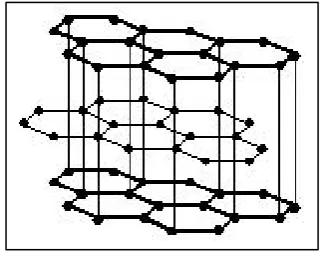
solid lubricant. Figure 2.1 showed crystal structure of graphite. As a result of the solid and crystalline nature of pigments, graphite and MoS2 show good resistance to
[image:22.595.248.413.488.619.2]high temperature and oxidizing atmosphere environments, though fluid greases ordinarily will structure.
Figure 2.1: Crystal structure of graphite (http://www.tribology-abc.com/abc/solidlub.htm)
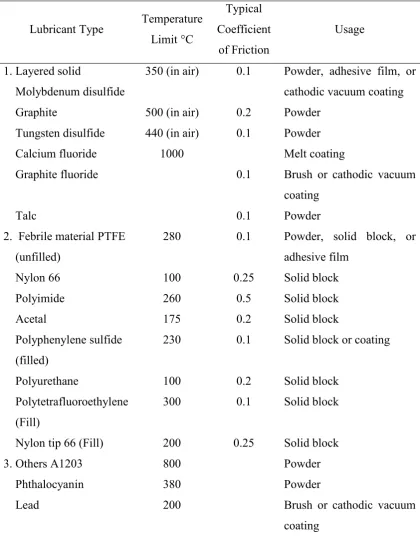
nitride, polytetrafluoroethylene (PTFE), calcium fluoride, and tungsten disulfide. The characteristics of commonly used solid lubricants are showed in table 2.1.
Table 2.1: Characteristics of common solid lubricants (Shizhu and Ping, 2012).
Lubricant Type Temperature Limit °C
Typical Coefficient
of Friction
Usage
1. Layered solid
Molybdenum disulfide
350 (in air) 0.1 Powder, adhesive film, or cathodic vacuum coating Graphite 500 (in air) 0.2 Powder
Tungsten disulfide 440 (in air) 0.1 Powder Calcium fluoride 1000 Melt coating
Graphite fluoride 0.1 Brush or cathodic vacuum coating
Talc 0.1 Powder
2. Febrile material PTFE (unfilled)
280 0.1 Powder, solid block, or adhesive film
Nylon 66 100 0.25 Solid block Polyimide 260 0.5 Solid block Acetal 175 0.2 Solid block Polyphenylene sulfide
(filled)
230 0.1 Solid block or coating
Polyurethane 100 0.2 Solid block Polytetrafluoroethylene
(Fill)
300 0.1 Solid block
Nylon tip 66 (Fill) 200 0.25 Solid block 3. Others A1203 800 Powder
Phthalocyanin 380 Powder
2.2.2 Advanced Semi-Solid Lubricant
Grease is a semi-solid lubricant produced by the dispersion of thickening agents in mineral oil or synthetic liquid base that may contain other ingredients that impart special properties (Rudnick, 2009). The main advantage of choosing the grease over conventional lubricating oil in certain applications because of the ability of grease to stay in contact with the surface is required to move. Grease is generally not leaked from the time of application. Thickeners in grease designed to minimize any migration due to gravity, pressure centrifugal action (Bhushan, 2013). Thickening agents are the most common metal soaps with aluminum, calcium, sodium, barium or lithium. Oils are liked to grease since they are better coolants and are simpler to deal with and apply. However, the preferred grease for applications where it is important that the oil did not run or drip for higher.
The greater part of greases is made out of petroleum and synthetic oil thickened with metal soaps and other agents, for example, silica, clay, and polytetrafluoroethylene. Most lubricant greases utilized as a part of industry have petroleum oils as their fluid base. However, practically every greasing up fluid can present with a reasonable to make grease. The petroleum oil based grease can be utilized at a temperature up to 175 °C relying upon the thickener and synthetic oil based greases may utilize at higher temperatures. Silicone thickened with ammeline and silica is the best materials in the greases and it can be utilized at temperatures up to 300 °C.