349 0144-8765/03 $10
© 2003 A B Academic Publishers Printed in Great Britain
Tradition, Dynamics and Sustainability
of Plant Species Composition and
Management in Homegardens on
Organic and Non-Organic Small Scale
Farms in Alpine Eastern Tyrol, Austria
Christian R. Vogl* and Brigitte Vogl-Lukasser
Institute for Organic Farming, University of Natural Resources and Applied Life Sciences Vienna, Gregor Mendel Strasse 33, 1180 Vienna, Austria
ABSTRACT
In Eastern Tyrol (Austria), homegardens are an integral part of the farming system. The aim of this paper is to present evidence for the development of gardening in the study area and to identify differences/similarities between gardens at organic and non-organic farms. In 1997 and 1998, in homegardens on 91 organic and 105 non-organic farms from 12 communities, occurrence and abundance of cultivated plant species were surveyed and interviews were carried out about garden history, management and plant use. For the factor organic/non-organic, differences between gardens were statistically tested. Garden management is similar in organic/non-organic gardens, except mixed cropping and the use of alternative remedies to combat diseases, both with significantly higher occurrence on organic farms. Popular innovations from organic farming did not have a strong and clearly visible impact on management of homegardens. The population of cultivated plant species, until the 1960s approx. 51; nowadays approx. 587 species in all gardens, and main use of garden produce has been in a process of change with an increase in importance of species used as food and for decoration, but with no significant differences concerning organic/ non-organic. Women farmers gardening in Eastern Tyrol are highly sympathetic to the principles of organic farming, even on non-organic farms. Sustainability can be increased when methods from organic gardening are promoted and tested locally more effectively. Science and policy should recognize the work of women farmers who maintain homegardens with high agrobiodiversity as part of their culture.
INTRODUCTION
In Austria, as in many other European countries, organic farming has been developed by farmers at mixed crop-livestock operations (Pirklhuber & Gründlinger, 1993; Vogl & Hess, 1999). Scientific research on organic farming in Austria has primarily been focused on these operations, especially on soil, plants and their interactions at arable plots (Lindenthal, 1993; Lindenthal et al.,
1995). Organic horticulture in Europe has been addressed in scientific literature only recently, and only for commercial horticulture, fruit culture or viticulture (Lindenthal et al., 1995). Data on the role of small gardens adjacent to most farmers’ living quarters (henceforth called ‘homegardens’) with respect to organic farming have not been published. Homegardens are small in area, not primarily market-oriented, and are usually managed by women. It may be that these factors are responsible for the fact that homegardens have been neglected (IPGRI, 2000) and that scientific research on farmers’ homegardens, despite the recent increased popularity of gardening, has not been realized either in Austria or at the European level, with a few exceptions (Hauser, 1976; Brun-Hool, 1980; Lohmeyer, 1983; Poppendieck, 1992; Inhetveen, 1994; Agelet et al., 2000; Vogl-Lukasser, 2000; Vogl-Lukasser & Vogl, 2002), and without focus on the organic operation.
The lack of scientific data on homegardens in temperate climates is surprising, because research on tropical home gardens is done intensively. Ethnobotanical research on gardens has been published about rural areas of Latin America, the Caribbean, the Pacific Islands, Asia, Africa or on urban gardens in different countries (Niñez, 1985; Landauer & Brazil, 1990; Rico-Gray et al., 1990; Padoch & De Jong, 1991; Caballero, 1992; Esquivel & Hammer, 1992; Anderson, 1993; Salvador Flores, 1993; Hochegger, 1995; Hodel & Gessler, 1999; Vogl et al.,
2002).
In Eastern Tyrol, homegardens are an integral part of the farming system in the study area. Until the 1960s, alpine farming in Eastern Tyrol was primarily done for subsistence and based on cereal cultivation (e.g. Secale cereale, Triticum aestivum), field vegetables (e.g. Pisum sativum, Vicia faba), fibre crops (e.g.
Farming systems in Eastern Tyrol have been going through a process of change in the last few decades, starting from the 1960s. The cultivation offibre crops has completely disappeared while the decline in cereal cultivation has been constant. Field vegetables and fruit trees are still cultivated, but reduced in extent and importance. Instead ofthese activities, specialized cattle breeding and the production ofmilk gained importance, paralleled by an increase ofarea used as meadows and pastures for these animals. Reasons for this development were the favourable prices ofhigh quality cattle breeds, as well as for their meat and milk and, simultaneously, the low prices paid for cereals. Today almost all of agri-cultural land is covered with meadows and pastures. Areas where machinery cannot be used is converted into forests (Vogl-Lukasser, 2000). In spite ofall these changes, homegardens remain colourful landmarks in the study area. Studies on homegardens ofother study areas has led tointeresting results and new insights into the composition, management and importance of these agroecosystems for subsistence, for conservation of agrobiodiversity and for sustainable development (Niñez, 1985; Landauer & Brazil, 1990; Watson & Eyzaguirre, 2001). The questions here are, is this also true for the homegardens of Eastern Tyrol and what impact does organic gardening have on homegardens here? The aim ofthis paper is to present evidence for the characteristics of tem-perate homegardening on organic and non-organic farms. Therefore, the flora composition, management and purpose of homegardens on organic and non-organic farms in Eastern Tyrol is presented and the sustainability oftemperate homegardening on farms in the study area is discussed.
MATERIALS AND METHODS
In 1997 and 1998, 196 homegardens on 196 farms from 12 communities in Eastern Tyrol were investigated. Of the 196 gardens studied, 91 were at certified organic farms (46.4% of the sample). Organic farms are farms certified by certification bodies according to EC-Regulation 2092/91. The terms homegarden or garden refer in this paper to the small, fenced plot close to the farmers’ homestead, where annual, biennial and perennial cultivated species are grown in beds. The homegarden is one of the women’s responsibilities, henceforth called here ‘women farmers’, at all farms studied. The term cultivated plants refers to domesticated plants and wild plants under incipient management (tolerated, encouraged or protected) in gardens (Bye, 1997). The term traditional refers to species and varieties that have survived for a long time in the region with direct agricultural use or as an element of the agroecosystem.
history and characteristics of organic farming in Austria). The farms surveyed are situated between 600 and 1641 m above sea level. The average area of agri-cultural land located near the homestead is 7 ha, and mainly consists of hay meadow. In addition to the managed homegardens, 47% of the surveyed farms have small plots (average size 0.01 ha) of field vegetables (mainly potatoes,
Solanum tuberosum),grown on moderate slopes and 79% have orchards (apples,
Malus domestica; pears, Pyrus communis).Most farmers own forests and alpine meadows at 1500 m above sea level and above, which are used as summer grazing grounds and for hay production. On average, each of the households observed keeps 12 dairy cows, two pigs, 12 hens and 30 sheep. Fifty percent of the farms studied are managed on a full-time basis; 50% are part-time farms. The ages of the respondents were between 25 and 85.
The occurrence and abundance of cultivated plant species, subspecies or varieties, all referred to henceforth as species were surveyed on each of three dates in spring, summer and autumn. Voucher specimens were taken (Martin, 1995; Alexiades & Sheldon, 1996) and species identified according to botanical references (Wehrhahn, 1937; Encke, 1961; Hegi, 1979; Holzner, 1981; Jäger et al., 1991; Pahlow, 1993; Fischer, 1994; Fitschen, 1994; Royal Horticultural Society, 1997; Hanf, 1998; Royal Horticultural Society, 1998).
Structured interviews were carried out with each of the women responsible for these homegardens. Information was collected in these interviews about different ethnobotanical topics for each cultivated plant species and on characteristics describing the location and the management of the garden. Semi-structured inter-views about the management of farms over the last 70 years with a special focus on homegardens were carried out with an additional sample of 27 elderly women. Results from these interviews serve as a historic baseline for the description of changes in floristic composition and management in recent years. Field research was supplemented with participant and non-participant observation, i.e. work with women farmers and the observation of their work (Bortz & Doring, 1995; Martin, 1995; Alexiades & Sheldon, 1996; Vogl et al., 2003).
All raw data were stored in an Access database (Microsoft Office package) and analysed with SPSS (version 7.5.2) for Windows (SPSS, 1997). For the factor ‘land use system’ (organic; non-organic) a one-way ANOVA was done for occurrence and abundance data of plants and a chi-square test for ordinal (intensity of mixed cropping) and nominal (e.g. presence/absence of compost) data. The influence of the factor is reported as being significant at a level of p< 0.05 and as a tendency at a level of p< 0.1.
RESULTS
Recent appearance and management of gardens
location and layout. They are generally found right next to the farmhouses and consist of a series of ordered and raised beds. Small paths that allow the gardener to reach every part of the bed for planting, watering, weeding and harvesting divide the approx. 1.5 m wide beds. The gardens are separated from the surrounding area by fences.
Homegardens do differ considerably in terms of area (Range: 12 m2–220 m2).
The differences in size (mean: organic 63 m2; non-organic 65 m2) cannot be
explained by the land use system (pANOVA = 0.662).
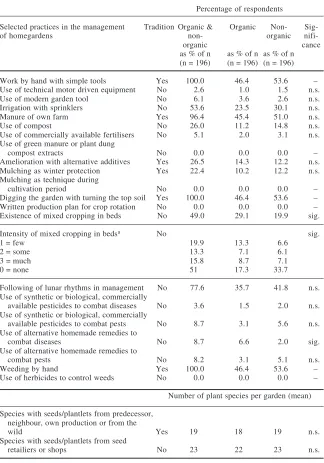
Work is done by hand, and all women use very simple tools like small hoes, rakes, spades, forks and watering cans. Some of them are made locally or maintained and repaired on the farm. Tools are built in a way to last a long time. Some are built from recycled material no longer being used on the farm; for example, greenhouses made from old windows. In only 2.6% of the gardens is motor driven technical equipment used to cultivate the soil (Table 1). Modern garden tools, such as the claw cultivator, which are promoted by local retailers and on TV are rarely found, in only 6.1% of the gardens, and, if owned, they are not regularly used on either organic or non-organic farms. Modern equipment such as rotary cultivators, tillers or flame weeders are not used at all. The only modern tool used by women farmers (in 53.6% of the gardens) is the sprinkler for irrigation, with no difference between land use systems (Table 1). Women emphasize that the use of sprinklers is not very popular and, if used at all, then only in summertime when labour demand for other duties at the farm is high. Most of the time women irrigate with watering cans or hosepipes because this saves water and allows the irrigation of each species according to its needs.
The fertility of the soil is maintained by the use of manure from the farm’s own cattle, sheep, horses or hens. Manure that is used as fertilizer in gardens is at least 2–3 years old. Fertilization with manure is utilized in almost all (96.4%) of the gardens and differences between gardens cannot be explained by the land use system (Table 1). Organic waste from the garden or kitchen is usually thrown on the dunghill. In addition, separate ‘formal’ composting of organic waste is done in 26% of the gardens. Women farmers have started formal composting only recently. They explicitly stress that they do not know how to prepare compost correctly, that composting is not very popular because of the increase in weeds after the application of compost, whereas no problems occur when the 2–3 years old manure is used. The land use system does not influence women farmers’ decision to use compost or not (Table 1).
Commercially available fertilizers are used in the gardens of six non-organic farms and four organic farms (Table 1). Green manure, or water extracts from plants or compost are not used at all. Amelioration with alternative soil additives such as lime, stone meal or turba is done in 26.5% of the gardens, independent of the land use system (Table 1).
TABLE 1
Selected practices in the management of homegardens and percentage of respondents of organic and non-organic farms who do use/not use these practices.
Percentage of respondents
Selected practices in the management Tradition Organic & Organic Non-
Sig-of homegardens non- organic
nifi-organic cance
as % of n as % of n as % of n (n = 196) (n = 196) (n = 196)
Work by hand with simple tools Yes 100.0 46.4 53.6 – Use of technical motor driven equipment No 2.6 1.0 1.5 n.s.
Use of modern garden tool No 6.1 3.6 2.6 n.s.
Irrigation with sprinklers No 53.6 23.5 30.1 n.s.
Manure of own farm Yes 96.4 45.4 51.0 n.s.
Use of compost No 26.0 11.2 14.8 n.s.
Use of commercially available fertilisers No 5.1 2.0 3.1 n.s. Use of green manure or plant dung
compost extracts No 0.0 0.0 0.0 –
Amelioration with alternative additives Yes 26.5 14.3 12.2 n.s. Mulching as winter protection Yes 22.4 10.2 12.2 n.s. Mulching as technique during
cultivation period No 0.0 0.0 0.0 –
Digging the garden with turning the top soil Yes 100.0 46.4 53.6 – Written production plan for crop rotation No 0.0 0.0 0.0 – Existence of mixed cropping in beds No 49.0 29.1 19.9 sig.
Intensity of mixed cropping in bedsa No sig.
1 = few 19.9 13.3 6.6
2 = some 13.3 7.1 6.1
3 = much 15.8 8.7 7.1
0 = none 51 17.3 33.7
Following of lunar rhythms in management No 77.6 35.7 41.8 n.s. Use of synthetic or biological, commercially
available pesticides to combat diseases No 3.6 1.5 2.0 n.s. Use of synthetic or biological, commercially
available pesticides to combat pests No 8.7 3.1 5.6 n.s. Use of alternative homemade remedies to
combat diseases No 8.7 6.6 2.0 sig.
Use of alternative homemade remedies to
combat pests No 8.2 3.1 5.1 n.s.
Weeding by hand Yes 100.0 46.4 53.6 –
Use of herbicides to control weeds No 0.0 0.0 0.0 –
Number of plant species per garden (mean)
Species with seeds/plantlets from predecessor, neighbour, own production or from the
wild Yes 19 18 19 n.s.
Species with seeds/plantlets from seed
retailiers or shops No 23 22 23 n.s.
Chi-square test for nominal and ordinal variables done with the actual numbers One-way ANOVA, done with the actual numbers
a1: Only one bed and in this bed less than three species; 2: Less than 50% of the beds with annual or
suppress weeds in the pathways between the beds. Mulching during the vegetation period in beds is not done, this being so because women farmers report negative experiences with the subsequent increase in weeds germinating in the beds, a high abundance of slugs and the fact that mulching does not correspond to their sense of garden aesthetic. Organic or non-organic farming has no influence on the occurrence of mulching in the sample (Table 1).
In autumn after harvest or in early spring, all 196 women farmers dig the garden down to 30 cm in depth. During this digging, manure is set in and the topsoil is turned 180º with a special shovel or fork. The loosening of the topsoil without turning it over is done only when plant species are already planted (Table 1).
Although women farmers do rotate most plant species in the beds every year, they do not report taking into account special demands, for example of nutrients for subsequently grown species. They do not use any kind of written plan for managing the garden with regard to crop rotation (Table 1).
Perennial plants, with a primarily ornamental purpose, are generally grown side by side in small beds adjacent to the surrounding fence. The beds in the centre of the gardens (approx. 85% of the total home garden area) are dedicated to food crops, mostly to annual or biennial species. In these beds, species are usually not mixed, i.e. the area covered by each species is clearly separated from areas designated for other species. If women practise mixed cropping in beds (in 49% of the gardens), then this is with different intensity. The cultivation of onions (Allium cepa)and carrots (Daucus carota)together in the same bed is the most frequent combination of crops. The land use system does influence the occurr-ence of mixed cropping. More women farmers from organic farms than from non-organic farms do mixed cropping. Women farmers at organic farms also do mixed cropping at more beds with more species than gardeners from non-organic farms (Table 1).
In 77.6% of the gardens, women take into account lunar rhythms and other astrological information for some management practices. Women report that they do take one or the other rule into account, especially for activities like planting and sowing. There is no significant difference between women farmers on organic or non-organic farms (Table 1).
The weeding process is done on all farms by hand with simple tools. During summer, women often complain that there is not enough time to weed due to their workload in other sectors of the farm. Nevertheless, herbicides are not used at all (Table 1).
Plants, seeds and plantlets come from predecessors, neighbours, the farmer’s own production, and are gathered in the wild or bought fromshops or retailers. The land use system does not influence a woman farmer’s choice of whether to obtain seeds/plantlets from the market or from regional sources (Table 1).
Appearance and management of gardens in the last century
A comparison of the modern situation with the reports of the elderly women shows that there has been no notable break with tradition in terms of the position and appearance of the garden. The main part of management techniques, such as working by hand with simple tools or digging the garden by turning the topsoil, are done in just the same way as the eldest living generation in the study area did it when they managed the gardens (Table 1). Only some innovations show a further distribution throughout the region, including sprinklers and work according to lunar rhythms.
The elder women report that, in former times, gardens were smaller and women would only work in them if they had any time left over after performing all of their other duties on the farm. Labour intensive crops are not grown in fields any more. Much of the labour done by hand and previously required for the cultivation of cereals, field vegetables and fibre crops (Linum usitatissimum was very labour intensive!) is now dedicated to garden work, i.e. in general, women use more time for gardening.
Recent plant species composition
The population of cultivated plant species across all 196 homegardens is made up of 587 species; a total of 445 species in gardens on organic and 512 in gardens on non-organically managed farms. An average of 42 plant species (Range: 7–119) and 746 plant individuals (Range: 138–2248) are cultivated per homegarden. The differences in occurrence and in abundance of plant species between gardens on organic and non-organic farms are not statistically significant.
Recent use of plant species
All women farmers grow plant species for family use. Garden produce is commercialized from only nine organic and nine non-organic farms. In contrast, 79.6% of the women report that the garden produce is also given away as a barter or gift. Therefore, the properties of plants respond to a wide array of local family and rural community needs.
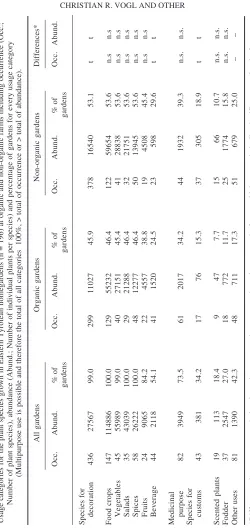
[image:9.612.173.423.171.353.2]The largest number of species can be allocated to the category decoration (436 ornamental plant species in 194 gardens). On average, 21 species used for decorative purposes are grown per garden (Range for n = 194: 4–84). A tendency in the differences between organic and non-organic gardens can be observed (pANOVA = 0.073 for occurrence and 0.062 for abundance) (Table 3). The area for ornamental plant species in the gardens covers approximately 15–20% of the total garden area. The abundance of ornamental species is 19% of the total abundance of all species in all 196 gardens (Table 3). Species from the decorative category are used to decorate the garden, cemetery, churches and chapels, and to make bouquets for the houses. One hundred women farmers report that “the pleasure of gardening” is a reason to manage a garden. This pleasure is, according to the women, closely related to the colourful appearance of ornamental plant species in gardens.
TABLE 2
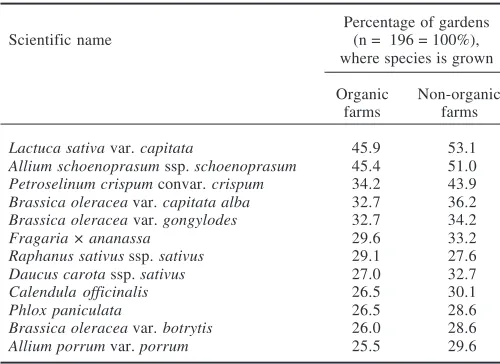
Percentage of gardens, where the most frequently cultivated plant species are grown.
Percentage of gardens
Scientific name (n = 196 = 100%),
where species is grown
Organic Non-organic farms farms
Lactuca sativa var. capitata 45.9 53.1
Allium schoenoprasum ssp. schoenoprasum 45.4 51.0
Petroselinum crispum convar. crispum 34.2 43.9
Brassica oleracea var. capitata alba 32.7 36.2
Brassica oleracea var. gongylodes 32.7 34.2
Fragaria × ananassa 29.6 33.2
Raphanus sativus ssp. sativus 29.1 27.6
Daucus carota ssp. sativus 27.0 32.7
Calendula officinalis 26.5 30.1
Phlox paniculata 26.5 28.6
Brassica oleracea var. botrytis 26.0 28.6
TABLE 3
Usage categories for the plant species grown in Eastern Tyrolean homegardens (n = 196) at organic and non-organic farms includi
ng occurrence (Occ.;
Number of plant species), abundance (Abund.; Number of individual plants per species) and percentage of gardens for every usage
category
(Multipurpose use is possible and therefore the total of all categories 100%, > total of occurrence or > total of abundance).
All gardens Organic gardens Non-organic gardens Differences* Occ. Abund. % o f Occ. Abund. % o f Occ. Abund. % o f Occ. Abund. gardens gardens gardens Species for decoration 436 27567 99.0 299 11027 45.9 378 16540 53.1 t t Food crops 147 114886 100.0 129 55232 46.4 122 59654 53.6 n.s n.s Vegetables 45 55989 99.0 40 27151 45.4 41 28838 53.6 n.s n.s Salads 35 43039 100.0 29 21288 46.4 32 21751 53.6 n.s n.s Spices 58 26222 100.0 48 12277 46.4 50 13945 53.6 n.s n.s Fruits 2 4 9065 84.2 22 4557 38.8 19 4508 45.4 n.s n.s Beverage 44 2118 54.1 41 1520 24.5 23 598 29.6 t t Medicinal purpose 82 3949 73.5 61 2017 34.2 44 1932 39.3 n.s. n.s. Species for customs 43 381 34.2 17 76 15.3 37 305 18.9 t t Scented plants 1 9 113 18.4 9 4 7 7 .7 1 5 6 6 10.7 n.s. n.s. Fodder 37 2547 27.0 18 772 11.7 25 1774 15.8 n.s. n.s. Other uses 8 1 1390 42.3 48 711 17.3 51 679 25.0 – –
*Differences in occurrence and abundance between gardens at organic and non-organic farms, which are statistically significant
at a level of p
ANOVA
< 0.05 are indicated as “sig.”, at a level of p
ANOVA
≥
One hundred and forty seven species are used for food. On average, every gardener grows 18 plant species to be used for food (Range: 4–57 species). No statistically significant differences were found in occurrence or abundance of species used for food between the homegardens on organic and non-organic farms (Table 3). Plant species used as food cover the major area of the home-gardens and are grown with a higher abundance than plant species used for decoration.
In the food category, herbs and spices dominate in species diversity (58 species) and vegetables dominate in abundance (55989 individuals) (Table 3). Seventy six percent of the women report that having home-grown food is the main motivation for managing a garden. They say it is important for them to know where produce comes from, how it has been grown and that it can be harvested rapidly according to demand. Vegetables and salads are used daily during the growing period and therefore grown in high abundance per garden in relation to other plants. No statistically significant differences were found in occurrence or abundance of species used as vegetable, salad, spice or fruit. A tendency in the differences for beverages can be observed (pANOVA = 0.098 for occurrence and 0.05 for abundance) (Table 3), because more women farmers at organic farms report the use of herbs (e.g. Mentha x piperita, Melissa officinalis) for the preparation of beverages for wintertime.
Species with medicinal purposes are grown in 73.5% of the gardens with a total of 82 species in the study area. On average, two medicinal plant species are grown per garden (Range: 1–34). Abundance is low in relation to plant species used for ornamental purposes or for food. Women report that, nowadays, medical supply for humans as well as for animals is always guaranteed and is affordable; therefore the dependency on their own formulas is no longer an issue. No statistically significant differences were found in occurrence or abundance of species used for medicinal purposes between the homegardens on organic and non-organic farms (Table 3). The preparation of teas used in the treatment of digestive trouble, colds and inflammations are some of the purposes reported for medicinal plants. Camomile (Chamomilla recut ita),sage (Salvia officinalis)and elderberry (Sambucus nigra)are the most common plant species grown and used for medicinal purposes. None of the women reported the production of medicinal plant species as a reason for managing a garden.
Scented plants, i.e. plants with a special scent and with an explicit use of this scent, are represented with 19 species with very few individual plants in 18.4% of the gardens. Between one and three species cultivated are used for scent in these gardens with no difference between organic and non-organic farms (Table 3).
Fodder species are those which are considered as greens for pigs, or as fodder for bees. Species used as fodder are not exclusively grown as fodder, except turnips (Brassica napus ssp. rapifera, Beta vulgaris var. rapacea).The majority are species for human consumption, where lower quality produce is given to the animals. No statistically significant differences were found in occurrence or abundance of species used as fodder between the homegardens on organic and non-organic farms (Table 3). Other uses such as shampoo, additives for the bath, dye plants for food, tools for the kitchen and toys were met occasionally but they are not common in the study area (Table 3).
Plant species composition and plant use in the last century
The floristic composition of the homegardens did not vary much across the region until the 1960s. According to the elder women, around 51 species were found across the region and the mean occurrence of species per homegarden did not exceed 10 species.
According to the elder women farmers, the most important species were herbal plant species used as spices (e.g. Allium fistulosum, Levisticum officinale) and for medicinal purposes (e.g. Althaea officinalis, Artemisia absinthium)at that time. The old term for home garden in the study area, Kräutlachgartl (garden of herbs), is a reference to this traditional purpose of the garden. At that time, several herbal plant species also played an important role in customs. In addition, species with symbolic value (e.g. Lilium candidum, Paeonia officinalis ssp.
officinalis), scented plants (e.g. Artemisia abrotanum, Rosa centifolia) and species for ornamental purposes were grown in gardens. Lettuce (Lactuca sativa
var. capitata)was the only vegetable, or rather salad, in gardens. Gardening, in the sense of the labour intensive cultivation of vegetables for subsistence, was not done in the home garden but at arable plots near the homestead. Produce of the homegarden was not brought to market, but only used at the farmstead.
DISCUSSION AND CONCLUSION Management
and the use of alternative remedies to combat diseases. The diachronic per-spective in our results shows that the appearance and management of gardens has not changed much in recent decades. Tools for gardening used in the Middle Ages in Central Europe (Willerding, 1994, 1995) are almost identical to tools and practices currently used. Popular innovations like those in the 1960s and 1970s from the green revolution or those in the 1990s from organic farming did not have a strong and clearly visible impact on homegardens. Some techniques discussed intensively in organic gardening (Franck, 1991; Kreuter, 1997) were tested and are practised by some, but not introduced in general. In homegardening in the study area, as in homegardens of other countries (Fernandes & Nair, 1986; Landauer & Brazil, 1990; Torquebiau, 1992), traditions in management seem to be stronger than innovations in management, the latter not having been tested locally and not having been successfully adopted locally over a longer period of time. Over decades, homegardens have been a system of low external input and high self-sufficiency. This has been observed also by other authors (Siller-Griessmair & Kompatscher-Hoppe, 1989; Inhetveen, 1994). It is concluded that traditional gardening in Eastern Tyrol is highly compatible with the principles of organic farming as defined by Lindenthal et al. (1995), even on non-organic farms, but probably, sustainability can be increased in gardens on organic as well as on non-organic managed farms when methods from organic gardening are promoted and tested locally more intensely.
Floristic composition and plant use
The data show that in Eastern Tyrol there is no difference in the floristic composition and use of plants between homegardens on organic farms and non-organic farms. The commercialization of garden produce is not usual, and in general no ingredients for organically certified nor for non-organic products in Eastern-Tyrol come from homegardens. In contrast, much more of the produce is given away in barter, as a gift or used by the owners of the gardens. This is similar to the traditional way of using garden products as also mentioned by other authors (e.g. Hauser, 1976; Anderson, 1986; Inhetveen, 1994; Agelet et al., 2000). The high idiosyncrasy of plant species (155 species in only one garden) shows that individual patterns of plant use exist, but at the same time one can speak of the culturally typical domain of garden plants for the study area (Table 2), whether they be on organic farms or not. This set of culturally typical plants is almost equal to the set of typical plants in other Central European countries (Titze, 1983). Some of these species have a long tradition in Central Europe; they were already grown in the time of Charlemagne (circa 800 AC) and were recom-mended for cultivation in the 19th century (Fischer-Benzon, 1894).
coniferous species parallel to the increase in economic wealth of gardeners. As a consequence, gardens have changed in appearance and gardens are no longer important for subsistence. In contrast in Catalonia/Spain (Agelet et al., 2000) and Switzerland (Hauser, 1976) homegardens have been and continue to be important for subsistence. An increase in importance, i.e. more useful species that are actually used frequently, can be observed in Eastern Tyrol. During the recent four decades, women farmers at organic and at non-organic farms actively enriched the diversity of plant species in their gardens.
Although the species diversity of medicinal plant species, plant species used in traditional customs and scented plant species have increased throughout the region from the last century to today, occurrence and abundance per garden is low now. In particular, plants with symbolic religious value are either no longer to be found in the region studied (e.g. Lilium candidum),or are only recognized as such by the older women (e.g. Paeonia officinalis ssp. officinalis).It is indeed true that a high diversity of plant species exists in homegardens; however, this very fact may hide the danger that some culturally and historically significant plants are disappearing completely. Public awareness of endangered cultivated plant species in Austria must, therefore, be heightened and an urgent assessment made in this regard.
Contributions of homegardens to the development of (organic) farming
In many alpine regions, land-use already shows “a devastating break-down” (Bätzing, 1996). Eastern Tyrol is no exception. As an example, the cultivation of field vegetables, cereals and fibre crops is in decline, as it is also in other regions (Netting, 1981; Penz, 1996; Cernusca et al., 1999). Changes in management techniques and in the abandonment of several practices, e.g. use of high alpine meadows as pasture, causes losses in agrobiodiversity and may increase the risk of natural disasters (Penz, 1996).
bio-cultural heritage of both organic and non-organic homegardens in Eastern Tyrol can be a source of the re-diversification of landscapes.
Neither policy, nor science nor the organic farming movement has recognized, recommended or supported by way of the transfer of knowledge or financial subsidies, women’s agrobiological conservation work in home gardens in Eastern Tyrol. This activity can be characterized as women farmer’s independent adaptive response to their emic perceptions of changing internal and external processes. According to Soemarwoto (1987) in the laboratory of adaptive response, women farmers manage home gardens as an area of experimentation and innovation. This is true for Eastern Tyrol too, and it is a process that takes its time, i.e. no hurry in the adoption of new practices can be observed. Science and policy should recognize the work of local people who still maintain agro-ecosystems with high agrobiodiversity as part of their culture, lifestyle or practice. This paper shows that women farmers play an important role in this process. Organic farmers who have shown that it is possible to protect and enhance agrobiodiversity (Lindenthal et al., 1995; McNeely & Scherr, 2001) can benefit from these people. Therefore, in Eastern-Tyrol, women farmers from organic and non-organic farms are important partners for the development of sustainable agriculture, for the testing of newly arriving innovations and for in situ conservation of agrobiodiversity. The local knowledge of women farmers is probably not limited to the management of useful plants in homegardens, but to a wide array of elements in the agroecosystem that have key functions in the survival and the welfare of rural people. Ethnobiological studies need to focus on all plots in the mosaic managed by women farmers. Ethnobiological knowledge gained through such studies will not only be important for scientists, development planners and policy makers, but also for the organic farming movement in its challenge to develop strategies for a site-appropriate and a sustainable management of diverse and risk-prone environments.
ACKNOWLEDGEMENTS
References
Agelet, A., Bonet, M.A. & Vallès, J. (2000). Homegardens and their role as a main source of medicinal plants in mountain regions of Catalonia (Iberian Peninsula). Economic Botany,54, 295–309.
Alexiades, M.N. & Sheldon, J.W. (1996). Selected Guidelines for Ethnobotanical Research: A Field Manual. The New York Botanical Garden Press; New York, U.S.A.
Anderson, E.N. (1993). Southeast Asian gardens: Nutrition, cash and ethnicity. Biotica Nueva Epoca, 1,1–11.
Anderson, J.N. (1986). House gardens—an appropriate village technology. In Community Management (D.C. Korten, ed.), pp. 105–112. Kumarian Press; Bloomfield, U.S.A.
Bätzing, W. (1996). Landwirtschaft im Alpenraum-unverzichtbar aber zukunftslos? Eine alpenweite Bilanz der aktuellen Probleme und der möglichen Lösungen. Blackwell Wissenschafts-Verlag; Berlin, Germany.
Bortz, J. & Döring, N. (1995). Forschungsmethoden und Evaluation. Springer; Berlin, Germany. Brun-Hool, J. (1980). Zur Pflanzensoziologie schweizerischer Gärten. Phytocoenologia,7, 73–99. Bye, R. (1997). The role of humans in the diversification of plants in Mexico. In Biological Diversity of Mexico—Origins and Distribution (T.P. Ramamoorthy, R. Bye, A. Lot, & J. Fa, eds.), pp. 707–731. Oxford University Press; Oxford, U.K.
Caballero, J. (1992). Maya homegardens: Past, present and future. Ethnoecolgia,1, 35–54. Cernusca, A., Tappeiner, U. & Bayfield, N. (1999). Land-Use Changes in European Mountain
Ecosystems: Ecomont- Concept and Results. Blackwell; Berlin, Germany.
Encke, F. (1961). Paul Pareys Blumengärtnerei. Beschreibung, Kultur und Verwendung der gesamten gärtnerischen Schmuckpflanzen. Paul Parey; Berlin, Germany.
Esquivel, M. & Hammer, K. (1992). The Cuban homegarden “Conuco”: A perspective environment for evolution and in situ conservation of plant genetic resources. Genetic Resources and Crop Evolution, 39, 9–22.
Fernandes, E.C.M. & Nair, P.K.R. (1986). An Evaluation of the Structure and Function of Tropical Homegardens. International Council for Research in Agroforestry (ICRAF); Nairobi, Kenya. Fischer, M. (1994). Exkursionsflora von Österreich. Ulmer; Vienna, Austria.
Fischer-Benzon, R. (1894). Altdeutsche Gartenflora. Untersuchungen über die Nutzpflanzen des deutschen Mittelalters, ihre Wanderung und ihre Vorgeschichte im klassischen Altertum. Publ. not known; Kiel & Leipzig, Germany.
Fitschen, J. (1994). Gehölzflora: Ein Buch zum Bestimmen der in Mitteleuropa wildwachsenden und angepflanzten Bäume und Sträucher. Quelle und Meyer; Heidelberg, Germany.
Franck, G. (1991). Gesunder Garten durch Mischkultur. Südwest; Munich, Germany. Hanf, M. (1998). Farbatlas der Wildkräuter und Unkräuter. Eugen Ulmer; Stuttgart, Germany. Hauser, A. (1976). Bauerngärten der Schweiz—Ursprung, Entwicklung und Bedeutung. Artemis;
Zurich, Switzerland.
Hegi, G. (1979). lllustrierte Flora von Mitteleuropa. Publ. not known; Munich, Germany. Hochegger, K. (1995). The Kandyan Forest Gardens, Gewatta, of Sri Lanka—Their Ecology,
Economy and Culture. Doctoral thesis. University for Natural Resources and Applied Life Sciences Vienna (BOKU); Vienna, Austria.
Hodel, U. & Gessler, M. (1999). In Situ Conservation of Plant Genetic Resources in Home Gardens
of Southern Vietnam. International Plant Genetic Resources Institute (IPGRI); Rome, Italy. Holzner, W. (1981). Acker-Unkräuter. Bestimmung, Verbreitung, Biologie und Ökologie. Leopold
Stocker; Graz, Austria.
Inhetveen, H. (1994). Die Landfrau und ihr Garten. Zur Soziologie der Hortikultur. Zeitschrift für Agrargeschichte und Agrarsoziologie, 42,41–58.
IPGRI (2000). Annual Report 1999. International Plant Genetic Resources Institute; Rome, Italy. Jäger, E., Schubert, R. & Werner, K. (1991). Werner Rothmaler’s Exkursionsflora von Deutschland
—Atlas der Gefäßpflanzen. Volk & Wissen; Berlin, Germany.
Kreuter, M.-L. (1997). Der Bio-Garten: Der praktische Ratgeber für den naturgemäßen Anbau von Gemüse, Obst und Blumen. BLV; Munich, Germany.
Landauer, K. & Brazil, M. (1990). Tropical Home Gardens. United Nations University Press; Tokyo, Japan.
Lindenthal, T., Vogl, C.R. & Hess, J. (1995). Forschung im Ökologischen Landbau- Integrale Schwerpunktthemen und Methodikkriterien. Der Förderungsdienst, No. 2c., Vienna, Austria. Lohmeyer, W. (1983). Liste der schon vor 1900 in Bauerngärten der Gebiete beiderseits des
mittel-und südlichen Niederrheins kultivierten Pflanzen. In Dörfliche Vegetation im Freilichtmuseum. Erhaltung gefährdeter dörflicher Pflanzengesellschaften und historischer Nutz-pflanzenkulturen (Stiftung zum Schutze gefährdeter Pflanzen, ed.), pp. 109–131; Stiftung zum Schutze gefährdeter Pflanzen; Bonn, Germany.
Mander, Ü., Mikk, M. & Külvik, M. (1999). Ecological and low intensity agriculture as contributors to landscape and biological diversity. Landscape and Urban Planning,46,169– 177.
Martin, G. (1995). Ethnobotany. Chapman & Hall; London, U.K.
McNeely, J.A. & Scherr, S.J. (2001). Common Ground; Common Future—How Ecoagriculture Can Help Feed the World and Save Wild Biodiversity. IUCN (International Union for Conservation of Nature and Natural Resources); Gland, Switzerland and Future Harvest; Washington, U.S.A.
Netting, R.M. (1981). Balancing on an Alp—Ecological Change & Continuity in a Swiss Mountain Community. Cambridge University Press; Cambridge, U.K.
Niñez, V.K. (1985). Household Food Production—Comparative Perspectives. International Potato Center (CIP); Lima, Peru.
Padoch, C. & De Jong, W. (1991). The house gardens of Santa Rosa: Diversity and variability in an Amazonian agricultural system. Economic Botany,45,166–175.
Pahlow, M. (1993). Das groβe Buch der Heilpflanzen. Gräfe und Unzer; Munich, Germany. Penz, H. (1996). Die Landwirtschaft in den Österreichischen Alpen. In Landwirtschaft im
Alpenraum-unverzichtbar aber zukunftslos? Eine alpenweite Bilanz der aktuellen Probleme und der möglichen Lösungen (W. Bätzing, ed.), pp. 141–167, Blackwell Wissenschaftsverlag; Berlin, Germany.
Pirklhuber, W. & Gründlinger, C. (1993). Der biologische Landbau in Österreich. Federal Agency for the Environment; Vienna, Austria.
Poppendieck, H.-H. (1992). Der erste Museums-Bauerngarten. Gartenkunst,4, 79–101.
Rico-Gray, V., Garcia-Franco, J.G., Chemas, A., Puch, A. & Sima, P. (1990). Species composition, similarity, and structure of Mayan homegardens in Tixpeual and Tixcaltuyub, Yucatan, Mexico. Economic Botany,44,470–487.
Royal Horticultural Society (1997). Gartenhandbuch Stauden. Translated by R. Ferstl & H. Kuwer. DuMont; Cologne, Germany.
Royal Horticultural Society (1998). Sommerblumen: Einjährige und Zweijährige; mit mehr als 500 Beet- und Balkonpflanzen. Translated by H. Kuwer & R. Ferstl. DuMont; Cologne, Germany. Salvador Flores, J. (1993). Observaciones preliminares sobre los huertos familiares Mayas en la
Ciudad de Mérida, Yucatán, México. Biotica nueva época,1,13–18.
Schulmeyer-Torres, D. (1994). Bauerngärten: Historische Entwicklung und Charakterisierung des aktuellen Artenbestandes der ländlichen Hausgärten in West-Miteleuropa anhand ökologischer und historisch-geographischer Merkmale-ein Beitrag zur Erforschung der Überreste des Bauerngartens. Logos; Saarbrücken, Germany.
Siller-Griessmair, B. & Kompatscher-Hoppe, A. (1989). Vielgeliebter Bauerngarten.
Verlagsanstalt Athesia; Bozen, Italy.
Soemarwoto, O. (1987). Homegardens: A traditional agroforestry system with a promising future. In Agroforestry, a Decade of Development (H.A. Steppler & P.K.R. Nair, eds.), pp. 157–170, ICRAF; Nairobi, Kenya.
SPSS (1997). Statistical Package for Social Sciences—version 7.5.2 for Windows. SPSS Inc; Chicago, U.S.A.
Titze, P. (1983). Das Pflanzenkleid des Dorfes—seine Gärten. In Dorfokölogie (Landschaftspflege, ed.), pp. 29–54, Laufener Seminarbeiträge; Laufen/Salzach, Austria.
Torquebiau, E. (1992). Are tropical agroforestry home gardens sustainable? Agriculture, Ecosystems and Environment,41,189–207.
Van Elsen, T. (2000). Species diversity as a task for organic agriculture in Europe. Agriculture, Ecosystems and Environment,77,101–109.
Vogl, C.R. & Hess, J. (1999). Organic farming in Austria. American Journal for Alternative Agriculture,14,137–143.
Vogl, C.R., Vogl-Lukasser, B. & Caballero, J. (2002). Homegardens of Maya migrants in the district of Palenque (Chiapas/Mexico): Implications for sustainable rural development. In
Ethnobiology and Biocultural Diversity (J.R. Stepp, F.S. Wyndham & R.K. Zarger, eds.), pp. 631–647. University of Georgia Press; Athens, U.S.A.
Vogl, C.R., Vogl-Lukasser, B. & Puri, R. (2003). Tools and methods for data collection in ethnobotanical studies of home gardens. Field Methods,Accepted.
Vogl-Lukasser, B. (2000). Studien zur funktionalen Bedeutung bäuerlicher Hausgärten in Osttirol basierend auf Artenzusammensetzung und ethnobotanischen Analysen. Doctoral thesis, University of Vienna; Vienna, Austria.
Vogl-Lukasser, B. & Vogl, C.R. (2002). Ethnobotany as an interdisciplinary tool for the study of the biocultural management of agrobiodiversity in homegardens of Alpine farmers in Eastern Tyrol. In Interdisciplinary Mountain Research (R. Bottarin & U. Tappeiner, eds.), pp. 264–273. Blackwell Science; London, U.K.
Waschgler, H. (1993). Landeskunde. In Bezirkskunde Osttirol (Katholischer Tiroler Lehrerverein, ed.), pp. 19–26, Oberdruck; Lienz, Austria.
Watson, J.W. & Eyzaguirre, P.B. (2001). Home gardens and in situ conservation of plant genetic resources in farming systems. In Proceedings of the Second International Home Gardens Workshop. International Plant Genetic Resources Institute (IPGRI); Rome, Italy.
Wehrhahn, H.R. (1937). Was wächst und blüht in meinem Garten? Blütenstauden und Sommerblumen. Tabellen zum Bestimmen von über 500 wichtigen Gartenpflanzen mit Kultur-und Verwendungsangaben. Francksche Verlagshandlung; Stuttgart, Germany.
Willerding, U. (1994). Zur frühen Geschichte des Gartenbaus in Mitteleuropa. In Geschichte des Gartenbaus und der Gartenkunst (Förderkreis Gartenbaumuseum Cyriaksburg e.V., eds.), pp. 127–148. Publ. not known; Erfurt, Germany.
Willerding, U. (1995). Garten und Pflanzen des Mittelalters. In Der Garten von der Antike bis zum Mittelalter, Vol. 57 (M. Carroll-Spillecke, ed.), pp. 249–284, Von Zabern; Mainz am Rhein, Germany.