City, University of London Institutional Repository
Citation:
Marshall, J. (1994). Sentence processing in aphasia : single case treatment studies. (Unpublished Doctoral thesis, City University London)This is the accepted version of the paper.
This version of the publication may differ from the final published
version.
Permanent repository link:
http://openaccess.city.ac.uk/id/eprint/7424/Link to published version:
Copyright and reuse: City Research Online aims to make research
outputs of City, University of London available to a wider audience.
Copyright and Moral Rights remain with the author(s) and/or copyright
holders. URLs from City Research Online may be freely distributed and
linked to.
City Research Online: http://openaccess.city.ac.uk/ [email protected]
Sentence Processing in Aphasia:
Single Case Treatment Studies
Volume II
Jane Marshall
Submitted for the Degree of: PhD
March, 1994
City University
Page No
1
1
2
10.11 The Therapy Programme
10.12 Evaluation of Therapy
10.13 Results and Discussion Table of Contents - Volume II
Chapter 10 - Case Study 2 VIM
The Subject
Spontaneous Speech
Investigations into Noun and Verb
Production 3
10.4 Investigations into Noun and Verb
Semantics 7
10.5 Investigation of Verb Argument
Knowledge 10
10.6 Investigations into Event
Conceptualisation 13
10.7 Reading Assessments 19
10.8 Cued Production 22
10.9 Investigation of Sentence
Comprehension 23
10.10 Summary of Assessment Findings &
Implications for Therapy 25
28
31
10.14 Summary and General Discussion 40
Chapter 11 Case Study 3 PB 49
11.1 The Subject 49
11.2 Investigations of Comprehension
Test of Sentence Comprehension 49
11.3 Investigation of Parsing Skills 51
11.4 Investigations of Noun and Verb
Semantics 52
11.5 Comprehension of Reverse Role Verbs 53
11.6 Sentence Judgement Test 54
11.7 Sentence Anagram Task with
Distractors 55
Sentence Anagram Task (2) 56
Summary and Conclusions from the
Comprehension Testing 57
11.10 Investigations of Production
Information Observations 58
11.11 Investigations of Verb Access 59
11.12 Verb and Noun Reading 61
11.13 Spontaneous Speech Analysis 65
11.15 Investigations of Event Analysis 70
11.16 Subcategorisation Analysis 72
11.17 Analysis of the Semantic Properties
of PB's Verb Phrases 75
11.18 Constrained Sentence Production Task 79
11.19 Summary and Conclusions of
Production Testing 84
11.20 The Design of the Therapy Study 87
11.21 The Therapy Rationale & Programme 91
11.22 Results of the Therapy Programme 98
11.23 Summary and Discussion 105
Chapter 12 Discussion 113
12.1 Summary of Case Study 1 - ivi 113
12.2 Summary of Case Study 2 - MM 118
12.3 Summary of Case Study 3 - PB 121
12.4 The Nature of the Message Level 125
12.5 The Nature of Verbs' Representations 130
12.6 The Role of Verb Information
12.7 Dissociations between Production
and Comprehension 138
12.8 The Influence of Therapy on
Cognitive Processing 143
Appendices 153
8.1 Examples from the Event Perception
Test 154
8.2 Stimuli from the Role Video 157
8.3 Stimuli from the Definition Naming
Test 161
8.4 Instructions for the Imagery
Rating Experiment 165
8.5 Noun/Verb Pairs Matched for
Frequency and Imageability 166
8.6 Sentence Anagram Task with
Distractors 168
8.7 Sentence Judgement Task Stimuli 170
9.1 Snow White Pre Therapy Sample 172
9.2 Cinderella Pre Therapy Sample 174
9.3 The Verbs Used in the First Therapy
9.4 Stories Used in the Evaluation of
the First and Second Therapy
Programme 177
9.5 Pre and Post Therapy Utterances
Produced by EM in the Story
Retelling Task 179
9.6 Analysed Utterances Produced in
the Cinderella Task after the First
Therapy Programme 181
9.7 Utterances Produced by EM in the
Story Retelling Task following the
Second Programme of Therapy 183
9.8 Analysed Utterances Produced in the
Cinderella Task after the Second
Therapy Programme 184
10.1 Pre Therapy Elicitation of the
Cinderella Sample 186
10.2 MM Pre Therapy Spontaneous
Utterances 188
10.3 Post Therapy Utterances from a
Cinderella Sample 191
11.1 Verbs Used in Sentence Anagram
Task (2) - PB 193
11.2 Spontaneous Speech Samples - PB 194
11.4 Post Therapy Cinderella (PB) 200
List of Tables - Volume II
Page No
10.1 Spontaneous Speech Samples 2
10.2 Analysis of Spontaneous Utterances 3
10.3 Picture Description 4
10.4 Picture Description with Verb
Provided 23
10.5 Number of Verbs Produced in the
Picture Description Task 33
10.6 Number of Argument Nouns Produced
in the Picture Description Task 34
10.7 Structure Scores for the Picture
Description Task 35
10.8 Number of Pictures Totally
Comprehended by Observers 36
10.9 Number of Verbs and Nouns
Comprehended by Observers 36
10.10 The Number of Verb/Argument
Relations Comprehended by Observers 37
10.11 Analysis of Post Therapy Spontaneous
Utterances with Comparative
Pre-Therapy Data 38
10.13 Examples of Spontaneous Sentences
Produced after Therapy 41
10.14 Scores on the Multiple Event
Description Task 46
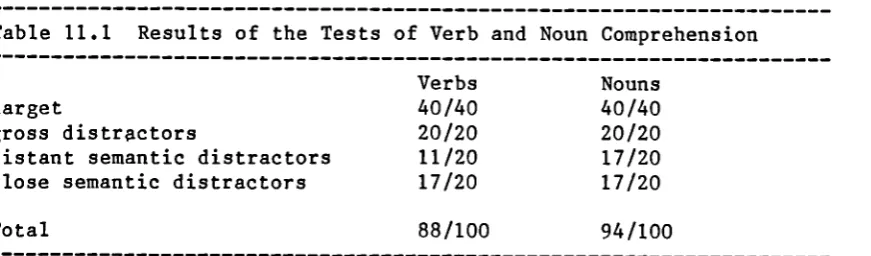
11.1 Results of the Tests of Verb and
Noun Comprehension 52
11.2 Samples of Spontaneous Speech
Pre Therapy 59
11.3 Results of the Verb and Noun
Naming Tasks 60
11.4 Analysis of Predicate Argument
Structure in Spontaneous Speech 65
11.5 Quantitative Analysis of
Spontaneous Speech 66
11.6 PB's Uses of Verbs about
Communication 74
11.7 Results of the Constrained Sentence
Production Task 81
11.8 Breakdown of Errors on the
Constrained Sentence Production Task 83
11.9 The Number of Correct Picture
Descriptions Achieved Pre Therapy,
11.10 The Number of Descriptions
Comprehended by Familiar & Naive
Observers 100
11.11 Number of Propositions Communicated
in the Story Retelling Task 101
11.12 Predicate Argument Analysis of Pre &
Post Therapy Narrative Utterances 102
11.13 Post Therapy Quantitative Analysis
of Spontaneous Speech with Pre
Therapy Comparative Data 103
11.14 Comprehension of Reverse Role Verbs 104
12.1 Summary of Outcomes from 7 Single
Case Investigations of Mapping
List of Figures - Volume II
Page
10.1 Example from NM's Verb-Picture
Matching Test 8
10.2 Examples from the Event Perception
Test 15
11.1 Example Stimulus from the Picture
Description Task 69
11.2 Example from the Event Perception
Test 71
11.3 Graph of the Results of the
Constrained Sentence Production Task 81
11.4 Example of Therapy Stimuli Used in
Task 4 97
11.5 Activation of a Verb Network 111
12.1 The Flow of Activation over Time
Chapter 10 Case Study 2 MM
10.1 The Subject
MM suffered a left CVA in January 1977 when she was 50. Her stroke resulted in severe dysphasia and a dense right hemiplegia. MM
recalls a brief period of therapy immediately following her CVA but
she was soon discharged on grounds of poor prognosis. Following self
referral she attended the City Dysphasic Groups (CDG) three times a
week between November 1989 and Easter 1993. This study was conducted
between January 1991 and August 1992.
MM left school at 14 to work as a machinist in a clothing factory,
where she was eventually promoted to supervisor. Prior to her CVA
she was employed as a civil servant. She is married with one adult
daughter, two step sons and two grand children. MM retains many
interests and hobbies. She is a keen dress maker and is a member of several societies for people with disabilities. With her husband she
campaigned for better transport services for members of the Dysphasic
Groups, which included lobbying her MP. She learnt to drive after
her CVA. She is a monolingual English speaker.
No information was available about NM's early speech and language
presentation. Informal observations at the time of referral to CDG
indicated that her comprehension was 'functional'. Speech was almost
entirely limited to single words with severe word finding problems
and dyspraxia. She made some use of supplementary gesture, which was
enhanced by her subsequent therapy in CDG. She also employed some
supportive writing which was largely confined to proper names and
numbers. Administration of the BDAE yielded a diagnosis of Broca's
10.2 Spontaneous Speech
Spontaneous speech (see table 10.1 and appendix 10.1) was hugely
impoverished. Three attempts to elicit a corpus yielded just 70
analysable words (further elicitation was deemed inappropriate).
Table 1: Spontaneous Speech Samples
Description of weekend:
'Mother's Day ...er Nichola ....meals ....flowers er chocolates'
Description of an episode of 'Home and Away':
'er .... house ... dinner nice ....oh yes drinking er man er police oh (gestures finger wagging) yes'
Account of the Cinderella Story:
'crying .... yes nice ... (writes '12' on pad) eleven o clock yes... er dance ....er wine .... cheerio ... er horses ... horses .... er twelve ... finish ....shoe ... no no no (gestures towards her feet) ah .... ball ...shoe ...shoes ... no no no big ones.
A simple quantitative analysis (table 10.2) showed an almost complete
lack of structure. There were no utterances with verb argument
structure and just one which combined arguments: 'Cinderella nice'.
The two word utterance count includes 2 compound nouns: 'Mother's
day' and 'leisure centre' and is therefore not a true reflection of
her ability to create novel phrases. The proportion of verbs in Nil's
output was also reduced when compared with normal, and non-fluent
dysphasic speakers (Saffran et al 1989).
In addition to the verb argument deficit, Nil's output was
morphologically impoverished. The proportion of closed class words
was well below normal (Saffran et al 1989) and even this may be an
over-estimation. Eight of Nil's closed class words were isolated
negative markers. Excluding these negatives would yield a closed
class count of virtually nil. While most of MM's verbs were
Table 10.2 Analysis of spontaneous utterances
Total number of words 70
Total number of utterances 62
Number of nouns 37
Number of verbs 12
Proportion nouns:verbs 3.1
Number of utterances with verb
argument structure 0
Number of utterances with
combined arguments 1
Number of phrases 5
Number of closed class words 10
Proportion of closed class words .14
Proportion of inflected verbs .83
Conclusion
MM displayed an almost total inability to signal verb argument
relationships in her output. This seemed partly due to a verb
production deficit, since the representation of verbs in her output
was reduced. Furthermore most of her verbs carried the nominal 'ing'
inflection, which raised doubt about their true status (in therapy
tasks MM was known to produce pseudo verbs, such as 'chipping' and
'carroting' for eating). Morphological/syntactic features were
almost completely lacking.
10.3 Investigations into Noun and Verb Production
An informal picture description task was used to test the hypothesis
that MM had a specific verb anomia. Her attempts to say in a single
word what people were doing in 12 simple action pictures are shown in
table 10.3. Just 2 'verbs' were elicited: 'spooning' for feeding and
'gardening' for carrying. Her attempts illustrate the noun
-3-preference seen in her spontaneous speech. For example she was able
to say 'duster' but not 'dusting', and when she produced 'painting'
she gestured the outline of the frame. Subsequent attempts to cue
the verb still elicited nouns.
Table 10.3 Picture Description:
Target. Production.
a man reading a book
a woman driving a car
a man smoking a pipe
a woman dusting a shelf
children watching television
a man carrying a box
a man cutting bread
a man closing a door
a woman feeding a baby
a man cutting a boy's hair
a woman giving a boy a present
a man painting a picture of a girl
'man ... chair ... book'
'my car ... ford escort .. blue ..(writes 'mirror') and er ford'
'man .. woman.. pipes .. jumper'
'woman .. books .. duster.. blue .. shoes'
'man no boy .. two .. girls.. telly'
'oh yes man .. shirt .. yellow .. gardening'
'man .. yellow .. shirt ..
'cupboard door'
'baby .. baby .. spooning'
'man ..'
'boy no girl no boy yes .. woman .. dress .. er boy good'
'girl .. father .. painting
(gestures frame)..girl chairs .. painting
The possible influence of frequency on performance was explored.
Most of the verb targets in the 12 pictures were of high frequency,
for example eight had ratings of over 100. The frequency range was
1264 - 9, and the group mean was 266 (stem ratings are used as any
produce in this task ranged in frequency from 2110 to 1. The mean
rating was 241. Thirteen items had ratings below 100 and three below
10. Thus MM was able to access nouns and adjectives which were
either of comparable or lower frequency than the verb targets. It
seemed that MM's failure to produce verbs was not due to frequency.
MM's naming in this task revealed a curious perspective on the
picture. She often mentioned quite 'peripheral' features of the
pictures such as the furniture or people's clothes and most
strikingly the mirror in the driving picture. Rather than focussing
on the main event MM seemed to be simply listing everything that she
could name.
More extensive investigations of MN's verb and noun production were
subsequently conducted.
Noun/Verb Photos (Byng 1988)
In this task MM was required to 'name' 42 object and 42 action
pictures. The target nouns and verbs shared phonological forms. For
example the noun member of a pair showed a square of butter and the
verb member someone buttering bread. The nouns and verbs were
presented on separate occasions to avoid priming (see section 9.4).
NM's naming of these pictures revealed a significant advantage for
the nouns (verbs: 16/42 vs nouns: 29/42 chi square = 6.89, p<.01).
Given the complete lack of appropriate verbs in the above task her
verb score here was surprisingly high. Her performance might have
been boosted by the nature of the stimuli. MM tended to create
pseudo verbs from nouns, eg in this task she produced 'cabbaging' for
a woman spooning cabbage into a jar and 'needling' for someone
threading a needle. It is possible that some of her correct verbs
When 'verbs' were accessed there was no evidence of any structure.
Most were produced in isolation or as part of a list of single words,
eg:
'zips .. zipping'
'oranges .. tangerine .. peel'
Seventeen of the verb errors involved the production of associated
nouns, such as 'bacon' for grilling. On five occasions she made
either no response or only produced a gesture. There were two pseudo
verbs and two inappropriate verbs. With the object pictures most
errors were again associated nouns or no responses. Three of these
associated responses seemed to be semantic errors: 'oven' for grill,
'record' for tape, and 'belt' for buckle.
The Definition Naming Test
In this test MM was asked to produce either a single noun or verb in
response to a definition cue (see section 8.4). The targets were
matched for frequency.
Once again MM found the nouns significantly easier to access than the
verbs (verbs: 8/33 vs nouns: 22/33, chi square = 10.32, p<.01).
There were 5 types of verb error: repetition of material in the
definition (8); production of associated nouns (8) eg 'blood' for
bleed and 'colours' for decorate; derivational errors (1) 'teacher'
for teach; no response (5); and semantic errors (3) eg 'freezing' for
melt, 'writing' for read and 'kneel' for bow. Most of the noun
errors were no responses (8). There were also 3 errors in which
associated nouns were produced, such as 'Town hall' for office. One
of these seemed a clear semantic error: 'atlas' for globe.
This task supported the earlier observation that the noun>verb effect
was not due to frequency, since the targets were matched. However
MN's ability to access verbs might be frequency sensitive, since 6 of
frequency effect was evident with the nouns: 12 correct responses
were above the median and 10 below.
Conclusions from the Naming Tasks
Nil's naming of nouns was consistently better than verbs across a
variety of tasks. Furthermore attempts to produce verbs often only
stimulated associated nouns. The noun advantage occurred even when
targets were matched for phonological form or frequency.
The tasks offered two early indicators of the site of Nil's naming
deficit. Firstly MM made a number of semantic errors, with both nouns
and verbs, indicating a possible central semantic deficit. Secondly
MM often named quite inconsequential aspects of pictures (see table
10.2), which suggested that she was failing to focus on the main
event. Without this focus the drive for verb production would be
markedly reduced.
These two early hypotheses motivated the following investigations.
Lexical semantics was investigated in a number of comprehension and
input tasks (sections 10.4 - 10.5). The ability to conceptualise
events was probed with the Event Perception Test and Role Video
(section 10.6).
10.4 Investigations of Noun and Verb Semantics
It was hypothesised that NM's naming deficit might be due to
disordered semantic representations. This would predict impaired
lexical comprehension, particularly with verbs.
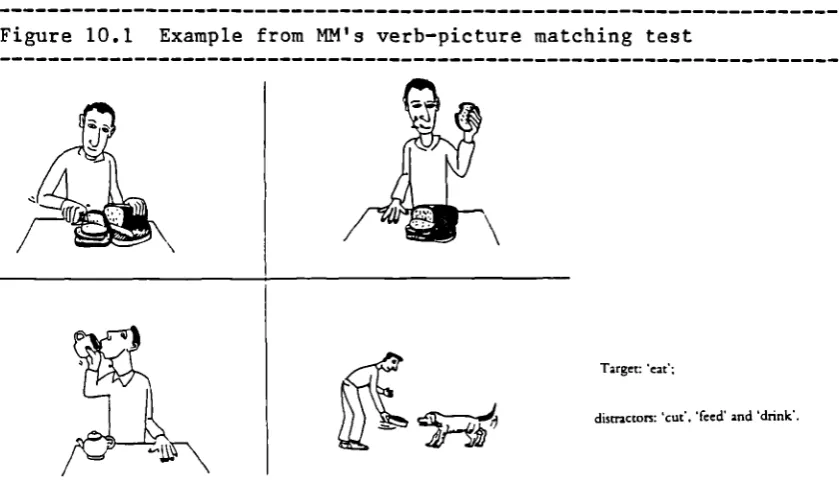
MM was asked to do a test in which a spoken verb is matched to one of
four action pictures. These consisted of the target, an unrelated
distractor and two semantically related distractors (Thus in figure
10.1: Target 'eat', Distractors 'cut', 'feed' and 'drink').
-7-Target: 'eat.;
distractors: 'cut', 'feed and 'drink'.
[image:20.595.93.513.110.352.2]a man pushing a car is this pulling ( " ) Figure 10.1 Example from MM's verb-picture matching test
Five non aphasic pilot subjects made no errors on this test. MM
scored 17/22 and all errors involved selection of related
distractors. Moreover, MM did slightly better on a similar test with
nouns (Kay, Lesser and Coltheart 1992) where she scored 37/40.
Though not a striking deficit the result was compatible with the view
that MN's verb access problems might originate in the semantic
system.
A second task permitted further comparisons between nouns and verbs.
MM was shown a single picture and asked a yes/no question, eg:
picture question
a man peeling an orange is this peeling (verb test)
an axe is this an axe (noun test)
The questions either offered the target word, a semantic distractor,
or a gross distractor. The tests are fully described in sections 8.6
and 8.7.
With the verb stimuli MM scored 84/100. Four errors involved the
rejection of the target word. All others entailed the acceptance of
a semantic distractor. Semantic distractors in this test were of two
kinds. Twenty were semantically related to the target but
syntactically different (SS distractors). For example the SS
distractor for 'roll' was 'fall'. MM made 3 errors with this type of
distractor (17/20). Twenty of the semantic distractors were both
semantically and syntactically related (SI distractors). For example
the SI distractor for 'spin' was 'roll'. These distractors were very
close in meaning to the targets. Thus 'spin' and 'roll' both denote
rotational movement which can be 'spontaneous' or initiated by an
agent. They differ purely in the idiosyncratic feature of direction.
With these distractors MM performed at chance (11/20).
MM scored 98/100 with nouns which was significantly better than her
verb result (comparing nouns and verbs 98/100 vs 84/100 chi square =
10.32, p<.01). Both errors involved the acceptance of close semantic
dis tractors.
Conclusions
MM made some semantic errors in all comprehension tests. However in
the second task she was significantly more impaired when tested with
verbs (despite the fact that the verb stimuli had higher frequency
ratings than the nouns). MM retained some verb knowledge. She could
differentiate targets from gross distractors and was above chance
with the SS distractors. However when distractors were both
semantically and syntactically related to the target her performance
dropped to chance.
These tests only probed verbs' core meaning. They did not explore
the structurally relevant aspects such as argument structure and
mapping rules. This was investigated in the following assessments.
10.5 Investigation of Verb Argument Knowledge
NM's semantic difficulties with verbs may impair her access to the
structural information encoded with them. Without this information
she will not know which argument roles are specified by a verb or how
they are mapped onto syntactic forms. This might impair both verb
access and use.
Sentence Judgement Task
Sensitivity to verb argument information was investigated in a
sentence judgement task. MM was presented with 76 spoken sentences,
half of which contained violations. Of the 38 anomalous sentences 20
involved verb role violations, eg:
a) The potato peels.
The dinner eats.
b) The man falls the stone.
The thug dies the woman.
c) The woman spills the floor.
The man fills the water.
Detection of these violations required knowledge about the number of
arguments commanded by the verb and how those arguments are mapped
onto syntax. (See section 8.9 for a fuller discussion of these
stimuli).
The remaining 18 sentences violated either verb selection
restrictions, eg:
The man writes the painting
or the relationship between the verb and an optional modifier, eg:
The man is swimming in the street.
Sensitivity to these latter violations did not depend on verb
accessing the core meaning of the verb. (MM was presented with an
early version of this test which contained only 18 stimuli of this
kind, compared with the final 20).
MM's scores were well above chance with both the correct sentences
and the violations of selection restrictions (correct: 34/38;
selection restriction violations: 15/18). Furthermore she displayed
some ability to correct these anomalies. For example with 'the man
skates on the water' she offered 'ice' as a suitable location.
Although MM made a few errors (which was unsurprising given her
impaired verb comprehension) it seemed that she could often access
the general verb semantics required by these stimuli.
With the verb role violations MM was at chance (8/20). This
suggested that she no longer retained the specific information about
the number of arguments entailed by verbs or how they should be
mapped onto sentence positions. Instead she seemed to infer probable
world events from the stimuli using an asyntactic interpretation of
the key words. For example with 'the man falls the stone' she
gestured being hit on the head and said 'ambulance'.
This task suggested that the structural information encoded with
verbs was no longer available to MM. Access to the components of
verb semantics which do not control syntax was better preserved.
This was evaluated further in a second sentence level task.
Sentence Anagram Task with Distractors
NM's knowledge of verbs was investigated further in a sentence
ordering task (see section 8.8 for a full description). The task had
two levels. At the first MM was asked to arrange three written
sentence fragments into a sensible order. Her performance was
virtually unimpaired (31/32) and indicated that she could arrange
arguments around a verb when all the components of a sentence were
In the second level a distractor fragment had to be eliminated before
those remaining were arranged into a sentence. Two types of
distractors were used, items being presented in random order. It
should be noted that some items permitted more than one resolution.
Half the items tapped mapping skills. Here all three noun phrases
were possible arguments of the event and to succeed MM had to know
how they are organised around the verb, eg:
the water the letter
the man the man
fills the pen
the jug writes
Thus in order to succeed with the first example, MM must know that
'fill' maps the goal rather than the theme, onto the direct object
position.
The other 16 items in the test did not call upon mapping knowledge.
Here success depended purely on awareness of the verbs' selection
restrictions, eg:
the mountain reads
the man the man
the field the television
climbs the newspaper
Distractors made the task more difficult for MM. However her
difficulty was not general. On selection restriction items her
performance remained prompt and virtually unimpaired (Section C:
15/16). When a mapping decision was demanded her performance (9/16)
showed a significant decline (chi square = 4.14, p<0.05). With just
one exception all errors involved the selection of an inappropriate
argument for the post verbal slot, eg: 'the man/pours/the glass',
'the man/writes/the pen'. Her approach to the task suggested that
results. For example she often produced bizarre orderings, such as
NNV, which were then rejected. Thus even successful performance on
these items was accompanied by considerable hesitation and
uncertainty.
Interpreting performance on this task is problematic. MM produced no
function words and showed difficulty understanding them in
comprehension testing (Test of the Reception of Grammar). It is
possible therefore that some of her errors with the verb role
distractors were due to her function word deficit. For example when
ordering 'the man/writes/the pen' MM may have intended 'the
man/writes/with the pen'. However not all her errors could be
explained this way. No additional function words could make 'the
man/pours/the glass' acceptable. Therefore the task gave further
support to the hypothesis that MM could not access the
subcategorisation information encoded with verbs.
Conclusions
Both the sentence judgement and anagram task suggested that MN's
semantic impairment with verbs extended beyond their core meanings.
She was poor at detecting verb argument anomalies and found it
difficult to order sentence fragments when a mapping decision was
required. It seemed that MM could no longer access verbs' thematic
structures or their mapping rules.
10.6 Investigations into Event Conceptualisation
The above tests supported the hypothesis that MM's verb production
deficit was partly due to a central semantic impairment affecting
verb's core meanings and their structural information.
The second assessment hypothesis stated that the verb disorder might
be related to a failure to conceptualise the actions and events which
they encode. This was derived from the observation that MM
-apparently failed to focus on the main event when describing
pictures.
MM performed well (48/52) on the pyramids and palm trees test,
suggesting that she could perceive and make semantic judgements about
object pictures. A similar non verbal assessment was used to
investigate her ability to process pictures of events.
The Event Perception Test
This test examined NH's ability to match different representations of
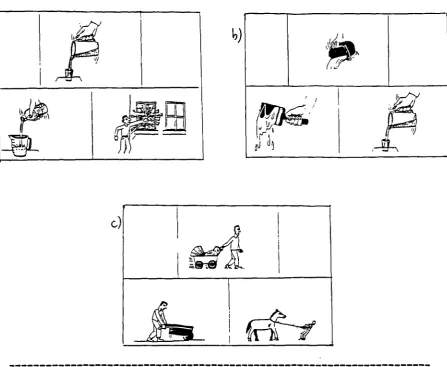
the same action or verb. Each item consisted of three pictures, two
of the target verb and a third of a distractor (see fig. 10.2). She
was asked to indicate which 2 pictures went together; no verbal
response was required. The test has 60 items. In 20 the distractor
verb picture is unrelated to the target (example a:'pour' and
'break'). In the other 40 the distractors and the target are
semantically related (example b: 'pour' and 'drip'; example c: 'pull'
and 'push'). The test is fully described in section 8.2.
In order to succeed on this task it is necessary to perceive the
aspects of events which relate to verb selection. In example (b) the
events are differentiated by manner of movement while example (c)
requires appreciation of direction. The differentiating features do
not necessarily reflect visual similarity. In example (b) all events
are visually similar while in example (c) the events which look alike
are in fact encoded by different verbs. Despite the non verbal
nature of the task the matching can therefore only be achieved
reliably if the subject is attending to the linguistically relevant
1
,kf 0
,
zAvm
../d
JL.,..a0
1 A [image:27.595.93.541.174.541.2]dd u
Figure 10.2 Examples from the Event Perception Test
MM made 10 errors on this test, 8 of which occurred on the semantic
distractor items. Errors were not obviously related to visual
factors. For example she succeeded with example (c), despite the
visual 'trap'. MM was worse than non dysphasic subjects on this task
(all of whom made 3 errors or less) although not dramatically so.
The Role Video Test
In this second non verbal task MM was asked to make decisions about
events recorded on video. Sixteen events represented people acting
upon an object
(a
woman burning paper, a man ironing a shirt) and afurther sixteen were reversible, involving either interactions
between two people or changes of possession (a woman shooting a man,
a man selling a camera to a woman).
MM saw each event twice. After the first presentation she was given
3 photographs. She was then shown the clip again and asked to select
the photograph which showed the outcome of the event. The photos
consisted of the target, an event distractor in which the theme has
been involved in a different action, and a role distractor in which
the target action has been performed on either a different theme or a
different goal (see section 8.3) for a fuller description of this
test). Below are some examples of stimuli from the test:
A. Non Reversible event: Video of a woman burning paper.
Photos: burnt paper (target)
torn paper (event distractor)
a burnt box (role distractor)
B. Reversible interactive event: Video of a woman shooting a man
Photos: the man dead on the floor (target)
the man wearing a coat (event distractor)
the woman dead on the floor (role distractor)
C. Change of possession event: Video of a man selling a camera to a
woman
Photos: the woman holding the camera (target)
the woman holding
a
letter (event distractor)the man holding the camera (role distractor)
In B the role distractors transpose agent and theme. Thus the woman
becomes the theme rather than the agent of the event. In C the role
not the source of the transaction. To succeed on these items the
subject must process and retain the specific roles performed by the
participants in the event. In contrast the role distractors in A
merely import objects visible in the video but uninvolved in the
event. Thus the box in the example is visible in the background of
the filmed event. This task enabled us to explore MM's ability to
make role judgements about events. In particular her performance on
the reversible items would show whether she could isolate and retain
key roles from interactive events.
On the non reversible items MM was error free. However she made 3
errors on reversible interactions (5/8) and 2 on changes of
possession (6/8). In each case the role distractor was selected. It
might be suggested that her problem here was visual, for example she
may be unable to discriminate the two people either in the video or
photographs. Yet this seems unlikely. Both the people in the video
were known to MM and she repeatedly named them during the task. Also
the visual demands of the non reversible items were often greater,
for example one item required her to discriminate a table completely
covered by a cloth and a covered chair. Despite these difficulties
her performance on this section was error free. The Role Video was
administered to 5 non dysphasic controls none of whom produced any
errors.
The result supports the hypothesis that MM has difficulty processing
role information from events. Her performance on non reversible
items showed that she can make broad decisions about cause and effect
and show basic sequencing skills. In interactive and change of
possession events the role distractors are a major problem for her.
Indeed, assuming that she can readily reject event distractors, her
choice between targets and role distractors is not significantly
Conclusions
The non verbal assessments suggested that the verb deficit might be
related to problems in processing representations of events. In the
Event Perception Test she had some difficulties matching different
portrayals of the same verb and with the video task she apparently
failed to focus on the role information within interactive events.
Accounting for MM's problems with these tests is difficult. Clearly
MM did not have a general event confusion. The Role Video revealed a
basic grasp of cause and effect and several other tests confirmed
that she could infer probable events from linguistic stimuli. For
example with the Sentence Anagram Task no pictures were provided.
Yet MM could still deduce the probable target and order the fragments
appropriately, providing there was no distractor. Furthermore her
gestures during the task showed that she was relating her sentence to
an event concept. MM's lifestyle would also argue against a general
confusion. She retained several interests (including political ones)
and, most strikingly, had learnt to drive since her stroke.
NM's problems did not seem to be visual. In the Event Perception
Test visually similar pictures did not consistently stimulate errors
and in the Role video she was able to perform subtle visual
discriminations with the non reversible items.
An alternative account would suggest that MM had problems isolating
the features of events which relate most to language. The Event
Perception Test required her to identify those properties of events
which are 'lexically significant'. For example 'Pouring' and
'Dripping' events have many similarities. They both involve liquids
descending under gravity. They are assigned different verb labels
purely on grounds of manner. In order to differentiate between
pictures of 'pouring' and 'dripping' the subject must focus on the
linguistically relevant manner information, and it may be here that
MM was failing. Her difficulties with the Role Video suggested that
would not disadvantage her with the non reversible events. For
example it is sufficient to know that some burning has occurred
involving a woman and a paper to select the correct outcome photo.
With interactions between people the loss of structured information
will cause difficulties. Here the outcome can only be detected if a
clear representation of who is performing which role has been formed.
The relationship between the event processing disorder and MM's
language problems is uncertain. It may be that MM was unable to
formulate structured and thematic representations at the message
level (see section 2.6). Without these representations she would be
unable to drive verb selection and create a predicate argument
structure. In other words the mechanism which mediates between
general thought and language may have been impaired. Alternatively
the errors in the non verbal tasks may be a product of her linguistic
problems, for example without verb argument information it may be
difficult to retain even non verbal representations of event
structures.
Despite these complexities NM's problems with the non verbal tasks
lent support to the hypothesis that a disorder in processing
representations of events was contributing to the verb production
problem.
10.7 Reading Assessments
Testing so far identified two possible impairments contributing to
the verb production deficit, namely a central semantic impairment and
a difficulty in processing representations of events. So far
phonological factors had not been considered. However MM had an
articulatory dyspraxia and made phonological errors. A further
deficit at the level of the phonological output lexicon therefore
seemed possible. This was explored via a number of assessments which
investigated MM's ability to access phonology from the written word.
-The first required MM to read aloud 15 non words, each of 3 letters
(this occurred prior to the publication of PALPA, therefore stimuli
were drawn from the Coltheart Battery). MM scored 1/15. Most errors
were lexicalisations, eg 'keg' for 'kag'. It seemed that MM could
not employ the sublexical reading route. Therefore when reading
aloud she would have to access her phonological output lexicon.
In the next task MM was asked to read aloud 12 verbs which she had
previously been asked to name from pictures (see table 10.3). She
scored 10/12, which was significantly better than her naming
performance (naming 0/12 vs reading 10/12, chi square = 13.89,
p<.001). This trend was confirmed in a second reading task, which
used 32 of the verb stimuli from the Definition Naming Test (see
section 10.3). MM had only been able to name 8 of these stimuli, yet
she read aloud 20, which was again a significant improvement (naming
8/32 vs reading 20/32, chi square = 7.68, p<.01). When the noun
stimuli were tested NM's reading was again better than her naming,
although not significantly (reading: 28/32; naming 21/32; chi square
= 3.13). Reading performance was not sensitive to frequency with
either the nouns or the verbs.
Why was MM's reading aloud of verbs better than her naming? It was
possible that when reading she was accessing phonology directly from
the visual input lexicon and thereby 'bypassing' her deficit within
the semantic system. If this were the case reading should be
impervious to the semantic status of the stimuli. This was
investigated by asking MM to read and 'define' 32 abstract words
(drawn from the Coltheart Battery). MM could only read aloud 8 of
these words. Furthermore her ability to pronounce them seemed
related to comprehension. All the words which she read aloud were
also appropriately 'defined'. For example with 'fraud' she gestured
money and indignation, and with 'false' offered 'teeth'. She was
only able to signal comprehension of 3 other words, none of which
were produced. Most of the words which were not read aloud were also
not understood. With several of these she seemed to make visual
gestured exercise and with 'prior' produced 'church' (which was
possibly derived from priory). There were two apparent homophone
errors. 'Pause' induced 'dog .. paw', and in response to 'fate' MM
produced 'ball .. raffle'.
NM's performance with the abstract words indicated that she received only minimal assistance from the direct reading route (her two
homophone errors above were possible applications of this route).
Generally her performance suggested that words which were difficult
to comprehend were also difficult to say. It seemed that MM was
having to read via her damaged semantic system.
The final reading assessment compared NM's ability to read aloud
nouns and verbs which were matched for imageability and frequency (see section 8.5). MM scored 20/22 for the nouns and 12/22 for the
verbs. As in her naming, nouns showed a significant advantage over
verbs (20/22 vs 12/22, chi square = 9.28, p<.01). There was no
frequency effect either for nouns or verbs.
Conclusions
NM's almost total inability to read non words confirmed that the
sub-lexical route was not available. Employment of the direct route to
the phonological output lexicon was counter indicated by her poor
performance with abstract words and the evidence that pronunciation
seemed to depend on comprehension. This suggested that MM had to
process words though her impaired semantic system when reading aloud.
The finding that nouns were better read than verbs was consistent
with this view, since comprehension testing had shown that the
semantic deficit was more profound for verbs (see section 10.4).
The evidence that MM read verbs better than she named them was more
difficult to explain, since in both tasks she was employing the same
semantic route to phonology. This result may be a further
manifestation of NM's problems in event processing. In the naming
tasks she either had to interpret a picture of an event, or infer an
-event from a definition. These processes were not engaged by the
reading task, which may account for the better performance.
Interestingly there were no significant differences between MM's
reading and naming of nouns. This finding is consistent with the
above discussion, since object naming also requires no event
processing.
The reading tasks confirmed that MM's production problems were due
mainly to deficits in the semantic system and possibly at the level
of event processing. There were signs of additional problems at the
level of phonology. MM made 6 phonological errors on the reading
tasks, eg /gettz/ for 'ask' and /d1u)L0/ for hanging (although
differentiating these from dyspraxic errors is problematic).
Furthermore with 4 of the verb stimuli she was able to demonstrate
good comprehension despite an inability to produce the word, eg with
'add' she wrote out a calculation. This suggested that there might
be some specific problems in accessing entries within the
phonological output lexicon. However this deficit seemed to impact
less on MN's production than her higher order impairments, as was
confirmed in the following cueing task.
10.8 Cued Production
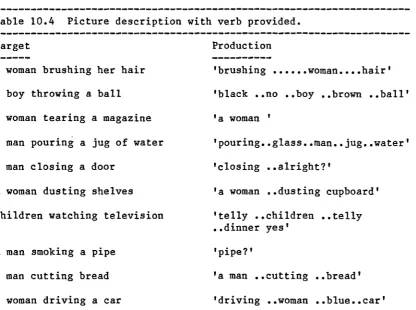
In this task MM was asked to describe 10 action pictures using a
given written verb. When necessary the therapist helped her to read
the verb aloud. Her attempts to employ the verbs are given in Table
10.4.
In two cases MM reproduced the verb within some argument structure.
However in the other 8 instances provision of the verb did not raise
the quality of her output. Indeed in four cases she still omitted
the verb from her description.
MM's performance on this task was consistent with the view that she
was unable to access the structural information encoded with verbs
know how many arguments the verb commands, or how those arguments
should be mapped onto sentence positions. As a result her output
[image:35.595.106.523.171.481.2]floundered among possible candidate nouns.
Table 10.4 Picture description with verb provided.
Target
a woman brushing her hair
a boy throwing a ball
a woman tearing a magazine
a man pouring a jug of water
a man closing a door
a woman dusting shelves
children watching television
a man smoking a pipe
a man cutting bread
a
woman driving a carProduction
'brushing woman....hair'
'black ..no ..boy ..brown ..ball'
'a woman
'pouring..glass..man..jug..water'
'closing ..alright?'
'a woman ..dusting cupboard'
'telly ..children ..telly ..dinner yes'
'pipe?'
'a man ..cutting ..bread'
'driving ..woman ..blue..car'
This task reduced the phonological demands to a minimum. MM was
given the target verb and helped to pronounce it. Yet her output was
still grossly impaired. It seemed that MM's speech was primarily
handicapped by her higher order semantic and event problems. The
implications for therapy were clear. Only treatment tackling these
conceptual and semantic problems could hope to benefit her output.
10.9 Investigation of Sentence Comprehension
Thus far assessments have indicated that MM could not compose verb
structures to represent meaning relationships. The Jones Word Order
Test was used to assess whether MM could comprehend meaning
relationships in sentences. In this task interactive events are
-described by simple SVO sentences ('The vicar shoots the doctor').
The target picture is presented with pictures of a reversal (the
doctor shooting the vicar) and a lexical distractor (the vicar
pushing the doctor). MM was presented with 30 items from the
auditory version of the task.
MM made 10 errors (20/30). Nine involved the selection of the
reversal picture. Her errors might be attributed to a failure to
retain word order on input. A simple word order task in which she
was asked to point to sequences of 2 and then 3 object pictures
appeared to rule this out. She scored (18/20) on this test and
quickly corrected her two errors.
Reversal errors in comprehension have been interpreted within the
mapping hypothesis (Schwartz et al 1980, Byng 1988 and see section
5.3). This states that errors arise because roles cannot be mapped
to the noun phrases in the sentence. Two types of mapping disorder
have been suggested. In the 'procedural' version the subject lacks
the general rules that assign thematic roles to syntax. In the
other, the verb-specific mapping information is lost. This form of
the disorder generates difficulties even with simple active
sentences, like those used in the Jones test. Previous comprehension
testing showed that MM lacked knowledge about verbs' thematic and
mapping structures. It therefore seemed likely that she had a
lexical, rather than procedural mapping disorder.
MN's performance on the Jones Test might also be compared with the
results of the Role Video. This showed that MM could not reliably
identify participant roles in interactive events. It is possible
that she experienced similar problems interpreting the Jones Test
pictures, or was failing to integrate her interpretation with the
10.10 Summary of Assessment Findings and Implications for Therapy
This section will attempt to interpret the assessment findings
against the production and comprehension 'models' offered in Chapter
7.
MM's output lacked verb argument structure. This seemed partly due
to a lexical verb deficit, since verb access was reduced in
spontaneous speech and picture description. Naming and reading
aloud tasks confirmed that verb production was significantly more
impaired than noun production, even when the targets were matched for
phonological form or frequency.
NM's lexical impairment seemed to reside in the semantic system,
since she made semantic errors both on output and input (the fact
that her production was not frequency sensitive was consistent with
this view). Comprehension testing produced significantly more errors
with verbs than nouns, which suggested that verbs' semantic
representations were particularly impaired. The verb impairment
seemed to affect her access to verbs' structural information. She
failed to detect verb role violations in a sentence judgement task
and was unable to organise sentence fragments when a mapping decision
was required.
It was therefore hypothesised that MM had an impairment in the
semantic lexicon, which particularly affected verbs and their
structural information. In production this would result in
inadequate verb information being supplied to the processor of the
predicate argument structure and therefore an inability to compute
the functional level representation. This interpretation of her
deficit was supported by a cuing task in which MM was asked to
describe pictures using a provided verb. Her output was still
massively impaired. It seemed that simply providing the phonological
form of the verb was insufficient to overcome her problems. Unlike
EM, MM was unable to use cue verbs, presumably because she lacked
their argument and mapping information.
-Non verbal assessments suggested that MM had additional problems in
interpreting representations of events. With the Event Perception
Test she had difficulties matching different representations of the
same verb and on the Role Video she apparently failed to focus on the
role information within interactive events. These problems seemed
neither visual nor due to a general confusion. Two possible accounts
of the 'event disorder' were entertained. One suggested that she was
failing to formulate structured and thematic representations at the
message level. As a result she lacked the mechanism which translates
between general thought and language and could not drive verb access
or create a linguistic predicate argument structure. The other
account argued that the event disorder was a product of the verb
impairment. Without verb argument structures it may be difficult to
formulate and retain even non-verbal representations of events.
Thus MM's principle output deficits seemed to reside in the early
message and functional level processes. Additional deficits at the
positional level were possible. When reading aloud she produced some
phonological errors and there were instances when she clearly had
some access to the meaning of the word despite an inability to access
its form. However any phonological deficit seemed much less
significant than her higher order semantic impairment. A deficit in
the syntactic processor was also possible, since MN's output showed
an almost complete absence of syntactic markers. MN's dyspraxia
signalled an impairment in the late articulatory processes.
Comprehension
The Jones Test showed that MM could not interpret even simple
reversible sentences. Parsing abilities were not specifically
tested. However MM could retain word order information, which is the
key syntactic device used by these forms. Therefore it seemed
unlikely that her difficulties on the test were syntactic. Instead
her problems were interpreted as a further manifestation of her
semantic verb impairment. It seemed that NM's verbs were stripped of
unable to operate. MM's problems with event representations may have
also contributed to her difficulties. In other words she may have
failed to interpret some of the Jones Test pictures.
Assessment findings suggested that production and comprehension were
impaired by two principal disorders: a difficulty in processing
events and a semantic verb impairment. The relationship between
these deficits was unclear. For example the verb deficit might be
due partly to the earlier event impairment, or MM's problems with
events might be a product of the verb disorder. The different
possible relationships offered different indications for therapy.
One would suggest that therapy should target the event disorder, in
order to bring about gains in verb and sentence production. The
other suggests that working on verbs and their argument structures
might resolve the event deficit.
I decided to take the first course and conduct an 'event therapy'. A
number of factors stimulated this decision:
- Event therapy could exploit non-verbal tasks. MM found production
effortful and quite stressful. It was therefore hypothesised that
she would benefit from a therapy which removed the emphasis from
speech.
- If necessary event therapy could act as a useful precursor to verb
therapy. In other words thematic concepts, such as agent and
patient, might be established in discussion about events and then
exploited in a verb/mapping therapy.
- Pure event therapy had not been tried. This, therefore, was an
10.11 The Therapy Programme
It was decided that therapy should target the very early stages of
sentence construction. A treatment was devised which aimed to help
MM identify the roles played by the participants in events. It also
aimed to improve her focus on the nature of the action or verb. It
was hypothesised that by stimulating more thematically structured
representations of events the production of verbs and verb structures
might improve.
The therapy was strongly influenced by Jones's work with BB (1986).
There the subject was asked to identify the verb and key roles from
given written sentences. MM was asked to make similar judgements
using representations of events. Eighteen such events were
videorecorded and presented in a hierarchy of complexity:
level 1: people acting upon objects, eg a man ironing a shirt (6
items)
level 2: instruments acting upon objects, eg a hammer breaking a cup
(4 items)
level 3: interactive events involving two people, eg a woman punching
a man (8 items)
In the first stage of therapy MM was shown the event and asked to
identify the agent. This was accomplished by selecting a photograph
from a given pair, eg: man or woman (level 1), hammer or saw (level
2) and man or woman again (level 3). Typical instructions for this
level were 'Can you show me which person is in charge of this
action?' or 'Who did it? or 'Which object did the action?'. With the
non-reversible events MM found this stage quite easy. Here agents
seemed relatively salient for her, possibly because they were either
the only animate or moving entity. With the reversible events MM
Following all selections MM was invited to review the event and check
that her response was correct.
As MM became more competent the number of distractors was increased.
Distractors were included which played different roles in the event.
For example selections for the level one item might include pictures
of a man, a woman, the shirt and the iron.
At the next stage MM was asked to identify the theme again from a
given photo selection: eg an ironed shirt or ironed pair of trousers
(level 1), a broken cup or broken saucer (level 2), and a man with a
black eye or woman with a black eye (level 3). In levels 1 and 2
distractor photographs were objects which appeared during the video.
Typical instructions for this stage were 'Who was the victim?' or
'Which object was changed by the event?'. Again the number of
distractors was increased when MM could select the theme from 2
photographs.
The concept of theme was more problematic for MM, particularly when
one of the distractors was the instrument. Here she was assisted by
further questions which aimed to emphasise that the theme undergoes a
change as
a
result of the event (eg 'which one ends up ironed?','which one ends up broken?', 'which one ends up with a black eye?').
As MM became more reliable in selecting the theme, these questions
were mixed with questions about the agent (eg 'which person gets
arrested?'/'which person ends up in hospital?'). The third stage of
therapy directed MM's focus onto the nature of the action or verb.
Here outcome photos were opposed for selection: (eg an ironed shirt
or a torn shirt (level 1), a broken cup or a full cup (level 2) and a
man with
a
black eye or a man who is soaking wet (level 3).Selection was followed by discussion of how MM would describe or
gesture the action that had occurred. The nature of the action in
the distractor photograph was also discussed.
Therapy was planned to include a further stage in which MM selected a
written verb from semantically related options. It did not include
-29-production, in other words MM was not required to map identified
roles onto an SVO structure or to produce spoken sentences. Both
intentions were amended. The early stages almost always stimulated
spoken verb production. As
a
result the verb selection task was notincluded. Furthermore MM made it clear that she wanted to make
additional use of the materials. Even in the early sessions it was
clear that she was relating the tasks to the formulation of an SVO
description of the events. For example she would arrange selected
agent and theme photographs in a subject and object position around a
'verb gap' on the desk before her. During stage 3 when the verb
photographs were selected and discussed her gestures showed that she
was relating this to her hypothesised verb gap. MN's contribution to
therapy resulted in a greater emphasis on speech production than
anticipated. From an early stage she began to produce SVO output and
even used distractor photographs to stimulate related productions.
The early emergence of structured output during therapy gave strong
support to the treatment rationale. I had hypothesised that sentence
production was being obstructed by poor event conceptualisation.
Clarifying her conceptions of events and encouraging her to focus on
participant roles seemed to have an immediate impact on MN's capacity
to create structure. The early non-verbal work also seemed to
provide a safe setting in which MM felt able to experiment with
output.
The therapy was administered three times a week over a period of one
month. The total therapy time was 12 hours. With the quite small
number of therapy stimuli and the repetitive nature of the task I was
concerned that MM might find the treatment boring. However there was
no indication that this was the case. She continued to listen
intently to the therapy questions and explanations, even when she had
heard them several times before. It seemed that the treatment made
10.12 Evaluation of Therapy
MN's ability to describe 50 action pictures was measured before and
after therapy. Reassessment was conducted 8 weeks after therapy to
measure maintenance.
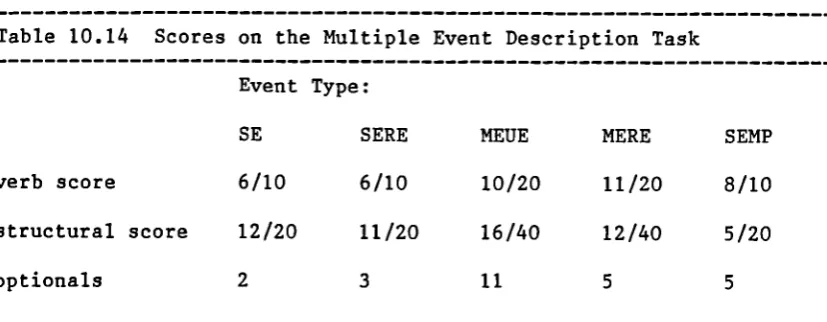
The pictures comprised:
10 non reversible pictures involving verbs which were treated in
therapy;
10 non reversible pictures involving novel verbs;
10 reversible pictures involving verbs treated in therapy;
10 reversible pictures involving novel verbs;
10 pictures showing change of possession events. These pictures
illustrate a 3 argument structure which was not treated in therapy.
Assessment of treated verbs introduced the verb in a new context.
Thus they did not simply reproduce events from therapy. Those of
novel verbs and of new structures were included to assess
generalisation.
MN's description of the pictures was videorecorded and scored using
two procedures:
a) Linguistic Score
The analysis produced numerical scores for both lexical and
structural features in production. The lexical score awarded one
point for each verb and each obligatory argument noun. Optional
arguments and modifiers were also noted. The structural score gave
one point for an argument correctly positioned in relationship to the
verb. Two points were awarded if all nouns were correctly arranged.
-31-Morphology was not scored, ie 'the man is breaking the window' would
receive the same score as 'man break window'.
b) Communicative Score
This procedure scored MN's capacity to communicate the content of the
pictures to observers. Two new videotapes were made. Each contained
a random ordering of half of each type of item from pre and post
therapy descriptions. No item was repeated on the tape. Two
observers were assigned to each tape and asked to judge the content
of the pictures described. In other words they were asked to repeat
everything that they had understood from MM's descriptions. There
were two familiar observers (MM's husband and her regular therapist)
and two naive observers who had no prior contact with a dysphasic
person.
The observers' judgments were recorded on audio tape and scored.
Separate scores were given for lexical and structural content. The
lexical score gave one point for each key word comprehended by the
observer. For example 'its something about a window' would gain a
point. In the structural scoring one point was given if the observer
recognised the relationship between one argument and the verb, such
as 'its about a man breaking something'. Two points were awarded
when the total verb argument relationship was understood.
The Communicative Score differed from the Linguistic Score in that
here MM could profit from items communicated in gesture or other non
verbal behaviours. Indeed the observers were encouraged to attend to
both MM's speech and her actions.
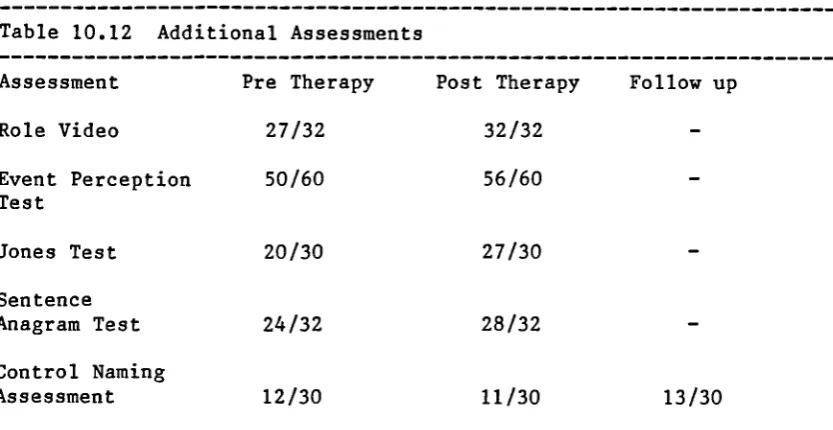
In addition a number of other measures were readministered after
therapy. These comprised: The Jones Test, The Role Video, The Test
of Event Perception, and the Sentence Anagram Task with distractors.
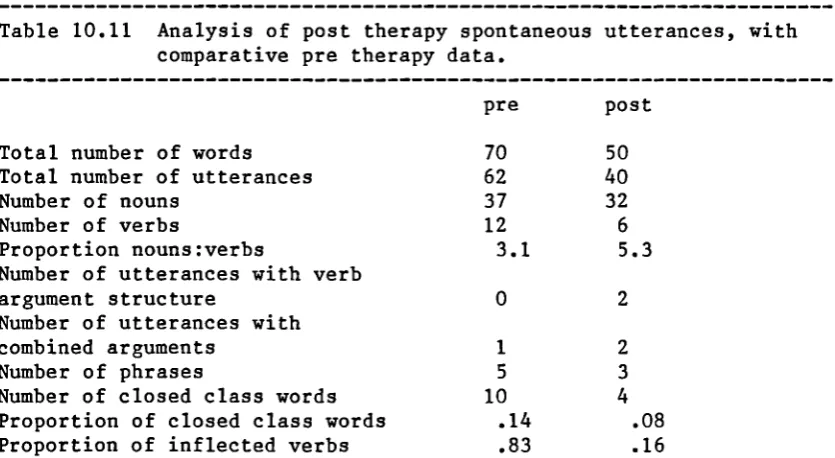
A post therapy spontaneous speech sample was taken to assess
generalisation to un-cued conditions. A control task consisting of
previous study had shown that NM's naming responded to therapy
(Pring, Hamilton, Harwood, and MacBride 1993). The naming task was
therefore judged to be a valid external control.
10.13 Results and Discussion
Picture Description Task - Linguistic Scores
Verb Production: MM's verb production (see table 10.5) during the
picture description task improved significantly (McNemar Test, chi
square = 8.47, p<0.005), and was maintained at follow up (chi square
= 8.44, p<0.01). Improvement was seen for both treated and untreated
SVO verbs, but not for SVO0 items. The scores for each category were
not analysed statistically due to the small number of items and the
accidental discrepancy between baseline scores for treated and
untreated verbs.
Table 10.5 Number of verbs produced in the picture description task
Pre Post Follow up
Total 18/50 32/50 31/50
Breakdown:
Treated items 12/20 20/20 17/20
Untreated items 5/20 9/20 11/20
Untreated SVO0 1/10 3/10 3/10
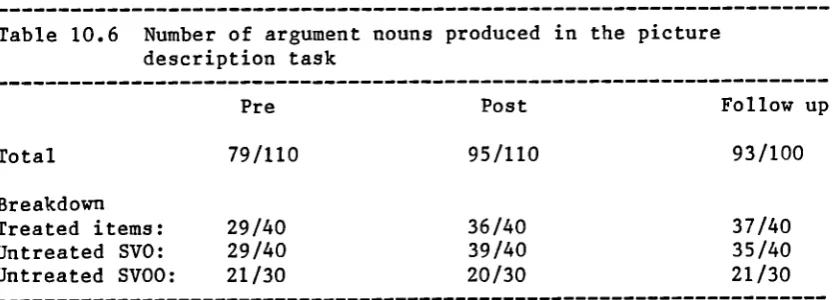
Argument Production: Table 10.6 shows the pre therapy, post therapy,
and follow up argument scores from the picture description task. The
results reflect only the naming of relevant arguments and not whether
the argument was appropriately positioned in respect to the verb.
Despite the unimpressive numerical improvement, an analysis comparing
the number of items in which all arguments are correctly named shows
significant gains post therapy (McNemar chi square = 8.47, p<0.01)
and at follow up (McNemar chi square = 5.06, p<0.025).
-33-Table 10.6 Number of argument nouns produced in the picture description task
Pre Post Follow up
Total 79/110 95/110 93/100
Breakdown
Treated items: 29/40 36/40 37/40
Untreated SVO: 29/40 39/40 35/40
Untreated SVOO: 21/30 20/30 21/30
Production of optional items: The number of optional items produced
was noted. These included instruments, adjectives, and nouns which
would appear as part of
a
modifying phrase in normal production.Prior to therapy MM produced 34 optional items. The suspicion that
this was abnormally high was investigated by asking 5 non dysphasic
subjects to describe the pictures. The mean number of optional items
produced by these subjects was 20.6 (range 8-28). Thus despite her
severe naming problems MM produced more optional elaborations than
any of the non dysphasics. Unlike these subjects MM was not
focussing her descriptions on the central verb argument relationship.
Post therapy MM produced 17 optional items, and at follow up 18.
Both scores were below the non dysphasic group mean. Therefore MN's
naming following therapy showed an interesting change. Optional
items were reduced while argument nouns increased. A plausible
interpretation is that through therapy she developed a more argument
centred focus on the pictured events.
Production of noun/verb combinations: The structural scores are
summarised in table 10.7. These show the number of noun/verb
combinations achieved during the picture description task. Given the
almost complete lack of structure at baseline the improvement
following therapy is obvious. Before therapy no items were totally
correct. Following therapy there were 18 in which full structure was
achieved (McNemar chi square = 16.05, p<0.001). This improvement was
maintained at follow up (McNemar chi square = 15.05, p<0.001). Thus
[image:46.595.99.516.104.254.2]10.7 Structure for description task
Table scores picture
Pre Post Follow up
All Items 2/100 45/100 43/100
Breakdown
Treated items: 2/40 30/40 23/40
Untreated SVO: 0/40 15/40 18/40
Untreated SVOO:
reversible SVO sentences only:
0/20 0/20 2/20
Total 0/40 23/40 21/40
Breakdown
Treated items: 0/20 15/20 9/20
Untreated items: 0/20 8/20 12/20
verb. The increase in argument production cannot account for this
gain. Prior to therapy MM accesses a large number of the required
nouns. Only after therapy is she able to place them in an
appropriate word order.
Function words and inflections: Even post therapy MN's output
omitted function words and inflections. No auxiliaries or
determiners were represented, and the majority of verbs were
uninflected or nominalised.
Picture Description Task - Communication Score
Familiar observers produced higher comprehension scores, both before
and after therapy. However the pattern of their results was similar
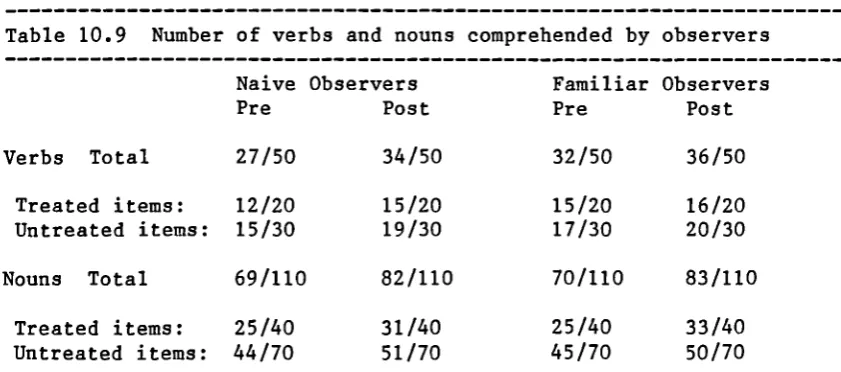
to that of the naive observers. Table 10.8 shows the changes after
therapy. Both pairs of observers showed significant improvement
(Naive observers: chi square = 6.28 p<0.025, familiar observers: chi
square = 6.08, p<0.025). Gains are seen in both treated and
untreated items. These scores only give credit for pictures which
are totally understood. Improved partial comprehension is not
reflected.