Effects of social support about physical activity on social networking sites: applying the Theory of Planned Behavior
Ni Zhang, MA, MPH, PhD, 1 Shelly Campo, PhD,2 Jingzhen Yang, MPH, PhD,3 Kathleen F Janz, EdD,4 Linda G Snetselaar, PhD,5 Petya Eckler, PhD,6
1
University of Missouri, Department of Health Sciences, Columbia, MO, United States 2
The University of Iowa, Department of Community and Behavioral Health, Iowa City, IA, United States
3
The Ohio State University, Department of Pediatrics, Columbus, OH, United States 4
The University of Iowa, Department of Health and Human Physiology, Iowa City, IA, United States
5
The University of Iowa, Department of Epidemiology, Iowa City, IA, United States 6
Abstract
Despite the physical and mental health benefits of leisure-time physical activity (LTPA), only about half of college students participate in the recommended amount of LTPA. While college students are avid users of social network sites (SNSs), whether SNSs would be an effective channel for promoting LTPA through peer social support is unclear. The aim of this study was to explore the effects of social support from students’ contacts on SNSs on their intention to
participate in LTPA, applying the Theory of Planned Behavior. Participants were recruited through a mass email sent to undergraduate students at a large Midwestern university in Fall 2011. A total of 439 surveys were analyzed. Descriptive analyses and analysis for mediating effects were conducted. Social support about LTPA from contacts on SNSs has indirect effect on intention through affective attitude, instrumental attitude and perceived behavioral control (PBC). The results indicate that social support about LTPA from contacts on SNSs might not be effective to change students’ intention unless attitudes and PBC are changed. Future
interventions aiming to promote students’ intention to participate in LTPA by increasing support from contacts on SNSs should increase affective attitude, instrumental attitude and PBC at the same time.
Effects of social support about physical activity on social networking sites: applying the Theory of Planned Behavior
Background
Leisure-time physical activity (LTPA; i.e., discretionary or recreational time for hobbies, sports, and exercises) benefits college students both physically and mentally (Cai, 2000; Fish & Nies, 1996; Sparling & Snow, 2002; Weinstock, 2010). LTPA has the potential to promote general mental health among college students (Cai, 2000; Downs & Ashton, 2011) and can be used to prevent hazardous drinking among college students (Weinstock, 2010). Moreover, the LTPA patterns formed by students during their college years are likely to be sustained into advanced adulthood, which can help prevent disease and promote long-term health (Fish & Nies, 1996; Sparling & Snow, 2002). However, upon a transition out of high school into colleges and universities, students’ LTPA levels drop significantly (Bray, 2007; Bray & Born, 2004). Only about half of all college students, the vast majority of whom are undergraduate students (90.5%), meet the physical activity (PA) recommendation for adults (American College Health
Association, 2010).
discussion in a lab setting (e.g., Calfas et al, 2000; Ince, 2008), or in the gym (e.g. Ince, 2008). These methods were limited in number of participants, continuation of social support, geographic locations, and time constraint.
Social networking sites (SNSs), the social media platform widely used by young adults, could potentially overcome those limitations and be better suited as a platform for social support with college students. SNSs are web-based services that allow individuals to both construct a profile and share a list of contacts (Boyd & Ellison, 2008) and they are broadly used among college students. Studies have found that 94% (Ellison, Steinfield, & Lampe, 2007) to 99% (Chu, 2009) of undergraduate students use SNSs to communicate with their friends and acquaintances. Students can provide support on SNSs anytime and anywhere on mobile devices.
However, SNSs’ application in promoting LTPA by providing social support is hampered due to the lack of evidence of distinguished effect. One recent innovative intervention enrolled students in a Facebook support group while providing them access to a physical-activity-focused website. The intervention increased perceived social support and LTPA among participants over time (Cavallo et al., 2012). However, it did not yield significant differences in the increase of perceived social support and PA between the intervention group and the control group (receiving the same access to a physical-activity-focused website) (Cavallo et al., 2012).
TPB constructs
Attitude is determined by the individual’s beliefs about outcomes or attributes of performing the behavior, weighted by evaluations of those outcomes and attributes (Ajzen, 1991). Numerous studies have discovered that different kinds of attitudes each play a different role in predicting intention to participate in physical activity (e.g., Blanchard et al., 2008; French et al., 2008; Wang, 2009). Therefore, this study examines two attitude types: affective attitude, which includes emotions and drive generated by performing a behavior, and instrumental attitude, which describes cognitive consideration of the extent to which performing a behavior would be advantageous (Ajzen, 1991; Blanchard et al., 2008; Courneya, Conner, & Rhodes, 2006; Fishbein, 2007; French et al., 2005;). One of the few studies that differentiated affective and instrumental attitudes found that among Caucasian college students, both affective and instrumental attitude were predictors of intention; while among African American college students, only affective attitude was a predictor of intention (Blanchard et al., 2008). These findings suggest that the two attitude types are distinct and worth exploring separately.
Subjective norm is the belief about whether important others in an individual’s life approve or disapprove of the behavior and the motivation to comply with those people (Ajzen, 1991). Perceived behavioral control (PBC) is the individual’s perceived amount of control over behavioral performance, determined by one’s perception of the degree to which various
(Courneya & McAuley, 1995; Okun et al., 2003), whereas another study suggested social support should replace subjective norm in TPB to directly predict intention to participate in LTPA (Courneya, Plotnikoff, Hotz, & Birkett, 2000). Furthermore, even less knowledge exists about the effect of social support from contacts on SNSs on students’ intention to participate in LTPA.
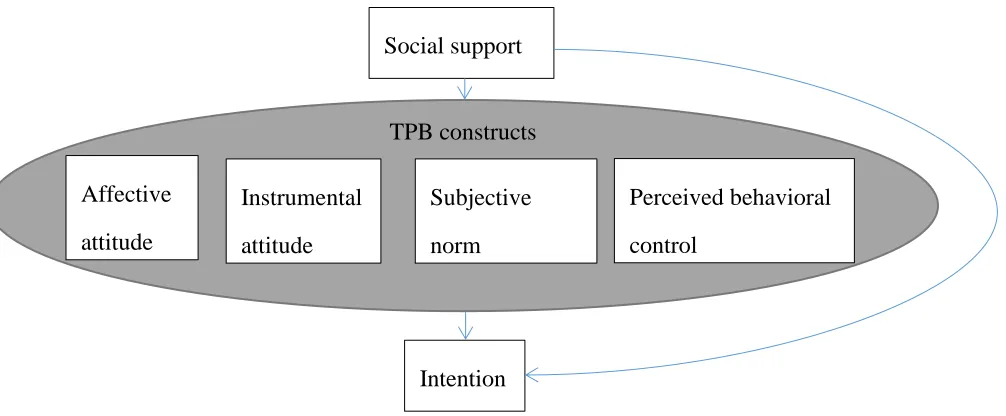
Thus, this present study applies TPB to investigate the effects of social support provided on SNSs about LTPA among undergraduate students. The evidence provided from this study could serve as a basis for designing future interventions using the novel communication channel of SNSs. The research question of this current study applies TPB and asks: Does social support from contacts on SNSs have direct or indirect effect on students’ intention to participate in LTPA? The conceptual model is illustrated in Figure 1.
Methods Data collection
Measurement
Independent variables
Social support about LTPA from contacts on SNSs. The Social Influence on Physical Activity Questionnaire (Chogahara, 1999) was modified to assess the social support that
participants received on SNSs about LTPA in the previous 12 months. Participants were asked to indicate how often their contacts on this SNS have demonstrated three dimensions of social support: 1) companionship support, which is participating in a LTPA with another person; 2) informational support, which is providing positive information regarding LTPA; and 3) esteem support, which refers to encouragement (Chogahara, 1999), using a 5-point scale ranging from 1 (never) to 5 (very often). An example for companionship support was “made plans with you for doing a leisure-time physical activity together;” for informational support was “informed you about the expected positive effects of a leisure-time physical activity on your health;” for esteem support was “complimented your good skill in a leisure-time physical activity.” The Cronbach’s alpha was .88. The score was summed, where a higher score indicates more social support.
TPB constructs
these five items were summed to form a composite score, with higher scores indicating more favorable affective attitude toward LTPA.
Instrumental attitude. Similar to the affective attitude items, students read a series of questions asking them to rate on a 5-point semantic differential scale whether or not they believed that participating in LTPA was: harmful (1) to beneficial (5); useless (1) to useful (5); weak (1) to strong (5); passive (1) to active (5); and foolish (1) to wise (5). These five items were also from an existing instrument of attitude toward LTPA used with the undergraduate student population (Okun et al., 2002; Okun et al., 2003) to measure instrumental attitude. The
Cronbach’s alpha was .86. The composite scores summing these items were calculated, with higher scores indicating more favorable instrumental attitude toward LTPA.
Subjective norm about LTPA from contacts on SNSs. Scales developed by Courneya et al. (2006) were modified for evaluating subjective norms from the contacts on “this SNS,” which refers to the SNS that the participant uses the most. Since students’ social networks enlarge after joining SNSs and befriending people they have never met face-to-face, the
subjective norm was modified to address all the contacts on “this SNS.” Participants were asked to respond to the question, “I think that if I were to participate in leisure-time physical activity over the next month, my contacts on this social network site would be…” on three semantic differential items: disapproving-approving, unsupportive-supportive, and
discouraging-encouraging. Each item was rated on a 5-point scale from 1 to 5. The Cronbach’s alpha was .94. The composite score was calculated by summing the three items. Higher scores indicate
PBC.The study adopted an existing instrument previously used with the undergraduate student population (Okun et al., 2002; Okun et al., 2003). Participants were asked to indicate the extent to which they agreed with two items for LTPA: “I have the resources required to engage in leisure-time physical activity” and “it is easy for me to engage in leisure-time physical activity.” The 5-point Likert-scale ranged from 1 (strongly disagree) to 5 (strongly agree). The composite score was calculated by summing the two items. The Cronbach’s alpha was .70. A higher score indicated higher perceived behavioral control.
Dependent variable
LTPA Intention. Intention was measured by adapting the scale developed by Courneya, Conner and Rhodes (2006). The reliability for the original 7-point scales ranged from 0.95 to 0.96 (Courneya et al., 2006). In this study, participants were asked to answer the following questions: 1) How motivated are you to participate in leisure-time physical activity over the next month? (1=not at all motivated, 7=extremely motivated); 2) How strongly do you intend to do everything you can to participate in any leisure-time physical activity over the next month? (1=do not intend, 7=strongly intend); and 3) How committed are you to doing any leisure-time physical activity over the next month? (1=not at all committed, 7=completely committed). The Cronbach’s alpha was .95. The composite score was calculated by summing the three items. A higher score indicated higher intention to participate in LTPA.
Covariates
Demographics.Demographics of the participants included age, gender, race/ethnicity, school year, and location of residence (see Table 1).
Activity Questionnaire (Chogahara, 1999) on a scale from 1 (never) to 5 (very often). Social negativity was measured by summing all scores of the 12 items of negativity. Examples of social negativity include “told you that you should keep away from a leisure-time physical activity in order to avoid falls or accidents;” “told you that more leisure-time physical activities are not necessary for you because you are already busy with your study (and/or work).” The Cronbach’s Alpha was .89. The score was summed, where a higher score indicates more social negativity.
Length of SNS membership. This variable was assessed by the question, “How long have you used this SNS? Response options were: less than 6 months; between 6 months and 1 year; more than 1 year but less than 2 years; and two or more years” (Hampton, Goulet, Rainie, & Purcell, 2011). Since the majority (90%) of the participants indicated using Facebook for two or more years, this variable was further categorized into the groups “less than two years” and “two or more years.”
Frequency of using this SNS. This variable was assessed by the question “How often do you visit this SNS? Response options were: several times a day; about once a day; 3-5 days a week; 1-2 days a week; every few weeks; less often” (Hampton, Goulet, Rainie, & Purcell, 2011). Since the majority (78%) of participants indicated visiting this SNS several times a day, this variable was categorized into two groups: “several times a day” and “once daily or less.”
Percentage of real life (not virtual only) contacts using this SNS. This variable was assessed by the open-ended question, “Approximately what percentage of your real life (not virtual only) contacts have an account on this social network site?”
Total volume of non-occupational PA (NOPA). This variable was measured by the questions regarding moderate and vigorous PA in the Behavioral Risk Factor Surveillance System Survey (BRFSS; CDC, 2009). Definitions of moderate and vigorous activities were provided in the instructions, along with examples, which were modified to fit the undergraduate student population. The total minutes spent in a usual week for moderate and vigorous PA were calculated respectively. Then, after multiplying the minutes of vigorous PA by two, the minutes were summed (CDC, 2009). For recommended activity, the validity of the BRFSS (assessed using accelerometer as standard) was 0.17-0.22 (Yore et al, 2007). The test-retest reliability scores for moderate PA and vigorous PA were 0.35-0.53 and 0.85-0.92, respectively (Yore et al., 2007). This variable was treated as a continuous variable with higher scores indicating more NOPA participation.
Occupational PA (OPA). This variable was assessed by two questions in the BRFSS survey (CDC, 2009): 1) “Are you employed?” and 2) “When you are at work, which of the following best describes what you do? Would you say…?” The participants were asked to choose from among the following activities: 1) “mostly sitting or standing;” 2) “mostly
walking;” 3) “mostly heavy labor or physically demanding work;” 4) “don’t know/not sure.” The answers to these two questions were then coded into the following four categories: 1)
unemployed; 2) mostly sitting or standing; 3) mostly walking; and 4) mostly heavy labor or physically demanding work.
Data analysis
the macro available in SPSS 20 (Hayes, 2009). Total, direct, and indirect effects of social support on intention through affective and instrumental attitude, subjective norm, and PBC were
estimated, while controlling for age, gender, race/ethnicity, residence, location of residence, length of this SNS membership, frequency of using this SNS, percentage of real life (i.e., not virtual only) contacts using this SNS, past talk about LTPA on this SNS, total volume of NOPA, OPA, and using Facebook or not. The interactions between social support and TPB constructs (i.e., affective, instrumental attitude, subjective norms and PBC) were estimated. The 95% bootstrap percentile confidence intervals for indirect effects are generated based on 5,000 bootstrap samples, as recommended by Hayes (2009).
Results Descriptive Analysis
Of the 439 participants included, the average age was 19 years (Table 1). The majority (81%) were non-Hispanic White students. Freshmen comprised over one-third (38.5%) of the participants, followed by sophomores (22.8%), juniors (16.9%), seniors (16.2%), and fifth-year or more (5.5%). Around half lived on campus (52.4%). Approximately 60% were employed; among these, 36.9% reported mostly sitting or standing in their job; 17.1% reported mostly walking in their work; and only 4.8% reported having a job that involved heavy labor or physically-demanding work.
participants’ real-life contacts perceived to be using this same SNS was 83.7% (SD = 21.6). Participants indicated most often that they have talked about LTPA on this SNS “sometimes” (36.2%), followed by “rarely” (24.8%), “never” (17.3%), “often” (15.5%), and “very often” (5.0%).
Correlation
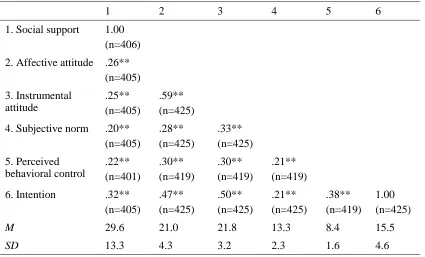
Table 2 illustrates the correlations between independent and dependent variables. Social support was significantly correlated with all variables, including affective attitude (ρ = .26, p < .01), instrumental attitude (ρ = .25, p < .01), subjective norm (ρ = .20, p < .01), PBC (ρ = .22, p < .01) and intent (ρ = .32, p < .01). Affective attitude was significantly related to instrumental attitude (ρ = .59, p < .01), subjective norm (ρ= .28, p < .01), PBC (ρ = .30, p < .01) and intention (ρ = .47, p < .01). Instrumental attitude was significantly correlated with subjective norm (ρ = .33, p < .01), PBC (ρ = .30, p < .01), and intention (ρ = .50, p < .01). Subjective norm was significantly correlated with PBC (ρ = .21, p < .01) and intention (ρ = .21, p < .01). PBC was significantly correlated with intention (ρ = .38, p < .01).
Effects of social support
support and TPB variables including affective attitude (R2 = .00, F(1, 363) = 3.37, p =.07), instrumental attitude (R2 =.00, F(1, 363) = 2.12, p = .15.), subjective norm (R2 = .00, F(1, 363) = .81, p = .37), and PBC (R2= .00, F(1, 363) = .19, p = .66).
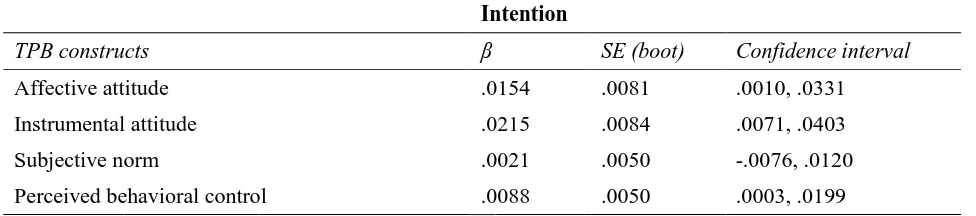
Based on 5,000 bootstrap samples, indirect effects of social support on intention were significant through affective attitude (β = .0154, 95% CI = [ .0010, .0331]); instrumental attitude (β = .0215; CI = [ .0071, .0403]); and PBC ( β = .0088, CI = [ .0003, .0199]) (see Table 4). However, no significant indirect effects of social support through subjective norms were found (β = .0021; CI = [-.0076, .0120]).
Discussion
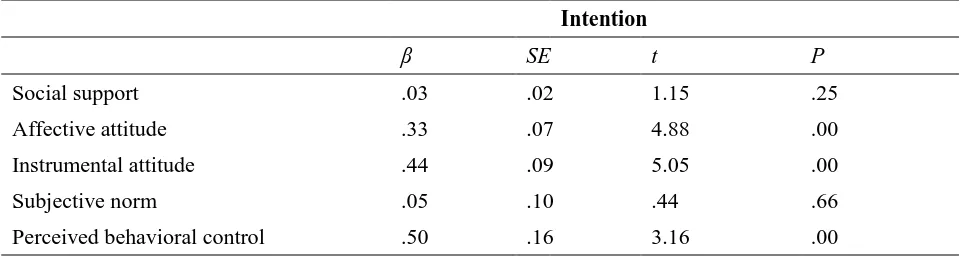
This study fills a research gap by examining the effects of social support received from contacts on SNSs on LTPA intention among college students when the TPB is applied. No direct effect of social support was found. Affective attitude, instrumental attitude and PBC mediated the association between social support on SNSs and intention. These findings suggested that social support from students’ friends might not be effective in changing students’ intention to participate in LTPA unless students’ attitudes and PBC are changed first.
On a theoretical level, these findings raise questions about the concept of social support and how it is processed at the intrapersonal level. Our findings are partially consistent with studies on the indirect effect of offline social support on intention. In offline settings, social support influenced PBC, which in turn predicted intention to participate in LTPA (Courneya & McAuley, 1995; Okun et al., 2003). However, our study found that social support on SNSs influences intention not only through PBC but also through both affective and instrumental attitudes.
In addition, the mediating effects of different kinds of attitudes found in our study were consistent with Wang’s (2009) study. Wang (2009) found that individuals’ intentions to regularly participate in physical activity were predicted by their utilitarian and self-esteem maintenance attitudes, the effects of which were further moderated by individuals’ strength of self-monitoring and self-esteem (Wang, 2009). We found that physical activity was driven by both affective and instrumental attitudes. Combined, the two studies suggest the importance of different kinds of attitudes.
On a practical level, the evidence provided from this study could serve as a basis for designing future interventions using the novel communication channel of SNSs for social support to promote LTPA among college students. LTPA promotion interventions using SNSs can
services, 2012), PBC can be addressed at the same time. An example of a message targeting the instrumental attitude of LTPA is, “A mix of cardio and strength interval workouts made to boost the metabolism! (The University of XXX recreation services, 2012).”
In addition to providing informational support, students can also be encouraged to provide companionship that addresses affective attitude, instrumental attitude, and PBC. For example, a student can be encouraged to post messages on SNSs asking contacts to participate in a fun Zumba dancing class with him/her. Furthermore, students could also be encouraged to provide social support by praising their friends’ LTPA skills so they feel more affective about LTPA. In summary, future interventions can encourage students to provide support to their contacts in a way which makes their contacts like LPTA and think LTPA is important and easy to do.
Study limitations and future research
The first limitation of this study was regarding the sample. We sent a recruitment email to all undergraduate students at the Midwestern university. Students volunteered to take the survey and therefore, the self-selection bias could not be eliminated, which affects the
representativeness of this sample. The sample was overrepresented by younger students, female students, students living on campus, and ethnic minority students when compared to the
University demographics as a whole. Future research can use different recruitment methods to obtain higher response rates and a more representative sample.
Other limitations were common in the cross-sectional studies using self-report surveys. The direction of the causality in the relationships tested in this study could not be clearly determined. Future research using a longitudinal study design allowing changes in actual
impact of social support on actual behaviors. Further, an experimental design, which tests specific message types would most clearly determine the causality direction between the studied variables.
Due to the length of the questionnaire, we did not ask questions about social support provided using different communication methods on SNSs. Students can provide support on others’ SNS profiles, which can be seen by all contacts, or through private messages. Future research can explore the different effects of social support provided through different
communication functions of SNSs. In addition, as the conversation needs to involve mutually co-oriented participants to reinforce existing beliefs, to remind a person of perceptions or ideas, or
to introduce new information (Southwell, 2013), future research should investigate the role of the
relationship between the sender and receiver of the social support particularly in terms of the
effect of social support on receivers’ intentions to participate in LTPA and subsequent
participation in LTPA.
Conclusion
References
Ajzen, I. (1991). The theory of planned behavior. Organizational Behavior and Human Decision Processes, 50(2), 179-211. doi:10.1016/0749-5978(91)90020-T
American College Health Association. (2010). National college health assessment reference group executive summary Spring 2010. Retrieved from
http://www.acha-ncha.org/docs/ACHA-NCHA-II_ReferenceGroup_ExecutiveSummary_Spring2010.pdf Blanchard, C., Fisher, J., Sparling, P., Nehl, E., Rhodes, R., Courneya, K., & Baker, F. (2008).
Understanding physical activity behavior in African American and Caucasian college students: An application of the Theory of Planned Behavior. Journal of American College Health, 56(4), 341-346. doi:10.3200/JACH.56.44.341-346
Boyd, D. M., & Ellison, N. B. (2008). Social network sites: Definition, history, and scholarship. Journal of Computer-Mediated Communication, 13(1), 210-230. doi:doi:10.1111/j.1083-6101.2007.00393.x
Boyle, J., Mattern, C.O., Lassiter, J.W., & Ritzler, J.A. (2011). Peer 2 Peer: Efficacy of a course-based peer education intervention to increase physical activity among college students. Journal of American College Health, 59(6), 519-529. doi:10.1080/07448481.2010.523854 Bray, S. R. (2007). Self-efficacy for coping with barriers helps students stay physically active
during transition to their first year at a university. Research Quarterly for Exercise and Sport, 78(2), 61-70. doi:doi:10.1080/02701367.2007.10599404
Cai, S. (2000). Physical exercise and mental health: A content integrated approach in coping with college student anxiety and depression. Physical Educator, 57(2), 69-76.
Calfas, K. J., Sallis, J. F., Nichols, J. F., Sarkin, J. A., Johnson, M. F., Caparosa, S., Thompson, S., Gehrman, C. A., & Alcaraz, J. E. (2000). Project GRAD: Two-year outcomes of a randomized controlled physical activity intervention among young adults. Graduate Ready for Activity Daily. American Journal of Preventive Medicine, 18(1), 28-37.
doi:doi:10.1016/S0749-3797(99)00117-8
Caspersen, C. J., Powell, K. E., & Christenson, G. M. (1985). Physical activity, exercise, and physical fitness: Definitions and distinctions for health-related research. Public Health Reports, 100(2), 126-131.
Cavallo, D.N. Tate, D.F., Ries, A.V., Brown, J., DeVellis, R.R., & Ammerman, A.S. (2012). A social media-based physical activity intervention. American Journal of Preventive Medicine, 43(5), 527-532. doi:10.1016/j.amepre.2012.07.019
Centers for Disease Control and Prevention. (2009). Behavioral risk factor surveillance system: Prevalence and trends data. Retrieved from
http://apps.nccd.cdc.gov/brfss/list.asp?cat=physical activity&yr=2009&qkey=4418&state=All
Chogahara, M. (1999). A multidimensional scale for assessing positive and negative social influences on physical activity in older adults. The Journals of Gerontology Series B: Psychological Sciences and Social Sciences, 54(6), S356-S367.
Cholewa, S., & Irwin, J. D. (2008). Project IMPACT: Brief report on a pilot programme promoting physical activity among university students. Journal of Health Psychology, 13, 1207–1212. doi:10.1177/1359105308095979
Chu, S. C. (2009). Determinants of consumer engagement in electronic word-of-mouth in social networking sites. Unpublished doctoral dissertation, University of Texas, Austin.
Courneya, K. S., Conner, M., & Rhodes, R. E. (2006). Effects of different measurement scales on the variability and predictive validity of the “two-component” model of the theory of planned behavior in the exercise domain. Psychology & Health, 21(5), 557-570.
doi:10.1080/14768320500422857
Courneya, K. S., & McAuley, E. (1995). Cognitive mediators of the social influence-exercise adherence relationship: A test of the theory of planned behavior. Journal of Behavioral Medicine, 18(5), 499-515. doi:10.1007/BF01904776
Courneya, K. S., Plotnikoff, R. C., Hotz, S. B., & Birkett, N. J. (2000). Social support and the theory of planned behavior in the exercise domain. American Journal of Health Behavior, 24(4), 300-308. doi: 10.5993/AJHB.24.4.6
Downs, A., & Ashton, J. (2011). Vigorous physical activity, sports participation, and athletic identity: Implications for mental and physical health in college students. Journal of Sport Behavior, 34(3), 228-249.
Ellison, N. B., Steinfield, C., & Lampe, C. (2007). The benefits of Facebook "friends:" Social capital and college students' use of online social network sites. Journal of Computer Mediated Communication, 12(4), 1143-1168. doi:10.1111/j.1083-6101.2007.00367.x Fish, C., & Nies, M. A. (1996). Health promotion needs of students in a college environment.
Fishbein, M. (2007). A reasoned action approach: some issues, questions, and clarifications. In Ajzen, I., Albarracin, D., & Hornik, R. (Eds.), Prediction and change of health behavior: Applying the reasoned action approach. Hillsdale, N.J.: Erlbaum.
Freberg, K. (2013). Using the Theory of Planned Behavior to predict intention to comply with a food recall message. Health Communication, 28, 359-365. doi:
10.1080/10410236.2012.688657
French, D. P., Sutton, S., Hennings, S. J., Mitchell, J., Wareham, N. J., Griffin, S., Hardeman, W., & Kinmonth, A. L. (2005). The importance of affective beliefs and attitudes in the Theory of Planned Behavior: Predicting intention to increase physical activity. Journal of Applied Social Psychology, 35(9), 1824-1848. doi:10.1111/j.1559-1816.2005.tb02197.x Godin, G., & Kok, G. (1996). The theory of planned behavior: A review of its applications to
health-related behaviors. American Journal of Health Promotion, 11(2), 87-98. doi:10.4278/0890-1171-11.2.87
Gómez-López, M., Gallegos, A. G., & Extremera, A. B. (2011). Perceived barriers by university students in the practice of physical activities. Journal of Sports Science and Medicine, 9, 374-381.
Hampton, K., Goulet, L. S., Rainie, L., & Purcell, K. (2011). Social networking sites and our lives. Retrieved from http://www.pewinternet.org/Reports/2011/Technology-and-social-networks.aspx
Hayes, A. F. (2009). Beyond Baron and Kenny: Statistical mediation analysis in the new millennium. Communication Monographs, 76 (4), 408-420.
Hennig-Thurau, T., Gwinner, K. P., Walsh, G., & Gremler, D. D. (2004). Electronic word-of-mouth via consumer-opinion platforms: What motivates consumers to articulate themselves on the internet? Journal of Interactive Marketing, 18(1), 38-52. doi:10.1002/dir.10073 House, J.S. (1981). Work Stress and Social Support. Reading, Mass: Addison-Wesley. Ince, M.L. (2008). Use of a social cognitive theory-based physical-activity intervention on
health-promoting behaviors of university students. Perceptual and Motor Skills, 107(3), 833-836. doi:10.2466/PMS.107.7.833-833-836.
Kesaniemi, Y. K., Danforth, E.,Jr, Jensen, M. D., Kopelman, P. G., Lefebvre, P., & Reeder, B. A. (2001). Dose-response issues concerning physical activity and health: An evidence-based symposium. Medicine and Science in Sports and Exercise, 33(6), S351-S358.
Leslie, E, Sparling P. B, & Owen N. (2001). University campus settings and the promotion of physical activity in young adults: Lessons from research in Australia and the USA. Health Education, 101, 116–125. doi:10.1108/09654280110387880
Okun, M. A., Karoly, P., & Lutz, R. (2002). Clarifying the contribution of subjective norm to predicting leisure-time exercise. American Journal of Health Behavior, 26(4), 296-305. doi:10.5993/AJHB.26.4.6
Okun, M. A., Ruehlman, L., Karoly, P., Lutz, R., Fairholme, C., & Schaub, R. (2003). Social support and social norms: Do both contribute to predicting leisure-time exercise? American Journal of Health Behavior, 27(5), 493-507. doi:10.5993/AJHB.27.5.2
Southwell, B. G. (2013). Social Networks and Popular Understanding of Science and Health: Sharing Disparities. Baltimore, MD: Johns Hopkins University Press.
Sparling, P. B., & Snow, T. K. (2002). Physical activity patterns in recent college alumni. Research Quarterly for Exercise and Sport, 73(2), 200-205.
doi:10.1080/02701367.2002.10609009
The University of XXX recreation services (2012). Fitness programs. Retrieved from http://recserv.XXX.edu/Apps/Programs/FitnessPrograms.aspx.
Trusov, M., Bucklin, R. E., & Pauwels, K. (2009). Effects of word-of-mouth versus traditional marketing: Findings from an Internet social network site. Journal of Marketing, 73, 90-102. doi:10.1509/jmkg.73.5.90
U.S. Department of Health and Human Services. (2011). Healthy people 2010: Understanding and improving health. Retrieved from
http://www.healthypeople.gov/2020/topicsobjectives2020/overview.aspx?topicid=33 Wang, X. (2009). Integrating the theory of planned behavior and attitude functions: Implications
for health campaign design. Health Communication, 24 (5), 426-434. doi: 10.1080/10410230903023477
Weinstock, J. (2010). A review of exercise as intervention for sedentary hazardous drinking college students: Rationale and issues. Journal of American College Health, 58(6), 539-544. doi:10.1080/07448481003686034
Figure 1. Conceptual Model
Social support
Affective attitude
Subjective norm
Intention
Perceived behavioral control
Instrumental attitude
Table 1
Participants’ Characteristics (N=439)
Participants’ characteristics Percent (%) Mean (SD) Range
Age 19.49
(1.45)
18-24
Gender Male
Female
20.7 78.1
Race
Non-Hispanic Whites 80.6
Ethnic minorities 18.9
School year
1st year 38.5
2nd year 22.8
3rd year 16.9
4th year 16.2
5th year or more 5.7
Residence
On campus 52.4
Off campus 47.6
Occupational physical activity
Unemployed 40.3
Mostly sitting or standing 36.9
Mostly walking 17.1
Mostly heavy labor or physically demanding work
4.8
Total volume of non-occupational physical activity (minutes)
638.7 (481.8)
0-2520.0
Moderate physical activity 329.3
(243.2)
0-900.0
Vigorous physical activity 154.7
(173.6)
0-900.0
Using Facebook the most or not
Table 1-continued Participants’ characteristics
Percent (%)
Mean (SD)
Range
Facebook 90.7
Length of this SNS membership
Less than two years 10.0
Two or more years 90.0
Frequency of using this SNS
Once daily or less 22.1
Several times a day 77.7
Percentage of real life (not virtual only) contacts using this SNS
83.65 (21.57)
0-100
Past talk about LTPA on this SNS
Never 17.3
Rarely 24.8
Sometimes 36.2
Often 15.5
Table 2 Spearman correlation, mean and standard deviation for predictor, intervening, and outcome variables
1 2 3 4 5 6
1. Social support 1.00 (n=406)
2. Affective attitude .26** (n=405) 3. Instrumental attitude .25** (n=405) .59** (n=425)
4. Subjective norm .20** (n=405) .28** (n=425) .33** (n=425) 5. Perceived behavioral control .22** (n=401) .30** (n=419) .30** (n=419) .21** (n=419)
6. Intention .32**
(n=405) .47** (n=425) .50** (n=425) .21** (n=425) .38** (n=419) 1.00 (n=425)
M 29.6 21.0 21.8 13.3 8.4 15.5
SD 13.3 4.3 3.2 2.3 1.6 4.6
Table 3 Direct effect of all independent variables on intention (N=383) Intention
β SE t P
Social support .03 .02 1.15 .25
Affective attitude .33 .07 4.88 .00
Instrumental attitude .44 .09 5.05 .00
Subjective norm .05 .10 .44 .66
Perceived behavioral control .50 .16 3.16 .00
Notes:β=coefficients. Covariates controlled in the model include age, gender, race/ethnicity, residence, location of residence, length of this SNS membership, frequency of using this SNS, percentage of real life (i.e., not virtual only) contacts using this SNS, past eWOM about LTPA on this SNS, total volume of NOPA, OPA, using Facebook or not, and social
Table 4 Indirect effect of social support on intention (N=383) Intention
TPB constructs β SE (boot) Confidence interval
Affective attitude .0154 .0081 .0010, .0331
Instrumental attitude .0215 .0084 .0071, .0403
Subjective norm .0021 .0050 -.0076, .0120
Perceived behavioral control .0088 .0050 .0003, .0199