JOURNAL OFVIROLOGY, Sept. 1989, p.3595-3600 0022-538X/89/093595-06$02.00/0
Copyright
© 1989, American Societyfor MicrobiologyFunctional Interaction of Constant and Variable Domains of Human
Immunodeficiency Virus
Type
1gpl20
RONALD L.
WILLEY,'*
ELIZABETH K. ROSS,' ALICIA J. BUCKLER-WHITE,2THEODORE S. THEODORE,' AND MALCOLM A. MARTIN'
Laboratory of MolecularMicrobiology, National Institute ofAllergy and Infectious Diseases, Bethesda, Maryland 20892,' and Georgetovn University, Division ofMolecuilar VirologyandImmuinology, Rockville, Maryland208522
Received9 February 1989/Accepted 8 May 1989
A previously reported amino acid substitution within the second conserved domain of the human immunodeficiency virustype 1 (HIV-1) gpl20envelope results in the production ofnoninfectious particles. Molecular characterizationofspontaneous revertantviruses, whicharoseduring long-termcocultures ofthis envmutant,revealed thatan amino acid change withinanotherregion ofgpl20 could functionallycompensate forthe mutationand restoreinfectivity. Inthecurrentstudy,we haveintroduced aconservative amino acid
substitutionatthis second-siterevertantcodon and observedamarkedreduction in HIV-1 infectivity.During
thepassageofthisdefectivevirus in cocultures,yetanotherrevertantappearedwhichcontainedanaminoacid changewithinavariable region ofgpl20which restored infectivitytonearwild-typelevels. Theseresults, in combination withotherpoint mutationsthat havebeenintroduced intotheHIV-1 envelope,suggestthatatleast three discrete regions of gpl20may interact during the establishment ofa productive viral infection. This critical stepoccurssubsequenttotheadsorption ofvirionstothecellsurfaceand eitherpriortoorconcomitant
withthe fusion ofviral and cellular membranes.
Acharacteristic feature of humanimmunodeficiency virus
type 1(HIV-1) is the extensive genetic variability that exists
among different isolates. This genomic diversity is most evident within the enm gene, which contains areas of
pro-nounced amino acid variability (2, 4, 19, 24). Interspersed
among these variable domains, however, are conserved
regions, several of which have been shown to mediate critical steps during the productiveviral infection of human Tcells (12, 15).
Informationrelatingenvgenestructure tofunction
contin-ues to accumulate. Several conserved domains within the gpl20envelope protein have been reported tobethe princi-pal determinants of the binding ofgpl20 tothecell surface viralreceptor molecule, CD4(10, 12). Other regionsappear
to mediate events which occur subsequent to viral absorp-tion (9, 10,25). Several reports alsoindicatethat conserved domains are involved in the processing of the HIV-1
enve-lope proteins (10, 15). Recent studies suggest that the variable domains of gpl20 may also play important roles
during productive viral infection. In particular, a variable
region withingpl20appears to elicit type-specific neutraliz-ing antibodies which can block HIV-1-mediated syncytium
formation and infection by cell-free virus (7, 13, 16, 17). Whiletheexactmechanismof thisinterference isunknown,
a likely explanation is that this variable gpl20 domain is
critical to events in the virus replicative cyclewhich occur
subsequent to adsorption to the CD4 receptor (18). The identification and functional characterization of these and other regions within the HIV-1 envelope may facilitate the development of antiviral intervention strategies.
Wepreviously identified a region within the second
con-served domain ofgpl20 that is critical for viral infectivity (25). Amino acid substitutionsat threeadjacentcodons (266
to268) within thisdomain rendered the virus noninfectious. Anamino acidsubstitution atadistantcodon (128)ofgpl20, which spontaneously occurred during long-term
cocultiva-* Correspondingauthor.
tions, compensated foroneof these mutations (267gln) (see
Fig. 1) and resulted in theemergenceofrevertantinfectious virus particles. In the work presented in this paper, we
mutatedthis second-site changeinthegpl20 of therevertant
and observed amarked reductionin viralreplicative
capac-ity. Long-term passage in tissue culture generated yet
an-otherrevertantviruspossessing biological propertiessimilar
to those of the first revertant virus. Molecular cloning and DNA sequence analysis of the second revertant revealed that an amino acid substitution within avariable domain of
gpl20 (codon 308) was responsible fortherevertant
pheno-type. These results suggest that the three regions within HIV-1envelope,definedbythe128, 267,and308mutantand revertant codon changes, interact with one another and
mediate acriticalearly step inthe virus life cycle.
MATERIALS AND METHODS
Oligonucleotide-directed mutagenesis. Amino acid codon substitutions were introduced into the env genes of the mutant and revertant HIV-1 proviral clones p7O52, p7055, and p7055R1A (25) (referred to as 266asp, 267gln, and
267gln/128asn in this report) as previously described (25).
Briefly, 2.7-kilobase (kb) EcoRI-BamHI env-containing DNA restriction fragments from the different HIV-1
pro-viral DNAclones were insertedinto the M13 vectormpl9, and specific nucleotide changes were introduced by
oligo-nucleotide-directed mutagenesis. Oligodeoxyribonucleo-tides were synthesizedand purifiedaspreviously described
(25). The mutagenesis protocolsofZollerand Smith(27)and Kunkel (11) (Bio-Rad Laboratories) were both used. The analogousenv-containingrestrictionfragmentfroman
infec-tiousmolecular clone ofHIV-1, pNL4-3 (1),wasalsoused to generate HIV-1 proviral clones with individual revertant codon substitutions. Dideoxy single-stranded M13 and dou-ble-stranded plasmid sequencing (Sequenase; U.S. Bio-chemical Corp.) were used to confirm the presence of the nucleotide substitutions in the mutated 2.7-kbEcoRI-BamHI fragments before and after their reintroduction into the 3595
Vol. 63,No.9
on November 10, 2019 by guest
http://jvi.asm.org/
3596 WILLEY ET AL.
parentalplasmid clones. Themutagenicoligonucleotides and designations used were as follows (5' to 3'): 128asn, CTCTG TGTTAaTTTAAAGTGC; 128gln, CCACTCTGTGTTcAaT TAAAGTGCACT; 308ile, CAACAATACAAtAAAAAGTA TCC. The lowercase lettersidentifynucleotide changes that were introduced.
Cell cultures and viral infectivity. TheCD4+ lymphocytic leukemia cell line A3.01 (5) and colon carcinoma cell line SW480 (ATCC CCL228) were maintained in supplemented RPMI 1640 and Dulbecco modified Eagle mediumas previ-ously described (25). Mutant HIV-1 virions were produced by transfecting uncleaved plasmid DNAs into the SW480 cells,and theinfectivity ofprogenyvirions wasassessedby establishing cocultures with the A3.01 cells as previously described(25).Cell culture supernatants were collected after transfection and during cocultivation and assayed for the presence of virion-associated reverse transcriptase (RT) activity (6, 25).
Revertant cloning and DNA sequence analysis.Infectionsof A3.01 cells were established by using cell-free, filtered supernatants (see below) collected from day 21 of the 267gln/128gln coculture experiment (see Fig. 2). Uninte-grated proviral DNA was isolated at 10days postinfection, and molecularclones of the revertantviruswereobtained as previously described (8, 25). The 2.7-kb EcoRI-BamHI env-containing restriction fragmentfrom arevertant recom-binant lambda bacteriophage clone was inserted into the 267gln/128gln mutant clone. Progeny virions resulting from transfections with this construction were monitored for infectivityby coculture and RT analysesasdescribed above. DideoxyDNAsequencing wasperformed on both strands of the revertant 2.7-kb EcoRI-BamHI fragment by using the reconstructed proviral plasmid DNA and synthetic oligonu-cleotideprimers (21, 25).
Infection kinetics and cytopathic effects. Theinfectivitiesof the wild-type pNL4-3 and the revertant 267gln/128asn, 267gln/308ile, and 266asp/308ile viruses were monitored by usingtheA3.01cellline. SW480 cellsweretransfected with the revertant plasmidproviral DNAs, and virus-containing supernatants were collected after 24 h. The pNL4-3 virus stockwasobtainedfromsupernatantsofpreviouslyinfected A3.01 cells. All supernatants were filtered (0.22-,um-pore-size filters) and assayed for virion-associated RT activity. Comparable amounts of RT activity for each virus were addedto2x 106A3.01 cells in 1 ml oftissue culturemedium and incubated in 15-ml conical tubes at 37°C for 2 h. Virus-cell suspensions were then transferred to
25-cm2
cul-tureflasks andmaintained in 10 ml of medium. Supernatant samples were collected every 2 days, beginning on day 5, and assayed for RT activity. Cell viability was also moni-toredateachtime pointbyusingtrypanblueexclusion,and concentrations were maintained at106/ml.
Infections were terminated whenextensive cell death was observed.RESULTS
We have previously shown that the substitution of glu-tamine for asparagine at codon 267 (a potential N-linked glycosylation site) within the HIV-1 gp120envelope gener-ates noninfectious virus (25). The mutated gp120 protein, produced from expression vectors, retained its capacity to bind tothe CD4 receptor and induce syncytium formation. Collectively, these results suggested that the HIV-1 267gln mutant wasblockedat astep inthe replicative cycle subse-quenttoCD4binding. During long-term cocultures with the 267glnvirus, however, infectious revertant virions emerged.
gp 120
0 100 200 300 400 500 aa
[~~m
LAV ELI WMJ2 ARV2 CDC42 HAT Z3 MAL NY5
HIl desigr
KtPCVKCLTPL LCTDLGNASN ...NS.ZLRNNG ...N. I .XNITDW
[image:2.612.318.554.75.359.2]N...K
... N...NTNiNT
... ...N...N ANLNGT
... ..rF....N.I.VKC.S..
... N....eNZVNGIiAV
.. ..S... N ..T. ..Y
IV-nainlfciii
pNL 4-3
267gin
267gln/i 28asn
267gin/i 28gin 267gn/128gln
/308ile
.6*
+I
267gin/308ile +
COOH
PVVSTQLL GSLAZEZVVIRS KINCTRPNNN SIRIQRGPGR
...I... I.T.A..YT.. RTP.--.L.Q
...
.I
...~~~~~~
I.... .... Y.. LS .......Y..._
... .. ...B. ...Q...
...
~~~
...IT...... .I K GSD .IRQS.RI...K
:... T. .. lSG
...
.G
.. ....G.A.--S N R
) mutagenesis
S Q R v
reversion
N Q R v
mutagenesis
a a R v
reversion
Q Q O
Ss (©Q I0 mutagenesis
~~~~~~~of
267glnFIG. 1. Location of amino acid substitutions within the HIV-1 envelopegpl20andtheireffectson viralinfectivity. The topofthe figure illustrates conserved (open) and variable (shaded) domains within gpl2O as previously described (2, 4, 19, 24). The middle section aligns amino acid residues from different HIV-1 clones withinthe 128, 267,and308regions ofgpl20.The bottom portion indicatesamino acid codon substitutions which eitherwere intro-duced by in vitro mutagenesis or occurred spontaneously during tissue culture. Shaded numbers identifyspecific codons involved. Solid letters represent codons present in the wild-type infectious (pNL4-3) proviral clone, while open letters indicate amino acid substitutions in theindicated HIV-1 recombinant plasmids. Infec-tivity ofprogenyvirions fromthevariousHIV-1proviralclones was determined bytransfection, coculture,and RTanalysesasdescribed inthe text. +/- indicatesa low-level infectioncomparedwiththe othervirus infections.The267gln and267gln/128asndata havebeen previously reported (25).
Nucleotide sequencing of revertant molecular proviral clones indicated that the substitution of anasparaginefor a serine at codon 128 ofgpl20 compensated for the retained 267glnmutation and restoredinfectivity (Fig. 1).
To evaluate the effect ofadditional substitutions at this second site, a conservative amino acid change was intro-duced into the 267gln/128asn revertant clone. Aglutamine residue was substituted for theasparaginecodonatposition 128, generating the HIV-1 recombinant plasmid 267gln/ 128gln.Itsbiological activitywasassessed after transfection into the SW480 codon carcinoma cells andcoculturingwith the CD4+ A3.01 cells as described in Materials and Meth-ods. Theparental 267g1n/128asnandwild-type pNL4-3 plas-mid cloneswere similarlyexamined. Spreadingviral infec-tion was monitored by assaying virion-associated RT activity in culture supernatants. Progeny virions from both thewild-typepNL4-3and the revertant267gln/128asnclones established productive infections(Fig. 2). Thehigh levelsof RTactivitydetected in the cocultures 9 to12daysafterthe addition oftheA3.01 cellsindicated thatpeak virus
produc-J. VIROL.
on November 10, 2019 by guest
http://jvi.asm.org/
INTERACTION OF HIV-1 gpl20 DOMAINS 3597
day
7 9 12 14 16 19 21 23
mock
pNL4-3 267gin128asn 267gin 128gin
*
.ww,.*..
*
*-FIG. 2. Infectivity of the 267gln/128gln mutant virus. Virion-associated RT activity was determined in
10-RI
culture supernatant samplesaftertransfectionof SW480 cells with the wild-type (pNL4-3), revertant (267gln/128asn), and mutant (267gln/128gln) plasmid DNAs (first vertical column) and at the indicated times after coculture withA3.01cells.tionoccurredduring this period. In contrast, only low levels ofthe267gln/128gln virus wereproduced during the first 19 days ofcoculture,suggesting that the 128gln substitution had significantly reduced, but not completely ablated, viral in-fectivity. HighlevelsofRTactivity were detected on day 21, however, implying the emergenceof a revertant virus.
To determine whether another revertant had emerged, cell-freevirusfromday 21ofthecoculture(Fig. 2) was used to directly infect the A3.01 cells as described in Materials and Methods. The kinetics of RT activity detected during thisinfection resembledthose of the parental 267gln/128asn virus (data not shown) and suggested that another reversion inthe env gene had occurred. Wetherefore isolated uninte-grated proviral DNA from the infected A3.01 cells and obtained several lambdaphage clones oftheputative rever-tantproviral DNA, as describedin Materials and Methods. When the 2.7-kb EcoRI-BamHI env-containing restriction fragment from one of the lambda phage clones was intro-duced into the defective 267gln/128gln proviral plasmid clone,fullinfectivitywasrestored. Theinfection kinetics of the resultant progeny virions were indistinguishable from those ofthe original parental 267gln/128asn virus (data not shown).
Toidentify the molecular basis for thischange, the com-plete nucleotide sequence of the revertant 2.7-kb EcoRI-BamHI fragment was determined. This analysis revealed thatthe 267gln and 128gln codons were both retained in the revertantvirus; however, fouradditional nucleotide substi-tutions, not present in the defective267gln/128gln provirus, weredetected. The first was a second-position change within codon 84ofthe HIV-1Rgene(26)resultingin an isoleucine-for-threonine substitution. The remaining three nucleotide changeswerealllocated within the
ens'
gene. Twoconsisted ofthird-position base changes (G to A and C to T within codons 367 and705,respectively)anddid not alter the codon specificities forlysine
and phenylalanine. The final change waslocated atamino acidposition 308, situated in a variable domain of gpl20. Within this codon, a second-position changeof Gto Tresulted in thesubstitution ofanisoleucine for an arginine residue. Thus, the 308ile substitution had restored the infectivity of the defective 267gln/128gln virus (Fig. 1).The results of these revertant virus analyses did not indicate whether the308ile substitution had compensated for the128glnmutationorthedefect associated with theoriginal 267gln mutation, both of whichwere retained inthesecond revertant.Toexamine thisquestionfurther,the308ile codon changewasintroduced into theoriginalnoninfectious267gln HIV-1 proviralclonebyoligonucleotide-directed
mutagene-TABLE 1. Infectivity of wild-type HIV-1containing revertant envelope codonsubstitutions
Amino acidat envelopecodonb:
HIV-1designation"
128 267 308
pNL4-3(wildtype) S N R
128asn N N R
308ile S N I
128asn/308ile N N I
"On thebasis of data from transfection,coculture,and RT analyseswith
theindicatedHIV-1 plasmidclones,everyviruswas fullyinfectious.
'Numbersreferto amino acid codons withingpl20(Fig. 1); boldfaceletters
indicate codon substitutions which were introduced into the pNL4-3proviral cloneasdescribed inthetext.
sis; theinfectivity of the resultant 267gln/308ile virions was evaluated by transfection and coculture. The 267gln/308ile virus particles were able to establish a spreading viral infection (Fig. 1) and exhibited infection kinetics that were similar to those of thewild-type virus (data not shown). This result indicated that the 308ile substitution, like the previ-ously described 128asn change (25), could functionally cor-rect the267gln mutation.
Since the 128asn and the 308ile substitutions could each restore envelope function in the noninfectious 267gln mu-tant, we wondered whether either revertant change could alter the infectivity of the original, fully infectious pNL4-3 provirus. The introduction ofthe 128asn and 308ile substi-tutions, alone or in combination, did not affect viral infec-tivity(Table 1).Thus,therevertantamino acidchangeswere functionally significant only in the presence of the 267gln mutation.
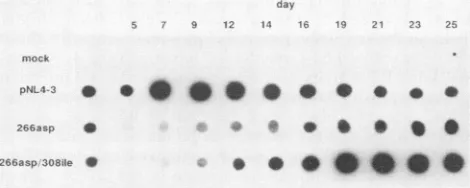
We next asked whether the 308ile substitution could compensate for other mutations within the 267 region of gpl20 that also impair HIV-1 infectivity. One such HIV-1 clone, designated 266asp, hasanaspartic acid codon substi-tuted for a leucine at position 266 in gpl20 (25) (see the aminoacid alignment inFig. 2). Lowbut measurable levels of the 266asp virus were produced (compared with the wild-typepNL4-3) after transfection and coculture (Fig. 3). When the308ile substitutionwasintroduced into the266asp clonebyoligonucleotide-directed mutagenesis, higherlevels of progeny virions were generated (Fig. 3), demonstrating again a functional interaction between the 267 and 308 regionsofgpl20.
These results show that the 128asn and 308ile codon substitutions can independently compensate for functional defects in HIV-1 envelope arising from mutations with the
aay
5 7 9 12 1 4 16 19 21 23 25
mock
pNL4-3 * * * * * * * * * * *
266asp 0 266asp308aIe 0
0
* *- 0
FIG. 3. Functionalcompensationof the308ileamino acidchange for the defect associatedwiththe266aspmutation ingpl20.
Virion-associated RTactivity was detected in culture supernatants after
transfection of SW480 cells with thepNL4-3, 266asp, and266asp/ 308ile plasmid DNAs (first vertical column) and at the indicated
timesafter coculture with A3.01 cells. VOL. 63, 1989
on November 10, 2019 by guest
http://jvi.asm.org/
[image:3.612.72.273.70.167.2] [image:3.612.312.553.95.169.2] [image:3.612.315.550.576.670.2]3598 WILLEY ET AL.
DISCUSSION 100
80
60
40
20
daypostinfection
a.
I~-18000
15000
12000
9000
6000
3000
0
0 3 6 9 12 15
day postinfection
FIG. 4. Infectivityof HIV-1revertantviruses. Par
ofA3.01cells wereestablished by using cell-free vir
bythe267gln/128asn, 267gln/308ile, and266asp/308ilh
the pNL4-3 wild-type proviralclonesasdescribed in
Methods.Cellviabilityandvirion-associated RT actiN
supernatantswereevaluated foreachinfectionatthe intervals. Symbols: W, mock; *, pNL4-3; 267
267gln/308ile; *,266asp/308ile.
267 region; however, the delayed infection played by the 266asp/308ile virus suggested th
may not always be restored to wild-type level
was evaluatedfurtherby infectingA3.01 cells virions produced by the revertant 267gln/12E 308ile, or266asp/308ile proviral clones andcon
infectionswithawild-type pNL4-3infection(Fi
associated RTactivitywas detected inthe pNL
by 7days postinfection; numerous cell aggreg;
cytium formation were also observed at this experiment, peakvirusproductiondidnotoccu
(Fig. 4B)andwasaccompanied byextensivece 4A). Similar observations were made in the 2
and 267gln/308ile infections, although associat
was delayed 2 days relative to the pNL4-3 ir infection kinetics of the 266asp/308ile virus M delayed, with detectable levels of RT activit3 untilday 17. Despite this delay, the spreading
virusinfection eventually led toextensivecell
The results of this study indicate that an amino acid change within a variable region ofthe HIV-1 envelope can functionallycompensate for defectsarisingfrom amino acid substitutions in at least two other conserved regions of gpl20. These data, inconjunction with ourprevious results (25), suggest that the interaction of the 128, 267, and 308 regionsofgpl20 is critical forefficient production ofprogeny virions. The 267 domain appears to be the most important elementfor thisinteraction,sinceamino acid substitutionsat
codons 128 and 308werefunctionally significantonly in the presence ofmutations within the 267region.
The 267region hasbeenpreviously reported tobe critical -r'r--. for the processing of the gpl60 precursor tothe gpl20and 18 21
gp4l
virion envelope proteins (10). We have observed that the 266asp mutation leads to reduced gp120 production in pulse-chase experiments in HeLa cells transfected with the 266aspor266asp/308ile proviral clone(unpublishedresults). Since the 308ile substitution has no effect on processing gpl60, yet increases the replicative capacity of the 266asp virus, an envelope function(s) unrelated to processing must be responsible for theaugmentedinfectivity observed. Inef-ficientprocessing, however, might contributetothedelayed infection kinetics characteristic ofthe 266asp/308ile virus.It is notpresently known why viralinfectivity is altered by the amino acid substitutions at codons 128, 267, and 308. Results fromanearlierstudy have suggested thatthe 128and 308regions of gpl20 may be involved in its association with gp4l (10). We have previously speculated that the 267 domain of gpl20 might mediate events occurringsubsequent to the binding of virions to the CD4 receptor, since the presence of the 267gln substitution in gpl20 produced in expression vectors didnot impair bindingtoCD4 (25). This
^,
, observation has beensupported by
another report which 1 8 21 demonstrated that antibodies specific for the 267 region blocked HIV-1 infection without interfering with CD4 bind-ing (9). The putative interaction between codon 308 andtherallel
nfections
267 domain identified in our current study further suggests rions produced that a postbinding event is involved, since the results of Materials and several recent studiesimply asimilar role forthe 308region. vities inculture Codon 308 is located within a stretch ofamino acidswhich indicatedtime elicits type-specific neutralizing antibodies to HIV-1 (7, 13, gln/128asn; o, 16, 17). These antibodies inhibitinfection by cell-free virus aswell as fusion of HIV-1-infected cells (13, 16, 17) butdo not affect CD4 binding (18). Type-specific virus neutraliza-tion even after the adsorpneutraliza-tion of virions to CD4+T cellshas kinetics dis- been reported (P. Nara, personal communication). Thus, at infectivity type-specific neutralization and the aminoacid substitutions Is. This issue we have identified in the gpl20 revertants may target the withcell-free same postbinding event, since both involve the 308 domain 8asn, 267gln/ of gpl20. Our results also imply that the 128 and 267 regions nparing these play an important role in this event and suggest that the ig. 4). Virion- interaction of at least these three domains of the HIV-1 _4-3infection envelope may be required for productive infection of T cells. ates and syn- At present, we can only speculate on which postbinding time. In this step(s) would involve the 128, 267, and 308 domains of iruntil day 11 gpl20. HIV-1 envelope-mediated fusion of the viral and -lldeath(Fig. cellular membranes could require the interaction of the 128, 267gln/128asn 267, and 308 regions, as described for other viruses (3); ;ed cell death however, it is not clear how the 128, 267, and 308regions of nfection. The gpl20 might participate in the fusion of viral and cellular vas markedly membranes, since the putative fusogenic domain of HIV-1 is y not present located at the N terminus of the gp4l envelope protein (10). 266asp/308ile The similarity of HIV-1 entry to that of both the para- and death. orthomyxoviruses may provide some clues. In Sendai andA
.0
.5c
=(U
B
J. VIROL.
on November 10, 2019 by guest
http://jvi.asm.org/
[image:4.612.68.296.78.442.2]INTERACTION OF HIV-1 gpl'0 DOMAINS 3599
influenza virus infections, a postbinding activation step must precede the fusion of the viral and cellular membranes. Extracellular fusion by Sendai virus is dependent on the proteolytic cleavage of the FO precursor envelope protein at the cell surface (3), while a pH-dependent conformational change allows the HA2 envelope cleavage product of the influenza virus hemagglutinin to fuse with endosomal mem-branes during viral entry (22). HIV-1 entry has been reported to occur by extracellular fusion that is pH independent (14,
20);
however, proteolytic processing of the HIV-1gp120and gp4l envelope components, which is also essential for infec-tivity (15), occurs intracellularly (23) prior to CD4 binding. Since the fusogenic domain of gp4l is most likely not exposed on the surface of HIV-1, a conformational change which alters the location of this region after adsorption to human T cells might be required to promote fusion of viral and cellular membranes. Such a conformational change could be triggered by the interaction ofgp120 with CD4 and depend on the structural interaction of the 128,267,
and 308 regions of the viral envelope.The delineation of regions within the HIV-1 envelope which are critical to viral infectivity may help to identify potential targets for antiviral intervention. The fact that antibodies directed against the 308 region can block viral infection raises the possibility that polyvalent vaccines might protect exposed individuals (16); however, the construction of such candidate vaccines may also have to be based on the contribution of the 128 and 267 domains as well. Amino acid changes at any one of these regions may allow the virus to
escape neutralizing antibodies which specifically target the 308 region. The types ofcompensatory amino acid changes thatwe have observed may represent a mechanism bywhich HIV-1 can escape immunologic recognition while maintain-ing functional integrity durmaintain-ing a productive viral infection.
ACKNOWLEDGMENTS
We thank Francois Clavel for assistance in thepreparation of the figures and Brenda Rae Marshall for typing the manuscript and for editorial assistance.
ADDENDUM IN PROOF
During preparation of the
manuscript,
Felser et al. (Vi-rology 170:566-670) reported that the 267gln mutation in gpl20 leads to a two- to fourfold reduction inHIV-1-mediated cell fusion.
LITERATURE CITED
1. Adachi, A., H. E. Gendelman, S. Koenig, T. Folks, R.Willey, A.
Rabson, and M. A. Martin. 1986. Production of acquired immu-nodeficiency syndrome-associated retrovirus in human and non-human cells transfected with an infectious molecular clone. J. Virol. 59:284-291.
2. Alizon, M., S. Wain-Hobson, L. Montagnier, and P. Sonigo.
1986. Genetic variability of the AIDS virus:nucleotide sequence analysis of two isolates from African patients. Cell 46:63-74. 3. Choppin, P. W., and A. Scheid. 1980). The role ofviral
glyco-proteins in adsorption, penetration. and pathogenicity of
vi-ruses. Rev. Infect. Dis. 2:40-61.
4. Desai, S. M., V. S. Kalyanaraman, J. M. Casey, A. Srinivasan, P. R. Anderson, and S. G. Devare. 1986. Molecularcloningand primary nucleotide sequence analysis of a distinct human im-munodeficiency virus isolate reveal significant divergencein its genomic sequences. Proc. Natl. Acad. Sci. USA 83:8380-8384.
5. Folks, T., S. Benn, A. Rabson, T. Theodore, M. D. Hoggan, M.
Martin, M.Lightfoote, and K. Sell. 1985. Characterization ofa continuousT-cell linesusceptibletothecytopathic effects ofthe acquired immunodeficiency syndrome (AIDS)-associated
retro-virus. Proc. Natl. Acad. Sci. USA 82:4539-4543.
6. Goff, S., P. Traktman, and D. Baltimore. 1981. Isolation and properties of Moloney murine leukemia virus mutants: use ofa rapidassayfor release of virion reverse transcriptase. J. Virol. 38:239-248.
7. Goudsmit, J., C.Debouck, R. H. Meloen, L. Smit, M.Bakker,
D. M. Asher, A. V. Wolff, C. J. Gibbs, and D. C. Gajdusek. 1988. Human immunodeficiency virus type 1 neutralization epitope with conserved architecture elicits early type-specific antibodies inexperimentally infected chimpanzees. Proc. Natl. Acad. Sci. USA 85:4478-4482.
8. Hirt, B. 1967. Selective extraction of polyoma DNA from infected mouse cell cultures. J. Mol. Biol. 26:364-369. 9. Ho, D. D., J. C. Kaplan, I. E. Rackauskas, andM. E. Gurney.
1988. Second conserved domain ofgpl20 is important forHIV infectivity and antibody neutralization. Science 239:1021-1023. 10. Kowalski, M., J. Potz, L. Basiripour, T. Dorfman, W. C. Goh,E. Terwilliger, A.Dayton,C.Rosen, W. Haseltine, and J. Sodroski. 1988. Functional regionsof the envelope glycoprotein of human immunodeficiency virus type 1. Science 237:1351-1355. 11. Kunkel, T. A. 1985. Rapid and efficient site-specific mutagenesis
without phenotypic selection. Proc. NatI. Acad. Sci. USA 82:488-492.
12. Lasky, L. A., G. Nakamura, J. H. Smith, C. Fennie, L. Shimo-saki, E.Patzer, P. Berman, T. Gregory, and D. J. Capon. 1987. Delineation ofa region of the human immunodeficiency virus type 1 (HIV-1) gpl20 glycoprotein critical for interaction with the CD4 receptor. Cell 50:975-985.
13. Matsushita, S., M. Robert-Guroff, J. Rusche, A. Koito, T.
Hattori, H. Hoshino, K. Javaherian, K. Takatsuki, and S. Putney. 1988. Characterization of a human immunodeficiency virus neutralizing monoclonal antibody and mapping of the neutralizing epitope. J. Virol. 62:2107-2114.
14. McClure, M. O., M. Marsh, and R. A. Weiss. 1988. Human immunodeficiency virus infection of CD4-bearing cells occurs by a pH-independent mechanism. EMBO J. 7:513-518.
15. McCune, J. M., L. B. Rabin, M. B. Feinberg, M. Lieberman,
J. C. Kosek, G. R. Reyes, andI. L. Weissman. 1988. Endopro-teolytic cleavage of gpl6( is required for the activation of human immunodeficiency virus. Cell 53:55-67.
16. Palker, T. J., M. E. Clark, A. J. Langlois, T. J.Matthews, K. J.
Weinhold, R. R. Randall, D. P. Bolognesi, and B. F. Haynes. 1988. Type specific neutralization of the human immunodefi-ciencyvirus with antibodies toem-encoded synthetic peptides. Proc. NatI. Acad. Sci. USA 85:1932-1936.
17. Rusche, J. R., K. Javalerian, C. McDanal, J. Petro, D. L. Lynn,
R. Grimalia, A. Langlois, R. C. Gallo, L. 0. Arthur, P. J. Fischinger, D. P. Bolognesi, S. D. Putney, and T. J. Matthews. 1988. Antibodies thatinhibit fusion of humanimmunodeficiency virus-infected cells bind a 24-amino acid sequence of the viral envelope. gp10. Proc. Natl. Acad. Sci. USA 85:3198-3202.
18. Skinner, M. A., A. J. Langlois, C. B. McDanal, J. S.McDougal, D. P. Bolognesi, and T. J. Matthews. 1988. Neutralizing antibod-ies to an immunodominant envelope sequence do not prevent gpl20 binding toCD4. J. Virol. 62:4195-4200.
19. Starcich, B. R., B. H. Hahn, G. M. Shaw, P. D. McNeely, S.
Modrow, H. Wolf, E. S. Parks, W. P. Parks, S. F. Josephs,
R. C. Gallo, and F. Wong-Staal. 1986. Identification and
char-acterization of conserved and variable regions in the envelope gene of HTLV-III/LAV. the retrovirus of AIDS. Cell 45:
637-648.
20. Stein, B. S., S. D. Gowda, J. D. Lifson, R. C. Penhallow, K. G. Bensch, and E. G. Engleman. 1987. pH-independent HIV entry
intoCD4-positive T cells viavirus envelopefusiontotheplasma
membrane. Cell 49:659-668.
21. Strauss, E. C., J. A. Kobori, G. Siu, and L. E. Hood. 1986. Specific-primer-directed DNAsequencing. Anal. Biochem. 154:
353-360.
2. Wiley,D. C., and J. J.Skehel. 1987.The structure andfunction
of the hemagglutinin membraneglycoprotein of influenza virus.
VOL. 63. 1989
on November 10, 2019 by guest
http://jvi.asm.org/
3600 WILLEY ET AL.
Annu. Rev. Biochem. 56:365-394.
23. Willey, R. L., J. S. Bonifacino, B. J. Potts, M. A. Martin, and R. D. Klausner. 1988. Biosynthesis, cleavage, and degradation ofthe human immunodeficiency virus 1 envelopeglycoprotein
gpl60. Proc. NatI. Acad. Sci. USA 85:9580-9584.
24. Willey, R. L., R. A. Rutledge, S. Dias, T. Folkes, T. Theodore,
C. E. Buckler, andM. A. Martin. 1986. Identification of
con-served and divergent domains within the envelopegene of the acquired immunodeficiency syndrome retrovirus. Proc. Natl. Acad. Sci. USA 83:5038-5042.
25. Willey, R. L., D. H.Smith, L. A. Lasky,T.S.Theodore, P.E.
Earl, B. Moss, D.J. Capon, and M.A. Martin. 1988. In vitro
mutagenesis identifiesaregion within the envelopegeneofthe
human immunodeficiency virus that iscritical for infectivity. J. Virol. 62:139-147.
26. Wong-Staal,F., P.Chaudra, andJ. Ghrayeb. 1987. AIDS. Res.
Hum. Retrovirol. 3:33-39.
27. Zoller, M. J., and M. Smith. 1984. Oligonucleotide-directed mutagenesis: asimple method usingtwooligonucleotide
prim-ersanda single-stranded DNAtemplate. DNA 3:479-488.
J. VIROL.