
Copyright© 1992,American Society forMicrobiology
Structure-Function
Analysis of the
Human
Papillomavirus
Type 16 E7
Oncoprotein
WILLIAM C.
PHELPS,`*
KARLMUNGER,2
CAROLE L.YEE,2
JULIE A.BARNES,1
AND PETER M.HOWLEY2
Division ofVirology, Burroughs Wellcome Co., Research TrianglePark,
North Carolina27709,
1andLaboratoryofTumorVirusBiology, NationalCancer Institute, Bethesda, Maryland208922
Received2October1991/Accepted 8 January 1992
The E7 gene of human papillomavirus type 16 encodes a multifunctional nuclear phosphoprotein that is
functionally
andstructurally
similar to the adenovirus (Ad) ElA proteins and the T antigens of other papovaviruses. E7 can cooperate with an activated ras oncogene to transform primary rodent cells, trans activate the Ad E2 promoter, and abrogate transforming growth factor13-mediated
repression ofc-myc. Recent studies suggest that these functions may in part be a consequence of theability
of E7 to associatewith the product of the retinoblastoma tumor suppressor gene (pRB). In this study, a series of site-specific mutations of the human papillomavirus type 16 E7 gene product were constructed and assessed for their effects on intracellular protein stability, rascooperativity,
transcriptional trans activation, pRB association, and phosphorylation. The results of these studies indicate that the transforming and trans-activating domainsextensively
overlapwithin a region of the protein analogous to conserved region 2 of Ad ElA, suggesting that pRB binding is necessaryfor both activities. Deletion of sequences in conserved region 1 abrogates cellular transformation but has only a marginal effect on trans activation. These data suggest that E7 trans activation and cellulartransformation are interrelated but separable functions.Bothepidemiologicalandbiological data support the divi-sion of the mucosa-associated human papillomaviruses
(HPVs) into two groups: those associated with benign
le-sions, including condyloma acuminata, whichare atlow risk
formalignantprogression(HPVtype6[HPV6] and HPV11),
and those represented by HPV16 and HPV18, which are consideredhighrisk because oftheir associationwith
intra-epithelial neoplasia,aprecursortocervicalcancer(57).The E7proteins of the high-risk HPVs, which are consistently expressedinHPV-positivecervicalcarcinomas and derived
celllines (3, 42, 43), caninducemorphological
transforma-tion of established rodentcells in culture (7, 22, 37,49, 50,
52). E7 also can cooperate with an activated ras orfos
oncogene to transform primary rodent cells (37, 48). The
expression of the high-riskHPV E6andE7proteins together can efficiently induce immortalization of primary human
epithelialcells(19, 20, 29).
The HPV16 E7proteinisanacidic 21-kDa nuclear phos-phoprotein with no known
enzymatic
activity. The amino terminus of the HPV E7 protein shares substantial amino acidsequencesimilarity withtwononcontiguousportions
ofthe adenovirus (Ad) ElA proteins
(37).
In addition, E7 is functionally relatedtoElAandsimian virus 40(SV40)
largeTantigenin that itcancooperatewith ras,transactivatethe Ad E2 promoter(37), andabrogatethetransforming growth
factor
3-induced transcriptional
repression of the c-myc promoterinkeratinocytes(38).The amino acid sequences in conservedregion 2(CR2) ofeach of theseoncoproteins are required for theirassociation withpRB, theproductof theretinoblastomatumorsusceptibilitygene(5, 6, 13, 14, 30, 53, 54).
Previousgenetic studies indicated that CR1 and CR2 are required forElAcellular transformationfunctions,including
stimulation of host DNA synthesis, cooperation with ras, pRB association, and transcriptional repression of certain
*Correspondingauthor.
genes. In contrast, CR3 ofElA, which is present in the
productof the AdElA13S RNA but not in theproduct of the 12S RNA, is responsible for the major ElA-mediated
transcriptional trans-activation function (9, 10, 32). Amino acid sequences that are similar to that of Ad ElACR3 are not present in SV40 T antigen or in the E7proteinsof the HPVs, suggestingthatthistranscriptional regulatoryregion isuniquetoElA.
Arecentanalysisof HPV16 E7 transactivation indicated that thebindingsites for the cellulartranscriptionfactor E2F arenecessaryforactivation of the Ad E2 promoterbyboth E7 and ElA. Recent studies have indicated that the E2F
transcriptionfactorisacellular target for thepRBprotein(2,
11,12).The E7proteinisfunctionally similartothe12SElA product in that it can perturb the association of E2F with cellularproteins, including cyclinA andpRB (34).
Inthisstudy,aseries of HPV16 E7mutants wereanalyzed to map the domains involved in the transcriptional trans activation and cellular transformation functions of the E7 geneproduct. These data suggest that for HPVE7, cellular
transformation andtrans activation of the Ad E2 promoter arerelatedbut separable functions. Cellular transformation
requiredtwoseparateregions analogoustotheAdElA CR1
and CR2 domains, and transcriptional trans activation mapped to anoverlapping region of the CR2domain.
MATERIALSANDMETHODS
Cell culture. African greenmonkey
kidney
CV-1 cells and COS-7 cells(ATCCCRL1651)weremaintained in Dulbeccomodified Eaglemediumwith 10% fetal bovineserum
supple-mented with penicillin (100 U/ml) and
streptomycin (100
,ug/ml). Primary baby rat kidneycells were
prepared
from6-day-old Fischer rats as
previously
described(40).
Thekidneys were finely minced and digested with
collagenase
anddispase. Approximately 3 x
105
to 5 x 10⁵ cells were platedin 60-mm dishes and grown in the medium described above.2418
on November 9, 2019 by guest
http://jvi.asm.org/
HPV16 E7 MUTAGENESIS 2419
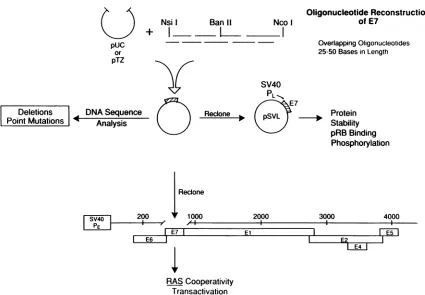
Recombinant plasmid DNAs. Mutations in the HPV16 E7 generesulting in amino acidsubstitutions and deletions were generated by oligonucleotide reconstruction essentially as described previously (28, 45). A schematic diagram of this process is shown in Fig. 2. Briefly, overlapping synthetic oligonucleotides of specified sequence were treated with polynuc-leotide kinase and annealed between the NsiI (nu-cleotide 565) and BanII (nucleotide 711) sites in the amino half and the BanII and NcoI (nucleotide 863) sites in the
carboxyl half of the gene. Mutations were then verified by DNA sequence analysis, and the DNAs were recloned into thep1059plasmid (37), which encodes the entire early region of the HPV16 genome downstream of the SV40 early pro-moter. In addition, mutated E7 genes were cloned into the SV40 late promoter vector pSVL (Pharmacia, Inc.) by polymerase chain reaction amplification and incorporation of new restriction enzyme sites for XhoI and BamHI. The integrity of these clones was again verified by DNA se-quence analysis. Ad type 5 pE2CAT (21) and pEJRAS
expressingthe activated ras oncogene (33) have been previ-ouslydescribed.
Mammalian celltransfections. DNA transfections for
tran-sient chloramphenicol acetyltransferase (CAT) assays were performed by calcium phosphate coprecipitation as previ-ously described (35)by using a total of 10 to 15 ,ug of DNA per60-mm dish (normally 5 ,ug of CAT plasmid plus S to 10 ,ug of E7 expression plasmid). At 4 h after addition of the DNA precipitate, the cells were treated with 15% glycerol for 1 min,washed twice with fresh medium, and incubated in complete medium containing 5 mM sodium butyrate (pH 7.0) for 48 h. For transformation assays, primary baby rat kidney cells weretransfected 2 days after plating with 5 ,ug of each DNAfor a total of 10,ug/60-mmdish aspreviously described (37). Precipitates were allowed to sit on the cells overnight, and the plates were refed the next day. For analysis of
protein stability,COS-7 cells were transfected with 60
jig
ofLipofectin (GIBCO BRL) and 6 ,ug of DNA (10:1) per 100-mm dish overnight in Opti-Mem I (GIBCO BRL) and refed with Dulbeccomodified Eagle medium with 10% fetal bovine serum.
Metabolic labeling of cells.Approximately 72 h after
trans-fection, cells were starved for either cysteine or phosphate for 1 h and labeled for 1.5 h with either [35S]cysteine (0.5 mCi/100-mm plate) or
[32P]Pi
(1 mCi/100-mm plate). Cells were washed twice with cold phosphate-buffered saline(PBS) and lysed in either radioimmunoprecipitation assay
(RIPA) buffer (20 mM morpholinepropanesulfonic acid
[MOPS], pH7.0; 150 mM NaCl; 1% [vol/vol] Nonidet P-40; 1% [vol/vol] deoxycholate; 0.1% [wt/vol] sodium dodecyl
sulfate (SDS); 1 mM EDTA; 100 ,ug of aprotinin per ml; 100
jig
of phenylmethylsulfonyl fluoride per ml; 100 jg ofNa-p-tosyl-L-lysine chloromethyl ketone per ml; 100 ,ug of
tolylsulfonyl phenylalanyl chloromethyl ketone [TPCK] or
ElAextraction buffer (50 mM N-2-hydroxyethylpiperazine-N'-2-ethanesulfonic acid [HEPES], pH 7.0; 0.1% Nonidet P-40; 250 mM NaCl; protease inhibitors [Sigma Chemical
Co.]) per mlas described above.
Antibodies. Polyclonal rabbit antisera (1:500) to the HPV16 E7protein expressed inEscherichia coli (32a) was usedtoimmunoprecipitate the E7 protein, and mouse mono-clonal antibody no. 100201 to HPV16 E7 (Triton
Diagnos-tics, Alameda, Calif.) was used for Western blot (immuno-blot) analysis of protein stability in COS-7 cells. For Western blotanalysis of pRB protein, a mouse monoclonal antibody, PMG3-245.11 (PharMingen), was used at 10
,ug/ml.
Immunoprecipitation. Immunoprecipitations from 35S- or
32P-labeled cell lysates were performed by incubation with antisera overnight (0°C). Immune complexes were collected by incubation (4°C)with protein A-Sepharose CL-4B for 30 min with rocking. The immune complexes were then washed twice with cold RIPA buffer plus protease inhibitors, once with a high-salt buffer (125 mMTris-HCI, pH 7.5; 12.5 mM dithiothreitol; 6.25 mM CaC12; 500 mMNaCI) at
37°C
for 30 min and once with TE (10 mM Tris-HCI, pH 7.5; 1 mM EDTA). Immune complexes were then resuspended in sam-ple buffer and analyzed by polyacrylamide gel electrophore-sis (PAGE).Western blot analysis. Immunoprecipitated protein sepa-rated on polyacrylamide gels was electroblotted to nitrocel-lulose at 40 V for 2 h in 12.5 mM Trizma-100 mM glycine, pH 8.3. The membranes were blocked (5% nonfat dry milk; 10 mMTris-HCI, pH 7.5; 2.5 mM EDTA; 50 mMNaCl; 0.1% Tween 20) for 1 h, incubated in fresh blocking buffer plus monoclonal antibody (no. 100201; Triton Diagnostics) for >1.5 h, and washed five times with PBS-0.1% Tween 20. Detection of mouse monoclonal antibodies was with
1251_
labeled goat anti-mouse antiserum (Amersham Corp.). CAT assays. CAT assays were performed as previously described (46). Cell extracts were incubated with
[14C]chlo-ramphenicol (50 mCi/mmol; Amersham Corp.) and 4 mM acetyl coenzyme A (Pharmacia, Inc.) in 250 mM Tris-HCI (pH 7.8) at 37°C for 0.5 to 2.0 h. The products of the acetylation reaction were separated by ascending thin-layer chromatography, localized by autoradiography, and quanti-tated by liquid scintillation after excision of the spots. Cell lysates were assayed for total protein concentration with the Bio-Rad protein assay (Bio-Rad Laboratories) so that each CAT reaction was conducted with equivalent amounts of protein (20,ug).
RESULTS
The amino-terminal 45 residues of the E7 proteins of the genital tract-associated HPVs possess a striking sequence similarity to portions of CR1 and CR2 of Ad ElA (Fig. 1, top) (37). The integrity of these domains is required for most of the transformation functions ofElA (32). Although the sequences in the carboxyl half of E7 are well conserved among the HPVs, this region possesses no substantial amino acidsequence similarity to any part ofElAwith the excep-tion of repeated Cys-X-X-Cys motifs, which are also found in CR3 ofElA (Fig. 1, bottom). In this study, mutations in the amino terminus of HPV16 E7 were constructed on the basis of the homology to ElA; mutations in the carboxyl terminus were based on conserved amino acids among the genital tract-associated HPVs. The E7 regions correspond-ing to Ad ElA CR1 and CR2 are referred to in this study as domains 1 and 2; the carboxyl portion of E7 (amino acids 38 to 98) isreferred to as domain 3.
Construction of HPV16 E7 mutations. A series of specific mutations were created in the HPV16 E7 gene as depicted in Fig. 2. Mutations, including amino acid substitutions, dele-tions, and theintroduction of premature termination codons, werecreated byoligonucleotide reconstruction between the NsiI,BanIl, and NcoI sites. In most cases, the amino acid substitutions were chosen to introduce relatively conserva-tivechanges that might not be expected to severely disrupt the overall structure of the protein.
The effect of amino acid changes on the intracellular stability of the E7 protein was assessed by expression of the alteredproteins from theSV40latepromoter in COS-7 cells. Transfected cells were metabolically labeled with [35S]cys-VOL. 66,1992
on November 9, 2019 by guest
http://jvi.asm.org/
Ad 5EIA
(289aa)
CR1 CR2 CR3
,
., .'
u
l
37
Ad5-ElA H F[EPPTLHE
121 I
HPV16E7
HjGD
TTPTLHEHPV18E7
HIGPKATLQD
HPV6 E7
HIGRMVTLKD
HPV11E7 HGRLVTLKD
SV40T-Ag
REnSLQ
M D7
38
HPV16 IDGPAG_-__
HPV18 IDG VNHCHLPA
HPV6 VDGQDS
----HPVll VDKQDAC
----49 116
-LYDL.----VP-E
VIDL16
Y?MLDL
--Q[-jE-TTDL
IVL
HL
EPQ N-EIP DLIVLDL --QP]PD-P GL
IVLDL
--QIPIPD-P
GLis
-LLGL NAFN-E-E NL
19 99
T
Y
L
H
H
F
137 154 157 171 174 CHEAGF 1PPSDDE D E...C RS C ...CSLC
1371
56
619l141
CFYIEQLNDSSEEE-DE
...CCKKCC...C9PIIC
CHEQLSD-SEEENDE...CCKC...CPWIC
CY E QL VDS S E DE VlDE...CC GC...ICIP IC CYE QL E D S S EDEVD K* CCGC... CP ILC
239
_
_
C S E E
M-[n]
SDSDDEATA ...C L KC ...H EK H116 301 304 316 319
SLLLGTLNIVCPICA-P
T [image:3.612.61.554.71.376.2])LLLGTLN|IVCP
-PJFIG. 1. (Top) Amino acidsequencehomology betweenAdElA,HPV16 E7, andSV40 T antigen (T-Ag). Amino acids identical to those in Adtype5ElAareboxed. (Bottom) Amino acidsequenceconservation inthe carboxylterminus ofHPV E7. Thecarboxyl half of the E7 proteins from HPVtypes 16, 18,6, and 11 arecompared. Amino acids conserved with respect to the HPV16 E7 protein are boxed. The Cys-X-X-Cysmotifswhich arealsofound in CR3ofElAarehighlighted inblack.
teine, and the E7 protein was immunoprecipitated with a
polyclonalrabbit antiserum. Inaddition, Western blot
anal-ysisofunlabeled, immunoprecipitated E7proteinwas used to confirm the relative levels of stable E7 protein that resulted from introduction of thevarious amino acid alter-ations. Undertheseconditions, [35S]cysteine labeling was a moresensitivemethod fordetectionoftransientlyexpressed E7protein. Data from representative protein gels are shown for each domain, and although somewhat differentgel
con-ditions andimmunoprecipitationwasheswereemployedfor someexperiments,areconstructedwild-typeE7wasalways
included as aninternal control.
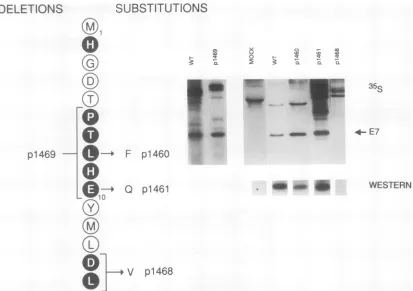
Stabilityof HPV16 E7mutants.The amino acidmutations in domains 1, 2, and 3 are depicted in Fig. 3, 4, and 5,
respectively.Aminoacids whichareconserved with respect to Ad ElA are indicated by solid circles. The two point mutants in Fig. 3, p1460 and
p1461,
make comparable amountsof stable E7protein comparedwithareconstructed wild type,indicatingthat anybiologicaleffect is notaresult of gross alteration of the intracellularstabilityof the mutated protein. By contrast, substitution ofasingle valine residue for D-14 and L-15 in p1468 which is analogous to that described forElA (23)resulted inanunstableprotein which was undetectable by either35S
labeling or Western blotanalysis.Thedeletionmutant(P-6T-7 L-8 H-9E-10),
p1469,
which has beenpreviously described (30), also was found to encode astablepolypeptide.
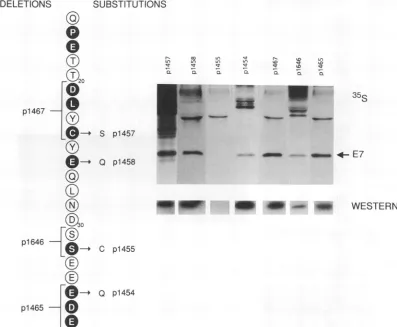
Theintroductionof various mutations into domain2ofthe E7protein (Fig. 4) ledto a substantial reduction in protein
stabilityinonlyonecase, that ofp1455 (S-32toC). Each of the other amino acid substitutions and deletions did not
significantlyreduce theintracellular stability of the protein. Amino acid changes in the carboxyl terminus of the E7
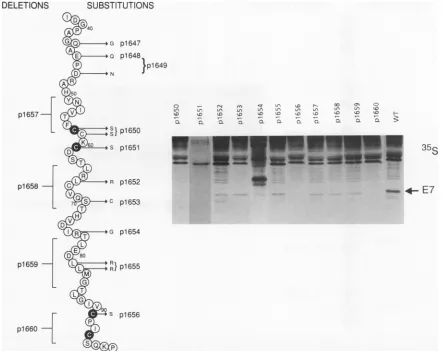
polypeptide (Fig. 5) in manyinstances resulted in unstable
proteins. Substitution or deletion of cysteine residues
(p1650, p1651, p1656, and p1660) resulted in an unstable protein that could notbe detectedbyeither35S labeling or Westernblotting (datanotshown).Deletions of six toeight
amino acids in p1657, p1658, andp1659 each resulted in a partial reduction in protein stability; however, the deletion of thecarboxyl-terminal Cys-X-X-Cys motif,p1660,had the most profound effect on the level of stable protein, since little or noE7 could be detected. The amino acid
substitu-tions in p1647, p1648, and p1649 were not assessed for protein stability, although, aswillbe discussedbelow, they werefullywild type in theirbiological characteristics,
sug-gestingthattheymade stable E7proteins. Theintroduction of premature termination codonsresultingin thedeletion of asfew asnine amino acids(1-89tostop)resulted in biolog-ically inactive mutant proteins presumably because of re-duced polypeptide stability (data not shown). These muta-tionswere not analyzedfurther.
Biological activity ofthe E7 mutant proteins. Each of the
stable, mutated proteins was then assessed for biological activity (Tables1to3).Thetwopointmutations in domain1, p1460 and p1461, demonstrated a wild-type capacity for
cooperationwithan activatedrasoncogenein the transfor-mation ofBRKcells in three separateexperiments.
Further-I I I
on November 9, 2019 by guest
http://jvi.asm.org/
HPV16 E7 MUTAGENESIS 2421
Nsi I Ban 11 Nco I
+
I___
__
pUC
or
pTZ
Deletions DNASequence
Point Mutations ( Analysis
C
SV40 PL ,
RecloeE7
Recdone
Oligonucleotide Reconstruction of E7
OverlappingOligonucleotides 25-50 BasesinLength
Protein Stability pRB Binding Phosphorylation
F
l 9WK.
IReclone
1000 2000
I E6
4F
3000 4000
* 1
m:
I E5 II E2 1
I E4 j
RASCooperativity Transactivation
FIG. 2. A schematicdiagram ofthemutagenesis. Site-specific mutationswerecreated in HPV16 E7by oligonucleotide reconstruction betweenthe NsiI andBanII sitesintheNterminusand between theBanIIand NcoIsitesinthe C terminus.Annealedoligonucleotideswere
cloned intopUC19orpTZ19,and mutationswereverifiedbyDNAsequenceanalysis. SelectedmutantE7 genesweresubcloned into the entireearly region of HPV16positioned downstream of the SV40 earlypromoter or intheSV40 latepromotervectorpSVL.
more,theseamino acidchangeshad littleor noeffectonthe
trans-activation function of E7, showing 100 and 79% of
wild-type activity, respectively. The deletion mutant p1469 possessed interesting biological properties in that it was completely inactive in ras cooperativity but retained sub-stantial trans-activating capacity (70%of wild type).These data indicate that the trans-activation and transformation functions can be separated because ras cooperativity, but notthetrans-activation property, requiresan intact domain 1.
Examination of the biological activity of the domain 2 mutations (Table 2) revealed a good correlation between trans activation andrascooperativity in this domain. Muta-tions thatdidnotseverely impairthetrans-activating
func-tion ofE7, including p1454 (E-35 to Q), p1646 (S-31 S-32
deletion),andp1465 (E-35D-36E-37deletion), hadnoeffect on ras cooperativity. In contrast, alterations in the
NH2-terminal half of domain 2 eliminated both the
trans-activat-ing and transforming functions:
p1457
(C-24 to S),p1458
(E-26toQ),andp1467 (D-21L-22Y-23 C-24deletion). These data indicate that amino acid sequences critical for both the
trans-activatingandtransformingfunctions of E7essentially overlap in the NH2-terminal portion of domain 2. This region was previously identified as critical to the ability of E7 to interact with thepRB(5, 6, 30). Alterations in the C terminus of domain 2 selectively reduced the levels of trans
activa-tion, suggestingthat these sequencesplaysomeindirect role in transcriptionalactivation of the Ad E2 promoter.
In domain3, therewasgenerally avery goodcorrelation
between ras cooperativity and the ability of E7 to trans
activate the Ad E2 promoter(Table 3).E7mutantsthat had
wild-type levels of trans activation (p1647, p1648, p1649, p1653, andp1654) possessed essentially wild-type transfor-mation activities. In contrast, those amino acidchangesthat resulted in asubstantial reduction in trans-activation levels (p1652, p1657, p1658, and p1659) hadadiminishedcapacity tocooperate with an activatedrasoncogene. Ineach case, asshown inFig. 3,theselatter mutations which diminished the biological activity of the E7 protein also substantially
reduced the intracellularprotein stability. One exception in domain 3, p1655, (L-82 L-83 to R R) can be noted. This mutant E7 polypeptide was stable and possessed good
transformationcapacitybutwasreduced in its
trans-activat-ing capacity (approximately 39% ofwildtype). Thissuggests that these leucineresidues,whicharewell conserved in the E7 proteins of other genital tract-associated HPVs, play somedirectorindirect structural role in thetrans-activating
function that is not important to the transformation
func-tions.
In vivopRB binding. In a previous study, domain2 was found to be responsible for the ability of HPV16 E7 to associate with thepRBprotein (30).That work also demon-strated that the E7proteinsfrom thegenitaltract-associated HPVs exhibit various capacities for the direct association withpRB dependingon whether the E7protein is encoded
byahigh-riskvirus(suchasHPV16orHPV18)or alow-risk virus(suchasHPV6orHPV11) (18, 30).Tofurther evaluate the role of this domain in pRB association, the domain 2 mutants of HPV16 E7 were examined for the capacity to associate withpRB in vivo.
66,
on November 9, 2019 by guest
http://jvi.asm.org/
[image:4.612.95.520.71.366.2]SUBSTITUTIONS
1
9--
Q
pl
461
-o
0
91
I
QJ
p1460
o f V p1468
U V 4
C5a 5
UF
35S
*- E7
WESTERN
FIG. 3. Mutations in CR1. The amino acidsequenceof the HPV16 E7genefrom M-1toL-15is shown. Amino acid residues whichare
alsofound in AdElAareindicated by shading and boldfacetype.Deletionsareindicatedonthe left and amino acidsubstitutionsareindicated ontheright. Anassessmentofthe intracellular stability of themutantproteins isprovided by the autoradiographsonthe far right. COS-7 cells
weretransfectedwithplasmids expressing the indicated mutations from theSV40 latepromoter.In thetoppanel, cellsweremetabolically
labeledwith[35S]cysteine andimmunoprecipitated. Representative laneswereexcised and aligned horizontally accordingtotheposition of
the E7proteinasindicated by thearrow.In the bottompanel,transfected COS-7 cells (unlabeled)wereimmunoprecipitated withanHPV16
E7rabbitpolyclonal antiserum, Western blottedwithanHPV16 E7monoclonal antibody (no. 100201; Triton Diagnostics), and detected with
"2I-labeled
goatanti-mouseantiserum. Proteinwasseparated in SDS-PAGE (12%polyacrylamide) gels, and autoradiographywasfor 1to4 days.Thepolypeptide derived fromthedeletionmutant,p1469,wasimmunoprecipitated withamousemonoclonalantibody (7F3) specific tothecarboxylterminus of HPV16 E7, whichwasprovided by TritonDiagnostics.COS-7 cellsweretransfected withplasmidsthatexpressed the CR2 mutations from the SV40late promoter. The cells
were lysed under conditions that would be expected to
preserve the pRB-E7 intracellular protein complex. The
protein lysateswerethenimmunoprecipitatedwitharabbit
polyclonal antibodytoHPV16E7, washed,andsubjectedto SDS-PAGE. Afterelectrophoretictransfertonitrocellulose, coprecipitated pRBwasdetectedbyimmunoblotanalysisas
shown inFig.6.On the far left isapositivecontrol inwhich pRBwasimmunoprecipitatedwithanantibodytopRBfrom actively growing COS-7 cells. Transfection with a plasmid
expressing wild-type E7 (p1453) is shown on the far right,
and, as can be seen, a substantial amount of pRB was
immunoprecipitated bytheE7antibody, presumably reflec-tiveof the stable invivo association between E7 andpRB. Mutations in the carboxyl end of CR2 within the casein kinase II (CKII) domain (p1454, p1646, and p1465) had no
apparenteffectontheabilityof E7toassociate withpRB.In contrast,mutations inthepreviouslydescribedpRB binding domain(p1467, p1457,andp1458) impairedtheabilityofE7 toassociate withpRBinvivo. It had beenpreviouslyshown that the mutations within p1467 (D-21 L-22 Y-23 C-24 deletion) and p1458 (E-26 to Q) virtuallyeliminated the in vitroassociation withpRBwhile the mutation within p1457 (C-24 toS)reduced butdidnotabolishpRB binding. These
data are entirely consistent with those from the in vitro mixingexperiments (6, 30) andfurther supporttheconcept that these arestable, biologicallyrelevant heteromeric
pro-teincomplexes.
ThebiologicaldatapresentedinTable 2confirm thatboth
ras cooperativity and Ad E2 promoter trans activation require overlapping sequenceswithindomain2 foractivity. Mutations in p1458 and p1467 completely abrogated both biological activities,while themutation inp1457,which still retained some pRB binding capacity, exhibited a residual
(35% of wild type) capacity for trans activation but no
apparent transforming activity.These data suggestthat the pRB binding region, and likely the association with pRB itself, iscritical tobothtransformation andtrans-activating functions of E7.
E7phosphorylation.HPV E7 isaphosphoprotein (44)and is a substrate for CKII phosphorylation (6, 16) at one or more serine residues (47). The consensus recognition
se-quenceof the HPV E7proteins,which is also found in Ad ElA and SV40 large T antigen, is conserved within the carboxylend ofCR2,andinHPV16E7,thepredicted CKII site isbetween D-30 and E-37(DS S E E EDE). Therefore,
aselectedsetof E7mutantswereanalyzedfor theabilityto bephosphorylated invivo in COS-7 cells. Duplicate plates
weretransfected, andone waslabeled with[35S]cysteineand
DELETIONS
p1469
on November 9, 2019 by guest
http://jvi.asm.org/
[image:5.612.103.516.74.365.2]HPV16 E7 MUTAGENESIS SUBSTITUTIONS
0 0
(0)20
0
p1467
-_3-- S p1457
0--+
Q p1458p1646
pl6L -- C p1455
0_Q p1454 p1465
-_0
r- CS; in 't
Un LO Ln U,
str Kr sqr "I
nL CL n& '
a__a
r_
a a a&
a*
_
4- E7
__ _ s WESTERN
FIG. 4. Mutations inCR2. The amino acidsequencebetweenQ-16 and E-37 is shown. Amino acid residues that alsoarefound in AdElA areindicatedby shading and boldface type.Analyses of intracellular protein stabilityareshownontheright, including both metabolically
labeled cells([35S]cysteine)and Western blots.
one was labeledwith 32P. The 35S-labeledprofiles
demon-strate that roughly equivalent amounts of each of the
pro-teinswereexpressed in vivo after transfection (Fig. 7, top).
The bottom panel of Fig. 7 is an autoradiograph of
3P-labeled proteins, and the position of the E7 protein is indicatedby thearrow.Awild-type control (p1453) is shown
onthe farright, anda mock-transfected negative control is
shown on the far left. As expected, alteration in the CKII
recognitionsequence,p1454 (E-35toQ)orp1465 (E-35 D-36
E-37deletion), significantly reduced the ability of the protein to be phosphorylated in vivo. In addition, deletion of the putative target serine residues (S-31 S-32) in p1646
com-pletely eliminated E7 phosphorylation in vivo, confirming that one or both of these serines are the major sites of
phosphorylation. In contrast, deletion of the pRB binding
sequences in p1467 hadno effect on the ability of E7tobe phosphorylated, and substitution of S-71 (S-71 to C), a
conserved serine in the carboxyl portion of E7, also hadno
effect onphosphorylation, indicating that it isnot asite for
serinephosphorylation.
Examination of thebiological activities of the CKII muta-tions (Table 2) indicated that phosphorylation-negative
mu-tants were unaffected in their transformation function
as-sayed byras cooperativity; however, trans activation was
reduced somewhat in p1465 (56% of wild-type) and p1646 (65%ofwildtype). Therefore, phosphorylation of the serine residues in CR2 by CKII is not essential for either the transformation orthetrans-activation functions of E7.
DISCUSSION
In this study, a series of mutations in the HPV16 E7
protein were generated and assayed for their effects on
intracellular protein stability, the ability to cooperatewith
rasintransformation of BRKcells, the abilitytoactivate the Ad E2 promoter, pRB association, and phosphorylation. Thegoal of this workwastoprovideabetterdefinition of the
functionaldomains of the HPV16E7oncoprotein involved in transformation andtranscriptional transactivation.
Previous genetic studies indicated that two conserved regions of Ad ElA, CR1 and CR2, are necessary for the
functions involved in cellular transformation, including the stimulation ofhost cellular DNAsynthesis, cellular immor-talization,rascooperativity, pRB association, and
transcrip-tional repression (9, 24, 32, 56). These functional domains
are physically distinct from CR3 of ElA, which has been
showntobetheprimary determinant of ElA-mediatedtrans activation (25, 27, 55).
Although the major trans-activating domain of ElA has been identified asCR3, anumber of studies have indicated
that the 243-amino acid product of the 12S ElA mRNA, whichcontains thetransforming domains (CR1 and CR2) but not CR3, has trans-activation properties (10, 32). The 12S ElAproduct will activateasubset of thepromotersthatare
responsive to ElA (12S plus 13S), including the Ad E2 promoter. Activation of the Ad E2promoterby 12S ElA is atleast inpartmediatedby alteration of heteromeric protein
DELETIONS VOL.66, 1992
on November 9, 2019 by guest
http://jvi.asm.org/
[image:6.612.108.505.83.410.2]SUBSTITUTIONS
)40
-,G p1647 -o p1648
}p1649
. fa
}S)
p1
650,s pl651
PR p1652
O) _ 1 en er Ym L0 r- 00 C: O)
M ,5M un LI) LM cnM
%Q tc LO nD LD Lo l) L0 LO LO LO
a Q IL I& a c a a IL a
35s
. -
E7
p1 653
p1 654
p1 655
pl656
p1660
FIG. 5. MutationsinCR3.The aminoacidsequencebetween1-38andP-98 is shown. The conservedcysteinesareindicatedbyshading. Analysis of protein stability by metabolical labelingoftransfected COS-7cellsis shownaspreviouslydescribed. Western blotsarenotshown.
complexes containing the cellular transcription factor E2F
(1).Thetrans-activatingpropertiesof the HPV16 E7protein
arequitesimilartothose described for 12SElA. HPV16 E7 mediates transcriptional trans activation through the E2F
transcription factor, and E7, like EMA, can disrupt cellular
protein complexes containingE2F(34).
The point mutations in domain 1 of E7 assayed in this
study had no effect on transformation (p1460 and
p1461);
however, deletion of fiveconserved amino acids,P T L H E
(p1469),
completely eliminated the abilityof E7 tocooperate with ras. This deletion has no effect on theabilityof E7 to associate withpRBin vitro(30). These resultsindicate thatdomain 1 plays a crucial role in cellular transformation
independent of pRB binding and further indicate that
[image:7.612.85.528.80.431.2]al-though pRB bindingisrequiredfor rascooperativity,it alone is not sufficient. These data are in agreement with other
TABLE 1. Biologicalactivityin domain 1
rascooperativity % trans
Plasmid (no. of timespositive/ activation
no.ofexperiments)
p1460 3/3 100
p1461 3/3 79
p1469 0/3 70
analyses, indicatingacriticalrole for CR1sequencesof ElA (54) and of HPV16 E7 (5) in transformation that donotaffect pRB association.
Although previous analyses of the HPV16 E7 protein determined that domains 1 and 2 are requiredfor transfor-mation, the domains of theproteininvolved intrans activa-tion havenotbeenwelldelineated. Some mutational
analy-ses indicated that theintegrity of domain 2 is important for
trans activation (15, 36); however, other studies concluded thateither the entirepolypeptide (51)orsimplythecarboxyl
terminus(39) is required fortrans activation. The resultsof thepresentstudy clearlyindicatethat it istheintegrity ofthe CR2sequencesthat iscriticaltotrans-activationactivityand
TABLE 2. Biological activityindomain2
rascooperativity %trans Plasmid (no.of timespositive/ activation
no.ofexperiments)
p1457 0/3 35
p1458 0/3 <5
p1454 3/3 97
p1467 0/3 <5
p1646 3/3 65
p1465 3/3 56
DELETIONS
p1657
p1658
p1659
on November 9, 2019 by guest
http://jvi.asm.org/
[image:7.612.316.556.641.731.2] [image:7.612.54.297.668.732.2]HPV16 E7 MUTAGENESIS 2425 TABLE 3. Biological activity in domain3
rascooperativity % trans Plasmid (no.oftimespositive! activation
no.ofexperiments)
p1647 3/3 100
p1648 3/3 97
p1649 3/3 84
p1652 2/4 10
p1653 4/4 100
p1654 4/4 100
p1655 4/4 39
p1657 1/4 32
p1658 2/4 35
p1659 3/4 57
Ne 4s %D 1- LI)
U - D i
C b Qo
5 a a& I a a
;*
am "Xk. * 00 me _,.
suggest that theprimary effect of mutations in the carboxyl terminus result from structural perturbations that affect the intracellular stability of the protein.
Ithas been recently suggested that alterations of the CKII sitepreferentially affect trans-activation (6) and transforma-tionfunctions(16). The role of serinephosphorylationorof
the aminoacidscomprising the CKII site itself isnotclear;
however, the data presented in this study indicate that phosphorylation itself isnotessential for transformationor
transcriptional regulatory functions of the protein.However,
the mutated E7 proteins that were poor substrates for
phosphorylation (p1465 and pl1646) were slightly impaired
fortransactivation of the Ad E2promoter(56 and 65% of the wild type, respectively). The mutant p1454, which was
wild-typeintrans activation, demonstrated amuch-reduced
abilityto bephosphorylated, suggesting thatahigh level of
phosphorylation per seis notrequired. It is important that mutations in the CKII site didnotalter theability of E7to interact with the pRB protein, indicating that substantial structuralperturbationswerenotintroducedby these muta-tions, and further, that in vivo phosphorylation plays no
direct role in the association of E7 and pRB. Furthermore,
mutations in theCKII domain described in thisstudy donot substantially alter the acidicnatureofthisregion (16).Thus, if maintenance of the negative charge in this domain is
important, the deletions and amino acid substitutions de-scribed in this workwouldnothavesubstantiallyalteredthis property.
L^l OD V) s
0Lvea a
a aL 2
-_i
4_1
.+-pRB
FIG. 6. pRB binding. Transfected COS-7 cellswere lysed and
immunoprecipitatedwithpolyclonal antiseratoHPV16E7.Immune precipitateswere run on SDS-PAGE (7.5% polyacrylamide) gels,
electroblotted to nitrocellulose, and probed with a monoclonal
antibody to human pRB. Detection was with 12-I-labeled goat
anti-mouseantiserum.Autoradiographywasfor 2to4days.
UO~ UN UD.t v,s LI
0 oa D Q
2 & a&
we
rn CL
0-4-- E7
FIG. 7. Phosphorylation of E7mutants.Transfected COS-7cells
weremetabolicallylabeled with[35S]cysteineor
[32p]pi.
Products ofimmunoprecipitations were separated on SDS-PAGE (12%
poly-acrylamide)gels.
Mutations in the carboxyl terminus of E7 generally af-fected the intracellular stability of the polypeptide. Both ElA and the HPV E7proteins containCys-X-X-Cysmotifs that have beenimplicated in the coordination of Zn +atoms. At leasttwofunctions, DNAbindingactivity (8) and protein dimerization (17), have been ascribed to polypeptide do-mainscontaining zinc thiolate complexes. Asyet,there isno
evidencethat E7 is
capable
ofsequence-specific DNA bind-ing, and the role of Zn + chelation in E7dimerizationhasnot yet been explored. With the extended distance (30 amino acids) between theCys-X-X-Cysmotifs inE7, this proteinis unlikelytoformaclassical zincfingerstructureasoriginallyproposed fortranscription factor IIIa (26). Nevertheless, the zinc thiolate complex maybe important for the structural
integrity of the E7 protein. Recent studies with chimeric HPV6 and HPV16 E7 proteins have also shown that the carboxyl-terminal regions of both high- and low-risk E7 proteins are interchangeable and thus functionally
equiva-lent(31). Therefore, substitutions which disrupt this frame-workwould beexpectedtoseverely alter thetertiary
struc-tureof the protein. In this work, the deletionorsubstitution
of cysteine residues in the carboxyl terminus generally resulted inan unstable,biologically inactive protein.
35s
4- E7 VOL.66, 1992
on November 9, 2019 by guest
http://jvi.asm.org/
[image:8.612.54.295.92.222.2] [image:8.612.69.275.541.676.2]Recent work has indicated that E2F is capable of directly associating with pRB and cyclinA (2, 4, 11, 12). The ability of E7 and ElA to specifically associate with pRB would therefore be expected to play a role in the modulation ofE2F complexes. The biological relevance of the E7-pRB interac-tion is supported by the recent studies of Scheffner et al. (41), which suggested that the putative
regulatory
function of pRB may be abrogated in transformed cells either by muta-tion or by associamuta-tion with the HPV E7 protein. The data in this study indicating that trans activation requires sequences in domain 2 are consistent with a role for pRB binding in transcriptional activation mediated through the E2F tran-scription factor. The E2F cellular trantran-scription factor isnecessary for activation of the Ad E2 promoter and is believed to play a role in the control of cell cycle-regulated genes such as c-myc. Both cellular transformation and trans-activation functions of E7 require amino acid se-quences important for pRB association, suggesting that E2F displacement or activation may play a critical role in both activities. Indeed, E7 trans activation may represent the activation of one component, E2F, of a pathway that, during virus infection, results in the induction of cellular prolifera-tion. Transcriptional trans activation by HPV E7 may be
more complicated, as recent studies indicate that low-risk HPV E7 proteins which are defective for transformation or immortalization (19, 29) and pRB binding (30) can still efficiently trans activate the Ad E2 promoter (31).
Cellular transformation and transcriptional trans activa-tion require overlapping sequences in CR2. The precise roles
of CR1 sequences and the CKII recognition site in CR2 in transformation and trans activation are less well understood. Mutations described in this
study
suggest that there are sequences in CR1 which are required fortransformation but not for pRB association. In addition, phosphorylationat theCKII recognition site or the inherent structureof the region
itself may play some role in E7-mediated transcriptional activation. Future studies of the additional proteins which
interact with E7 during the cell cycle and further studies of the mechanism of E2F activation are likely to elucidate the roles of these regions in the function of E7.
ACKNOWLEDGMENTS
We thankGreg Pahel and Dave Lobe for production of the E7 polyclonal antisera and Triton Diagnostics for thegift to P.H. and K.M. of the monoclonal antisera used for Fig. 3.
K.M. was supportedby an advanced training grant fromthe Swiss National Science Foundation.
REFERENCES
1. Bagchi,S., P. Raychaudhuri, and J. R.Nevins. 1990.Adenovirus ElAproteins can dissociate heteromeric complexes involving the E2F transcription factor: a novel mechanism for ElA trans-activation. Cell62:4352-4356.
2. Bagchi, S., R. Weinmann, and P. Raychaudhuri. 1991. The retinoblastoma protein copurifieswithE2F-I,anElA-regulated inhibitor of the transcription factorE2F. Cell65:1063-1072. 3. Baker, C. C., W. C.Phelps, V.Lindgren, M. J. Braun, M. A.
Gonda, and P. M. Howley. 1987. Structuralandtranscriptional analysis of human papillomavirustype 16sequencesincervical carcinoma cell lines. J. Virol. 61:962-971.
4. Bandara, L. R., and N. B.LaThangue. 1991. Adenovirus E1A prevents the retinoblastoma geneproduct from complexing with a cellular transcription factor. Nature (London)351:494-497. 5. Banks, L., C. Edmonds,and K. H.Vousden.1990.Abilityof the
HPV16 E7 protein tobind RB and induceDNA synthesisis not sufficient for efficient transforming activity in NIH3T3 cells. Oncogene 5:1383-1389.
6. Barbosa, M. S., C. Edmonds, C. Fisher, J. T. Schiller, D. R.
Lowy, and K. H. Vousden. 1990. The region of the HPV E7 oncoprotein homologoustoadenovirus ElA and SV40 largeT antigen contains separate domains for RB binding and casein kinase II phosphorylation. EMBO J. 9:153-160.
7. Bedell, M. A., K. H. Jones, and L. A. Laimins. 1987. The E6-E7 region of human papillomavirus type 18 issufficient for trans-formation of NIH 3T3 and Rat-1 cells. J. Virol. 61:3635-3640. 8. Berg, J. M. 1988. Proposed structure for the zinc binding
domains from transcription factor IIIA and related proteins. Proc. Natl. Acad. Sci. USA 85:99-102.
9. Berk, A. J. 1986. Adenovirus promoters and ElA transactiva-tion. Annu. Rev. Genet. 20:45-79.
10. Braithwaite, A. W., C. C. Nelson, and A. J. D. Bellett. 1991. Ela revisited: the case for multiple cooperative trans-activation domains. New Biol. 3:18-26.
11. Chellappan, S. P.,S. Heibert, M.Mudryj,J.M. Horowitz, and J. R. Nevins. 1991. The E2F transcription factor is a cellular target for the RB protein. Cell 65:1053-1061.
12. Chittenden, T.,D. M. Livingston, and W. G. Kaelin. 1991. The T/ElA-binding domain of the retinoblastoma product can inter-act selectively with a sequence-specific DNA-binding protein. Cell 65:1073-1082.
13. DeCaprio, J. A., J. W. Ludlow, J. Figge, J.-Y. Shew, C.-M. Huang, W.-H. Lee, E. Marsilio, E. Paucha, and D. M. Living-ston. 1988. SV40 large tumor antigen forms aspecificcomplex with the productof the retinoblastoma susceptibility gene. Cell 54:275-283.
14. Dyson, N., P.M. Howley, K. Munger, and E. Harlow. 1989. The human papillomavirus-16 E7oncoprotein is able to bind to the retinoblastoma gene product. Science 243:934-937.
15. Edmonds, C., and K. H. Vousden. 1989. A point mutational analysis of human papillomavirus type 16 E7 protein. J. Virol. 63:2650-2656.
16. Firzlaff, J. M.,B. Luscher, and R. N. Eisenman. 1991. Negative charge at the casein kinase IIphosphorylation siteisimportant for transformation but not for Rb protein binding by the E7 protein of human papillomavirustype 16. Proc. Natl. Acad. Sci. USA 88:5187-5191.
17. Frankel,A. D., D. S. Bredt, and C. 0. Pabo. 1988. Tatprotein from human immunodeficiency virus forms a metal linked dimer. Science 240:70-83.
18. Gage, J. R., C. Meyers, and F. 0. Wettstein. 1990. The E7 proteins of the nononcogenic human papillomavirus type 6b (HPV-6b) andof the oncogenic HPV-16 differ in retinoblastoma protein binding and other properties. J. Virol. 64:723-730. 19. Hawley-Nelson, P., K.H. Vousden, N. L. Hubbert, D. R. Lowy,
andJ. T. Schiller. 1989. HPV16 E6 and E7 proteins cooperateto
immortalize human foreskin keratinocytes. EMBO J. 8:3905-3910.
20. Hudson,J. B., M. A. Bedell, D. J.McCance, and L. A. Laimins. 1990. Immortalization and altered differentiation of human ke-ratinocytes invitro by the E6 and E7 open reading frames of human papillomavirus type 18. J.Virol. 64:519-526.
21. Imperiale, M. J., and J. R. Nevins. 1984. Adenovirus S E2 transcription unit: anElA-induciblepromoterwithanessential element that functionsindependentlyofpositionororientation. Mol. Cell. Biol. 4:875-882.
22. Kanda, T., S. Watanabe, and K. Yoshiike.1988. Immortalization ofprimary rat cells by human papillomavirus type 16 subge-nomic DNAfragments controlled by the SV40 promoter. Virol-ogy 165:321-325.
23. Kuppuswamy, M., T.Subramanian,and G. Chinnadurai. 1988. Separation of immortalization and T24-ras oncogene coopera-tivefunctions of adenovirus ElA. Oncogene 2:613-615. 24. Lillie, J. W., M. Green, and M. R. Green. 1986. An adenovirus
ElA protein region required for transformation and transcrip-tional repression. Cell46:1043-1051.
25. Lillie, J.W., P. M. Loewenstein, M. R. Green, and M. Green. 1987. Functional domains of adenovirus type 5 ElA proteins. Cell50:1091-1100.
26. Miller, J., A. D. McLachlan, and A. Klug. 1985. Repetitive zinc-binding domains in the protein transcription factor IIIA fromXenopusoocytes. EMBO J.4:1609-1614.
on November 9, 2019 by guest
http://jvi.asm.org/
HPV16 E7 MUTAGENESIS 2427 27. Moran, E., B. Zerler, T. M. Harrison, and M. B. Mathews.1986.
Identification ofseparatedomainsintheadenovirusElAgene for immortalization activity and the activation ofvirus early genes. Mol. Cell. Biol. 6:3470-3480.
28. Moser, R., S. Frey, K. Munger, T. Hehlgans, S. Klauser, H. Langen, E.-L. Winnacker, R. Mertz, and B. Gutte. 1987. Expression of the syntheticgene ofanartificial DDT binding polypeptide in E. coli.Protein Eng. 1:339-343.
29. Munger, K., W. C. Phelps, V. Bubb, P. M. Howley, and R. Schlegel.1989. TheE6andE7 genes ofthe human papillomavi-rus type16togetherarenecessaryandsufficientfor transforma-tion of primary humankeratinocytes. J. Virol.63:4417-4421. 30. Munger,K., B. A.Werness, N.Dyson,W.C.Phelps, E. Harlow,
and P. M. Howley. 1989.Complex formation of human papillo-mavirusE7proteins withtheretinoblastomatumorsuppressor geneproduct.EMBO J. 8:4099-4105.
31. Munger, K., C. L. Yee, W.C. Phelps, J. A. Pietenpol, H. L. Moses, and P. M. Howley. 1991. Biochemical and biological differences betweenE7oncoproteins of thehigh-andlow-risk humanpapillomavirus types aredetermined by amino-terminal sequences.J. Virol. 65:3943-3948.
32. Nevins,J.R.1989. Mechanisms of viral-mediated trans-activa-tion oftranscription. Adv. Virus Res. 37:35-83.
32a.Pahel, G.,andD. Lobe.Unpublished data.
33. Parada, L. F., C. J. Tabin,C.Shih,and R. A.Weinberg. 1982. Human EJ bladder carcinoma oncogene is a homologue of Harvey sarcomavirusras gene.Nature(London)297:474-478. 34. Phelps, W. C., S. Bagchi, J. A. Barnes, P. Raychaudhuri, V. Kraus, K. Munger, P. M. Howley, and J. R. Nevins. 1991. Analysisof trans activationby human papillomavirus type16 E7 andadenovirus12S ElAsuggests a commonmechanism.J. Virol. 65:6922-6930.
35. Phelps, W.C.,andP. M.Howley. 1987. Transcriptional trans-activationby thehumanpapillomavirus type 16E2 gene prod-uct. J.Virol. 61:1630-1638.
36. Phelps, W.C.,K.Munger,C. L.Yee, and P. M. Howley.1990. Site directedmutagenesis of the HPV16 E7gene.UCLASymp. Mol.Cell. Biol. 124:305-311.
37. Phelps, W.C., C.L.Yee, K.Munger,and P. M. Howley.1988. Thehuman papillomavirus type16 E7gene encodes transacti-vationandtransformation functionssimilartothose of adeno-virusElA. Cell 53:539-547.
38. Pietenpol, J. A., R. W.Stein,E.Moran, P. Yaciuk, R. Schlegel, R. M.Lyons, M. R. Pittelkow, K. Munger, P. M. Howley, and H. L.Moses.1990.TGF-f1inhibitionof c-myctranscription and growth in keratinocytes is abrogated by viral transforming proteins withpRBbinding domains.Cell61:777-785.
39. Rawls, J. A.,R.Pusztai,andM.Green.1990.Chemical synthe-sis ofhuman papillomavirus type 16 E7oncoprotein: autono-mousproteindomainsfor inductionofcellularDNAsynthesis andfortransactivation.J.Virol. 64:6121-6129.
40. Ruley,H. E.1983.Adenovirusearly region1Aenables viral and cellular transforming genes to transform primary cells in
cul-ture.Nature(London) 304:602-606.
41. Scheffner, M., K. Munger, J. C. Byrne, and P. M. Howley. 1991. Thestateof the p53andretinoblastomagenesin human cervical
carcinoma cell lines. Proc.Natl. Acad.Sci.USA88:5523-5527. 42. Schwarz, E.,U. K.Freese,L.Gissmann,W.Mayer,B. Roggen-buck, A. Stremlau, and H. zurHausen. 1985. Structure and transcription of human papillomavirus sequences in cervical carcinoma cells. Nature(London)314:111-114.
43. Smotkin,D., and F. 0. Wettstein.1986.Transcription of human papillomavirus type 16 early genes in cervical cancer and a cervical cancer-derived cell line and identification of the E7 protein.Proc. Natl. Acad. Sci. USA83:4680-4684.
44. Smotkdn, D., and F. 0. Wettstein. 1987. The major human papillomavirus protein in cervical cancers is a cytoplasmic phosphoprotein. J.Virol. 61:1686-1689.
45. Spalholz,B.A., J.C.Byrne,and P. M.Howley.1988.Evidence forcooperativitybetween E2binding sites in E2 trans-regula-tion ofbovine papillomavirus type1. J. Virol.62:3143-3150. 46. Spalholz,B.A.,Y.-C. Yang,and P. M.Howley. 1985.
Transac-tivation of abovine papillomavirus transcriptional regulatory elementby the E2geneproduct. Cell 42:183-191.
47. Storey, A., N. Almond, K. Osborn, and L. Crawford. 1990. Mutations of the human papillomavirus type 16 E7 gene that affecttransformation, transactivation, and phosphorylation by the E7protein. J. Gen. Virol. 71:965-970.
48. Storey, A., D. Pim, A. Murray, K.Osborn, L. Banks, andL. Crawford. 1988.Comparison of thein vitrotransforming activ-ities of humanpapillomavirustypes.EMBOJ.7:1815-1820. 49. Tanaka, A., T.Noda,H.Yajima,M.Hatanaka,and Y. Ito.1989.
Identification ofatransforminggene of human papillomavirus type16. J.Virol. 63:1465-1469.
50. Vousden, K. H.,J. Doniger,J. A. DiPaolo, and D. R. Lowy. 1988.TheE7 openreading frame of humanpapillomavirustype 16encodesatransforminggene.Oncogene Res. 3:167-175. 51. Watanabe, S.,T.Kanda, H. Sato,A.Furuno,and K. Yoshiike.
1990. Mutationalanalysis of human papillomavirustype 16E7 functions.J. Virol. 64:207-214.
52. Watanabe, S.,and K.Yoshiike.1988. Transformationof rat3Y1 cells by human papillomavirus type-18 DNA. Int. J. Cancer 41:896-900.
53. Whyte, P., K. J.Buchkovich, J. M.Horowitz,S. H.Friend,M. Raybuck, R. A.Weinberg, and E. Harlow. 1988. Association betweenanoncogeneandananti-oncogene: the adenovirusEla proteins bindtothe retinoblastomageneproduct. Nature (Lon-don) 334:124-129.
54. Whyte, P.,H. E.Ruley,and E.Harlow.1988.Tworegions of the adenovirus earlyregion la proteins arerequiredfor transforma-tion.J. Virol. 62:257-265.
55. Winberg, G., and T. Shenk. 1984. Dissection of overlapping functions within the adenovirus type 5 ElA gene. EMBO J. 3:1907-1912.
56. Zerler, B.,R.J.Roberts,M. B.Mathews, and E. Moran. 1987. Different functional domains of the adenovirus ElAgene are involved in regulation of host cell cycle products. Mol. Cell. Biol. 7:821-829.
57. zurHausen, H.,and A.Schneider. 1987. The role of papilloma-virusesinhumananogenitalcancers, p.245-263.In N.Salzman and P. M. Howley (ed.), The Papoviridae 2: the papillomavi-ruses. Plenum Press,New York.
66,

![FIG. 7.wereimmunoprecipitationsacrylamide) Phosphorylation of E7 mutants. Transfected COS-7 cells metabolically labeled with [35S]cysteine or [32p]pi](https://thumb-us.123doks.com/thumbv2/123dok_us/1309623.84247/8.612.366.505.85.446/wereimmunoprecipitationsacrylamide-phosphorylation-mutants-transfected-cells-metabolically-labeled-cysteine.webp)
