City, University of London Institutional Repository
Citation
: Rodriguez, C., Vidal, A., Koukouvinis, P. ORCID: 0000-0002-3945-3707,
Gavaises, M. ORCID: 0000-0003-0874-8534 and McHugh, M. A. (2018). Simulation of transcritical fluid jets using the PC-SAFT EoS. Journal of Computational Physics, 374, doi: 10.1016/j.jcp.2018.07.030This is the accepted version of the paper.
This version of the publication may differ from the final published
version.
Permanent repository link:
http://openaccess.city.ac.uk/20290/Link to published version
: http://dx.doi.org/10.1016/j.jcp.2018.07.030
Copyright and reuse:
City Research Online aims to make research
outputs of City, University of London available to a wider audience.
Copyright and Moral Rights remain with the author(s) and/or copyright
holders. URLs from City Research Online may be freely distributed and
linked to.
City Research Online: http://openaccess.city.ac.uk/ [email protected]
Accepted Manuscript
Simulation of transcritical fluid jets using the PC-SAFT EoS
C. Rodriguez, A. Vidal, P. Koukouvinis, M. Gavaises, M.A. McHugh
PII: S0021-9991(18)30491-1
DOI: https://doi.org/10.1016/j.jcp.2018.07.030
Reference: YJCPH 8155
To appear in: Journal of Computational Physics Received date: 1 February 2018
Revised date: 11 July 2018 Accepted date: 12 July 2018
Please cite this article in press as: C. Rodriguez et al., Simulation of transcritical fluid jets using the PC-SAFT EoS,J. Comput. Phys. (2018), https://doi.org/10.1016/j.jcp.2018.07.030
Highlights
• A numerical framework to simulate transcritical and supercritical flows utilising the compressible form of the Navier–Stokes equations coupled with the Perturbed Chain Statistical Associating Fluid Theory (PC-SAFT) equation of state (EoS) is presented.
• Both conservative and quasi-conservative formulations have been tested.
• Advection test cases and shock tube problems are included to show the overall performance of the developed framework.
1 1
Simulation of transcritical fluid jets using the PC-SAFT EoS
2
3
C. Rodriguez
a,*, A. Vidal
a, P. Koukouvinis
a, M. Gavaises
a, M. A. McHugh
b 45
a School of Mathematics, Computer Science & Engineering, Department of
6
Mechanical Engineering & Aeronautics, City University London, Northampton
7
Square EC1V 0HB, United Kingdom
8
b Department of Chemical and Life Science Engineering, 601 West Main Street,
9
Richmond, VA 23284, USA
10 11
*Corresponding author: [email protected]
12 13
Abstract
14
The present paper describes a numerical framework to simulate transcritical and supercritical 15
flows utilising the compressible form of the Navier-Stokes equations coupled with the 16
Perturbed Chain Statistical Associating Fluid Theory (PC-SAFT) equation of state (EoS); 17
both conservative and quasi-conservative formulations have been tested. This molecular 18
model is an alternative to cubic EoS which show low accuracy computing the thermodynamic 19
properties of hydrocarbons at temperatures typical for high pressure injection systems. Liquid 20
density, compressibility, speed of sound, vapour pressures and density derivatives are 21
calculated with more precision when compared to cubic EoS. Advection test cases and shock 22
tube problems are included to show the overall performance of the developed framework 23
employing both formulations. Additionally, two-dimensional simulations of nitrogen and 24
dodecane jets are presented to demonstrate the multidimensional capability of the developed 25
model. 26
27
Keywords: Supercritical, transcritical, PC-SAFT EoS, double-flux model, Riemann problem
28 29
Nomenclature
30 31
List of abbreviations 32
AAD Average Absolute Deviation 33
CFD Computational Fluid Dynamics 34
CFL Courant–Friedrichs–Lewy 35
ENO Essentially Non-Oscillatory 36
EoS Equation of State 37
FC Fully Conservative 38
HLLC Harten-Lax-van Leer-Contact 39
LES Large Eddy Simulation 40
PR Peng-Robinson
41
PC-SAFT Perturbed Chain Statistical Associating Fluid Theory 42
QC Quasi-Conservative
43
RK2 Second-order Runge–Kutta 44
2
SSP-RK3 Third-order strong-stability-preserving Runge–Kutta 46
TVD Total Variation Diminishing 47
WENO Weighted Essentially Non-Oscillatory 48
49
List of Symbols 50
res
a
Reduced Helmholtz free energy [-] 51c
Sound speed [m s-1] 52d Temperature-dependent segment diameter [Å] 53
g Radial distribution function [-] 54
I
Integrals of the perturbation theory [-] 55B
k Boltzmann constant [J/K] 56
m Number of segments per chain [-] 57
m
Mean segment number in the system [-] 58p
Pressure [Pa] 59R
Gas constant [J mol-1 K-1] 60T Temperature [K] 61
i
x
Mole fraction of component i [-] 62Z
Compressibility factor [-] 63U Conservative variable vector 64
F x-convective flux vector 65
G y-convective flux vector 66
V
F x-diffusive flux vector 67
V
G y-diffusive flux vector 68
69
Greek Letters 70
ε
Depth of pair potential [J] 71η
Packing fraction [-] 72ρ
Density [kg/m3] 73m
ρ
Total number density of molecules [1/Å3] 74d
σ
Segment diameter [Å] 7576
Superscripts 77
disp Contribution due to dispersive attraction 78
hc Residual contribution of hard-chain system 79
hs Residual contribution of hard-sphere system 80
id Ideal gas contribution 81
3
1. Introduction
89
Transcritical and supercritical states occur in modern combustion engines that operate at 90
pressures higher than the critical pressure of the fuels utilised. In Diesel engines for example, 91
the liquid fuel is injected into air at pressure and temperature conditions higher than the 92
critical point of the fuel [1]. The liquid injection temperature is lower than the fuel critical 93
temperature but as the liquid is heated, it may reach supercritical temperature before full 94
vaporisation. This is known as a transcritical injection. Similarly, in liquid rocket engines, 95
cryogenic propellants are injected into chambers under conditions that exceed the critical 96
pressure and temperature of the propellants. 97
A single-species fluid or a mixture reaches a supercritical state when the pressure and 98
temperature surpass its critical properties. In the critical region, repulsive interactions 99
overcome the surface tension resulting in the existence of a single-phase that exhibits 100
properties of both gases and liquids (e.g., gas-like diffusivity and liquid-like density). A 101
diffuse interface method is commonly employed in supercritical and transcritical jet 102
simulations to capture the properties of the flow [2]–[4]. Several difficulties should be 103
overcome for simulating the mixing of the jets using a diffused interface [5]. The presence of 104
large density gradients between the liquid-like and the gas-like regions, the need of using a 105
real-fluid EoS, or the spurious pressure oscillations generated in conservative schemes are the 106
main challenges. 107
High order reconstruction methods are usually applied to capture the large density 108
gradients. The authors of [6] performed a two-dimensional large-eddy simulation (LES) of 109
supercritical mixing and combustion employing a fourth-order flux-differencing scheme and a 110
total-variation-diminishing (TVD) scheme in the spatial discretization. In [7] a fourth-order 111
central differencing scheme with fourth-order scalar dissipation was applied in order to 112
stabilize the simulation of a cryogenic fluid injection and mixing under supercritical 113
conditions. Moreover, [8] employed an eighth-order finite differencing scheme to simulate 114
homogeneous isotropic turbulence under supercritical pressure conditions, while in [9] a 115
density-based sensor was utilized, which switches between a second-order ENO (Essentially 116
non-oscillatory) and a first-order scheme to suppress oscillations. In the present study a fifth-117
order WENO (Weighted Essentially Non-Oscillatory) scheme [10] is applied due to its high 118
order accuracy and non-oscillatory behaviour. 119
Cubic EoS models like PR (Peng-Robinson) [11] and SRK (Soave-Redlich-Kwong) EoS 120
[12] are usually used in supercritical and transcritical simulations. In the studies reported in 121
[4], [13]–[15] the SRK EoS was employed in order to close the Navier Stokes equations and 122
compute the fluid properties under supercritical and transcritical conditions. Moreover, the 123
works reported in [3], [9], [16], [17] modeled the non-ideal fluid behavior applying the PR 124
EoS. However, cubic models commonly present low accuracy computing the thermodynamic 125
properties of hydrocarbons at temperatures typical for injection systems [2]. To overcome 126
this, the Statistical Association Fluid Theory Equation of State (SAFT EoS) can be employed. 127
This molecular model is based on the perturbation theory, as extensively studied in [18]–[21] 128
by Wertheim. The authors of [22], [23] developed this EoS by applying Wertheim’s theory 129
and extending it to mixtures. Figure 1 shows a schematic representation of the terms 130
considered in the SAFT equation. Each molecule is represented by segments of equal size, 131
assumed to form a repulsive, hard sphere reference fluid. Next, the attractive interactions 132
between segments are added to the model. The segment-segment energy needed to form a 133
chain between the hard-sphere fluid segments is included and, if the segments exhibit 134
4
Among the different variants of the SAFT model, the PC-SAFT is the one implemented 136
here. In this model, hard chains are used as the reference fluid instead of hard spheres. While 137
the SAFT EoS computes segment-segment attractive interactions, the PC-SAFT EoS 138
computes chain interactions, which improves the thermodynamic description of chain-139
like, fluid mixtures [24]. 140
Several papers have been published pointing out the advantages of the SAFT models 141
with respect to the cubic EoS commonly used in CFD simulations. For example, [25] 142
describes how the PC-SAFT model is better than cubic EoS for predicting gas phase 143
compressibility factors and oil phase compressibilities. In [26] the superiority of the PC-144
SAFT performance is demonstrated relative to the Cubic Plus Association (CPA) EoS in 145
correlating second order derivative properties, like speed of sound, dP/dV and dP/dT 146
derivatives, heat capacities and the Joule–Thomson coefficient in the alkanes investigated. 147
Similarly, [27] points out the superiority of the SAFT-BACK EoS over the PR EOS, 148
particularly at high-density conditions, for computing second order derivative properties such 149
as sound velocity and isobaric and isochoric properties. The study of [28] states that cubic 150
EoS predict a linear increase of the Z factor (compressibility factor) with pressure, while the 151
PC-SAFT EoS shows a better pressure dependence. Finally, [29] shows how the sPC-SAFT 152
(simplified PC-SAFT) is more precise than SRK and CPA to compute the speed of sound of 153
normal alkanes and methanol. 154
If a fully conservative (FC) formulation is employed along with a real-fluid EoS, 155
spurious pressure oscillations may appear; the work of [4] has related this problem to 156
computational stability issues, turbulence, and acoustics accuracy loss. The same authors of 157
[4] developed a quasi-conservative (QC) scheme solving a pressure evolution equation 158
instead of the energy conservation equation, while [30] developed a quasi-conservative 159
framework where the artificial dissipation terms in the mass, momentum and energy 160
equations are related and the pressure differential is considered to be zero. In [31] the double 161
flux model was developed to avoid spurious pressure oscillations in simulations of 162
compressible multicomponent flows that employ a perfect gas EoS; [32] extended it to 163
reactive flows; and finally, [3], [17], [33] extended the double flux model to real-fluids and 164
transcritical conditions. However, recently it has been reported that the large energy 165
conservation error in quasi-conservative schemes maybe produce an unphysical quick heat-up 166
[image:7.612.104.499.323.653.2]of the jet [2]. 167
Figure 1. Schematic representation of the attractive and repulsive contributions of the SAFT EoS
168
and the PC-SAFT EoS [24]
169 170
The novelty of the approach described here is the coupling of the PC-SAFT EoS with 171
the Navier-Stokes equations, which it is not present in the literature. During the last years 172
conservative and quasi-conservative formulations have been employed in the simulation of 173
Hard sphere fluid
Associative forces between molecules
Attractive forces between molecules
Chains with hard sphere segments
5
supercritical and transcritical jets. For this reason, two codes have been developed employing 174
both schemes: the conservative and the so-called quasi-conservative approach, where the 175
double flux model of [3], [17], [33] is utilized. The aim of this research is not to solve the 176
spurious pressure oscillations characteristic of FC schemes when real-fluid EoS are applied or 177
the energy conservation error of QC formulations but to present how the Navier-Stokes 178
equations can be closed with the PC-SAFT in both scenarios. Advection test cases and shock 179
tube problems are included to show the overall performance of the developed framework 180
using both formulations. Moreover, two-dimensional simulations of nitrogen and dodecane 181
jets are presented to demonstrate the capability of the code to predict fluid mixing. 182
183
2. Numerical Method
184
The Navier-Stokes equations for a non-reacting multi-component mixture containing N 185
species in a x-y 2D Cartesian system are given by: 186
187
v v
t x y x y
∂ ∂
∂ +∂ +∂ = +
∂ ∂ ∂ ∂ ∂
F G
U F G
(1)
188
189
The vectors of eq. 1 are: 190 x,1 1 x,N N xx 2 xy
xx xy x
J
Y
J
Y
,
,
,
v
v
u
v
q
(
)
(
)
1 1 N N 2uY
vY
uY
vY
u
u
p
vu
uv
p
E
E
p u
E
p v
ρ
ρ
ρ
ρ
ρ
ρ
σ
ρ
ρ
ρ
σ
ρ
ρ
ρ
σ
σ
ρ
ρ
ρ
ª
º
ª
º
ª
º
ª
º
«
»
«
»
«
»
«
»
«
»
«
»
«
»
«
»
«
»
«
»
«
»
«
»
=
«
»
=
«
»
=
«
»
=
«
»
+
«
»
«
»
«
»
«
»
«
»
«
»
«
»
«
+
»
«
»
«
»
«
»
«
»
+
−
+
+
«
»
«
»
«
»
«
»
¬
¼
¬
¼
¬
¼
¬
¼
v
U
F
G
, F
#
#
#
#
(2) 191 y,1 y,N yx yyyx yy y
J
J
u v q
σ
σ
σ
σ
ª º « » « » « » =« » « » « » « » + − « » ¬ ¼ v G # 192 193where ȡ is the fluid density, u and v are the velocity components, p is the pressure, E is the 194
total energy, Ji is the mass diffusion flux of species i, ı is the deviatoric stress tensor and q is
195
the diffusion heat flux vector. 196
The finite volume method has been applied in this work for obtaining a numerical 197
solution to the above equations. The PC-SAFT EoS is implemented to simulate supercritical 198
and transcritical states. The developed numerical framework considers a condition of 199
thermodynamic equilibrium in each cell. Phase separations or metastable thermodynamic 200
states are beyond the scope of this research and are not considered. 201
202
2.1 Formulations
203
Since PC-SAFT EoS is rarely used in CFD simulations, two codes have been 204
6
determine which one is more appropriate for the simulation of transcritical and supercritical 206
fluid jets. 207
2.1.1 Conservative formulation
208
Operator splitting [34] is adopted to divide the physical processes into hyperbolic and 209
parabolic sub-steps. The global time step is computed using the CFL (Courant–Friedrichs– 210
Lewy) criterion of the hyperbolic operator. 211
212
Hyperbolic sub-step 213
The HLLC (Harten-Lax-van Leer-Contact) solver is used to solve the Riemann 214
problem. The conservative variables are interpolated onto the cell faces using a fifth-order 215
WENO scheme [10] due to its high order accuracy and non-oscillatory behaviour. TVD 216
(Total Variation Diminishing) limiters [34] are applied to avoid oscillations near 217
discontinuities. Time integration is performed using a SSP-RK3 (third-order strong-stability-218
preserving Runge–Kutta) method [35]. 219
220
Parabolic sub-step 221
The method developed in [36] is applied to calculate the values of the dynamic 222
viscosity and thermal conductivity of the mixture. The model of [37] is implemented to 223
compute the diffusion coefficient. A RK2 (second-order Runge–Kutta) scheme is employed 224
to perform the time integration of this sub-step. Linear interpolation is performed for 225
computing the conservative variables, enthalpy and temperature on faces from cell centres. 226
227
2.1.2 Quasi-conservative formulation
228
The physical processes are divided into hyperbolic and parabolic sub-steps using 229
operator splitting as well [34]. The CFL criterion of the hyperbolic operator is used to 230
compute the global time step. 231
232
Hyperbolic sub-step 233
The double flux model of [3], [17], [33] has been implemented. The HLLC solver is 234
used to solve the Riemann problem. In the one-dimensional cases presented, the primitive 235
variables are interpolated onto the cell faces using a fifth-order WENO scheme [10]. In the 236
two-dimensional cases, a sensor that compares the value of the density in the faces and the 237
centre of the cells is employed to determine in which regions a more dissipative scheme must 238
be applied [3] . If the sensor is activated, TVD limiters [34] are employed. The solution is 239
then blended with a first-order scheme (90% WENO). Time integration is performed using a 240
SSP-RK3 method [35]. 241
242
The following steps were followed to implement the double flux model [3], [17], [33]: 243
1) In each cell are stored the values of
γ
* (eq.3) ande
*0 (eq.4). 2442
*
c
p
ρ
γ
=
(3)245
*
0 *
1
pv
e
e
γ
= −
−
(4)246
where
p
is the pressure,c
is the sound speed,e
is the internal energy andv
is the 247specific volume. 248
7 2) Runge-Kutta scheme
250
• Step 1: The fluxes at the faces are computed using the primitive variables. The total 251
energy in the left (L) and right (R) states are computed using eq.5. 252
, *,
, *, , 0, , , ,
1
(
)
1
2
n L R
n n n n n n
L R n L R j L R L R L R j
p
E
e
ρ
ρ
ρ
γ
=
+
+
⋅
−
u
u
(5)253
• Step 2: Update conservative variables using the RK scheme 254
• Step 3: Update primitive variables (using the double flux model to compute the 255
pressure). 256
257
3) Update total energy: The total energy is updated from primitive variables based on the EoS 258
(eq.6). Only at this point the PC-SAFT EoS is used to compute the internal energy, sound 259
speed, temperature and enthalpy. 260
1
2
E
e
ρ
=
ρ
+
ρ
u u
⋅
(6)261
262
Parabolic sub-step 263
The diffusion fluxes are calculated conservatively in the same way that is explained in the 264
conservative formulation. 265
266
2.2 PC-SAFT EoS subroutine
267
A different subroutine has been developed for each formulation because of the different 268
inputs of the EoS subroutine. 269
270
Conservative formulation 271
The thermodynamic variables computed in the CFD code by the PC-SAFT EoS are 272
the temperature, pressure, sound speed and enthalpy. The algorithm inputs are the density, 273
internal energy, molar fractions and three pure component parameters per component 274
(number of segments per chain, energy parameter of each component and segment diameter), 275
see Table 1. The density and the internal energy are obtained from the conservative variables 276
of the CFD code. The molar fractions are computed using the mass fractions employed in the 277
continuity equations and the molar weights of the components. The pure component 278
parameters are specified in the initialization of the simulation. A detailed description of the 279
PC-SAFT EoS can be found in the Appendix A. 280
The Newton-Raphson method is employed to compute the temperature that is needed 281
to calculate the value of all other thermodynamic variables. The temperature dependent 282
function used in the iterative method is the internal energy. Initially, a temperature value is 283
assumed (for example the value of the temperature from the previous time RK sub-step or 284
from the previous time step) to initialize the iteration process. In most cells, this value is close 285
to the solution. Then the compressibility factor is calculated as the sum of the ideal gas 286
contribution (considered to be 1), the dispersion contribution and the residual hard-chain 287
contribution (Appendix A): 288
289
1
hc dispZ
= +
Z
+
Z
(7)290 291
8
( )
10 310
B m
p Zk T
=
ρ
(8)293
where
k
is the Boltzmann constant and ρm is the total number density of molecules. 294Finally, the internal energy is estimated as the sum of the ideal internal energy and the 295
residual internal energy. The ideal internal energy is computed using the ideal enthalpy. The 296
residual internal energy is calculated using eq.9 [39]: 297
298
,
ρ
§
∂
·
= −
¨
¸
∂
©
¹
i
res res
x
e
a
T
RT
T
(9)299
where
a
res is the reduced Helmholtz free energy. 300301
If the difference between the internal energy computed with the PC-SAFT model and the 302
value obtained from the conservative variables is bigger than 0.001J/kg, the Newton-Raphson 303
method is applied to calculate a new value of the temperature and the aforementioned steps 304
are repeated, see Appendix D. 305
306
Quasi-conservative formulation 307
The thermodynamic variables computed in the CFD code by the PC-SAFT EoS are the 308
temperature, internal energy, sound speed and enthalpy. The algorithm inputs are the density, 309
pressure, molar fractions and three pure component parameters per component. The density 310
and mass fractions (used to compute the molar fractions) are obtained from the conservative 311
variables. The pressure is obtained employing the double flux model. The temperature is 312
iterated until the difference between the pressure computed with the PC-SAFT model and the 313
value obtained from the double flux model is lower than 0.001Pa, see Appendix D. 314
315
2.3 Peng-Robinson EoS and PC-SAFT EoS comparison
316
The most attractive feature of the PC-SAFT EoS is the better prediction of derivative 317
properties such as compressibility and speed of sound. [27] shows the inaccuracy of cubic 318
models to predict second derivative properties such as isobaric heat capacity and sound 319
velocity in hydrocarbons at high density ranges. In the case of the sonic fluid velocity, the 320
AAD% (Average Absolute Deviation) by PR EoS for methane, ethane, and propane are 321
28.6%, 14.7%, and 61.2%, respectively. 322
Figure 2 presents a comparison of the thermodynamic properties of n-dodecane at 323
6MPa computed using the PC-SAFT EoS and the Peng-Robinson EoS. NIST Refprop [40] 324
has been used as reference due to its extensive validation with experimental data. While the 325
results of both EoS are quite similar at density values lower than 550 Kg/m3 there is a 326
significant difference at higher densities, especially in the sound speed. Cubic models 327
commonly present low accuracy computing the thermodynamic properties of hydrocarbons at 328
temperatures typical for injection systems [2]. However, the PC-SAFT EoS shows an 329
accuracy similar to NIST without the need of an extensive model calibration as only three 330
parameters are needed to model a specific component. Another advantage is the possibility of 331
computing the thermodynamic properties of mixtures; NIST has limited mixture 332
9
Figure 2: Comparison of thermodynamic properties of n-dodecane at 6MPa computed using the
334
PC-SAFT EoS and the Peng-Robinson EoS: (a) density, (b) sound speed, (c) internal energy
335
3. Results
336
Initially, advection test cases and shock tube problems are solved to validate the 337
hyperbolic part of the numerical framework employing the conservative and quasi-338
conservative formulations, while the parabolic part is omitted. Following, two-dimensional 339
simulations of transcritical and supercritical nitrogen and dodecane jets are presented, 340
including the parabolic part, to prove the multi-dimensional capability of the code. 341
342
3.1. One-dimensional cases
343
3.1.1 Advection test cases
344
Conservative formulation 345
Figure 3 shows the results of the supercritical Advection Test Case 1, see Table 2. 346
Nitrogen is used as working fluid (The critical properties of nitrogen are pc,N2 = 3.4 MPa and 347
Tc,N2 = 126.2 K). The computational domain is x ࣅ [0, 1] m; the initial conditions in 0.25m < x 348
< 0.75m are ȡ=250 kg/m3, p=5 MPa, and T=139.4 K; in the rest of the domain are ȡ= 45.5 349
kg/m3, p=5 MPa, and T=367.4 K. The advection velocity applied is 50m/s; periodic boundary 350
conditions are utilized; a uniform grid spacing of 0.01m is employed; the simulated time is 351
t=0.02s; and the CFL is set to be 0.5. Four spatial discretization schemes are compared: fifth-352
order WENO, second-order (based on the Minmod limiter), first order and a blend of the 353
fifth-order WENO and the first-order schemes (95% WENO and rest 1st order). 354
The oscillations are more severe when high-order reconstruction schemes are applied. 355
By blending a high-order scheme and a low-order model, dissipation can be used to smooth 356
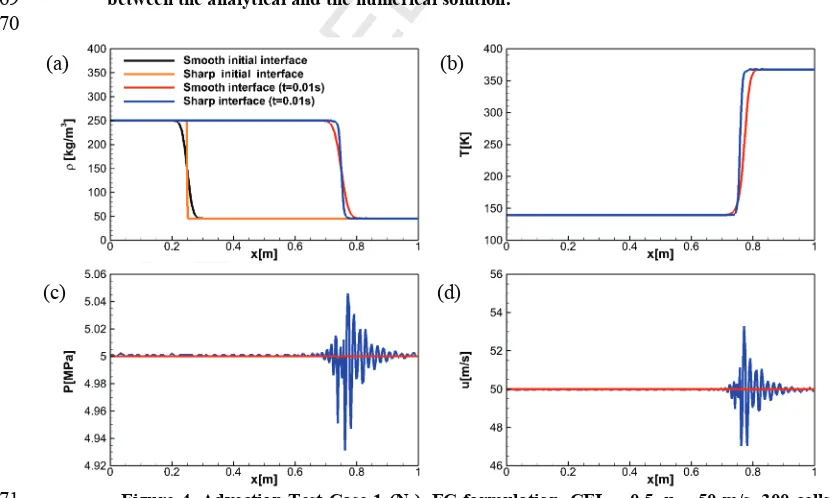
the numerical solution. If the advection test case is initialized using a smooth profile no 357
spurious pressure oscillation appear in the solution as the sharp jumps in the thermodynamic 358
properties between cells are avoided, see Figure 4. The smooth initial interface was generated 359
as described in [13] using eq.10. 360
(a) (b)
10
(1
)
=
L−
sm+
R smq q
f
q f
(10)361
(1
[
/ ])
2
ε
+
Δ
=
sm
erf R
f
(11)362
Where L and R refers to the left and right states respectively and
Δ
R
is the distance from the 363initial interface.
ε
= Δ
C x
ε , whereΔ
x
is the grid spacing andC
ε is a free parameter to 364determine the interface smoothness set to be 8. 365
[image:13.612.71.501.53.715.2]366
Figure 3. Advection Test Case 1 (N2), FC formulation, CFL = 0.5, u = 50 m/s, 100 cells,
367
t=0.02 s. Comparison of the (a) density, (b) temperature, (c) pressure and (d) x-velocity
368
between the analytical and the numerical solution.
[image:13.612.84.499.436.685.2]369 370
Figure 4. Advection Test Case 1 (N2), FC formulation, CFL = 0.5, u = 50 m/s, 300 cells,
371
t=0.01 s. Comparison of the (a) density, (b) temperature, (c) pressure and (d) x-velocity
372
between the analytical and the numerical solution.
373
(a) (b)
(c) (d)
(a) (b)
11 Quasi-conservative formulation
374
Figure 5 presents the results of the transcritical Advection Test Case 1 solved using the 375
QC formulation. The advection velocity applied is 50m/s; periodic boundary conditions are 376
applied; a uniform grid spacing of 0.01m is used; the simulated time is t=0.02s; and the CFL 377
is set to be 1. Unlike the fully conservative scheme, spurious pressure oscillations are not 378
present in the solution. 379
[image:14.612.110.501.150.449.2]380
Figure 5. Advection Test Case 1 (N2), FC and QC formulations, CFL(FC) = 0.5,
381
CFL(QC)=1.0, u = 50 m/s, 100 cells, t=0.02 s. Comparison of the (a) density, (b)
382
temperature, (c) pressure and (d) x-velocity between the analytical and the numerical
383
solution.
384 385
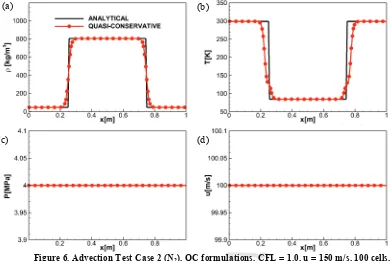
Figure 6 presents the results of the transcritical Advection Test Case 2 where nitrogen 386
is used as working fluid, see Table 2. The computational domain is x ࣅ [0, 1] m; the initial 387
conditions in 0.25 m < x < 0.75 m are ȡ=804.0 kg/m3, p=4 MPa, and T=84.41 K; in the rest of 388
the domain the initial conditions are ȡ=45.5 kg/m3, p=4 MPa, and T=299.0 K. The advection 389
velocity utilized is 100 m/s; periodic boundary conditions are used; the computational domain 390
is x ࣅ [0, 1] m; 150 cells are employed; the simulated time is t=0.01 s; a fifth-order WENO 391
discretization scheme is used; and the CFL is set to be 1.0. It can be observed how large 392
density gradients are solved without spurious pressure oscillations applying the double flux 393
model. 394
Figure 7 shows the results of the transcritical advection of n-dodecane at supercritical 395
pressure and subcritical temperature (pc,n-dodecane =1.817 MPa, Tc,n-dodecane =658.1 K) in 396
supercritical nitrogen, Advection Test Case 3 (Table 2). The computational domain is x ࣅ 397
[0,1] m; the initial conditions in 0.25m < x < 0.75m are ȡn-dodecane =700.0 kg/m3, pn-dodecane = 398
6MPa, and Tn-dodecane =360.1 K; in the rest of the domain ȡN2 =20.0 kg/m3, pN2 =6 MPa, and TN2 399
=965.7 K. The advection velocity utilized is 100 m/s; periodic boundary conditions are used; 400
150 cells are employed; the simulated time is t=0.01 s; a fifth-order WENO discretization 401
scheme is used; and the CFL is set to be 1.0. Unlike conservative codes, velocity and pressure 402
equilibriums are preserved in multicomponent cases if the double flux model is applied. 403
(a) (b)
12
Table 1. PC-SAFT pure component parameters [38]
404
m
σ
ª º
¬ ¼
Å
ε
/ k K
[ ]
NITROGEN 1.2053 3.3130 90.96
DODECANE 5.3060 3.8959 249.21
405 406
Table 2. 1D Test Cases
407
ADVECTION TEST CASES
CASE 1 Pressure [MPa] Density [kg/m3] Temperature [K]
0.25 m < x < 0.75 m N2,5 N2,250 N2,139.4
0.25 m > x or x > 0.75 m N2,5 N2,45.5 N2,367.4
CASE 2
0.25 m < x < 0.75 m N2,4 N2,804 N2,84.4
0.25 m > x or x > 0.75 m N2,4 N2,45.5 N2,299.0
CASE 3
0.25 m < x < 0.75 m n-dodecane,6.0 n-dodecane,700.0 n-dodecane,360.1
0.25 m > x or x > 0.75 m N2,6.0 N2,20.0 N2,965.7
SHOCK TUBE PROBLEM
PROBLEM Pressure [MPa] Density [kg/m3] Temperature [K]
x < 0.5 m n-dodecane,13.0 n-dodecane,700.0 n-dodecane, 372.8
x > 0.5 m n-dodecane,6.0 n-dodecane,150.0 n-dodecane, 944.4 408
409
Table 3. 2D Test Cases
410
CASE A Pressure [MPa] Density [kg/m3] Temperature [K]
JET N2,4.0 N2,804.0 N2,84.4
CHAMBER N2,4.0 N2,45.5 N2,299.5
CASE B
JET N2,4.0 N2,440.0 N2,127.0
CHAMBER N2,4.0 N2,44.5 N2,305.0
CASE C
JET n-dodecane,11.1 n-dodecane, 450.0 n-dodecane, 687.2
CHAMBER N2,11.1 N2,37.0 N2,972.9
13
Figure 6. Advection Test Case 2 (N2), QC formulations, CFL = 1.0, u = 150 m/s, 100 cells,
412
t=0.01s. Comparison of the (a) density, (b) temperature, (c) pressure and (d) x-velocity
413
between the analytical and the numerical solution.
[image:16.612.111.501.77.338.2]414 415 416
Figure 7. Advection Test Case 3 (N2 - Dodecane), QC formulations, CFL = 1.0, u = 100
417
m/s, 150 cells, t=0.01 s. Comparison of the (a) density, (b) temperature, (c) pressure and
418
(d) x-velocity between the analytical and the numerical solution.
419 420 421 422
(c) (d)
(a) (b)
(a) (b)
14
Energy conservation error in the quasi-conservative formulation 423
The evolution of the energy conservation error of the Advection Test Case 2 is presented in 424
Figure 8 . The error has been evaluated employing eq.12 [3]. 425
426
[
(
)( ) (
)(0)
]
(
)(0)
ρ
ρ
ε
ρ
Ω
Ω
−
=
³
³
E t
E
dx
E
dx
(12)427
where
ε
is the relative error of the total energy respect to initial conditions andΩ
is the 428computational domain. 429
430
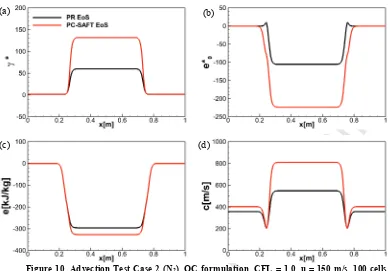
The energy conservation error is higher using the PC-SAFT EoS than Peng-Robinson EoS. 431
This is related to the fact that the profiles of
γ
* ande
*0 are smoother employing the cubic 432model. There are shaper jumps in the internal energy and speed of sound employing the PC-433
SAFT EoS, see Figure 10. The error in the conservation of the energy depends on the jumps 434
in the variables
1/
(
γ
*−
1
)
ande
*[3]. A convergence of the error to 0 exists increasing the 435refinement. 436
[image:17.612.68.500.55.724.2]437
Figure 8. Relative energy conservation error computed using eq.10 of the QC formulation for the
438
Advection Test Case 2 (Transcritical nitrogen) using the Peng-Robinson EoS (PR) and the
PC-439
SAFT EoS. N is the number of cells employed.
440 441
442
Figure 9. Relative energy conservation error computed using eq.10 of QC formulation for the
443
Advection Test Case 3 using the PC-SAFT EoS. N is the number of cells employed.
[image:17.612.95.428.513.686.2]15
Figure 10. Advection Test Case 2 (N2), QC formulation, CFL = 1.0, u = 150 m/s, 100 cells,
445
t=0.01s. Comparison of Ȗ* and e0* computed using the Peng Robinson EoS (PR EoS) and
446
the PC-SAFT in the Advection Test Case 2.
447 448
Figure 9 presents the evolution of the energy conservation error of the Advection Test 449
Case 3. Because of the different thermodynamic properties of the components, a higher 450
energy conservation error than in the single-species cases appears. Although, a convergence 451
to 0 is observed in one-dimensional cases increasing the refinement like in the single-species 452
cases. 453
454
3.1.2 Shock tube problems
455
The Euler equations are solved in this validation so a direct comparison with the exact solver 456
can be done. The exact solution has been computed using the methodology described in [41]. 457
458
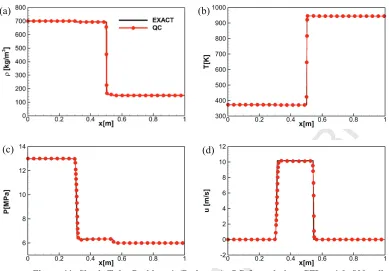
Quasi-conservative formulation 459
The domain is x ࣅ [0, 1] m. The working fluid employed is dodecane. A fifth-order 460
WENO scheme is employed to interpolate the primitive variables onto the cell faces. 800 461
equally spaced cells were used. Wave transmissive boundary conditions are implemented in 462
the left and right sides. The double flux model is applied. The pressure exceeds the critical 463
value in all the domain while there is a transition in the temperature from subcritical to 464
supercritical from left to right. The initial conditions in the left state are ȡL=700 kg/m3, pL=13 465
MPa, uL=0 m/s; and in the right state are ȡR=150 kg/m3, pR=6 MPa, uR=0 m/s. The simulated 466
time is t=0.2 ms. 467
Figure 11 displays the results obtained for density, temperature, pressure and 468
velocity. Despite being a quasi-conservative scheme, the double flux model [3], [17], [33] can 469
solve strong shock waves in transcritical cases with a high degree of accuracy without 470
generating spurious pressure oscillations. 471
472
(b) (a)
16
Figure 11. Shock Tube Problem 1 (Dodecane), QC formulation, CFL = 1.0, 800 cells,
473
t=0.2 ms. Comparisons of (a) density, (b) temperature, (c) velocity and (d) pressure
474
profiles: exact solution and numerical solution.
[image:19.612.91.502.115.678.2]475 476
Figure 12. Shock Tube Problem 1 (Dodecane), FC formulation, CFL = 0.5, 4000 cells,
477
t=0.2 ms. Comparisons of (a) density, (b) temperature, (c) velocity and (d) pressure
478
profiles: exact solution and numerical solution.
479 480
(a) (b)
(c) (d)
(a) (b)
17 Conservative formulation
481
The same shock tube problem described before is solved. A fifth-order WENO 482
scheme is employed to interpolate the conservative variables onto the cell faces. Large 483
spurious pressure oscillations appear in the solution because of the sharp jumps in the 484
thermodynamic properties between cells, see Figure 12. 485
486
Comparison with the Peng-Robinson EoS (Quasi-conservative formulation) 487
Figure 13 shows the density, temperature, pressure, velocity, sound speed and 488
internal energy of the same shock tube problem solved in a larger domain x ࣅ [0, 2] m using 489
the PC-SAFT and the Peng-Robinson EoS. The simulated time is t=0.3 ms. The quasi-490
conservative formulation has been employed. 800 equally spaced cells were used. A 491
significant difference can be observed in the results between the two EoS. Due to the high 492
deviation in the sound speed computed by the Peng-Robinson EoS in the high-density region, 493
the expansion wave travels much faster using the cubic model. Moreover, the calculated 494
temperatures are much lower using the Peng-Robinson EoS in the high-density region. 495
496
Figure 13. Shock Tube Problem 2 (Dodecane), QC formulation, CFL = 1.0, 800 cells,
497
t=0.3 ms. Comparison of the (a) density, (b) temperature, (c) pressure, (d) x-velocity, (e)
498
sound speed, (f) internal energy between the numerical solutions obtained using the
499
Peng-Robinson EoS and the PC-SAFT EoS.
500
(a) (b)
(c) (d)
18
3.2 Two-dimensional cases
501
Planar two-dimensional simulations of transcritical and supercritical jets are presented 502
in this section. The initial conditions are summarized in Table 3. The parabolic sub-step is 503
included into these simulations, without sub-grid scale modelling for turbulence or 504
heat/species diffusion. 505
506
Transcritical nitrogen injection (Quasi-Conservative formulation, Case A) 507
A structured mesh is applied with a uniform cell distribution. The cell size is 0.043 mm 508
× 0.043 mm. The domain used is 30mm × 15mm. Transmissive boundary conditions are 509
applied at the top, bottom and right boundaries while a wall condition is employed at the left 510
boundary. A flat velocity profile is imposed at the inlet. The case is initialized using a 511
pressure in the chamber of 4 MPa, the density of the nitrogen in the chamber is 45.5 kg/m3 512
and the temperature is 299.5 K.The temperature of the jet is 84.4 K and the density is 804.0 513
kg/m. A summary of the initial conditions can be found in Table 3. The velocity of the jet is 514
100 m/s and the diameter of the exit nozzle is 1.0 mm. 515
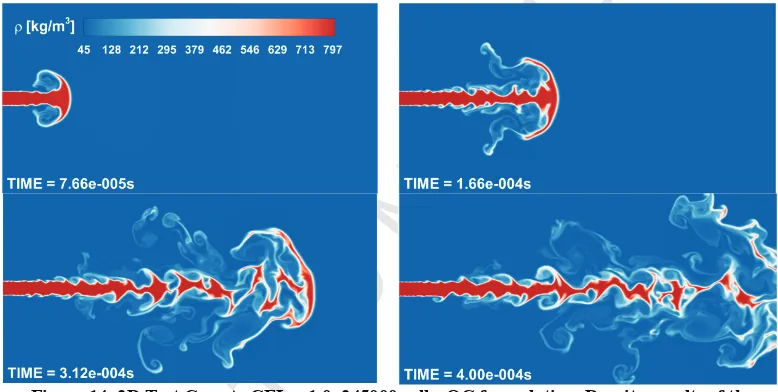
[image:21.612.110.499.285.481.2]516
Figure 14. 2D Test Case A, CFL = 1.0, 245000 cells, QC formulation. Density results of the
517
simulation of the planar cryogenic nitrogen jet at various times.
518 519
When the jet enters the elevated temperature environment of the chamber, the 520
velocity gradients at the jet surface generate a vortex rollup that finally breakup into ligament-521
shaped structures, see Figure 14. The Kelvin Helmholtz instability can be observed in the 522
shear layer, which is similar to a gas/gas turbulent mixing case. No droplets are formed at 523
these conditions. The jet is quickly heated to a gas-like supercritical state after the injection 524
takes place. It must be highlighted that the mesh resolution is not enough to resolve all the 525
scales (the aim of these simulations is to test the developed numerical framework). Moreover, 526
2D simulation cannot resolve turbulence.Figure 17 shows the density, temperature, pressure 527
and sound speed results at 4 x 10⁻⁴ s. 528
Figure 15 shows a scatter plot of pressure as a function of density for the planar 529
cryogenic nitrogen jet. The simulated case remains in the hyperbolic region of the governing 530
equations with a real-valued speed of sound (Appendix B). The mixing trajectory passes close 531
to the critical point with a few individual points inside the saturation curve, which means that 532
19
or the two-dimensionality of the case could be the reason why a small number of cells are in 534
the unstable region [3]. 535
Although one of reasons of the prevailing usage of cubic EoS is their efficiency, 536
practical simulations can be performed using the PC-SAFT EoS. The quasi-conservative 537
formulation is computationally less expensive than the conservative scheme because the PC-538
SAFT EoS has to be used only once in the hyperbolic operator in each time step. The 539
[image:22.612.185.428.282.448.2]computational time is 65-70% higher using the PC-SAFT EoS than utilizing the PR EoS. 540
Figure 16 shows the time taken by the code to solve the transcritical nitrogen injection case 541
depending on the number of cells used (only one core is used to perform the simulation). 542
The PC-SAFT EoS is implemented using loops that depend on the number of 543
components solved, which means that it takes more time to compute the properties of 544
mixtures. However, knowing the mass fractions it is possible to determine how many 545
components are present in a cell a priori. The PC-SAFT is then only solved for that specific 546
number of components. Most cells along the simulation in the combustion chamber contain 547
only nitrogen. For this reason, a significant increment on time has not been observed 548
performing two-component simulations. 549
550
Figure 15. Scatter plot of pressure as a function of density for the transcritical nitrogen jet (Case
551
A). The vapor dome, non-convex region and the region with complex speed of sound (SOS) are
552
included.
553
[image:22.612.125.414.496.674.2]554
Figure 16. Computational time employed to compute the solution of the transcritical nitrogen jet
555
(Case A) at t = 4 x 10⁻⁴ employing a variable number of cells.
20
Figure 17. 2D Test Case A, CFL = 1.0, 245000 cells, QC formulation. Results of the simulation
558
of the planar cryogenic nitrogen jet at t = 4 x 10⁻⁴ s using the quasi-conservative formulation: (a)
559
density, (b) temperature, (c) pressure, (d) sound speed.
560 561
(a)
(b)
21
Supercritical nitrogen injection (Conservative formulation, Case B) 562
The case is initialized using a pressure in the chamber of 4 MPa, the density of the 563
nitrogen in the chamber is 45.5 kg/m3 and the density of the jet is 440.0 kg/m3 (Table 3). The 564
velocity of the jet is 50 m/s. The spatial reconstruction is carried out using a blending of the 565
fifth-order WENO and the first-order schemes (95% fifth-order WENO). The CFL number is 566
set at 0.4. Transmissive boundary conditions are applied at the top, bottom and right 567
boundaries while a wall condition is employed at the left boundary. A flat velocity profile is 568
imposed at the inlet. 569
If sharp interface methods (i.e. front tracking method) are not applied, the interfaces 570
are not sharp one-point jumps but smooth as they are resolved [43]. This is the reason why the 571
wiggles that appear in this 2D simulation are not as severe as in the 1D cases presented in 572
Section 3.1 initialized using a sharp interface, see Figure 18. The study of [43] shows how 573
smooth interfaces can reduce the spurious pressure oscillations. 574
The minimum pressure encountered along the simulation is higher than the nitrogen 575
critical pressure so there are no cells in the vapor-liquid equilibrium region. The heat-up of 576
the jet follows the same density-temperature trajectory employing a FC or a QC formulation 577
in single-species cases, see Figure 19. In the works of [2], [44] a different behaviour in 578
multicomponent cases can be observed, where QC formulations follow an isobaric-isochoric 579
mixing model for binary mixtures while conservative schemes follow an isobaric-adiabatic 580
mixing model. 581
[image:24.612.129.484.356.654.2]582
Figure 18. 2D Test Case B, CFL = 0.4, 180000 cells, FC formulation. Results of the simulation of
583
the supercritical nitrogen jet at t = 7.84 x 10⁻⁴ s: (a) density, (b) pressure.
584
22 585
Figure 19. 2D Test Case B solved using the FC and QC formulations. Scattered data of density
586
and temperature. The nitrogen vapor dome is included.
587 588
Supercritical dodecane injection (Conservative formulation, Case C) 589
Dodecane/nitrogen mixtures are Type IV as stated by [45], which means that the 590
critical temperature of the mixture is an intermediate value of the critical temperature of both 591
components and the mixture critical pressure is higher than the critical pressure of either 592
component, see Figure 23. A simulation of a dodecane jet where VLE (Vapor-Liquid 593
Equilibrium) conditions are avoided injecting the dodecane at a temperature higher than its 594
critical value has been included to prove the multi-species capability of the code. To check 595
that any cell is in a thermodynamic metastable state, the vapor-liquid saturation curves were 596
computed (Appendix C). 597
A structured mesh is applied with a uniform cell distribution. The cell size is 8.3μm × 598
8.3μm. The domain used is 5mm × 2.5mm. Transmissive boundary conditions are applied at 599
the top, bottom and right boundaries while a wall condition is employed at the left boundary. 600
A flat velocity profile is imposed at the inlet. The case is initialized using a pressure in the 601
chamber of 11.1 MPa, the density and the temperature of the nitrogen in the chamber are 37.0 602
kg/m3 and 973 K (high-load Diesel operation conditions [46]) respectively. The density and 603
temperature of the jet are 450.0 kg/m3 and 687 K (Table 3). The velocity of the jet is 200 m/s 604
and the diameter of the exit nozzle is 0.1 mm. 605
As in the transcritical nitrogen case ligament-shaped structures appear and the Kelvin 606
Helmholtz instability can be observed in the shear layer, see Figure 20. The jet is quickly 607
heated-up from a liquid-like supercritical state to a gas-like supercritical state. Some spurious 608
oscillations appear in the pressure field because of the high non-linearity of the EoS. The 609
quasi-conservative formulation was not employed because of the incorrect prediction of the 610
jet heat-up that appear in multi-component cases [2], [44]. 611
A comparison of averaged scattered data of composition and temperature and an 612
isobaric-adiabatic mixing process can be seen in Figure 21. As [44] stated, fully conservative 613
schemes describe an isobaric-adiabatic mixing process. The isobaric-adiabatic line in the 614
Figure 21 was computed using eq.13-14 and the initial conditions of this case. 615
3 1 2
m
=
m
+
m
(13)
616
3 3 1 1 2 2
m h
=
m h
+
m h
(14)23
Figure 20. 2D Test Case C, CFL = 0.5, 180000 cells, FC formulation. Results of the simulation of
618
the supercritical dodecane jet at t = 2.5 x 10⁻⁵ s: (a) density, (b) temperature, (c) pressure, (d)
619
sound speed.
620 621
(a)
(b)
24 622
Figure 21. Scattered data of composition and temperature of the planar dodecane jet Case C.
623
Solid lines are dodecane-nitrogen phase boundaries from VLE at 4.5 MPa and 6 MPa.
624
4. Conclusions
625
The Perturbated Chain Statistical Associating Fluid Theory (PC-SAFT) is utilized to close the 626
Navier-Stokes equations using both a conservative and a quasi-conservative formulation, 627
where the double flux model of [3], [17], [33] is applied. The PC-SAFT EoS presents a 628
precision similar to NIST without the need of an extensive calibration as only three 629
parameters are needed to model a specific component. It is presented as an alternative to the 630
commonly used cubic EoS that present a low accuracy for computing the thermodynamic 631
properties of hydrocarbons at temperatures typical for high pressure injection systems. 632
Advection test cases and shock tube problems have been used to validate the hyperbolic 633
operator of the developed numerical framework. The conservative formulation generates 634
spurious pressure oscillations, like it has been reported with other diffuse interface density-635
based codes employing a real-fluid EoS. Due to fact that the interfaces are not sharp one-point 636
jumps but smooth, as they are resolved in 2D simulations, the wiggles generated do not 637
compromise the stability of the simulation. The quasi-conservative scheme can model 638
transcritical single- and multicomponent cases without spurious pressure oscillations. Errors 639
in the energy conservation that appear employing this formulation may produce an unphysical 640
quick heat-up of the injected jet in multicomponent cases. Two-dimensional simulations of 641
nitrogen and dodecane jets have been presented to demonstrate the multidimensional and 642
multicomponent capability of the numerical framework. 643
Acknowledgments
644
This project has received funding from the European Union Horizon-2020 Research 645
and Innovation Programme with grant Agreement No 675528. 646
25
Appendix A PC-SAFT EoS
652
The PC-SAFT EoS is expressed as the sum of all the residual Helmholtz free energy 653
contributions. These contributions correspond to the distinct types of molecular interactions. 654
The residual Helmholtz free energy is computed using eq.15 [38]. 655
656
=
+
res hc dispa
a
a
(15)657 658
The hard-chain term,
a
hc, for a mixture of nc components, is given in eq. 16 659(
1)ln
(
)
nc
hc hs hs
i i ii d ii i
a
=
ma
−
¦
x m
−
g
σ
(16)660
where
m
is the number of segments for a multicomponent mixture (eq. 17),x
i is the mole 661fraction of every component i in the fluid,
a
hsis the hard sphere contribution (eq. 18),g
iihsis 662the radial distribution function of the hard-sphere fluid (eq.23) and
m
i is the number of 663segments per chain of every component. 664
665
The number of segments for a multicomponent mixture is: 666
=
¦
nc i ii
m
x m
(17)667
The hard sphere contribution is: 668
(
)
(
)
(
)
3 3
1 2 2 2
0 3
2 2
0 3 3 3 3
1
3
ln 1
1
1
ς ς
ς
ς
ς
ς
ς
ς
ς
ς
ς
ª
§
·
º
=
«
+
+
¨
−
¸
−
»
−
−
«
©
¹
»
¬
¼
hsa
(18)669
ς
n is defined as:670
6
π
ς
=
ρ
¦
nn m i i i i
x m d
n
∈
{
0,1, 2,3
}
(19)671
where
ρ
m is the molecular density andd
i is the temperature-dependent segment diameter of 672component i (eq.21). 673
1 3
6
m i i i
i
x m d
ρ
η
π
−
§
·
=
¨
¸
©
¦
¹
beingη ς
=
3 (20)674
1 0.12 exp
3
ε
σ
ª
§
·
º
=
«
−
¨
−
¸
»
©
¹
¬
¼
i i di
d
kT
(21)675
where
k
is the Boltzmann constant,T
is the temperature andε
i is the depth of pair potential 676of the component. 677
26
The mixture parameters
σ
ij andε
ij which are defined for every pair of unlike segments are 679modeled using a Berthelot-Lorentz combining rule. 680
1
(
)
2
σ
ij=
σ σ
i+
j (22)681
(1
)
ε
ij=
ε ε
i j−
k
ij (23)682
where
k
ij is the binary interaction parameter. 683684
The radial distribution function of the hard-sphere fluid is: 685
2 2
2 2
2 3
3 3 3
1
3
3
(1
)
(1
)
(1
)
ς
ς
ς
ς
ς
§
·
§
·
=
+
¨
¨
¸
¸
+
¨
¨
¸
¸
−
©
+
¹
−
©
+
¹
−
i j i j
hs ij
i j i j
d d
d d
g
d
d
d
d
(24)686
The dispersion term is defined as: 687
2 3 2 2 3
1 1 2
2
πρ η
( , )
εσ πρ
( , )
η
ε σ
=−
−
dispm d m d
a
I
m m
mC I
m m
(25)688
where
η ζ
=
3 is the reduced density,I
1 andI
2 are integrals approximated by simple power 689series in density 690
6
1
0
( , )
η
( )
η
=
=
¦
ii i
I
m
a m
(26)691
6
2
0
( , )
η
( )
η
=
=
¦
ii i
I
m
b m
(27)692
The coefficients ai and bi depend on the chain length: 693
0 1 2
1
1
2
( )
=
+
−
+
−
−
i i i i
m
m
m
a m
a
a
a
m
m
m
(28)694
0 1 2
1
1
2
( )
=
+
−
+
−
−
i i i i
m
m
m
b m
b
b
b
m
m
m
(29)695
Where
a a a b b b
0i,
1i,
2i,
0i, ,
1i 2i are constants [38]. 6961
C
is defined as: 697(
)
( )
[
]
1
1
1
2 2 3 4
4 2
1
8
8
20
27
12
2
1
1
1
(1
)(2
)
ρ
ρ
η η
η
η
η
η
η
η
η
− −
![Figure 1. Schematic representation of the attractive and repulsive contributions of the SAFT EoS and the PC-SAFT EoS [24]](https://thumb-us.123doks.com/thumbv2/123dok_us/1388844.92028/7.612.104.499.323.653/figure-schematic-representation-attractive-repulsive-contributions-saft-saft.webp)


![Table 1. PC-SAFT pure component parameters [38]](https://thumb-us.123doks.com/thumbv2/123dok_us/1388844.92028/15.612.86.502.73.680/table-pc-saft-pure-component-parameters.webp)