Agent Technology Roadmap
A Roadmap for Agent Based Computing
Michael Luck, Peter McBurney, Onn Shehory, Steve Willmott
Compiled, written and edited by
Economics Philosophy Game Theory Biology Logic Sociology Political Science Anthropology Marketing Organisation Design Decision Theory Artificial Life Robotics Uncertainty in AI Logic Programminggg Mathematical Modelling Organisations Complex Systems Reasoning and Learning Self-* Systems Grid Computing Ambient intelligence Peer-to-peer
Computing Service OrientedComputing
Semantic Web Trust and Reputation
User Interaction Design
Simulation
Software
Engineering Interoperability Infrastructure Formal
Methods ProgrammingLanguages
Coordination Negotiation Communication
Trends and Drivers Technologies
2
AgentLink Roadmap
2
Michael Luck, Peter McBurney, Onn Shehory and Steven Willmott © September 2005, AgentLink III
ISBN 085432 845 9
This roadmap has been prepared as part of the activities of AgentLink III, the European Coordination Action for Agent-Based Computing (IST-FP6-002006CA). It is a collaborative effort, involving numerous contributors listed at the end of the report. We are grateful to all who contributed, including those not named.
Neither the editors, authors, contributors, nor reviewers accept any responsibility for loss or damage arising from the use of information contained in this report.
Special thanks go to Catherine Atherton, Roxana Belecheanu, Rebecca Earl, Adele Maggs, Steve Munroe and Serena Raffi n, who all contributed in essential ways to the production of this document.
The cover was produced by Serena Raffi n, based on an original design by Magdalena Koralewska.
Editors:
Michael Luck
School of Electronics and Computer Science University of Southampton
Southampton SO17 1BJ United Kingdom [email protected]
Peter McBurney
Department of Computer Science University of Liverpool
Liverpool L69 3BX United Kingdom
Onn Shehory
IBM - Haifa Research Labs Haifa University
Mount Carmel, Haifa 31905 Israel
Steven Willmott
Departament Llenguatges i Sistemes Informàtics Universitat Politècnica de Catalunya
Jordi-Girona 1-3E-08034 Barcelona, Spain [email protected]
3
AgentLink III
AgentLink III is an Information Society Technologies (IST) Coordination Action for Agent-Based Computing, funded under the European Commission’s Sixth Framework Programme (FP6), running through 2004 and 2005. Agent-based systems are one of the most vibrant and important areas of research and development to have emerged in information technology in recent years, underpinning many aspects of broader information society technologies.The long-term goal of AgentLink is to put Europe at the leading edge of international competitiveness in this increasingly important area. AgentLink is working towards this by seeking to achieve the following objectives.
■ To gain competitive advantage for European industry by promoting and raising awareness of agent systems technology.
■ To support standardisation of agent technologies and promote interoperability.
■ To facilitate improvement in the quality, profi le, and industrial relevance of European research in the area of agent-based computer systems, and draw in relevant prior work from related areas and disciplines.
■ To support student integration into the agent community and to promote excellence in teaching in the area of agent-based systems.
■ To provide a widely known, high-quality European forum in which current issues, prob-lems, and solutions in the research, development and deployment of agent-based computer systems may be debated, discussed, and resolved.
■ To identify areas of critical importance in agent technology for the broader IST com-munity, and to focus work in agent systems and deployment in these areas.
Further information about AgentLink III, and its activities, is available from the AgentLink website at www.agentlink.org
5
Contents
Executive Summary 7
1 What is Agent Technology? 11
1.1 Agents as Design Metaphor 11 1.2 Agents as a Source of Technologies 12 1.3 Agents as Simulation 12
2 Technological Context 15
3 Emerging Trends and Critical Drivers 19
3.1 Semantic Web 19
3.2 Web Services and Service Oriented Computing 19 3.3 Peer-to-Peer Computing 20
3.4 Grid Computing 21
3.5 Ambient Intelligence 23 3.6 Self-* Systems and Autonomic Computing 24
3.7 Complex Systems 25
3.8 Summary 26
4 Agent Technologies, Tools and Techniques 29
4.1 Organisation Level 30
4.1.1 Organisations 30
4.1.2 Complex Systems and Self Organisation 30 4.1.3 Trust and Reputation 32
4.2 Interaction Level 33
4.2.1 Coordination 33
4.2.2 Negotiation 34
4.2.3 Communication 35
4.3 Agent Level 35
4.4 Infrastructure and Supporting Technologies 36 4.4.1 Interoperability 37 4.4.2 Agent Oriented Software Engineering 37 4.4.3 Agent Programming Languages 39
4.4.4 Formal Methods 40
4.4.5 Simulation 41
6
5 Adoption of Agent Technologies 43
5.1 Diffusion of Innovations 43 5.2 Product Life Cycles 43 5.3 Standards and Adoption 46 5.4 Agent Technologies 47 5.5 Modelling Diffusion of Agent Technologies 51
5.5.1 Model Design 51
5.5.2 Simulation Results 52 5.6 Activity in Europe 53
6 Market and Deployment Analysis 57
6.1 Deliberative Delphi Survey 57 6.1.1 Industry Sector Penetration 57 6.1.2 Deployment of Agent Technologies 59 6.1.3 Technology Areas and Maturity 60
6.1.4 Standards 63
6.1.5 Prospects 63
6.2 The Agent Technology Hype Cycle 65 6.2.1 The Gartner Analysis 66 6.2.2 The AgentLink Analysis 67
7 Technology Roadmap 71
7.1 Phase 1: Current 71
7.2 Phase 2: Short-Term Future 72 7.3 Phase 3: Medium-Term Future 72 7.4 Phase 4: Long-Term Future 73 7.5 Technologies and Timescales 74
8 Challenges 77
8.1 Broad Challenges 77
8.2 Specifi c Challenges 78
8.3 Recommendations 83
9 Conclusions 85
References 87
Glossary 91
Web Resources and URLs 93
Methodology 95
AgentLink Members 97
7
Executive Summary
Executive Summary
In its brief history, computing has enjoyed several different metaphors for the notion of computation. From the time of Charles Babbage in the nineteenth century until the mid-1960s, most people thought of computation as calculation, or operations undertaken on numbers. With widespread digital storage and manipulation of non-numerical information from the 1960s onwards, computation was re-conceptualised more generally as information processing, or operations on text, audio or video data. With the growth of the Internet and the World Wide Web over the last fi fteen years, we have reached a position where a new metaphor for computation is required: computation as interaction. In this metaphor, computing is something that happens by and through communication between computational entities. In the current radical reconceptualisation of computing, the network is the computer, to coin a phrase.
In this new metaphor, computing is an activity that is inherently social, rather than solitary, leading to new ways of conceiving, designing, developing and managing computational systems. One example of the infl uence of this viewpoint is the emerging model of software as a service, for example in service-oriented architectures. In this model, applications are no longer monolithic, functioning on one machine (for single user applications), or distributed applications managed by a single organisation (such as today’s Intranet applications), but instead are societies of components.
■ These components are viewed as providing services to one another. They may not all have been designed together or even by the same software development team; they may be created, operate and be decommissioned according to different times-cales; they may enter and leave different societies at different times and for different reasons; and they may form coalitions or virtual organisations with one another to achieve particular temporary objectives. Examples are automated procurement sys-tems comprising all the companies connected along a supply chain, or service crea-tion and service delivery platforms for dynamic provision of value-added telecommu-nications services.
8
■ The components are not necessarily activated by human users but may also carry out actions in an automated and coordinated manner when certain conditions hold. These preconditions may themselves be distributed across components, so that action by one component requires prior co-ordination and agreement with other compo-nents. Simple multi-party database commit protocols are examples, but signifi cantly more complex coordination and negotiation protocols have been studied and de-ployed, for example in utility computing systems and ad hoc wireless networks.
■ Intelligent, automated components may even undertake self-assembly of software and systems, to enable adaptation or response to changing external or internal cir-cumstances. An example of this is the creation of on-the-fl y coalitions in automated supply-chain systems in order to exploit dynamic commercial opportunities. Such sys-tems resemble those of the natural world and human societies much more than they do the example arithmetic programs taught in Fortran classes, so ideas from biology, statistical physics, sociology and economics play an increasingly important role in computing systems.
How should we exploit this new metaphor of computing as social activity, as interaction between independent and sometimes intelligent entities, adapting and co-evolving with one another? The answer, many people believe, lies with agent technologies. An agent is a computer program capable of fl exible and autonomous action in a dynamic environment, usually an environment containing other agents. In this abstraction, we have encapsulated autonomous and intelligent software entities, called agents, and we have demarcated the society in which they operate, a multi-agent system. Agent-based computing concerns the theoretical and practical working through of the details of this simple two-level abstraction.
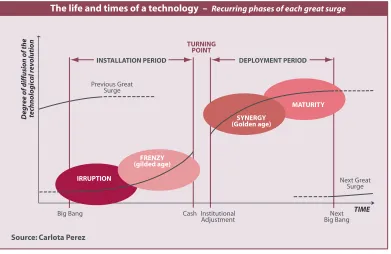
In the sense that it is a new paradigm, agent-based computing is disruptive. As outlined above, it causes a re-evaluation of the very nature of computing, computation and computational systems, through concepts such as autonomy, coalitions and ecosystems, which make no sense to earlier paradigms. Economic historians have witnessed such disruption with new technologies repeatedly, as new technologies are created, are adopted, and then mature. A model of the life-cycle of such technologies, developed by Perez (2002), and reproduced in Figure 0.1, suggests two major parts: an installation
9
Executive Summary
This document is a strategic roadmap for agent-based computing over the next decade. It has been prepared by AgentLink III, a European Commission-funded coordination action, intended to support and facilitate European research and development in agent technologies. The contents of the roadmap are the result of an extensive, eighteen-month effort of consultation and dialogue with experts in agent technology from the 192 member organisations of AgentLink III, in addition to experts in the Americas, Japan and Australasia. The roadmap presents our views of how the technology will likely develop over the decade to 2015, the key research and development issues involved in this development, and the challenges that currently confront research, development and further adoption of agent technologies.
[image:10.567.37.428.277.531.2]This strategic technology roadmap is not intended as a prediction of the future. Instead, it is a reasoned analysis: given an analysis of the recent past and current state of agent technologies, and of computing more generally, we present one possible future development path for the technology. By doing this, we aim to identify the challenges and obstacles that will need to be overcome for progress to be made in research and
Figure 0.1: The phases of technology life-cycles. Source: Carlota Perez
The life and times of a technology – Recurring phases of each great surge
SYNERGY (Golden age) Next Great Surge Previous Great Surge
Big Bang Next
Big Bang Cash Institutional Adjustment MATURITY IRRUPTION TURNING POINT
INSTALLATION PERIOD DEPLOYMENT PERIOD
TIME
Degree of diffusion of the tec
h n o lo g ic a l r ev o lu ti o n
Source: Carlota Perez
10
11
Agent Technology
1 What is Agent Technology?
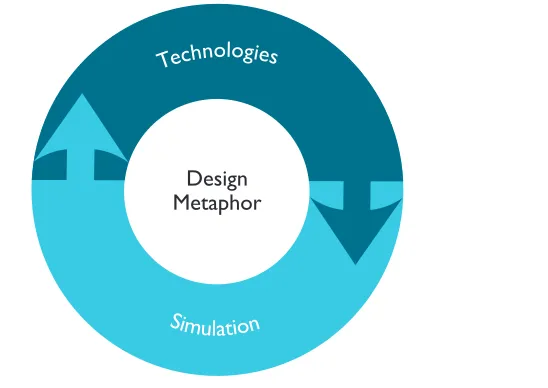
Agent-based systems are one of the most vibrant and important areas of research and development to have emerged in information technology in the 1990s. Put at its simplest, an agent is a computer system that is capable of fl exible autonomous action in dynamic, unpredictable, typically multi-agent domains. In particular, the characteristics of dynamic and open environments in which, for example, heterogeneous systems must interact, span organisational boundaries, and operate effectively within rapidly changing circumstances and with dramatically increasing quantities of available information, suggest that improvements on traditional computing models and paradigms are required. Thus, the need for some degree of autonomy, to enable components to respond dynamically to changing circumstances while trying to achieve over-arching objectives, is seen by many as fundamental. Many observers therefore believe that agents represent the most important new paradigm for software development since object orientation.The concept of an agent has found currency in a diverse range of sub-disciplines of information technology, including computer networks, software engineering, artifi cial intelligence, human-computer interaction, distributed and concurrent systems, mobile systems, telematics, computer-supported cooperative work, control systems, decision support, information retrieval and management, and electronic commerce. In practical developments, web services, for example, now offer fundamentally new ways of doing business through a set of standardised tools, and support a service-oriented view of distinct and independent software components interacting to provide valuable functionality. In the context of such developments, agent technologies have increasingly come to the foreground. Because of its horizontal nature, it is likely that the successful adoption of agent technology will have a profound, long-term impact both on the competitiveness and viability of IT industries, and on the way in which future computer systems will be conceptualised and implemented. Agent technologies can be considered from three perspectives, each outlined below, as illustrated in Figure 1.1.
1.1 Agents as Design Metaphor
12
supporting infrastructure (embracing other relevant, widely used technologies, such as web services) must be integrated.
1.2 Agents as a Source of Technologies
Agent technologies span a range of specifi c techniques and algorithms for dealing with interactions in dynamic, open environments. These address issues such as balancing reaction and deliberation in individual agent architectures, learning from and about other agents in the environment, eliciting and acting upon user preferences, fi nding ways to negotiate and cooperate with other agents, and developing appropriate means of forming and managing coalitions (and other organisations). Moreover, the adoption of agent-based approaches is increasingly infl uential in other domains. For example, multi-agent systems are already providing new and more effective methods of resource allocation in complex environments than previous approaches.
1.3 Agents as Simulation
[image:13.567.232.506.334.528.2]Multi-agent systems offer strong models for representing complex and dynamic real-world environments. For example, simulation of economies, societies and biological environments are typical application areas.
Figure 1.1: Agent-based computing spans technologies, design and simulation
Simulation
Technologies
13
Agent Technology
The use of agent systems to simulate real-world domains may provide answers to complex physical or social problems that would otherwise be unobtainable due to the complexity involved, as in the modelling of the impact of climate change on biological populations, or modelling the impact of public policy options on social or economic behaviour. Agent-based simulation spans: social structures and institutions to develop plausible explanations of observed phenomena, to help in the design of organisational structures, and to inform policy or managerial decisions; physical systems, including intelligent buildings, traffi c systems and biological populations; and software systems of all types, currently including eCommerce and information management systems.
In addition, multi-agent models can be used to simulate the behaviour of complex computer systems, including multi-agent computer systems. Such simulation models can assist designers and developers of complex computational systems and provide guidance to software engineers responsible for the operational control of these systems. Multi-agent simulation models thus effectively provide a new set of tools for the management of complex adaptive systems, such as large-scale online resource allocation environments.
We do not claim that agent systems are simply panaceas for these large problems; rather they have been demonstrated to provide concrete competitive advantages such as:
■ improving operational robustness with intelligent failure recovery;
■ reducing sourcing costs by computing the most benefi cial acquistion policies in online markets; and
14
Netherlands-based Acklin BV was asked by a group of three insurance
com-panies, from Belgium, the Netherlands and Germany, to help automate their
international vehicle claims processing system. At present, European rules
require settlement of cross-border insurance claims for international motor
accidents within 3 months of the accident. However, the back-offi ce
sys-tems used by insurance companies are diverse, with data stored and used
in different ways. Because of this and because of confi dentiality concerns,
information between insurance companies is usually transferred manually,
with contacts between claim handlers only by phone, fax and email. Acklin
developed a multi-agent system, the KIR system, with business rules and
logic encoded into discrete agents representing the data sources of the
dif-ferent companies involved. This approach means the system can ensure
confi dentiality, with agent access to data sources mediated through other
agents representing the data owners. Access to data sources is only granted
to a requesting agent when the relevant permissions are present and for
specifi ed data items. Because some data sources are only accessible
dur-ing business hours, agents can also be programmed to operate only within
agreed time windows. Moreover, structuring the system as a collection of
intelligent components in this way also enables greater system robustness,
so that business processes can survive system shutdowns and failures. The
deployment of the KIR system immediately reduced the human workload at
one of the participating companies by three people, and reduced the total
time of identifi cation of client and claim from 6 months to 2 minutes! For
reasons of security, the KIR system used email for inter-agent
communica-tion, and the 2 minutes maximum time is mainly comprised of delays in the
email servers and mail communication involved.
15
Technological Context
2 Technological Context
The growth of the World Wide Web and the rapid rise of eCommerce have led to signifi cant efforts to develop standardised software models and technologies to support and enable the engineering of systems involving distributed computation. These efforts are creating a rich and sophisticated context for the development of agent technologies. For example, so-called service-oriented architectures (SOAs) for distributed applications involve the creation of systems based on components, each of which provides pre-defi ned computational services, and which can then be aggregated dynamically at runtime to create new applications. Other relevant efforts range from low-level wireless communications protocols such as Bluetooth to higher-level web services abstractions and middleware.The development of standard technologies and infrastructure for distributed and eCommerce systems has impacted on the development of agent systems in two major ways.
■ Many of these technologies provide implementation methods and middleware, ena-bling the easy creation of infrastructures for agent-based systems, such as standard-ised methods for discovery and communication between heterogeneous services. ■ Applications now enabled by these technologies are becoming increasingly
agent-like, and address diffi cult technical challenges similar to those that have been the focus of multi-agent systems. These include issues such as trust, reputation, obligations, contract management, team formation, and management of large-scale open sys-tems.
In terms of providing potential infrastructures for the development of agent systems, technologies of particular relevance include the following.
■ Base Technologies:
■ The Extensible Markup Language (XML) is a language for defi ning mark-up lan-guages and syntactic structures for data formats. Though lacking in machine- readable semantics, XML has been used to defi ne higher-level knowledge rep-resentations that facilitate semantic annotation of structured documents on the Web.
16
■ eBusiness:
■ ebXML aims to standardise XML business specifi cations by providing an open XML-based infrastructure enabling the global use of electronic business information in an interoperable, secure and consistent manner.
■ RosettaNet is a consortium of major technology companies working to create and implement industry-wide eBusiness process standards. RosettaNet standards offer a robust non-proprietary solution, encompassing data dictionaries, an im-plementation framework, and XML-based business message schemas and proc-ess specifi cations for eBusinproc-ess standardisation.
■ Universal Plug & Play:
■ Jini network technology provides simple mechanisms that enable devices to plug together to form an emergent community in which each device pro-vides services that other devices in the community may use.
■ UPnP offers pervasive peer-to-peer network connectivity of intelligent applianc-es and wirelapplianc-ess devicapplianc-es through a distributed, open networking architecture to enable seamless proximity networking in addition to control and data transfer among networked devices.
■ Web Services:
■ UDDI is an industry initiative aimed at creating a platform-independent, open framework for describing services and discovering businesses using the Internet. It is a cross-industry effort driven by platform and software providers, marketplace operators and eBusiness leaders.
■ SOAP provides a simple and lightweight mechanism for exchanging structured and typed information between peers in a decentralised, distributed environ-ment using XML.
■ WSDL/WS-CDL: WSDL provides an XML grammar for describing network services as collections of communication endpoints capable of exchanging messages, thus enabling the automation of the details involved in applications communi-cation. WS-CDL allows the defi nition of abstract interfaces of web services, that is, the business-level conversations or public processes supported by a web service.
17
Technological Context
the Foundation for Intelligent Physical Agents (FIPA; accepted in 2005 by the IEEE as its eleventh standards committee), which defi nes a range of architectural elements similar to those now adopted in the W3C Web Services Architecture specifi cations and elsewhere.
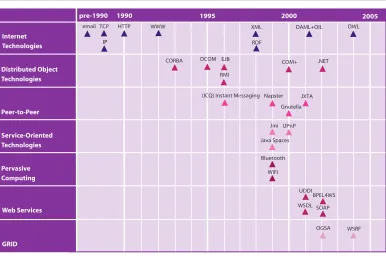
[image:18.567.39.425.274.530.2]These developments with regard to the technological context for agent systems are illustrated in Figure 2.1, which presents the main contextual technologies supporting agent systems development. While research in agent technologies has now been active for over a decade, the fi gure shows that it is only from 1999, with the appearance of effective service-oriented technologies and pervasive computing technologies, that truly dynamic (ad hoc) networked systems could be built without large investments in establishing the underlying infrastructure. In particular, only with the emergence of Grid computing from 2002, and calls for adaptive wide-scale web service based solutions, is there now a widespread need to provide attractive solutions to the higher-level issues of communication, coordination and security.
Figure 2.1: Agent-related technologies for infrastructure support
2005
CORBA
RMI
DCOM EJB COM+ .NET
(ICQ) Instant Messaging Napster JXTA Gnutella
OGSA WSRF Bluetooth
WiFi
WSDL SOAP BPEL4WS UDDI Jini UPnP
Java Spaces
1990 1995 2000 2005
pre-1990
Internet Technologies
Distributed Object Technologies
Peer-to-Peer
GRID
Service-Oriented Technologies
Web Services Pervasive Computing
RDF email TCP
IP
WWW
18
In general, it is clear that broad technological developments in distributed computation are increasingly addressing problems long explored within the agent research community. There are two inter-related developments here. First, supporting technologies are emerging very quickly. As a consequence, the primary research focus for agent technologies has moved from infrastructure to the higher-level issues concerned with effective coordination and cooperation between disparate services. Second, large numbers of systems are being built and designed using these emerging infrastructures, and are becoming ever more like multi-agent systems; their developers therefore face the same conceptual and technical challenges encountered in the fi eld of agent-based computing.
Many companies fi nd themselves under strong pressures to deliver
just-in-time high quality products and services, while operating in a highly
competitive market. In one of SCA Packaging’s corrugated box plants,
customer orders often arrive simultaneously for a range of different boxes,
each order with its own colour scheme and specifi c printing, and often to
be delivered at very short notice. Because of the complexity of factory
processes and the diffi culty of predicting customer behaviour and machine
failure, large inventories of fi nished goods must therefore be managed.
SCA Packaging turned to Eurobios to provide an agent-based modelling
solution in order to explore different strategies for reducing stock levels
without compromising delivery times, as well as evaluating consequences
of changes in the customer base. The agent-based simulation developed
by Eurobios allowed the company to reduce warehouse levels by over
35% while maintaining delivery commitments.
19
Trends and Drivers
3 Emerging Trends and Critical Drivers
The development of agent technologies has taken place within a context of wider visions for information technology. In addition to the specifi c technologies mentioned in the previous section, there are also several key trends and drivers that suggest that agents and agent technologies will be vital. The discussion is not intended to be exhaustive, but instead indicative of the current impetus for use and deployment of agent systems.3.1 Semantic Web
Since it was fi rst developed in the early 1990s, the World Wide Web has rapidly and dramatically become a critically important and powerful medium for communication, research and commerce. However, the Web was designed for use by humans, and its power is limited by the ability of humans to navigate the data of different information sources.
The Semantic Web is based on the idea that the data on the Web can be defi ned and linked in such a way that it can be used by machines for the automatic processing and integration of data across different applications (Berners-Lee et al., 2001). This is motivated by the fundamental recognition that, in order for web-based applications to scale, programs must be able to share and process data, particularly when they have been designed independently. The key to achieving this is by augmenting web pages with descriptions of their content in such a way that it is possible for machines to reason automatically about that content.
Among the particular requirements for the realisation of the Semantic Web vision are: rich descriptions of media and content to improve search and management; rich descriptions of web services to enable and improve discovery and composition; common interfaces to simplify integration of disparate systems; and a common language for the exchange of semantically-rich information between software agents.
It should be clear from this that the Semantic Web demands effort and involvement from the fi eld of agent-based computing, and the two fi elds are intimately connected. Indeed, the Semantic Web offers a rich breeding ground for both further fundamental research and a whole range of agent applications that can (and should) be built on top of it.
3.2 Web Services and Service Oriented Computing
20
to service discovery and the composition of individual services into structured workfl ows. Standards for each of these areas, produced by bodies such as W3C and OASIS, provide a framework for the deployment of component services accessible using HTTP and XML interfaces. These components can subsequently be combined into loosely coupled applications that deliver increasingly sophisticated value-added services.
In a more general sense, web services standards serve as a potential convergence point for diverse technology efforts such as eBusiness frameworks (ebXML, RosettaNet, etc), Grid architectures (which are now increasingly based on web services infrastructures) and others, towards a more general notion of service-oriented architectures (SOA). Here, distributed systems are increasingly viewed as collections of service provider and service consumer components, interlinked by dynamically defi ned workfl ows. Web services can therefore be realised by agents that send and receive messages, while the services themselves are the resources characterised by the functionality provided. In the same way as agents may perform tasks on behalf of a user, a web service provides this functionality on behalf of its owner, a person or organisation.
Web services thus provide a ready-made infrastructure that is almost ideal for use in supporting agent interactions in a multi-agent system. More importantly, perhaps, this infrastructure is widely accepted, standardised, and likely to be the dominant base technology over the coming years. Conversely, an agent-oriented view of web services is gaining increased traction and exposure, since provider and consumer web services environments are naturally seen as a form of agent-based system (Booth et al., 2004).
3.3 Peer-to-Peer Computing
Peer-to-peer (P2P) computing covers a wide range of infrastructures, technologies and applications that share a single characteristic: they are designed to create networked applications in which every node (or deployed system) is in some sense equivalent to all others, and application functionality is created by potentially arbitrary interconnection between these peers. The consequent absence of the need for centralised server components to manage P2P systems makes them highly attractive in terms of robustness against failure, ease of deployment, scalability and maintenance (Milojicic et al., 2002).
21
Trends and Drivers
management features. Standardisation for P2P technologies is also underway within the Global Grid Forum (GGF), which now includes a P2P working group established by Intel in 2000.
P2P applications display a range of agent-like characteristics, often applying self-organisation techniques in order to ensure continuous operation of the network, and relying on protocol design to encourage correct behaviour of clients. (For example, many commercial e-marketplace systems, such as eBay, include simple credit-reputation systems to reward socially benefi cial behaviour). As P2P systems become more complex, an increasing number of agent technologies may also become relevant. These include, for example: auction mechanism design to provide a rigorous basis to incentivise rational behaviour among clients in P2P networks; agent negotiation techniques to improve the level of automation of peers in popular applications; increasingly advanced approaches to trust and reputation; and the application of social norms, rules and structures, as well as social simulation, in order to better understand the dynamics of populations of independent agents.
3.4 Grid Computing
The Grid is the high-performance computing infrastructure for supporting large-scale distributed scientifi c endeavour that has recently gained heightened and sustained interest from several communities (Foster and Kesselman, 2004). The Grid provides a means of developing eScience applications such as those demanded by, for example, the Large Hadron Collider facility at CERN, engineering design optimisation, bioinformatics and combinatorial chemistry. Yet it also provides a computing infrastructure for supporting more general applications that involve large-scale information handling, knowledge management and service provision. Typically, Grid systems are abstracted into several layers, which might include: a data-computation layer dealing with computational resource allocation, scheduling and execution; an information layer dealing with the representation, storage and access of information; and a knowledge layer, which deals with the way knowledge is acquired, retrieved, published and maintained.
The Grid thus refers to an infrastructure that enables the integrated, collaborative use of high-end computers, networks, databases, and scientifi c instruments owned and managed by multiple organisations. Grid applications often involve large amounts of data and computer processing, and often require secure resource sharing across organisational boundaries; they are thus not easily handled by today’s Internet and Web infrastructures.
The key benefi t of Grid computing more generally is fl exibility – the distributed system and network can be reconfi gured on demand in different ways as business needs change,
22
in principle enabling more fl exible IT deployment and more effi cient use of computing resources (Information Age Partnership, 2004). According to BAE Systems (Gould et al., 2003), while the technology is already in a state in which it can realise these benefi ts in a single organisational domain, the real value comes from cross-organisation use, through virtual organisations, which require ownership, management and accounting to be handled within trusted partnerships. In economic terms, such virtual organisations provide an appropriate way to develop new products and services in high value markets; this facilitates the notion of service-centric software, which is only now emerging because of the constraints imposed by traditional organisations. As the Information Age Partnership (2004) suggests, the future of the Grid is not in the provision of computing power, but in the provision of information and knowledge in a service-oriented economy. Ultimately,
The Internet has enabled computational resources to be accessed
remotely. Networked resources such as digital information, specialised
laboratory equipment and computer processing power may now be
shared between users in multiple organisations, located at multiple
sites. For example, the emerging Grid networks of scientifi c communities
enable shared and remote access to advanced equipment such as
supercomputers, telescopes and electron microscopes. Similarly, in the
commercial IT arena, shared access to computer processing resources
has recently drawn the attention of major IT vendors with companies
such as HP (“utility computing”), IBM (“on-demand computing”), and
Sun (“N1 Strategy”) announcing initiatives in this area. Sharing resources
across multiple users, whether commercial or scientifi c, allows scientists
and IT managers to access resources on a more cost-effective basis,
and achieves a closer match between demand and supply of resources.
Ensuring effi cient use of shared resources in this way will require design,
implementation and management of resource-allocation mechanisms in
a computational setting.
23
Trends and Drivers
the success of the Grid will depend on standardisation and the creation of products, and efforts in this direction are already underway from a range of vendors, including Sun, IBM and HP.
3.5 Ambient Intelligence
The notion of ambient intelligence has largely arisen through the efforts of the European Commission in identifying challenges for European research and development in Information Society Technologies (IST Advisory Group, 2002). Aimed at seamless delivery of services and applications, it relies on the areas of ubiquitous computing, ubiquitous communication and intelligent user interfaces. The vision describes an environment of potentially thousands of embedded and mobile devices (or software components) interacting to support user-centred goals and activity, and suggests a component-oriented view of the world in which the components are independent and distributed. The consensus is that autonomy, distribution, adaptation, responsiveness, and so on, are key characteristics of these components, and in this sense they share the same characteristics as agents.
Ambient intelligence requires these agents to be able to interact with numerous other agents in the environment around them in order to achieve their goals. Such interactions take place between pairs of agents (in one-to-one collaboration or competition), between groups (in reaching consensus decisions or acting as a team), and between agents and the infrastructure resources that comprise their environments (such as large-scale information repositories). Interactions like these enable the establishment of virtual organisations, in which groups of agents come together to form coherent groups able to achieve overarching objectives.
The environment provides the infrastructure that enables ambient intelligence scenarios to be realised. On the one hand, agents offering higher-level services can be distinguished from the physical infrastructure and connectivity of sensors, actuators and networks, for example. On the other hand, they can also be distinguished from the virtual infrastructure needed to support resource discovery, large-scale distributed and robust information repositories (as mentioned above), and the logical connectivity needed to enable effective interactions between large numbers of distributed agents and services, for example.
24
3.6 Self-* Systems and Autonomic Computing
Computational systems that are able to manage themselves have been part of the vision for computer science since the work of Charles Babbage. With the increasing complexity of advanced information technology systems, and the increasing reliance of modern society on these systems, attention in recent years has returned to this. Such systems have come to be called self-* systems and networks (pronounced “self-star”), with the asterisk indicating that a variety of attributes are under consideration. While an agreed defi nition of * systems is still emerging, aspects of these systems include properties such as: self-awareness, self-organisation, self-confi guration, self-management, self-diagnosis, self correction, and self-repair.
Such systems abound in nature, from the level of ecosystems, through large primates (such as man) and down to processes inside single cells. Similarly, many chemical, physical, economic and social systems exhibit self-* properties. Thus, the development of computational systems that have self-* properties is increasingly drawing on research in biology, ecology, statistical physics and the social sciences. Recent research on computational self-* systems has tried to formalise some of the ideas from these different disciplines, and to identify algorithms and procedures that could realise various self-* attributes, for example in peer-to-peer networks. One particular approach to self-* systems has become known as autonomic computing, considered below.
Computational self-* systems and networks provide an application domain for research and development of agent technologies, and also a contribution to agent-based computing theory and practice, because many self-* systems may be viewed as involving interactions between autonomous entities and components.
25
Trends and Drivers
in accordance with its current environment, adapting to best interact with other systems, by negotiating for resource use; it must function in a heterogeneous world and implement open standards; and it must marshal resources to reduce the gap between its (user) goals and their achievement, without direct user intervention.
Ultimately, the aim is to realise the promise of IT: increasing productivity while minimising complexity for users. The key message to be drawn from this vision is that it shares many of the goals of agent-based computing, and agents offer a way to manage the complexity of self-* and autonomic systems.
3.7 Complex Systems
Modern software and technological systems are among the most complex human artefacts, and are ever-increasing in complexity. Some of these systems, such as the Internet, were not designed but simply grew organically, with no central human control or even understanding. Other systems, such as global mobile satellite communications networks or current PC operating systems, have been designed centrally, but comprise so many interacting components and so many types of interactions that no single person or even team of people could hope to comprehend the detailed system operations. This lack of understanding may explain why such systems are prone to error as, for example, in the large-scale electricity network failures in North America and in Italy in 2003.
Moreover, many systems that affect our lives involve more than just software. For example, the ecosystem of malaria involves natural entities (parasites and mosquitos), humans, human culture, and technological artefacts (drugs and treatments), all interacting in complex, subtle and dynamic ways. Intervening in such an ecosystem, for example by providing a new treatment regime for malaria, may have unintended and unforeseen consequences due to the nature of these interactions being poorly understood. The science of complex adaptive systems is still in its infancy, and as yet provides little in the way of guidance for designers and controllers of specifi c systems.
26
provide a valuable way of coping with the increasing complexity of modern software systems (Zambonelli and Parunak, 2002), particularly the characteristics of pervasive devices, ambient intelligence, continuous operation (allowing no downtime for upgrades or maintenance), and open systems.
3.8 Summary
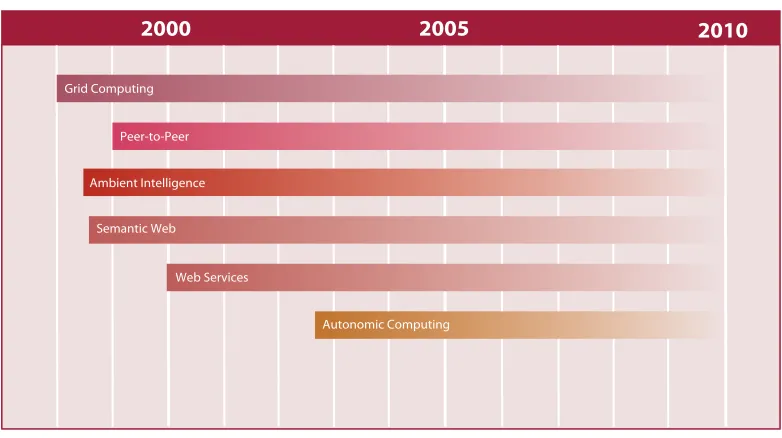
It is natural to view large systems in terms of the services they offer, and consequently in terms of the entities or agents providing or consuming services. The domains discussed here refl ect the trends and drivers for applications in which typically many agents and services may be involved, and spread widely over a geographically distributed environment. Figure 3.1 depicts the emergence of these driver domains over time, suggesting that their maturity, which will demand the use of agent technologies, is likely to be some years away.
[image:27.567.141.532.312.531.2]Most importantly perhaps, the environments that have been identifi ed here are open and dynamic so that new agents may join and existing ones leave. In this view, agents act on behalf of service owners, managing access to services, and ensuring that contracts are fulfi lled. They also act on behalf of service consumers, locating services, agreeing contracts, and receiving and presenting results. In these domains, agents will be required
Figure 3.1: The emergence of agent-related domains over time.
2000
2005
2010
Ambient Intelligence
Autonomic Computing Web Services
Grid Computing
Peer-to-Peer
27
Trends and Drivers
to engage in interactions, to negotiate, to make pro-active run-time decisions while responding to changing circumstances, and to allocate and schedule resources across the diverse competing demands placed on infrastructures and systems. In particular, agents with different capabilities will need to collaborate and to form coalitions in support of new virtual organisations.
Of course, these drivers do not cover all areas within the fi eld of agent-based computing. For example, there is a need for systems that can behave intelligently and work as part of a community, supporting or replacing humans in environments that are dirty, dull or dangerous. There are also drivers relating to human-agent interfaces, learning agents, robotic agents, and many others, but those identifi ed here provide a context that is likely to drive forward the whole fi eld.
NuTech and Air Liquide
29
Tools and Techniques
4 Agent Technologies, Tools and Techniques
It should be clear that there are several distinct high-level trends and drivers leading to interest in agent technologies, and low-level computing infrastructures making them practically feasible. In this context, we now consider the key technologies and techniques required to design and implement agent systems that are the focus of current research and development. Because agent technologies are mission-critical for engineering and for managing certain types of information systems, such as Grid systems and systems for ambient intelligence, the technologies and techniques discussed below will be important for many applications, even those not labelled as agent systems.These technologies can now be grouped into three categories, according to the scale at which they apply:
■ Organisation-level: At the top level are technologies and techniques related to agent societies as a whole. Here, issues of organisational structure, trust, norms and obli-gations, and self-organisation in open agent societies are paramount. Once again, many of these questions have been studied in other disciplines — for example, in soci-ology, anthropology and biology. Drawing on this related work, research and devel-opment is currently focused on technologies for designing, evolving and managing complex agent societies.
■ Interaction-level: These are technologies and techniques that concern the commu-nications between agents — for example, technologies related to communication languages, interaction protocols and resource allocation mechanisms. Many of the problems solved by these technologies have been studied in other disciplines, includ-ing economics, political science, philosophy and linclud-inguistics. Accordinclud-ingly, research and development is drawing on this prior work to develop computational theories and technologies for agent interaction, communication and decision-making. ■ Agent-level: These are technologies and techniques concerned only with individual
agents — for example, procedures for agent reasoning and learning. Problems at this level have been the primary focus of artifi cial intelligence since its inception, aiming to build machines that can reason and operate autonomously in the world. Agent re-search and development has drawn extensively on this prior work, and most attention in the fi eld of agent-based computing now focuses at the previous two higher levels.
30
4.1 Organisation Level
4.1.1 Organisations
Dynamic agent organisations that adjust themselves to gain advantage in their current environments are likely to become increasingly important over the next fi ve years. They will arise in dynamic (or emergent) agent societies, such as those suggested by the Grid, ambient intelligence and other domains in which agents come together to deliver composite services, all of which require that agents can adapt to function effectively in uncertain or hostile environments. Some work has already started on the development of systems that can meet this challenge, which is fundamental to realising the power of the agent paradigm; its relevance will remain at the forefront of R&D efforts over the next 10-15 years, especially in relation to commercial efforts at exploitation. In particular, building dynamic agent organisations (including, for example, methods for teamwork, coalition formation, and so on) for dealing with aspects of the emerging visions of the Grid and the Web, as well as aspects of ubiquitous computing, will be crucial.
Social factors in the organisation of multi-agent systems will also become increasingly important over the next decade as we seek ways to structure interactions in an open and dynamic online world. This relates to the need to properly assign roles, (institutional) powers, rights and obligations to agents in order to control security and trust-related aspects of multi-agent systems at a semantic level, as opposed to current developments, which deal with them at the infrastructure level. These social factors can provide the basis on which to develop methods for access control, for example, and to ensure that behaviour is regulated and structured when faced with dynamic environments in which traditional techniques are not viable. In addition to appropriate methods and technologies for agent team formation, management, assessment, coordination and dissolution, technologies will also be required for these processes to be undertaken automatically at runtime in dynamic environments.
4.1.2 Complex Systems and Self Organisation
Self-organisation refers to the process by which a system changes its internal organisation to adapt to changes in its goals and environment without explicit external control. This can often result in emergent behaviour that may or may not be desirable. Due to the dynamism and openness of contemporary computing environments, understanding the mechanisms that can be used to model, assess and engineer self-organisation and emergence in multi-agent systems is an issue of major interest.
31
Tools and Techniques
behaviour emerges from their mutual interactions. Such a system modifi es its structure and functionality to adapt to changes to requirements and to the environment based on previous experience. Nature provides examples of self-organisation, such as ants foraging for food, molecule formation, and antibody detection. Similarly, current software applications involve social interactions (such as negotiations and transactions) with autonomous entities or agents, in highly dynamic environments. Engineering applications to achieve robustness and adaptability, based on the principles of self-organisation, is thus gaining increasing interest in the software community. This interest originates from the fact that current software applications need to cope with requirements and constraints stemming from the increased dynamism, sophisticated resource control, autonomy and decentralisation inherent in contemporary business and social environments. The majority of these characteristics and constraints are the same as those that can be observed in natural systems exhibiting self-organisation.
Self-organisation mechanisms provide the decision-making engines based on which system components process input from software and hardware sensors to decide how, when and where to modify the system’s structure and functionality. This enables a better fi t with the current requirements and environment, while preventing damage or loss of service. It is therefore necessary to characterise the applications in which existing mechanisms, such as stigmergy (or the means by which the individual parts of a system communicate with one another by modifying their local environment, much like ants), can be used, and to develop new generic mechanisms independent of any particular application domain.
In some cases, self-organisation mechanisms have been modelled using rule-based approaches or control theory. Furthermore, on many occasions the self-organising actions have been inspired by biological and natural processes, such as the human nervous system and the behaviour observed in insect species that form colonies. Although such approaches to self-organisation have been effective in certain domains, environmental dynamics and software complexity have limited their general applicability. More extensive research in modelling self-organisation mechanisms and systematically constructing new ones is therefore needed. Future self-organising systems must accommodate high-dimensional sensory data, continue to learn from new experiences and take advantage of new self-organisation acts and mechanisms as they become available.
32
undesirable; building systems with desirable emergent behaviour capabilities can increase their robustness, autonomy, openness and dynamism.
To achieve desired global emergent system behaviour, local agent behaviours and interactions should comply with some behavioural framework dictated by a suitable theory of emergence. Unfortunately, too few theories of emergence are currently available and existing ones still require improvement. In consequence, therefore, new theories of emergence need to be developed based on inspiration from natural or social systems, for example.
An important open issue in self-organising systems relates to modelling the application context and environment. In this respect, a key question is the defi nition of the relevant environmental parameters that need to be considered in determining the evolving structure and functionality of self-organising software. Additional open questions relate to: how context can be captured, processed and exploited for adjusting the services provided by the application in a given situation; how the self-organising effects occurring from participation of the application in different contexts can be synchronised; how to effectively model user preferences and intentions; and the amount of historical information that should be recorded by the system and considered in determining its evolution over time.
4.1.3 Trust and Reputation
Many applications involving multiple individuals or organisations must take into account the relationships (explicit or implicit) between participants. Furthermore, individual agents may also need to be aware of these relationships in order to make appropriate decisions. The fi eld of trust, reputation and social structure seeks to capture human notions such as trust, reputation, dependence, obligations, permissions, norms, institutions and other social structures in electronic form.
By modelling these notions, engineers can borrow strategies commonly used by humans to resolve confl icts that arise when creating distributed applications, such as regulating the actions of large populations of agents using fi nancial disincentives for breaking social rules or devising market mechanisms that are proof against certain types of malicious manipulation. The theories are often based on insights from different domains including economics (market-based approaches), other social sciences (social laws, social power) or mathematics (game theory and mechanism design).
33
Tools and Techniques
provide good security, when considering agents autonomously acting on behalf of their owner several additional factors need to be addressed. In particular, collaboration of any kind, especially in situations in which computers act on behalf of users or organisations, will only succeed if there is trust. Ensuring this trust requires, for example, the use of: reputation mechanisms to assess prior behaviour; norms (or social rules) and the enforcement of sanctions; and electronic contracts to represent agreements.
Whereas assurance deals primarily with system integrity, security addresses protection from malicious entities: preventing would-be attackers from exploiting self-organisation mechanisms that alter system structure and behaviour. In addition, to verify component sources, a self-organising software system must protect its core from attacks. Various well-studied security mechanisms are available, such as strong encryption to ensure confi dentiality and authenticity of messages related to self-organisation. However, the frameworks within which such mechanisms can be effectively applied in self-organising systems still require considerable further research.
In addition, the results of applying self-organisation and emergence approaches over long time periods lead to concerns about the privacy and trustworthiness of such systems and the data they hold. The areas of security, privacy and trust are critical components for the next stages of research and deployment of open distributed systems and as a result of self-organising systems. New approaches are required to take into account both social and technical aspects of this issue to drive the proliferation of self-organising software in a large range of application domains.
4.2 Interaction Level
4.2.1 Coordination
Coordination is defi ned in many ways but in its simplest form it refers to ensuring that the actions of independent actors (agents) in an environment are coherent in some way. The challenge therefore is to identify mechanisms that allow agents to coordinate their actions automatically without the need for human supervision, a requirement found in a wide variety of real applications. In turn, cooperation refers to coordination with a common goal in mind.
34
that enable asynchronous communication of goals, objectives or other useful data), to distributed planning (which takes into account possible and likely actions of agents in the domain).
4.2.2 Negotiation
Goal-driven agents in a multi-agent society typically have confl icting goals; in other words, not all agents may be able to satisfy their respective goals simultaneously. This may occur, for example, with regard to contested resources or with multiple demands on an agent’s time and attention. In such circumstances, agents will need to enter into negotiations with each other to resolve confl icts. Accordingly, considerable effort has been devoted to negotiation protocols, resource-allocation methods, and optimal division procedures. This work has drawn on ideas from computer science and artifi cial intelligence on the one hand, and the socio-economic sciences on the other.
For example, a typical objective in multi-agent resource allocation is to fi nd an allocation that is optimal with respect to a suitable metric that depends, in one way or another, on the preferences of the individual agents in the system. Many concepts studied in social choice theory can be utilised to assess the quality of resource allocations. Of particular importance are concepts such as envy-freeness and equitability that can be used to model fairness considerations (Brams & Taylor, 1996; Endriss & Maudet, 2004). These concepts are relevant to a wide range of applications. A good example is the work on the fair and effi cient exploitation of Earth Observation Satellite resources carried out at ONERA, the French National Aeronautics Research Centre (Lemaître et al., 2003).
35
Tools and Techniques
Other negotiation techniques are also likely to become increasingly prevalent. For example, one-to-one negotiation, or bargaining, over multiple parameters or attributes to establish service-level agreements between service providers and service consumers will be key in future service-oriented computing environments. In addition to approaches drawn from economics and social choice theory in political science, recent efforts in argumentation-based negotiation have drawn on ideas from the philosophy of argument and the psychology of persuasion. These efforts potentially provide a means to enable niches of deeper interactions between agents than do the relatively simpler protocols of economic auction and negotiation mechanisms. Considerable research and development efforts will be needed to create computational mechanisms and strategies for such interactions, and this is likely to be an important focus of agent systems research in the next decade.
4.2.3 Communication
Agent communication is the study of how two or more software entities may communicate with each other. The research issues in the domain are long-standing and deep. One challenge is the diffi culty of assigning meaning to utterances, since the precise meaning of a statement depends upon: the context in which it is uttered; its position in a sequence of previous utterances; the nature of the statement (for example, a proposition, a commitment to undertake some action, a request, etc); the objects referred to in the statement (such as a real world object, a mental state, a future world-state, etc); and the identity of the speaker and of the intended hearers. Another challenge, perhaps insurmountable, is semantic verifi cation: how to verify that an agent means what it says when it makes an utterance. In an open agent system, one agent is not normally able to view the internal code of another agent in order to verify an utterance by the latter; even if this were possible, a suffi ciently-clever agent could always simulate any desired mental state when inspected by another agent.
Key to this area is the need to map the relevant theories in the domain, and to develop a unifying framework for them. In particular, a formal theory of agent languages and protocols is necessary, so as to be able to study language and protocol properties comprehensively, and to rigorously compare one language or protocol with another. In addition, progress towards understanding the applicability of different agent communication languages, content languages and protocols in different application domains is necessary for wider adoption of research fi ndings.
4.3 Agent Level
36
handling and recovery, and societal change. Work must be continued on the representation of computational concepts for the norms, legislation, authorities, enforcement, and so forth, which can underpin the development and deployment of dynamic electronic institutions or other open multi-agent systems. Similarly, current work on coalition formation for virtual organisations is limited, with such organisations largely static. The automation of coalition formation may be more effective at fi nding better coalitions than humans can in complex settings, and is required, for example, for Grid applications.
One enabler for this is negotiation, yet while there have already been signifi cant advances and real-world applications, research into negotiation mechanisms that are more complex than auctions and game-theoretic mechanisms is still in its infancy. Research into argumentation mechanisms, for example, and the strategies appropriate for participants under them, is also needed before argumentation techniques will achieve widespread deployment. In addition, many virtual organisations will be required to make decisions collectively, aggregating in some fashion the individual preferences or decisions of the participants. Research on the application to agent societies of social choice theory from political science and sociology is also relatively new, and considerably more work is needed here. Both these topics were considered in the discussion on negotiation above.
Even though learning technology is clearly important for open and scalable multi-agent systems, it is still in early development. While there has been progress in many areas, such as evolutionary approaches and reinforcement learning, these have still not made the transition to real-world applications. Reasons for this can be found in the fundamental diffi culty of learning, but also in problems of scalability and in user trust in self-adapting software. In the longer term, learning techniques are likely to become a central part of agent systems, while the shorter term offers application opportunities in areas such as interactive entertainment, which are not safety-critical.
4.4 Infrastructure and Supporting Technologies
37
Tools and Techniques
4.4.1 Interoperability
At present, the majority of agent applications exist in academic and commercial laboratories, but are not widely available in the real world. The move out of the laboratory is likely to happen over the next ten years, but a much higher degree of automation than is currently available in dealing with knowledge management is needed for information agents. In particular, this demands new web standards that enable structural and semantic description of information; and services that make use of these semantic representations for information access at a higher level. The creation of common ontologies, thesauri or knowledge bases plays a central role here, and merits further work on the formal descriptions of information and, potentially, a reference architecture to support the higher level services mentioned above.
Distributed agent systems that adapt to their environment must both adapt individual agent components and coordinate adaptation across system layers (i.e. application, presentation and middleware) and platforms. In other words interoperability must be maintained across possibly heterogeneous agent components during and after self-organisation actions and outcomes. Furthermore, agent components are likely to come from different vendors and hence the developer may need to integrate different self-organisation mechanisms to meet an application’s requirements. The problem is further complicated by the diversity of self-organisation approaches applicable at different system layers. In many cases, even solutions within the same layer are often not compatible. Consequently, developers need tools and methods to integrate the operation of agent components across the layers of a single system, among multiple computing systems, as well as between different self-organisation frameworks.