1
Running Head: Sensorimotor Effects in Semantic Processing
Getting a Grip on Sensorimotor Effects in Lexical-Semantic Processing
Alison Heard 1,2, Christopher R. Madan 3, Andrea B. Protzner 1,2 & Penny M. Pexman 1,2
1 Department of Psychology, University of Calgary 2 Hotchkiss Brain Institute, University of Calgary 3 School of Psychology, University of Nottingham
Corresponding author: Penny M. Pexman
Department of Psychology University of Calgary 2500 University Drive NW Calgary, AB, T2N1N4 Tel: (403) 220-6352
2
To appear in Behavior Research Methods Abstract
3
Getting a Grip on Sensorimotor Effects in Lexical-Semantic Processing
In recent years, studying sensorimotor effects in lexical-semantic processing has been a vibrant topic of research. This interest has been driven largely by the relevance of these effects to theories of semantic representation. In particular, embodied semantic theories claim that retrieval of word meaning, even in simple reading and semantic decision tasks, involves activation of the sensorimotor and perceptual systems (e.g., Barsalou, 2008; Glenberg, 2015). As such,
sensorimotor effects in lexical-semantic processing have been used to test the viability of embodied accounts of semantic representation.
One common strategy researchers have used to study sensorimotor effects in lexical processing is to examine effects of words’ rated body-object interaction (BOI). BOI has been a focus of study because the dimension captures the relative availability of sensorimotor
information (Hargreaves, Leonard, Pexman, Pittman, Siakaluk, & Goodyear, 2012). Ratings of BOI are intended to measure the ease with which the human body can interact with a word’s referent (Siakaluk, Pexman, Aguilera, Owen, & Sears, 2008). Words whose referents afford relatively more BOI (e.g., toothbrush) are typically processed faster than words whose referents afford fewer opportunities for interaction (e.g., elephant) (Siakaluk et al., 2008a; Siakaluk, Pexman, Sears, Wilson, Locheed, & Owen, 2008). Facilitation for high BOI words in lexical-semantic tasks is typically attributed to richer lexical-semantic representations of motoric interactions for those items (Pexman, 2012; Yap, Pexman, Wellsby, Hargreaves, & Huff, 2012).
4
lexical decision tasks (LDT) (Siakaluk et al., 2008a; Tillotson, Siakaluk, & Pexman, 2008; Van Havermaet & Wurm, 2014), semantic decision tasks (e.g., “Is it concrete?”, “Is it easily
imageable?”)(Bennett, Burnett, Siakaluk, & Pexman, 2011; Hansen, Siakaluk, & Pexman, 2012; Hargreaves et al., 2012; Siakaluk et al., 2008b; Tousignant & Pexman, 2012; Yap et al., 2012), a semantic lexical decision task (i.e., “is it a word?” then “Is it easily imageable?”, Siakaluk et al., 2008b), sentence reading (Phillips, Sears, & Pexman, 2012), and with child participants in
auditory word naming (6 – 7-year-old children; Inkster, Wellsby, Lloyd, & Pexman, 2016) and in printed word naming (8 – 9-year-old children; Wellsby & Pexman, 2014). The BOI effect has also been observed using fMRI: high BOI words were associated with higher levels of activation in the left inferior parietal lobule (a sensory association area involved in the planning of object-directed hand movements; van Elk, 2014) than were low BOI words (Hargreaves et al., 2012). The fact that BOI effects are observed in lexical-semantic tasks suggests that children and adults routinely access information about their past sensorimotor experience with words’ referents when making decisions about word meaning. Thus, BOI effects have been taken as evidence that sensorimotor information is important to representations of word meaning, although they cannot adjudicate between models that assume sensorimotor information is necessary for meaning activation (e.g., Glenberg, 2015) and those that assume sensorimotor information is simply activated as a by-product of meaning activation (e.g., Mahon, 2015).
5
previously been examined. The imprecision of the BOI measure makes it challenging to draw theoretical conclusions, because it is not clear what aspects of bodily information are being activated when word meanings are retrieved. The goal of the present study was to identify which aspects of motor experience drive BOI effects in order to better understand the BOI effects observed thus far, and to help refine theories of semantic representation by specifying the types of motor information involved in lexical-semantic processing.
Candidate Motor Dimensions
There are several more specific motor dimensions that may drive the BOI effects observed in lexical-semantic processing. In particular, there are specific aspects of object
manipulation that have primarily been explored in the cognitive neuroscience, neuropsychology, and/or object recognition literatures, where the stimuli are line drawings or photographs (e.g., Boronat et al., 2005; Garcea & Mahon, 2012; Guérard, Lagacé & Brodeur, 2015; Madan, Chen, & Singhal, 2016; Madan, Ng, & Singhal, 2018; Salmon, McMullen & Filliter, 2010; Salmon, Matheson, & McMullen, 2014; Tobia & Madan, 2017). In the present work we considered whether these specific dimensions are related to BOI and whether they also explain word recognition behavior. We chose three candidate motor dimensions that have been shown in the object recognition literature to be related but also somewhat distinct aspects of objects’ motor attributes (Guérard et al., 2015).
6
interact with a word’s referent, BOI measures the ease with which any part of the body can interact with the word’s referent. Nonetheless, the fact that the hands are primary for most human interactions with objects means that there is likely a good deal of overlap in the two dimensions. Effects of graspability have been investigated in both object recognition (Grèzes & Decety, 2002; Guérard, et al., 2015; Salmon et al., 2014) and word recognition (Amsel, Urbach, & Kutas, 2012;
Díez-Álamo, Díez, Alonso, Vargas, & Fernandez, 2017) research. Two previous studies
examined the relationship between graspability and BOI for word stimuli: Amsel et al. (2012) found a moderate correlation of r = .62 between the two dimensions for a set of 266 words, Díez-Álamo et al. (2017) found r = .75 for the same relationship in a set of 342 Spanish words. Thus,
there is evidence suggesting that there is indeed overlap in the types of motoric information captured by these two measures, but neither previous study explored their relative contributions to lexical processes.
7
Number of actions. The number of actions dimension captures the number of functional actions that can typically be performed with an object (Guérard et al. 2015; Lagacé, Downing-Doucet, & Guérard, 2013). This dimension also has a relationship with object naming latencies, such that objects that afford more actions are associated with faster object naming (Guérard et al. 2015). Interaction between a word’s referent and the human body typically occurs while using the referent for a functional purpose. For example, a word with a referent that affords few actions (e.g., fleck) is unlikely to be easy for the human body to interact with, while a word with a
referent that affords many actions (e.g., baby, holding, cuddling, playing, etc.) is very easy for the human body to interact with. Thus, high BOI words may afford relatively more actions and motor information regarding the number of actions a word’s referent affords may drive or help drive the BOI effect.
Other Non-Motor Dimensions Related to BOI
Several other semantic dimensions might be related to BOI. In particular, we expected that animacy, size, danger, and usefulness might be relevant. BOI attempts to capture the ease with which the human body can interact with a word’s referent and so it is possible that words
with referents that are small, inanimate, nondangerous, and useful would be rated high on this
dimension and that these factors may be related to the facilitation effect observed for BOI in
lexical-semantic processing. Previous research suggests that each of these four dimensions may
be related to semantic processing. For instance, there is evidence of faster recognition of animate
objects than inanimate objects (Proverbio, Del Zotto, & Zani, 2007), and of better memory for words referring to animate concepts than words referring to inanimate concepts (e.g., Bonin, Gelin, & Bugaiska, 2014). There is also evidence that words referring to large objects are
8
at the same time there is evidence that object size does not affect word recognition (Kang, Yap, Tse, & Kurby, 2011). Effects of danger, usefulness, and their interactions with BOI have been characterized in recent studies by Wurm and colleagues (e.g., Van Havermaet & Wurm, 2014; 2017; Wurm, 2007; Wurm & Seaman, 2008). While some dangerous objects are frequent targets of interaction, it seemed possible that the caution required when interacting with such objects might lead to lower BOI values since those assess relative “ease” of interaction. We included each of these variables in the present study in order to assess their relationships with BOI, and to allow us to examine effects of the candidate motor dimensions independent of these other non-motor factors.
Present Study
Here we investigated several semantic dimensions that could be related to BOI effects observed in lexical-semantic processing, focusing in particular on the motor dimensions
9
because the LDT is so widely used, we also examined whether our candidate dimensions predicted variance in LDT behaviour using response data from the English Lexicon Project (Balota et al., 2007). We predicted that the semantic variables would account for less variance in LDT than SDT.
If a single motor dimension underlies the BOI dimension, then a significant amount of unique variance in BOI ratings should be predicted by ratings on that motor dimension. If
multiple motor dimensions underlie the BOI dimension, then ratings on several motor dimensions should significantly predict variance in BOI ratings. Lastly, the motor dimension(s) found to predict unique variance in BOI ratings will likely also predict SDT and LDT response behaviour, and may be a stronger predictor of SDT and/or LDT behaviour than is BOI.
Method Participants
A total of 490 participants were recruited for the ratings task. All participants were undergraduate students at the University of Calgary who received partial course credit in exchange for participation. Each participant provided ratings on one of the seven ratings scales for half of the stimuli, with 70 participants assigned to each rating scale (35 to each half of the stimuli). A total of 23 participants did not complete their assigned survey. In addition,
10
dimension (for each half of the stimuli; see below) were as follows: graspability (29 and 29), ease of pantomime (29 and 32), number of actions (28 and 33), animacy (31 and 29), size (31 and 34), danger (29 and 32), and usefulness (35 and 30).
Stimuli
The stimuli were 621 words from the Tillotson et al. (2008) and Bennett et al. (2011) BOI norms that were also included as stimuli in the Calgary SDT (Pexman et al., 2017) and English Lexicon (Balota et al., 2007) Projects. Stimuli were divided into two lists consisting of 311 and 310 words such that the two lists were matched for mean BOI rating (3.57 and 3.58,
respectively). Descriptive characteristics for these stimuli can be found in Table 1. Procedure
The two stimuli lists were used to make two versions of an online questionnaire for ratings on each of the seven semantic dimensions; these 14 online questionnaires were created using Qualtrics. On each ratings questionnaire, words were presented in random order, 30 to a screen, with the relevant rating scale presented below each word. The ratings instructions are described in brief here and full versions of the ratings instructions for each semantic dimension are available in the Appendix. For ratings of graspability, ease of pantomime, and number of actions, scale anchors were adapted from those used by Guérard et al. (2015). For ratings of danger and usefulness, scale anchors were adapted from those used by Wurm (2007).
Graspability. Participants were asked to rate how easily each word’s referent could be grasped using one hand from 1-7 (1 = cannot be grasped; 7 = very graspable).
11
Number of actions. Participants were asked to rate the number of actions that can
typically be performed with a word’s referent from 0 (no actions) to 6+ (more than six actions). Animacy. Participants were asked to rate how alive and capable of self-propelled motion each word’s referent is from 1-7 (1 = inanimate; 7 = animate).
Size. Participants were asked to rate the size of a word’s referent from 1-7 (1 = very small; 7 = very large).
Danger. Participants were asked to rate how dangerous a word’s referent is for human survival from 1-7 (1 = not at all dangerous; 7 = extremely dangerous).
Usefulness. Participants were asked to rate how useful a word’s referent is for human survival from 1-7 (1 = not at all useful; 7 = extremely useful).
Results
12
Figure 1. Distributions for semantic variable ratings. Histograms for each semantic variable are depicted. The x-axes depict the full range of each rating scale (1-7; number of actions 0-6+) and the y-axes depict the frequency of items within each rating bin. Bins were created for each 0.5 increment of the rating scale.
To explore relationships between the seven semantic ratings dimensions, BOI, and SDT and LDT performance, we conducted six main analyses. In the first regression analysis we
examined the extent to which the semantic dimensions predicted BOI ratings, after controlling for lexical factors that could also influence BOI ratings. In the second and third analyses we
examined the extent to which the semantic dimensions predicted SDT response latencies and SDT response accuracy, again after controlling for lexical factors that usually influence SDT performance. In the fourth and fifth analyses we examined the extent to which semantic
dimensions predicted LDT response latencies and LDT response accuracy, again after controlling for lexical factors that usually influence LDT performance. Finally, we conducted analyses to
0 50 100 150 200 250
0-0.1 0.1-0.2 0.2-0.3 0.3-0.4 0.4-0.5 0.5-0.6 0.6-0.7 0.7-0.8 0.8-0.9 0.9-1.0
Fr eq uen cy Rating Log Danger 0 20 40 60 80 100 120
1-1.5 1.5-2 2-2.5 2.5-3 3-3.5 3.5-4 4-4.5 4.5-5 5-5.5 5.5-6 6-6.5 6.5-7
Fr eque nc y Rating Graspability 0 20 40 60 80 100 120
1-1.5 1.5-2 2-2.5 2.5-3 3-3.5 3.5-4 4-4.5 4.5-5 5-5.5 5.5-6 6-6.5 6.5-7
Fr
eque
nc
y
Rating Ease of Pantomime
0 50 100 150 200 250
0-0.5 0.5-1 1-1.5 1.5-2 2-2.5 2.5-3 3-3.5 3.5-4 4-4.5 4.5-5 5-5.5 5.5-6
Fr
eque
nc
y
Rating Number of Actions
0 50 100 150 200
1-1.5 1.5-2 2-2.5 2.5-3 3-3.5 3.5-4 4-4.5 4.5-5 5-5.5 5.5-6 6-6.5 6.5-7
Fr eq uen cy Rating Animacy 0 20 40 60 80 100 120 140
1-1.5 1.5-2 2-2.5 2.5-3 3-3.5 3.5-4 4-4.5 4.5-5 5-5.5 5.5-6 6-6.5 6.5-7
Fr eq uen cy Rating Size 0 50 100 150 200
1-1.5 1.5-2 2-2.5 2.5-3 3-3.5 3.5-4 4-4.5 4.5-5 5-5.5 5.5-6 6-6.5 6.5-7
Fr eq uen cy Rating Usefulness
1 2 3 4 5 6 7
1 2 3 4 5 6 7 0 1 2 3 4 5 6+
13
examine whether BOI or the three candidate motor dimensions were better predictors of lexical-semantic processing.
The variables used in the analyses were divided into two clusters: lexical control variables and semantic dimensions. Lexical control variables were those that have been shown to be the most important non-semantic predictors of lexical and semantic decision performance: word length (Balota et al., 2007), and frequency (log transformed SUBTL word frequency; Brysbaert & New, 2009). Semantic dimensions included BOI (Bennett et al., 2011; Tillotson et al., 2008), our collected ratings: graspability, ease of pantomime, number of actions (Guérard et al., 2015),
animacy (Amsel et al., 2012), size, danger and usefulness (Wurm, 2007) and age of acquisition
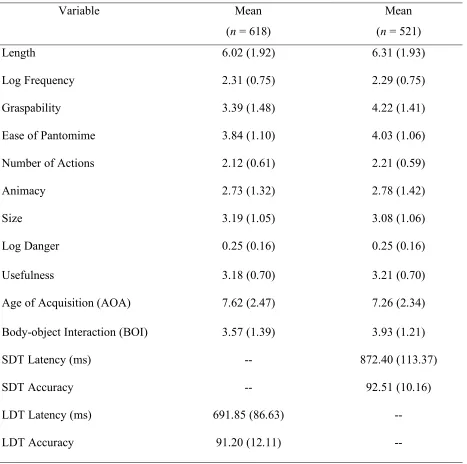
(AOA, Kuperman, Stadthagen-Gonzalez & Brysbaert, 2012). We included AOA because AOA has been previously shown to be related to BOI (Connell & Lynott, 2016). That is, high BOI words tend to be acquired earlier than low BOI words (Thill & Twomey, 2016). Descriptive characteristics for each of these variables are presented in Table 1. AOA ratings (Kuperman et
14
Table 1
Mean descriptive statistics (standard deviations in parentheses) for 618 stimuli included in BOI and LDT analyses and 521 stimuli included in SDT analyses
Variable Mean
(n = 618)
Mean (n = 521)
Length 6.02 (1.92) 6.31 (1.93)
Log Frequency 2.31 (0.75) 2.29 (0.75)
Graspability 3.39 (1.48) 4.22 (1.41)
Ease of Pantomime 3.84 (1.10) 4.03 (1.06)
Number of Actions 2.12 (0.61) 2.21 (0.59)
Animacy 2.73 (1.32) 2.78 (1.42)
Size 3.19 (1.05) 3.08 (1.06)
Log Danger 0.25 (0.16) 0.25 (0.16)
Usefulness 3.18 (0.70) 3.21 (0.70)
Age of Acquisition (AOA) 7.62 (2.47) 7.26 (2.34)
Body-object Interaction (BOI) 3.57 (1.39) 3.93 (1.21)
SDT Latency (ms) -- 872.40 (113.37)
SDT Accuracy -- 92.51 (10.16)
LDT Latency (ms) 691.85 (86.63) --
LDT Accuracy 91.20 (12.11) --
15
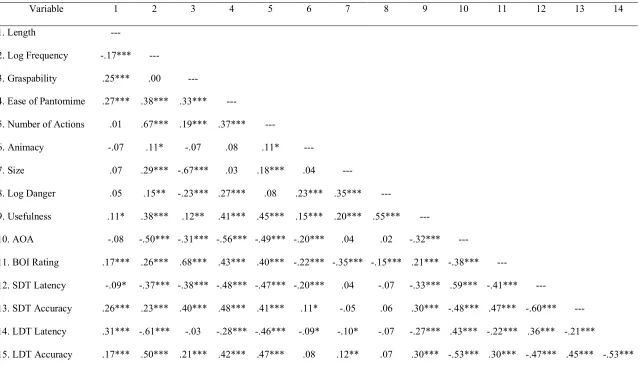
Correlations between all variables are presented in Table 2. The semantic dimension most highly correlated with BOI ratings was graspability. In addition, the correlation between
16
Table 2
Correlations between predictor variables and dependent measures
Variable 1 2 3 4 5 6 7 8 9 10 11 12 13 14
1. Length ---
2. Log Frequency -.17*** ---
3. Graspability .25*** .00 ---
4. Ease of Pantomime .27*** .38*** .33*** ---
5. Number of Actions .01 .67*** .19*** .37*** ---
6. Animacy -.07 .11* -.07 .08 .11* ---
7. Size .07 .29*** -.67*** .03 .18*** .04 ---
8. Log Danger .05 .15** -.23*** .27*** .08 .23*** .35*** ---
9. Usefulness .11* .38*** .12** .41*** .45*** .15*** .20*** .55*** ---
10. AOA -.08 -.50*** -.31*** -.56*** -.49*** -.20*** .04 .02 -.32*** ---
11. BOI Rating .17*** .26*** .68*** .43*** .40*** -.22*** -.35*** -.15*** .21*** -.38*** ---
12. SDT Latency -.09* -.37*** -.38*** -.48*** -.47*** -.20*** .04 -.07 -.33*** .59*** -.41*** ---
13. SDT Accuracy .26*** .23*** .40*** .48*** .41*** .11* -.05 .06 .30*** -.48*** .47*** -.60*** --- 14. LDT Latency .31*** -.61*** -.03 -.28*** -.46*** -.09* -.10* -.07 -.27*** .43*** -.22*** .36*** -.21***
17
Hierarchical Regression Analyses
Regression 1: BOI Ratings. Control variables were entered in step 1 and semantic
dimensions were entered in step 2 of a hierarchical regression with BOI ratings as the dependent
variable. Results of the regression analysis are presented in Table 3. Both length and frequency
were significant predictors of BOI ratings, with higher BOI ratings for longer, more frequent
words. Together, the semantic dimensions accounted for a significant amount of variance in BOI
ratings. Significant, unique relationships were observed for graspability, ease of pantomime,
number of actions, and animacy. That is, BOI ratings were higher for words with referents that
are easier to grasp, easier to pantomime, afford more actions, and are less animate. Relationships
18
Table 3
Regression coefficients from item-level regression analyses for BOI ratings
Variable B SEB β R2 Δ R2
Step 1 (Control variables) .16*** .16***
Length 0.27 0.03 .37***
Log Frequency 0.42 0.07 .23***
Step 2 (Semantic variables) .69*** .53***
Graspability 0.48 0.04 .51***
Ease of Pantomime 0.24 0.04 .19***
Number of Actions 0.64 0.08 .28***
Animacy -0.17 0.03 -.16***
Size -0.08 0.05 -.06
Log Danger -0.23 0.27 -.03
Usefulness -0.04 0.06 -.02
AOA -0.01 0.02 -.03
* p < .05; ** p < .01; *** p < .001
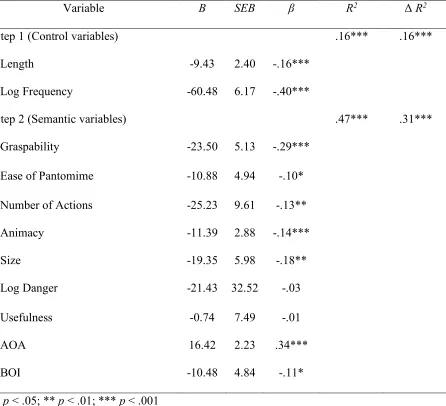
Regression 2: SDT Response Latencies. Lexical control variables were entered in step 1
and semantic dimensions in step 2 of a hierarchical regression analysis with SDT response
latencies as the dependent variable. The regression results are presented in Table 4. Both length
and frequency were significant predictor of SDT response latencies, with faster latencies for
19
additional variance. Significant relationships were observed for graspability, ease of pantomime,
number of actions, animacy, size, AOA, and BOI. More specifically, SDT latencies were faster
for words with referents that are easier to grasp, easier to pantomime, afford more actions, are
more animate, larger in size, acquired earlier in life, and high in body-object interaction. The
20
Table 4
Regression coefficients from item-level regression analyses for SDT latencies
Variable B SEB β R2 Δ R2
Step 1 (Control variables) .16*** .16***
Length -9.43 2.40 -.16***
Log Frequency -60.48 6.17 -.40***
Step 2 (Semantic variables) .47*** .31***
Graspability -23.50 5.13 -.29***
Ease of Pantomime -10.88 4.94 -.10*
Number of Actions -25.23 9.61 -.13**
Animacy -11.39 2.88 -.14***
Size -19.35 5.98 -.18**
Log Danger -21.43 32.52 -.03
Usefulness -0.74 7.49 -.01
AOA 16.42 2.23 .34***
BOI -10.48 4.84 -.11*
* p < .05; ** p < .01; *** p < .001
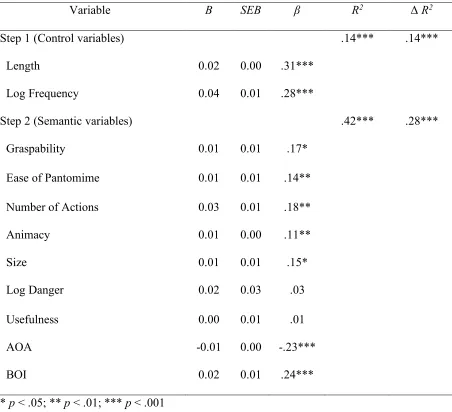
Regression 3: SDT Accuracy. Control variables were entered in step 1 and semantic
dimensions in step 2 of a hierarchical regression analysis with SDT response accuracies as the
dependent variable. The regression results are presented in Table 5. Both length and frequency
21
frequent words. The semantic dimensions predicted a significant amount of additional variance.
Significant relationships were observed for graspability, ease of pantomime, number of actions,
animacy, size, AOA, and BOI. That is, SDT responses were more accurate for words with
referents that are easier to grasp, easier to pantomime, afford more actions, are more animate, are
larger in size, acquired earlier in life, and have higher body-object interaction. The relationships
between SDT accuracy and danger and usefulness were not significant.
For both SDT response latencies and accuracy, parallel analyses were also conducted on
trial-level data using a linear mixed effects approach. These analyses yielded comparable results
to our hierarchical regressions. That is, the same significant relationships observed in the
22
Table 5
Regression coefficients from item-level regression analyses for SDT accuracy
Variable B SEB β R2 Δ R2
Step 1 (Control variables) .14*** .14***
Length 0.02 0.00 .31***
Log Frequency 0.04 0.01 .28***
Step 2 (Semantic variables) .42*** .28***
Graspability 0.01 0.01 .17*
Ease of Pantomime 0.01 0.01 .14**
Number of Actions 0.03 0.01 .18**
Animacy 0.01 0.00 .11**
Size 0.01 0.01 .15*
Log Danger 0.02 0.03 .03
Usefulness 0.00 0.01 .01
AOA -0.01 0.00 -.23***
BOI 0.02 0.01 .24***
* p < .05; ** p < .01; *** p < .001
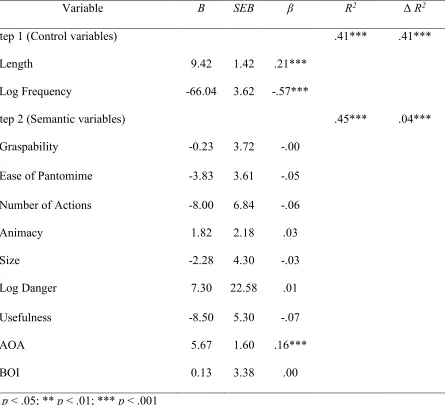
Regression 4: LDTResponse Latencies. Lexical control variables were entered in step 1
and semantic dimensions in step 2 of a hierarchical regression analysis with LDT response
latencies as the dependent variable. The regression results are presented in Table 6. Both length
23
shorter, more frequent words. The semantic dimensions predicted a significant amount of
additional variance although, as expected, much less than they explained in the analysis of SDT
latencies. A significant relationship was observed only for AOA, in that LDT latencies were
faster for words that are acquired earlier in life. The relationships between LDT latencies and
graspability, ease of pantomime, number of actions, animacy, size, danger, usefulness, and BOI
24
Table 6
Regression coefficients from item-level regression analyses for LDT latencies
Variable B SEB β R2 Δ R2
Step 1 (Control variables) .41*** .41***
Length 9.42 1.42 .21***
Log Frequency -66.04 3.62 -.57***
Step 2 (Semantic variables) .45*** .04***
Graspability -0.23 3.72 -.00
Ease of Pantomime -3.83 3.61 -.05
Number of Actions -8.00 6.84 -.06
Animacy 1.82 2.18 .03
Size -2.28 4.30 -.03
Log Danger 7.30 22.58 .01
Usefulness -8.50 5.30 -.07
AOA 5.67 1.60 .16***
BOI 0.13 3.38 .00
* p < .05; ** p < .01; *** p < .001
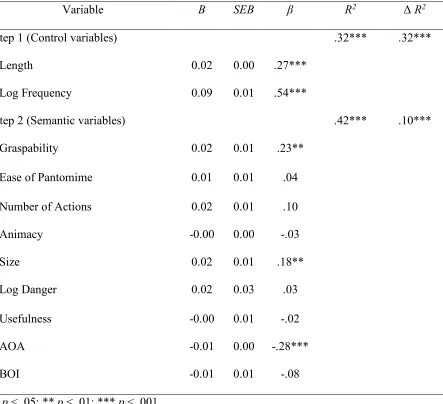
Regression 5: LDT Accuracy. Control variables were entered in step 1 and semantic
dimensions in step 2 of a hierarchical regression analysis with LDT response accuracies as the
dependent variable. The regression results are presented in Table 7. Both length and frequency
25
frequent words. The semantic dimensions predicted a significant amount of additional variance.
Significant relationships were observed for graspability, size, and AOA. That is, LDT responses
were more accurate for words with referents that are easier to grasp, larger, and acquired earlier
in life. The relationships between LDT accuracy and pantomime, number of actions, animacy,
[image:25.612.79.522.305.709.2]danger, usefulness, and BOI were not significant.
Table 7
Regression coefficients from item-level regression analyses for LDT accuracy
Variable B SEB β R2 Δ R2
Step 1 (Control variables) .32*** .32***
Length 0.02 0.00 .27***
Log Frequency 0.09 0.01 .54***
Step 2 (Semantic variables) .42*** .10***
Graspability 0.02 0.01 .23**
Ease of Pantomime 0.01 0.01 .04
Number of Actions 0.02 0.01 .10
Animacy -0.00 0.00 -.03
Size 0.02 0.01 .18**
Log Danger 0.02 0.03 .03
Usefulness -0.00 0.01 -.02
AOA -0.01 0.00 -.28***
BOI -0.01 0.01 -.08
26
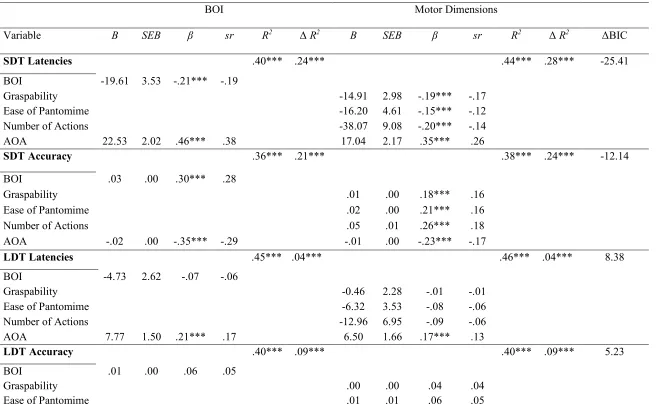
Regression 6: Comparative Analyses. We conducted one final set of analyses to compare
the amount of variance in SDT and LDT behavioural performance explained by BOI with that
explained by our three candidate motor dimensions (graspability, ease of pantomime, number of
actions). Again, we entered lexical factors on step 1 of these analyses, and then entered BOI or
the three candidate motor dimensions on step 2 of the analyses, along with AOA. We also
calculated BIC values (Wagenmakers, 2007) in order to compare the effectiveness of the models
containing the two different sets of predictors, for each dependent variable. The results of these
analyses are presented in Table 8, with results for analyses of SDT latencies, SDT accuracy,
LDT latencies, and LDT accuracy presented separately. BIC analyses show that for SDT
latencies and accuracy, the models with the candidate motor dimensions together were more
effective than the models with BOI. In contrast, for LDT latencies and accuracy, the models with
27
Table 8
Regression coefficients from item-level regression analyses comparing variance explained by BOI vs Motor Dimensions
BOI Motor Dimensions
Variable B SEB β sr R2 Δ R2 B SEB β sr R2 Δ R2 ΔBIC
SDT Latencies .40*** .24*** .44*** .28*** -25.41
BOI -19.61 3.53 -.21*** -.19
Graspability -14.91 2.98 -.19*** -.17
Ease of Pantomime -16.20 4.61 -.15*** -.12
Number of Actions -38.07 9.08 -.20*** -.14
AOA 22.53 2.02 .46*** .38 17.04 2.17 .35*** .26
SDT Accuracy .36*** .21*** .38*** .24*** -12.14
BOI .03 .00 .30*** .28
Graspability .01 .00 .18*** .16
Ease of Pantomime .02 .00 .21*** .16
Number of Actions .05 .01 .26*** .18
AOA -.02 .00 -.35*** -.29 -.01 .00 -.23*** -.17
LDT Latencies .45*** .04*** .46*** .04*** 8.38
BOI -4.73 2.62 -.07 -.06
Graspability -0.46 2.28 -.01 -.01
Ease of Pantomime -6.32 3.53 -.08 -.06
Number of Actions -12.96 6.95 -.09 -.06
AOA 7.77 1.50 .21*** .17 6.50 1.66 .17*** .13
LDT Accuracy .40*** .09*** .40*** .09*** 5.23
BOI .01 .00 .06 .05
Graspability .00 .00 .04 .04
28
Number of Actions .02 .01 .11* .08
AOA -.02 .00 -.32*** -.26 -.01 .00 -.28*** -.20
* p < .05; ** p < .01; *** p < .001
29
Discussion
The goal of the present study was to investigate which aspects of motor experience drive
BOI effects in lexical-semantic processing. To do so, we collected ratings for 621 words on
seven semantic dimensions, including three motor attributes (graspability, ease of pantomime,
number of actions) and four other non-motor dimensions that we thought might be related to BOI
(animacy, size, danger, usefulness). We found that the semantic dimension ratings collected in
the present study could explain a considerable amount (53%) of the variance in the BOI ratings
that were collected in previous studies (Bennett et al., 2011; Tillotson et al., 2008). Thus, the
present findings offer some insights about factors that are related to BOI ratings. Graspability
was the most significant predictor of BOI ratings, with high BOI concepts tending to be easier to
grasp. This is presumably because upper-limb interactions are important to human motor
behaviour and thus to the relative ease of our interactions with objects. Whereas graspability is
based only on interactions of the hands with objects, BOI may also include interactions with
other body parts. For instance, interactions of the feet with objects are likely important, as
indicated by the moderately high BOI ratings for foot-related words like stair (5.23) and step
(4.6). In addition, it seems likely that a more general bodily sense like that described by Borghi
and Cimatti (2010) is also relevant. That is, a proprioceptive sense, involving an awareness of the
body in place and time, may be part of what participants consider when they provide ratings of
BOI. This might explain why words like fire and shower, which afford few opportunities for
grasping, nonetheless receive moderate BOI ratings (4.27 and 4.33).
The seven semantic variables together explained a substantial amount of variance in SDT
30
semantic processing, whereas LDT responses rely more heavily on lexical and orthographic
processing (e.g., Pexman & Yap, in press; Taikh, Hargreaves, Yap, & Pexman, 2014; Yap et al.,
2012). Indeed, the lexical control variables (length and frequency) explained considerably more
variance in LDT performance than in SDT performance. Of the seven semantic variables,
graspability was one of the two most consistent semantic predictors of lexical-semantic
processing, as high graspability was associated with faster and more accurate SDT responses,
and with more accurate LDT responses. The other consistent semantic predictor was size, but in
a way that suggests it works in opposition to BOI. The zero-order correlations (Table 2) show
that, as expected, size was negatively related to BOI. Words that refer to small objects tend to
have higher BOI ratings. The analyses of lexical-semantic processing, however, showed that
words that refer to large objects have faster and more accurate SDT responses, and more
accurate LDT responses. These facilitory effects of referent object size are consistent with those
reported by Sereno et al. (2009; cf. Kang et al., 2011). Sereno et al. attributed size effects to
faster retrieval of visual representations for large objects than for small objects, and took such
effects as evidence that sensorimotor information is automatically accessed when reading a
word.
Similarly, the patterns observed for the animacy variable suggest that its effects also work
in opposition to those of BOI. As expected, animacy was negatively related to BOI ratings, such
that more animate objects tended to have lower BOI ratings; many animate objects (e.g., tiger,
rhinoceros) do not afford easy interaction. In lexical-semantic processing, however, animacy
facilitated responses: in SDT, responses were faster and more accurate for words referring to
more animate objects. The present finding of an animacy effect in SDT extends the effects
31
memory (e.g., Bonin et al., 2014). Animacy effects have been attributed to the survival
advantage for these concepts (e.g., Nairne, 2010), in that animate objects play an important role
in human survival, as both predators and prey. Thus, while size and animacy are related to BOI
ratings, they are likely not drivers of the facilitory BOI effect observed in lexical-semantic
processing.
Instead, our results suggest that, from among the variables we measured in the present
study, the three motor dimensions are the most likely drivers of BOI effects in lexical-semantic
processing. Further, the comparative analyses showed that these three variables are more
effective than BOI at explaining variance in SDT, and somewhat less effective at explaining
variance in LDT responses. We speculate that the candidate motor dimensions are particularly
effective predictors in SDT because the concrete/abstract decision depends on extensive
semantic processing and a strategy of focusing on tactile and tangible features (Hargreaves,
White, Pexman, Pittman, & Goodyear, 2012). Specific dimensions of motor information better
predict this more specific semantic processing in SDT. In contrast, in LDT the focus is largely on
orthographic processing and while semantic processing is relevant it is less extensive and less
specific. The single predictor of BOI is effective in that case.
Depending on their goals, researchers may want to use these more specific motor
dimensions rather than BOI to examine whether particular aspects of motor information are
accessed in language or cognitive tasks. For instance, in past research less-specific measures of
motor-related attributes of functionality and manipulability have been examined and found to
influence a variety of cognitive domains, including memory, attention, and semantic processing
(e.g., Creem & Proffitt, 2001; Hauk, Johnsrude, & Pulvermüller, 2004; Just, Cherkassky, Aryal,
32
eld, & Mammarella, 2012; Shebani & Pulvermüller, 2013). The ratings collected in the present
study offer researchers the opportunity to investigate the contributions of motor information in a
more fine-grained way, helping advance our understanding of the role that motor information
plays in human cognition.
33
Acknowledgements
This work was supported by the Natural Sciences and Engineering Research Council of
Canada (NSERC), through a CREATE Scholarship to A. Heard, and Discovery Grants to A.
34
References
Amsel, B. D., Urbach, T. P., & Kutas, M. (2012). Perceptual and motor attribute ratings for 559
object concepts. Behavior Research Methods, 44, 1028-1041.
Balota, D. A., Yap, M. J., Cortese, M. J., Hutchison, K. A., Kessler, B., Loftis, B., Neely, J. H.,
Nelson, D. L., Simpson, G. B., & Treiman, R. (2007). The English Lexicon Project.
Behavior Research Methods, 39, 445-459.
Barsalou, L. W. (2008). Grounded cognition. Annual Review of Psychology, 59, 617-645.
Bennett, S. D., Burnett, A. N., Siakaluk, P. D., & Pexman, P. M. (2011). Imageability and body–
object interaction ratings for 599 multisyllabic nouns. Behavior Research Methods, 43,
1100-1109.
Bonin, P., Gelin, M., & Bugaiska, A. (2014). Animates are better remembered than inanimates:
further evidence from word and picture stimuli. Memory & Cognition, 42, 370-382.
Borghi, A. M., & Cimatti, F. (2010). Embodied cognition and beyond: Acting and sensing the
body. Neuropsychologia, 48, 763-773.
Boronat, C. B., Buxbaum, L. J., Coslett, H. B., Tang, K., Saffran, E. M., Kimberg, D. Y., et al.
(2005). Distinctions between manipulation and function knowledge of objects: evidence
from functional magnetic resonance imaging. Cognitive Brain Research, 23, 361–373.
Brodeur, M. B., Dionne-Dostie, E., Montreuil, T., & Lepage, M. (2010). The Bank of
Standardized Stimuli (BOSS), a new set of 480 normative photos of objects to be used as
visual stimuli in cognitive research. PLoS ONE, 5, e10773.
Brysbaert, M., & New, B. (2009). Moving beyond Kucera and Francis: A critical evaluation of
current word frequency norms and the introduction of a new and improved word
35
Connell, L., & Lynott, D. (2016). Embodied semantic effects in visual word recognition. In Y.
Coello, & M. Fischer (Eds.), Foundations of Embodied Cognition (Vol. 2): Conceptual
and Interactive Embodiment (pp. 71-92). Hove, UK: Psychology Press.
Creem, S. H., & Proffitt, D. R. (2001). Grasping objects by their handles: a necessary interaction
between cognition and action. Journal of Experimental Psychology: Human Perception
and Performance, 27, 218.
Díez-Álamo, A. M., Díez, E., Alonso, M. Á., Vargas, C. A., & Fernandez, A. (2017). Normative
ratings for perceptual and motor attributes of 750 object concepts in Spanish. Behavior
Research Methods, 1-13.
Garcea, F. E., & Mahon, B. Z. (2012). What is in a tool concept? Dissociating manipulation
knowledge from function knowledge. Memory & Cognition, 40, 1303-1313.
Glenberg, A. M. (2015). Few believe the world is flat: How embodiment is changing the
scientific understanding of cognition. Canadian Journal of Experimental Psychology, 69,
165-171.
Grèzes, J., & Decety, J. (2002). Does visual perception of object afford action? Evidence from a
neuroimaging study. Neuropsychologia, 40, 212-222
Guérard, K., Lagacé, S., & Brodeur, M. B. (2015). Four types of manipulability ratings and
naming latencies for a set of 560 photographs of objects. Behavior Research Methods, 47,
443-470.
Hansen, D., Siakaluk, P. D., & Pexman, P. M. (2012). The influence of print exposure on the
body-object interaction effect in visual word recognition. Frontiers in Human
36
Hauk, O., Johnsrude, I., & Pulvermüller, F. (2004). Somatotopic representation of action words
in human motor and premotor cortex. Neuron, 41, 301–307.
Hargreaves, I. S., Leonard, G. A., Pexman, P. M., Pittman, D. J., Siakaluk, P. D., & Goodyear,
B. G. (2012). The neural correlates of the body-object interaction effect in semantic
processing. Frontiers in Human Neuroscience, doi: 10.3389/fnhum.2012.00022.
Hargreaves, I. S., White, M., Pexman, P. M., Pittman, D., & Goodyear, B. G. (2012). The
question shapes the answer: The neural correlates of task differences reveal dynamic
semantic processing. Brain & Language, 120, 73-78.
Inkster, M., Wellsby, M., Lloyd, E., & Pexman, P. M. (2016). Development of embodied word
meanings: Sensorimotor effects in children’s lexical processing. Frontiers in
Psychology, doi: 10.3389/fpsyg.2016.00317.
Just, M. A., Cherkassky, V. L., Aryal, S., & Mitchell, T. M. (2010). The neurosemantic theory of
concrete noun representations based on the underlying brain codes. PLOS ONE, 5, e8622.
Kang, S. H. K., Yap, M. J., Tse, C.-S., & Kurby, C. A. (2011). Semantic size does not matter:
“Bigger” words are not recognized faster. Quarterly Journal of Experimental Psychology,
64, 1041-1047.
Kuperman, V., Stadthagen-Gonzalez, H., & Brysbaert, M. (2012). Age-of acquisition ratings for
30,000 English words. Behavior Research Methods, 44, 978–990.
Lagacé, S., Downing-Doucet, F., & Guérard, K. (2013). Norms for grip agreement for 296
photographs of objects. Behavior Research Methods, 45, 772-781.
Madan, C. R. (2014). Manipulability impairs association-memory: Revisiting effects of
37
Madan, C. R. (2017). Motivated cognition: Effects of reward, emotion, and other motivational
factors across a variety of cognitive domains. Collabra: Psychology, 3, 24.
Madan, C. R., Chen, Y. Y., & Singhal, A. (2016). ERPs differentially reflect automatic and
deliberate processing of the functional manipulability of objects. Frontiers in Human
Neuroscience, 10, 360.
Madan, C. R., Ng, A., & Singhal, A. (2018). Prototypical actions with objects are more easily
imagined than atypical actions. Journal of Cognitive Psychology, 30, 314-210.
Madan, C. R., & Singhal, A. (2012). Encoding the world around us: Motor-related processing
influences verbal memory. Consciousness and Cognition, 21, 1563-1570.
Magnié, M. N., Besson, M., Poncet, M., & Dolisi, C. (2003). The Snodgrass and Vanderwart set
revisited: Norms for object manipulability and for pictorial ambiguity of objects,
chimeric objects, and nonobjects. Journal of Clinical and Experimental
Neuropsychology, 25, 521–560.
Mahon, B. Z. (2015). The burden of embodied cognition. Canadian Journal of Experimental
Psychology, 69, 172-178.
Montefinese, M., Ambrosini, E., Fair eld, B., & Mammarella, N. (2013). The ‘subjective’ pupil
old/new effect: Is the truth plain to see? International Journal of Psychophysiology, 89,
48–56.
Nairne, J. S. (2010). Adaptive memory: Evolutionary constraints on remembering. In B. H. Ross
(Ed.), The psychology of learning and motivation (Vol. 53, pp. 1-32). Burlington, VT:
38
Pexman, P. M., Heard, A., Lloyd, E., & Yap, M. J. (2017). The Calgary semantic decision
project: concrete/abstract decision data for 10,000 English words. Behavior Research
Methods, 49, 407-417.
Pexman, P. M. (2012). Meaning based influences on visual word recognition. In J. S. Adelman
(Ed.), Visual word recognition, Vol 2. (pp. 24-43). New York, NY: Psychology Press.
Pexman, P. M., & Yap, M. J. (in press). Individual differences in semantic processing: Insights
from the Calgary semantic decision project. Journal of Experimental Psychology:
Learning, Memory, & Cognition.
Phillips, C. I., Sears, C. R., & Pexman, P. M. (2012). An embodied semantic processing effect on
eye gaze during sentence reading. Langage & Cognition,4, 99-114.
Proverbio, A. M., Del Zotto, M., & Zani, A. (2007). The emergence of semantic categorization
in early visual processing: ERP indices of animal vs. artifact recognition. BMC
Neuroscience, 8. doi: 10.1186/1471-2202-8-24.
Salmon, J. P., Matheson, H. E., & McMullen, P. A. (2014). Slow categorization but fast naming
for photographs of manipulable objects. Visual Cognition, 22, 141-172.
Salmon, J. P., McMullen, P. A., & Filliter, J. H. (2010). Norms for two types of manipulability
(graspability and functional usage), familiarity, and age of acquisition for 320
photographs of objects. Behavior Research Methods, 42, 82-95.
Sereno, S. C., O’Donnell, P. J., Sereno, M. E. (2009). Size matters: Bigger is faster. The
Quarterly Journal of Experimental Psychology, 62, 1115-1122.
Shebani, Z., & Pulvermüller, F. (2013). Moving the hands and feet specifically impairs working
39
Siakaluk, P. D., Pexman, P. M., Aguilera, L., Owen, W. J., & Sears, C. R. (2008a). Evidence for
the activation of sensorimotor information during visual word recognition: The body–
object interaction effect. Cognition, 106, 433-443.
Siakaluk, P. D., Pexman, P. M., Sears, C. R., Wilson, K., Locheed, K., & Owen, W. J. (2008b).
The benefits of sensorimotor knowledge: Body–object interaction facilitates semantic
processing. Cognitive Science, 32, 591-605.
Taikh, A., Hargreaves, I. S., Yap, M., & Pexman, P. M. (2014). Semantic classification of
pictures and words. Quarterly Journal of Experimental Psychology, 68, 1502-1518.
Thill, S., & Twomey, K. E. (2012). What’s on the inside counts: A grounded account of concept
acquisition and development. Frontiers in Psychology. doi: 10.3389/fpsyg.2016.00402
Tillotson, S. M., Siakaluk, P. D., & Pexman, P. M. (2008). Body-object interaction ratings for
1,618 monosyllabic nouns. Behavior Research Methods, 40, 1075-1078.
Tobia, M. J., & Madan, C. R. (2017). Tool selection and the ventral-dorsal organization of
tool-related knowledge. Physiological Reports, 5, e13078.
Tousignant, C., & Pexman, P. M. (2012). Flexible recruitment of semantic richness: Context
modulates body-object interaction effects in lexical-semantic processing. Frontiers in
Human Neuroscience, doi: 10.3389/fnhum.2012.0053
Van Havermaet, L. R., & Wurm, L. H. (2014). Semantic effects in word recognition are
moderated by body-object interaction. The Mental Lexicon, 9, 1-22.
Van Havermaet, L. R., & Wurm, L. H. (2017). Effects of Danger, Usefulness, and Body-Object
Interaction in picture naming. The Mental Lexicon, 12, 51-70.
Wagenmakers, E.-J. (2007). A practical solution to the pervasive problem of p-values.
40
Wellsby, M., & Pexman, P. M. (2014). The influence of bodily experience on children's
language processing. Topics in Cognitive Science, 6, 425-441.
Wurm, L. H. (2007). Danger and usefulness: An alternative framework for understanding rapid
evaluation effects in perception? Psychonomic Bulletin & Review, 14, 1218-1225.
Wurm, L. H., & Seaman, S. R. (2008). Semantic effects in naming and perceptual identification,
but not in delayed naming: Implications for models and tasks. Journal of Experimental
Psychology: Learning, Memory, and Cognition, 34, 381–398.
Yap, M. J., Pexman, P. M., Wellsby, M., Hargreaves, I. S., & Huff, M. J. (2012). An abundance
of riches: Cross-task comparisons of semantic richness effects in visual word
41
Appendix
Written Instructions for the Graspability Rating Task
The referents that words refer to vary in terms of how graspable they are. Something that is graspable can be grasped using one hand whereas something that is not graspable cannot.
In this study your task is to rate each word’s referent based on how graspable it is. Ratings will be made on a scale from 1 to 7. Any referent you believe not graspable should be rated as a 1 and any referent you believe to be very graspable should be rated a 7.
For example, the word ‘beach’ should be rated as a 1 since its referent cannot be grasped with one hand whereas the word ‘scissors’ should be rated as a 7 since its referent can easily be grasped with one hand.
When rating a referent, try to be as accurate as possible, but do not spend too much time on it.
1 2 3 4 5 6 7
Not Graspable Very Graspable
Written Instructions for the Ease of Pantomime Rating Task
Objects differ in the extent to which a person can think of an action involving that object. For some objects it is easier to think of an action than for others. The purpose of the present
experiment is to rate words regarding how easily a person could pantomime or act out the use of their referent (what the word is referring to).
In this case a pantomime is defined as a concept that can be expressed with a few simple
gestures. For example, interactions with a “hammer” are probably quite easy to pantomime (eg. a downward swinging gesture). It is more difficult to pantomime interactions with a “ceiling”.
Any referent that is easy to pantomime should be given a high rating. Any referent that is
difficult to pantomime should be given a low rating. Your ratings will be made on a 1 to 7 scale, a value of 1 indicates that you think the referent is very difficult to pantomime and a value of 7 indicating that the referent is very easy to pantomime. Values of 2 to 6 indicate intermediate ratings. Click on the most appropriate value for each referent. When rating a referent, try to be as accurate as possible, but do not spend too much time on it.
1 2 3 4 5 6 7
Very difficult Very Easy
to Pantomime to Pantomime
42
Some objects can be used to perform multiple actions (e.g., a dog can be pet, brushed, hugged, etc.) while other objects can only be used for one particular action (e.g., chopsticks can be used for picking up food). For each word, your task is to estimate the number of actions that you can typically perform with the word’s referent (what the word refers to). For each object, click on the value corresponding to the number of possible actions.
For example, “scissors” would probably have one action as it would typically be used to cut whereas “ball” would likely have multiple actions as it can be thrown, caught, kicked, etc.
*please note: although it may be possible to use the word’s referent for other actions (eg. using a screwdriver to hammer a nail) we ask that you rate the referent on the number of actions it would typically be used for.
Your ratings will be made on a 0 to 6+ scale. Any referent with 6 or more associated actions should be rated a 6+. When rating a referent, try to be as accurate as possible, but do not spend too much time on it.
0 1 2 3 4 5 6+
No Action Many
Written Instructions for the Animacy Rating Task
The referents that words refer to vary in terms of whether they are animate or inanimate. An animate thing is something that is living and capable of self-propelled motion whereas an inanimate thing is something that is nonliving and incapable of self-propelled motion.
In this study your task is to rate the animacy of the word’s referent. Ratings will be made on a scale from 1 to 7. Any referent you believe is completely inanimate should be rated a 1 and any referent you believe to be completely animate should be rated a 7.
For example, the word ‘wall’ should be rated as a 1 since its referent is completely inanimate whereas the word ‘rabbit’ should be rated as a 7 since its referent is completely animate.
When rating a referent, try to be as accurate as possible, but do not spend too much time on it.
1 2 3 4 5 6 7
Inanimate Animate
Written Instructions for the Size Rating Task
43
Any referent you believe is very small should be rated a 1 and any referent you believe to be very large should be rated a 7.
For example, the word ‘pin’ should be rated as a 1 since its referent is very small whereas the word ‘Earth’ should be rated as a 7 since its referent is very large.
When rating a referent, try to be as accurate as possible, but do not spend too much time on it.
1 2 3 4 5 6 7
Small Large
Written Instructions for the Danger Rating Task
We would like you to rate how dangerous for human survival you think each word’s referent is.
Your ratings will be made on a 1 to 7 scale, a value of 1 indicating that the referent is not at all dangerous to human survival and a value of 7 indicating that the referent is extremely dangerous for human survival. Values of 2 to 6 indicate intermediate ratings.
For example, the word ‘thief’ may be rated highly whereas the word ‘grape’ may be rated low.
There are no right or wrong answers -- it's up to you to decide. There are quite a few words, so don't spend a lot of time on each one. Just go with your first judgment.
A number line will appear on-screen for you to use in making your rating. Please use the rating options displayed below the word to indicate your choice.
1 2 3 4 5 6 7
Not at all Dangerous Very Dangerous
for human survival for human survival
Written Instructions for the Usefulness Rating Task
We would like you to rate how useful for human survival you think each word’s referent is.
Your ratings will be made on a 1 to 7 scale, a value of 1 indicating that the referent is not at all useful to human survival and a value of 7 indicating that the referent is extremely useful for human survival. Values of 2 to 6 indicate intermediate ratings.
44
There are no right or wrong answers -- it's up to you to decide. There are quite a few words, so don't spend a lot of time on each one. Just go with your first judgment.
A number line will appear on-screen for you to use in making your rating. Please use the rating options displayed below the word to indicate your choice.
1 2 3 4 5 6 7
Not at all Useful Very Useful