“I hereby declare that I have read through this report entitle “Fruit Sorting By Machine Vision Technique” and found that it has comply the partial fulfilment for awarding the degree of Bachelor of Mechatronics Engineering.
Signature : ...
Supervisor’s Name : ...
FRUIT SORTING BY MACHINE VISION TECHNIQUE
KHOR CHIN WE
A report submitted in partial fulfilment of the requirements for the degree of Bachelor of Mechatronics Engineering
Faculty of Electrical Engineering
UNIVERSITI TEKNIKAL MALAYSIA MELAKA
iii
I declare that this report entitle “Fruit Sorting By Machine Vision Technique” is the result of my own research except as cited in the references. The report has not been accepted for any degree and is not concurrently submitted in candidature of any other degree.
Signature : ...
Name : ...
Date : ... KHOR CHIN WE
iv
v
ACKNOWLEDGEMENT
First, I would like to thank to my supervisor, Pn. Nursabillilah Mohd Ali who accept me as her FYP student to carry out her research with the title of ‘Fruit Sorting by Machine Vision’. Pn. Nursabillilah gives me a lot of valuable advices and guides me throughout the whole semester. Without her guidance and persistent help, I would not be able to complete this Final Year Project Report 1 and Final Year Project Report 2.
vi
ABSTRACT
vii
ABSTRAK
viii
TABLE OF CONTENTS
CHAPTER TITLE PAGE
ACKNOWLEDGEMENT v
ABSTRACT vi
ABSTRAK vii
TABLE OF CONTENTS viii
LIST OF TABLES xi
LIST OF FIGURES xii
LIST OF APPENDICES xv
1 INTRODUCTION 1
1.1 Introduction 1
1.2 Motivation 2
1.3 Problem Statement 4
1.4 Objectives 5
1.5 Scopes 5
1.6 Thesis Organization 6
2 LITERATURE REVIEW 7
2.1 Fruit Sorting and Grading System 7
2.2 Background of Machine Vision 8
2.3 Components of Machine Vision System 9
ix
2.3.2 Frame Grabber 10
2.3.3 Software - MATLAB 11
2.3.4 Cameras 11
2.3.5 Image Processing 12
2.3.6 Example of Image Processing Algorithm 18 2.4 Summary of Image Processing Technique 23
3 METHODOLOGY 24
3.1 Description of Research Project 25
3.2 Description of Fruit Sorting System Flow 27
3.3 Component Used 29
3.3.1 Digital Camera 29
3.3.2 Microcontroller (Arduino UNO) 30
3.3.3 DC Gear Motor (SPG30) 31
3.3.4 Single Channel 5V Relay 32
3.3.5 Light Bulb 33
3.4 Materials Used 34
3.4.1 Apples 34
3.5 Prototype of Fruit Sorting System 34
3.6 Analysis Tools 36
3.6.1 MATLAB 36
3.7 Experiment Setup 37
3.7.1 Experiment 1:Comparison of HSV 37 3.7.2 Experiment 2:Thresholding Value Comparison 38 3.7.3 Experiment 3:Distance of Camera 40
4 RESULT AND DISCUSSION 41
x
4.1.1 Precision Analysis 41
4.1.2 Performance Evaluation 45
4.1.3 Hue Tolerance Setting 46
4.2 Experiment 2: Thresholding Value Comparison 50 4.2.1 Image Thresholding Analysis 50
4.2.2 Performance Evaluation 52
4.3 Experiment 3: Comparison of Distance of Camera 55 4.3.1 Number of Pixels Tolerance Setting 55
4.3.2 Performance Evaluation 61
5 CONCLUSION AND RECOMMENDATION 62
5.1 Conclusion 62
5.2 Recommendation 63
REFERENCES 64
xi
LIST OF TABLES
TABLE TITLE PAGE
2.1 Characteristics of CCD and CMOS Cameras [19] 12
2.2 Summary of Image Processing Technique 23
3.1 Properties of Labeled Regions [46] 31
4.1 Results in different TH value 51
4.2 Detectability (Red Apple) in different TH value 52
xii
LIST OF FIGURES
FIGURE TITLE PAGE
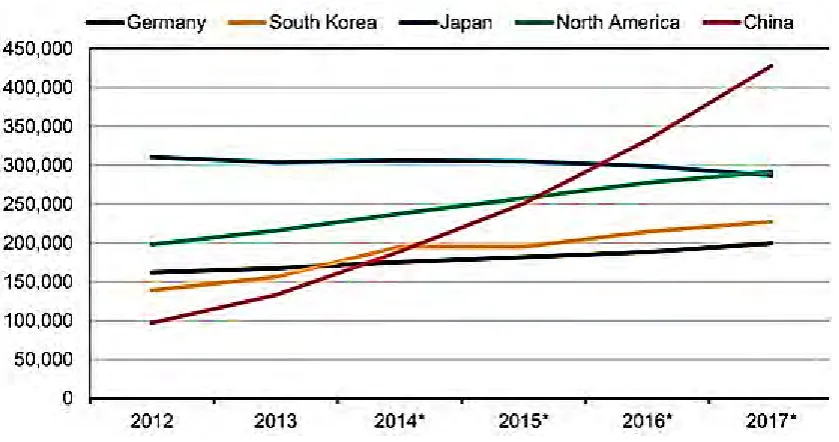
1.1 The number of robots in use in the five largest global markets, projected to 2017 [3]
2
1.2 The efficiency of implementing manual facilities and automated facilities [4]
3
2.1 Automated fruit sorting and grading system [16] 10
2.2 Image Processing Main Steps [5] 12
2.3 Brightness matrix adjustment [19] 13
2.4 Contrast matrix adjustment [19] 14
2.5 Cropping Image in matrix mode [19] 15
2.6 Image Zooming in matrix mode [19] 15
2.7 Rotation of Image in matrix mode [19] 16
2.8 Image Dilation in matrix mode [19] 17
2.9 Image Erosion in matrix mode [19] 17
2.10 Image captured from mobile device is converted into L*a*b 18 2.11 Typical segmentation techniques (a) Thresholding, (b) edge-based
segmentation and (c) region based segmentation [5] age
19
2.12 Standard deviation measurement superimposed on each object in the im
19
2.13 Pipeline of detection algorithm [14] 20
xiii
2.15 Block diagram of thresholding process [5] 22
3.1 Research project flow chart 26
3.2 Fruit Sorting System flow chart 28
3.3 CMOS Camera 29
3.4 Arduino UNO 30
3.5 DC Gear Motor 31
3.6 Single Channel 5V Relay 32
3.7 Fluorescent light bulbs 33
3.8 Incandescent light bulbs 33
3.9 Type of apples 34
3.10 Conveyer belt 35
3.11 Inspection box 35
3.12 Assembled prototype 35
3.13 MATLAB Computer Software 36
3.14 Experiment setup 37
3.15 Installation of light bulb 38
3.16 Tracking process 39
3.17 Distance variation 40
4.1 HSV color space in a conical object 42
4.2 Low precision (left) and high precision (high) 43
4.3 Standard deviation in different illuminations 44
4.4 Overall performance in different illuminations 45
4.5 Control limit of hue value (Red) 46
4.6 Control limit of hue value (Green) 47
4.7 Rotten and yellowish red apples 48
xiv
4.9 Red and Green apples hue value region 51
4.10 Accuracy of red apple detection 54
4.11 Accuracy of green apple detection 54
xv
LIST OF APPENDICES
APPENDIX TITLE PAGE
A Program code 69
B Gantt chart for FYP1 and FYP2 73
C Table of Result 74
1
CHAPTER 1
1. INTRODUCTION
This chapter review the introduction of automation fruit sorting system. The motivation, problem statement, objective and scope about this research project are discussed in this chapter. Besides, the thesis organization is descripted at the last part of this chapter.
1.1 Introduction
2
1.2 Motivation
Manpower contributed by labour is flexible and fast. Meanwhile, machine vision is type of automatic system which is dependable and precise. Many manufacturing industries have tried to implement the automated system to reduce the use of manpower.
[image:17.595.72.492.386.607.2]The Figure 1.1 shows the number of robots in use in the five largest global markets. From the graph, the demand of robots from 4 countries except Japan shows the trend of increase from year 2012 to 2017. According to the German-based International Federation of Robotics, China is already the world’s largest market for industrial robots [3]. These trends will keep increasing in the next few years. Hence, the trend obviously indicate that automatic fruit sorting method is more preferable choice for fruit industrial compared to manual sorting method.
3
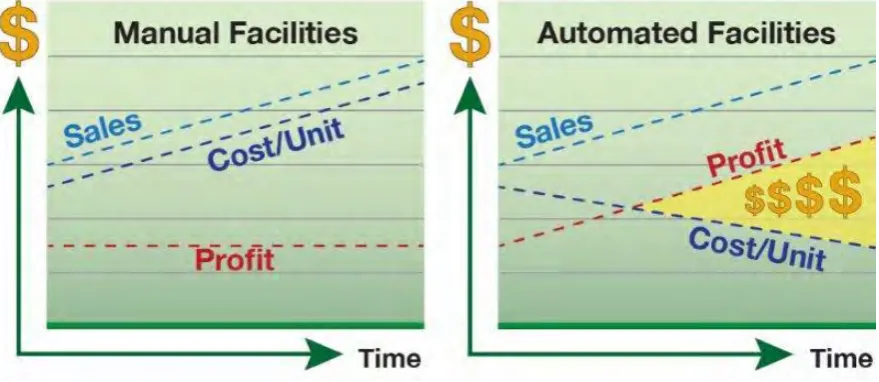
[image:18.595.73.513.217.408.2]The Figure 1.2 represents the differences in term of profit, cost, and sales between manual operating system and automated system. The sales of both systems are the same but the operating cost of automated system decrease drastically while the profit increases by time. The trends clearly indicate that most of the industries choose automation system rather that manual system.
Figure 1.2: The efficiency of implementing manual facilities and automated facilities [4]
The reason of using machine vision system that can be able to increase the profit is high productivity. However, some industries hire more labours in order to seek and achieve higher productivity but normally manual fruit sorting causes unwanted problems that may directly influence the production result. Hence, training is basically to be provided for labours in order to produce skillful, experience and quality worker but high investment cost on labours will highly reduce a company profit.
4
Besides, the visual results generally are highly dependent on labours mental and physical fitness. Humans are not able to have fully concentration while making many decisions within a certain time. Human decisions are variable and difficult to be standardized. In addition, the task of visualizing fruit is quite tedious. It probably causes the problems of difficulty to hire workers and labours turnover. Therefore, fruit sorting by using the technique of machine vision is recommended system to be implemented.
1.3 Problem Statement
Machine vision technology is highly used in factory automation. It is a system that camera captures products’ picture and interprets them to find defects and categorize them. Nowadays, camera has become common in our life. Camera has been transformed from analogue to digital camera and even the mobile phone has the function of high quality camera. Thus, with this huge change of camera, it has become a selective device to detect object or feature.
There are thousand types of camera in the market. Different cameras have different image processing quality. Camera quality is a constraint that should be considered in machine vision system. Normally, high Mega-Pixels of camera will cause a challenge in having too much information. In real system operating time, high resolution camera will cause unacceptable processing time [5]. Large image sizes require longer time to compute and collect data from camera. Thus, selecting an appropriate type of camera based on the requirement is able to improve a vision system in term of efficiency.
Besides, another problem should be overcome is the illumination conditions that surround the camera. The colour detection and ability to distinguish an object are can be affected by the surrounding environment [5]. The surrounding lighting condition should be standardized in order to get precise analysis result. In addition, reflection of light on an object causes analysis errors during image processing.
5
error and random error from happening. Thus, the result consistency is highly maintained with a good design of image processing algorithm.
1.4 Objectives
The objectives of the research project are:
1. To design and develop an algorithm for fruit classification based on size and colour. 2. To evaluate the system performance for fruit sorting and classification in term of
accuracy and precision.
3. To optimize the system performance by manipulating the illumination, thresholding value and distance of camera.
1.5 Scopes
The scopes of the research project are listed as the following:
6
1.6 Thesis Organization
This report is the study about the fruit sorting by using the machine vision technique. In this report, the chapter 1 will cover about the motivation and problem statement for designing an image processing algorithm of fruit sorting system. Besides that, chapter 1 will state about the objective and scope. For chapter 2, it will cover the theoretical background and basic principle of machine vision. The previous related research of automatic fruit sorting system and machine vision are also covered in chapter 2 and the methods and techniques in designing an image processing algorithm of fruit sorting system will be discussed in chapter 3. Finally, the result and conclusion will be covered in the last two chapters which are chapter 4 and chapter 5.
7
CHAPTER 2
2. LITERATURE REVIEW
This chapter presents the overview about the preview research project which related to fruit sorting and grading system. Furthermore, the methods and theories of image processing which related to fruit sorting process are reviewed and analyzed. The constraints of applying machine vision technique are described in this chapter as well.
2.1 Fruit Sorting and Grading System
The demand of fruit based on the quality is getting high in market. Sorting and grading are the important process to maintain the quality of fruit [6]. Many machine vision systems have been proposed for agricultural applications such as fruit grading, fruit maturity analyzing and fruit sorting. Machine vision has been used in the research of mango inspection and grading system, mango maturity prediction and vegetable automation sorting by machine vision [7]. The fruits such as citrus fruits, apple and strawberry have been used.
8
For some small agro-industrial companies, it is burdensome to procure a high cost sorting machine in order to maintain and increase their product quality. A portable smart sorting and grading machine by using computer vision was presented to solve the problem of heavy built-up system [9].
Grading and sorting system by using machine vision is very useful in maintaining the consistency, uniformity and depletion of time. An integral automation industrial fruit and vegetable system and the research is aim to meet the market standards, classified according to quality levels based on the maturity, size, weight, density and skin defect [10]. To analyzing the image, algorithm should be designed. There are different kinds of fruits that can be different by applying the image processing technique. Image processing is widely used in different agriculture products such as apple, tomatoes, mango, strawberry, cherries, orange, lemon and banana was presented [11]. Besides, the application analysis of machine vision technology in agricultural inspection consist various kind of problems [12]. The problems such as surrounding light intensity should be taken serious to get a precise result.
2.2 Background of Machine Vision
Machine Vision (MV) is the technology and method that provide digital imaging information from the environment and use it for analysis purpose. The analysis method by using MV can be applied in many fields such as industrial inspection, medical visualization, law enforcement and artistic effect. MV is highly demanded in many fields due to speed, consistency and rest period. Machine Vision can process hundreds or thousands pieces of information in a few seconds. Whereas human operative system cannot process information as fast as machine vision based system. Besides that, the consistency of output process by human is truly unstable compared to machine vision system. Humans are not able to work 24 hours per day but machine vision system can operate continuously with stop unless maintenance.
9
application of camera. The camera will capture a scene and the internal processor will process the data of input image. The image will undergo noise removal, sharpening, brightness adjustment and etc. Finally, the output image will be stored in the memory and it has been ready for photo printing. For image analysis, the image after capturing or recording, it will be undergoes the analysis process. The analysis process is basically running based on the features, shape and texture of an object. The application of image analysis can be used in object recognition and segmentation. Computer vision is basically the high level image process which is used the computer system and digital processing image system. For this digital processing image category, it needs to design a set of program based on requirements and used for scene understanding and autonomous navigation. Normally, this kind of technique has been applied for face recognition, fingerprint system and object tracking system.
2.3 Components of Machine Vision System
The basic components of a machine vision system consist of a camera, a computer and a lighting system [13]. The computer should be equipped with an image acquisition board. Besides, computer software is needed for transmitting electronic signals to computers, acquiring images and performing storage and processing of the images.
2.3.1 Lighting
The lighting unit selection is dependable for different applications. With a suitable-chosen lighting system, recognition and analysis process will be taken easier in the optimal way [14]. Also, eliminating the tedious image processing procedures is one of the reasons to choose a best lighting system.