Low-Complexity Channel Estimation
for OFDM and MC-CDMA
J. Akhtman and L. Hanzo
School of ECS., Univ. of Southampton, SO17 1BJ, UK. Tel: +44-23-80-593 125, Fax: +44-23-80-593 045 Email: [email protected], http://www-mobile.ecs.soton.ac.uk
Abstract— A low complexity decision-directed channel estimation method is pro-posed, which is suitable for a wide range of multi-carrier modulation schemes such as OFDM and MC-CDMA. The method exploits the a priori knowledge available con-cerning the nature of the wireless channel and exploits both the time- and frequency-domain correlation of the channel parameters, yet it is shown to be robust to the chan-nel model mismatch routichan-nely encountered in practical propagation environments. The performance of the OFDM system using the channel estimation scheme proposed in the scenario of encountering multipath Rayleigh-fading channel conditions is shown to be close to that of the idealistic system assuming perfect channel knowledge.
I. INTRODUCTION
The ever-increasing demand for high data-rates in wireless networks requires the efficient utilisation of the limited bandwidth available, while supporting a high grade of mobility in diverse propagation en-vironments. Orthogonal Frequency Devision Multiplexing (OFDM) and Multi-Carrier Code Devision Multiple Access (MC-CDMA) tech-niques [1] are capable of satisfying these requirements. This is a benefit of their ability to cope with highly time-variant wireless channel char-acteristics. However, as pointed out in [2], the capacity and the achiev-able integrity of communication systems is highly dependent on the system’s knowledge concerning the channel conditions encountered. Thus, the provision of an accurate and robust channel estimation strat-egy is a crucial factor in achieving a high performance.
The rest of this paper is structured as follows. The system model and the channel model considered are described in Section II. A one-dimensional a posteriori decision directed channel estimator is derived in Section III-A. The resultant one-dimensional channel estimator is then enhanced with the aid of a time-domain predictor described in details in [1]. Our simulation results are presented in Section IV.
II. SYSTEMMODEL
The discrete baseband model of the OFDM/MC-CDMA system can be described as in [3]
y[n, k] =H[n, k]x[n, k] +w[n, k], (1) fork= 0, . . . , K−1and alln, wherey[n, k], x[n, k]andw[n, k]are the received symbol, the transmitted symbol and the Gaussian noise sample respectively, corresponding to the kth subcarrier of the nth OFDM block. Furthermore, H[n, k]is the complex channel transfer function (CTF) coefficient associated withkth subcarrier and time in-stancen. Note, that in the case of anM-QAM modulated OFDM sys-tem,x[n, k]corresponds to the M-QAM symbol accommodated by the kth subcarrier, while in a MC-CDMA system, such as a Walsh-Hadamard Transform (WHT) assisted OFDM scheme supporting G
users [1] we have
x[n, k] = G−1
X
p=0
c[k, p]s[n, p], (2)
Acknowledgements: The work reported in this paper has formed part of the Wireless Enabling Tech-niques work area of the Core 3 Research Programme of the Virtual Centre of Excellence in Mobile and Personal Communications, Mobile VCE, www.mobilevce.com, whose funding support, including that of EPSRC, is gratefully acknowledged. Fully detailed technical reports on this research are available to In-dustrial Members of Mobile VCE.
wherec[k, p]is thekth chip of thepth spreading code, whiles[n, p]is theM-QAM symbol spread by thepth code. Each of theGspreading codes is constituted byGchips.
We now continue our discourse with a brief analysis of the properties of the channel model considered based on the widely used physical interpretation of the wireless mobile channel.
A. Channel Statistics
A Single Input Single Output (SISO) wireless communication link is constituted by a multiplicity of statistically independent components, termed as paths. Thus, such a channel is referred to as a multipath channel. The physical interpretation of each individual path is a single distortionless ray between the transmitter and the receiver antennas. We adopt the complex baseband representation of the continuous-time channel impulse response (CIR), as given by [4]
h(t, τ) =X l
αl(t)c(τ−τl), (3)
whereαl(t)is the time-variant complex amplitude of thelth path and theτlis the corresponding path delay, whilec(τ)is the aggregate im-pulse response of the transmitter-receiver pair, which usually corre-sponds to that of the raised-cosine Nyquist filter.
The scattered and delayed indirect signal paths usually arise as a result of diffraction from scattering surfaces and are termed as Non-Line-Of-Sight (NLOS) paths. In most recently proposed wireless mo-bile channel models each CIR componentαlassociated with a NLOS channel path is modelled by a wide sense stationary (WSS) narrow-band complex Gaussian process [4] having correlation properties char-acterised by the cross-correlation function
E{αi[n]α∗j[n−m]}=rt[m]δ[i−j], (4) wherenis a discrete time-domain index andδ[·]is the Kronecker delta function. The above equation suggests that the different CIR compo-nents are assumed to be mutually uncorrelated and each exhibits simi-lar time-domain autocorrelation properties defined by the time-domain correlation function rt[n]. The Fourier transform pair of the corre-lation functionrt[n]associated with each CIR tap corresponds to a band-limited power spectral density (PSD)pt(f), such that we have
pt(f) = 0, if|f|> fd, wherefdis termed as the maximum Doppler
frequency. The time period1/fdis the so-called coherence time of the channel [4] and usually we have1/fdT, whereTis the duration of the OFDM blockx[n].
A particularly popular model of the time-domain correlation function
rt[n]was proposed by Jakes in [5] and is described by
rt[n],rJ[n] =J0(nwd), (5) whereJ0(x)is a zero-order Bessel function of the first kind andwd= 2πT fd is the normalised Doppler frequency. The corresponding U-shaped PSD function, termed as the Jakes-spectrum is given by [5]
pJ(w) = ( 2
wd
1
√
1−(w/wd)2, if|w|< wd
From (3) the continuous channel transfer function can be described as in [3]
H(t, f) = Z ∞
0
h(t, τ) e−2πf τdτ
= C(f)X l
αl(t) e−2πf τl, (6)
whereC(f)is the Fourier transform pair of the transceiver’s impulse responsec(τ).
As it was pointed out in [6], in OFDM/MC-CDMA systems using a sufficiently long cyclic prefix and adequate synchronisation, the dis-crete CTF can be expressed as
H[n, k] , H(nT, k∆f)
= K0−1
X
m=0
WKkmh[n, m]
= C[k] L X
l=1
Wkτl/Ts
K αl[n], (7)
fork = −K
2,· · ·,
K
2 −1, whereh[n, m] , h(nT, mT /K)is the
sample-spaced CIR (SS-CIR) and WK = exp(−2π/K). Note, that in realistic channel conditions associated with non-sample-spaced path-delays the receiver will encounter dispersed received signal compo-nents in several neighbouring samples owing to the convolution of the transmitted signal with the system’s impulse response, which we refer to as leakage. This phenomenon is usually unavoidable and therefore the resultant SS-CIRh[n, m]will be constituted of numer-ous correlated non-zero taps. By contrast, the fractionally-spaced CIR (FS-CIR)αl[n] , αl(nT)will be constituted by a lower number of
LK0 Knon-zero statistically independent taps associated with distinctive propagation paths.
III. CHANNELESTIMATION
Decoder Detector
Demodulator Feedback
CIR Predictor Robust a priori FFT
CIR estimator
a posteriori
IFFT
[image:2.595.56.282.420.548.2]
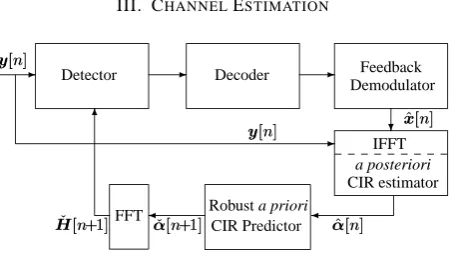
Fig. 1. Channel estimator constituted by an a posteriori decision-directed CIR estima-tor, based on frequency-domain modulated symbol estimates, followed by an a priori CIR predictor.
The schematics of the proposed channel estimation method is de-picted in Figure 1. Our channel estimator is constituted by what we refer to as an a posteriori decision-directed CIR estimator followed by an a priori CIR predictor [1]. As seen in Figure 1, the task of the CIR estimator is to estimate the FS-CIR taps of Equation (7). The transfor-mation from the subcarrier-related frequency domain to the FS-CIR-related time domain is invoked in order to exploit the frequency-domain correlation of the subcarrier-related CTF coefficients as well as to re-duce the computational complexity associated with the CTF prediction process, because the FS-CIR typically has a lower number ofLK
significant taps, which have to be predicted, than theKnumber of FD-CTF coefficients. Hence the overall channel estimation complexity is reduced, even when the complexity of the FD-CTF to CIR transforma-tion and its inverse are taken into account.
The a posteriori FS-CIR estimator inputs are the frequency-domain signaly[n]and the decision-based estimatexˆ[n]. The transformation from the frequency to time domain is performed within the CIR esti-mator of Figure 1 and its output is an a posteriori estimateαˆl[n]of the FS-CIR taps of Equation (3) which is fed into the low-rank time-domain FS-CIR tap predictor of Figure 1 for the sake of producing an a
priori estimateαˇ[n+ 1, l]of the next FS-CIR on a FS-CIR tap-by-tap basis [1]. Finally, the predicted FS-CIR is converted to the FD-CTF. The resultant FD-CTF is employed by the receiver for the sake of de-tecting and decoding of the next OFDM symbol. Note, that this prin-ciple requires the transmission of a channel sounding sequence during the initialisation stage.
A. A Posteriori FS-CIR Estimator
We would like to commence our portrayal of the proposed channel estimation philosophy with the derivation of the a posteriori FS-CIR estimator of Figure 1.
By substituting the FD-CTF of Equation (7) into (1) we arrive at
y[n, k] =C[k] L X
l=1 Wk
τl Ts
K αl[n]ˆx[n, k] +w[n, k], (8) which can be expressed in a matrix form as
y[n] = diag (C[k]ˆx[n, k])W α[n] +w[n], (9) where we define the(K×K)-dimensional matrixdiag (v[k])as a diag-onal matrix with the corresponding elements of the vectorv[k]on the main diagonal, as well as the(K×L)-dimensional Fourier Transform matrixW described byWkl,W
kτl Ts
K fork=− K
2,· · ·,
K
2 −1and l= 1,· · ·, L.
The MMSE estimator of the FS-CIR tapsαl[n]of the linear vector model described by (9) is given by [7]
ˆ
α =
C−α1+ 1
σ2
w
WHdiag |C[k]ˆx[k]|2
W
−1
× WH
diag (C∗[k]ˆx∗[k])y, (10) where we omit the time-domain OFDM-block-spaced indexnfor the sake of notational simplicity and defineCαas the covariance matrix of the FS-CIR vectorα.
In order to characterise the properties of the expression (10) we would like to recall the corresponding properties of the matrices in-volved. The vectorC[k]is the discrete frequency response of the sys-tem’s Nyquist filterc(τ)in Equation (3). It is evident that in any reason-ably designed system, we have|C(f)|2≈
1for any values offwithin the system’s transmission band, which corresponds to|C[k]|2 ≈
1 fork = −K
2,· · ·,
K
2 −1, and therefore we havediag (C[k]) ≈ I.
Furthermore, the matrixW is a Fourier Transform matrix having el-ements given byW[k, l] = exp−2πKk τl
T s. Thus, the square matrix WH
diag |xˆ[k]|2
Wis a Toeplitz Hermitian matrix.
Let us also recall that the channel model assumed is not limited by the Wide Sense Stationary (WSS) conditions. Thus the corresponding channel parametersσ2
l are time-variant and hence are characterised by the energy expectation valueσ2
l ,E
|αl[n]|2 of the FS-CIR’slth tap. The best estimate of the expectation valueσl2available in the con-text of our FS-CIR estimator is the a priori estimate|αˇl[n]|2generated by the FS-CIR predictor of Figure 1. By substituting the correspond-ing estimates of the expectation values of the FS-CIR taps’ energy into Equation (10) we arrive at
ˆ
α =
diag
1 |αˇl[n]|2
+ 1
σ2
w
WHdiag |xˆ[k]|2
W
−1
where the matrix inversion operation is performed for the low-rank (L×L)-dimentional matrixdiag 1
|αˇl[n]|2
+ 1
σ2
wW
H
diag |xˆ[k]|2
W. We now turn our attention to the problem of exploiting the time-domain correlation of the FS-CIR tapsαl[n].
B. Time-Domain Channel Predictor
Our aim is to predict the FS-CIR taps
{α1[n+ 1],· · ·, αL[n+ 1, K0−1]}associated with the channel ex-pected during the reception of the next OFDM symbol, given the history of the previous CIRs, namely the a posteriori estimates {{αˆl[n]},{αˆl[n−1]},· · ·}, l= 1,· · ·, L.
As portrayed in Section II, thelth CIR tapαl[n]undergoes a narrow-band time-domain fading process characterised by its cross-correlation properties, which can be described by
E{α∗l[n]αl0[n−m]}=rt[m]δ[l−l0], (12)
wherert[n]is the corresponding time-domain correlation function and
δ[·]is the Kronecker Delta function.
This narrow-band WSS process can be approximately modelled as a finite impulse response (FIR) auto-regressive process of the orderNtap [1]
αl[n+ 1] = Ntap−1
X
m=0
q[m]αl[n−m] +vl[n+ 1], (13)
whereq[m]represents the autoregressive coefficients andvl[n]is the model noise.
Let us now define the column vectors
αl[n] , (αl[n], αl[n−1],· · ·, αl[n−Ntap+ 1])T q , (q[0],1[1],· · ·, q[Ntap−1])T (14) and rewrite Equation (13) in a vectorial form as
αl[n+ 1] =αl[n]Tq+v[n+ 1]. (15) Left-multiplying both sides of (15) with the complex conjugate of the column vector αl[n, l]and obtaining the expectation value over the time-domain indexnyields
E{α∗l[n]αl[n+ 1]}=E
α∗l[n](α T
l[n]q+v[n+ 1]) , (16) which can be represented as a set of Yule-Walker or Wiener-Hopf equa-tions in the following form [8]
rapr=Raptq, (17)
where the vectorrapris the autocorrelation vector of the predicted a
priori CIR taps defined by
rapr= 1
σ2
l
E{α∗l[n]αl[n+ 1]}, (18)
and the matrixRapt is the autocorrelation matrix of the a posteriori CIR taps described in [1]
Rapt = 1
σ2
l
E ˆ
αl[n] ˆαHl[n]
= Rapr+ρI,
where Rapr = 1
σ2
l
E
αl[n]αHl[n] . (19)
The optimal solution of Equation (17) evaluated in the MSE sense is given by
qpre=R −1
aptrapr. (20)
In the specific scenario when the channel is described by Jakes’ model [5], the a priori autocorrelation vectorrapr can be formulated asrapr[n] =rJ[n] =J0(2πFdn), n= 1,2, . . . , Ntap, whereJ0(x) is a zero-order Bessel function of the first kind. The corresponding
a posteriori autocorrelation matrixRapr is given byRapr[n, m] =
rJ[n−m] +ρδ[n−m], n, m= 0,1, . . . Ntap−1, while the CIR predictor’s coefficient vector is described by (20) and the prediction is performed according to
ˇ
αl[n+ 1] =qTpreαˆl[n], l= 1,2, . . . , L. (21)
C. Robust Predictor
The CIR-tap prediction process described in the previous subsec-tion exhibits a high CIR-tap estimasubsec-tion performance under the assump-tion of having perfect knowledge of the channel statistics. However, it suffers from a significant performance degradation, when the actual channel statistics deviate from the model assumed, such as for example Jakes’ model. The issue of statistical mismatch becomes increasingly detrimental in diverse wireless environments, where the channel condi-tions and the corresponding statistics are time-dependent and cannot be assumed to be wide-sense stationary.
As it has been shown in [6] and [1], the MSE of the linear CIR predic-tor of (21) is upper-bounded by the MSE encountered, when communi-cating over an ideally band-limited channel having a perfect low-pass Doppler PSD function given by
pB,unif(f) = 1
2fd, if|f|< fd
0, otherwise. (22)
Hence, we arrive at the concept of designing Li’s [6] so-called robust linear predictor [1], which assumes encountering the worst possible channel statistics. As pointed out in [9], such a robust channel predic-tor, optimised for the worst-case PSD of Equation (22), can be designed by using the corresponding sinc-shaped a priori autocorrelation vector
rapr,rob, which is given by
rapr,rob[n] =rB[n] =
sin 2πfdn 2πfdn
, n= 1,2, . . . , Ntap (23)
and by invoking the corresponding a posteriori autocorrelation matrix
Rapt,robdefined by
Rapr,rob[n, m] =rB[n−m] +ρδ[n−m], (24) where we haven, m= 0,1, . . . Ntap−1. The robust time-domain a
priori FS-CIR tap predictor employed in the channel estimation scheme
depicted in Figure 1 is extensively characterised in [1].
D. Complexity Study
The complexity of the proposed CIR estimation method of Figure 1 was found to be lower than that of other channel estimation techniques of comparable performance, such as that of the estimators proposed and investigated in [6] and [1]. More explicitly, the a posteriori estimator of Equation (10) has a computational complexity which is of the order ofO(L2K+L3), whereLis the number of significant FS-CIR taps encountered andKis the number of OFDM subcarriers.
IV. SIMULATIONRESULTS
In this section, we present our simulation results for the CIR estima-tion scheme advocated both in the context of OFDM and MC-CDMA systems communicating over multi-path Rayleigh fading channels.
A. System Parameters
TABLE I SYSTEM PARAMETERS.
Parameter OFDM MC-CDMA
Channel bandwidth 800 kHz
Number of carriersK 128
Symbol durationT 160µs
Max. delay spreadτmax 40µs
No. of CIR taps 3
Channel interleaver WCDMA [10] – 248 bit
Modulation QPSK
Spreading scheme – WH
FEC Turbo code [11] , rate 1/2
component codes RSC, K=3(7,5)
code interleaver WCDMA (124 bit)
Our simulations were performed in the base-band frequency domain and the system configuration characterised in Table I is to a large extent similar to that in [6]. We assume having a total bandwidth of 800kHz. In the OFDM mode, the system utilises 128 QPSK-modulated orthog-onal subcarriers. In the MC-CDMA mode we employ a full set of 128-chip Walsh-Hadamard (WH) codes for frequency-domain spreading of the QPSK-modulated bits over 128 orthogonal subcarriers. All spread-ing codes are assigned to a sspread-ingle user and the data-rate is similar in both the OFDM and the MC-CDMA modes. For forward error correc-tion (FEC) we use 1
2-rate turbo coding [11] employing two
constraint-lengthK= 3Recursive Systematic Convolutional (RSC) component codes and a 124-bit WCDMA code interleaver [10]. The octally repre-sented generator polynomials of (7,5) were used.
We employed a three-path Rayleigh-fading channel model associ-ated with delay spreads of up toτmax= 40µs and varied the Doppler frequencyfdin the range of5−200Hz. Our simulations were per-formed for various types of multipath intensity profiles and it was found that the channel estimator’s performance is lower-bounded by the uni-form multipath intensity profile (see also [1]). Therefore, we consider the uniform intensity profile as the worst-case scenario and present our results for this scenario only.
The channel is assumed to be quasi-stationary, namely we assume the channel’s CIR to be constant for the duration of one OFDM/MC-CDMA symbol and assume different tap values before the arrival of the next OFDM symbol. Furthermore, we assume having perfect power control, resulting in having a constant overall channel output energy, namely to
X
l
|αl[n]|2= 1
K
K−1
X
k=0
|H[n, k]|2= 1 (25)
for alln. The reason for stipulating this assumption was to avoid the situation, where the system’s performance is dominated by the time-domain distribution of the overall power level of the received signal inflicted by the particular channel-model.1
10-4 10-3 10-2 10-1 100
0 2 4 6 8 10
CWER
SNR [dB]
OFDM ideal CIR estimator OFDM error-free decisions OFDM decision errors MC-CDMA ideal CIR estimator MC-CDMA error-free decisions MC-CDMA decision errors
(a)
-35 -30 -25 -20 -15 -10 -5 0
0 2 4 6 8 10
MSE [dB]
SNR [dB]
OFDM error-free decisions OFDM decision errors MC-CDMA error-free decisions MC-CDMA decision errors
[image:4.595.309.563.68.507.2](b)
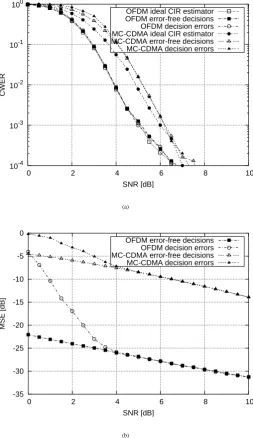
Fig. 2. (a) CWER and (b) MSE of the QPSK-modulated OFDM and MC-CDMA sys-tems with DDCE and robust time-domain predictor under matched Doppler PSD conditions having a OFDM-symbol normalised Doppler frequency offdT =0.01. We assume here having an infinite time-domain interleaver, which is equivalent to having a constant overall channel output energy.
B. Performance Results
Figure 2 demonstrates (a) the achievable turbo-coded Code-Word Er-ror Rate (CWER), where a Code-Word corresponds to a single turbo-coded OFDM/MC-CDMA symbol, and (b) the MSE performance of the channel estimator for both the OFDM and the MC-CDMA systems considered under matched time-domain channel correlation conditions. Thus, the Doppler frequency assumed in the design of the robust CIR predictor matches the actual Doppler frequency of the Jakes-correlated Rayleigh fading channel. The channel estimator featured employs the
a posteriori FS-CIR estimator of Section III-A followed by the robust a priori CIR predictor , as depicted in Figure 1. The simulations were
1We note that in practice this condition cannot be maintained. However, this assumption allowed us
carried out over the period of 100,000 QPSK-modulated K = 128 -subcarrier OFDM/MC-CDMA symbols. It can be seen in Figure 2(a), that the performance of the channel estimator evaluated in the OFDM mode is close to that of the ideal estimator assuming perfect knowl-edge of the CIR. More explicitly, at low SNR values the achievable performance is degraded by the associated decision-error propagation, however the decision process becomes reliable for SNRs in excess of 4 dB.
In the MC-CDMA mode a 128-chip WH spreading code was as-sumed and a single user transmitted all the spreading codes in parallel in order to maintain a data-rate similar to that of the OFDM system. All transmitted codes experienced the same SNR value. As seen in Figure 2, the MC-CDMA mode suffers from an SNR performance degrada-tion of about 1 dB even under the assumpdegrada-tion of a perfect CIR knowl-edge. This degradation is inflicted mainly by the associated sub-optimal MMSE multi-code detection process [1]. The channel estimator im-poses a further slight SNR degradation of about0.3dB on the MC-CDMA mode as a result of the Rayleigh-like energy distribution of the transmitted frequency-domain subcarriersx[n, k]within each OFDM symbol, which are employed in the CIR estimator of Section III-A. By contrast, in the QPSK-modulated OFDM mode the energy of the trans-mitted frequency-domain samplesx[n, k]remains constant.
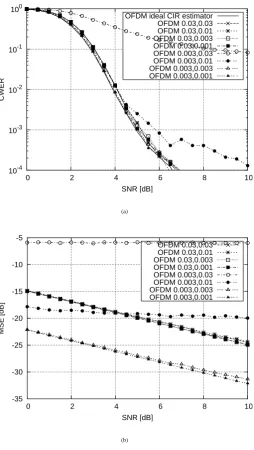
Finally, Figure 3 depicts (a) the CWER and (b) the MSE perfor-mance of the channel estimator in the context of an OFDM system un-der unmatched time-domain channel correlation conditions. Our simu-lations were performed for two different values of the OFDM-symbol normalised Doppler frequency assumed during the design of the ro-bust CIR predictor, namely forfˇdT = 0.03and0.003. Furthermore, four different values of the actual normalised Doppler frequencies were used, namelyfdT = 0.03,0.01,0.003and0.001. It can be seen that the performance of the CIR predictor advocated is indeed tolerant to the mismatch of the actual Doppler frequency and that assumed during the predictor design, as long as the actual Doppler frequency does not exceed the value assumed in the predictor’s design.
V. SUMMARY
In this paper we have proposed a channel estimation method, which is based on a low-complexity decision directed MMSE FS-CIR estima-tor combined with a robust time-domain FS-CIR predicestima-tor. We have found that the method proposed is effective in both WSS channels as-sociated with a constant power intensity profile (PIP) and in channels having time-variant PIP. In the case of constant PIP the knowledge of the channel’s correlation properties can be exploited by the receiver for increasing the accuracy of the channel estimation process.
REFERENCES
[1] L. Hanzo, M¨unster, B. Choi, and T. Keller, OFDM and MC-CDMA for Broadband Multi-user
Com-munications, WLANs and Broadcasting. John Wiley – IEEE Press, 2003.
[2] A. Goldsmith, S. Jafar, N. Jindal, and S. Vishwanath, “Capacity limits of MIMO channels,” IEEE
Journal on Selected Areas in Communications, vol. 21, pp. 684–702, June 2003.
[3] Y. Li, “Simplified channel estimation for OFDM systems with multiple transmit antennas,” IEEE
Transactions on Wireless Communications, vol. 1, pp. 67–75, January 2002.
[4] R. Steele and L. Hanzo, eds., Mobile Radio Communications. New York, USA: IEEE Press - John Wiley & Sons, 2nd ed., 1999.
[5] W. Jakes Jr., ed., Microwave Mobile Communications. New York, USA: John Wiley & Sons, 1974. [6] Y. Li, L. Cimini, and N. Sollenberger, “Robust channel estimation for OFDM systems with rapid
dispersive fading channels,” IEEE Transactions on Communications, vol. 46, pp. 902–915, April 1998.
[7] S. Kay, Fundamentals of Statistical Signal Processing. Englewood Cliffs, NJ, USA: Prentice-Hall, 1998.
[8] S. L. Marple, Digital spectral analysis with applications. Englewood Cliffs, NJ, USA: Prentice Hall, 1987.
[9] M. M¨unster, Antenna Diversity-Assisted Adaptive Wireless Multiuser OFDM Systems. PhD thesis, University of Southampton, UK, 2002.
[10] H. Holma and A. Toskala, eds., WCDMA for UMTS : Radio Access for Third Generation Mobile
Communications. John Wiley and Sons, Ltd., 2000.
[11] L. Hanzo, T. Liew, and B. Yeap, Turbo Coding, Turbo Equalisation and Space-Time Coding. John Wiley, IEEE Press, 2002. (For detailed contents, please refer to http://www-mobile.ecs.soton.ac.uk.).
10-4 10-3 10-2 10-1 100
0 2 4 6 8 10
CWER
SNR [dB]
OFDM ideal CIR estimator OFDM 0.03,0.03 OFDM 0.03,0.01 OFDM 0.03,0.003 OFDM 0.03,0.001 OFDM 0.003,0.03 OFDM 0.003,0.01 OFDM 0.003,0.003 OFDM 0.003,0.001
(a)
-35 -30 -25 -20 -15 -10 -5
0 2 4 6 8 10
MSE [dB]
SNR [dB]
OFDM 0.03,0.03 OFDM 0.03,0.01 OFDM 0.03,0.003 OFDM 0.03,0.001 OFDM 0.003,0.03 OFDM 0.003,0.01 OFDM 0.003,0.003 OFDM 0.003,0.001
(b)
[image:5.595.310.565.142.593.2]