COMMISSION OF THE EUROPEAN COMMUNITIES
COM(93) 651 final
Brussels, 14 December 1993
IMP ACT programme (EC programme for the establishment of an information services market)
COMMUNICATION AND REPORT FROM THE COMMISSION TO THE COUNCIL, THE EUROPEAN PARLIAMENT AND TO THE ECONOMIC AND SOCIAL COMMITTEE
IMPACT programme (EC programme for the establishment of an information services market)
COMMUNICATION FROM THE COMMISSION TO THE COUNCIL, THE EUROPEAN PARLIAMENT AND TO THE ECONOMIC AND SOCIAL COMMIITEE
1. This Communication concerns the IMP ACf Programme (EC plan of action for setting up an information services market) adopted by Council Decision 91/691/EEC of 12 December 1991. 2. In conformity with article 6 of Council Decision 91/691/EEC, a report has been prepared on the main events and developments which occurred in the electronic information services market in 1991/92 and is attached to this Communication. Three similar reports, covering the state of the market in the periods 1988-89, 1989-90 and 1990-91 have been forwarded to the European Parliament and to the Council as docs. SEC(90) 1788 final, dated 24 September 1990, SEC(92) 1536 final, dated 2 September 1992, and COM(93) 156 final, dated 19 Aprill993.
3. This fourth report reviews the most important trends which became apparent over the period 1991/92, within the following sectors:
"classical" on-line ASCII database services, videotex services,
publications on optical disk,
fax-based and audiotex information services.
4. The following major findings arc highlighted in the report, which to some extent confirm earlier findings:
- Europe is a major world force in world-wide on-line production and distribution: by end of 1991, 35% of all database producers and 30% of on-line service operators were based within the Community. However, the international marketplace for text and bibliographic on-line services is dominated by two US vendors.
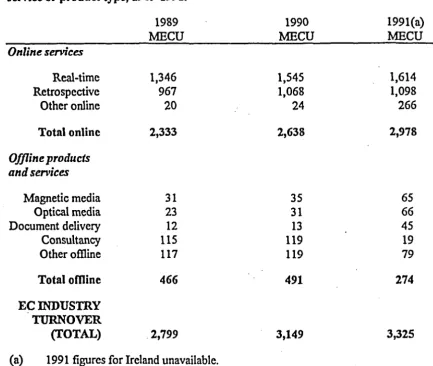
- World-wide sales in 1991, generated by EC-based hosts and information providers amounted to a value of 3.3 BECU, an increase of 5.6% in absolute terms compared with 1990. The strongest growth came from off-line sales: magnetic and optical media (which doubled) and document delivezy (which trebled). However, in relation to total income, these media types accounted for only 5.4% of the 1991 total industzy value.
- The videotex market continues to be nationally based, mainly as a result of the lack of standardisation and compat.J.bility between the various systems and language barriers. France remains the largest national market, with some 75 million connections per month (mid-1991), although the most intensive levels of professional demand are to be found in Italy and Germany.
- Although the number of installed CD-ROM drives in Europe has increased from 0.2 m. in 1991, to an estimated 0.6m. by end of 1992, the number of people actually able to use CD-ROM titles remains small. In the years to come multi-media information products and services will have a tremendous impact on most information technology sectors.
- Total world-wide turnover of audiotex services in 1991 is estimated at 2.8 BECU, and is projected to grow annually by between 25 and 30 per cent Europe with a turnover of 765 MECU compares with USA 754 MECU, and Japan 989 MECU. The development of the European Audiotex market is presently restricted by technical, linguistic and legal barriers, as well as the fragmented nature of the industry.
- Telecommunications and software developments will have a significant impact on the future shape of the European Information services sector. Investment is therefore required in a high-speed
trans-european telecommunications infrastructure to improve the competitive position in relation to US and Japanese competitors.
- Increasing globalisation of information markets means that there is a need for legal protection and regulation of the electronic services sector at the international level, which has been recognised by the Commission's publication in 1992 of two Draft Directives concerning copyright
5. The main conclusions highlight the report's major theme of Europe's international competitiveness in electronic information services in relation to USA and Japan. In this respect: - The significant gap between US and EC information service sector revenues (worth 8.2 and 3.3 BECU in 1991 respectively), shows signs of further widening. Future prospects for reducing this gap depend upon the quality and performance of the telecommunications infrastructure, e.g. the EC's Integrated Services Digital Network (ISDN) initiatives.
Japan is not as yet a major player in electronic information services, but has a comparative strength in hardware and consumer electronics, which ·will allow it to compete in the new markets for interactive media. A key factor for its relative weak position stems from the failure of Japan to find markets outside of its domestic market, despite the fact tlmt the supply of new database services being offered bas increased significantly.
- Europe still has significant strengths in publishing and a rich legacy of recorded information. Success depends on the extent to which these assets can be exploited by European actors.
- The European firm is typically smaller and less vertically integrated and more nationally focused than its US counterpart, and will therefore in order to survive need to enter joint ventures and alliances, as well as take advantage of the opportunities presented by multi-media technologies. - Demographic and social changes in Europe arc likely to lead to an increase in demand for information communication technologies and services as a means of increasing productivity and rationalising costs.
IMP ACT programme (EC programme for the establishment of an information services market)
REPORT FROM THE COMMISSION
TO TilE COUNCIL,
THE
EUROPEAN PARLIAMENT AND TO THE ECONOMIC AND SOCIAL COMMITTEECONTENTS
INTR.ODUCTION ... 6
EXECUTIVE OVERVIEW ... 7
1 INFORMATION FOR EUROPEAN COMPETITIVENESS ... 14
1.1 Information: a critical European resource ... 14
1.2 Current issues in information and European competitiveness ... 14
1.2.1 European telecommunications infrastrocture ... 14
1.2.2 lnfonnation, telecommunications and regional development ... 16
1.2.3 Technical barriers to infonnation market development ... 16
1. 2.4 Standards for infonnation transfer ... 17
1.2.5 Transitional regime for value added taxes ... 18
2 THE BUSINESS ENVmONl\ffiNT FOR ELECTRONIC PUDLISHING .... 19
2.1 Economics of electronic publishing ... 19
2.1.1 Cost-benefits of electronic publishing ... 19
2.1.2 Traditional and alternative delivery media ... 20
2.1.3 Multimedia issues from the industry's perspective ... 21
2.2 Barriers to electronic publishing ... 22
2.3 New opportunities for traditional publishers ... 23
2.4 Cross-sector, cross-border alliances and Europe's electronic information services sector ... 25
2.4.1 Data-Star!KJJight Ridder ... 26
2.4.2 Reed Intemationa//Elsevier ... 26
2.4.3 US West/1'ime-Wamer ... 27
2.5 Legal and regulatory issues ... 27
2.5.1 Copyright and intellectual property ... 28
2.5.2 Transborder data flows and trade-related issues ... ; ... 29
2.5.3 Public-private synergy in the infonnation market ... 30
3 THE EUROPEAN INFORMATION MARKETPLACE ... 32
3.1 Print publishing ... 32
3.2 Retrospective online database services ... 35
3.3 Real-time financial data services ... .40
3.4 Videotex services ... 42
3.5 Audiotex services ... 44
3.6 Fax-based information services ... 47
3.7 Optical information media ... 48
3.7.1 CD-ROM ... 52
3. 7.2 Interactive multimedia ... ,53
3.8 Electronic information services in the home ... ~ ... 55
3.8.1 General interest consumer videotex services ... 55
3.8.2 Prospects for consumer market development ... 57
4 THE INTERNATIONAL INFORMATION MARKETPLACE ... 61
4.1 The information marketplace ... 61
4.1.1 Defining the information services sector ... 61
4.1.2 Telecommunications infrastructure ... 63
4.2 Europe's competitive position in world markets ... 66
4.2.1 Electronic information services ... 66
4.2.2 Multimedia industries ... 68
4.3 Developments in the USA ... 70
4.3.1 Market size and trends ... 70
4.3.2 High-speed network infrastructure ... 72
4.4 Developments in Japan and the Pacific Rim ... ~ ... 73
4.4. 1 Japan: market size and trends ... 73
4.4.2 Longer-range developments in the Pacific Rim ... ~ ... 76
5 THE EVOLVING EUROPEAN INFORMATION MARKETPLACE ... 78
5.1 Demographic and social change ... : ... 78
5.1.1 EC population trends ... 78
5.1.2 Labour force participation ... 79
5.1.3 Industrial structure ... 80
5.1.4 uvels of income ... 80
5.1.5 Flexible working patterns and teleworldng ... 81
5.2 Economic and industrial change ... 82
5.3 Implications of demographic and social change for the information services market ... 83
6 CONCLUSIONS ... 85
ANNEXES A Electronic information in the wine industry ... 87
B Definitions of terms ... 89
C Acronyms and abbreviations ... 91
D List of publications ... 94
TABLES AND FIGURES TABLES
1. Printed and spin-off electronic publications; comparative cost structures ... 19
2. EC's top ranking publishing companies, by 1992 turnover ... 20
3. Electronic publishing; market potential in key European traditional print publishing market segments, 1992 and 2000 ... 24
4. World markets for books; 1990 estimates and forecast for 1995 ... 33
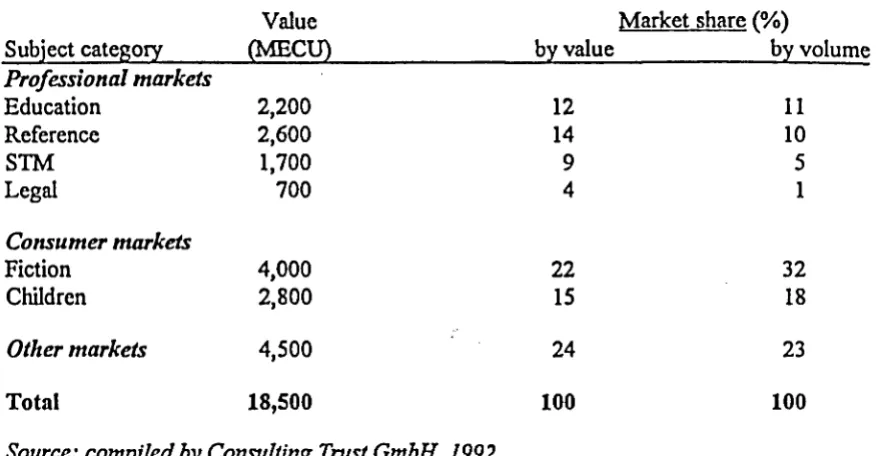
5. Book markets by subject category; EC, 1992 ... 34
6. Online ASCII database production I distribution; EC, end-1991 ... 35
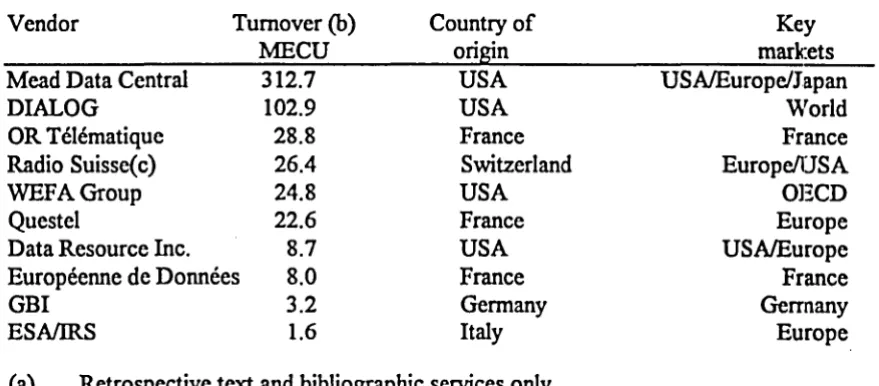
7. Leading international database vendors, ranked by 1990 turnover ... 36
8. Distribution of professional electronic information services; EC industry turnover by service or product type, 1989-1991 ... 37
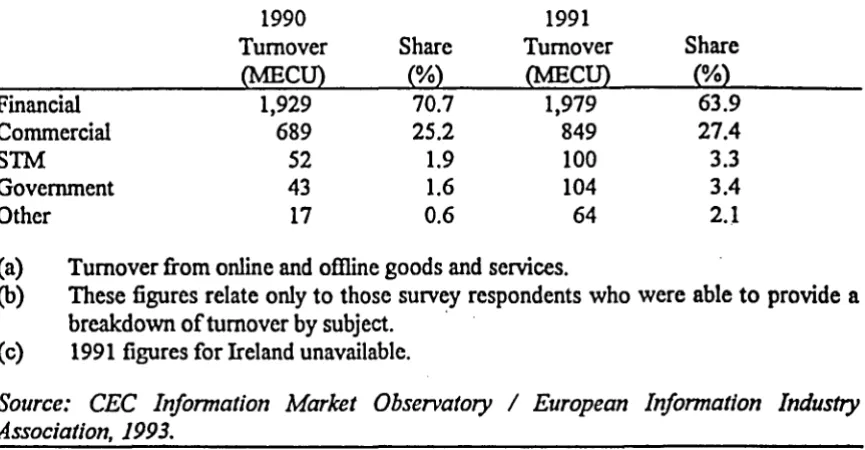
9. Distribution of professional electronic information services; EC industry turnover by subject interest, 1989-1991 ... 38
10. Public videotex services; monthly number of connections and average connect time per terminal; selected EC Member States, mid-1991 ... .44
11. Audiotex services; market size estimates, selected EC Member States, USA and Japan, end-1992 ... 46
12. Commercial CD-ROM and multimedia CD; EC Member States, indicators ofindustry structure, end-1991 ... .49
13. Commercial CD-ROM and multimedia CD; EC industry structure compared with EFTA, the USA, and Japan, end-1991.. ... 50
14. CD-ROM and multimedia CD; worldwide title production by region, . end-1988 to end-1991 ... 51
15. CD-ROM and multimedia CD; publishers and information providers by world region, end-1991 ... 51
16. Consumer videotex: household adoption rates; EC Member States, mid-1991 ... 56
17. Consumer videotex; major services, system operators and subscriber base, USA, 1991 ... 57
18. The information industries: USA and Japan compared with the EC ... 66
19. Online ASCII database production I distribution; worldwide, 1992 ... 67
20. Online ASCII databases; geographic distribution ofEC industry turnover, 1990-1991 ... 68
21. Multimedia industries; strengths and weaknesses by region, 1992 ... 69
22. Electronic information services; USA and EC, industry turnover and forecasts, 1988-1993 ... 71
23. Electronic information services; Japan and EC, industry turnover, 1988-1991 ... 73
FIGURES
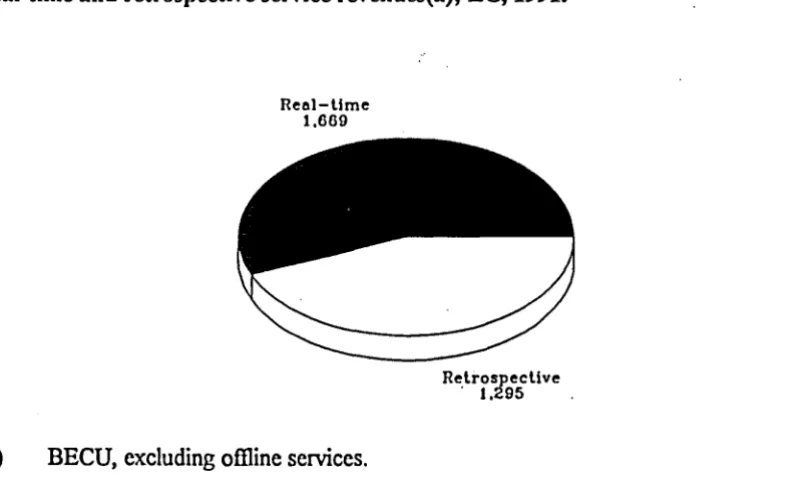
1. Print publishing; EC industry value, 1991 ... 32 2. Real-time and retrospective service revenues; EC, 1991 ... .40 3. Real-time financial data services and retrospective online
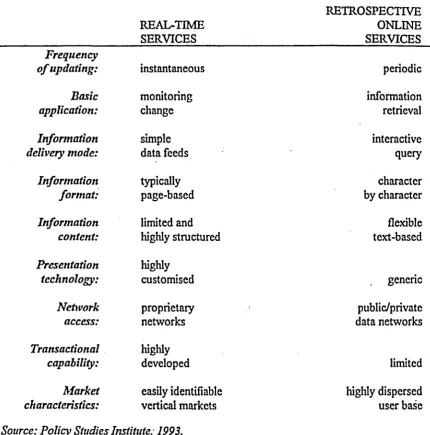
database services compared ... 41 4. World markets for audiotex services, 1992 ... 45
5. Worldwide multimedia revenues, 1991 ... 53 6. Multimedia applications in Western Europe; percentage market
shares, 1996 forecast ... , ... 54 7. Western European consumers; interest in residential electronic
infol"l11ation services,
1992 ... 59 8. Map of the infonnation business ... 62 9. New finns entering the Japanese database sector, 1980-1991 ... 74 10. Number of Japan-based online database_services accessibleoutside Japan, 1992 ... : .... : ... 75 11. EC population as a percentage of world population, 1960-2020 ... 78 12. EC population by age group (%), 1960-2020 ... : ... 79 13. Average income from paid employment per employee; EC Member
INTRODUCI'ION
When on 26 July 1988, the Council adopted a plan of action for setting up an information services market (the IMPACT programme), it asked the Commission to establish an Information Market Observatory (IMO) and to present an Annual Report on the most significant developments and trends in the European electronic information services market. This fourth Annual Report, based on data collected by the IMO during 1992, reviews the overall state of the European market for electronic information services and identifies the most important trends which became apparent during that year. As before, this Report reviews in more detail developments in four key segments of the European marketplace for professional electronic information services:
0 "classical" online ASCII database services Ovideotex services
Opublications on optical disk (including interactive multimedia) 0 audiotex and fax-based information services
EXECUTIVE OVERVIEW
Information as a critical European resource
1 January 1993, the inauguration of the Single European Market, is not a 'finishing line' but rather a ·signpost to the way ahead.' The success of the single market depends upon the complete removal of all barriers to trade; including barriers to flows of tradeable information. With much of the developed world
in
recession and Europe experiencing high levels of unemployment, all Member States are having to make concerted efforts to boost confidence and to promote economic recovery. One important factor in improving European competitiveness is by making better use of information as a factor of production. This requires that information resources be managed and deployed more efficiently and that the links between the creators of information products and the ultimate users are effective. Information and communications technologies (ICTs) have a crucial role to play here; by improving the competitiveness of European industry they may help to promote economic growth and employment.Tlte European information marketplace
Europe is a major world force in worldwide online production and distribution: by the end of 1991, 35 per cent of all database producers and 30 per cent of online service operators were based within the Community. According to supply-side indicators for 1991 and 1990, there has been a striking increase in the numbers of Community databases (by 26.3%) and database producers (by 21.7%). Although these figures, which represent directory entries, need to be interpreted with caution, they nonetheless provide confirmation of trends noted in earlier IM:O Annual Reports; these include the fact that the pattern of database distribution continues to be more highly concentrated in North America than in the Community (2.4 and 2.0 databases per host respectively).
The international marketplace for text and bibliographic online services in dominated by two US vendors: Mead Data Central (MDC) and Dialog. While EC-based vendors (OR Telematique, Questel, Europeenne des Donnees, GBI and ESAIIRS) occupied five positions out of the top ten world rankings, none came within the range of either. of the two US mega-host. This tends to support the view that the markets for EC vendors are predominantly national or regional, rather than worldwide.
CD-ROM
The number of people actually able to use CD-ROM titles remains small. Recent estimates suggest that the worldwide installed base of CD-ROM drives at the end of 1991 was around 2.25 million, with 1.44m in the USA, 0.62m in Asia, and 0.2m in Western Europe. High growth rates are predicted; by the end of 1992, the European installed CD-ROM base is likely to rise to around 600,000 with the largest single national marketplace being the UK (185,000 units). Other leading EC markets include Germany (125,000 units), Italy (85,000), France (50,000) and the Netherlands (25,000). Worldwide revenues for the commercial and in-house CD-ROM sectors have grown from 66.5 MECU (1987) to 3,200 MECU (1992). Global revenues from commercial titles and drives were said to amount to 2.2 BECU in 1992. The long-range impact of the CD-ROM on online markets is likely to be considerable, especially in the academic and library communities where CD-ROM pricing structures can be highly attractive.
Videotex services
The videotex market continues to be predominantly nationally based. The largest market for videotex within the EC continues to be France, where Teletel attracts, on average, around 75 million connections per month (mid-1991 estimate). National videotex markets outside France are much smaller, but they are nonetheless used just as, if not more, intensively. In fact the most intensive levels of professional demand for videotex are to be found in Germany and in Italy. One reason for videotex services continuing to cater predominantly for national markets is the lack of standardisation and compatibility between the various systems. The European Commission has recently, through the introduction of the multilingual IMP ACT videotex service, implemented sample pages in existing national systems in ten Member States, making the same information available in the native language of each country. This is designed partly to overcome the lack of common standards and also to increase awareness of the advantages of accessing electronic information resources.
Audiotex services
Europe in tlte global marketplace
The Asia-Pacific region is emerging as a major hub of the world's economy; regional cooperation has led to the assembly of a powerful network infrastructure (including the ASEAN optical fibre cable network). The region is relatively information-poor, however, and market opportunities for the supply of external information arc likely to present themselves. Compared with Japan, the Community has a significant strategic advantage in
terms of industry size, which is likely to grow in absolute if not relative terms over the next five years. A key factor explaining Japan's relative weakness in the electronic information sector lies in its continuing failure to find markets outside of Japan, despite the fact that the supply of new database services being offered has increased markedly. Foreign access to Japanese data is limited, despite high potential demand, by a number of factors: including lack of language skills, operational problems, uncertainty over copyright, and difficulties in setting up foreign sales and distribution networks.
Developments in telecommunications and software
Telecommunications and software developments will have a very considerable bearing on the future shape of the European information services sector. Investment in high-speed transeuropean telecommunications infrastructure is needed to improve the competitive position ofthe European information industry in relation to its US and Japan competitors. The Commission's policies of liberalisation and hannonisation to create an internal market in telecommunications are important if service innovation is to flourish. In most of the EC Member States little progress has been made in the supply of high-speed lines. Tariffs for broadband leased lines vary considerably across the Community. On the positive side, however, competition has increased in terminal equipment markets and in those for value added and network services (one ofthe fastest growing markets for telecommunications-based services).
In June 1993, a Resolution was adopted by the EC Council of Telecommunications Ministers on the liberalisation of voice telephone services. This is to apply to all international (within and outside the Community) and national domestic services, but the action has been postponed until 1998. Furthermore, special arrangements and transitional periods will apply to the Community's peripheral regions and to those Member States with small and less developed networks. The speed at which liberalisation is to proceed is likely to remain a high priority issue throughout 1993. Much more emphasis is to be placed on the improvement of cross-border telecommunication networks which ·link national administrations. This should facilitate the processing and interchange of information between national administrations and Community institutions which is necessary for the functioning of the internal market and the implementation of common policies.
Barriers to access to electronic information services
Some of the most important barriers to increasing access to electronic information services arc technical in nature. Many of the software and display interfaces, information retrieval languages and database structures arc inappropriate to users' needs. Overcoming user access difficulties will depend to a large extent on the availability of advanced information engineering technologies. The development of generic applications often requires a multi-disciplinary approach, as well as large inputs of capital and RTD resources; since such resources are often beyond the capability of even the larger European players, the CEC intends to give the development of generic technologies a prominent place in the implementation of a Community fourth framework programme for research and technological development {1994-98).
Industry analysts are predicting that multimedia information products and services will have an enormous impact on all information technology sectors over the next few years. While the EC has undoubted strengths in publishing and in information content, it is comparatively weak in computing and consumer electronics, both of which arc needed to develop interactive multimedia services imd products. There has been considerable progress in developing multimedia products in Japan and the USA, but Europe is lagging behind. In the USA, most of the· major software suppliers have developed multimedia applications.
Further progress in the field of information transfer standards and their adoption is vital if
the Community is to establish a presence in world markets for interactive multimedia, where the need to integrate data from different sources in a hardware-independent environment will be a critical factor in competitive success. IMP ACT, through its Open Information Interchange activity, is currently providing support for a range of strategic initiatives.
Cltanges in tlte marketplace and t!te impact on company structure
Europe's electronic information services operate in a global market which is undergoing considerable structural change. Typically, the average European information services provider is smaller, less vertically integrated, and much more nationally orientated than its US counterpart. In general, European publishers and broadcasters arc far behind their US counterparts in their interest and participation in multimedia. The strategic alliances that have recently been forged between the US film and music companies and major Japanese electronic companies and telecoms and software producers, for example Microsoft and AT&T, could exclude and damage the traditionally strorig European publishing sector if it fails to enter the learning curve for multimedia and electronic publishing at an early enough stage.
made Reed/Elsevier a colossus among quoted publishing and information companies, surpassed only by Time Warner and Dun & Bradstreet.
There is no doubting the need for cross-sectoral, cross-border alliances and more intensive R&D integration if Europe is to be able to develop new information-based products and services. Support will be required, however, in order to overcome the difficulties of a highly fragmented, multilingual market. The processes of convergence between production, packaging, distribution and facilitation add considerably to the already intense problems of mapping, defining and measuring the information industry. The rapid diffusion of ICTs will inevitably generate stresses and strains which may amplify existing problems such as skill shortages, divergences in technical standards, low levels of user awareness and legal and regulatory barriers. It is important for the IMO to continue to develop statistical tools and other ways of mapping and monitoring the EC information services sector in order to shed light on important policy issues. ·
New opportunities for traditional publislters
Despite the barriers to entry, electronic publishing offers significant new market opportunities for traditional publishers. The EC print publishing sector was worth an estimated 75.5 BECU in 1991. This includes books,· newspapers, consumer/general interest magazines and corporate publications. A review of the key European market segments for print publishing in 1992 showed that the corporate business market offers.the largest potential for expansion since it is likely to need more information on markets in the context of European integration.
Although the business and professional markets appear to offer less risk (but ultimately a smaller demand base) than consumer markets, two other electronic media markets arc likely to experience higher than average growth over the next ten years: traveVtourism and children's publishing. The travel and tourist industry is a key market given the vast amounts of information the industry generates. The potential for expansion in this area has been reflected in the Reed/Elsevier letter of intent to purchase the Official Airlines Guide, in addition to the ABC Airlines Guide it already owns. The benefits of children's publishing are equally clear; children are more easily attracted by computer-based interactive services (and far less critical of display quality) than adults. Secondly, the video games industry is expected to create a significant residential installed hardware base for compact disc drives.
Globalisation ofinformation markets
The increasing globalisation of information markets means that there is a need for legal protection and regulation of the electronic services sector at the international level. The concentration of publications in an ever smaller number of multinational conglomerates threatens to create a near monopoly on commercial information transfer. Commercial database distribution raises problems both of intellectual property and personal data; these have been the focus of the debate since GATT's TRIP (Trade Related Aspects of Intellectual Property) negotiations were launched.
During 1992 the Commission published two Draft Directives concerning copyright; that on the Legal Protection of Databases relates more directly to electronic copyright. It was introduced by the Commission partly to overcome ambiguities in the existing legal framework, partly to address the potential for the widespread pirating of databases and to enable the EC information industry as a whole to challenge the US, where a coherent and consistent framework already exists.
This Report illustrates how the supply of electronic information products is shaped by the complex interplay of external forces. These include the legal and regulatory environment; technological advance and innovation; and investment in the telecommunications infrastructure. Supply-side factors alone, however, cannot create markets without the necessary demand. Industry analysts constantly try to predict future demand levels by taking account of economic, social and demographic trends. The spurt of merger and acquisition activity in the ICT sector in recent years is indicative of· wide-reaching structural changes taking place both within the :EC and in global markets.
The European information marketplace and demographic change
The Community is currently undergoing some very complex demographic changes: the shift towards greater female participation in the workforce, the rise in migration from Central and Eastern Europe and the Mediterranean rim, the ageing populations of the northern and eastern Member States and the problems of national labour markets. These
all present new challenges and new opportunities for the information services sector because they represent forces shaping future demand for those services.
EC and national government policy will need to address these challenges and continue to support industry, particularly the electronic information services industry. This support will include the need to respond to intellectual property issues; to continue to review and work towards the harmonisation of IT standards; to provide incentives for R&D investment; to protect individual privacy and to uphold anti-trust and other competition
policy. ·
Within the CEC, the IMP ACT programme aims to respond flexibly to the emerging needs of the changing market, and is working at a strategic level to ensure that the market for information services is nurtured and developed in the best interests of the entire Community, giving special attention to LFRs and small and medium-sized enterprises. The Information Market Observatory's role will prove to be increasingly important in evaluating the impact of EC policy instruments and their effect on both the demand and
1 INFORMATION FOR EUROPEAN COMPETITIVENESS 1.1 Information: a critical European resource
From 1 January 1993, the single European market was complete in all essential respects (95 per cent of the programme outlined in the CEC's White Paper of 19&5 had been adopted). The success of the single market depends upon the complete removal of all
barriers to trade; including barriers to information flows. DG-XIIT, through its IMP ACT programme, tries to identify areas in which technical, legal, regulatory and other barriers are seen to impair the free flow of information and thus the effective operation of the market. In addition, the input received from the Information Market Observatory through analysis of the market from the user and supplier sides, has continued to play a useful role in identifying market trends. Using these and other inputs, the Commission is then able to formulate initiatives to overcome these barriers which take full account of the needs of the information industry.
With much of the developed world in recession and Europe experiencing high levels of unemployment, all Member States need to make concerted efforts to boost confidence and promote economic recovery. Information and communications technologies (ICTs} have a crucial role to play in this respect; by improving the competitiveness of European industry they can promote economic growth and employment. Managing information properly as a resource can improve a company's organisational efficiency; increase market awareness, and improve access to markets which can help firms to increase their market share. As firms in all sectors adjust to the pan-European market competition and regulation, the need for Community-wide information will increase, particularly in the area of marketing data, mailing lists, credit ratings and company information.
As the barriers to trade fall, and cross-border economic transactions increase, there will be a growing need for Europeans to communicate quickly and efficiently. While the role of information and communication technologies as a vital corporate asset is being increasingly re.cognised, many executives are still to be convinced of the benefits that can be derived - often because they are not fully aware of the range of information services which are available or of the means by which they can be delivered.
1.2 Current issues in information and European competitiveness
1.2.1 European telecommunications infrastructure
In terms. of competitiveness, one of the most crucial factors in determining a company's pan-European success is the establishment of efficient distribution networks. These have to be supported by equivalent information flows and the necessary cross-border infrastructure. Historic parallels can be drawn between the Community's programme to liberalise and harmonise European telecommunications services and the nineteenth century development of railroads where a series of local or regional systems interfaced, evolving toward systems that crossed national frontiers. The CEC programme of regulatory change in the telecommunications services sector remains one of the most difficult outstanding challenges of the internal market.
Commission found the main problem to be the high tariffs charged to telephone users for intra-Community services which are known to have a very negative effect on the use of electronic information. On the other hand, competition has increased in terminal equipment markets and in those for value added and network services. Goods and services have improved, innovation has increased and costs have fallen. There has been steady liberalisation and growth in communications and computer services, and in the provision of information services.
There is still little progress in most Member States in the supply of high-speed lines, which arc essential for the connection of Local Area Networks, and for the creation of Community-wide networks for private corporations and closed user groups. Broadband leased lines commonly have tariffs which vary considerably between Member States, and there are still few high-speed leased lines.
In order that there may be further development in the liberalisation and harmonisation of telecommunications services, the Commission . review set forward four options for progress:
Option 1:
Option 2:
Option 3:
Option 4:
freezing the progress ofliberalisation and maintaining the situation as it was at the end of 1992
regulating extensively on tariffs and investments, in order to remove the surcharge on intra-Community tariffs
liberalising all voice telephone services internationally (within and outside the Community) and also national domestic services
opening up competition on voice telephone services between Member States
In its initial appraisal of the options available, the Commission favoured option 4 as an intermediate alternative, believing it would best maintain the balance between liberalisation and harmonisation. It also believed this option would provide the legal basis for the establishment of trans-European networks for telecommunications.
Following extensive consultation with 130 companies, regulators, national governments and users, the Commission decided that option 4 would be superfluous. At a meeting of Telecommunications Ministers on 16 June 1993 a Resolution was passed to adopt option 3, but with implementation delayed until 1 January 1998. Special arrangements and transitional periods will apply to the peripheral regions and countries with small and less developed networks. The speed at which liberalisation will be introduced is likely to be a high priority issue throughout 1993.
1.2.2 Information, telecommunications and regional development
Since the publication of its Green Paper on telecommunications in 1987, the Commission has adopted a range of practical proposals within a framework of two specific programmes, RACE and STAR. The purpose of the RACE programme, the main telecommunications R&D effort, is to develop the technologies necessary for setting up the broadband networks of the future. The STAR programme (Community programme for the development of certain less-favoured regions of the Community by improving access to advanced telecommunications services) was originally geared to specific regions in seven of the Member States, financed through the European Regional Development Fund (ERDF). The STAR programme hinged on two major lines of action:
0 helping to set up infrastructure offering users advanced services
0 supporting measures . designed to stimulate demand and encourage the use of advanced services, in particular by SMEs
The services part of STAR ended in October 1991 but was extended in 1992 and 1993 under the Telematique programme, the aim of which was to develop telematic services in the less-favoured regions (objective 1) of the Community. It is planned to extend the infrastructure part of the STAR programme from 1993. STAR aims to boost regional development by encouraging:
Othe introduction of advanced telecommunications services into small and medium-sized enterprises
0 the introduction of data communications for .users in the public sectors
Othe improvement of access to data communications networks within the Community
1.2.3 Technical barriers to information market development
Some of the most important barriers to the access of information are technical ones; software and display interfaces, information retrieval languages and database structures, are all areas where current technologies are a very long way from offering user-friendly access to.electronic information. This is not because current technologies are too complex, but rather that they are inappropriate to users' needs and so place a lower limit on the potential market.
the investment and resources needed to develop generic solutions are beyond the capability even of the larger European information industry players.
The development of generic technologies will be given a prominent place in the implementation of a Community fourth Framework programme for research and technological development (1994-98). One of the core themes of the programme corresponds to priority technology activities, by addressing broad application, generic technologies, which arc critical to the competitiveness of the European industrial system. The development of generic applications often requires a multidisciplinary approach, as well as large inputs of capital and RTD resources.
1.2.4 Standards for information transfer
As well as the need to develop better human-machine interfaces, a key element in improving access to the Community's rich information assets will also depend on the consistent application of information standards and norms. In September 1992 a report was presented by the Commission of the EC to the Council and the European Parliament, regarding standardisation in the field of information technology and telecommunications in the years 1990-91 (SEC(92) 1598 final). The period 1990-91 was marked by the:
0 extension of the fields covered by standardisation
Odevelopment of'tools' to speed up and improve the work Opractical application of the projects launched previously
0 promotion of the standards by the Commission
In pursuit of the practical application of standards in the exchange of computerised information, Community projects in the 1991 programme, including IMPACT and the Libraries programme, supported the application and promotion of standards in the information sector. Under the IMP ACT programme, the activity Open Information Interchange (Oil) promotes the application of information encoding standards for electronic documents such as SGML (Standard Generalised Markup Language); MHEG (Multimedia/Hypermedia Expert Group); and ODA (Open Document Architecture) through workshops, publications and the stimulation of new applications. Standards for the interchange of geographic information are under development, supported through IMP ACT strategic project activity. The standardisation process is to be followed up in the technical committee (TC-287) set up within the framework of the European Committee for Standardisation (CEN). Geographic information systems are of growing importance for a wide range of applications and
it is an area in which the Less Favoured Regions have
a strong interest and a role to play.Further progress in the field of information transfer standards and their application is vital if companies are to establish a presence in world markets for interactive multimedia, where the need to integrate data from different sources in a hardware-independent environment will be a critical factor in competitive success.
1.2.5 Transitional regime for value added taxes
Although new (transitional) rules for value added taxes in intra-Community trade apply, from 1 January 1993 until 1 January 1997, for the most part there has been no change in the VAT treatment of services, particularly for intangible services. Electronic information providers continue to face uncertainty, both because of delays in the adoption of a Directive on the approximation of VAT rates applied by Member States and because there is still no specific VAT classification for electronic services. At present a higher level of VAT is imposed on information products in electronic form than on paper-based products (i.e. books, newspapers and magazines). The definition of 'books' does not include electronic media, which means they are charg~d at the standard rate, which varies across Member States. While the Commission does not oppose non-inclusion, this does mean that print has an price advantage over parallel electronic versions.
2 THE BUSINESS ENVID.ONMENT FOR ELECTRONIC PUBLISHING 2.1 Economics of electronic publishing
2.1.1 Cost-benefits of electronic publishing
Any commercially-based decision regarding whether or not to enter electronic publishing has to take into account a complex cost-benefit analysis. Each product and application has to be considered separately. The combination and use options of media choices is likely to multiply over the next decade, such that publishing will become far more integrated: paper, optical memory, magnetic memory, online databases, etc. Thus the opportunity costs of
not entering this market have also to be taken into account.
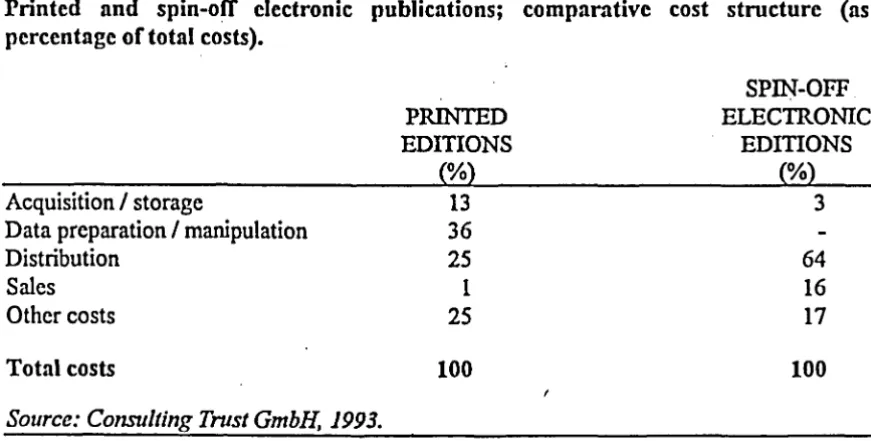
As Table 1 shows, the most attractive benefit of publishing print and electronic versions in parallel is the low spin-off costs of the electronic version (as a proportion of total costs). Print publishers can use the new media to improve internal efficiencies by adding more secondary media products and producing current products more economically for their present customers. Electronic publishing opportunities are not confined to traditional publishers but other content suppliers are also establishing themselves. Despite the lack of predictability over the development costs and market performance of electronic publishing technologies, European publishers have taken steps to incorporate this technology into
their overall company strategy. ·
Table"!
Printed and spin-off electronic publications; comparative cost structure (as percentage of total costs).
Acquisition I storage
Data preparation I manipulation Distribution
Sales Other costs Total costs
Source: Consulting Trost GmbH, 1993.
PRINTED EDITIONS
(%)
13 36 25
1
25
100
SPIN-OFF ELECTRONIC
EDITIONS
(%)
3 64 16 17
100
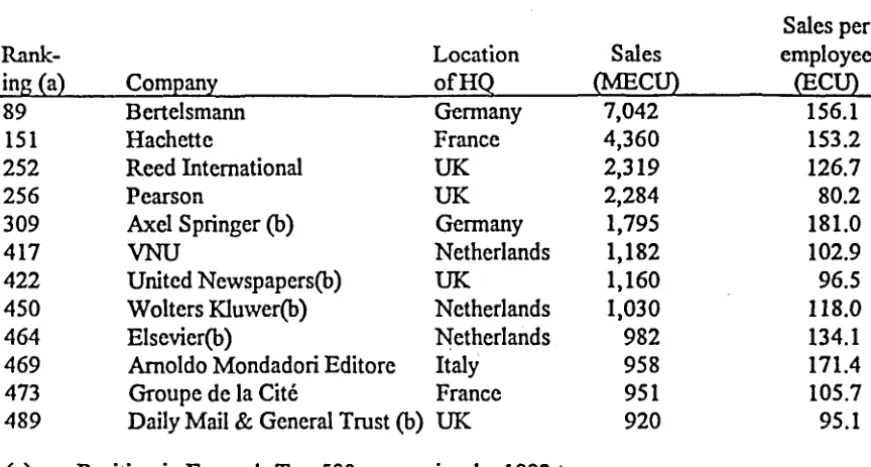
[image:22.543.70.506.390.610.2]Table 2
EC's top ranking publishing companies, by 1992 turnover.
Sales per
Rank- Location Sales employee
ing {a} ComE ani: ofHQ (MECU) (ECU)
89 Bertelsmann Germany 7,042 156.1
151 Hachette France 4,360 153.2
252 Reed International UK 2,319 126.7
256 Pearson UK 2,284 80.2
309 Axel Springer (b) Germany 1,795 181.0
417 VNU Netherlands 1,182 102.9
422 United Newspapers(b) UK 1,160 96.5
450 Wolters Kluwer(b) Netherlands 1,030 118.0
464 Elsevier(b) Netherlands 982 134.1
469 Amoldo Mondadori Editore Italy 958 171.4
473 Groupe de la Cite France 951 105.7
489 Daily Mail & General Trust (b) UK 920 95.1
(a) Position in Europe's Top 500 companies, by 1992 turnover. (b) Includes printing operation.
Source: International Management, 1993.
2.1.2 Traditional and alternative delivery media
There are three basic offline publishing media: paper, magnetic disc and optical disc. Traditional print products are progressively losing their guiding function in several areas and are no longer the exclusive attribute of intellectual activity. Of the alternative media available, those produced on optical storage media - magneto-optical re-writable disc storage and CD-ROM have the advantage of large capacity, robustness and relative cheapness. A recent study on opportunities in electronic publishing has found that for traditional publishers, offline publishing (CD-ROM, CD-I, memory cards, print-on demand etc.) is likely to be more attractive than online in the short to medium term. CD-ROM is currently the most used medium for offline information storage and has rapidly become a major area of activity within the publishing industry.
Considerable progress has also been made in developing alternatives, such as CD-ROM
XA, CD-I, CDTV, and DVI, which facilitate the combination of text, images and sound (multimedia). There are many examples of multimedia products already among Japanese and North American companies. · Besides the Grolier . Encyclopedia on CDTV/PC!Macintosh, these include Compton's Multimedia Encyclopedia which combines text, sound and pictures, Computer Select an on-going information dissemination/retrieval service, and Discis Talking Books - a range of multimedia electronic talking pictures books on CD-ROM aimed at young children. In contrast, there are few examples of European developed products, apart from Philips' CD-I (see Section 3. 7 .2), which was jointly developed with Sony.
publication called Screen Design for Computer-based Training (CBT), as part of a research programme looking at the usc of telemedia learning for the support of flexible learning using CBT methods. In the library sector, electronic books could be used as a means of storing, sharing and communicating large volumes of multimedia information. Polymedia workstations (i.e. using a combination of several different media, such as CD-ROM and magnetic disc) could be used to provide access to such systems and the mechanisms which would enable users to use and interact with both paper-based and electronic publications. Using telecommunications links it will then be possible to link together such workstations so as to achieve the global and dynamic sharing ofinformation.
2.1.3 Multimedia issues from tlte industry's perspective
European publishing companies (and broadcasters) arc in general far behind their US counterparts in their interest and participation in multimedia. Within Europe, the most active broadcasting companies are those in the UK, with most commercial broadcasters having an active interest (many are involved with Philips' CD-I). The British Broadcasting Corporation (BBC) has a special interest through its spin-off company, the Multimedia Corporation. Within the publishing sector, the most active company is Hachette, France's largest publishing company and communications group. It recently purchased Grolier, one of the US publishers most active in the field of multimedia. According to The Bookseller
(2.4.1993) total sales of Grolier's Encyclopedia arc more than one million copies. On 31 December 1992, Hachette merged with the defence and transport group, Matra. Matra's interests include telecommunications and satellite manufacturing.
These companies remain exceptions in Europe and on the whole European players who do have strengths in broadcasting and publishing arc hanging back on multimedia waiting to see what will happen, especially in establishing networks which tie together players from different sectors. Apart from Philips, European involvement in·networks generally centres on the United States. A large share of the revenues of the top European information/publishing companies, including those of Bertelsmann, Hachette and Reed come from there.
In 1992, a distribution scheme which addresses the problems of retail distribution was launched by Sony Electronic Publishing; the 'Affiliated Label' CD-ROM programme. Under the programme, Sony Electronic Publishing manufactures, markets and distributes education and entertainment titles from many leading US publishers. They will also feedback sales and demographic data back to the publishers, thereby helping identify sales trends and new market opportunities.
All of the major suppliers of application software in the USA have concentrated increasingly on multimedia applications of their products. This area is considered as one of the most promising markets, such that some have themselves entered electronic publishing. The strong US film and video industry also has a comparative advantage in multimedia publishing as compared with European actors. Moreover, major Japanese electronics companies are acquiring major US-based film and music companies, which gives both the USA and Japan favourable global positions in competition.
together to develop technologies, standards, concepts or products in the pre-marketing phase, starting to compete only once products have been launched on the market. In this case competition is based not on the different technologies or standards, but on product features and customer benefits. This approach allows all participants to agree on compatible concepts at a very early stage and develop products and contents in parallel thereafter. In addition to this, Japanese companies benefit from a high level of vertical integration in electronics, telecommunications and computing.
The pattern in Europe is beginning to take on some of these characteristics as product technologies converge and key players recognise the need for cross-sectoral, cross-border alliances and more intensive R&D integration in order to develop new information-based products and services. Increasingly all players in publishing, electronics and networking, will have to recognise the fact that these technologies are rapidly converging, driving alliances and joint ventures to form the new information industry.
2.2 Barriers to electronic publishing
For the foreseeable future electronic publishers will continue to face high marketing and . distribution costs. In this respect, schemes such as Sony's will be invaluable in identifying target groups and the level of readily available reading equipment. More difficult to overcome, for traditional print publishers, is a general lack of awareness and appreciation of the new media. Many publishing houses, drawing· on their experiences of the 1970s and 1980s, when many suffered losses in their attempts to produce new media, have expressed uncertainty about new technologies and have resisted further product innovation.
Publishers are also deterred by confusion and · uncertainty over standards. There are several personal computer operating systems and numerous ·search languages and protocols. Different proprietary software applications .requires the user to learn new procedures. Many publishers hold data in a format which would be difficult and costly to convert to another. Publishers are thus very much dependent on third parties, such as system integrators or developers, for electronic publishing skills.
The European market is highly fragmented and on the whole, has a low penetration rate of computers, reading devices, and terminals. The use of electronic information products varies significantly, from very well developed markets such the UK, France, and Italy to countries such as Portugal and Greece. Unlike the global market for real-time financial data services, patents, STM and newswire services, electronic publishing markets have so far been developed mostly within and for national markets; too often these are not large enough to offer the economies of scale and scope which are necessary to attract investment for product development.
The marketing problems of electronic publishing products are considerable, since the products are not directly accessible to users and require special reading devices with the appropriate search and retrieval software. Since it is not normally the content itself: but the enhanced access to it, that makes an electronic publishing product attractive, the only way to market the product is by encouraging the user to try it for her/himself: which in tum requires the appropriate distribution channels.
Multimedia products are likely to suffer the same problems as educational software has
areas for multimedia products. However, despite the large potential take-up in these markets, it is extremely hard for producers to recoup development costs, given financial constraints affecting potential users in the education sector and the fragmentation of markets and the lack of worldwide standards.
Other barriers include language barriers; only English language electronic information services have a world market, although individual languages such as Spanish in South and Central America or French in the former colonies have international significance. Just as online services and infonnation providers which do not operate in English are largely excluded, not only from the North American market, but also from much of the remaining markets, the same holds true for the European publishing market as a whole. The advantages to be gained by using English texts involves an even more costly and risky learning process for non-English publishers.
Pricing strategies are a key obstacle. It is very difficult to assess the true 'value' of an information product or service. The approach to pricing differs between traditional and non-traditional publishers. Electronic publishers will expect to make a profit on sales. Traditional publishers currently tend to consider these products as an incremental income source. The need to keep prices affordable will, in general, demand mass production of products and a reasonable degree of standardisation of reading device designs, disc media and disc loading processes. If either the cost or production speed requirements for competing with particular types of current print products cannot be met, then alternative significant advantages will be needed that will enable effective indirect competition with print.
Most print publishers own copyright in a single medium whereas other media producers often have comprehensive copyrights. This gives them a higher leverage in multimedia. Given that most global players in movie and music production are non-European, this leaves many European publishers exposed in trading rights. If they fail to establish multimedia cooperations and strategic alliances at an early enough stage, many publishers will be unable to exploit the potential electronic publishing markets, especially if they wait until the point when the operating costs of electronic alternatives fall below those of print. Journal publishers believe this transition will occur before the tum of the century, as paper and mail costs increase rapidly and exceed telecommunications and data storage and processing costs, (especially as Commission initiatives to further liberalise and harmonise telecommunications services are well advanced). The potential high cost of increasingly shorter print production runs is another factor which can have a significant bearing on the switch to electronic media.
2.3 New opportunities for traditional publishers
Despite the barriers to entry outlined above; electronic publishing offers significant new market opportunities for traditional publishers. Table 3 reviews the key European market segments for print publishing in 1992 and assesses the potential for replacement by electronic publication by the year 2000.
Within the book market, the greatest potential for electronic products is likely to be in children's publishing. This is because children in general are greatly attracted by electronic media and this, taken together with the growth in the video games industry, is expected to lead to a significant, worldwide installation base of compact disc readers. This global hardware base, although presently tailored to the needs of interactive games, could be exploited by electronic publishers in cooperation with video games suppliers. Other important market segments include directories, reference material, legal, S1M, education, hobbies and special interest.
Table3
Electronic publishing; market potential in key European traditional print publishing market segments, 1992 and 2000.
Traditional print publishing markets
1992 2000
(MECU) (MECU)
Books 18,500 27,200
Magazines 22,000 32,500
Newspapers 25,000 37,000
Corporate 10,000 15,000
Total 75,000 111,700
Electronic publislting markets in 2000
Potential for Market
electronic forecast
publishing (MECU)
{Eercentage share}
Books 8~18% 3,480
Magazines 5-15% 3,250
Newspapers 5~10% 2,775
Corporate 10~25% 2,625
Total 12,130
Source: Consulting Trost GmbH, 1993.
One of the RACE II programme activities (see section 1.2.2) includes the Telepublishing Project, which involves sixteen partners and is coordinated by Deutsche Telepost Consulting GmbH. One of the sub-projects of the programme which ran throughout 1992 was the Individualised Electronic Newspaper (lEN). Users receive individually composed newspapers based on a profile specified in advance. Another project, part of the Europublishing project, is the development of a multimedia dictionary of art using data supplied by UK publisher Macmillan. The project is designed to identify gaps between those in the academic world developing original technical work and publishers like Macmillan. It involves developing a "publication development environment" within which new and existing systems arc integrated to provide a platform for demonstrating parallel publishing (publishing in both print and electronic form) and the development of innovative publishing products. The second project, DIDOS (Distributed Document Services), involves technical documentation and aims to create a "distributed service centre" to provide, via ISDN and broadband networks, authoring, editing, composition, printing and multimedia services to those producing technical documents. The overall aim is to make open access to advanced authoring, production and distribution methods available across Europe.
There exist many opportunities for new 'generic' applications which are relevant to electronic publishing. These include multimedia information handling, offered via high speed networks such as the US National Research and Education Network (NREN) and the UK Joint Academic Network (JANET), tcleshopping, tcleworking and multimedia confcrencing. Teleworking provides the opportunity for workers to enjoy a more flexible working life and for employers it is accepted as having the potential to foster a higher level of productivity as employees are removed from the distractions of the office. These developments are not without concern, 'however, especially from the users• point of view. The concentration of publications in an ever smaller number of multinational conglomerates threatens to create a ncar monopoly on commercial information transfer. The notion of intellectual property becomes difficult when material is 'published' across networks.
2.4 Cross-sector, cross-border alliances and Europe's electronic information services sector
2.4.1 Data-Star/Knigltt-Ridder
The uncontested acquisition of Data-Star by Knight-Riddcr, in March 1993, raised important issues for the future of Europe's emerging electronic information services.sector. Data-Star, owned by Radio Suisse AG, was the leading European supplier of text and bibliographic information in electronic form. Knight-Ridder Inc. is the owner of DIALOG Information Services, which is one of the world's leading database hosts. Before the merger, DIALOG was Data-Stars main competitor in the European market, especially in the area of biomedicine and hcalthcare. Knight-Ridder has other substantial interests besides DIALOG, including newspaper publishing and popular television. The merger effectively gives Data-Stars main competitor enhanced access to European markets and distribution rights to a number of key European sources of business, biomedical and other scientific information. This, in turn, raises wider issues relating to industry concentration and cross-media ownership.
The EC has considerable over-capacity in the database distribution sector. The market is highly fragmented and there are no hosts in the text and bibliographic area to match either the market share or the pan-European marketing capability of Knight-Ridder following the acquisition ofData-Star. This will intensify competition in a market segment where host revenues are already being eroded by a trend for database producers to sell information direct (typically in the form of CD-ROM). These factors will make business conditions more difficult for EC-based hosts, and may possibly force some hosts to leave the market. Despite the potential opportunities of the single European :market, few pan-European information services ·have been brought to the marketplace. The persistence of technical, linguistic, administrative and legal barriers continue to hamper the emergence of a truly common European market for information services and considerable effort and investment still has to be made if these barriers arc to be overcome. ·
A
difficult question facing European actors in the information services sector is to what extent such investment can or should be European, given that overseas investment might provide the desired impetus to the development of a strong European industry.The acquisition of Data-Star .demonstrates the powerful trends operating within the electronic infonnation services sector which favour both the rationalisation and consolidation of large 'supermarket'-type hosts operations. It is increasingly important for· the Commission of the EC to respond to these trends by creating an appropriate framework in which the potential strengths of European electronic information services can be maintained and developed, without endangering the 'level playing field'.
2.4.2 Reed International/Elsevier
Reed/Elseviers combined sales of 3.2 BECU in 1992 (see Table 2) makes it a colossus among quoted publishing and information companies; the group should now have the necessary financial strength, technical expertise and access to global markets to enable it to enter into the development of electronic publishing and to make further strategic acquisitions.
As part of this strategy, Reed/Elsevier have reached an agreement to acquire at least a controlling interest in Editions Techniques, the largest general legal publisher in France. It has also signed a letter of intent to purchase Official Airlines Guide (OAG). Reed/Elsevier already owns ABC airlines guide and has argued that combining the two will allow the business to compete more effectively with the electronic systems now being operated by many airlines.
2.4.3 US JVestiTime-Warner
US West, one of the seven US regional "BabyBells" is to invest US$ 2.5 billion in Time-Warner Entertainment, part of Time-Time-Warner, the US media and entertainment conglomerate; US$ 1 billion of equity is to be used for the five-year investment programme in Time Warners planned fibre-optic 'full service• network, an interactive cable-based home entertainment and communications network. In return for this investment, Time-Warner hopes to benefit from US West's detailed knowledge of network switching which facilitates efficient tracking and billing of transactions. US West also has direct experience of working alongside a cable company, having linked up with Tele-Communications (TCI), the largest US cable television operator, to provide telephone and cable services in the UK. TCI is also Time-Warners arch rival.
Once fully optical networks are in operation, the price of data transmission will fall dramatically. Profits will be made in the main from value added services such as high-speed computing, video telecommunications, information and entertainment. US West will be well placed to exploit this profit potential, as will TCI.
This merger illustrates US cable and telecommunications companies' willingness to collaborate in the building of America's 'information superhighways• rather than compete with each other as was initially expected. This reflects a growing realisation that data highways require technical expertise of telecommunications operators to build the necessary switched networks. Cable television companies lack the necessary capital to meet the required investment costs themselves; nor are they allowed to pass on those costs to their customers, since price rises are limited by the Federal Communications Commission (FCC). Likewise telecommunications opefators recognise the value of links with cable companies who are ahead on certain technologies, such as digital compression. The impact that new technologies are having on the regulatory framework is also significant. Cellular networks for example, are in direct competition to the local-exchange monopolies.
2.5 Legal nnd regulatory issues
the fact, whether a Gennan service provider markets its products via a French host, or whether an English customer of a database service has access to an information pool in The Netherlands.
2.5.1 Copyright and intellectual property
Electronic publishers can refer to known and conventional legal structures for guidance on legal copyright issues. They must always ensure they have the appropriate rights of a publication that is to be published. However, ambiguities and uncertainties over copyright status have led to operators relying increasingly on contracts, rather than copyright law, to regulate their trading relationships. This can still lead to problems, especially where reference to editions in electronic fonn is omitted.
The threat of piracy is a serious concern to the publisher and content owner and many book publishers fear that if they put their books on to an optical disk, this will encourage copying and potential loss of revenue. Also;" as transborder infonnation flows increase, there has been some pressure on the Commission to take action to establish a legal framework for copyright which is coherent and consistent for both print and non-print material.
In the EC, copyright and related rights are considered to be intellectual property items. A framework of intellectual· property rights already exists. The. problem is how to make this ·framework work effectively. In so far as both copyright and related rights are concerned, · the tenns of protection differ considerably within individual Member States, despite global adherence to the Berne Convention. The Convention insists on a minimu111 protection period of 50 years, but allows for countries to extend this if they wish -Gennany, France and Spain do so. The Berne Convention on copyright is based on the application of the principle of 'national treatment', which essentially states that a member country must . accord the same protection to works by nationals of other member countries as it does to
works of domestic origin.
During 1992 the Commission published two Draft Directives concerning copyright. The first, which proposed that copyright protection on literary works· be extended from 50 to 70 years, was approved in June 1993; for electronic publishers the impact is likely to be small, although it could prove to be marginally negative in that it puts Community countries out of line with the USA.
The second, the draft Directive on the Legal Protection of Databases relates more directly to electronic copyright. It was introduced by the Commission partly to overcome the ambiguities outlined above, partly to address the potential for widespread pirating of databases and, finally, in order to enable the EC infonnation industry as a whole to challenge the US, where a coherent and ~onsistent framework already exists. The Draft Directive:
0 clearly and unambiguously defines what constitutes a database
Oconfinns that databases are to be protected as Literary Works under copyright law