first spectroscopy of S 45
.
White Rose Research Online URL for this paper:
http://eprints.whiterose.ac.uk/105380/
Version: Accepted Version
Article:
Gade, A., Tostevin, J. A., Bader, V. et al. (13 more authors) (2016) Single-particle structure
at N=29 : The structure of Ar 47 and first spectroscopy of S 45. Physical Review C.
054315. ISSN 1089-490X
https://doi.org/10.1103/PhysRevC.93.054315
[email protected] https://eprints.whiterose.ac.uk/
Reuse
Items deposited in White Rose Research Online are protected by copyright, with all rights reserved unless indicated otherwise. They may be downloaded and/or printed for private study, or other acts as permitted by national copyright laws. The publisher or other rights holders may allow further reproduction and re-use of the full text version. This is indicated by the licence information on the White Rose Research Online record for the item.
Takedown
If you consider content in White Rose Research Online to be in breach of UK law, please notify us by
Single-particle structure at
N
= 29
: The structure of
47Ar and first spectroscopy of
45S
A. Gade,1, 2 J. A. Tostevin,3 V. Bader,1, 2 T. Baugher,1, 2 D. Bazin,1 J. S. Berryman,1
B. A. Brown,1, 2 C. Aa. Diget,1,∗ T. Glasmacher,1, 2 D. J. Hartley,4 E. Lunderberg,1, 2 S.
R. Stroberg,1, 2,† F. Recchia,1 A. Ratkiewicz,1, 2,‡ D. Weisshaar,1 and K. Wimmer5, 1,§
1
National Superconducting Cyclotron Laboratory, Michigan State University, East Lansing, Michigan 48824, USA
2Department of Physics and Astronomy, Michigan State University, East Lansing, Michigan 48824, USA 3Department of Physics, University of Surrey, Guildford, Surrey GU2 7XH, United Kingdom
4Department of Physics, U.S. Naval Academy, Annapolis, Maryland 21402, USA 5Department of Physics, Central Michigan University, Mount Pleasant, Michigan 48859, USA
(Dated: April 22, 2016)
Comprehensive spectroscopy of theN = 29 nucleus47Ar is presented, based on two
complemen-tary direct reaction mechanisms: one-neutron pickup onto46Ar projectiles and one-proton removal
from the 1−ground state of48K. The results are compared to shell-model calculations that use the
state-of-the-art SDPF-U and SDPF-MU effective interactions. Also, from the 9Be(46Cl,45S+γ)X
one-proton removal reaction, we report the firstγ-ray transitions observed from45S. Using
compar-isons with shell-model calculations, and from the observed intensities and energy sums, we propose a first tentative level scheme for45S.
I. INTRODUCTION
The region around the neutron-rich N = 28 isotones
46Ar, 44S and 42Si has provided much insight into the
changes to nuclear structure that occur in neutron-rich nuclei. First evidence for a breakdown of the N = 28 magic number in 44S, from an emergence of
collectiv-ity, was hinted at by β-decay work [1] and was ulti-mately quantified with intermediate-energy Coulomb ex-citation [2, 3]. More recently, shape- and configuration-coexistence was established in 44S [4–7], adding to the
rich structure observed at neutron number N = 28 in the sulfur isotopes. Beyond N = 28, only the energy of the first excited 2+ state in 46S has been reported [8].
Two protons below, in 42Si, excitations (of quadrupole
nature) across the reducedN = 28 andZ = 14 sub-shell gaps mutually enhance one another, contributing to de-formation and making42Si the most collective nucleus in
the region [9, 10]. No spectroscopic information is avail-able beyondN = 28 in the silicon isotopes. Shell-model calculations in the sd-pf shell, using the SDPF-U [11] and SDPF-MU [10] effective interactions, have been very successful in describing the available experimental obser-vations for 44S [4, 5] and 42Si [9, 12], which are related
to collectivity and shape.
The less-neutron-rich 46Ar system, located between
doubly-magic 48Ca and collective 44S on the nuclear
chart, has challenged the existing shell-model (SM) de-scriptions. While some observables, for example those
re-∗Present address: Department of Physics, University of York,
Hels-ington, York YO10 5DD, United Kingdom
†Present address: TRIUMF, Vancouver, British Columbia V6T
2A3, Canada
‡Present address: Lawrence Livermore National Laboratory,
Liv-ermore, California 94551, USA
§Present address: Department of Physics, The University of Tokyo,
Hongo, Bunkyo-ku, Tokyo 113-0033, Japan
lated to the masses of the Ar isotopes aroundN = 28 [13], are well described, calculations appear to over-predict the B(E2) excitation strength to the first 2+ state [2, 14–
16]. This result is not without controversy, on the ex-perimental side, where an excited-state lifetime measure-ment yields higher collectivity, in agreemeasure-ment with the shell model [17], but is at odds with several Coulomb excitation measurements that consistently yield a lower B(E2) value [2, 14, 16]. Using an inverse kinematics
46Ar(d, p) reaction, states in47Ar with significant
single-neutron spectroscopic strength were measured [18] and were used in the development of the SDPF-U SM effec-tive interaction [11]. BeyondN = 28,B(E2) transition strengths were measured for47,48Ar [15], andγ-ray
spec-troscopy following deep-inelastic reactions [19] and nu-cleon exchange [8] were performed for47,48Ar and48Ar,
respectively. Most recently, excited states of 50Ar were
populated for the first time in secondary fragmentation reactions [20].
Here we present a new study of 47Ar using two
com-plementary intermediate-energy direct nuclear reactions: (i) the neutron-adding12C(46Ar,47Ar+γ)X reaction, and
(ii) the9Be(48K,47Ar+γ)X proton removal reaction. We
also report the first spectroscopy of45S, populated in the
one-proton removal reaction from46Cl projectiles.
II. THEORETICAL DESCRIPTION
A. Shell model calculations
We employ shell-model calculations made with the SDPF-U [11] and the more recent SDPF-MU [10] effective Hamiltonians. These Hamiltonians were designed to be used in a model space with the full set of configurations made from protons in the (2s1/2,1d5/2,1d3/2) (sd) set of orbitals and neutrons in
the (2p3/2,2p1/2,1f7/2,1f5/2) (pf) set of orbitals. The
cal-culations were carried out with the code NuShellX [21]. The former (SDPF-U), tuned for 0¯hω-truncatedpf-shell calculations of neutron-rich silicon isotopes, incorporated theoretical and empirical information that enhanced re-liability for these isotopes. The latter (SDPF-MU) the-oretical study incorporated and clarified the importance of including tensor-force components in thesd-pf cross-shell proton-neutron interaction for reproducing the mea-sured 2+1- and 4
+
1-state energies and theB(E2,0 +
→2+)
values in the silicon and sulfur isotopes near N ≈28 – including the energy of the (tentatively) assigned 42Si
4+
1 state in Ref. [22]. Wave functions and spectroscopic
factors,C2S, are computed for both interactions and all
final states below the one-neutron emission thresholds of the47Ar and45S residual nuclei.
B. Reaction model calculations
1. Proton-removal calculations
The use of the nucleon-removal reaction technique for the spectroscopy of nuclei produced as fast secondary beams is now well established [23], exploiting both their high detection efficiency and sizeable cross sections. The key approximations made, of eikonal dynamics and spec-tator cores, were recently summarized in Ref. [24]. We first detail the parameters used in the proton-removal calculations from48K. A9Be reaction target was used at
an incident beam energy (at mid-target) of 87.5 MeV/u. Here, Jπ
i,f will label the spins and parities of the 48K
projectile ground state (i) and of the47Ar residue states
(f). The active single-particle orbitals, α≡[nℓj], from which the proton is removed are denotedψα. The model
inputs use the systematic approach detailed in Section III of Ref. [25]. The geometries of the complex residue-and proton-target distorting potentials are deduced from the neutron and proton densities of 47Ar and the 9Be
target density. The47Ar-target interaction is calculated
using the double-folding (tN Nρcρt) model with an
effec-tive nucleon-nucleon (NN) interactiontN N. The
proton-target interaction is calculated using the single-folding (tN Nρt) model. The 47Ar density (ρc) is taken from
a spherical Skyrme (SkX interaction [26]) Hartree-Fock (HF) calculation. A Gaussian density (ρt) with rms
ra-dius of 2.36 fm is assumed for9Be. t
N N is also assumed
to be Gaussian [27] with a range parameter 0.5 fm. Its (complex) strength was determined from: (a) the free NN
cross sections, and (b) the ratio of the real-to-imaginary parts of the forward scattering NN amplitude for 100 MeV/u, as tabulated by Ray [28].
The geometries of the Woods-Saxon (WS) potentials that bind the removed protons are deduced from the root mean squared (rms) radii of the active proton orbitals from HF calculations for48K. These WS potentials have
a fixed diffuseness a0 = 0.7 fm and spin-orbit strength
Vso = 6 MeV. The deduced radius parameters,r0, were
1.287, 1.325, and 1.324 fm for the 2s1/2, 1d3/2and 1d5/2
orbitals, respectively. The WS potential depth for each ψα was adjusted to reproduce the physical separation
energy for the removal reaction to each final state, i.e. Sf i
p =Sp+Ef, whereSp is the state to
ground-state proton separation energy of 14.362 MeV [29]. The same approach was used for the proton-removals from46Cl(Jπ
i) where the incident beam energy (at
mid-target) is 86.6 MeV/u. Here, the deduced 2s1/2, 1d3/2
and 1d5/2 bound states radius parameters r0 are 1.292,
1.332, and 1.323 fm, and the ground-state to ground-state proton separation energy is 17.10 MeV [29].
Table I shows the details of the calculated single-particle cross sections for 48K (with C2S = 1, and
de-notedσsp
α), being the contributions from eachψαorbital
to the given final state. Calculations using the C2S of
the48K(1−
1) SDPF-U and the SDPF-MU SM wave
func-tions are also shown. The SM level energies are used. In constructing the theoretical cross sections, the sd-shell SMC2S are multiplied by the (near-unity) [A/(A−1)]2
center-of-mass correction. We show the theoretical cross sections for eachα,σth
α, and for each final state,σth(Jfπ),
the sums of theαcontributions. All energies are in MeV and all cross sections are in mb. We have assumed here the 1− ground-state spin assignment of48K [30].
Table II collects a summary of these 48K(1− 1) to 47Ar(Jπ
f) partial cross sections for the SDPF-U and
SDPF-MU SM wave functions. Also shown are the cross-section-weighted asymmetries, ∆S=Sf i
p −Sn, of the
ef-fective proton and neutron separation energies from48K,
for whichSn = 4.644 MeV [29].
The corresponding summary of partial cross sections for the proton removal reaction from46Cl(1−), using both
the SDPF-U and SDPF-MU SM wave functions, is pre-sented in Table III. The neutron separation energy from
46Cl, used in the cross-section-weighted asymmetry ∆S,
is nowSn = 3.52 MeV [29] (see Section III.B for a
dis-cussion on the ground-state spin of46Cl).
2. Neutron-pickup calculations
The 46Ar(12C,11C)47Ar neutron pickup calculations
follow the distorted wave Born approximation (DWBA) approach discussed in Ref. [31] and its supplemental in-formation [32]. This approach produces the optimal the-oretically and experimentally constrained data set used here. The neutron-pickups from 12C are assumed to
populate the Iπ = 3/2−
3
TABLE I: Calculated partial cross sections to47Ar(Jπ
f) final states, with energyEf, following proton removal from48K. The 48K beam energy is 87.5 MeV/u on a 9Be target. The calculations take the spectroscopic factors, C2S, from SDPF-U and
SDPF-MU interaction shell model calculations and assume the48K ground-state is theJπ
i = 1−1 shell model state. The shell
model energies are used. The48K 1−
1 state for the SDPF-U and SDPF-MU shell model interactions lies at 395 and 262 keV,
respectively. The theoretical cross sections include the [A/(A−1)]
2 center-of-mass correction for removals from thesd-shell.
Jπ
i Jfπ ψα Ef σspα C2S σαth σth(Jfπ) Ef σαsp C2S σthα σth(Jfπ)
(MeV) (mb) (SDPF-U) (mb) (mb) (MeV) (mb) (SDPF-MU) (mb) (mb)
1−
1 3/2
− 2s
1/2 0.000 10.15 0.1954 2.069 3.931 0.000 10.15 0.2446 2.590 4.328
1d3/2 7.95 0.2181 1.809 7.95 0.2016 1.672
1d5/2 9.30 0.0055 0.053 9.30 0.0068 0.066
1−
1 1/2
− 2s
1/2 1.139 9.67 0.0014 0.014 0.367 0.931 9.76 0.0000 0.000 0.091
1d3/2 7.65 0.0443 0.353 7.70 0.0113 0.091
1−
1 5/2
− 1d
3/2 1.277 7.61 0.4037 3.205 3.655 1.139 7.65 0.4530 3.613 4.185
1d5/2 8.88 0.0486 0.450 8.92 0.0615 0.572
1−
1 7/2
− 1d
5/2 1.575 8.78 0.0428 0.392 0.392 1.371 8.85 0.0578 0.533 0.533
1−
1 3/2
− 2s
1/2 2.125 9.29 0.2680 2.598 2.604 1.918 9.37 0.1073 1.049 1.202
1d3/2 7.41 0.0003 0.002 7.45 0.0192 0.149
1d5/2 8.62 0.0004 0.004 8.68 0.0004 0.004
1−
1 5/2
− 1d
3/2 2.836 7.24 0.0404 0.305 0.522 2.379 7.35 0.0246 0.188 0.284
1d5/2 8.42 0.0247 0.217 8.54 0.0107 0.095
1−
1 5/2
− 1d
3/2 3.384 7.12 0.0001 0.001 0.003 2.752 7.26 0.0144 0.109 0.124
1d5/2 8.27 0.0003 0.003 8.44 0.0017 0.015
Incl. 1.29 11.47 1.21 10.75
TABLE II: Summary of the calculated48K(1−) to47Ar(Jπ f)
proton-removal partial cross sections using the SDPF-U and SDPF-MU shell-model wave functions, collected from Table I. The shell-model energies are used. The calculated par-tial cross-section-weighted asymmetries, ∆S =Sf i
p −Sn, of
the proton and neutron separation energies from48K are also
shown.
SDPF-U Ef(U) σth(U) SDPF-MU Ef(MU) σth(MU) 47Ar(Jπ
f) (MeV) (mb) 47Ar(Jfπ) (MeV) (mb)
3/2− 0.000 3.931 3/2− 0.000 4.328
1/2− 1.139 0.367 1/2− 0.931 0.091
5/2− 1.277 3.655 5/2− 1.139 4.185
7/2− 1.575 0.392 7/2− 1.371 0.533
3/2− 2.125 2.604 3/2− 1.918 1.202
5/2− 2.836 0.522 5/2− 2.379 0.284
5/2− 3.384 0.003 5/2− 2.752 0.124
Incl. (mb) 11.47 10.75
∆S(MeV) 10.83 10.55
3/2−
2 (4.8 MeV) bound final states of 11C. For these 12C neutron-removal vertices (overlaps) we use the
ex-tracted spectroscopic factors (SF) from the analyses of final-state-exclusive12C(e, e′p) proton-removal
[image:4.612.316.564.452.639.2]measure-ments, as presented in Table 8 of Ref. [33], of 1.72(11), 0.26(2), and 0.20(2), respectively. In the present 47Ar
TABLE III: Summary of the calculated proton-removal par-tial cross sections from 46Cl(1−) at 86.6 MeV/u, based on
the SDPF-U and SDPF-MU shell-model wave functions. The shell-model energies are used. The calculated partial cross-section-weighted asymmetries, ∆S=Sf i
p −Sn, of the proton
and neutron separation energies from46Cl are also shown.
SDPF-U Ef(U) σth(U) SDPF-MU Ef(MU) σth(MU) 45S(Jπ
f) (MeV) (mb)
45S(Jπ
f) (MeV) (mb)
3/2− 0.000 2.848 3/2− 0.000 3.425
1/2− 0.633 1.588 1/2− 0.239 0.589
7/2− 0.746 0.138 3/2− 0.941 0.778
3/2− 1.098 0.449 5/2− 1.109 2.702
7/2− 1.394 0.244 7/2− 1.148 0.379
5/2− 1.473 0.650 5/2− 1.421 0.103
5/2− 2.045 0.188 3/2− 1.680 0.889
1/2− 2.079 0.592 1/2− 2.001 0.173
3/2− 2.101 0.963 3/2− 2.156 0.252
7/2− 2.161 0.030 – – –
Incl. (mb) 7.69 9.29
∆S (MeV) 14.46 14.34
case, the reduced radii,r0, from the (Hartree-Fock
con-strained) Woods-Saxon neutron potentials, that bind the 2p3/2, 2p1/2, 1f7/2 and 1f5/2 orbitals, are 1.069, 1.095,
[image:4.612.53.300.464.611.2]the same fixed diffuseness a0 = 0.7 fm and spin-orbit
interaction strength Vso = 6.0 MeV as in the removal
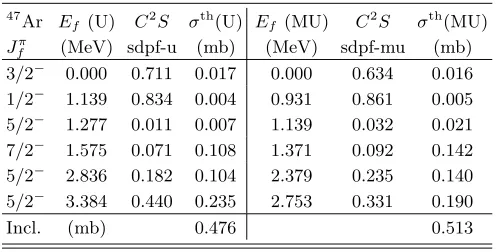
calculations. A summary of the calculated cross sections to the SDPF-U and SDPF-MU47Ar(Jπ
f) SM final states
[image:5.612.322.554.51.193.2]are presented in Table IV.
TABLE IV: Summary of the calculated partial cross sections for the46Ar(12C,11C)47Ar(Jπ
f) neutron-pickup reaction at 62
MeV/u for those bound47Ar(Jπ
f) final states with significant
spectroscopic factors. Theσth(U) andσth(MU), that use the
SDPF-U and SDPF-MU SM wave functions and overlaps, are the sums of the yields to the 3/2−
1(g.s.), 1/2
−
1(2.0 MeV), and
3/2−
2(4.8 MeV)
11C final states. The shell model energies are
used.
47Ar E
f (U) C2S σth(U) Ef (MU) C2S σth(MU)
Jπ
f (MeV) sdpf-u (mb) (MeV) sdpf-mu (mb)
3/2− 0.000 0.711 0.017 0.000 0.634 0.016
1/2− 1.139 0.834 0.004 0.931 0.861 0.005
5/2− 1.277 0.011 0.007 1.139 0.032 0.021
7/2− 1.575 0.071 0.108 1.371 0.092 0.142
5/2− 2.836 0.182 0.104 2.379 0.235 0.140
5/2− 3.384 0.440 0.235 2.753 0.331 0.190
Incl. (mb) 0.476 0.513
III. EXPERIMENTS AND DISCUSSION
All measurements described in the present work were performed at the Coupled Cyclotron Facility at the Na-tional Superconducting Cyclotron Laboratory (NSCL) on the campus of Michigan State University.
The particle identification for all measurements was performed event-by-event with the focal-plane detection system of the large-acceptance S800 spectrograph [34]. The energy loss measured with the S800 ionization cham-ber and time-of-flight information, taken between plastic scintillators, corrected for the angle and momentum of each ion, were used to unambiguously identify the re-action residues emerging from the target. The particle-identification spectra for 47Ar and 45S from one-proton
removal are shown in Fig. 1(a) and (b), as examples. Gamma-ray detection was performed with SeGA [35] or GRETINA [36], set up around the target position of the S800 spectrograph. The photopeak efficiency of each array was calibrated with standard sources and corrected for the Lorentz boost of theγ-ray distribution emitted by the residual nuclei moving at more than 30% of the speed of light. Theγ-ray intensities, corrected for the efficiency and indirect feeding, were used to derive the partial cross sections for the population of individual final states.
En
e
rg
y
lo
ss
(a
rb
.
u
n
it
s)
18+
48K
Time of flight (arb. units)
Ar
47
Ar
46
S
45
S
44
16+
46
Cl
(a) (b)
FIG. 1: (Color online) Particle identification spectra for the one-proton removal reactions to: (a)47Ar, and (b)45S, used
to determine the inclusive cross sections. The most intense structure in each spectrum is the hydrogen-like charge state of the projectile beam.
A. 47Ar populated in one-neutron pickup and one-proton removal
For the12C(46Ar,47Ar+γ)X one-neutron pickup
reac-tion, the secondary beam of46Ar (100% pure) was
pro-duced from a 140 MeV/u stable48Ca primary beam
in-teracting with a 1363 mg/cm2 9Be production target in
the A1900 fragment separator [37]. A 240 mg/cm2 Al
degrader was used for separation. A comparably thick production target was used to degrade the beam energy to 67 MeV/u to increase the pickup cross section (see the discussion in Ref. [31]). The total momentum ac-ceptance of the A1900 was restricted to ∆p/p= 0.25%, resulting in an on-target rate of about 3 ×10⁵ 46Ar/s.
A 149 mg/cm2 glassy carbon target was used to induce
the one-neutron pickup reaction. The high-resolution γ-ray detection system GRETINA [36], an arγ-ray of 36-fold segmented high-purity Ge detectors, surrounded the tar-get position and measured the prompt γ rays emitted by the reaction products. The seven GRETINA mod-ules, with four crystals each, were arranged in two rings. Four modules were located at 58◦ center angle with
re-spect to the beam axis and three modules occupied adja-cent positions in the 90◦ ring. Online signal
decomposi-tion providedγ-ray interaction points for event-by-event Doppler reconstruction of the photons emitted in flight at 30% of the speed of light. The momentum vector of projectile-like reaction residues, as obtained from trajec-tory reconstruction through the S800 spectrograph, was incorporated into the Doppler reconstruction. The re-sultingγ-ray spectrum is shown in Fig. 2(a).
For clean particle identification, γ-ray coincidences were required to eliminate a tail of unreacted46Ar
jectiles entering the focal plane. Due to this small pro-jectile beam contamination, absolute partial cross sec-tions could be cleanly extracted for the excited states, but only an upper limit can be deduced for the inclusive and ground state cross sections (σ+1n
[image:5.612.53.302.226.352.2]5
As shown in Ref. [31], the spin alignment in fast-beam one-nucleon pickup is strong. Thus, because of its broad angular coverage, theγ-ray angular distributions have to be taken into account for a precise determination of the in-beam γ-ray efficiency of the GRETINA array. Here, for mixedM1/E2 transitions, we used the multipole mix-ing ratiosδfrom the SDPF-MU shell model calculations to determine the angular distributions and account for their effect on the in-beamγ-ray efficiency of GRETINA. A 10% systematic uncertainty was added to the intensi-ties of transitions with mixed M1/E2 multipolarity to account for the uncertainty introduced by this choice. The statistics were not sufficient for an angular distribu-tion analysis as presented in [31].
For the 9Be(48K,47Ar+γ)X one-proton removal
reac-tion, the secondary beam of 48K (100% pure) was
pro-duced from a 140 MeV/u stable primary beam of 48Ca
impinging on a 705 mg/cm2 9Be production target at
the entrance of the A1900 fragment separator [37] and separated using a 390 mg/cm2 Al degrader. The total
momentum acceptance of the A1900 was restricted to ∆p/p = 0.5%, yielding a rate on target of 1.1 × 10⁵ 48K/s. The 376 mg/cm2 thick 9Be reaction target was
surrounded by SeGA, an array of 32-fold segmented high-purity germanium detectors [35]. The high degree of seg-mentation enables event-by-event Doppler reconstruction of the energies of γ rays emitted in flight by the reac-tion residues. The emission angle needed for the Doppler reconstruction was determined from the position of the segment that registered the largest γ-ray energy depo-sition. The 16 detectors of SeGA were arranged in two rings with 90◦and 37◦central angles with respect to the
beam axis. Seven detectors were located at 37◦, while the
90◦ring was equipped with nine detectors. The resulting
γ-ray spectrum is shown in Fig. 2(b).
The inclusive cross section for the9Be(48K,47Ar)X
one-proton removal reaction, of σ−1incp = 5.4(3) mb, was
de-rived from the yield of47Ar reaction residues divided by
the number of incoming 48K projectiles relative to the
number density of the reaction target. A systematic un-certainty of 5%, attributed to the stability of the incom-ing beam for normalization, has been added in quadra-ture to the statistical uncertainty. This inclusive cross section was determined in a dedicated run with 47Ar
centered in the S800 focal plane. The high-statistics set-ting for the measurement of partial cross sections is the one run in the measurement described in [8], with the low-momentum tail slightly cut, possibly introducing an ℓ-dependent uncertainty in the determination of the par-tial cross sections relative to the total number of 47Ar.
A conservative 10% systematic uncertainty was added in quadrature to the statistical uncertainty of the partial cross sections deduced from theγ-ray data.
The γ-ray spectra in Fig. 2(a) and (b) highlight the complementarity of the two direct reaction mechanisms used to populate excited states in47Ar, with rather
dif-ferent intensity patterns and the unique observation of some states in one of the reactions only. As is
dis-0
1000 2000 3000 4000
100 500 1000
200
100 270
0
C
o
u
n
ts
/
1
0
ke
V
C
o
u
n
ts
/
8
ke
V
Energy (keV)
Ar
470 2 4
6 515
1017
-2 coinc. with 1231 keV 515(3)
1
0
1
7
(4
)
1231(4)
1
5
3
0
(4
)
1
6
9
2
(5
)
1744(5) 3438(7)
48K-1p
Ar
4746Ar+1n
516(5)
1
0
1
8
(7
)
9
5
5
(6
)
1229(5)
1745(6) 2188(8)
(a)
[image:6.612.325.550.52.321.2](b)
FIG. 2: Event-by-event Doppler reconstructed γ-ray spec-tra of 47Ar: (a) as detected with GRETINA following 12C(46Ar,47Ar+γ)X one-neutron pickup (v/c = 0.337)
us-ing nearest neighbor addback, and (b) one-proton removal
9Be(48K,47Ar+γ)X with γ-ray spectroscopy using SeGA
(v/c= 0.4). The inset to (a) shows a coincidence spectrum with a software gate applied on the 1231 keV line indicating that the 515, 1016, and 1231 keV transitions are in coinci-dence.
cussed in Ref. [31], the fast-beam-induced one-neutron pickup reaction selectively populates states with high or-bital angular momenta; i.e. ℓ = 3 in the case of the
12C(46Ar,47Ar+γ)X reaction. States with ℓ = 4 have
been suggested above the neutron separation energy [18] but cannot be observed in the present work in the ab-sence ofγ-ray branches. The high coincidence efficiency of GRETINA allowed for the use of γγ coincidences to establish the level scheme. Such a coincidence spectrum is shown as inset to Fig. 2(a) where the 1231-keV tran-sition was clearly found in coincidence with γ rays at 515 keV and 1017 keV. For47Ar produced in one-proton
removal from48K, SeGA’s coincidence efficiency and the
statistics (in all lines but 1229(5) keV) are too low forγγ coincidence analyses. Based on γγ coincidences, where possible, and with the help of energy sums and previ-ously reported energies [18], the level schemes shown in Fig. 3 were constructed. Both level schemes show all bound states of47Ar known so far; transitions and levels
marked in black were observed in the respective setting. The only level that was not observed in either of our measurements is the proposed 1/2− state at 1130 keV
1/2−state (in both measurements) is consistent with the
calculations that combine nuclear structure and reaction theory input.
3438
3438 1693
1745 2761
1017
515
1231
1231
2188
2188 956 1530
1745
3/2 -3/2
-5/2 -5/2 -5/2
-7/2
-47Ar from 48K-1p
1130
1/2
-3438
3438 1693
1745 2761
1017
515
1231
1231
2188
2188 956 1530
1745
3/2 -3/2
-5/2 -5/2 -5/2
-7/2
-47Ar from 46Ar+1n
1130
1/2
-(a) (b)
FIG. 3: (Color online) Level scheme of47Ar as observed in:
(a) one-neutron pickup, and (b) one-proton removal. Lev-els and transitions indicated in black were observed to be populated with the respective reaction, levels and transitions marked in gray are known but were not observed in the re-spective reaction. The complementarity of the two reactions is apparent. Only the 1130 keV 1/2−state [18] could not be
accessed in the presented measurements.
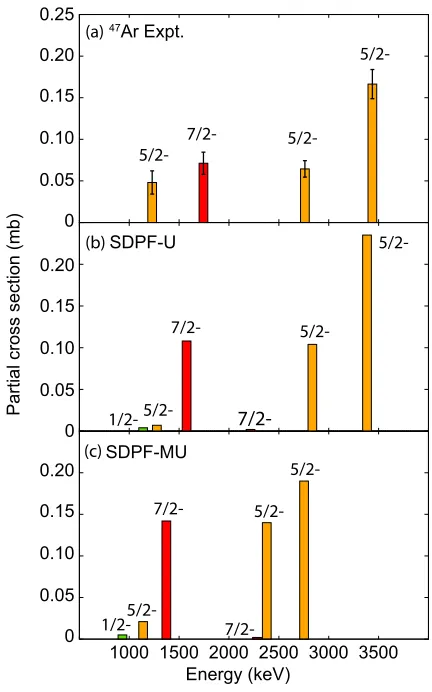
The observed level scheme in the one-neutron pickup reaction is largely driven by linear and angular momen-tum matching conditions that favor the transfer into high-ℓ orbitals. This is quantified in Fig. 4 where the measured (Fig. 4(a)) and calculated partial cross sec-tions, Fig. 4(b) and (c), for the population of individ-ual bound final states are compared. The single-particle cross sections for Fig. 4(b) and (c) were calculated as summarized in Section II. Figures 4(b) and (c) only dif-fer in the spectroscopic factors and level energies em-ployed, using the SDPF-U [11] and SDPF-MU [10] shell-model effective interactions, respectively. The SDPF-U effective interaction describes the measured energies very well and matches the observed spectroscopic strengths pattern, at least qualitatively. The 1/2− state,
carry-ing significant ℓ = 1 spectroscopic strength, is not ex-pected to be populated due to orbital angular momen-tum mismatch reducing the single-particle cross section for pickup into thep1/2orbital. For the SDPF-MU
effec-tive interaction, the two strongest bound states, carrying f5/2 strength, are lower in energy with the majority of
the bound strength concentrated around 2.5 MeV, while the centroid of boundf5/2strength in SDPF-U is located
above 3 MeV. This is indicative of a smallerN = 32 shell gap in SDPF-MU than in SDPF-U, with SDPF-U being closer to experiment in terms of excitation energies and single-particle strengths.
The way in which one-proton removal from odd-odd
48K probes the single-particle structure is
complemen-tary to the one-neutron pickup, and more complicated.
0.25
0 0.05 0.10 0.15 0.20
1000 1500 2000 2500 3000 3500 Energy (keV)
Pa
rt
ia
l
cro
ss
se
ct
io
n
(mb
)
SDPF-U
5/2-7/2-
5/2-
7/2-1/2-
7/2-
5/2-
1/2-SDPF-MU
47Ar Expt.
0 0.05 0.10 0.15 0.20 0 0.05 0.10 0.15 0.20
(a)
(b)
(c)
FIG. 4: (Color online) One-neutron pickup partial cross sec-tions to excited final states: (a) as measured in the exper-iment, and as calculated, following Section II, with the (b) SDPF-U, and (c) SDPF-MU SM spectroscopic factors.
The ground-state spin of48K was assigned 1−from
laser-spectroscopy hyperfine structure measurements [30], con-firming the earlier proposal of (1−) by [38] from the
analysis ofγ-ray decay patterns in deep-inelastic trans-fer reactions. For the removal to a given final state of
47Ar, with spin and parity J−, typically several proton
orbitals contribute. For example, non-zero 2s1/2, 1d3/2
and 1d5/2 proton spectroscopic factors characterize the
wave function overlap of the 48K ground state and the 47Ar(3/2−
g.s.)+psystem (see Table I). Figure 5 compares
the measured 9Be(48K,47Ar+γ)X partial cross sections
to calculations with the SDPF-U and SDPF-MU spec-troscopic factors, using the formalism described in Sec-tion II. When taking into account the reducSec-tion factor of
≈0.5, from the one-nucleon removal systematics [24, 25] in this regime of binding (∆S ≈ 10.5 MeV, Table II), the agreement between measurement and calculation is remarkable, with the SDPF-MU Hamiltonian better de-scribing the relative populations of the 3/2− and 5/2−
[image:7.612.327.543.50.396.2] [image:7.612.64.286.100.271.2]7
input is the spectroscopic strength of the first excited 3/2−state at 2188 keV, where the data are closer to the
SDPF-MU predictions. The overestimation of the 3/2− 2
partial cross section with the SDPF-U structure input can be traced back to the 2s1/2proton spectroscopic
fac-tor that is higher by more than a facfac-tor of two as com-pared to SDPF-MU, and which increases the contribu-tion to the 3/2−ground state from 2s
1/2proton removal
(Table I).
0 1 2 3 4 5 6
0 500 1000 1500 2000 2500 3000 3500 Energy (keV)
SDPF-MU 48K-1p from 1
1
0 1 2 3 4 5 6
Pa
rt
ia
l
cro
ss
se
ct
io
n
(mb
)
SDPF-U 48K-1p from 1
1
0 0.5 1.0 1.5 2.0 2.5 3.0
Expt. 48K-1p
3/2-
1/2-
5/2- 3/2-
7/2-7/2-
3/2-(a)
(b)
(c)
FIG. 5: (Color online) One-proton removal partial cross sec-tions to47Ar final states: (a) as measured in the experiment,
and as calculated following Section II with (b) SDPF-U, and (c) SDPF-MU model spectroscopic factors. The shell-model calculations use the wave function of the lowest-lying 1−state although this is not the ground state in either
shell-model calculation. TheJπ= 1−spin assignment was
deter-mined from laser spectroscopy [30].
Both shell-model effective interactions give a remark-ably consistent picture, describing the single-particle structure of 47Ar well. The SDPF-U case provides a
more consistent comparison with the data in terms of the gap separating the f7/2 orbital from the f5/2 and
the p-orbitals. On the other hand, the SDPF-MU case better describes the proton overlaps with respect to the assumed48K ground state. We note that, for both
shell-model Hamiltonians, the first 1−state is the third excited
state – at 395 keV and 263 keV in U and
SDPF-MU, respectively – lying above 2− ground and excited
states in both cases.
B. First spectroscopy of45S from one-proton
removal from46Cl
For the 9Be(46Cl,45S+γ)X one-proton removal
reac-tion, the secondary beam of46Cl (purity exceeding 98%)
was produced from a 140 MeV/u stable primary beam of48Ca impinging on a 705 mg/cm2 9Be production
tar-get at the entrance of the A1900 fragment separator [37] and separated using a 390 mg/cm2Al degrader. The
to-tal momentum acceptance of the A1900 was restricted to ∆p/p = 2%, yielding a rate on target of 6 × 10³ 46Cl/s. The 376 mg/cm2 thick 9Be reaction target was
surrounded by SeGA [35] and Doppler reconstruction was performed as described for the proton removal to47Ar,
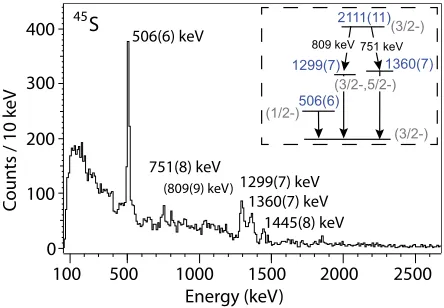
discussed in Section III A. The resultingγ-ray spectrum is shown in Fig. 6. This constitutes the first observation ofγ-ray transitions in theN = 29 nucleus45S. Given the
level of statistics,γγ coincidences could not be used to build a level scheme. Instead, energy sums, intensities, and comparisons to predicted level schemes and popu-lation patterns based on SM calcupopu-lations were used to propose the tentative level scheme shown as an inset in Fig. 6.
0
500 1000 1500 2000 2500
100 400
100 200 300
45 S
Energy (keV)
C
oun
ts / 10 keV
506(6) keV
1299(7) keV 1360(7) keV
1445(8) keV 751(8) keV
(809(9) keV)
2111(11)
809 keV 751 keV
506(6)
1299(7) 1360(7)
(3/2-) (1/2-)
(3/2-)
(3/2-,5/2-)
FIG. 6: (color online) Event-by-event Doppler reconstructed γ-ray spectrum of45S following population of the nucleus in
the 9Be(46Cl,45S+γ)X one-proton removal reaction (v/c =
0.393). The inset shows a tentative level scheme based on energy sums, intensity arguments, and comparison to shell-model calculations (see text).
A quantitative evaluation of the 9Be(46Cl,45S+γ)X
one-proton removal reaction is hardly possible since the ground-state spin of 46Cl is not known. The SDPF-U
and SDPF-MU Hamiltonians predict closely spaced low-lying states with (2−,0−,1−) = (0,437,480) keV and
(0−,2−,1−) = (0,162,313) keV, respectively. Although
not much is known about the level scheme of46Cl, the
[image:8.612.329.551.377.531.2]have been report from in-beam γ-ray spectroscopy [39]. Inclusive cross sections were calculated from the spec-troscopic factors for both shell-model Hamiltonians, as-suming each of the three spins possible for the ground state, giving σ−1incp = 11.8,7.7, and 9.2 mb for the
low-lying 2−, 1−, and 0− states of 46Cl in SDPF-U and
σinc−1p = 10.3,9.3, and 10.9 mb for the low-lying 2−, 1−,
and 0− states of46Cl in SDPF-MU.
As for the proton removal to 47Ar, described in
Sec-tion III.A, an inclusive 9Be(46Cl,45S)X cross section of
σinc−1p = 2.6(1) mb was derived from the yield of 45S
re-action residues divided by the number of incoming46Cl
projectiles relative to the number density of the reaction target. A systematic uncertainty of 5%, attributed to the stability of the incoming beam for normalization, has been added in quadrature to the statistical uncertainty. With a reduction factor Rs ≈ 0.4, from the
systemat-ics [24] in the binding energy regime (∆S ≈ 14.4 MeV, Table III) of the 46Cl projectiles, the lowest calculated
inclusive cross section of 7.7 mb, for the 1− state of46Cl
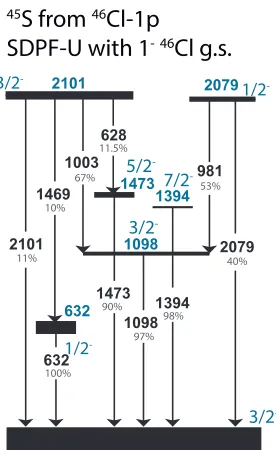
within SDPF-U, agrees with the low measured inclusive cross section. Figure 7 shows the level scheme of 45S as
predicted by the SDPF-U shell model. There, the final state populations, from the one-proton removal reaction from the first 1−state of46Cl, are indicated by the widths
of the lines representing the levels. In comparison to the spectrum of Fig. 6, the tentative level scheme shown in the inset is conceivable. We note that both shell-model effective interactions predict an isomeric 7/2− state at
low energy, at 896 keV MU) and 746 keV (SDPF-U), with half-lives of around 500 ps and 3 ns, respectively. Should the 1−ground-state spin suggestion be confirmed,
the population of the isomeric state would account for less than 2% of the inclusive cross section within SDPF-U. The only possible indication in our spectrum for the decay of a long-lived state is a bump at about 500 keV that, in fact, appears to form the base of the strong and narrow 506 keV transition. For comparison, Fig. 3 (up-per left) of Ref. [40] shows how a 336 keVτ=1.4 nsγ-ray transition would appear in a spectrum taken with SeGA in the relevant geometry and velocity regime.
A determination of the ground-state spin of46Cl would
enable a more quantitative analysis, as performed for the one-proton removal from48K, and higher-statistics data
would be invaluable to confirm the tentative level scheme of45S as proposed in Fig. 6.
IV. SUMMARY
We have presented a comprehensive spectroscopy of
47Ar performed using two complementary direct
reac-tions, one-neutron pickup onto46Ar projectiles and
one-proton removal from the 1−ground state of48K. Both of
the state-of-the-art SDPF-U and SDPF-MU shell-model effective interactions provide a good description of the data, with (a) SDPF-U in better agreement with the47Ar
excitation energies and the location of the neutron
spec-632
632
1098
1098 1394
1394 1473
1473
2079
2079 981 2101
2101
628
1469
3/2 -1/2
-3/2
-5/2
-7/2
-1/2
-3/2
-45
S from
46Cl-1p
SDPF-U with 1
-46Cl g.s.
100%
97% 90%
98% 53%
40% 11%
10%
1003
67% 11.5%
FIG. 7: (Color online) SDPF-U shell-model level scheme of
45S. The widths of the lines representing energy levels are
proportional to the calculated partial cross section for the
9Be(46Cl,45S)X one-proton removal reaction, taking the wave
function of the lowest 1− state as the ground state of 46Cl
(see text and Table III). Only states predicted to be popu-lated with more than 0.2 mb cross section are shown and only transitions with a branching ratio of 10% or higher are drawn.
troscopic strength, and (b) SDPF-MU describing better the47Ar yield from proton removal from the 2s
1/2orbital
in the 48K ground-state. From the 9Be(46Cl,45S+γ)X
one-proton removal reaction, we report the first observed γ-ray transitions in 45S. From comparisons with shell
model calculations, and arguments based on intensities and energy sums, we propose a first tentative level scheme for 45S. Our 45S γ-ray spectrum is broadly consistent
with expectations when assuming a 1−46Cl ground-state
spin and the proton spectroscopic factors from the SDPF-U interaction. Opportunities to advance our understand-ing of the N = 29 nucleus 45S will emerge once the
ground-state spin of 46Cl is known, after which a more
quantitative analysis can be performed of the one-proton removal data reported here.
Acknowledgments
[image:9.612.371.509.53.278.2]9
acknowledges funding from NSF grant PHY-1203100. J.A.T. acknowledges support of the Science and
Tech-nology Facilities Council (UK) grants ST/J000051 and ST/L005743.
[1] O. Sorlin, D. Guillemaud-Mueller, A. C. Mueller, V. Bor-rel, S. Dogny, F. Pougheon, K.-L. Kratz, H. Gabelmann, B. Pfeiffer, A. W¨ohr, W. Ziegert, Yu. E. Penionzhkevich, S. M. Lukyanov, V. S. Salamatin, R. Anne, C. Borcea, L. K. Fifield, M. Lewitowicz, M. G. Saint-Laurent, D. Bazin, C. Detraz, F.-K. Thielemann, and W. Hillebrandt, Phys. Rev. C 47, 2941 (1993).
[2] H. Scheit, T. Glasmacher, B. A. Brown, J. A. Brown, P. D. Cottle, P. G. Hansen, R. Harkewicz, M. Hellstr¨om, R. W. Ibbotson, J. K. Jewell, K. W. Kemper, D. J. Morris-sey, M. Steiner, P. Thirolf, and M. Thoennessen, Phys. Rev. Lett. 77, 3967 (1996).
[3] T. Glasmacher, B.A. Brown, M.J. Chromik, P.D. Cottle, M. Fauerbach, R.W. Ibbotson, K.W. Kemper, D.J. Mor-rissey, H. Scheit, D.W. Sklenicka, M. Steiner, Phys. Lett. B 395, 163 (1997).
[4] C. Force, S. Grevy, L. Gaudefroy, O. Sorlin, L. Caceres, F. Rotaru, J. Mrazek, N. L. Achouri, J. C. Anglique, F. Azaiez, B. Bastin, R. Borcea, A. Buta, J. M. Daugas, Z. Dlouhy, Zs. Dombradi, F. De Oliveira, F. Negoita, Y. Penionzhkevich, M. G. Saint-Laurent, D. Sohler, M. Stanoiu, I. Stefan, C. Stodel, and F. Nowacki, Phys. Rev. Lett. 105, 102501 (2010).
[5] D. Santiago-Gonzalez, I. Wiedenh¨over, V. Abramkina, M. L. Avila, T. Baugher, D. Bazin, B. A. Brown, P. D. Cottle, A. Gade, T. Glasmacher, K. W. Kemper, S. McDaniel, A. Rojas, A. Ratkiewicz, R. Meharchand, E. C. Simpson, J. A. Tostevin, A. Volya, and D. Weisshaar, Phys. Rev. C 83, 061305(R) (2011).
[6] Yutaka Utsuno, Noritaka Shimizu, Takaharu Otsuka, Tooru Yoshida, and Yusuke Tsunoda, Phys. Rev. Lett. 114, 032501 (2015).
[7] J. Luis Egido, Marta Borrajo, and Tomas R. Rodriguez Phys. Rev. Lett. 116, 052502 (2016).
[8] A. Gade, P. Adrich, D. Bazin, B.A. Brown, J.M. Cook, C. Aa. Diget, T. Glasmacher, S. McDaniel, A. Ratkiewicz, K. Siwek, and D. Weisshaar, Phys. Rev. Lett. 102, 182502 (2009).
[9] B. Bastin, S. Grevy, D. Sohler, O. Sorlin, Zs. Dombradi, N. L. Achouri, J. C. Angelique, F. Azaiez, D. Baiborodin, R. Borcea, C. Bourgeois, A. Buta, A. B¨urger, R. Chap-man, J. C. Dalouzy, Z. Dlouhy, A. Drouard, Z. Elekes, S. Franchoo, S. Iacob, B. Laurent, M. Lazar, X. Liang, E. Lienard, J. Mrazek, L. Nalpas, F. Negoita, N. A. Orr, Y. Penionzhkevich, Zs. Podolyak, F. Pougheon, P. Roussel-Chomaz, M. G. Saint-Laurent, M. Stanoiu, and I. Stefan, Phys. Rev. Lett. 99, 022503 (2007).
[10] Yutaka Utsuno, Takaharu Otsuka, B. Alex Brown, Mi-chio Honma, Takahiro Mizusaki, and Noritaka Shimizu, Phys. Rev. C 86, 051301(R) (2012).
[11] F. Nowacki and A. Poves, Phys. Rev. C 79, 014310 (2009).
[12] S. Takeuchi, M. Matsushita, N. Aoi, P. Doornenbal, K. Li, T. Motobayashi, H. Scheit, D. Steppenbeck, H. Wang, H. Baba, D. Bazin, L. Caceres, H. Crawford, P. Fallon, R. Gernh¨auser, J. Gibelin, S. Go, S. Grevy, C. Hinke, C. R. Hoffman, R. Hughes, E. Ideguchi, D. Jenkins, N.
Kobayashi, Y. Kondo, R. Kr¨ucken, T. Le Bleis, J. Lee, G. Lee, A. Matta, S. Michimasa, T. Nakamura, S. Ota, M. Petri, T. Sako, H. Sakurai, S. Shimoura, K. Steiger, K. Takahashi, M. Takechi, Y. Togano, R. Winkler, and K. Yoneda, Phys. Rev. Lett. 109, 182501 (2012). [13] Z. Meisel, S. George, S. Ahn, J. Browne, D. Bazin,
B.A. Brown, J.F. Carpino, H. Chung, R.H. Cyburt, A. Estrade, M. Famiano, A. Gade, C. Langer, M. Matos, W. Mittig, F. Montes, D.J. Morrissey, J. Pereira, H. Schatz, J. Schatz, M. Scott, D. Shapira, K. Smith, J. Stevens, W. Tan, O. Tarasov, S. Towers, K. Wimmer, J.R. Winkel-bauer, J. Yurkon, and R.G.T. Zegers, Phys. Rev. Lett. 114, 022501 (2015).
[14] A. Gade, D. Bazin, C. M. Campbell, J. A. Church, D. C. Dinca, J. Enders, T. Glasmacher, Z. Hu, K. W. Kemper, W. F. Mueller, H. Olliver, B. C. Perry, L. A. Riley, B. T. Roeder, B. M. Sherrill, and J. R. Terry Phys. Rev. C 68, 014302 (2003).
[15] R. Winkler, A. Gade, T. Baugher, D. Bazin, B. A. Brown, T. Glasmacher, G. F. Grinyer, R. Meharchand, S. Mc-Daniel, A. Ratkiewicz, and D. Weisshaar, Phys. Rev. Lett. 108, 182501 (2012).
[16] S. Calinescu et al., Acta Phys. Pol. B 45, 199 (2014). [17] D. Mengoni, J. J. Valiente-Dobon, A. Gadea, S. Lunardi,
S. M. Lenzi, R. Broda, A. Dewald, T. Pissulla, L. J. An-gus, S. Aydin, D. Bazzacco, G. Benzoni, P. G. Bizzeti, A. M. Bizzeti-Sona, P. Boutachkov, L. Corradi, F. Crespi, G. de Angelis, E. Farnea, E. Fioretto, A. Goergen, M. Gorska, A. Gottardo, E. Grodner, A. M. Howard, W. Krolas, S. Leoni, P. Mason, D. Montanari, G. Montag-noli, D. R. Napoli, A. Obertelli, R. Orlandi, T. Pawlat, G. Pollarolo, F. Recchia, A. Algora, B. Rubio, E. Sahin, F. Scarlassara, R. Silvestri, J. F. Smith, A. M. Stefanini, D. Steppenbeck, S. Szilner, C. A. Ur, P. T. Wady, and J. Wrzesinski, Phys. Rev. C 82, 024308 (2010).
[18] L. Gaudefroy, O. Sorlin, D. Beaumel, Y. Blumenfeld, Z. Dombradi, S. Fortier, S. Franchoo, M. Gelin, J. Gibelin, S. Grevy, F. Hammache, F. Ibrahim, K.W. Kemper, K.-L. Kratz, S.M. Lukyanov, C. Monrozeau, K.-L. Nalpas, F. Nowacki, A.N. Ostrowski, T. Otsuka, Yu.-E. Penionzhke-vich, J. Piekarewicz, E.C. Pollacco, P. Roussel-Chomaz, E. Rich, J.A. Scarpaci, M.G. St.Laurent, D. Sohler, M. Stanoiu, T. Suzuki, E. Tryggestad, D. Verney, Phys. Rev. Lett. 97, 092501 (2006).
[23] P. G. Hansen and J. A. Tostevin, Annu. Rev. Nucl. Part. Sci. 53, 219 (2003).
[24] J. A. Tostevin and A. Gade, Phys. Rev. C 90, 057602 (2014).
[25] A. Gade, P. Adrich, D. Bazin, M. D. Bowen, B. A. Brown, C. M. Campbell, J. M. Cook, T. Glasmacher, P. G. Hansen, K. Hosier, S. McDaniel, D. McGlinchery, A. Obertelli, K. Siwek, L. A. Riley, J.A. Tostevin, and D. Weisshaar, Phys. Rev. C 77, 044306 (2008).
[26] B. A. Brown, Phys. Rev. C 58, 220 (1998).
[27] J. A. Tostevin, G. Podolyak, B. A. Brown, and P. G. Hansen, Phys. Rev. C 70, 064602 (2004); J. A. Tostevin and B. A. Brown, ibid. 74, 064604 (2006).
[28] L. Ray, Phys. Rev. C 20, 1857 (1979).
[29] M. Wang, G. Audi, A. H. Wapstra, F. G. Kondev, M. MacCormick, X. Xu, and B. Pfeiffer, Chin. Phys. C 36, 1603 (2012).
[30] K. Kreim, M.L. Bissell, J. Papuga, K. Blaum, M. De Rydt, R.F. Garcia Ruiz, S. Goriely, H. Heylen, M. Kowal-ska, R. Neugart, G. Neyens, W. N¨ortersh¨auser, M.M. Ra-jabali, R. Sanchez Alarcon, H.H. Stroke, D.T. Yordanov, Phys. Lett. B 731, 97 (2014).
[31] A. Gade, J. A. Tostevin, V. Bader, T. Baugher, D. Bazin, J. S. Berryman, B. A. Brown, D. J. Hartley, E. Lunder-berg, F. Recchia, S. R. StroLunder-berg, Y. Utsuno, D. Weis-shaar, and K. Wimmer, Phys. Rev. C 93, 031601(R) (2016).
[32] Supplement to [31].
[33] G. van der Steenhoven, H. P. Blok, E. Jans, M. de Jong, L. Lapikas, E. N. M. Quint and P. K. A. de Witt Huberts, Nucl. Phys. A480, 547 (1988).
[34] D. Bazinet al., Nucl. Instrum. Methods Phys. Res., Sect.
B 204, 629 (2003).
[35] W. F. Muelleret al., Nucl. Instrum. Methods Phys. Res., Sect. A 466, 492 (2001).
[36] S. Paschalis, I.Y. Lee, A.O. Macchiavelli, C.M. Camp-bell, M. Cromaz, S. Gros, J. Pavan, J. Qian, R.M. Clark, H.L. Crawford, D. Doering, P. Fallon, C. Lionberger, T. Loew, M. Petri, T. Stezelberger, S. Zimmermann, D.C. Radford, K. Lagergren, D. Weisshaar, R. Winkler, T. Glasmacher, J.T. Anderson, C.W. Beausang, Nucl. In-strum. Methods Phys. Res., Sect. A 709, 44 (2013). [37] D. J. Morrissey et al., Nucl. Instrum. Methods Phys.
Res., Sect. B 204, 90 (2003).
[38] W. Krolas, R. Broda, B. Fornal, R. V. F. Janssens, A. Gadea, S. Lunardi, J. J. Valiente-Dobon, D. Mengoni, N. Marginean, L. Corradi, A. M. Stefanini, D. Bazzacco, M. P. Carpenter, G. De Angelis, E. Farnea, E. Fioretto, F. Galtarossa, T. Lauritsen, G. Montagnoli, D. R. Napoli, R. Orlandi, T. Pawlat, I. Pokrovskiy, G. Pollarolo, E. Sahin, F. Scarlassara, D. Seweryniak, S. Szilner, B. Sz-pak, C. A. Ur, J. Wrzesinski, and S. Zhu, Phys. Rev. C 84, 064301 (2011).
[39] S. R. Stroberg, A. Gade, T. Baugher, D. Bazin, B. A. Brown, J. M. Cook, T. Glasmacher, G. F. Grinyer, S. McDaniel, A. Ratkiewicz, and D. Weisshaar, Phys. Rev. C 86, 024321 (2012).