Normal Forms for Priority Graphs
∗
Johan van Benthem and Davide Grossi
Institute for Logic, Language and Computation
[email protected]
Abstract
This brief note compares a few ways of deriving pre-orders over sets of objects from strict partial orders over properties of those objects— so-called
priority graphsthat have recently been used by logicians as a rich explicit model of preference merge, belief revision, norm change, and other aspects of agency. Our note establishes equivalence results between three popular formats for priority graphs, and defines a normal form for them.
1
Introduction
Pre-orders over a given finite setSof objects can be derived from strict partial orders over properties of these objects, forming a richer medium for showing how these orderings arise. Properties in such priority graphs are expressed by simple propositional formulae and partial orders over these: cf. [1, 4] for concrete examples concerning social preference merge, and reason-based preference of single agents. In [6], the authors apply the format to deontic reasoning, contrary-to-duity norms, and norm change.
The present note investigates three typical formats of priority graphs and proves their equivalence with respect to two different ‘recipes’ for deriving pre-orders, where equivalence is understood as the definition of the same class of underlying order structures for objects. This type of equivalence reasoning allows us to suggest two normal-form formats for priority graphs. What we will see, in particular, is how inclusion orders of predicates can mimick the effects of abstract prority orders.
1.1
Priority graphs
Definition 1 (P-graphs). LetL(P)be a propositional language built on the set of
atomsP. A P-graph is a tupleG=hΦ,≺isuch that: ␐ Φ⊂ L(P)with|Φ|< ω;
∗
␐ ≺is a strict order onΦ.1
The set of all P-graphs forL(P)is denoted SOP(“Strict Orders”).2
Given a P-graphG, we denote with↑G ϕ ={ψ ∈ Φ |ϕ ≺ ψorψ =ϕ}the
upsetofϕinG. We also denote with↑+
Gϕ={ψ∈ Φ|ϕ≺ψ}thestrict upsetof
ϕinG. When clear from the context, we will drop the index and write simply ↑ϕand↑+ϕ.
1.2
Derivation functions
Derivation functions for P-graphs are functions of type:
δ:SOP×VP−→POS (1)
where VP is the set of valuation functions VP : P −→ 2S, andPOS the set
of pre-orders over S. That is, given a strict order on propositional formulae from L(P) and a valuation for P over S, δ outputs a preorder on the set S.
We will work in particular with two functions of the type given in Formula1: the lexicographic derivation (borrowed from [1]), and the subsumption-based derivation (borrowed from [4]).
be strict orders. will simplify the presentation of our result considerably
Definition 2(Lexicographic derivation function). LetG =hΦ,≺ibe a P-graph,
S a non-empty set of states andV :P −→ 2Sa valuation function. The preference
relationlex
G ⊆S
2is defined as follows:
slex
G s
0 ⇐⇒ ∀ϕ∈Φ
: [s∈ϕ⇒s0∈ϕ
or∃ϕ0: [ϕ≺ϕ0and s<ϕ0 and s0∈ϕ0]]. (2)
The procedure works as a form of lexicographic ordering. The relation slex
G s
0
holds ifssatisfies all formulae in the sequence that alsos0
satisfies or, if that is not the case, ifs0satisfies a formula whichsdoes not satisfy and which is ranked higher in the P-graph. In a P-graph where all properties happen to be disjoint the effect of this latter clause is clear. will be ranked accord-ing to the rankaccord-ing of the proposition whose truth-So we can recognize in the lexicographic derivation two components: a set-inclusion component that de-termines the equivalence classes of the derived pre-order by essentially looking at the relative logical strength of the properties each element satisfies; and a “compensation” component which ranks element that would be left unrelated by the set-inclusion component by resorting to the strict order information present in the P-graph.
Definition 3(Subsumption-based derivation). LetG=hΦ,≺ibe a P-graph, S a
non-empty set of states andV:P−→2Sa valuation function. The preference relation
sub
G ⊆S
2is defined as follows:
ssub
G s
0 ⇐⇒ ∀
ϕ∈Φ:s∈ϕ=⇒s0∈ϕ. (3) 1That is, an irreflexive and transitive binary relation.
Intuitively, according to Definition3, a statesis ranked above a states0
if and only if any of the properties in the graph satisfied bys0
it is also satisfied bys. In other words,senjoys at least all the properties ofs0
. So, subsumption-based derivation consists of the sole set-inclusion component of the lexicographic derivation.
in such a way that no inclusion relation holds among them, then the valu-ation interprets the properties in the graph as an ascending chain of below), as if a state satisfies a property in the sequence, then it also satisfies all
Remark 1. It should be noted that in “flat” P-graphs, i.e., P-graphsG=hΦ,∅iwhere
the strict order is empty, the two derivation methods are equivalent, as the second part of the lexicographic method (see Formula2) cannot be called in. More precisely, for any P-graphGwith empty orders, and any valuationVit is the case that:
lex(G,V)=sub(G,V).
2
Classes of P-graphs
The section deals with two specific classes of P-graphs whose elements exhibit logical structure and which we call: inclusive and, respectively, exclusive P-graphs.
Definition 4(Inclusive P-graphs). An inclusive P-graphG=hΦ,≺ifor language
L(P)is a P-graphGsuch that, for everyϕ∈Φ:
ϕ ↔ _↑ϕ
The set of all inclusive P-graphs for languageL(P)is denoted SOin(P).
In other words, each property in an inclusive graph is equivalent to the big disjunction of all elements in the upset of that property. So, an inclusive P-graph is a strict order over disjunctions built in such a way that if a property occurs as a disjunct at some point in the graph, it occurs in all lower points. Two examples of such graphs are depicted in Figure1.
Remark 2. It is useful to see how Definition4simplifies in the case ofG=hϕ1, . . . , ϕni
being a strict linear order, i.e., a chain:
ϕi ↔ _↑ϕi
↔ _
1≤j≤i ϕj
with1≤i≤n. In this case, each element is equivalent to the disjunction of itself with
the union of all the preceding elements.
Definition 5(Exclusive P-graphs). An exclusive P-graphG=hΦ,≺ifor language
L(P)is a P-graphGsuch that, for everyϕ∈Φ:
ϕ ↔ ϕ∧ ¬_↑+ϕ
The set of all inclusive P-graphs for languageL(P)is denoted SOex(P).
p1
p1∨p2 p1∨p3
p1∨p2∨p3
p1 p2
p1∨p2∨p3
[image:4.595.158.447.133.226.2]p1∨p2∨p3∨p4
Figure 1: Hasse diagrams of inclusive P-graphs
3
Normal forms for P-graphs
Let us first stress an aspect of Definition2.
Remark 3. It is interesting to see how the strict part≺lex
G and the indifference part
∼lex
G of
lex
G can be independently defined. We start with the very natural definition of
∼lex
G :
s∼lex
G s
0 ⇐⇒ ∀
ϕ∈Φ: [s∈ϕ⇐⇒s0∈ϕ]
As to the strict part: s≺lex
G s
0 ⇐⇒ ∃ϕ∈Φ
: [s<ϕ and s0∈ϕ
and∀ϕ0: [s∈ϕ0 and s0<ϕ0=⇒ϕ0≺ϕ]].
It is then easy to see that the following is the case: slex
G s
0 ⇐⇒
s∼lex
G s
0
or s≺lex
G s
0
.
In other words, the lexicographic derivation builds a pre-order consisting of equivalence classes—of relation ∼lex
G —strictly ordered according to
lex
G .
Now, these equivalence classes consist of elements that satisfy precisely the same properties. It becomes then evident that such classes could themselves be used as properties in a P-graph, with the same order. Such new P-graph will obviously be equivalent. The next section makes this intuition precise.
p1
p2∧ ¬p1 p3∧ ¬p1
p4∧ ¬p1∧ ¬p2∧ ¬p3
p1 p2
p3∧ ¬p1∧ ¬p2
p4∧ ¬p1∧ ¬p2∧ ¬p3
[image:4.595.139.456.589.681.2]p q
r
p∧q∧r
p∧q∧ ¬r
p∧ ¬q∧r ¬p∧q∧r
p∧ ¬q∧ ¬r ¬p∧q∧ ¬r
¬p∧ ¬q∧r
[image:5.595.156.476.133.344.2]¬p∧ ¬q∧ ¬r
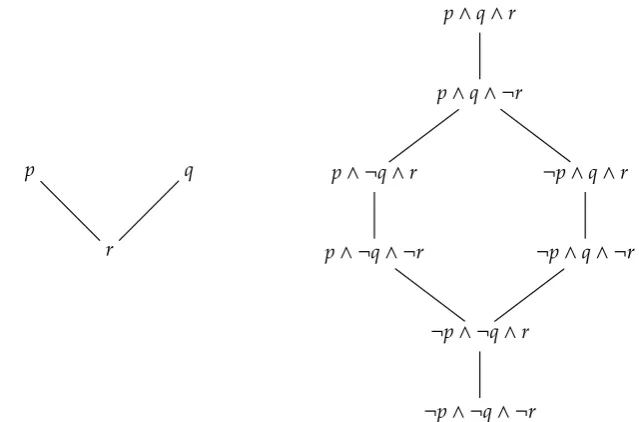
Figure 3: Hasse diagrams of a P-graph (left) and its exclusive normal form (right)
3.1
Exclusive normal form
We introduce the first type of normal form.
Definition 6(Exclusive normal form for P-graphs). LetG=hΦ,≺ibe a P-graph.
The exclusive normal form ofGis a P-graphGex=hΦex,≺exisuch that: ␐ Φex=2Φ. Each elementΨ∈Φ∧¬has to be read as a finite conjunction:
^
Ψ∧^¬(Φ−Ψ)
that is, the conjunction of all properties inΨand all the negations of the properties not inΨ.
␐ The relation≺exis defined as follows:
Ψ≺ex Ψ0 ⇐⇒ ∃ϕ∈Φ: [ϕ∈Ψ0andϕ<Ψ
and∀ϕ0: [ϕ0<Ψ0andϕ∈Ψ =⇒ϕ0≺ϕ]].
An example of the exclusive normal form of a graph is given in Figure3.3 It should be clear by the construction of the exclusive normal forms that these graphs are indeed exclusive in the sense of Definition5. Notice also that the number of elements in the exclusive normal form is bound by the cardinality ofΦbeing equal to 2|Φ|
.
We can now prove a simple normal form theorem guaranteeing that every P-graph has an equivalent exclusive normal form.
3It might be instructive to compare the definition of≺
exwith the definition of the strict part of
Lemma 1(Adequacy of exclusive normal forms). Each graphGislex-equivalent to its exclusive normal formGex.
Proof. Let us restate the lemma in a more extensive way:
∀G ∈SO: [∀V ∈V:lex(G,V)=lex(Gex,V)].
We prove the claim by showing that, for any valuationV:
(i) |S|lex
G =
|S|lex
Gex, i.e., the two preorders give rise to the same equivalence
classes; (ii) ≺lex
G =≺
lex
Gex, i.e., the strict part of the two preorders is the same.
As to (i) it suffices to observe that all equivalence classes |s|lex
G yielded by lex
G must be the truth-sets—underV—of some conjunctions of length|Φ|of
formulae of the formVΨ∧V¬
(Φ\Ψ) withΨ⊆Φ. But these are precisely the
disjoint elements of the normal form. As to (ii), it is proven by the following series of equivalences:
s≺lex
G s
0 ⇐⇒ ∃ϕ∈Φ
:s<ϕ ands0∈ϕ
and∀ϕ0: (s∈ϕ0 ands0<ϕ=⇒ϕ0≺ϕ] (4) ⇐⇒ ∀Ψ,Ψ0∈Ψex: [ if ~Ψ=|s|∼lex
G and ~Ψ
0
=|s0|∼lex
G
then∃ϕ∈Φ: [ϕ∈Ψ0
andϕ<Ψ
and∀ϕ0: [ ifϕ0<Ψ0andϕ∈Ψthenϕ0≺ϕ]]] (5) ⇐⇒ ∀Ψ,Ψ0∈Ψex: [ if ~Ψ=|s|∼lex
G and ~Ψ
0
=|s0|∼lex
G (6)
thenΨ≺ex Ψ0
]
⇐⇒ ∃Ξ∈Φex: [s< ~Ξ ands0∈~Ξ
and∀Ξ0: [s∈~Ξ0 ands0< ~Ξ0=⇒Ξ0≺ex Ξ]] (7) ⇐⇒ s≺lex
Gex s 0
(8) where, to simplify notation, byΨ,Ξwe still also denote the finite conjunction of the elements ofΨ,Ξand of the negations of the members of its complement. Equivalence4holds by definition. Equivalence5reformulates4by resorting to elements of the exclusive graph corresponding to the equivalence classes of sands0
. By the construction of the exclusive normal form we know that such elements exist. Equivalence6holds by the definition of exclusive normal form. Equivalence7holds because of the fact that exclusive graphs consist of disjoint
elements. Finally,8holds by definition.
Remark 4. It is worth noticing that the exclusive normal formGex of a P-graph G
is order-isomorphic to the quotient Q(P)of the pre-order P = hS,≺lex
G iobtained by
lexicographic derivation fromG. The following diagram depicts this observation.
P Q- Q(P)
G lex
6
ex - Gex
lex
p q
r∧ ¬p∧ ¬q
p q
[image:7.595.161.432.131.187.2]r∨p∨q
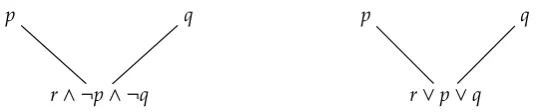
Figure 4: Hasse diagrams of an exclusive P-graph (left) and its inclusive normal form (right)
3.2
Inclusive normal form
Definition 7(Inclusive normal forms). LetG= hΦ,≺ibe an exclusive P-graph.
The inclusive normal form ofGis a P-graphGin=hΦin,≺inisuch that:
␐ Φin = ↑ G, that is, the set of upsets ofG. To simplify notation, each element
Ψ∈Φinwill be read also as the finite disjunction:WΨ
.
␐ The relation≺inis defined as follows:
Ψ≺inΨ0 ⇐⇒ Ψ0⊂Ψ.
An example of inclusive normal form is given in Figure4. Notice that this form is defined only for graphs in exclusive form.
Like for the case of exclusive normal forms, we obtain a simple theorem guaranteeing that every exclusive P-graph has an equivalent inclusive normal form.
Lemma 2(Adequacy of inclusive normal forms). Each graphG, used as argument
oflex, is equivalent to its inclusive normal formGin, used as argument ofsub. Proof. Let us restate the lemma in a more extensive way:
∀G ∈SO: [∀V ∈V:lex(G,V)=sub(Gin,V)].
We prove the claim by the following series of equivalences: slex
G s
0 ⇐⇒ ∃
ϕ∈Φ: (s<ϕ ands0∈ϕ
and∀ϕ0
: (s∈ϕ0
ands0
<ϕ0=⇒ϕ0≺ϕ) (9) ⇐⇒ ∀Ψ,Ψ0∈Φin: [ if ~Ψ=↑ |s|∼lex
G and ~Ψ
0
=↑ |s0|∼lex
G
thenΨ0⊆ Ψ] (10)
⇐⇒ ∀Ξ∈Φin:s∈~Ξ=⇒s0∈
~Ξ (11)
⇐⇒ ssub
Gin s 0
(12) where↑Gex|s|∼lex
G denotes the upset of the equivalence class ofsin the exclusive
normal form of G. Equivalence9 holds by definition. Equivalence10holds
under the assumption thatGis exclusive, and hence that it has yields pre-orders
with just as many equivalence classes as the elements of its domain. It just says that for any two elements of the inclusive normal form, if they coincide with the upsets of the equivalence classes of sand s0
So, any exclusive graph has an equivalent inclusive normal form. What about general graphs? In that case an inclusive normal form can be obtained from the exclusive normal form of the graph. To make it clear, the inclusive normal form of the graph given in Figure3(left) is not the graph given in Figure 4 (right), but a graph obtained from Figure3 (right) which consists of all the upsets of the latter, ordered by set inclusion.
Remark 5. What discussed in this section is strictly related to a well-known result in
order theory:
Every pre-order is order-isomorphic to the set of upsets of its elements ordered by set-inclusion [2, Theorem 5.9].
In fact, the disjunctive normal form of an exclusive P-graph is the set of upsets of the graph, ordered by (strict) set-inclusion. Unlike exclusive normal forms, inclusive normal forms are therefore order-isomorphic to their original graphs. However, notice that the inclusive normal form of an exclusive normal form will not be order-isomorphic any more with respect to the original graph.
3.3
Graph equivalences
We can now pull together Lemmata1and2into one characterization theorem showing that the class of P-graphs defines, by lexicographic derivation, the same class of pre-orders that can be derived via the exclusive normal forms of those graphs by lexicographic derivation, or by subsumption-based derivation from the inclusive normal form of the exclusive normal form of the graph.
Theorem 1(Equivalence of classes of graphs). For any P-graphGand valuation
Vit holds that:
lex(G,V)=lex(Gex,V)=sub((Gex)in,V). (13)
Proof. It follows from Lemmata1and2.
4
Conclusions
In the light of Theorem1, the following two equations summarize the findings of this note:
lex = ex◦lex (14)
lex = ex◦in◦sub (15)
is illustrated by the following commutative diagram:
Gex in- (Gex)in
G
ex 6
lex
- P
sub
?
lex
-To put it yet otherwise, given a graphG, the pre-order obtained from it via
lexicographic derivation is the same pre-order that is obtained via lexicographic derivation from the exclusive normal formGexofG, or via subsumption-based
derivation from the inclusive normal form (Gex)inofGex.
We thus obtain an effective procedure for transforming priority graphs into semantically equivalent ones—its normal forms. This analysis clarifies various points in the recent literature, especially, the use of inclusion-nested graphs of propositions as in [6] versus other formats, where the latter need additional priority order, whereas the former does not. The syntactic aspects of our analysis also fit quite well with the modal graph logic of [3] and the “internal graph algebra” of [5].
We see various further questions opening up at this point, among which: the study of a richer set of dynamic graph transformations than has been considered so far; the study of priority graphs where properties are described in terms of modal languages, and not just propositional ones.
References
[1] H. Andreka, M. Ryan, and P. Schobbens. Operators and laws for combining preference relations.Journal of Logic and Computation, 12:13–53, 2002. [2] B. A. Davey and H. A. Priestley.Introduction to Lattices and Order. Cambridge
University Press, 1990.
[3] P. Girard.Modal Logic for Belief and Preference Change. PhD thesis, University of Amsterdam, 2008.
[4] F. Liu. Changing for the Better. Preferemce dynamics and Agent Diversity. PhD thesis, University of Amsterdam, 2008.
[5] F. Liu. A two-level perspective on preference. To appear in the Journal of Philosophical Logic, 2011.