Int. J. Electrochem. Sci., 12 (2017) 6557 – 6565, doi: 10.20964/2017.07.63
International Journal of
ELECTROCHEMICAL
SCIENCE
www.electrochemsci.orgAluminium in a Cu-Mo-Al Thin Film Generated Resonantly in
an Aqueous Solution using a Megahertz Rectangular Pulse
Current Electrodeposition Technique
M. Saitou
University of the Ryukyus, Department of Mechanical Systems Engineering, 1 Senbaru Nishihara-cho Okinawa, 903-0213, Japan.
E-mail: [email protected]
Received: 12 April 2017 / Accepted: 9 May 2017 / Published: 12 June 2017
Aluminium in a Cu-Mo-Al thin film generated on an indium tin oxide (ITO) glass substrate in an aqueous solution by a rectangular pulse current technique in a range of frequency from 0.2 to 1.5 MHz was demonstrated. The aluminium concentration in the Cu-Mo-Al thin film measured with energy dispersive X-ray spectroscopy (EDX) was observed only in the vicinity of a resonant frequency. Several resonant frequencies existed at a certain interval in the range of the frequency. The resonant frequency spacing between the neighboring resonant frequencies became about 0.2 MHz. These experimental results are discussed from a viewpoint of energy level transition between the Fermi energy of electron in an electrode and a quantized rotational energy of a cluster of a trivalent aluminium ion and divalent molybdate ion. The maximum aluminium concentration in the Cu-Mo-Al thin film was about 6 wt. %. X-ray diffraction (XRD) analysis showed that (111), (200), (220), and (311) planes well consistent with those of polycrystalline copper existed parallel to the ITO glass. The Cu-Mo-Al thin film is found to be an alloy comprising Cu, Mo, and Al. In addition, surface images of the Cu-Mo-Al thin film observed with scanning electron microscope (SEM) showed an aggregation of nano cauliflowers.
Keywords: aluminium electrodeposition; aqueous solution; megahertz; energy level transition; resonant frequency; alloy; nano cauliflower.
1. INTRODUCTION
aluminium thin film with a mirror-like surface appearance was successfully electrodeposited in the ionic liquid including AlCl3 and additives [4].
Aluminium alloy thin films, Fe-Al [10], Co-Al [11], Mg-Al [12], and Cu-Al [13], attracted researchers owing to their magnetic properties, lightweight and corrosion resistance. These thin films were reported to be co-electrodeposited in the ionic liquids. The Mg-Al thin film was shown to have a smooth surface and other aluminium alloy thin films comprised nano crystalline grains.
In the framework of energy level transition [14], electrodeposition has recently been reported to take place resonantly at megahertz frequencies. In nickel electrodeposition [15] in the aqueous solution, a resonant frequency at which the nickel electrodeposit drastically increases, and a resonant frequency spacing between the neighboring resonant frequencies were found to exist in the range of megahertz frequency. If an electron in the electrode at the Fermi level gain the transfer energy by an applied electric field, the electron can transfer the quantized rotational energy level of the ion. In the Cu-Mo co-electrodeposition with a non-iron group element in the aqueous solution [16], the Mo concentration was shown to change at the resonant frequency.
When in equilibrium, the trivalent aluminium ion changes an aluminium atom according to the electrochemical reaction Al+3+3e-⟶Al [1], the standard electrode potential is known to be -1.663V. In other words, the electrochemical reaction does not proceed because the free energy has a positive value. In the aqueous solution, the aluminium atom does not deposit on a cathode electrode. However, if an interplay between the trivalent aluminium ion and the divalent molybdate ion usually used as a source of Mo exists, the two ions may apparently behave as a monovalent ion. The ionization energy of monovalent aluminium [17] takes a value close to that of other metal ions electrodeposited in the aqueous solution. In addition, if the electric field in the megahertz region provides the transition energy to the electron at the Fermi level in the cathode electrode, the trivalent aluminium ion may become an aluminium atom. This is our motivation for the present study.
In the present study, we demonstrate that the aluminium electrodeposition occurs in the aqueous solution at the resonant frequency and the Cu-Mo-Al thin film is an alloy comprising Cu, Mo, and Al.
2. EXPERIMENTAL SETUP
The aqueous solution including chemical compounds (mol L-1): Al2(SO4)3・16H2O, 0.25; CuSO4・5H2O, 0.5; KNaC4H4O6・4H2O, 0.65; and Na2MoO4・2H2O, 0.5 was prepared for electrodeposition. After dissolution of the chemical compounds in distilled water, the aqueous solution was strained with a membrane filter (pore size 0.1 m) and a glass fiber prefilter (pore size 0.7 m) to remove copper and aluminium hydroxides.
electrode was small because of the high concentration of the chemical compounds. The potential was almost applied to the electric double layer formed on the ITO glass.
The rectangular pulse current having a frequency from 0.2 MHz to 1.5 MHz was provided with a function generator. Electrodeposition was performed at a solution temperature of 303 K. The rectangular pulse current flowing in the electrochemical cell was calculated from a voltage drop across a metal film resistor connected in series with the electrochemical cell. Amplitudes of 23 mA/cm2 and 35 mA/cm2 were used for electrodeposition. The impedance of the metal film resistor does not change at the frequency below 80 MHz. The on-time of the rectangular pulse current was chosen to be equal to the off-time of the rectangular pulse current.
After deposition, the Cu-Mo-Al thin film generated on the ITO glass substrate was rinsed thoroughly in distilled water and put in a vacuum chamber. The measurement of element in the Cu-Mo-Al thin film generated on the ITO glass was performed with EDX (Shimazu EDX-800). A crystallographic structure of the Cu-Mo-Al thin film was investigated with the conventional XRD (Rigaku Ultima) with CuK radiation. The surface morphology of the Cu-Mo-Al thin film was observed with SEM (Hitachi TM3030).
3. RESULTS AND DISCUSSION
First, we briefly explain the energy level transition. We reported Ni thin films generated resonantly at a rate of megahertz on the basis of the energy level transition [15]. The energy level transition occurs owing to the energy difference between two nergy levels [18]. In electrodeposition, the lowest energy level among the energy level transitions is a transition between the Fermi energy level of the electron in the electrode and the quantized rotational energy level of ions in the electric double layer. We consider the quantized rotational energy of a linear molecule, for example, a metal ion and a complexing agent. As well-known [19], the quantized rotational energy level, E for the linear molecule is given by
, (1)
where h is the Planck’s constant, is the moment of inertia, is the reduced mass, and j is the quantum number. The transition energy spacing from j=0 to j=1 becomes
. (2)
Eq. (2) indicates that the linear molecular has a fixed energy spacing. In electrodeposition, this means that the deposited mass rapidly increases at the resonant frequency and the resonant frequency spacing between the neighbouring resonant frequencies has a fixed value.
3.1 Cu-Mo-Al thin film electrodeposited at an amplitude of 23 mA/cm2
resonant frequency, but takes place in the vicinity of the resonant frequency [20]. The five resonant frequencies are observed in a range of frequency from 0.3 to 1.5 MHz. The resonant frequencies can be read as 0.4, 0.53, 0.81, 1.08, and 1.26 MHz. The maximum concentration of aluminium is 6.2 wt. % at a resonant frequency of 1.26 MHz
Figure 1. Frequency-dependence of the Al concentration in the Cu-Mo-Al thin film electrodeposited at an amplitude of 23 mA/cm2.
[image:4.596.163.430.158.381.2] [image:4.596.176.419.448.697.2]
The average frequency spacing between the neighbouring resonant frequencies approximately has a constant value of 0.220.07 MHz. This suggests that the trivalent aluminium ion and the divalent molybdate ion may act as the linear molecule. The Mo concentration dependent on the frequency will be discussed in the chapter 3.3.
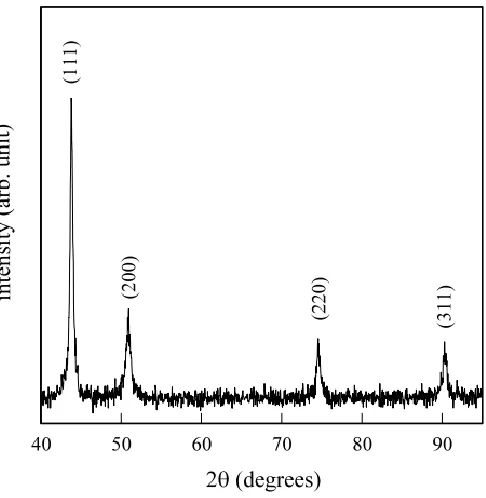
Figure 2 shows an XRD chart of the Cu-Mo-Al thin film having the maximum aluminium concentration of 6.2 wt. %. The diffraction peaks are indexed as the (111), (200), (220), and (311) crystallographic plane and are well consistent with those of polycrystalline copper [21]. These crystallographic planes are also consistent with those of a Cu-Mo thin film [16] and exit in the Cu-Mo-Al thin film parallel to the ITO glass. No other diffraction peaks are observed for the Cu-Mo-Cu-Mo-Al thin films deposited at different frequencies. The mean grain size calculated using the well-known Scherrer equation and [111] diffraction profile becomes 19 nm.
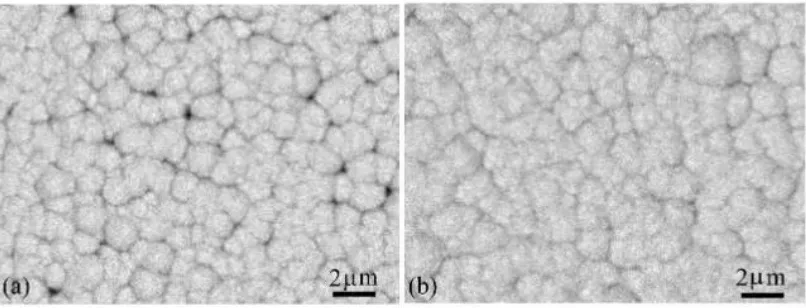
Figure 3. SEM images of the Cu-Mo-Al films electrodeposited (a) at a frequency of 0.4 MHz and (b) at a frequency of 1.26 MHz.
Figure 3 shows SEM images of the Cu-Mo-Al thin films electrodeposited at frequencies of 0.4 and 1.26 MHz. The Cu-Mo-Al thin film comprises islands having about 2 m in size. The mean grain size calculated from the XRD chart indicates that the island comprises grains of 19 nm in size. Hence, the island is called the nano cauliflower [23-24] consisting of the nanometer grains.
3.2 Cu-Mo-Al thin film electrodeposited at an amplitude of 35 mA/cm2
[image:5.596.101.504.288.442.2]
Figure 4. Frequency-dependence of the Al concentration in the Cu-Mo-Al thin film electrodeposited at an amplitude of 35 mA/cm2.
[image:6.596.147.447.75.319.2] [image:6.596.141.459.392.695.2]
In comparison with the resonant frequency in Fig. 1, the resonant frequency shifts to a higher frequency. So as to ascertain the presence of the resonant frequency that corresponds to the first excited state of the quantized rotational energy (j=1 in Eq. (4)) [26], we investigate the presence of the resonant frequency in a range of frequency from 0.2 to 0.4 MHz in details. As shown in Fig. 4, there is no resonant frequency. Hence, the resonant frequency of 0.5 MHz is thought to correspond to the frequency related to the first excited state.
[image:7.596.98.503.296.450.2]Figure 5 shows an XRD chart for the Cu-Mo-Al thin film having the maximum aluminium concentration of 5.2 wt. %. The diffraction peaks are indexed as the (111), (200), (220), and (311) crystallographic plane and are well consistent with those of polycrystalline copper. As no other diffraction peaks for Mo-Al thin films deposited at different frequencies are also observed, the Cu-Mo-Al thin film is an alloy comprising Cu, Mo, and Al. The mean grain size calculated using the Scherrer equation and [111] diffraction profile becomes 30 nm.
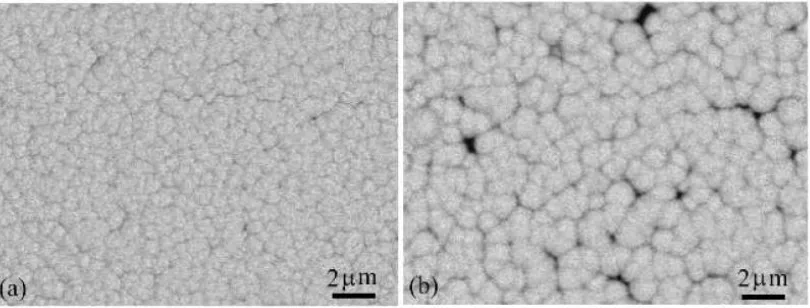
Figure 6. SEM images of the Cu-Mo-Al films electrodeposited (a) at a frequency of 0.7 MHz and (b) at a frequency of 1.2 MHz.
Figure 6 shows SEM images of the Cu-Mo-Al thin films electrodeposited at a frequency of 0.7 and 1.2 MHz. The Cu-Mo-Al thin film comprises islands having about 1 m in size. The mean grain size calculated from the XRD chart indicates that the island comprises grains of 30 nm in size. The Cu-Mo-Al thin film has the nano cauliflower structure.
3.3 Mo concentration in the Cu-Mo-Al thin film dependent on the frequency
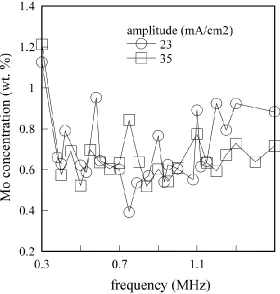
Figure 7. Frequency-dependence of the Mo concentration in the Cu-Mo-Al thin film electrodeposited at amplitudes of 23 and 35 mA/cm2.
4. CONCLUSIONS
Aluminium in the Cu-Mo-Al thin film electrodeposited in the aqueous solution was demonstrated as an alloy element by EDX and XRD. The resonant frequency, the resonant frequency spacing between the neighboring resonant frequencies, and the resonant frequency corresponding to the first excited state, which were found in a range of frequency from 0.2 to 1.5 MHz, are discussed from the viewpoint of the energy level transition. The maximum aluminium concentration in the Cu-Mo-Al thin film was about 6 wt. %. The XRD analysis showed that the (111), (200), (220), and (311) crystallographic plane parallel to the ITO glass substrate existed in the Cu-Mo-Al thin film. The surface images of the Cu-Mo-Al thin film were shown to be an aggregation of the nano cauliflower. References
1. R. K. Pandey, S. N. Sahu, and S. Chandra, Handbook of Semiconductor Electrodeposition, Marcel Dekker, New York, 1996.
2. W, Simka, D. Puszczyk, and G. Nawrat, Electrochim. Acta, 54 (2009) 5307. 3. M. Zhang, V. Kamavaram, and R. G. Reddy, JOM, 55 (2003) 54.
4. K. Uehara, K. Yamazaki, T. Gunji, S. Kaneko, T. Tanabe, T. Ohsaka, and F. Matsumoto, Electrochim. Acta, 215 (2016) 556.
L. Fredrickson, and J. S. Herring, Surf. Coat. Technol., 258 (2014) 652.
6. M. Lia, B. Gao, W. Chen, C. Liu, Z. Wang, Z. Shi, and X. Hu, Electrochim. Acta, 185 (2015) 148. 7. G. Pulletikurthi, B. Bödecker, A.Borodin, B. Weidenfeller, and F. Endres, Prog. Nat. Sci., 25
(2015) 603.
8. Y. Zheng, Y. Zheng, C. Peng, Z. Zhao, and D. Tian, Int. J. Electrochem. Sci., 11 (2016) 9585. 9. A. Bakkar and V. Neubert, Electrochem. Commun., 51 (2015) 113.
10. P. Giridhar, B. Weidenfeller, S. Z. E. Abedin, and F. Endres, Phys. Chem. Chem. Phys., 16 (2014) 9317.
11. J. A. Mitchell, W. R. Pitner, and C. L. Hussey, J. Electrochem. Soc., 143 (1996) 3448. 12. M. R. Ali, A. P. Abbott, and K. S. Ryder, J. Electrochem., 172 (2015) 172.
13. P. Giridhar, S. Z. E. Abedin, and F. Endres, J. Solid State Electrochem., 16 (2012) 3487. 14. W. J. Moore, Physical Chemistry, New Jersey, Prentice-Hall, (1999).
15. M. Saitou, Int. J. Electrochem. Sci., 11 (2016) 5535. 16. M. Saitou, Int. J. Electrochem. Sci., 12 (2017) 1193.
17. D. L. Lide, CRC Handbook of Chemistry and Physics, Boston, CRC Press, (1998). 18. R. M. Dimeo, Am. J. Phys., 71 (2003) 885.
19. W. Demtröder, Atoms,Molecules and Photons, Heidelburg, Springer, (2010). 20. R. G-Férez and P. Schmelcher, Phys. Rev. A, 69 (2004) 023402.
21. JCPDS No. 04-0836.
22. M. Gotou, T. Arakawa, N. Watanabe, T. Hara, T. Tomita, A. Hashimoto, H. Takanashi, and I. Koiwa, Bull. Chem. Soc. Jpn., 88 (2015) 173.
23. B. N. Sahoo and K. Balasubramanian, J. Colloid Interface Sci., 436 (2014) 111.
24. M. Castro, R. Cuerno, M. Nicoli, L. Vázquez, and J. G. Buijnsters, New J. Phys., 14 (2012) 103039.
25. V. I. Makarov, S. A. Kochubei and I. V. Khmelinski, Phys. Rev. A, 68 (2003) 043403. 26. A. V. Phelps, Rev. Mod. Phys., 40 (1968) 399.