Rochester Institute of Technology
RIT Scholar Works
Theses
Thesis/Dissertation Collections
1995
Ascension
Clifford M. Commanday
Follow this and additional works at:
http://scholarworks.rit.edu/theses
This Thesis is brought to you for free and open access by the Thesis/Dissertation Collections at RIT Scholar Works. It has been accepted for inclusion
in Theses by an authorized administrator of RIT Scholar Works. For more information, please contact
Recommended Citation
ROCHESTER INSTITUTE
OF
TECHNOLOGY
A Thesis Submitted
to the
Faculty
of
The
College
of
Imaging
Arts
and
Sciences
In
Candidacy
for
the
Degree
of
MASTER
OF FINE
ARTS
Ascension
by
Clifford M
Commanday
Approvals
Robert Schmitz
Advisor
date
/2
-1-
'1':
Richard Hirsch
/ 2
UiJ
Ii'
5./
Associate Advisor
date
Bruce Ian Meader
Associate Advisor
date
fl- d-O-1?"
I, Clifford M Commanday
prefer to be contacted each time a request for production is made.
I can be reached at one of the following addresses:
716 Linden Street
Rochester New York
14623
716 473-01 99
7 Greenfield Terrace
Dedication
I
dedicate
this thesis to
my
parents;
they
aremy
support,
my
inspiration,
andmy
friends.
Special Thanks
I
owethanks to
Bob, Rick,
andBruce,
my
thesis advisors;
to
Sandy
Beckerman,
for
alwayshelping
mestay
ontrack
my
first
year;
to
Katelyn
Thorne,
for
being
anhonest
colleague andfriend
(and
the
best
neighborI've
had
in
quite awhile);
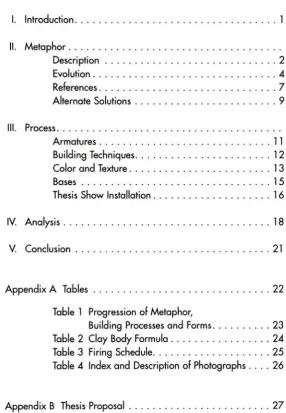
Table
of
Contents
I.
Introduction
1
II.
Metaphor
Description
2
Evolution
4
References
7
Alternate Solutions
9
III.
Process
Armatures
11
Building
Techniques
12
Color
andTexture
13
Bases
15
Thesis Show Installation
16
IV.
Analysis
18
V.
Conclusion
21
[image:5.539.146.433.102.516.2]Appendix A
Tables
22
Table 1
Progression
ofMetaphor,
Building
Processes
andForms
23
Table 2
Clay Body
Formula
24
Table 3
Firing
Schedule
25
Table 4 Index
andDescription
ofPhotographs
....26
Appendix B Thesis Proposal
27
Appendix
C
Photographic References
30
RIT,
Brutalism
31
Highland Waterfalls
36
Beverly
Pepper
38
Appendix
D
Thesis Show Sculptures
39
Introduction
"
I
look
uponlife
as a series ofjourneys.
This
series offorms
is
devoted
to
a sense ofAscension,
both
physical andspiritual."
Clifford
M
Commanday
This
statement accompaniedmy
thesis
show atthe
Bevier
Gallery,
andclearly
andsimply
describes
the
intent
ofmy
thesis.
One
ofthe
strongestcharacteristicsI
see present withinall
the
journeys
ofmy
life
thus
far
is
adesire
to
succeed and advance:to
ascend.I
have
made a series of sculptures
focused
oncommunicating
these
feelings.
This
thesis
is
divided
into three
sections:I
willdiscuss
my
metaphor ofascension,
describe
the
processesinvolved in
creating
the sculptures,
andthen
describe
and analyzeMetaphor
Description
Throughout
my
life,
I
have had
a powerfuldesire
to
succeed-to
ascend.I
can rememberalways
wishing
to advance, to grow,
andto
raisemy
level
of consciousness and personalspirituality.
As
anexample,
whenI
wasyoung
this
manifested asthe
desire
to
become
a
better basketball
player;
I
would shootboth left
and right-handeddrills for hours
in
the
cold.
In
schoolmy
interests
werein
computerscience;
I
spenthours
andhours
atmy
keyboard,
andmy
teachers
had
to
workhard
to
keep
up
with me.I
wrote muchpoetry
and
many
short storiesexploring
how
I
viewedthe
world.I
sawlife
asthe
opportunity
to
grow.It
seemslogical
to
me nowthat
I
would create a series of sculpturesintending
to
communicate
the
forces behind
suchdesires.
The
installation
for
my
thesis
show consistedof seven
tall,
upreaching
sculptures made of ceramics and cementthat
risefrom
the
floor
to
a peak often
feet.
They
stand atleast
afew feet
taller than the
averageperson,
forcing
a viewerto
look
upward when closeto them.
In my
first
year ofstudy
atRIT,
I
realizedthat this
use of scale wouldbe
essentialto
draw
the
viewerinto the
pieces.The
technical
solutionto
this
wasdifficult
to
achieve,
but
I
wantedto
createthis
specificinteraction
withmy
pieces.I
wanted peopleto
have
to
physically
lift
their
heads,
to
look
up,
andpotentially
feel
the
desire
to
riseup
withthe
sculpture.I
wastold
by
a numberof people
that
viewing
the
collection ofthe
sculpturesin the
gallery
waslike
walking
through
an oldforest,
rich withhistory,
rich withlife.
The
pieceshave
many
edges,
ledges,
andfacets.
Each
ofthese
represents astep
in
aare grouped
together,
they
canbe
seen as collections ofthese
journeys.
Early
on,
I
had
conversations with
Bruce
Meader,
a member ofmy
thesis committee,
about whetherI
wastrying
in
each pieceto
represent completejourneys
or parts ofjourneys.
I
realizedthat
within our
lives
we engagein
many
journeys.
It
is
in
these
journeys,
combinedtogether,
that
wedefine
ourlives.
Critical
to the
interpretation
ofmy
ascension metaphoris that there is
no representationof a specific
destination
or end-goalto the
journey
onetakes
upwardthe
piece.It
is the
journey
itself,
notthe
destination,
ofwhichI
wantedthe
sculpturesto
speak.Success
is
not
merely
adestination,
it is the
process ofcontinuing
to
reach upwards.Each step
becomes
the
foundation
to
build
uponto
reachthe
nextstep
orlevel.
I
wantedthe
sculpturesto
address a sense of personal spirituality.That
is,
not oneattached
to,
andI
believe
thus
limited
by,
any
of society'sformal
religiousinstitutions.
I
intentionally
avoided specific religiousiconography
andimagery
to
increase
the
possibility
ofthe
viewer's accessto
such a sense of personal spirituality.I
am reminded of a commentby
Rosalind E. Krause
discussing
the
work ofBeverly
Pepper. She
spoke ofthe
"inner
logic
ofthe
analogiesthat
drive
art,
that
cause someoneat one
time
or anotherto stand,
transfixed,
in
front
of asoaring,
uselesswall"
(143).
I
createmy
work withboth
anintellectual
and emotionalconsciousness,
which oftenleads
meto
stand,
transfixed,
in
front
ofsoaring RIT
walls.The
processesin
whichI
workedhad
adirect
influence
onthe
final look
ofthe
sculpturesin
my
thesis
show.The
exuberanceI
felt
asI
createdthe
tall
ceramic spiresis
reflected,
I
believe,
in their
form
and surface.The
cementbases
retain visual remnants ofthe
of
the
processfurther
justify
eachstep
taken
in
the
creation ofthe pieces,
andfurther
allude
to
a sense ofjourney.
Evolution
My
development
ofthis thesis
has
itself
been
part of a personaljourney.
It
has
provento
be
a crucialstep
in
my
development
as an artist and sculptor.My
metaphorhas
developed
overthe
pastfive
years,
withits
rootsin the
workI
did for
my
undergraduatedegree. (See
Table 1
Progression
ofMetaphor,
Building
Processes
andForms
in
Appendix
A.)
When
I
cameto
RIT,
I
had
a"large
bucket
of ideas"that
I
wastrying
to
communicatein
my
pieces all at once.At
first,
I
wastrying
to
communicate a complex set ofideas
about
the
interaction
ofhumankind
with nature andspirituality,
humankind
withtechnology, humankind
witharchitecture,
andhumankind
withhumankind.
The
development
ofthis
thesis
was a constantbattle
to
remove allthe
unnecessary
elements,
allthe
"extra
information"from
the
"bucket."From
the
beginning,
my
professor
Rick Hirsch
urged meto
focus,
to
be
moredeliberate
andless literal
withmy
sculptures.These
recommendations reflectedmy
personal strugglesto
sharpenmy
views onthese issues.
I
realizedthat
I
should nottry
to
answer somany
broad
and generalized questionsin
my
sculptures.At
first,
the
communicationI
was perhaps most successful atachieving
was
intrapersonal:
developing
my understanding
ofhow
I
feel
aboutthe
relationship
between
spirituality
andtechnology.
I
believe
westrongly
feel
the
influence
oftechnology
upon our
society,
but
I
do
notbelieve
it is
technology
that
preventsus,
as aculture,
from
developing
orascending
to
a personal sense of spirituality.I
realizedthat
it
was notgrowth and
the
personal riskthat
attachesto growth,
andthe
effortto
ascend.This
wasa major
step
in the
evolution ofmy
thesis.
In
the end,
I
believe
I
was successful withmy
sculptures
because
I
focused
not onspecifics,
but
on an abstract notion andfeeling,
this
desire
to ascend,
or succeed.When I
wasdeveloping
my
skills onthe
potter's wheelin
undergraduate school atSyracuse
University,
I
wantedthose
potsto
"rise,
lift
up,"as
I
described
it
then.
I
focused
heavily
onthe
lip,
andhow
its
curve could activate a great amount of spaceabove a pot.
I
wasdrawn
to
the
architecture ofDoric
columns,
for
their
physical andvisual strength and
lift,
andI
wasinspired to
create a series oftall,
pottery-influencedvessel
forms.
One
ofmy
goalsfor
attending
graduate school wasto
clarify
in
my
pieces,
andto
myself, the
separateinfluences
uponmy
work ofpottery
and of vessels and sculpture.My
decision
in
my
first
year atRIT
to
focus
heavily
on sculpture ratherthan
pottery
was a
difficult
one.I
have
alove for
the
process ofthrowing, but
asmy
workdeveloped
it
became
clear asI
filtered
through
my
"big
bucket"that
this
changeof
focus
was necessary.No
longer
weremy
ideas
as connectedto
the
functionalism
associated with pottery.
The
highly
conceptualideas
I
wantedto
discuss
in
my
work werenot centered on
the
conceptsof"inside/outside"
or
"container/contents"
which
vessel-making
can so wellcommunicate,
but
my
intentions
ofcommunicating
a sense ofascension seemed
better
suitedto
sculpturalforms.
This
process ofmoving
towards
sculpture
involved
afew
stagesfor
me;
I
considerthe
series"Watching
Places"
which
I
created
next,
to
be
animportant
step
in
this
direction.
These
sculptures ofthe
"Watching
Places"
series were
approximately
five feet
high,
andThere
is
anopening
atthe
top
of eachpiece,
aform
suggesting
an altarinside the
large
implied
interior volume;
rising
from
the
base
weremany
small, intricate
steps carvedinto
the
surface.I
wastrying
to
develop
the
concept of architecture as a containerfor human
activity, the
activity
in this
casebeing
worship.But
my
"big
bucket"was stillvery
full.
I
wastrying
to
use explicitimagery
-the
detailed
carving
ofthe
steps and staircasesto
altars-to
draw
uponhistorical
referencesto
architecture of spiritual
places, to
avoid referenceto
any
specificreligion,
and alsoto
draw
uponhighly
metaphorical referencesto the
interaction
ofhumankind
withthese
sculptures.
In
plainterms,
the
contents ofmy
"bucket"
were
spilling
all overthe
floor.
I
had
to
choose andfocus.
It
was not until afterI
finished
this
seriesthat
I
realizedI
neededto
focus
onthe
underlying
emotionguiding
allthese
ideas.
I
decided
to
usethe
concepts andimagery
associated with architecture as abackground,
or
supporting
metaphor,
for
my
work;
these
references andtranslations
ofdifferent
examples of architecture provided a context
for
the
main metaphor.I
began
to
use anextremely
linear
vocabulary
ofform
to
focus
the
attention ofthe
viewer upwards.
With
a much simpler and cleareridea
ofwhatI
wantedto
create,
after
developing
the technical
resolutionto the
armature(which
I
describe
in
the
Process
Section
ofthis
thesis),
I
producedthe
ceramic portions ofthe
final
sculptures ratherquickly.
My
nexttask
wasto
resolvethe
transition
from
the
piecesto
their
bases.
What
a simple sentenceto
write...but
solving
this transition
was one ofthe
mostchallenging
aspects ofthis
thesis,
anddemanded
the
greatest portion ofmy
attentionduring
the
last
few
monthsbefore
my
thesis
show.At
first,
the transition
wastoo
drastic
ceramic
portion,
aswell asto
integrate
the
faceted
imagery
from
the
top
into the
cementbase.
The
evolution wasslow-going,
but
I
wasdetermined
to
makeit
work.I
knew
that
I
had
finally
chosen allthe
right piecesto the puzzle;
I
just
had
to
keep
working
to
find
solutions
I
was satisfied with - andI
did.
References
One
theme
running
through
my
two
years ofworkandstudy
atRIT
has
been
a referenceto
architectural materials.In
my
first
year of graduate work atRIT I
was struckvery
profoundly
by
the
Brutalist
architectural style ofthe
campus.When
I
walked aroundcampus
I
found
myselfexploring
andtouching
the
bricks
ofthe
buildings.
I
wasdrawn
to the
intensity
ofthe
forms
in space,
andthe
angles createdby
the
interaction
ofthe
buildings.
My
favorite
spot ofinspiration
wasthe
ramp
between buildings
7A
and7B
(see Photographs 1-5
in
Appendix
C). From
that
vantagepoint,
there
were somany
subtleties
to observe,
such asthe
way
alayer
ofbricks
would protrudefrom
a structurallayer
implied
underneaththe
surface,
and create shadows onthe
railingsbelow.
The
images
ofthese
bricks
andtheir
surfaces appearin
much ofthe
workI
have done
at
RIT,
from
pottery
forms
with carvedbrick
detail,
to the
sculpturesin
my
thesis
show.The
deep
burnt
orange colors ofthese
surfaces also affected me.The
ingredient
in
the
bricks
that
is
mostly
responsiblefor
this
coloris
rediron
oxide(Fe203),
a material whichhas fascinated
me since undergraduate school.It
has
along
and variedhistory
in
ceramics,
from
its
natural occurrencein
earthenware claysto
its
usein the
decoration
of
Egyptian
pottery.The
cement presentin
the
bases
ofmy
thesis
show sculpturesis
a reference
to
architecturalbuilding
materials,
a connection strengthenedby
the
useof red
iron
oxide.century.
The
styleis
characterizedby
aclarity
ofform,
a celebration of materialsin their
raw
state,
and aspecificity
of spaces andtheir use;
it
has
its
origins ofthought
in the
modernist style of
the
Bauhaus,
and architectsWalter
Gropius
andMies Van
der
Rohe.
RIT's
campus,
openedin
1968
anddesigned
by
Roche
andDinkeloo,
has
aBrutalist
core,
characterizedby
a"punched
block"aesthetic and
the
gestaltof a massivesculptural expression of
the
rigors of academic pursuit.In
winter,
ablanket
of snowtransforms the
campus'stark geometry.
The
snow pilesup,
and
the
windfills
the
sharp
brick
angleswith snow.The
wind channelsthrough
the
pathsbetween buildings
and createslong
curved embankments ofsnow.I
remember onecold
evening
leaving
the
studio andbecoming
enthralled with oneparticularly
long
embankment.
The
wind wasshaping
it
asI
watched,
creating
anamazing
texture
I
canonly
describe
aswhite uponwhite steps of snow.To
be
honest,
afterfour
yearsof
Syracuse
weather(and
being
anon-skier)
I
was plumb sick ofthe
sight ofsnow,
but
this
experience changedmy
mind,
and gave me a newway
to
seeit.
An
important influence
on mehas been
the
work ofBeverly
Pepper.
(See Photographs
8-9
in
Appendix
C.)
Her
workis
consistently
strong
in
its
use ofform
in
space,
andthe
activation of
the
spacesurrounding
the
forms.
The
works ofhers
that
I
amdrawn
to
mostare
those
which referenceboth
primitive and moderntools.
The
pieces arestrong
andmassive,
rising
ashigh
asfifty
feet,
boldly
piercing
the
sky.Although
these
sculpturesof
Pepper's
reflecta sense ofmass,
where mine utilize a morelinear
vocabulary
ofform,
her
referencesto
man-made objectshave
similaritiesto
some ofmy
ownconcerns,
and
her
simple and elegant solutionshave
intrigued
me.Another strong
influence
onmy
work wasthe
ancient architecture of spiritual places.Peruvian
temples.
I
sawthese
as ancientimages
of a culture whose members carvedspiritual places out of mountains.
An
incredible
amount of attention wasfocused
onthe
carved staircases
to these
places.I imagined
that
as one climbedthem
one wouldhave
aritualistic experience of
ascending
the
mountainto
reach an altar.I
wasimmersed in
those
steps.From
the
first
sight ofthese
temples,
their
images
have been
astrong
continuous
influence
onmy
work.The
mannerin
whichthe
bases
ofthe
modular series ofmy
thesis
show sculptures areplaced
have
referencesto
ancient architectural planning.In
the
design
ofthe
spacebetween
the
bases.
I
drew
upon referencesfrom
Egyptian city
planning,
as well asRomantic
Roman city
planning.I
try
to
balance
the
inspirations
from
the
products ofboth humankind
and nature.Around
October,
1994
I
visitedthe
Highland
Waterfalls
in
Rochester. I very
muchenjoyed
the
waterfallsthemselves,
andthe
way
the
waterflows downstream
overthe rocks,
but
I
believe
whatinfluenced
me most wasthe
sight ofthe
layers
of earthexposed
by
the
ancientflow
ofthe
river.(See Photographs 6-7
in
Appendix
C.)
The
carved channel ofthe
old riverbed
revealedlayers
andlayers
of ancient earthand
land,
cutsharp,
but
withthe
undulating
curve of afluid
river.This
referenceto,
and product
of,
ancienttime
affected medeeply.
It
is
notthe
first
time
I
have
seensuch
imagery,
northe
first
time
I
have
enjoyedit, but
there
wassomething
profoundabout
this
experiencein the
context ofmy
otherstudy
and researchfor
my
thesis.
Alternate Solutions
A
major one wasto
createwalking
sticks.I
felt
awalking
stickinherently
reinforcedthe
idea
of ajourney.
It
could referto the
person or peoplescarrying
outthe
journey,
as well as
to the
kind
of primitivesociety
which would createthe
kinds
of placesof
worship
such asI
wasimagining.
The walking
sticksI
created were ofwood,
fallen branches
from
trees in
Rochester's Highland Park
that
I
then
carved and sanded.The
linear
nature ofthe
sticks correspondsto the
linearity
ofthe
sculpturesI
wasto
develop.
I
did
not usethe
walking
sticksfor
afew
reasons.The
mostimportant
wasthat
I
wasnot satisfied with
their evolution;
they
were notfully
resolved.I
wasworking
onthem
during
winter quarter ofmy
secondyear,
andin the interests
oftime
management,
I
choseto
refocusmy
efforts onresolving
the
issues
withthe
major pieces.Also,
I
was not surehow
I
felt
aboutthe
different
use of scalefrom
the
sticksto the
sculptures.
The
sticks existed on ahuman
scale,
but
the
sculptures relied onplaying
with
perspective,
alluding
to
heights larger
than
life.
At
the
very
least,
I
enjoyedbeing
outin the
coldsearching
for
just the
rightbranches.
Another
possible solutioninvolved
linear
constructions of collections of cast cement poles.I
chose notto
do
these
simply
because
I
wantedto
resolvethe
other sculpturesI
had
Process
During
the
course ofthis
thesis,
I
explored avariety
ofbuilding
techniques.
As
my
metaphor
developed,
I
alwaystried to
use an appropriatetechnique.
(See
Table 1
Progression
ofMetaphor,
Building
Processes
andForms in
Appendix
A.)
As
I
statedearlier, the
processesin
whichI
workedhad
adirect
influence
onthe
final
look
ofthe
sculptures
in
my
thesis
show.(See Photographs 10-29
in
Appendix
D.)
I have
groupedthe
sculpturesinto two
categories:the
organic series(Photographs
10-15,
and17-27)
and
the
modular series(Photographs
16,
28-29). In my
thesis show, the
modular seriesis
representedby
onesculpture,
createdby
a pair of square columns placedclosely
to
each other.
Armatures
When
I
decided
to
createextremely
tall
andthin sculptures, it
was adifficult
processto
develop
the
appropriate armaturesfor
creating
anddisplaying
the
sculptures.I
spent agood
deal
oftime
brainstorming
ideas
withmy
professorBob Schmitz.
For
the
organicseries,
the
resulting
armaturefor
creating
the
worksin
clay
consisted of aten
foot
long,
one
inch
diameter
aluminum pole setvertically
in
a cement-filledbucket.
The
display
armature
for both
series consisted of ahalf-inch
diameter black-iron
pipe setvertically
in
a solidbase
of cast cement.The
fired
clay
and cast-cement sections ofthe
final
pieceswere slid over
the
pipe.Afterwards,
I
cut each pipe with ahacksaw
to the
appropriateheight for
each sculpture.These
armatures provedto
workvery
well.While
I
wascreating
the works,
the
roundbucket
allowedfor
relative easein
moving
the
armatureduring
construction asI
couldlean
the
pole and rollit
along
the
edge ofthe
bucket.
The
decrease
in the
pipediameter
Building
Techniques
To
createthe
ceramic sectionsI
coveredthe
entire pole withclay,
having
first
coveredit
withlayers
of newspaperto
aid removal.I
experimented withboth
coilbuilding
androlling
slabs aroundthe
pole.It
was notfeasible
to
smooththe
joint
connections onthe
interior
ofthe
coilwalls,
whichled
to
weakjoints
between
the
coils.The
slab methodin this
case created strongerjoints,
and was quicker and more efficient atcontrolling
the
widths of
the
walls.At
this stage,
I
manipulatedthe
clay
in
avariety
ofways.I
experimented withpaddling
the
surfacewith an assortment ofhand-made
paddles,
including
found
scrap
woods,
but
the
method usedfor
the
final
piecesin
my
showinvolved
using
a wire-cutterto
slice off chunks ofclay creating
facets.
(See Photographs 24-25
in
Appendix
D.)
I
used avariety
ofdifferent
wires,
including
pianowire,
guitarstrings,
andbraided
wireof assorted
types.
I
wantedthe
piecesto
reflect a sense of aggressive and controlledlift.
I
gatheredmy
energy
and"hacked
away"
with
the wire-cutter,
causing
chunks ofclay
to
fly
aboutmy
area
(and
my
neighbor's area as well).I
oftenbuilt
up
afrantic
rhythm andsweat,
pacing
andcircling
aroundthe
piece whileslicing;
sometimesI
think
I
wasworking
in
an oxygen-deprivedstate,
drawing
further
into
my
instinct,
pastthe
guide ofmy
intellect.
I
began
to
work at nightbecause
I
felt
freer
to
act"crazed"
like
this
whenI
was alonein the
studio.After
I
faceted
this
tall
column ofclay, it
wasnecessary
to
divide
it into
sections.I
attemptedto
do
this
atvisualjunctures
in
orderto
help
disguise
the joint.
(See
Photographs
26-27.)
As
I
created afew
ofthese,
I
became
more aware ofthe
I "hacked
away
in
a frenzy."I
believe
an artist'sinstinct
shouldbe
primedby
researchand
life
experiences.The
work of an artist whodraws
only
uponinstinct
might notcontinue
to
develop
and grow.I
spentmy
first
year of graduatestudy analyzing
anddeveloping
many
complexideas.
In
my
second yearI
realizedit
wastime to
stop
intellectualizing
asmuch,
andbegin
responding
moreto the
information
I
had
gathered.The
modular series was not created on anarmature,
but
constructedfrom
template-cut
slabs scored
together.
Instead
ofwirecutters,
I
usedthe
claw of ahammer
to
gougethe
surface.Clawing
atthese
hollow
rectangular columnsI
felt like
a mountainclimber,
reaching
andgrabbing
upwards with each stroke ofthe
claw.Color
andTexture
In
an effortto
convey
a sense of ageI
createdmany
layers
oftexture
and colorin
the
surfaces of
the
pieces.The
colors ofthese
layers
were createdin
a number of ways.I
used an earthenwareclay
body
once-firedto
A2
(pronounced
"cone
two"),
approximately 2124T.
(See
Table 2
Clay Body
Formula
in
Appendix
A.)
The
naturaldeep
browns
ofthe
clay
were a result ofthe
heavy
reductionI
employed atthe
endof
the
firing
process.I
did
not useany slip
or glazesbecause
the
resulting
surfaceof
the
bare
clay
wasthe
desired
effect.The clay
body
recipethat
I
used originatedfrom
afew
ofmy
peersin
the
ceramicstudio
utilizing
alow
to
mid-fire sculptureclay
body.
For
addedtexture
andstrength,
I
modifiedthe
originalformula
to
include
mediumgrog,
and some occasional coursegrog, instead
offine
grog.I
also added2%
barium
carbonateto the
body
to
preventscumming,
awhitefilm
that
can result onthe
surface offired
piecesfrom
a reactionI
createdthe
range ofdeep
burnt
orangesin the
bases
by
adding
different
amounts ofred
iron
oxideto the
wet cement mixturebefore
applying
or casting.I
did
most ofthe
mixing in
alarge
50
gallon metalbarrel
cutin
half
andturned
onits side,
orin
plasticbuckets for
smallerbatches.
I
used a pre-mixedcement;
allI
neededto
add was waterand color.
I
did
not measurethe
cement,
water,
and oxide exactly.I
developed
akeen
sense of
it
after a greatdeal
of mixing.Onto
the
surface ofthe
clay
before
firing,
I
used avariety
oftechniques, from
lightly
burnishing
with rubber and metalribs, to
scraping
the
surface witheverything
from
metalnails
to
my
fingernails,
to
gouging
the
surface withthe
claw of ahammer.
After
firing
I
sanded, ground, scraped,
anddrilled
through
layers
ofspray
paint and rediron
oxide.An
essentialtool
for
affecting
the
surfaces afterfiring
wasmy
cordless powerdrill.
I
had
alot
offun
in the
hardware
storesearching
through
allthe
different
sanding
and
grinding
bits.
I
gathered quite an eclectic collection ofdifferent
size andtextured
bits
that
allowed meto
createthe
aged-looking
surfaces ofthe
finished
pieces.The
sculpture representedin
Photographs
15,
24
and25
uses a somewhatunorthodox method of color application.
I
used charcoalsticks,
atraditional
drawing
medium,
to
rub ontothe
edges ofthe
ceramicfacets
to
accentuatethe
edges.Underneath
the
charcoal werelayers
of white andblack
spray
paint,
andI
used aspray
fixative
atop
ofthe
charcoalto
makeit
more permanent.Consistent
withthe
mannerI
achieved allthe
layer
effects,
I
did
the
process oflayering
the
dark
charcoal andthe
Bases
To
createthe
cementbases,
I
pouredthe
wet mixtureinto
moldforms
made of wood.On
aleveled
surface,
I
first
poured a one cubicfoot
cementcube, the
moldform
createdwith plywood connected
by
metalbrackets
and screwsto
aid removal.I
coveredthe
interior
ofthe
wood surfaceswith athin
coat ofvaseline alsoto
aidremoval,
andprevent
leakage between
the
boards. When I
had
the
moldhalf full
I
inserted the
pipevertically,
keeping
it
atleast
aninch
abovethe
ground.To
keep
the
pipe perpendicularto
the
floor
asI
finished
pouring
into the
mold and asit set,
I
taped the
pipeto
a polelaid
horizontally
acrosstwo chairs,
one on each side ofthe
mold.I
then
used alevel
to
ensurethe
pole was perpendicularto
the
leveled
surface onthe
floor.
After
this
initial
base
waspoured, it
allowed meto
insert the
ceramic sections overthe
pole,
andbegin
integrating
the two.
At
first,
the transition
from
the
squarebase
wastoo
drastic.
To
help
this transition area,
onetechnique
I
tried
waschiselling away
atthe
top
andthe
corners ofthe
cement cube.I
used a cold-press chisel and aheavy
mallet.Again,
pieces wentflying
aboutmy
area,
landing
oftenin
my
neighbor's areaas well.
This
proved notto
be
as effective asI
had
hoped,
and was aswell,
physically
demanding
(and
damaging
to
my
mallet),
soI
began
to
raisethe
ceramic sectionhigher
above
the
squarebase before
I
began
to
castin
orderto
have
more roomto
createthe
transition.
Instead
ofbeginning
with a cubicfoot base
for
the
last
two sculptures,
I
pouredthe
mixture
into
atwo
foot
cardboard cylinderthat
I
cutin
half
lengthwise,
andlined
withvaseline
to
aid removal.The
cardboard cylinder was quitestrong;
it
wasthe
centerof
the
end-roll paperthat the
studio usesfrom
the
printing
department.
Due
to
its
smallerdiameter,
this
shiftto the
cylindricalform
gave me morefreedom
to
build
the
transition
I
developed
animprovisational
method ofcreating
the
woodforms
to
pourthe
cementinto,
aroundthis
base,
to
build
up
the
stepped andfaceted
imagery
presentin the
final
pieces.
The
method was rathersimple;
I
usedfound
scrap
woodto
build
up
verticalforms
around
the
base,
supportedit
with otherwood,
andthen
filled
the
inside
ofthe
form
created with cement.
I
learned
that
in
orderfor
this
additional cementto
adhereto the
initial
base,
I
neededto
surroundthe
pole with atleast
1/4" of cement.I
repeatedthis
processmany
times:
first
making
the mold,
pouring
the cement,
andthen
letting
it
setat
least
overnight.After
I
removedthe mold,
I
couldthen
add anotherlayer higher
up
on
the
base,
continuing
this
process untilI
had
fully
integrated the
base
to the
ceramicsections.
I
learned
that
different
proportions of cement mixtureto
water yielded cement ofdifferent
strengths and
textures: the
less
water, the
strongerthe
cement.It
was aninteresting
process,
learning
how
to
balance
these
properties.I
neverthought
I
would cometo
know
so much about cement.Thesis
Show
Installation
My
thesis
showinstallation
consisted of sevensculptures,
sixrepresenting
the
organicseries,
and onerepresenting
the
modular series.There
waslimited floor
space availablein
the
Bevier
Gallery
due
to the
large
numberofMasters Candidates
in
the show,
as well as
to
alimited
areain the
gallery
that
had
adequateceiling
height.
I
debated
atfirst
whetherto
display
these tall
linear
spiresin
a consolidatedgroup,
or spread out
through the
floor
space.Working
withthe
assistance ofBetsy
Murkett,
the
Gallery
Director,
we chose afloorplan
somewhatin
between.
The
sculptureswereplaced
along
somewhat of anL-shape
dividing
the
front
part ofthe
gallery.This
allowedThis
arrangement allowedfor
individual
views of each sculpture.As
described
in the
processsection, the individual
sections of each sculpture werestacked
atop
each other around ablack-iron
pipeextending vertically
from
each cementbase. For
the
temporary
installation
requiredfor
the thesis show,
I
used athin
layer
ofplasticine
between
sectionsto
increase
stability
and ensure atight
fit.
I
was ableto
hand
mix
different
colored plasticineto
best
matchthe
colorsurrounding
the
joints.
For
the
modularseries,
however,
I
used a more visiblethick
layer
ofcontrasting
black
plasticine
to
accentuatethe
joints
between
each module.Overall,
the
plasticine provedto
Analysis
The
sculptures aretall,
slender,
andlinear
spires.Each
has
astrong
solidbase,
and
taper
upwards withmany
edges,
ledges
andfacets
to
a peak ashigh
asten
feet.
Each
sculptureis
a collection ofphysically
separate sectionsjoined
together,
andan
important
distinction
between
the
sculpturesis
how
these
joints
aretreated.
You
can view ajourney
ashaving
many
parts;
sometimesit is
easierto
distinguish
the
individual
partsthan
othertimes.
I
recognized a cleardistinction between
the
different
processesinvolved in
making
the
organic series and
the
modular series.In
orderto
createthe
organicseries,
I
had
to
create a
sculpture, then
sectionit into
pieces.The
modular series was quitethe
opposite:I
created piecesto
be
puttogether
afterwards.I
realizedsomething very
important
aboutmyself-
I
prefermaking
assemblages,
putting
piecestogether.
I
believe
this
relatesto
my
interests in
graphicdesign.
I
look
uponthat
medium,
especially
typography,
as a collection of pre-made elements almostin
desire
themselves
to
be
moved around over and over again until
they
find
ahome.
I
believe
this
observationabout
myself,
my
preferenceto
workin
modular art andassemblage,
is
one ofthe
mostimportant
discoveries
anddevelopments
sofar
in
my
career as an artist anddesigner.
The
modularseries'
visually
separate units might elicitthe
notion of clear anddistinctive
steps within a
journey
-a collection of sep-ar-ate events
joined
only
by
physical meansand
their
placement.These
separate events couldbe
seen asdistinct
partswithin ajourney
riddledwiththeir
owninnate
difficulties,
in
whichfurther
tension is
then
createdby
the
connections ofthese
eventsto
each other.The
joints
ofthe
organicseries'
visual and physical
junctures.
(See Figures
26-27.)
This
creates a more continuousflow
ofline
anddirection
in the
organic series.I
believe
this
flow describes
the
steps within
those
journeys
as moreinterdependent,
interlocked
physically
andinterconnected
metaphorically.The
sculpturein
my
thesis
showrepresenting
the
modular seriesis
very
different
in
appearance and configuration
from
the
other series.Instead
of a singlespire, it
consists of
two
square columns placedin
very
close proximity.(See Photograph
28,
detailing
how
closely
the
bases
ofthe two
columns areplaced.)
When
these two
columns are placed
in this
closeproximity, there is
anexciting
activation ofthe
negativespace
between
them.
Furthermore,
when agrouping
ofthese
sculpturesis
displayed,
this
sense of negative space and
interaction is
greatly
enhanced.These
columns,
made of modular pieces either ofclay
orcement,
are achievedthrough
a
"stacking
effect,"
placing
the
modules one ontop
of another.Some
ofthe
cementmodules extend
laterally
from
the column,
and producestrong
visual connections andrelationships
to the
other column.(See
Photograph
29.)
Formally,
the
height
and widthof each module and each cement connector
form
an organic sense of regularinterval
spacing.
This
regularinterval
flows
vertically
through
eachcolumn,
andis
accentuatedand
balanced
by
the
lateral
extensions ofthe
cement modulars.Additionally,
focus
andinterest
are createdthrough the
variety
ofthe
angles anddepths
ofthe
cement modules.These
relationships,
between
the two
columns and atthe
interaction
ofthe two
bases,
can
be
seen asrevealing
how
two
journeys,
either concurrentin
time
ornot,
can
influence
eachother,
and caninfluence the
steps onetakes
withinthose journeys.
relate
to the
othersin
terms
ofthe
nature of sequentialtime.
Following
arethree
possibleinterpretations:
the
individual
modules represent separate eventsthat
canbe
seen asoccurring sequentially
one right afteranother;
or ashappening
attimes
spaced acrossa
lifespan;
or asbelonging
to
morethan
onejourney
occurring
concurrently,
withthe
events woven
through
a span oftime.
Describing
actions asfollowing
each otherimplies
anecessary
dependence
on eachother,
which reflects more uponthe
organic series and represents a gestaltthat
ouractions are
integrally
connected anddependent,
unableto
be
fully
separated withoutlosing
a greater meaning.The
modularseries,
onthe
otherhand,
being
a collectionof separate
modules,
represents a viewthat the
actionsthat
makeup
ajourney
need notbe
sodirectly
connected oraligned,
but
couldbe
purposefully
placedin these
alignmentsfor
the
intended
purpose ofthe
journey.
In
otherwords,
sometimes portions of ajourney
may
be
spanned across alarge bridge
oftime,
andit is
ourintentional
and consciousgrouping
ofthese
eventsthat
formulate
the
sense ofthe
journey.
These
journeys
canhave
metaphorical and allegoricallinks
across alifespan.
As I
statedin
Section
I,
Metaphor,
"It
is in
these
journeys,
combinedtogether,
that
wedefine
Conclusion
I
can recall a particularmoment,
about a month aftermy
thesis
showclosed,
that
I
truly
felt
my
thesis
development
to
be
valid and successful.Walking
about campusI
looked
down
andfound
a small chunk of abrick,
not so uncommon on aBrutalist-style
campus.But
this
brick,
this
little
chunk of abrick,
reminded me of allthe
physical and emotionalqualities
that
I
strovefor
in
my
sculptures-from
specifictextures
to
form
andconfiguration.
I
realizedthat
allmy study
andstaring,
my
continuous absorptionin the
images
presented
by
the
RIT
campus,
had
truly
become
integrated into
my
sculptures.I
felt
asif
another pathin
the
cycle ofmy
development
had been
completed;
I
wasready
nowto
continueforward.
I
have
been honored
in that
one ofthe
piecesfrom
my
thesis
show,
the
sculpture representedin
Photograph 14
in
Appendix
D,
receivedthe
Wallace
Library
Memorial Purchase Prize
Award
andhas
been
placed on exhibit onthe
first
floor
ofWallace
Library.
This
prizeis
very
specialto
me;
I
take
great prideknowing
Appendix A
Tables
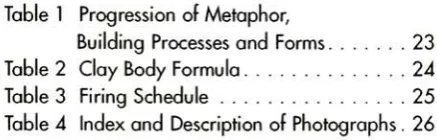
Table
1
Progression
ofMetaphor,
Building
Processes
andForms
23
Table 2
Clay
Body
Formula
24
Table
3
Firing
Schedule
25
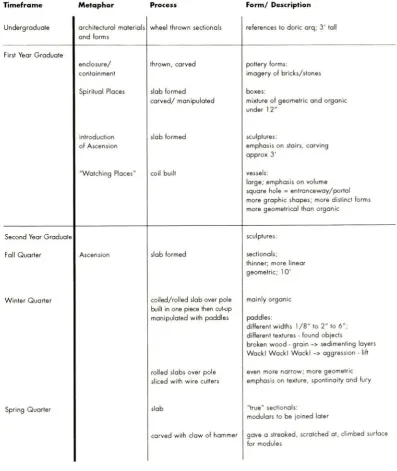
[image:27.539.196.415.109.179.2]Table 1
Progression
of
Metaphor,
Building
Processes
and
Forms
Timeframe Metaphor Process
Form/
DescriptionUndergraduate architecturalmaterials
and
forms
wheelthrownsectionals referencesto
doric
arq;3'
tall
First Year Graduate
enclosure/ containment
thrown,carved pottery
forms:
imagery
ofbricks/stonesSpiritual Places slab
formed
boxes:
carved/manipulated mixture of geometric and organic under 12"
introduction slabformed sculptures:
ofAscension emphasisonstairs,carving approx3'
"Watching
Places" coilbuill vessels:large;
emphasison volume squarehole=entranceway/portal more graphicshapes;moredistinct forms more geometricalthanorganicSecond Year Graduate sculptures:
FallQuarter Ascension slabformed sectionals; thinner;morelinear geometric;
10'
WinterQuarter coiled/rolledslab over pole
built
inone piecethen cut-upmanipulatedwith paddles
mainlyorganic paddles: differentwidths 1/8" to2" to
6";
differenttextures-foundobjects brokenwood-grain->sedimenh'nglayersWacklWacklWackl->aggression-lift
rolled slabs over pole slicedwith wire cutters
evenmorenarrow;more geometric emphasis onlexture,spontinaityand
fury
Spring
Quarter slab"true"
sectionals: modularstobejoinedlater
Table 2
Clay Body
Formula
Redart
50
Ib.
30%
Foundry
Hill
Creme
50
30
Hawthorne
33
20
Grog,
Medium
33
20
166
1b.
100%
Barium Carbonate
3
Ib.
2
%
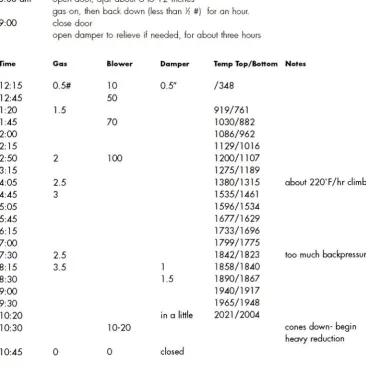
Table
3
Firing
Schedule
This is
a sample ofmy
firing
schedulefor
the
Alpine Gas
Downdraft
kiln.
Overnite
pilots onovernite,door
and spyholesclosed,
damper
mostly
closed8:00
am opendoor,
ajar about6
to1
2
inches
gas
on, then
back down
(less
than
!_
#) for
anhour.
9:00
closedoor
open
damper
to
relieveif needed,
for
aboutthree
hours
Time Gas Blower Damper
Temp
Top/Bottom Notes12:15
0.5#
10
0.5"/348
1 2:45
50
1:20
1.5
919/761
1:45
70
1030/882
2:00
1086/962
2:15
1129/1016
2:50
2
100
1200/1107
3:15
1275/1189
4:05
2.5
1380/1315
about220'F/hr
climb4:45
3
1535/1461
5:05
1596/1534
5:45
1677/1629
6:15
1733/1696
7:00
1799/1775
7:30
2.5
1842/1823
too
muchbackpressure
8:15
3.5
1
1858/1840
8:30
1.5
1890/1867
9:00
1940/1917
9:30
1965/1948
10:20
in
alittle
2021/2004
10:30
10-20
conesdown-begin
10:45
[image:30.539.85.452.189.557.2]Table 4
Index
and
Description
of
Photographs
Photograph
Description
paqe
Appendix C
1
RIT,
building
7B,
extremeview31
2
RIT,
between buildings
7A
and7B
32
3
RIT,
academicbuilding,
extreme view33
4
RIT,
ramp
andguiderailbetween buildings
7A
and7B
34
5
RIT,
glass"hot
house"showing variety
ofbuilding
materials35
6
Highland
Falls,
exposed riverbed36
7
Highland
Falls,
waterfall and rocks37
8
Beverly
Pepper,
Basalt
Ritual,
1
985-6
38
9
Beverly
Pepper,
Genesis
Altar,
1
985-6
39
Appendix
D
1 0
Organic
Series,
Sculpture
#1
;
in
background:
Sculpture
#6; far background:
Sculpture
#7
41
1 1
Organic
Series,
Sculpture
#2; background:
Sculpture
#5
42
1 2
Organic
Series,
Sculpture
#3
43
13
Organic
Series,
Sculpture
#4
44
14
Organic
Series,
Sculpture
#5; background:
Sculpture
#1
45
15
Organic
Series,
Sculpture #6
46
1
6
Modular
Series,
Sculpture
#7;
background:
Organic
Series,
Sculpture #2
andSculpture
#3
47
1 7
Organic
Series,
Sculpture
#5,
detail,
base
48
1 8
Organic
Series,
Sculpture
#5,
detail, base,
extreme view49
1
9
Organic
Series,
Sculpture
#1
,detail,
base
and ceramictransition
area50
20
Organic
Series,
Sculpture
#1,
detail, base,
cement51
21
Organic
Series,
Sculpture
#3,
detail, base,
ceramic,
extremecloseup
52
22
Organic
Series,
Sculpture
#6,
detail,
cement and ceramic
transition area,
extremecloseup
53
23
Organic
Series,
Sculpture
#6,
detail,
cement and ceramic
transition area,
extremecloseup
54
24
Organic
Series,
Sculpture
#6,
detail,
ceramicfacets,
closeup
55
25
Organic
Series,
Sculpture
#6,
detail,
ceramicfacets,
closeup
56
26
Organic
Series,
Sculpture
#3,
detail,
joint
57
Thesis Proposal
for
the
Masters
of
Fine Arts Degree
College
of
Imaging
Arts
and
Sciences
Rochester
Institute
of
Technology
Title
Ascension
Submitted
by
Clifford M.
Commanday
Date
9/13/94
Thesis Committee
Chief
Adviser
Robert Schmitz
>,Associate Advisers
Richard Hirsch
Bruce
Ian Meader
Approval
Thesis
Committee Approval
Department Chairperson
I
-<?{
Isignaluie
ofDepl./Chai.person|
Dale
Committee
Approval
Clifford M.
Commanday
I intend
to
create aseries ofsculptureswhich communicate a sense ofAscension,
a sense ofmoving
upwards.This
refersto
ascensionbotfi
physically
and spiritually.I
leave
openthe
possibilities ofmaterial,
firing
temperatures,
andscale,
as appropriatedecisions
shallbe
made as needed.Spirituality
and religionhave
alwaysbeen
important
elementsin my
life.
In
retrospect,
1
have
alwayslooked
atspirituality
as a meanstowards
^ personalgrowth anddevelopment.
My
interests in
sculpturehave
provenAppendix
C
Photographic
References
RIT,
Brutalism
31
Highland Waterfalls
36
<t_-
<fr
SfM.
tilj-j.'
_________
Works Cited
Krauss,
Rosalind
E.,
Beverly
Pepper: Sculpture in Place
(Buffalo,
Albright-Knox
Art
Gallery,
NY,
Abberville
Press,
1
986)
Photographic
References
Photographs 8
and9
from
Beverly Pepper: Sculpture in
Place;