R E S E A R C H
Open Access
Prophylactic use of levosimendan in
pediatric patients undergoing cardiac
surgery: a prospective randomized
controlled trial
Anbiao Wang
1†, Chaomei Cui
1†, Yiou Fan
3, Jie Zi
1, Jie Zhang
1, Guanglai Wang
1, Fang Wang
1, Jun Wang
4and
Qi Tan
1,2*Abstract
Background:The administration of levosimendan prophylactically to patients undergoing cardiac surgery remains a controversial practice, and few studies have specifically assessed the value of this approach in pediatric patients. This study therefore sought to explore the safety and efficacy of prophylactic levosimendan administration to pediatric patients as a means of preventing low cardiac output syndrome (LCOS) based upon hemodynamic, biomarker, and pharmacokinetic readouts.
Methods:This was a single-center, double-blind, randomized, placebo-controlled trial. Patients≤48 months old were enrolled between July 2018 and April 2019 and were randomly assigned to groups that received either placebo or levosimendan infusions for 48 h post-surgery, along with all other standard methods of care. LCOS incidence was the primary outcome of this study.
Results:A total of 187 patients were enrolled, of whom 94 and 93 received levosimendan and placebo, respectively. LCOS incidence did not differ significantly between the levosimendan and placebo groups (10 [10.6%] versus 18 [19.4%] patients, respectively; 95% confidence interval [CI] 0.19–1.13;p= 0.090) nor did 90-day mortality (3 [3.2%] versus 4 [4.3%] patients, CI 0.14–3.69,p= 0.693), duration of mechanical ventilation (median, 47.5 h and 39.5 h, respectively; p= 0.532), ICU stay (median, 114.5 h and 118 h, respectively;p= 0.442), and hospital stay (median, 20 days and 20 days, respectively;p= 0.806). The incidence of hypotension and cardiac arrhythmia did not differ significantly between the groups. Levels of levosimendan fell rapidly without any plateau in plasma concentrations during infusion. A multiple logistic regression indicated that randomization to the levosimendan group was a predictor of LCOS.
Conclusions:Prophylactic levosimendan administration was safe in pediatric patients and had some benefit to postoperative hemodynamic parameters, but failed to provide significant benefit with respect to LCOS or 90-day mortality relative to placebo.
Trial registration:Name of the registry: Safety evaluation and therapeutic effect of levosimendan on the low cardiac output syndrome in patients after cardiopulmonary bypass. Trial registration number: ChiCTR1800016594. Date of registration: 11 June 2018. URL of trial registry record:http://www.chictr.org.cn/index.aspx
Keywords:Levosimendan, Pediatric, Cardiac surgery, Low cardiac output syndrome, Safety
© The Author(s). 2019Open AccessThis article is distributed under the terms of the Creative Commons Attribution 4.0 International License (http://creativecommons.org/licenses/by/4.0/), which permits unrestricted use, distribution, and reproduction in any medium, provided you give appropriate credit to the original author(s) and the source, provide a link to the Creative Commons license, and indicate if changes were made. The Creative Commons Public Domain Dedication waiver (http://creativecommons.org/publicdomain/zero/1.0/) applies to the data made available in this article, unless otherwise stated. * Correspondence:[email protected]
†Anbiao Wang and Chaomei Cui contributed equally to this work.
1
Intensive Care Unit (ICU), Department of Cardiac Surgery, Provincial Hospital Affiliated to Shandong University, No. 9677 Jingshi Road, Jinan 250021, China
2Intensive Care Unit (ICU), Department of Cardiac Surgery, Provincial Hospital
Background
The 2019 report of cardiovascular disease in China indi-cated that there are roughly 2 million individuals suffer-ing from congenital heart disease (CHD), with over 110, 000 pediatric patients undergoing surgical treatment for this condition annually. Given that pediatric patients have a very physiologically limited contractile reserve, they are at a high risk of marked reductions in ventricu-lar performance during cardiac surgery as a consequence of factors such as hypoxia, acidosis, ischemia-reperfusion injury, neurohormone-mediated activation, or systemic inflammation [1, 2]. These risk factors can lead to 3~14% of patients that undergo surgery with cardiopul-monary bypass (CPB) suffering from heart failure or low cardiac output syndrome (LCOS), while these rates can be as high as 25% in pediatric patients and are linked to a 15-fold rise in morbidity and mortality following surgi-cal treatment of CHD [3–5].
As the consequences of LCOS can be fatal, determin-ing the optimal treatment strategy for these pediatric pa-tients remains a daunting task. The administration of specific pharmaceutical agents is essential to achieving satisfactory pre-, peri-, and postoperative outcomes for LCOS. However, specific guidelines regarding the safe and effective use of drugs for the prevention and treat-ment of LCOS in infants and children are lacking. Cat-echolamine and milrinone remain the current traditional approach to treating LCOS [6]. Catecholamines can pro-vide a valuable short-term benefit, but these benefits are constrained by adrenergic receptor downregulation and excessive chronotropy as doses are escalated. Milrinone has been prophylactically administered to patients, helping to prevent postoperative LCOS and associated clinical symptoms, but this drug also causes well-characterized and potentially serious side effects due to increases in myocyte cyclic adenosine monophosphate levels, leading to tachycardia, elevated myocardial oxy-gen consumption, and even myocardial necrosis [7].
The inotropic and lusitropic effects of levosimendan at low concentrations (nM) have been attributed to Ca2+ sensitization and phosphodiesterase3 inhibition mecha-nisms [8]. As it acts in a very specific manner, levosi-mendan has been found to achieve satisfactory preconditioning and positive inotropic effects without Ca2+ overload, thereby improving survival rates among adult heart failure patients [9, 10]. Furthermore, levosi-mendan has been linked to higher CPB weaning rates, lower periprocedural myocardial infarction rates, and de-creased lactate levels owing to superior tissue perfusion as compared with placebo [11,12], dobutamine [13], or milrinone [14]. Although many small-scale trials have suggested that levosimendan can provide substantial benefit to patients, large-scale comparative trials have not been able to reproduce this effect [15].
Evidence-based medicine in pediatric cardiology is a particular chal-lenge, and levosimendan is still used as an off-label drug for pediatric patients in most counties, potentially due to insufficient supportive research data. At present, levosi-mendan pharmacokinetics in pediatric patients is not well-documented. However, given that pediatric myocyte contractility is more Ca2+-dependent than in adults, and that small-scale studies have shown great promise with re-spect to the mechanism of action of levosimendan, further assessment of whether this drug can prevent or treat LCOS in pediatric patients is warranted.
In the present study, we aimed to assess the safety and efficacy of prophylactically administering levosimendan to pediatric patients undergoing cardiac surgery with CPB, working under the hypothesis that prophylactic ad-ministration of this compound for 48 h after surgery may help to reduce LCOS incidence. Importantly, we have for the first time implemented valuable invasive hemodynamic monitoring and described the pharmaco-kinetics of levosimendan in the context of cardiac sur-gery in pediatric patients. This was a single-center pilot study designed with the goal of supporting a consecutive multicenter trial.
Materials and methods
Trial design and oversight
This was a single-center, prospective, randomized, placebo-controlled trial that received approval from the Ethics Committee of the Provincial Hospital affiliated to Shandong University (approval number 2018-019). In addition, this study was registered with the National Clinical Trial Center (ChiCTR1800016594). Patients treated in this trial purchased the drug at full cost, and trial design, data collection, subsequent analyses, and manuscript submission were not influenced by the drug manufacturer or the funding agencies supporting this trial. All authors affirmed that the data and analyses in this trial were accurate and complete and that the trial was conducted in a manner consistent with the study protocol. The Shandong Centers for Disease Control and Prevention served as a neutral third party which supported data management and quality control. The School of Public Health of Shandong University per-formed all statistical analyses for this study.
Study participants
Randomization and blinding
Eligible patients were assigned at random to receive ei-ther levosimendan or placebo infusions (at a 1:1 ratio) following the postoperative entry into the ICU. A computer-generated, permuted block sequence stratified according to the trial center was used to support the study randomization. Sequentially numbered opaque en-velopes containing participant assignment groups were sealed, with all physicians, patients, outcome assessors, and research staff being blinded to the patient treatment assignments.
Study interventions
All patients were at random assigned to receive a prepar-ation of levosimendan (QiLu Medicine Corporprepar-ation, China) or a placebo control, with these preparations being prepared by dedicated trial personnel such that patients and physicians were unaware of which treatment a given patient was received. For levosimendan preparation, 12.5 mg of the drug (5 mL) was dissolved into 45 mL of 5% glu-cose. As a placebo, a yellow-colored solution of vitamins without any relevant cardiovascular effects but visually identical to levosimendan was instead used, shown in Additional file1: Figure S1. Patients received a continuous 0.05μg/kg/min infusion of their indicated treatment as quickly as possible following surgery. Infusions were con-tinued for 48 h, adjusting infusion rate according to ad-verse events. Attending physicians were given full discretion to administer any additional medications to the patients as appropriate, including other inotropes and va-sopressors. Concomitant nesiritide use was not permitted.
Data collection and follow-up
We collected baseline, intraoperative, postoperative, clinical, and safety outcome data of each patient. Potential postop-erative conditions of patients were monitored including acute renal injury necessitating dialysis or pneumonia. Myocardial enzymology analyses included troponin T (TNT), creatine phosphokinase-MB (CK-MB), and NT-proBNP; invasive hemodynamic parameters were deter-mined via the pressure recording analytical method (PRAM) including heart rate (HR), systolic atrial pressure (SAP), cardiac index (CI), systemic vascular resistance index (SVRI), maximum pressure gradient (dp/dtMAX), and car-diac cycle efficiency (CCE) [16]. CCE is a novel indicator that describes hemodynamic performance in terms of en-ergy expenditure (as reported in Additional file 1). Vasoactive-Inotropic Score (VIS) is calculated as follows: dopamine (μg/kg/min) + dobutamine (μg/kg/min) + [100 × epinephrine (μg/kg/min)] + [10 × milrinone (μg/kg/min)] +
[10,000 × vasopressin (U/kg/min)] + [100 × norepinephrine (μg/kg/min)] [17]. Patients underwent 90 days of post-surgical follow-up, with survival and rehospitalization status during this period being recorded.
Pharmacokinetic assessments
At 6, 12, 24, 48, 72, and 120 h after initiating levosimen-dan dosing, venous blood samples were collected in chilled tubes that contained K3EDTA to measure plasma levosimendan concentrations, while collections at 6, 12, 24, 48, 72, 120, and 168 h after initiating levosimendan dosing were used for measuring the concentrations of OR-1855 and OR-1896 metabolites in the plasma.
High-performance liquid chromatography (HPLC) with ultraviolet detection was used to detect levosimen-dan concentrations, while HPLC with tandem mass spectrometry was used to detect concentrations of the indicated metabolites of OR-1855 and OR-1896. Ter-minal half-life (T1/2), time to peak concentration (Tmax), peak concentration in the plasma (Cmax), area under the curve to the last measurable concentration (AUC0−t), and area under the concentration-time curve (AUC0−∞) were obtained.
Study endpoints
LCOS incidence was the primary outcome of this trial. LCOS was defined as two consecutive measurements of low cardiac output (defined as a cardiac output of≤2.2 L/min/m2, without associated relative hypovolaemia), one measurement of low cardiac output plus the use of two or more inotropes at or beyond 24 h after surgery, or the use of two or more inotropes at or beyond 24 h after surgery with the indicated reason being low cardiac output. Secondary outcomes for this trial included (a) mortality and rehospitalization within 90 days post-surgery; (b) duration of mechanical ventilation; (c) dura-tions of ICU and hospital stay; (d) incidences of postop-erative complications; (e) myocardial enzymology at 24, 48, 72, and 96 h post-surgery; (f) invasive hemodynamic parameters at 24, 48, and 72 h post-surgery; (g) VIS at 2, 24, 48, and 72 h post-surgery; and (h) post-surgical safety outcomes including hypotension, arrhythmia, and hepa-torenal function.
Statistical analysis
Normally and non-normally distributed data were presented as means with standard deviations and me-dians with interquartile ranges, respectively, and cat-egorical variables were presented as n (%). Two-tailed chi-squared tests with Yates correction were used to compare the prespecified postoperative events of interest. Student’s t test or Mann-Whitney U tests were used to compare continuous variables. Odds ratios and confidence intervals were estimated from a logistic regression model with age, BSA, sex, and RACHS as covariates. The duration of mechanical ventilation, duration of ICU stay, and duration of hos-pital stay were analyzed by linear regression with the same covariates. Univariate analysis and multivariate logistic regression modeling were used to assess the associations between baseline factors and LCOS inci-dence. Mortality at 90 days was summarized with the use of Kaplan-Meier estimates and log-rank tests. A two-sided p< 0.05 was the significance threshold. All the statistical analyses were performed at the School of Public Health of Shandong University (Shandong Province, China) with the use of SPSS software, ver-sion 25.0.
Results
Enrollment and baseline characteristics
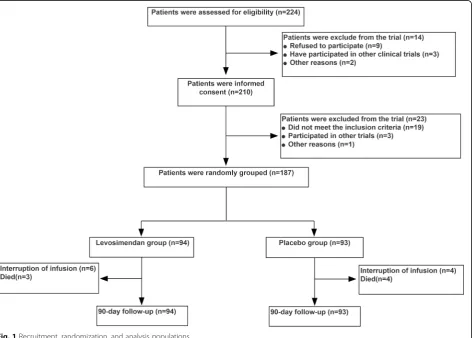
We assessed the eligibility of 224 consecutive pediatric patients between July 2018 and April 2019, with the par-ents of 210 of these patipar-ents providing written informed consent. Patient randomization and follow-up are de-tailed in Fig.1. All patients that survived completed the 90 days of study follow-up.
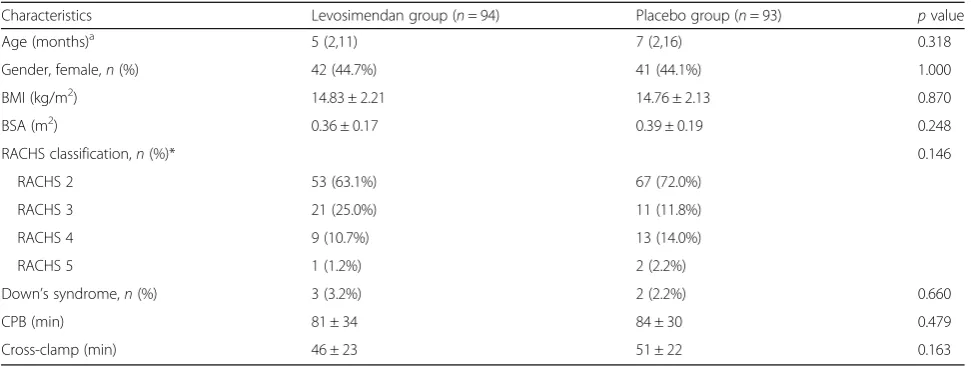
Patients in both groups had similar baseline and intraop-erative characteristics, with no differences in age, gender, BMI, BSA, or RACHS between the groups, shown in Table1. The CPB duration in the levosimendan and placebo groups was 81 ± 34 and 84 ± 30 min (p= 0.479), respectively, whereas the cross-clamp duration was 46 ± 23 and 51 ± 22 min (p= 0.163), respectively. Baseline hemodynamics and biomarkers also did not differ between the groups.
Levosimendan or placebo infusion
The average time until infusion initiation in the levosi-mendan and placebo groups was 2.27 ± 0.81 h and 2.39 ± 0.81 h post-surgery, respectively (p= 0.453; Table2). A total of 83 and 86 patients in the levosimen-dan and placebo groups (88.3% and 92.5%, respectively)
[image:4.595.66.541.386.724.2]completed 48 h infusion course, while 3 and 2 patients in the levosimendan and placebo groups (3.2% and 2.2%, respectively) were infused < 24 h, and 8 and 5 patients in the levosimendan and placebo groups (8.5% and 5.4%, respectively) were infused for 24 to 48 h. The reasons for non-completion of levosimendan or placebo regimens are shown in more detail (as reported in Additional file1).
Primary and secondary outcomes
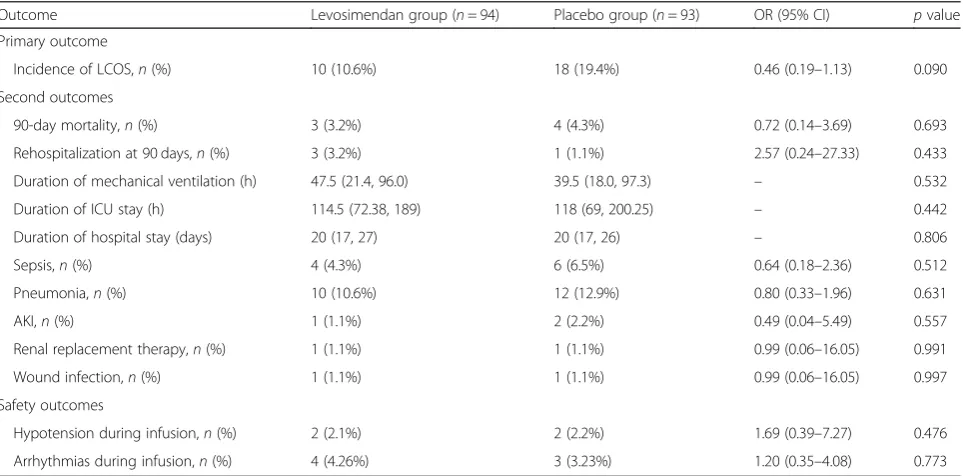
LCOS incidence, which was the primary study outcome, was 10.6% (10/94) in the levosimendan group and 19.4% (18/93) in the placebo group (OR 0.46; 95% CI, 0.19– 1.13; p= 0.09). With respect to the secondary outcomes, 900-day mortality in the levosimendan group was 3.2% (3/94) versus 4.3% (4/93) in the placebo group (OR, 0.72; 95% CI, 0.14–3.69; p= 0.693). Survival curves also indicated that there were no differences in between-group mortality rates over time (p= 0.685; Fig.2). Rates of rehospitalization within 90 days were 3.2% (3/94) and 1.1% (1/93) in the levosimendan and placebo groups, re-spectively (OR 2.57; 95% CI, 0.24 to 27.33; p= 0.433), with no significant differences in the duration of
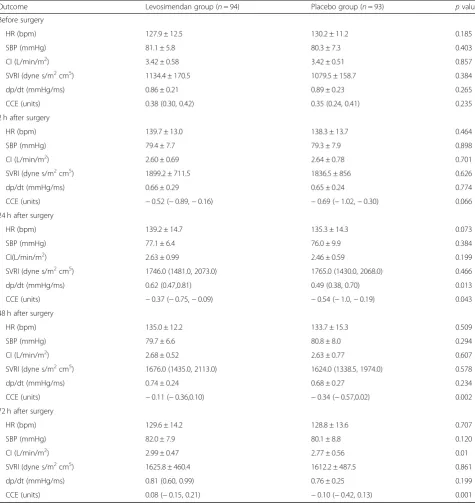
mechanical ventilation (median, 47.5 h and 39.5 h, respect-ively;p= 0.532), ICU stay (median, 114.5 h and 118 h, re-spectively; p= 0.442), or hospital stay (median, 20 days and 20 days, respectively;p= 0.806), as shown in Table3. Hemodynamic results were compiled in Table 4, and myocardial enzymology was shown in Additional file 1: Table S3. There was a significant difference between the groups with respect to the CCE hemodynamic variable following infusion, while arterial blood gas and VIS did not differ between the groups, as shown in Additional file1: Table S4 and S5.
[image:5.595.56.542.98.281.2]Exploratory subgroup analysis results were shown in Additional file1: Table S7. However, there were no signifi-cant treatment-by-subgroup interactions with respect to RACHS, cross-clamp time, CPB time, or VIS. There was an observed effect on LCOS incidence between the two treatment groups in the subgroup of patients aged 1 to 6 months. Univariate and multivariate analyses confirmed an association between LCOS and levosimendan (p= 0.037) as shown in Additional file1: Table S8 and Table5. With respect to safety outcomes, refractory hypotension rates were 2.1% (2/94) and 2.2% (2/93) in levosimendan Table 1Study population baseline demographic and surgical characteristics
Characteristics Levosimendan group (n= 94) Placebo group (n= 93) pvalue
Age (months)a 5 (2,11) 7 (2,16) 0.318
Gender, female,n(%) 42 (44.7%) 41 (44.1%) 1.000
BMI (kg/m2) 14.83 ± 2.21 14.76 ± 2.13 0.870
BSA (m2) 0.36 ± 0.17 0.39 ± 0.19 0.248
RACHS classification,n(%)* 0.146
RACHS 2 53 (63.1%) 67 (72.0%)
RACHS 3 21 (25.0%) 11 (11.8%)
RACHS 4 9 (10.7%) 13 (14.0%)
RACHS 5 1 (1.2%) 2 (2.2%)
Down’s syndrome,n(%) 3 (3.2%) 2 (2.2%) 0.660
CPB (min) 81 ± 34 84 ± 30 0.479
Cross-clamp (min) 46 ± 23 51 ± 22 0.163
Data are means ± standard deviation (SD) for continuous variables and number of subjects (n) and percentage (%) for categorical variables
BSAbody surface area,RACHSRisk Adjustment for Congenital Heart Surgery,CPBcardiopulmonary bypass,BMIbody mass index a
Data are medians [Q1, Q3]
[image:5.595.55.536.625.724.2]*RACHS classification was used to divide surgical procedures for congenital heart diseases into six categories of increasing predicted operative risk. The greater the score, the higher the risk associated with the procedure
Table 2Administration of levosimendan or placebo
Variable Levosimendan group (n= 94) Placebo group (n= 93) pvalue
Time of infusion started after surgery (h) 2.27 ± 0.81 2.39 ± 0.81 0.453
Interruption of infusion due to adverse events,n(%) 6 (6.4%) 5 (5.4%) 0.770
Duration of infusion,n(%)
< 24 3 (3.2%) 2 (2.2%) 0.659
24–48 8 (8.5%) 5 (5.4%) 0.399
48 83 (88.3%) 86 (92.5%) 0.333
and placebo groups, respectively, while rates of arrhyth-mias were 4.26% (4/94) and 3.23% (3/93), respectively. No significant differences were detected with respect to hep-atic or renal function variables between the groups, shown in Additional file1: Table S6.
Pharmacokinetics
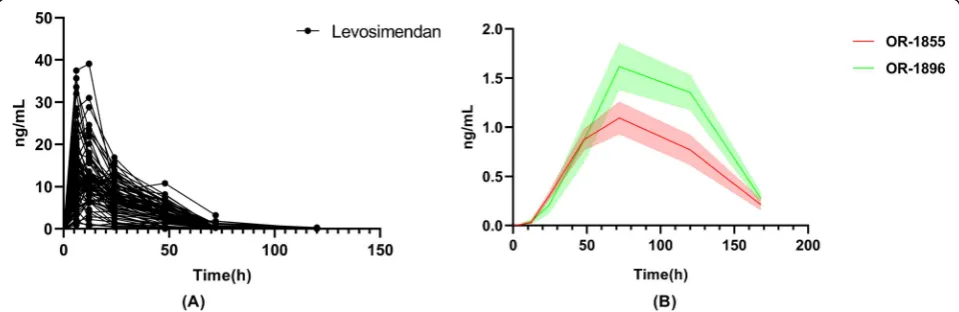
Levosimendan and metabolite concentrations at different time points were summarized in Fig. 3. Plasma levosi-mendan concentrations at 6, 12, 24, 48, 72, and 120 h after initiating the 48-h infusion were 11.61 (7.89, 16.90), 11.0 (8.14, 13.6), 7.17 (4.72, 10.11), 3.43 (2.09, 5.34), and
0.22 (0, 0.32) ng/mL, respectively. The levosimendan ter-minal half-life was 17.47 h, with the mean peak concen-tration of 14.94 ± 7.51 ng/mL having been reached 10.21 ± 6.35 h after infusion initiation. The mean AUC0−t was 401.13 ± 186.44 h ng/mL. Levosimendan pharmaco-kinetic parameters were summarized in Additional file1: Table S9.
Discussion
[image:6.595.58.539.88.259.2]This study was the first trial using continuous invasive hemodynamics and pharmacokinetics in order to explore the efficacy and safety of prophylactic levosimendan in Fig. 2Kaplan-Meier survival estimates of mortality
Table 3Pre-specified clinical outcomes
Outcome Levosimendan group (n= 94) Placebo group (n= 93) OR (95% CI) pvalue
Primary outcome
Incidence of LCOS,n(%) 10 (10.6%) 18 (19.4%) 0.46 (0.19–1.13) 0.090
Second outcomes
90-day mortality,n(%) 3 (3.2%) 4 (4.3%) 0.72 (0.14–3.69) 0.693
Rehospitalization at 90 days,n(%) 3 (3.2%) 1 (1.1%) 2.57 (0.24–27.33) 0.433
Duration of mechanical ventilation (h) 47.5 (21.4, 96.0) 39.5 (18.0, 97.3) – 0.532
Duration of ICU stay (h) 114.5 (72.38, 189) 118 (69, 200.25) – 0.442
Duration of hospital stay (days) 20 (17, 27) 20 (17, 26) – 0.806
Sepsis,n(%) 4 (4.3%) 6 (6.5%) 0.64 (0.18–2.36) 0.512
Pneumonia,n(%) 10 (10.6%) 12 (12.9%) 0.80 (0.33–1.96) 0.631
AKI,n(%) 1 (1.1%) 2 (2.2%) 0.49 (0.04–5.49) 0.557
Renal replacement therapy,n(%) 1 (1.1%) 1 (1.1%) 0.99 (0.06–16.05) 0.991
Wound infection,n(%) 1 (1.1%) 1 (1.1%) 0.99 (0.06–16.05) 0.997
Safety outcomes
Hypotension during infusion,n(%) 2 (2.1%) 2 (2.2%) 1.69 (0.39–7.27) 0.476
Arrhythmias during infusion,n(%) 4 (4.26%) 3 (3.23%) 1.20 (0.35–4.08) 0.773
Data are medians [Q1, Q3] for continuous variables and number of subjects (n) and percentage (%) for categorical variables. Differences between the percent values are given in percentage points, thus potentially not summing to the expected values as a consequence of rounding. Other variable differences are in the indicated units
[image:6.595.58.540.459.697.2]pediatric patients undergoing cardiac surgery. We ob-served no significant benefit from levosimendan admin-istration with respect to LCOS incidence rates, although there was a favorable association with a lower hazard ra-tio to 0.46 relative to placebo. Levosimendan treatment also failed to have any significant impact on 90-day mor-tality or on the duration of ICU or hospital stay. How-ever, CCE values in levosimendan treated-patients were
higher, consistent with improvements to the ability of the cardiovascular system to maintain homeostasis fol-lowing treatment. Multivariate logistic regression ana-lyses confirmed the effects of levosimendan on LCOS.
[image:7.595.59.535.99.603.2]Previous clinical studies with levosimendan have sug-gested that this drug offers a direct benefit to cardiac function in pediatric trials. Ricci et al. found that levosi-mendan treatment was associated with a LCOS Table 4Hemodynamic analysis
Outcome Levosimendan group (n= 94) Placebo group (n= 93) pvalue
Before surgery
HR (bpm) 127.9 ± 12.5 130.2 ± 11.2 0.185
SBP (mmHg) 81.1 ± 5.8 80.3 ± 7.3 0.403
CI (L/min/m2) 3.42 ± 0.58 3.42 ± 0.51 0.857
SVRI (dyne s/m2cm5) 1134.4 ± 170.5 1079.5 ± 158.7 0.384
dp/dt (mmHg/ms) 0.86 ± 0.21 0.89 ± 0.23 0.265
CCE (units) 0.38 (0.30, 0.42) 0.35 (0.24, 0.41) 0.235
2 h after surgery
HR (bpm) 139.7 ± 13.0 138.3 ± 13.7 0.464
SBP (mmHg) 79.4 ± 7.7 79.3 ± 7.9 0.898
CI (L/min/m2) 2.60 ± 0.69 2.64 ± 0.78 0.701
SVRI (dyne s/m2cm5) 1899.2 ± 711.5 1836.5 ± 856 0.626
dp/dt (mmHg/ms) 0.66 ± 0.29 0.65 ± 0.24 0.774
CCE (units) −0.52 (−0.89,−0.16) −0.69 (−1.02,−0.30) 0.066
24 h after surgery
HR (bpm) 139.2 ± 14.7 135.3 ± 14.3 0.073
SBP (mmHg) 77.1 ± 6.4 76.0 ± 9.9 0.384
CI(L/min/m2) 2.63 ± 0.99 2.46 ± 0.59 0.199
SVRI (dyne s/m2cm5) 1746.0 (1481.0, 2073.0) 1765.0 (1430.0, 2068.0) 0.466
dp/dt (mmHg/ms) 0.62 (0.47,0.81) 0.49 (0.38, 0.70) 0.013
CCE (units) −0.37 (−0.75,−0.09) −0.54 (−1.0,−0.19) 0.043
48 h after surgery
HR (bpm) 135.0 ± 12.2 133.7 ± 15.3 0.509
SBP (mmHg) 79.7 ± 6.6 80.8 ± 8.0 0.294
CI (L/min/m2) 2.68 ± 0.52 2.63 ± 0.77 0.607
SVRI (dyne s/m2cm5) 1676.0 (1435.0, 2113.0) 1624.0 (1338.5, 1974.0) 0.578
dp/dt (mmHg/ms) 0.74 ± 0.24 0.68 ± 0.27 0.234
CCE (units) −0.11 (−0.36,0.10) −0.34 (−0.57,0.02) 0.002
72 h after surgery
HR (bpm) 129.6 ± 14.2 128.8 ± 13.6 0.707
SBP (mmHg) 82.0 ± 7.9 80.1 ± 8.8 0.120
CI (L/min/m2) 2.99 ± 0.47 2.77 ± 0.56 0.01
SVRI (dyne s/m2cm5) 1625.8 ± 460.4 1612.2 ± 487.5 0.861
dp/dt (mmHg/ms) 0.81 (0.60, 0.99) 0.76 ± 0.25 0.199
CCE (units) 0.08 (−0.15, 0.21) −0.10 (−0.42, 0.13) 0.001
Data are means ± standard deviation (SD) or medians [Q1, Q3] for continuous variables and number of subjects (n) and percentage (%) for categorical variables
HRheart rate,SBPsystolic blood pressure,CIcardiac index,SVRIsystemic vascular resistance index,dp/dtMAXmaximum pressure gradient,CCEcardiac cycle
incidence of 37% as compared with a 61% incidence in placebo-treated patients in a population of RACHS 3–4 neonates [18]. Similarly, Amiet et al. demonstrated that the use of levosimendan as a rescue therapy was associ-ated with significant reductions in plasmatic lactate, VIS reductions, and increases in diuresis and SvO2 [17]. However, three recent randomized, placebo-controlled, multicenter studies: LICORN [19], CHEETAH [20], and LEVO-CTS [21], failed to demonstrate any impact of levosimendan administration on a broader mortality endpoint. A meta-analysis also confirmed this neutral ef-fect in pediatric patients undergoing surgical treatment of CHD [22]. Our present results were not entirely con-sistent with these previous prospective clinical trials. We did observe a non-significant trend towards decreased LCOS incidence in levosimendan-treated patients rela-tive to placebo controls (10.6% versus 19.4%), and no benefits in the outcomes such as mortality or duration of hospital/ICU stay following levosimendan administra-tion. However, the subgroup analysis of patients aged 1 to 6 months indicated the efficacy of levosimendan, the use of which was associated with a significant reduction in LCOS. Furthermore, baseline factors predictive of LCOS revealed that levosimendan administration was an independent predictor of LCOS, and this was just as
important as was RACHS classification. Although we were unable to rule out the null hypothesis, we felt that this nonetheless still suggested that levosimendan might be a promising and effective inodilator drug for use in cardiac surgery.
[image:8.595.56.290.111.166.2]Prediction of cardiac function parameters is primarily based upon invasive hemodynamic findings, biomarker findings, and echocardiography findings [23]. Such inva-sive measurements are not routinely performed in chil-dren, and as such, LCOS is usually defined based upon objective symptoms including tachycardia, metabolic acidosis, low SBP, oliguria, and poor perfusion with in-creasing core-peripheral temperature gap [24]. However, basic clinical symptoms may lead to an inaccurate diag-nosis of LCOS, potentially explaining why the incidence of LCOS in our study was significantly lower than in previous studies. Relative to more commonly used methods for CO/CI estimation, PRAM simplifies the im-plementation, making it of significant value for monitor-ing LCOS and associated deterioration in pediatric patients [25–27]. In our study, we found that HR and SAP were the least sensitive to LCOS, while CI and bio-markers also fell significantly and required an extended period of time to recover. These values, however, may be modulated by other organs to yield false-positive re-sults, in addition to having the potential to be insuffi-ciently sensitive to changes in acute hemodynamic parameters. Interestingly, CCE, after levosimendan treat-ment, deviated significantly from that in patients in the placebo group. Scolletta et al. found CCE was of prog-nostic relevance with cardiac surgery, correlated well with NT-proBNP levels [28]. With respect to the value of CCE in more detail (as reported in Additional file1), our results suggested that CCE offered a means whereby it was possible to identify suitable cardiac function after car-diac surgery, in addition to revealing that levosimendan Table 5Baseline factors predictive of LCOS incidence based
upon a multivariate logistic regression analysis
Variable OR 95% CI pvalue
Randomization to levosimendan 0.38 0.15–0.94 0.037
Age 0.98 0.94–1.02 0.282
RACHS – – 0.001
Per the“10 events per variable”principle, this multivariate logistic regression model incorporated the most relevant variables related to levosimendan randomization, age, and RACHS and for 1-month increase
ORodds ratio,BMIbody mass index,CIconfidence interval,CPB
cardiopulmonary bypass,RACHSRisk Adjustment for Congenital Heart Surgery
[image:8.595.58.538.547.703.2]exerted a positive inotropic effect, normalizing vasodila-tion and energy expenditure and thereby aiding the recov-ery of pediatric patients.
At present, levosimendan is not routinely administered to pediatric patients. The LeoPARDS trial found that a 0.2-μg/kg/min infusion dose linked to increased hypotension and arrhythmia incidence [29]. In the CHEETAH trial, without a loading dose and with an average of 0.07-μg/kg/min dose, very low hypotension and arrhythmias incidence were observed [20]. Amiet et al. found levosimendan to be well tolerated in pediatric patients after cardiac surgery [17]. Higher doses of levosimendan have the potential to achieve greater hemodynamic effects at the cost of more pro-nounced vasodilatation and consequent hypotension, and as such, these results suggest that it is rationale to omit a loading dose, with individual determinations be-ing made with regard to the maintenance infusion dose (0.05–0.2μg/kg/min). With respect to the optimal levo-simendan dosing duration, a range of durations from 24 to 72 h have been reported in pediatric clinical settings [17,30]. Physicians in our center determined that levosi-mendan should be administered as early as possible post-surgery, with a 48-h infusion period serving to strike a balance between the potential for reduced LCOS and potential adverse events. We observed no differ-ences in adverse events between the levosimendan and placebo groups, consistent with most previous reports suggesting that levosimendan was well tolerated in pediatric patients.
Another goal of this study was to explore levosimen-dan and its metabolite plasma concentrations over time in pediatric patients. Surprisingly, we did not detect any plateau in levosimendan concentration during the infu-sion period, with a very rapid decline in these concentra-tions in contrast to the results from previous studies [31]. There may be several explanations for this unique pharmacokinetics. For one, physicians had the ability to adjust the levosimendan regimen delivered to patients according to adverse events. Variations in infusion rates might have led to reduced plasma drug concentrations and rapid drug elimination. Second, how levosimendan interacts with other drugs is not well documented. Rou-tine complement blood volume and diuresis treatments are likely to disrupt drug concentrations [32]. The exces-sive urine production of patients may have led to more rapid levosimendan excretion. Third, the pathological state of patients following cardiac surgery can impact drug pharmacokinetics. Levosimendan has been shown to be excreted into the small intestine, where it is re-duced mainly by intestinal bacteria to OR-1855 [33]. Antibiotic administration may result in intestinal dysbiosis that is more common in pediatric patients. Alternatively, mechanical ventilation and long-term immobilization may
have led to gastrointestinal dysfunction. In addition, as 97–98% of levosimendan binds to plasma proteins, mainly albumin, significant postoperative reductions in albumin levels may result in decreased drug binding and more rapid elimination from circulation. Fourth, age-related variables such as the percentage of body water and the im-maturity of metabolic pathways affect drug pharmacokin-etics [31]. Lastly, no pharmacokinetic data in Asians and other ethnic groups except Caucasians and Blacks are so far available. It was proved that there was a relationship between genetic phenotypes and the metabolism of levosi-mendan [34]. These factors suggest that a 0.025–0.1-μg/ kg/min infusion is safe for pediatric patients but results in lower-than-expected plasma concentrations that may fail to achieve maximal clinical efficiency. In addition, while the majority of the clinical activity of levosimendan is at-tributable to its active metabolite OR-1896 with a long half-life (about 81 h) [35], rapid reductions in drug levels shorten the long-term clinical efficacy. As such, pediatric patients may achieve better clinical outcomes from either a longer infusion period or repeated infusions [36].
There are certain limitations to the present trial. For one, the thermodilution method is regarded as the gold-standard technique in hemodynamically stable subjects. Al-though there are many studies demonstrating the efficient use of PRAM when the patient vascular tone is affected [37], the accuracy of PRAM requires further exploration. Furthermore, the lower rate of LCOS than the power calcu-lations predicted may have limited the statistical power of our study. As a result, the enrollment of more patients may be needed in order to overcome this low LCOS incidence. Finally, considering the low body weight of pediatric pa-tients and the need to strictly control supplemental fluid administration following cardiac surgery, we prepared levo-simendan in a 45-mL volume of glucose solution rather than the recommended 250 mL. At such high concentra-tions, the stability of the molecule is not guaranteed and precipitation may occur. This formulation thus necessitates further assessment and confirmation.
Conclusions
Supplementary information
Supplementary informationaccompanies this paper athttps://doi.org/10. 1186/s13054-019-2704-2.
Additional file 1:Supplemental description of methods and results, including RACHS method, Placebo preparation, Clinical Management, Details of CCE,Tables S1-S9andFigure S1.
Abbreviations
LCOS:Low cardiac output syndrome; OR: Odds ratio; CI: Confidence interval; CHD: Congenital heart disease; CPB: Cardiopulmonary bypass; ICU: Intensive care unit; RACHS: Risk Adjustment for Congenital Heart Surgery;
PRAM: Pressure recording analytical method; CI: Cardiac index; SVRI: Systemic vascular resistance index; dp/dtMAX: Maximum pressure gradient;
CCE: Cardiac cycle efficiency; VIS: Vasoactive-Inotropic Score; HPLC: High-performance liquid chromatography; AKI: Acute kidney injury; BSA: Body surface area; BMI: Body mass index; HR: Heart rate; MAP: Mean arterial pressure
Acknowledgements
The authors would like to thank ShanSong Zheng for the pharmacokinetic test and statistical contribution to the project and review of the final manuscript. The authors would also like to thank all of the clinicians and staff in the ICU for their assistance in screening the patients and the Safety and Data Monitoring Committee for their assistance in monitoring this trial.
Authors’contributions
AW, JW, and QT came up with the study concept. All authors developed the study design and protocol. FW, GW, and JZ collected the study data. YF, CC, and QT were involved in the analysis and interpretation of the data. All co-authors provided input and a critical review of the manuscript leading to the final version. All authors read and approved the final manuscript.
Funding
This work was supported by the Cardiovascular Multidisciplinary Integrated Research Fund (CIMF-Z-2016-23-1823), the Natural Science Foundation of Shandong Province (ZR201702210404), the Clinical Science and Technology Innovation Program of Jinan City (201805040), and the Medicine and Health Science Technology Development of Shandong Province (2017WS191).
Availability of data and materials
The datasets used and/or analyzed during the current study are available from the corresponding author on reasonable request.
Ethics approval and consent to participate
This study was approved by the Ethics Committee of the Provincial Hospital affiliated to Shandong University (approval number 2018-019) and registered atchictr.org.cn(ChiCTR1800016594). As most participants were newborns or infants who were lacking the capacity to give consent, approval was granted by the guardian of patients.
Consent for publication
Not applicable
Competing interests
The authors declare that they have no competing interests.
Author details
1
Intensive Care Unit (ICU), Department of Cardiac Surgery, Provincial Hospital Affiliated to Shandong University, No. 9677 Jingshi Road, Jinan 250021, China.2Intensive Care Unit (ICU), Department of Cardiac Surgery, Provincial
Hospital Affiliated to Shandong First Medical University, Jinan 250021, China.
3
Department of Toxicological and Functional Test, Centers for Disease Control and Prevention of Shandong, Jinan 250014, China.4Department of
Pharmacy, Shandong Provincial Hospital Affiliated to Shandong University, Jinan 250021, China.
Received: 13 September 2019 Accepted: 13 December 2019
References
1. Huang JS, Chen Q, Chen LW, Kuo YR, Hong ZN, Cao H. Changes in the levels of inflammatory markers after transthoracic device closure of ventricular septal defects in pediatric patients. J Cardiothorac Surg. 2019;14:70.
2. Nordness MJ, Westrick AC, Chen H, Clay MA. Identification of low cardiac output syndrome at the bedside: a pediatric cardiac intensive care unit survey. Crit Care Nurse. 2019;39:e1–7.
3. Algarni KD, Elhenawy AM, Maganti M, Collins S, Yau TM. Decreasing prevalence but increasing importance of left ventricular dysfunction and reoperative surgery in prediction of mortality in coronary artery bypass surgery: trends over 18 years. J Thorac Cardiovasc Surg. 2012;144:340–6.e1. 4. Wernovsky G, Wypij D, Jonas RA, Mayer JE Jr, Hanley FL, Hickey PR, et al.
Postoperative course and hemodynamic profile after the arterial switch operation in neonates and infants. A comparison of low-flow
cardiopulmonary bypass and circulatory arrest. Circulation. 1995;92:2226–35. 5. Yuan SM. Acute kidney injury after pediatric cardiac surgery. Pediatr
Neonatol. 2019;60:3–11.
6. Cavigelli-Brunner A, Hug MI, Dave H, Baenziger O, Buerki C, Bettex D, et al. Prevention of low cardiac output syndrome after pediatric cardiac surgery: a double-blind randomized clinical pilot study comparing dobutamine and milrinone. Pediatr Crit Care Med. 2018;19:619–25.
7. Stocker CF, Shekerdemian LS, Nørgaard MA, Brizard CP, Mynard JP, Horton SB, et al. Mechanisms of a reduced cardiac output and the effects of milrinone and levosimendan in a model of infant cardiopulmonary bypass. Crit Care Med. 2007;35:252–9.
8. Rungatscher A, Hallström S, Giacomazzi A, Linardi D, Milani E, Tessari M, et al. Role of calcium desensitization in the treatment of myocardial dysfunction after deep hypothermic circulatory arrest. Crit Care. 2013;17: R245.
9. Chen QH, Zheng RQ, Lin H, Shao J, Yu JQ, Wang HL. Effect of levosimendan on prognosis in adult patients undergoing cardiac surgery: a meta-analysis of randomized controlled trials. Crit Care. 2017;21:253.
10. Follath F, Cleland JG, Just H, Papp JG, Scholz H, Peuhkurinen K, et al. Efficacy and safety of intravenous levosimendan compared with dobutamine in severe low-output heart failure (the LIDO study): a randomised double-blind trial. Lancet. 2002;360:196–202.
11. Atalay H, Temizturk Z, Altinsoy HB, Azboy D, Colak S, Atalay A, et al. Levosimendan use increases cardiac performance after coronary artery bypass grafting in end-stage renal disease patients. Heart Surg Forum. 2016; 19(5):E230–6.
12. van Diepen S, Mehta RH, Leimberger JD, Goodman SG, Fremes S, Jankowich R, et al. Levosimendan in patients with reduced left ventricular function undergoing isolated coronary or valve surgery. J Thorac Cardiovasc Surg. 2019.https://doi.org/10.1016/j.jtcvs.2019.06.020.
13. Levin RL, Degrange MA, Porcile R, Salvagio F, Blanco N, Botbol AL, et al. The calcium sensitizer levosimendan gives superior results to dobutamine in postoperative low cardiac output syndrome. Rev Esp Cardiol. 2008;61:471–9 (in Spanish).
14. Lechner E, Hofer A, Leitner-Peneder G, Freynschlag R, Mair R, Weinzettel R, et al. Levosimendan versus milrinone in neonates and infants after corrective open-heart surgery: a pilot study. Pediatr Crit Care Med. 2012;13: 542–8.
15. Sanfilippo F, Knight JB, Scolletta S, Santonocito C, Pastore F, Lorini FL, et al. Levosimendan for patients with severely reduced left ventricular systolic function and/or low cardiac output syndrome undergoing cardiac surgery: a systematic review and meta-analysis. Crit Care. 2017;21:252.
16. Ricci Z, Polito A, Netto R, De Razza F, Favia I, Carotti A, et al. Assessment of modified ultrafiltration hemodynamic impact by pressure recording analytical method during pediatric cardiac surgery. Pediatr Crit Care Med. 2013;14:390–5.
17. Amiet V, Perez MH, Longchamp D, Boulos Ksontini T, Natterer J, Plaza Wuthrich S, et al. Use of levosimendan in postoperative setting after surgical repair of congenital heart disease in children. Pediatr Cardiol. 2018; 39:19–25.
19. Cholley B, Caruba T, Grosjean S, Amour J, Ouattara A, Villacorta J, et al. Effect of levosimendan on low cardiac output syndrome in patients with low ejection fraction undergoing coronary artery bypass grafting with cardiopulmonary bypass: the LICORN randomized clinical trial. JAMA. 2017; 318:548–56.
20. Landoni G, Lomivorotov VV, Alvaro G, Lobreglio R, Pisano A, Guarracino F, et al. Levosimendan for hemodynamic support after cardiac surgery. N Engl J Med. 2017;376:2021–31.
21. Mehta RH, Leimberger JD, van Diepen S, Meza J, Wang A, Jankowich R, et al. Levosimendan in patients with left ventricular dysfunction undergoing cardiac surgery. N Engl J Med. 2017;376:2032–42.
22. Hummel J, Rücker G, Stiller B. Prophylactic levosimendan for the prevention of low cardiac output syndrome andmortality in paediatric patients undergoing surgery for congenital heart disease. Cochrane Database Syst Rev. 2017.https://doi.org/10.1002/14651858.
23. Kreusser MM, Geis NA, Berlin N, Greiner S, Pleger ST, Bekeredjian R, et al. Invasive hemodynamics and cardiac biomarkers to predict outcomes after percutaneous edge-to-edge mitral valve repair in patients with severe heart failure. Clin Res Cardiol. 2019;108:375–87.
24. Harrison RW, Hasselblad V, Mehta RH, Levin R, Harrington RA, Alexander JH. Effect of levosimendan on survival and adverse events after cardiac surgery: a meta-analysis. J Cardiothorac Vasc Anesth. 2013;27:1224–32.
25. Yang F, Iacobelli R, Wang JM, Lorio FS. Assessment of cardiac function in infants with transposition of the great arteries after surgery: comparison of two methods. World J Pediatr. 2018;14:373–7.
26. Guarracino F, Ferro B, Forfori F, Bertini P, Magliacano L, Pinsky MR. Jugular vein distensibility predicts fluid responsiveness in septic patients. Crit Care. 2014;18:647.
27. Favia I, Rizza A, Garisto C, Haiberger R, Di Chiara L, Romagnoli S, et al. Cardiac index assessment by the pressure recording analytical method in infants after paediatric cardiac surgery: a pilot retrospective study. Interact Cardiovasc Thorac Surg. 2016;23:919–23.
28. Scolletta S, Ranaldi G, Carlucci F, Franchi F, Romano SM, Biagioli B. Relationship between N-terminal pro-B-type natriuretic peptide (Nt-proBNP) and cardiac cycle efficiency in cardiac surgery. Biomed Pharmacother. 2010; 64:5115.
29. Gordon AC, Perkins GD, Singer M, McAuley DF, Orme RM, Santhakumaran S, et al. Levosimendan for the prevention of acute organ dysfunction in sepsis. N Engl J Med. 2016;375:1638–48.
30. Toller W, Heringlake M, Guarracino F, Algotsson L, Alvarez J, Argyriadou H, et al. Preoperative and perioperative use of levosimendan in cardiac surgery: European expert opinion. Int J Cardiol. 2015;184:323–36. 31. Puttonen J, Kantele S, Ruck A, Ramela M, Häkkinen S, Kivikko M, et al.
Pharmacokinetics of intravenous levosimendan and its metabolites in subjects with hepatic impairment. J Clin Pharmacol. 2008;48:445–54. 32. Turanlahti M, Boldt T, Palkama T, Antila S, Lehtonen L, Pesonen E.
Pharmacokinetics of levosimendan in pediatric patients evaluated for cardiac surgery. Pediatr Crit Care Med. 2004;5:457–62.
33. Antila S, Sundberg S, Lehtonen LA. Clinical pharmacology of levosimendan. Clin Pharmacokinet. 2007;46:535–52.
34. Antila S, Pesonen U, Lehtonen L, Tapanainen P, Nikkanen H, Vaahtera K, et al. Pharmacokinetics of levosimendan and its active metabolite OR-1896 in rapid and slow acetylators. Eur J Pharm Sci. 2004;23:213–22.
35. Antila S, Kivikko M, Lehtonen L, Eha J, Heikkilä A, Pohjanjousi P, et al. Pharmacokinetics of levosimendan and its circulating metabolites in patients with heart failure after an extended continuous infusion of levosimendan. Br J Clin Pharmacol. 2004;57:412–5.
36. Oliva F, Comin-Colet J, Fedele F, Fruhwald F, Gustafsson F, Kivikko M, et al. Repetitive levosimendan treatment in the management of advanced heart failure. Eur Heart J Suppl. 2018;20:I11–20.
37. Scolletta S, Franchi F, Romagnoli S, Carlà R, Donati A, Fabbri LP, et al. Comparison between doppler-echocardiography and uncalibrated pulse contour method for cardiac output measurement: a multicenter observational study. Crit Care Med. 2016;44:1370–9.
Publisher’s Note