R E S E A R C H A R T I C L E
Open Access
Performance of point-of-care CD4 testing
technologies in resource-constrained
settings: a systematic review and
meta-analysis
Minh D. PhamM.D., MPH
1,2*, Paul A. Agius
1, Lorena Romero
3, Peter McGlynn
2, David Anderson
1,4,
Suzanne M. Crowe
1,5and Stanley Luchters
1,2,6Abstract
Background:Point-of-care (POC) CD4 testing increases patient accessibility to assessment of antiretroviral therapy eligibility. This review evaluates field performance in low and middle-income countries (LMICs) of currently available POC CD4 technologies.
Methods:Eight electronic databases were searched for field studies published between January 2005 and January 2015 of six POC CD4 platforms: PointCare NOW™, Alere Pima™CD4, Daktari™CD4 Counter, CyFlow® CD4 miniPOC, BD FACSPresto™, and MyT4™CD4. Due to limited data availability, meta-analysis was conducted only for diagnostic performance of Pima at a threshold of 350 cells/μl, applying a bivariate multi-level random-effects modelling approach. A covariate extended model was also explored to test for difference in diagnostic performance between capillary and venous blood.
Results:Twenty seven studies were included. Published field study results were found for three of the six POC CD4 tests, 24 of which used Pima. For Pima, test failure rates varied from 2 to 23 % across study settings. Pooled sensitivity and specificity were 0.92 (95 % CI = 0.88–0.95) and 0.87 (95 % CI = 0.85–0.88) respectively. Diagnostic performance by blood sample type (venous vs. capillary) revealed non-significant differences in sensitivity (0.94 vs 0. 89) and specificity (0.86 vs 0.87), respectively in the extended model (Waldχ2(2) = 4.77,p= 0.09).
Conclusions:POC CD4 testing can provides reliable results for making treatment decision under field conditions in low-resource settings. The Pima test shows a good diagnostic performance at CD4 cut-off of 350 cells/μl. More data are required to evaluate performance of POC CD4 testing using venous versus capillary blood in LMICs which might otherwise influence clinical practice.
Keywords:CD4, Point of care testing, Diagnostic accuracy, Systematic review, Meta-analysis
Background
Increased testing of those at risk of HIV infection and improving access to antiretroviral therapy (ART) par-ticularly in the most HIV-affected regions is a recog-nized global strategy to end the AIDS epidemic. However, only 15.0 million of an estimated of 36.9
million (40.6 %) HIV-infected individuals have access to ART [1]. Whilst new evidence endorses treatment of all HIV-infected individuals [2, 3] and the World Health Organization (WHO) guideline supports treatment of all individuals regardless of CD4 count [4], the current practical goal, one that is likely to apply in most re-source limited countries into the foreseeable future, is to achieve ART coverage of all HIV-infected adults with low CD4 cell count (<350 cells/μL) before expanding ART scale-up to people with higher CD4 cell counts. Furthermore, for patients who are presenting late to * Correspondence:[email protected]
1Burnet Institute, 85 Commercial Road, Melbourne, VIC 3004, Australia 2Department of Epidemiology and Preventive Medicine, Faculty of Medicine
Nursing and Health Science, Monash University, Melbourne, Australia Full list of author information is available at the end of the article
© The Author(s). 2016Open AccessThis article is distributed under the terms of the Creative Commons Attribution 4.0 International License (http://creativecommons.org/licenses/by/4.0/), which permits unrestricted use, distribution, and reproduction in any medium, provided you give appropriate credit to the original author(s) and the source, provide a link to the Creative Commons license, and indicate if changes were made. The Creative Commons Public Domain Dedication waiver (http://creativecommons.org/publicdomain/zero/1.0/) applies to the data made available in this article, unless otherwise stated. Phamet al. BMC Infectious Diseases (2016) 16:592
care, a CD4 count is required as a baseline measurement to identify the need for screening and prophylaxis for major opportunistic infections which are often associ-ated with low CD4 count and increased risk of mortality. For treatment monitoring, CD4 count is important to assess CD4-related risk of toxicity to Nevirapine and, CD4 testing remains an important method to monitor patients who are on treatment in settings where access to viral load monitoring is still limited [5]. Thus, CD4 monitoring remains an essential and practical compo-nent of HIV care in the near future [6].
It has been known that barriers resulting in substantial losses to the continuum of HIV care include poor access to CD4 testing, particularly in disadvantaged and remote areas where laboratory-based CD4 testing by flow cy-tometry is not available [7, 8]. Point-of-care (POC) test-ing is an effective strategy to overcome this challenge. Findings from a number of field studies show that POC CD4 testing can have a positive impact on the HIV con-tinuum of care [9–15]. The use of POC CD4 in lower and middle income countries (LMICs) where resources for HIV care are most limited, is expected to produce greatest clinical and economic impacts from both patient and health system perspectives [16, 17]. With a number of POC CD4 technologies available or in the pipe-line [18], there is a need for consolidated evidence on the performance of different POC CD4 tests, particularly in LMICs, to inform decision-making related to selection of an appropriate test in field settings. A systematic review and a meta-analysis of test performance of CD4 count technologies showed that POC CD4 test is suitable for ART eligibility assessment at CD4 thresholds of 350 and 500 cells/μL [19, 20]. However, these studies pooled data from both laboratory and field evaluations in low and high income countries. As there is evidence to suggest that performance of the test varies significantly across evaluation settings (laboratory vs clinic) in different countries [21, 22], the question remains whether these study findings are transferable, specifically to non-laboratory environ-ments in LMICs. We, therefore, conducted a system-atic review to assess the performance, acceptability and feasibility in non-laboratory field settings of cur-rently available or prototype commercial POC CD4 tests in LMICs. Here, we report on “field perform-ance” of different POC CD4 tests; findings on “ ac-ceptability, feasibility” will be reported elsewhere.
Methods
This systematic review was conducted according to a protocol developed using the preferred reporting items for systematic reviews and meta-analyses (PRISMA) statement [23].
Literature search strategy
The search strategy was designed to identify any studies describing POC CD4 tests. After an initial search for ar-ticles in Medline and Embase, an assessment of text words within the title and abstract and of the index terms used to describe these articles was conducted. A subsequent full search using clearly established search terms (see Additional file 1: Annex 1) was undertaken across included databases, and adapted as appropriate to the specifications for the respective databases: Medline, Embase, CENTRAL, Cinahl, PsycINFO, Biological Ab-stracts, and Scopus. Web of Science and conference da-tabases were also searched to identify relevant studies. Reference lists of all identified reports and articles were searched for additional studies. Moreover, searches were conducted in grey literature resources such as confer-ence websites (NLM Gateway, the British Library Con-ference and International AIDS Society and ConCon-ference on Retroviruses and Opportunistic Infections) and clin-ical trials websites. Hand-searching and reference check-ing of citations and reference lists was undertaken. Authors of relevant studies were contacted if insufficient data were published. Government reports, letters to editors, commentaries, editorials, non-peer reviewed ar-ticles and review arar-ticles were excluded. Studies con-ducted and funded by the manufacturer, if stated, were also excluded.
Study selection
Inclusion criteria were that studies needed to be pub-lished between January 2005 and January 2015, written in English language and conducted in LMICs (http:// data.worldbank.org/about/country-and-lending-groups). Studies conducted in both LMICs and non-LMICs were included if data from LMICs were presented separately. Further eligibility criteria were defined using PICO (par-ticipants, interventions, comparisons, outcomes) format [24]. Participants (P) included HIV positive, HIV nega-tive and unknown HIV status persons aged≥12 months. For intervention (I), any of the following six commer-cially available POC CD4 testing platforms listed in the UNITAID“2014 HIV/AIDS Diagnosis Technology Land-scape” report [18] were included: (1) PointCare NOW™ (PointCare Technology Inc, Marlborough, MA, USA); (2) Pima™ CD4 (Alere Inc, Waltham, MA, USA); (3) Daktari™ CD4 Counter (Daktari Diagnostics Inc, Cam-bridge MA, USA); (4) CyFlow® CD4 miniPOC (Partec, Munich, Germany); (5) BD FACSPresto™ (BD Biosci-ences, San Jose, CA, USA); and (6) MyT4™ CD4 Test (Zyomyx Inc, Fremont, CA, USA). Results of POC CD4 test needed to be compared (C) to reference laboratory-based assays with outcomes (O) containing diagnostic performance of POC CD4 test in field settings. All re-trieved articles were checked for duplication; conference
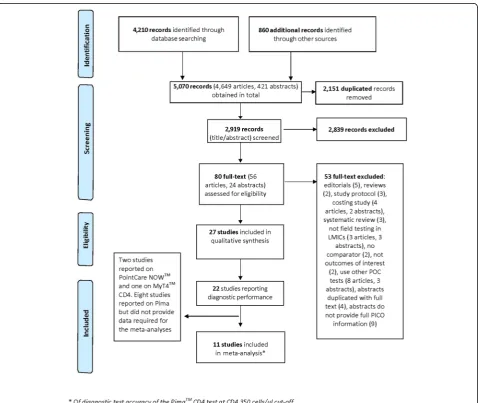
abstracts were excluded if duplicated with full-text articles. Titles, abstracts and summaries of identified records were screened for relevance. Retained records meeting the in-clusion criteria were then examined in full text (Fig. 1).
Data extraction and data analysis
An electronic data extraction form was developed, pre-tested and finalized by consensus among authors. Data extraction was conducted by one reviewer and verified by the second using the data extraction form with 20 % duplicate extraction. Quality of included studies was assessed using EPHPP tool for quantitative studies [25] and QUADAS tool for diagnostic accuracy studies [26].
Key measures used to evaluate performance of POC CD4 tests were: (1) failure rates defined as the percent-age of the total number of tests performed with an in-valid result such that tests did not provide results and/or
results could not be read. (2) Sensitivity and specificity of index POC CD4 test at certain CD4 thresholds as compared to the predicate method. (3) Misclassification of index POC CD4 at certain CD4 thresholds. Misclassi-fication is defined as the percentage of total HIV-infected individuals/blood samples tested with disagree-ment in results between POC CD4 and predicate method for the purpose of identifying ART eligibility at pre-specified CD4 threshold values of 200, 350 and 500 cells/μl; and (4) Difference in mean (bias) of CD4 counts and limit of agreement between index POC CD4 and predicate method. Bias included absolute and relative bias defined as the mean absolute and/or relative difference in CD4 count between the index POC CD4 and the predicate test. Limit of agreement was calculated as the mean difference ± 1.96 standard deviation of the difference.
Fig. 1Selection process of included studies
[image:3.595.60.539.307.710.2]A meta-analysis of diagnostic test accuracy (DTA) was conducted of the Alere Pima™ CD4 (Pima) test through application of a bivariate multi-level random effects modeling approach [27], recommended for meta-analysis for Cochrane DTA reviews. The bivariate random-effects model accounts for both the correlation between study sensitivity and specificity estimates, and also unobserved between-study heterogeneity in test per-formance through specification of a multi-level bivariate normal regression approach. The bivariate model esti-mates sensitivity and specificity by modeling random-effects across two levels; level 1 representing the within-study variability between sensitivity and specificity and level 2 representing heterogeneity in diagnostic perform-ance of the index test across studies. Using the multi-level bivariate model; sensitivity, specificity, positive and negative likelihood ratios (±LR) of the Pima test were estimated. In order to test for any difference in diagnos-tic performance across venous and capillary sample methods, the multi-level bivariate random-effects model was extended to include a covariate for blood sample type. Post-estimation Wald tests were used to test the joint (i.e. for sensitivity and specificity simultaneously) effect of blood sample type on diagnostic accuracy. In all multi-level analyses of pooled Pima test diagnostic per-formance, Huber/White variance estimation was used to provide appropriate standard errors in instances where multiple sets of diagnostic data were taken from a single study [28]. Diagnostic statistics (Cook’s distance [using a 5 parameter model based cutoff >2] and standardized re-sidual plots) from multi-level bivariate random-effect models were examined to assess pooled sensitivity and specificity estimates for outlier bias. Using Stata version 13.1 (Stata Corporation, TX, USA), both the user-written Stata programMidas[29] and author-written code using GLLAMM (Generalized Latent and Linear Mixed Mod-eling) [30] were used to provide key statistical output for pooled multi-level bivariate random-effect model ana-lyses of the diagnostic performance of the Pima test. The user-written Stata programmetandiplot[31] was used to plot the hierarchical summary receiver operating charac-teristic (HSROC) curve [32] from observed study sensi-tivity and specificity estimates. Statistical significance was assessed at 5 % in all analyses.
Results
Study characteristics
The initial search, after removing duplicates, yielded 2,919 records, among which 27 studies met all of the in-clusion criteria and comprised 24 full-text articles and three conference abstracts [33–35].
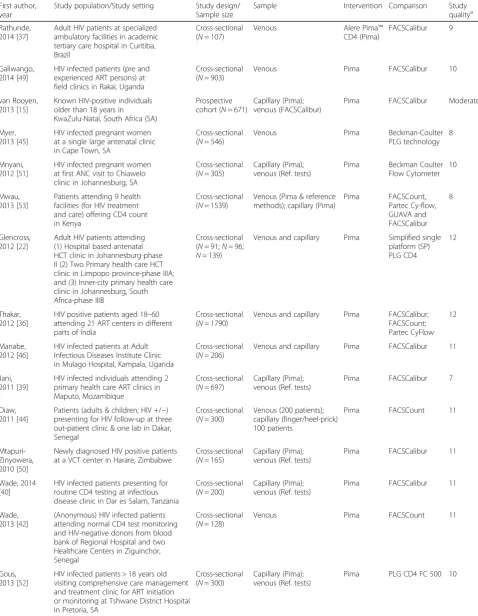
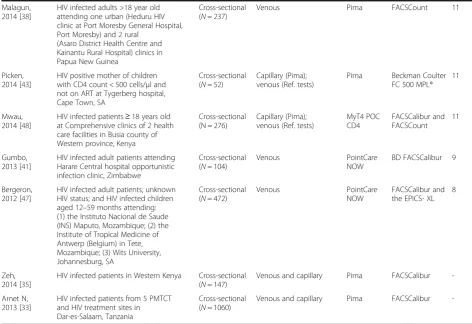
Twenty four studies (24) used Pima, two studies used PointCare NOW, one used MyT4 as the index POC CD4 test. Overall, the quality of included studies was
considered between moderate and strong. The QUADAS scores ranged from 7 to 12 (of a maximum score of 14) with 63 % (12/19) of studies scoring between 10 and 12. Among 22 studies reporting performance of POC CD4 test (Table 1), 19 (86 %) were conducted in sub-Saharan countries and three others were in India [36], Brazil [37] and PNG [38]. CD4 predicate testing technologies used as reference include FACSCalibur, FACSCount, Panleu-cogating (PLG) flow cytometry, Partec CyFlow and GUAVA. Only one study performed duplicate testing [39], and three studies performed precision testing of the reference method on a subset of whole blood sam-ples (3–15 blood specimens) [40–42]. Among 19 stud-ies reporting diagnostic performance of Pima, only 11 studies provided data required for and then subsequently included in the meta-analyses.
Performance of POC CD4 tests in field settings
Failure rates
For Pima, studies with capillary blood reported a wide range of failure rates from 2 % [43] to 23.3 % [44]. Studies using venous blood in various clinical settings reported failure rates ranging from 4.8 to 15.2 % [40, 44–46]. One study reported a zero“no read”error in laboratory evalu-ation of Pima with venous blood, however, in field evalua-tions in different clinical settings failure rate was recorded at a wide range from 6.8 to 20.9 % [22]. For PointCare Now the failure rate varied from 2.9 % in one study [41] to 9.2 % in another [47]. With MyT4 CD4 test a study-wide error rate of 9.6 % was recorded [48].
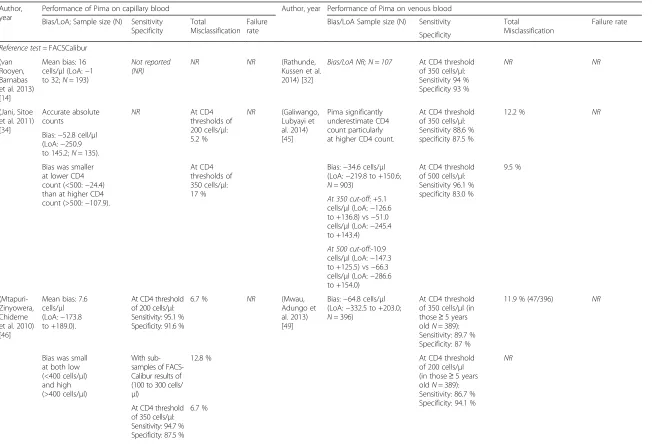
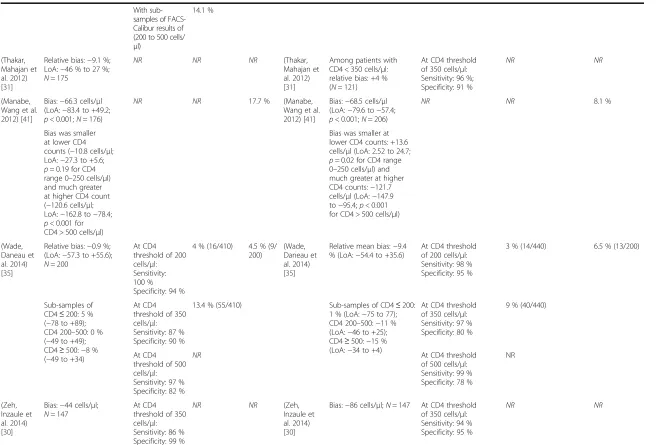
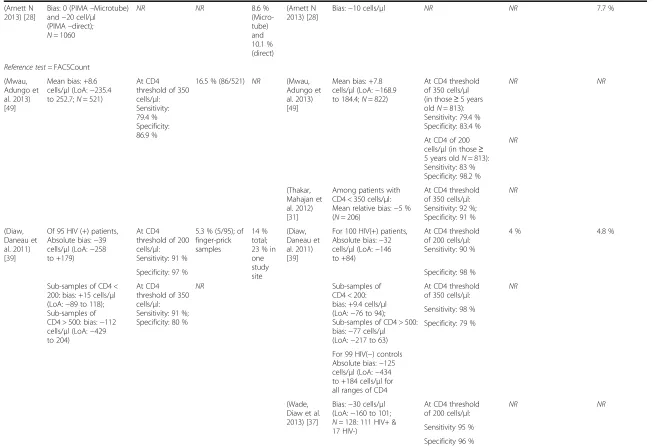
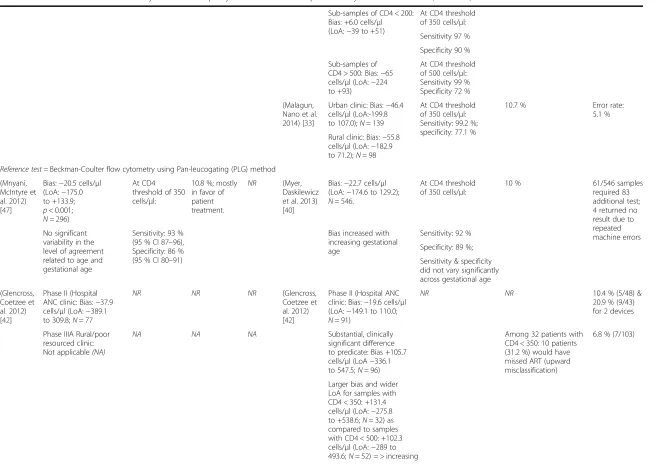
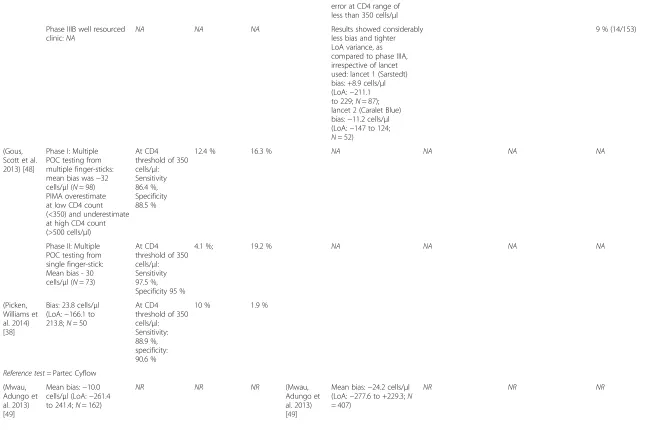
Detailed performance data of Pima is presented in Table 2.
Misclassification, sensitivity and specificity
When CD4 count testing was conducted using a venous blood specimen Pima showed lower misclassification and higher probabilities of correctly identifying patients eligible for ART across studies and different reference methods. At a CD4 threshold of 350 cells/μl, the total misclassification probability of Pima test using venous blood was 4.0–12.2 % [44, 49] versus 6.7–17 % for capil-lary blood [39, 50]. Pima point estimates for sensitivity and specificity ranged from 89–99 % and 77–93 % for venous blood; and 79–98 % and 80–99 % for capil-lary, respectively. For PointCare Now, one study [47] reported site-specific sensitivity ranging from 38 to 63 %, resulting in misclassification of 50 % of patients tested as ineligible for ART; another study [41] re-ported a lower misclassification of 6 % of patients as ineligible for treatment. For MyT4 CD4, the sensitiv-ity and specificsensitiv-ity of the test were 88 and 84 % when compared to FACSCalibur and 95 and 88 % as com-pared to FACSCount [48].
Table 1Characteristics and Quality assessment of studies included in the review
First author, year
Study population/Study setting Study design/ Sample size
Sample Intervention Comparison Study qualitya
Rathunde, 2014 [37]
Adult HIV patients at specialized ambulatory facilities in academic tertiary care hospital in Curitiba, Brazil
Cross-sectional (N= 107)
Venous Alere Pima™
CD4 (Pima)
FACSCalibur 9
Galiwango, 2014 [49]
HIV infected patients (pre and experienced ART persons) at field clinics in Rakai, Uganda
Cross-sectional (N= 903)
Venous Pima FACSCalibur 10
van Rooyen, 2013 [15]
Known HIV-positive individuals older than 18 years in KwaZulu-Natal, South Africa (SA)
Prospective cohort (N= 671)
Capillary (Pima); venous (FACSCalibur)
Pima FACSCalibur Moderate
Myer, 2013 [45]
HIV infected pregnant women at a single large antenatal clinic in Cape Town, SA
Cross-sectional (N= 546)
Venous Pima Beckman-Coulter
PLG technology 8
Mnyani, 2012 [51]
HIV infected pregnant women at first ANC visit to Chiawelo clinic in Johannesburg, SA
Cross-sectional (N= 305)
Capillary (Pima); venous (Ref. tests)
Pima Beckman Coulter Flow Cytometer
10
Mwau, 2013 [53]
Patients attending 9 health facilities (for HIV treatment and care) offering CD4 count in Kenya
Cross-sectional (N= 1539)
Venous (Pima & reference methods); capillary (Pima)
Pima FACSCount, Partec Cy-flow, GUAVA and FACSCalibur 8 Glencross, 2012 [22]
Adult HIV patients attending (1) Hospital based antenatal HCT clinic in Johannesburg-phase II (2) Two Primary health care HCT clinic in Limpopo province-phase IIIA; and (3) Inner-city primary health care clinic in Johannesburg, South Africa-phase IIIB
Cross-sectional (N= 91;N= 96;
N= 139)
Venous and capillary Pima Simplified single platform (SP) PLG CD4
12
Thakar, 2012 [36]
HIV positive patients aged 18–60 attending 21 ART centers in different parts of India
Cross-sectional (N= 1790)
Venous and capillary Pima FACSCalibur; FACSCount; Partec CyFlow
12
Manabe, 2012 [46]
HIV infected patients at Adult Infectious Diseases Institute Clinic in Mulago Hospital, Kampala, Uganda
Cross-sectional (N= 206)
Venous and capillary Pima FACSCalibur 11
Jani, 2011 [39]
HIV infected individuals attending 2 primary health care ART clinics in Maputo, Mozambique
Cross-sectional (N= 697)
Capillary (Pima); venous (Ref. tests)
Pima FACSCalibur 7
Diaw, 2011 [44]
Patients (adults & children; HIV +/−) presenting for HIV follow-up at three out-patient clinic & one lab in Dakar, Senegal
Cross-sectional (N= 300)
Venous (200 patients); capillary (finger/heel-prick) 100 patients
Pima FACSCount 11
Mtapuri-Zinyowera, 2010 [50]
Newly diagnosed HIV positive patients at a VCT center in Harare, Zimbabwe
Cross-sectional (N= 165)
Capillary (Pima); venous (Ref. tests)
Pima FACSCalibur 11
Wade, 2014 [40]
HIV infected patients presenting for routine CD4 testing at infectious disease clinic in Dar es Salam, Tanzania
Cross-sectional (N= 200)
Capillary (Pima); venous (Ref. tests)
Pima FACSCalibur 11
Wade, 2013 [42]
(Anonymous) HIV infected patients attending normal CD4 test monitoring and HIV-negative donors from blood bank of Regional Hospital and two Healthcare Centers in Ziguinchor, Senegal
Cross-sectional (N= 128)
Venous Pima FACSCount 11
Gous, 2013 [52]
HIV infected patients > 18 years old visiting comprehensive care management and treatment clinic for ART initiation or monitoring at Tshwane District Hospital in Pretoria, SA
Cross-sectional (N= 300)
Capillary (Pima); venous (Ref. tests)
Pima PLG CD4 FC 500 10
Meta-analysis of diagnostic accuracy of the Alere Pima™CD4 in field testing We aimed to conduct cat-egorical data analysis of diagnostic accuracy of Pima at CD4 350 and 500 cells/μl cut-offs. However, only three included studies [40, 42, 49] reported data required for meta-analysis at the 500 cut-off. Thus only analysis at a CD4 threshold of 350 cells/μl was performed. Required data including number of true positive, false positive, false negative and true negative cases were reported in the literature from 9 studies [38, 40, 42, 43, 45, 49–52]. Data from two studies [37, 53] were received from the authors following email contact, yielding a final dataset comprising 11 studies for the meta-analysis. Among these, two studies [40, 53] reported Pima test results for both venous and capillary blood, and these data were treated in meta-analyses as independent study results but with model standard errors corrected for the lack of independence in observations. Five studies [37, 38, 42, 45, 49] reported the results with venous and four studies [43, 50–52] with capillary blood only.
Examination of post-estimation of diagnostic statistics after preliminary meta-analyses provided some evidence of model outlier bias, with two studies [53] (capillary)
and [38] (venous) showing model discrepant test sensi-tivity and specificity (Cook’s distances: 2.12 and 3.65 re-spectively). However, diagnostic test data from these studies were included in the pooled meta-analysis after sensitivity analysis, with outlying cases excluded, indi-cated no marked difference in pooled estimates (in-cluded versus ex(in-cluded sensitivity and specificity: 92 vs. 92 % and 87 vs. 88 %, respectively).
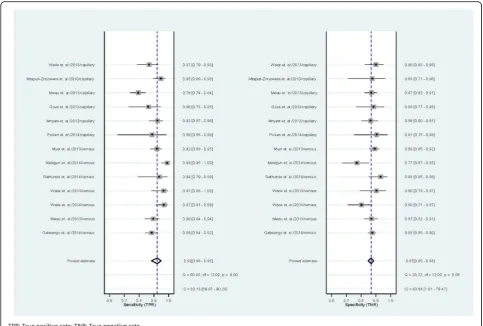
Diagnostic accuracy of the test in field settings was relatively high, with pooled sensitivity and specificity estimated at 92 % (95 % CI = 88–95 %) and 87 % (95 % CI = 85–88 %) respectively (Fig. 2). Further, pooled positive and negative likelihood ratios were also at levels indicating relatively strong diagnostic perform-ance of Pima (+LR = 7.0, 95 % CI = 6.1–7.9; −LR = 0.09, 95 % CI = 0.06–0.13). Figure 3 shows observed sensitivity and specificity plotted for each included study with the HSROC curve, the pooled estimate and 95 % confidence and prediction contours.
[image:6.595.55.528.101.425.2]Bivariate random-effect hierarchical models estimating pooled diagnostic performance with a covariate for blood sample type showed some potential difference in summary sensitivity and specificity by blood sample
Table 1Characteristics and Quality assessment of studies included in the review(Continued)
Malagun, 2014 [38]
HIV infected adults >18 year old attending one urban (Heduru HIV clinic at Port Moresby General Hospital, Port Moresby) and 2 rural
(Asaro District Health Centre and Kainantu Rural Hospital) clinics in Papua New Guinea
Cross-sectional (N= 237)
Venous Pima FACSCount 11
Picken, 2014 [43]
HIV positive mother of children with CD4 count < 500 cells/μl and not on ART at Tygerberg hospital, Cape Town, SA
Cross-sectional (N= 52)
Capillary (Pima); venous (Ref. tests)
Pima Beckman Coulter FC 500 MPL®
11
Mwau, 2014 [48]
HIV infected patients≥18 years old at Comprehensive clinics of 2 health care facilities in Busia county of Western province, Kenya
Cross-sectional (N = 276)
Capillary (Pima); venous (Ref. tests)
MyT4 POC CD4
FACSCalibur and FACSCount
11
Gumbo, 2013 [41]
HIV infected adult patients attending Harare Central hospital opportunistic infection clinic, Zimbabwe
Cross-sectional (N= 104)
Venous PointCare
NOW
BD FACSCalibur 9
Bergeron, 2012 [47]
HIV infected adult patients; unknown HIV status; and HIV infected children aged 12–59 months attending: (1) the Instituto Nacional de Saude (INS) Maputo, Mozambique; (2) the Institute of Tropical Medicine of Antwerp (Belgium) in Tete, Mozambique; (3) Wits University, Johannesburg, SA
Cross-sectional (N= 472)
Venous PointCare
NOW
FACSCalibur and the EPICS- XL
8
Zeh, 2014 [35]
HIV infected patients in Western Kenya Cross-sectional (N= 147)
Venous and capillary Pima FACSCalibur
-Arnet N, 2013 [33]
HIV infected patients from 5 PMTCT and HIV treatment sites in Dar-es-Salaam, Tanzania
Cross-sectional (N= 1060)
Venous and capillary Pima FACSCalibur
-HCTHIV counseling and testing,ARTAntiretroviral therapy,VCTVoluntary counseling and testing;PMTCTPrevention of mother to child transmission a
Study quality assessment usingEPHPP tool (strong/moderate/weak), or QUADAS score (out of 14)
Table 2Performance of Pima stratified by venous and capillary blood collection and presented by reference test used
Author, year
Performance of Pima on capillary blood Author, year Performance of Pima on venous blood
Bias/LoA; Sample size (N) Sensitivity Specificity
Total
Misclassification Failure rate
Bias/LoA Sample size (N) Sensitivity Total
Misclassification
Failure rate
Specificity
Reference test =FACSCalibur (van
Rooyen, Barnabas et al. 2013) [14]
Mean bias: 16 cells/μl (LoA:−1 to 32;N= 193)
Not reported (NR)
NR NR (Rathunde,
Kussen et al. 2014) [32]
Bias/LoA NR; N=107 At CD4 threshold of 350 cells/μl: Sensitivity 94 % Specificity 93 %
NR NR
(Jani, Sitoe et al. 2011) [34]
Accurate absolute
counts NR
At CD4 thresholds of 200 cells/μl: 5.2 %
NR (Galiwango,
Lubyayi et al. 2014) [45]
Pima significantly underestimate CD4 count particularly at higher CD4 count.
At CD4 threshold of 350 cells/μl: Sensitivity 88.6 % specificity 87.5 %
12.2 % NR
Bias:−52.8 cell/μl (LoA:−250.9 to 145.2;N= 135).
Bias was smaller at lower CD4 count (<500:−24.4) than at higher CD4 count (>500:−107.9).
At CD4 thresholds of 350 cells/μl: 17 %
Bias:−34.6 cells/μl (LoA:−219.8 to +150.6;
N= 903)
At CD4 threshold of 500 cells/μl: Sensitivity 96.1 % specificity 83.0 %
9.5 %
At 350 cut-off: +5.1 cells/μl (LoA:−126.6 to +136.8) vs−51.0 cells/μl (LoA:−245.4 to +143.4)
At 500 cut-off:-10.9 cells/μl (LoA:−147.3 to +125.5) vs−66.3 cells/μl (LoA:−286.6 to +154.0)
(Mtapuri-Zinyowera, Chideme et al. 2010) [46]
Mean bias: 7.6 cells/μl (LoA:−173.8 to +189.0).
At CD4 threshold of 200 cells/μl: Sensitivity: 95.1 % Specificity: 91.6 %
6.7 % NR (Mwau,
Adungo et al. 2013) [49]
Bias:−64.8 cells/μl (LoA:−332.5 to +203.0;
N= 396)
At CD4 threshold of 350 cells/μl (in those≥5 years oldN= 389): Sensitivity: 89.7 % Specificity: 87 %
11.9 % (47/396) NR
Bias was small at both low (<400 cells/μl) and high (>400 cells/μl)
With sub-samples of FACS-Calibur results of (100 to 300 cells/
μl)
12.8 % At CD4 threshold
of 200 cells/μl (in those≥5 years oldN= 389): Sensitivity: 86.7 % Specificity: 94.1 %
NR
At CD4 threshold of 350 cells/μl: Sensitivity: 94.7 % Specificity: 87.5 %
6.7 %
Pham
et
al.
BMC
Infectious
Diseases
(2016) 16:592
Page
7
of
Table 2Performance of Pima stratified by venous and capillary blood collection and presented by reference test used(Continued)
With sub-samples of FACS-Calibur results of (200 to 500 cells/
μl)
14.1 %
(Thakar, Mahajan et al. 2012) [31]
Relative bias:−9.1 %; LoA:−46 % to 27 %;
N= 175
NR NR NR (Thakar,
Mahajan et al. 2012) [31]
Among patients with CD4 < 350 cells/μl: relative bias: +4 % (N= 121)
At CD4 threshold of 350 cells/μl: Sensitivity: 96 %; Specificity: 91 %
NR NR
(Manabe, Wang et al. 2012) [41]
Bias:−66.3 cells/μl (LoA:−83.4 to +49.2;
p< 0.001;N= 176)
NR NR 17.7 % (Manabe,
Wang et al. 2012) [41]
Bias:−68.5 cells/μl (LoA:−79.6 to−57.4;
p< 0.001;N= 206)
NR NR 8.1 %
Bias was smaller at lower CD4 counts (−10.8 cells/μl; LoA:−27.3 to +5.6;
p= 0.19 for CD4 range 0–250 cells/μl) and much greater at higher CD4 count (−120.6 cells/μl; LoA:−162.8 to−78.4;
p< 0.001 for CD4 > 500 cells/μl)
Bias was smaller at lower CD4 counts: +13.6 cells/μl (LoA: 2.52 to 24.7;
p= 0.02 for CD4 range 0–250 cells/μl) and much greater at higher CD4 counts:−121.7 cells/μl (LoA:−147.9 to−95.4;p< 0.001 for CD4 > 500 cells/μl)
(Wade, Daneau et al. 2014) [35]
Relative bias:−0.9 %; (LoA:−57.3 to +55.6);
N= 200
At CD4 threshold of 200 cells/μl: Sensitivity: 100 % Specificity: 94 %
4 % (16/410) 4.5 % (9/ 200)
(Wade, Daneau et al. 2014) [35]
Relative mean bias:−9.4 % (LoA:−54.4 to +35.6)
At CD4 threshold of 200 cells/μl: Sensitivity: 98 % Specificity: 95 %
3 % (14/440) 6.5 % (13/200)
Sub-samples of CD4≤200: 5 % (−78 to +89); CD4 200–500: 0 % (−49 to +49); CD4≥500:−8 % (−49 to +34)
At CD4 threshold of 350 cells/μl: Sensitivity: 87 % Specificity: 90 %
13.4 % (55/410) Sub-samples of CD4≤200:
1 % (LoA:−75 to 77); CD4 200–500:−11 % (LoA:−46 to +25); CD4≥500:−15 % (LoA:−34 to +4)
At CD4 threshold of 350 cells/μl: Sensitivity: 97 % Specificity: 80 %
9 % (40/440)
At CD4 threshold of 500 cells/μl: Sensitivity: 97 % Specificity: 82 %
NR At CD4 threshold
of 500 cells/μl: Sensitivity: 99 % Specificity: 78 %
NR
(Zeh, Inzaule et al. 2014) [30]
Bias:−44 cells/μl;
N= 147
At CD4 threshold of 350 cells/μl: Sensitivity: 86 % Specificity: 99 %
NR NR (Zeh,
Inzaule et al. 2014) [30]
Bias:−86 cells/μl;N= 147 At CD4 threshold of 350 cells/μl: Sensitivity: 94 % Specificity: 95 %
Table 2Performance of Pima stratified by venous and capillary blood collection and presented by reference test used(Continued)
(Arnett N 2013) [28]
Bias: 0 (PIMA–Microtube) and−20 cell/μl (PIMA–direct);
N= 1060
NR NR 8.6 %
(Micro-tube) and 10.1 % (direct)
(Arnett N 2013) [28]
Bias:−10 cells/μl NR NR 7.7 %
Reference test =FACSCount (Mwau,
Adungo et al. 2013) [49]
Mean bias: +8.6 cells/μl (LoA:−235.4 to 252.7;N= 521)
At CD4 threshold of 350 cells/μl: Sensitivity: 79.4 % Specificity: 86.9 %
16.5 % (86/521) NR (Mwau,
Adungo et al. 2013) [49]
Mean bias: +7.8 cells/μl (LoA:−168.9 to 184.4;N= 822)
At CD4 threshold of 350 cells/μl (in those≥5 years oldN= 813): Sensitivity: 79.4 % Specificity: 83.4 %
NR NR
At CD4 of 200 cells/μl (in those≥ 5 years oldN= 813): Sensitivity: 83 % Specificity: 98.2 %
NR
(Thakar, Mahajan et al. 2012) [31]
Among patients with CD4 < 350 cells/μl: Mean relative bias:−5 % (N= 206)
At CD4 threshold of 350 cells/μl: Sensitivity: 92 %; Specificity: 91 %
NR
(Diaw, Daneau et al. 2011) [39]
Of 95 HIV (+) patients, Absolute bias:−39 cells/μl (LoA:−258 to +179)
At CD4 threshold of 200 cells/μl: Sensitivity: 91 %
5.3 % (5/95); of finger-prick samples
14 % total; 23 % in one study site
(Diaw, Daneau et al. 2011) [39]
For 100 HIV(+) patients, Absolute bias:−32 cells/μl (LoA:−146 to +84)
At CD4 threshold of 200 cells/μl: Sensitivity: 90 %
4 % 4.8 %
Specificity: 97 % Specificity: 98 %
Sub-samples of CD4 < 200: bias: +15 cells/μl (LoA:−89 to 118); Sub-samples of CD4 > 500: bias:−112 cells/μl (LoA:−429 to 204)
At CD4 threshold of 350 cells/μl: Sensitivity: 91 %; Specificity: 80 %
NR Sub-samples of
CD4 < 200: bias: +9.4 cells/μl (LoA:−76 to 94); Sub-samples of CD4 > 500: bias:−77 cells/μl (LoA:−217 to 63)
At CD4 threshold of 350 cells/μl:
NR
Sensitivity: 98 %
Specificity: 79 %
For 99 HIV(−) controls Absolute bias:−125 cells/μl (LoA:−434 to +184 cells/μl for all ranges of CD4
(Wade, Diaw et al. 2013) [37]
Bias:−30 cells/μl (LoA:−160 to 101;
N= 128: 111 HIV+ & 17 HIV-)
At CD4 threshold of 200 cells/μl:
NR NR
Sensitivity 95 %
Specificity 96 %
Pham
et
al.
BMC
Infectious
Diseases
(2016) 16:592
Page
9
of
Table 2Performance of Pima stratified by venous and capillary blood collection and presented by reference test used(Continued)
Sub-samples of CD4 < 200: Bias: +6.0 cells/μl (LoA:−39 to +51)
At CD4 threshold of 350 cells/μl:
Sensitivity 97 %
Specificity 90 %
Sub-samples of CD4 > 500: Bias:−65 cells/μl (LoA:−224 to +93)
At CD4 threshold of 500 cells/μl:: Sensitivity 99 % Specificity 72 %
(Malagun, Nano et al. 2014) [33]
Urban clinic: Bias:−46.4 cells/μl (LoA:-199.8 to 107.0);N= 139
At CD4 threshold of 350 cells/μl: Sensitivity: 99.2 %; specificity: 77.1 %
10.7 % Error rate:
5.1 %
Rural clinic: Bias:−55.8 cells/μl (LoA:−182.9 to 71.2);N= 98
Reference test =Beckman-Coulter flow cytometry using Pan-leucogating (PLG) method (Mnyani,
McIntyre et al. 2012) [47]
Bias:−20.5 cells/μl (LoA:−175.0 to +133.9;
p< 0.001;
N= 296)
At CD4 threshold of 350 cells/μl:
10.8 %; mostly in favor of patient treatment.
NR (Myer,
Daskilewicz et al. 2013) [40]
Bias:−22.7 cells/μl (LoA:−174.6 to 129.2);
N= 546.
At CD4 threshold of 350 cells/μl:
10 % 61/546 samples
required 83 additional test; 4 returned no result due to repeated machine errors No significant
variability in the level of agreement related to age and gestational age
Sensitivity: 93 % (95 % CI 87–96), Specificity: 86 % (95 % CI 80–91)
Bias increased with increasing gestational age
Sensitivity: 92 %
Specificity: 89 %;
Sensitivity & specificity did not vary significantly across gestational age
(Glencross, Coetzee et al. 2012) [42]
Phase II (Hospital ANC clinic: Bias:−37.9 cells/μl (LoA:−389.1 to 309.8;N= 77
NR NR NR (Glencross,
Coetzee et al. 2012) [42]
Phase II (Hospital ANC clinic: Bias:−19.6 cells/μl (LoA:−149.1 to 110.0;
N= 91)
NR NR 10.4 % (5/48) &
20.9 % (9/43) for 2 devices
Phase IIIA Rural/poor resourced clinic: Not applicable(NA)
NA NA NA Substantial, clinically
significant difference to predicate: Bias +105.7 cells/μl (LoA−336.1 to 547.5;N= 96)
Among 32 patients with CD4 < 350: 10 patients (31.2 %) would have missed ART (upward misclassification)
6.8 % (7/103)
Larger bias and wider LoA for samples with CD4 < 350: +131.4 cells/μl (LoA:−275.8 to +538.6;N= 32) as compared to samples with CD4 < 500: +102.3 cells/μl (LoA:−289 to 493.6;N= 52) = > increasing
Pham
et
al.
BMC
Infectious
Diseases
(2016) 16:592
Page
10
of
Table 2Performance of Pima stratified by venous and capillary blood collection and presented by reference test used(Continued)
error at CD4 range of less than 350 cells/μl
Phase IIIB well resourced
clinic:NA NA NA NA
Results showed considerably less bias and tighter LoA variance, as compared to phase IIIA, irrespective of lancet used: lancet 1 (Sarstedt) bias: +8.9 cells/μl (LoA:−211.1 to 229;N= 87); lancet 2 (Caralet Blue) bias:−11.2 cells/μl (LoA:−147 to 124;
N= 52)
9 % (14/153)
(Gous, Scott et al. 2013) [48]
Phase I: Multiple POC testing from multiple finger-sticks: mean bias was−32 cells/μl (N= 98) PIMA overestimate at low CD4 count (<350) and underestimate at high CD4 count (>500 cells/μl)
At CD4 threshold of 350 cells/μl: Sensitivity 86.4 %, Specificity 88.5 %
12.4 % 16.3 % NA NA NA NA
Phase II: Multiple POC testing from single finger-stick: Mean bias - 30 cells/μl (N= 73)
At CD4 threshold of 350 cells/μl: Sensitivity 97.5 %, Specificity 95 %
4.1 %; 19.2 % NA NA NA NA
(Picken, Williams et al. 2014) [38]
Bias: 23.8 cells/μl (LoA:−166.1 to 213.8;N= 50
At CD4 threshold of 350 cells/μl: Sensitivity: 88.9 %, specificity: 90.6 %
10 % 1.9 %
Reference test =Partec Cyflow (Mwau,
Adungo et al. 2013) [49]
Mean bias:−10.0 cells/μl (LoA:−261.4 to 241.4;N= 162)
NR NR NR (Mwau,
Adungo et al. 2013) [49]
Mean bias:−24.2 cells/μl (LoA:−277.6 to +229.3;N
= 407)
NR NR NR
Pham
et
al.
BMC
Infectious
Diseases
(2016) 16:592
Page
11
of
Table 2Performance of Pima stratified by venous and capillary blood collection and presented by reference test used(Continued)
(Thakar, Mahajan et al. 2012) [31]
Among patients with CD4 < 350 cells/μl: mean relative bias +8 % (N= 550)
At CD4 350 threshold: Sensitivity: 91 %; Specificity: 96 %
NR NR
Reference test =GUAVA (Mwau,
Adungo et al. 2013) [49]
Mean bias: +23.9 cells/μl (LoA−329.6 to 281.9;N= 176)
NR NR NR (Mwau,
Adungo et al. 2013) [49]
Mean bias:−0.3 cells/μl (LoA:−315.0 to 315.6;N= 191)
NR NR NR
LoAlimit of agreement,POCpoint-of-care,ANCantenatal care
Pham
et
al.
BMC
Infectious
Diseases
(2016) 16:592
Page
12
of
type. Using venous samples, pooled sensitivity was 94 % (95 % CI = 89–97 %) and pooled specificity 86 % (95 % CI = 82–89 %), while using capillary blood pooled sensi-tivity was 89 % (95 % CI = 83–93 %) and specificity 87 % (95 % CI = 86–89 %). However, a post-estimation test of the joint effect of blood sample type on the sensitivity and specificity of Pima showed that these differences in diagnostic accuracy did not reach statistical significance (Waldχ2(2) = 4.77,p= 0.09).
Bias and limit of agreement (LoA)
Overall, Pima showed a better performance with venous compared to capillary blood samples with a smaller range of bias and tighter LoA across studies with differ-ent predicate technologies. Studies reported absolute bias of Pima at CD4 > 500 cells/μl ranging from −66.3 cells/μl (LoA:−286.6, +154.0) for venous [49] to−120.6 cells/μl (LoA:−162.8,−78.4) for capillary blood [46]. At lower CD4 ranges, bias were reported at +15 cells/μl (LoA: −89 to +118) for CD4 < 200 cell/μl using capillary blood [44]; and +5.1 cells/μl (LoA: −126.6, +136.8) for CD4 < 350 cell/μl using venous sample [49]. These data suggest that Pima overestimates the CD4 count at lower
CD4 ranges and underestimates the CD4 count at higher ranges; the bias was also increased at higher CD4 counts.
Discussion
Findings of this review suggest that POC CD4 testing can provide reliable results for making treatment deci-sions among HIV patients in LMICs. This review high-lights the need for published data regarding the field evaluation of available POC CD4 tests, particularly in low-resource settings where these novel technologies are already demonstrating significant impact on the con-tinuum of care for HIV-positive persons. Among six current or prospective commercially available POC CD4 technologies, only three have published studies that meet inclusion criteria and most of these used Pima as the index test. Among 19 studies reporting Pima per-formance data, 11 studies provided data required for meta-analysis of diagnostic test accuracy.
Findings on Pima performance from two studies using both venous and capillary blood showed that CD4 counts on venous blood samples produced more accur-ate results than capillary blood, with lower failure/error Fig. 2Point estimates‡of diagnostics performance of Pima in field settings at CD4 350 cells/μl cut-off
[image:13.595.56.540.87.413.2]reading rate, the authors suggest that variation in test re-sults was likely due to quality of capillary sampling [22, 44]. However, other evidence supports the use of either venous or capillary specimens [35, 40]. Though not sta-tistically significant, our meta-analysis shows that there is a trend towards a better performance of the test with venous blood, with a sensitivity of 0.94 for venous and 0.89 for capillary blood (p= 0.09) in identifying HIV-positive person eligible for ART at a cut-off of 350 cells/ μL. If this is a true difference in performance of the test, the use of venous blood when using Pima for ART eligi-bility assessment would be preferable as it could reduce false negative test results which represent patient’s missed opportunities for timely treatment initiation.
An observed wide range of failure rate of the Pima technology across studies is another attribute that needs
further attention. Apart from technical and operational characteristics of the test, evidence from field studies suggests that performance of the test operator influences the accuracy of diagnostic test in the field [11, 22]. Therefore, the quality of training on POC testing for test operators and their supervisors becomes critically im-portant to ensure effectiveness and efficiency of the technology in field settings. Of note, few of the included studies mentioned the effect of staff training on per-formance of POC CD4 test and none described details of the training program.
Bias in assessing the diagnostic accuracy of any new test could arise from faulty results of the reference test itself as there is no gold standard for CD4 testing al-though single platform flow cytometry has assumed that position. Thus evidence of participation and successful Fig. 3HSROC curve from multi-level bivariate random effects model estimation of diagnostic performance of Pima at CD4 350 cells/μcut-off¥: plots observed sensitivity and specificity, diagnostic summary point, 95 % confidence and prediction contours.
[image:14.595.61.535.85.505.2]performance in external quality assurance (EQA) pro-grams and performing duplicate tests on a sample using the predicate test are worthy recommendations in order to ensure the highest accuracy of predicate results. In this review only half of the included studies described EQA participation for the reference test and only one study conducted duplicate testing.
In order to better inform the decision making process on selection and adoption of POC CD4 testing in LMICs, further studies on currently and newly available POC CD4 technologies in various level settings and dif-ferent geographic regions are needed. It is recommended that the quality of studies as well as quality of study reporting should be improved by following established standards [26, 54] and the focus of these future studies should not only be on test diagnostic accuracy but also on implementation aspects of the test, aiming at provid-ing practical evidence to inform effective implementa-tion strategies of POC CD4 testing.
There are two published systematic reviews and meta-analyses of the performance of POC CD4 tests, one by Scott et al. [19] and one by Peeling et al. [20]. In com-parison, our review included 22 peer reviewed publica-tions, providing a large increase in analysis of published work on POC CD4 technologies compared to the other reviews. Importantly, our study differed from the previ-ously published reviews in that only studies conducted in field settings were included and thereby specially assessed field performance of the Pima. We demon-strated that misclassification by Pima, particularly with the use of capillary blood samples under field conditions, can be higher than that under a laboratory environment; thus our data vary with the earlier study where the re-ported probability of Pima misclassification was less than 10 % [20]. A significant methodological strength of our meta-analysis is the direct estimation of the joint effect of blood sample type on Pima sensitivity and specificity simultaneously, using a bivariate multi-level random ef-fect model with pooled study data. This is a significant improvement in statistical robustness compared to the simple comparison of 95 % CI estimates for sensitivity and specificity applied in the other meta-analysis [19]. Encouragingly, our results, in line with findings from other reviews, confirm that POC CD4 tests also perform well if assessed specifically in field settings. Pima there-fore has the potential for further deployment for ART eligibility assessment and treatment monitoring, espe-cially in areas where laboratory-based CD4 testing is not available or difficult to access.
This review has some limitations which may affect the generalization of the findings. First, we included only pub-lished, peer-reviewed journal articles in English and this inclusion may overlook data from studies published in other languages or unpublished data from evaluations/
studies conducted by government agencies, reference fa-cilities or similar institutions. The inclusion of conference abstracts has it strengths in limiting publication bias; how-ever, confidence in these findings is limited as the quality of these studies has not been assessed via formal peer re-view. Second, only three of the six POC CD4 technologies found in this review were published with field study data and one technology (Pima) featured most prominently in the included studies. This presents challenges in terms of generalizing many of the findings of the review to “all” POC CD4 tests as it may be subjected to reporting bias. Third, interpretation of findings from meta-analyses of this review should be contextualized in terms of the lim-ited diagnostic test data available from published studies. This limitation cannot be overcome until more data from field studies of different POC CD4 technologies, including the Pima, are available.
Conclusions
Findings of this review suggest that field studies of POC CD4 tests currently available on the market and those eagerly anticipated, conducted in LMICs where they are needed the most, remain much in need. The Pima™CD4 showed acceptable diagnostic test accuracy using either venous or capillary blood. Existing evidence indicates that POC CD4 testing, can provide reliable results under field conditions and could play an important role in HIV continuum of care. This remains true, despite the chan-ging landscape with respect to guidelines for ART initi-ation. Whilst evidence supports increasingly earlier commencement of treatment at an individual and com-munity level, the financial reality is that in many parts of the world priority for ART initiation must still continue to be given to those with evidence of declining immune function. Further evidence is needed to ensure that effi-cacy is acceptable with both venous and capillary blood samples in field settings.
Additional file
Additional file 1:Annex 1. Medline Search Strategy - Descriptions of search terms used for literature search in Medline. (DOCX 16 kb)
Abbreviations
ART:Antiretroviral therapy; DTA: Diagnostic test accuracy;
GLLAMM: Generalized latent and linear mixed modeling; HSROC: Hierarchical summary receiver operating characteristic; LMICs: Low and middle income countries; LoA: Limit of agreement; POC: Point-of-care; WHO: The World Health Organization
Acknowledgments
The authors gratefully acknowledge the contribution to this work of the Victorian Operational Infrastructure Support Program received by the Burnet Institute.
Funding
Funding was provided by the National Health and Medical Research Council of Australia (NHMRC) (Project grant GNT 1063725, and Career Development Fellowship to S. Luchters. Infrastructure for Research Institutes Support Scheme Grant. Suzanne Crowe is a recipient of an NHMRC Principle Research fellowship). Minh Pham received support via an International Postgraduate Research Scholarship (IPRS) from the Commonwealth of Australia and the Victorian International Research Scholarship (VIRS) from State Government of Victoria, Australia (VIRS). For the remaining authors none were declared.
Availability of data and materials
The dataset supporting the conclusion of this article is included within the article and its additional files.
Authors’contributions
ICMJE criteria for authorship read and met: MP, PA, LR, PG, DA, SC, SL. Developed review protocol: MP, SL, DA, SC. Performed literature search: LR, MP. Performed data extraction: MP, PG. Conducted Meta-analysis: PA, MP. Wrote the first draft of the manuscript: MP, LR, PA. Contributed to the writing of the manuscript: MP, LR, PA, SL, DA, SC. Agreed with the manuscript’s re-sults and conclusions: MP, PA, LR, PG, DA, SC, SL. All authors read and ap-proved the final manuscript.
Competing interest
The authors declare that they have no competing interests.
Consent for publication
Not applicable.
Ethics approval and consent to participate
Not applicable.
Author details
1Burnet Institute, 85 Commercial Road, Melbourne, VIC 3004, Australia. 2Department of Epidemiology and Preventive Medicine, Faculty of Medicine
Nursing and Health Science, Monash University, Melbourne, Australia.3The Alfred Hospital, The Ian Potter Library, Melbourne, VIC, Australia.4Department
of Immunology, Faculty of Medicine Nursing and Health Science, Monash University, Melbourne, Australia.5Department of Infectious Diseases, The
Alfred Hospital and Monash University, Melbourne, Australia.6Department of Obstetrics and Gynecology, International Centre for Reproductive Health, Faculty of Medicine and Health Sciences, Ghent University, Ghent, Belgium.
Received: 24 June 2016 Accepted: 13 October 2016
References
1. UNAIDS. How AIDS changed Every thing: MD6: 15 years, 15 lessons of Hope from the AIDS response. 2015. Available at: http://www.unaids.org/en/ resources/documents/2015/MDG6_15years-15lessonsfromtheAIDSresponse. 2. TEMPRANO. A trial of early antiretrovirals and isoniazid preventive therapy
in Africa. N Engl J Med. 2015;373:808–22.
3. INSIGHTSTART. Initiation of antiretroviral therapy in early asymptomatic HIV infection. N Engl J Med. 2015;373:795–807.
4. WHO. Guideline on when to start antiretroviral therapy and on pre-exposure prophylaxis for HIV. Geneva: World Health Organization; 2015. p. 78. 5. WHO. Consoldated guidlines on the use of antiretroviral drugs for treating
and preventing HIV infection Recommendations for a public health approach. Geneva: World Health Organization; 2013. p. 272.
6. Ford N, et al. The future role of CD4 cell count for monitoring antiretroviral therapy. Lancet Infect Dis. 2015;15(2):241–7.
7. Kranzer K, et al. Quantifying and addressing losses along the continuum of care for people living with HIV infection in sub-Saharan Africa: a systematic review. J Int AIDS Soc. 2012;15(2):17383.
8. Govindasamy D, Ford N, Kranzer K. Risk factors, barriers and facilitators for linkage to antiretroviral therapy care: a systematic review. AIDS. 2012; 26(16):2059–67.
9. Wynberg E, et al. Impact of point-of-care CD4 testing on linkage to HIV care: a systematic review. J Int AIDS Soc. 2014;17:18809.
10. Patten GE, et al. Impact on ART initiation of point-of-care CD4 testing at HIV diagnosis among HIV-positive youth in Khayelitsha, South Africa. J Int AIDS Soc. 2013;16:18518.
11. Mtapuri-Zinyowera S, et al. PIMA Point of Care CD4+ Cell Count Machines in Remote MNCH Settings: Lessons Learned from Seven Districts in Zimbabwe. Infect Dis (Auckl). 2013;6:51–60.
12. Feyissa G, Demissie T. Effect of point of care CD4 cell count tests on retention of patients and rates of antiretroviral therapy initiation in sub-Saharan African countries: a systematic review. JBI Database System Rev Implement Rep. 2014;12(4):395–429.
13. Faal M, et al. Providing immediate CD4 count results at HIV testing improves ART initiation. J Acquir Immune Defic Syndr. 2011;58(3):e54–9. 14. Jani IV, et al. Effect of point-of-care CD4 cell count tests on retention of
patients and rates of antiretroviral therapy initiation in primary health clinics: an observational cohort study. Lancet. 2011;378(9802):1572–9.
15. van Rooyen H, et al. High HIV testing uptake and linkage to care in a novel program of home-based HIV counseling and testing with facilitated referral in KwaZulu-Natal, South Africa. J Acquir Immune Defic Syndr. 2013;64(1):e1–8. 16. Zachariah R, et al. Viewpoint: Why do we need a point-of-care CD4 test for
low-income countries? Trop Med Int Health. 2011;16(1):37–41.
17. Hyle E, et al. The Clinical and Economic Impact of Point-of-Care CD4 Testing in Mozambique and Other Resource-Limited Settings: A Cost-Effectiveness Analysis. PLoS Med. 2014;11(9), e1001725.
18. UNITAID. 2014 HIV/AIDS diagnostics technology landscape. 4th ed. 2014. Available at: http://www.unitaid.eu/en/resources/publications/technical-reports.
19. Scott LE, et al. A meta-analysis of the performance of the Pima(TM) CD4 for point of care testing. BMC Med. 2015;13:168.
20. Peeling RW, et al. CD4 enumeration technologies: a systematic review of test performance for determining eligibility for antiretroviral therapy. PLoS One. 2015;10(3):e0115019.
21. Fajardo E, et al. Errors generated by a point-of-care CD4+ T-lymphocyte analyser: a retrospective observational study in nine countries. Bull World Health Organ. 2015;93:623–30.
22. Glencross DK, et al. Performance evaluation of the Pima™point-of-care CD4 analyser using capillary blood sampling in field tests in South Africa. J Int AIDS Soc. 2012;15(1):3.
23. Moher D, et al. Preferred reporting items for systematic reviews and meta-analyses: the PRISMA statement. PLoS Med. 2009;6(7):e1000097.
24. Counsell C. Formulating questions and locating primary studies for inclusion in systematic reviews. Ann Intern Med. 1997;127(5):380–7.
25. Jackson N, et al. Criteria for the systematic review of health promotion and public health interventions. Health Promot Int. 2005;20(4):367–74. 26. Whiting P, et al. The development of QUADAS: a tool for the quality
assessment of studies of diagnostic accuracy included in systematic reviews. BMC Med Res Methodol. 2003;3:25.
27. Reitsma JB, et al. Bivariate analysis of sensitivity and specificity produces informative summary measures in diagnostic reviews. J Clin Epidemiol. 2005;58(10):982–90.
28. Huber PJ. The behavior of maximum likelihood estimates under nonstandard conditions. In: Fifth Berkeley Symposium on Mathematical Statistics and Probability. Berkeley: University of California Press; 1967. p. 221–33.
29. Dwamena BA. Midas: Stata module for Meta-analytical Integration of Diagnostic Accuracy Studies. 2007.
30. Rabe-Hesketh S, Pickles A, Taylor C. Generalized linear latent and mixed models. Stata Technical Bulletin 53. Stata Technical Bulletin Reprints. 2000;9: 293–307.
31. Harbord RM, Whiting P. metandi: Meta-analysis of diagnostic accuracy using hierarchical logistic regression. Stata Journal. 2009;9(2):211–29.
32. Rutter CM, Gatsonis CA. A hierarchical regression approach to meta-analysis of diagnostic test accuracy evaluations. Stat Med. 2001;20(19):2865–84. 33. Arnett N, Chang K, Schmitz M, Lemwayi R, Rwehumbiza P, Mwasekaga M.
Healthcare workers’acceptance and performance of point-of-care CD4 testing in Dar es Salaam, Tanzania, 2011. In: 7th IAS Conference on HIV Pathogenesis and Treatment; Kuala Lumpur; 30 June-3 July 2013, 2013 (Abstract TUPDD0103 - Poster Discussion Session). 2013.
34. Rioja M, MbohKhan E, Nzuobontane D, Munyaburanga F, PiusMuffih T, Asong T. Improving access to care and treatment by strengthening CD4 count testing capacity in rural health districts in Cameroon through point-of-care technology. In: 7th IAS Conference on HIV
Pathogenesis and Treatment; Kuala Lumpur; 30 June-3 July 2013., 2013 (Abstract WEPE609). 2013.
35. Zeh C, et al. Evaluation of Pima CD4 Point-Of-Care Device in Western Kenya for Potential Use in Field Settings. In: Conference on Retroviruses and Opportunistic Infections; Boston, Massachusetts; March 3–6 2014., (Abstract 624). 2014. 36. Thakar M, et al. Utility of the point of care CD4 analyzer, PIMA, to enumerate
CD4 counts in the field settings in India. AIDS Res Ther. 2012;9(1):26. 37. Rathunde L, et al. Evaluation of the Alere Pima™for CD4+ T lymphocytes
counts in HIV-positive outpatients in Southern Brazil. Int J STD AIDS. 2014; 25:956–9.
38. Malagun M, et al. Multisite evaluation of point of care CD4 testing in Papua New Guinea. PLoS One. 2014;9(11):e112173.
39. Jani IV, et al. Accurate CD4 T-cell enumeration and antiretroviral drug toxicity monitoring in primary healthcare clinics using point-of-care testing. AIDS. 2011;25(6):807–12.
40. Wade D, et al. WHO multicenter evaluation of FACSCount CD4 and Pima CD4 T-cell count systems: instrument performance and misclassification of HIV-infected patients. J Acquir Immune Defic Syndr. 2014;66(5):e98–107. 41. Gumbo P, et al. Analysis of Bias and ART Enrollment for a Point-of-Care
CD4/CD4% Analyzer. J AIDS Clin Res. 2013;4:247.
42. Wade D, et al. CD4 T-cell enumeration in a field setting: evaluation of CyFlow counter using the CD4 easy count kit-dry and Pima CD4 systems. PLoS One. 2013;8(9):e75484.
43. Picken S, et al. The routine paediatric human immunodeficiency virus visit as an intervention opportunity for failed maternal care, and use of point-of-care CD4 testing as an adjunct in determining antiretroviral therapy eligibility. Southern African Journal of Epidemiology and Infection. 2014;29(2):70–4. 44. Diaw PA, et al. Multisite evaluation of a point-of-care instrument for CD4(+)
T-cell enumeration using venous and finger-prick blood: the PIMA CD4. J Acquir Immune Defic Syndr. 2011;58(4):e103–11.
45. Myer L, et al. Comparison of point-of-care versus laboratory-based CD4 cell enumeration in HIV-positive pregnant women. J Int AIDS Soc. 2013;16(1):18649. 46. Manabe YC, et al. Evaluation of portable point-of-care CD4 counter with
high sensitivity for detecting patients eligible for antiretroviral therapy. PLoS One. 2012;7(4):e34319.
47. Bergeron M, et al. Performance of the PointCare NOW system for CD4 counting in HIV patients based on five independent evaluations. PLoS One. 2012;7(8):e41166.
48. Mwau M, et al. Technical Performance Evaluation of the MyT4 Point of Care Technology for CD4+ T Cell Enumeration. PLoS One. 2014;9(9):e107410. 49. Galiwango RM, et al. Field evaluation of PIMA point-of-care CD4 testing in
Rakai, Uganda. PLoS One. 2014;9(3):e88928.
50. Mtapuri-Zinyowera S, et al. Evaluation of the PIMA point-of-care CD4 analyzer in VCT clinics in Zimbabwe. J Acquir Immune Defic Syndr. 2010;55(1):1–7. 51. Mnyani CN, McIntyre JA, Myer L. The reliability of point-of-care CD4 testing
in identifying HIV-infected pregnant women eligible for antiretroviral therapy. J Acquir Immune Defic Syndr. 2012;60(3):260–4.
52. Gous N, et al. Feasibility of performing multiple point of care testing for HIV anti-retroviral treatment initiation and monitoring from multiple or single fingersticks. PLoS One. 2013;8(12):e85265.
53. Mwau M, et al. Evaluation of PIMA™® point of care technology for CD4 T cell enumeration in Kenya. PLoS One. 2013;8(6):e67612.
54. Bossuyt PM, et al. Towards complete and accurate reporting of studies of diagnostic accuracy: The STARD Initiative. Ann Intern Med. 2003;138(1):40–4.
• We accept pre-submission inquiries
• Our selector tool helps you to find the most relevant journal
• We provide round the clock customer support
• Convenient online submission
• Thorough peer review
• Inclusion in PubMed and all major indexing services
• Maximum visibility for your research
Submit your manuscript at www.biomedcentral.com/submit