Running head: VOCAL PRACTICE AND PHONOLOGICAL WORKING MEMORY
The role of vocal practice in constructing phonological working memory
Tamar Keren-Portnoy*, Marilyn. M. Vihman, University of York
Rory. A. DePaolis James Madison University
Chris. J. Whitaker Bangor University Nicola M. Williams
University of York
*Contact author
Contact information for contact author: Tamar Keren-Portnoy
Dept. of Language and Linguistic Science V/B/220, 2nd Floor, Block B, Vanbrugh College University of York, Heslington
York YO10 5DD UK
Abstract
Purpose: This study looks for effects of vocal practice on phonological working memory. Method:We used a longitudinal design, combining both naturalistic observations and a nonword repetition test. Fifteen 26-month-olds (twelve of whom were followed from age eleven months) were administered a nonword test including real words, “standard” nonwords (identical for all children), and nonwords based on individual children’s production inventory (INandOUTwords).
Results:A strong relationship was found between (i) length of experience with consonant production and (ii) nonword repetition and between (i) differential experience with specific consonants through production and (ii) performance on theINvs.OUTwords.
There is a general consensus that Nonword Repetition Tests tap phonological short-term memory (though see Jones, Macken, & Nicholls, 2004). One widely used model of short term memory for verbal information is that described by Gathercole & Baddeley (1993) and Gathercole (2006), which involves a component called the phonological loop or the phonological store: “Auditory linguistic inputs are automatically represented in the store, where they are subject to rapid time-based decay. The decay of the representations can be offset by a subvocal rehearsal process that boosts their activation levels” (Gathercole, 2006, p.519). As the phonological loop is usually mentioned in relation to short term memory, it is typically conceived of as primarily serving receptive functions, theperception or
comprehensionof language, that is, for maintaining input in memory.
The suggestion that the phonological loop might be part of the speech output system has also been made (Ellis, 1980; Klapp, 1976; Morton, 1970), but that hypothesis has been largely set aside (e.g., Gathercole & Baddeley, 1993; Klapp, Greim, & Marshburn, 1981). It is generally claimed that although a speech output buffer may be needed for storing
impending speech in the service of rapid speech production, this is probably distinct from the phonological loop (Gathercole & Baddelely, 1993; see also Adams & Gathercole, 1995), which serves for storing the same type of information, but for a different purpose.
short term memory (Klapp et al., 1981; Sternberg et al., 1978). This is taken as evidence for the independence of the two hypothesized buffer systems. It could be argued, however, that the differences reflect task demands (e.g., the degree of memory load involved). Planning sequential behavior (such as speech) while using pre-stored units does not engage short term memory in the same way as does the storage of random sequences of input items for access for production – as in word list and nonword repetition.
However, we remain agnostic as to whether or not the phonological loop is distinct from the response buffer in adults. Whatever the end state, we would like to raise the
possibility that in development, at least, the role of the phonological loop is also (or mainly) to serve thespeech production system(cf. also Gathercole & Baddeley, 1993). We suggest further that while phonological working memory is affected by learning through registering and processing of input, it is also affected by the learning which results from language use, more specifically, from speech production.
We will claim here that phonological working memory develops to a large extent along with and as a result of practice experience with vocal production. We therefore explore the option of a shared structure, serving both productive and receptive functions, as suggested by Ellis (1980): “A phonological store … termed theresponse buffer,whose normal function is to allow the efficient programming of speech production by holding preplanned stretches of impending speech. It may be called upon [...] to assist in immediate recall”, particularly when the subject is unable to use higher-order (i.e. top-down) processes (p.624).
1This idea originated in the seminal work of Leonard, Schwartz, Morris, and Chapman (1981) and Schwartz and Leonard (1982), who were the first to demonstrate the contribution of production practice to novel word learning.
exemplars of one sound/syllable or another (successful categorizing of aperceived target), and (c) gaining sufficient familiarity with the sound/syllable to be able to aim for it as an articulatory target, plan its execution, and realize it (see also Edwards & Lahey, 1998; Munson, Edwards, & Beckman, 2005). Such competence builds only slowly, as a result of growing experience with both talking and listening, including, importantly, listening to one’s own vocal production, which enables matching between auditory and articulatory targets (see also Callan, Kent, Guenther, & Vorperian, 2000, Elbers, 2000, DePaolis, 2006, Westermann & Miranda, 2004).
The goal of our study is to assess the contribution of language production experience to phonological working memory. Edwards and Lahey (1998) and Munson et al. (2005) have shown that the expressive lexicon better accounts for performance on Nonword Repetition Tests than does the receptive lexicon. We will go one step further and test the idea that, beyond the make-up of a child’s lexicon, knowledge pertaining to sequences of linguistic sounds must also depend on experience originating in language production practice as motoric behaviour1. We operationalize production experience in two ways:
a) Length of experience at controlling speech sounds: Will babblers who use the response buffer early show better phonological working memory at a later age?
A developmental study
To test our predictions we followed a group of children longitudinally from 11 to 26 months, using a combination of experimental and naturalistic procedures. The main
independent variables were: (1) the onset of consistency or control in speech sound
production and (2) familiarity with specific speech sounds gained through production. Both of these measures were based on data from naturalistic observations of the child in interaction with a caregiver. Our main dependent variable, phonological working memory, was assessed at age 26 months using a Nonword Repetition Test that we constructed. As far as we know no previous studies have directly investigated the effect of long-term production practice on phonological working memory (but see Edwards and Lahey, 1998, on short-term effects). Evaluating production practice
I. Stable control over consonant production. We measured the age of onset of stable consonant use, or Vocal Motor Schemes, defined as “generalized action patterns that yield consistent phonetic forms” (McCune & Vihman, 2001, p. 673). This gauges production capacities at a very early stage, when most (if not all) of a child’s utterances are babbled vocalizations, uninterpretable as words. McCune and Vihman (2001) found the onset of Vocal Motor Schemes to be a reliable measure of phonetic advance for predicting later lexical development. The Vocal Motor Scheme measure identifies only those supraglottal consonants that a child controls well enough to produce frequently over a period of time. This assesses both stability and consistency in consonant production. Like McCune and Vihman, we used the age at which the children gained their second Vocal Motor Scheme to define the age of onset of consonantal control. Such control involves, at a minimum, the ability to aim at a particular sound or state of the vocal apparatus, plan the necessary articulatory gestures for producing it, and execute those gestures in a precise enough way for adult listeners to
If, as suggested by Ellis (1980), the response buffer is the part of the production mechanism which serves speech programming by holding preplanned stretches of speech, then any child who has an identifiable Vocal Motor Scheme can be taken to have started to plan and program speech, albeit at the most basic level. (Note that although we are
disregarding the vowels which accompany Vocal Motor Schemes for the sake of assessment, it may be more appropriate to conceptualize speech planning at this stage as involving
syllables rather than individual segments: Davis & MacNeilage, 1995). The age of emergence of two Vocal Motor Schemes can thus also be seen as the age at which the response buffer begins to be used efficiently, or at which it begins to be constructed through effective, consistently repeated babbling patterns. Our prediction is that children who start to exercise (or to build) their response buffer early will also have better phonological working memory at a later age, since an important part of the theoretical construct of phonological working memory is the phonological (or articulatory) loop.
II. Familiarity with speech sounds gained through production.As children become more proficient language users we expect units of varying sizes to become easier for them to register, categorize and produce. This advance specifically depends on production
experience. We therefore expect children to be more successful at remembering sound
comparable length and phonotactic complexity to be harder to repeat when they contain little-practiced sounds. If the problem were merely one of producing an unknown segment, we would expect the sequence itself to be repeated correctly, but with substitution of a more familiar sound for the unfamiliar sound. However, if we are right in thinking that successful storage of the sound sequence is in itself dependent on a child’s familiarity with the units within it, then failure to repeat sequences which contain unfamiliar sounds should involve misremembering of larger parts of the sequence, not merely of the one or two problematic segments: We expect errors to affect the whole (non)word, including such features as the number of segments or syllables, the ordering of segments, and the identity of the vowels (cf. also Edwards and Lahey, 1998).
Phonological working memory at 26 months of age
Phonological working memory at 26 months of age was gauged using a Nonword Repetition Test that included real words, “standard” nonwords, identical for all the children (taken from Roy & Chiat, 2004), and nonwords specifically tailored for each child.
Method Participants
not be constructed for them in full (seeNonword Repetition Test, below). The children were recruited through advertisements in local papers and posters hung in clinics, nurseries, etc. as part of the larger study. No parents reported any hearing problems; all children were full term. Participating families were paid for their time after each session.
Procedure
The 12 children in the Longitudinal Sample were followed from age 11 months on for half-hour recording sessions of naturalistic interaction with a caregiver. The sessions were conducted on a monthly basis until the child produced four spontaneous words in a session and then continued bi-weekly until the child produced 25 or more different words
spontaneously within a session (‘the 25-word point’: this typically coincides with the end of the single word period). The three children in the Partial Sample were recorded for only two half-hour sessions, scheduled when they reached about two years of age. All 15 children were given a Nonword Repetition Test at 26 months .
Naturalistic Recording Sessions
Ascertaining age at the first two Vocal Motor Schemes
The earliest transcripts of the 12 children in the Longitudinal sample were searched for all occurrences of true consonants (supraglottal, non-glide), and the frequency of each consonant was tabulated. A consonant was considered a Vocal Motor Scheme (a) when it had been used at least ten times in a session in at least three different vocalizations, for at least three
consecutive sessions with no more than one intervening session with fewer uses or,
alternatively, (b) once a consonant had reached a minimum frequency of fifty uses, over one to three sessions, in at least three vocalizations in each session. By either criterion,
acquisition of each Vocal Motor Scheme was credited to the first of these sessions (see also McCune & Vihman, 2001, DePaolis, 2006). The age of acquisition of the second Vocal Motor Scheme was taken as the developmental milestone, “age at two Vocal Motor Schemes”.
Determining each child’s consonant repertoire for the Nonword Repetition Test
The consonant repertoire for each of the children in the Longitudinal Sample was determined based on a “repertoire session” recorded prior to the test, usually the 25-word-point session, or if the child had not yet reached the 25-word point by 26 months, on the recent
observational session with the most vocalizations. For children who had reached the 25-word-point session at a very young age so that several months had elapsed by the time of the Nonword Repetition Test, we used a more recent session. For the children in the Partial Sample we used the more voluble of the two recordings made around age two years. The average age at the repertoire session was 1;11.6 (SD 1.4 months).
2We included real words in the test to make it less daunting for the children over all. In the event, the comparison between the real words and the nonwords proved to be of interest in its own right (see Results, II-c). The real words were chosen for their frequency, as described above, as well as for their phonotactic simplicity. Based on a separate sample of 54 British children aged 1;5 to 1;7, the words used in the test were reported as known on the CDI by 73% of the children on average, with a range of 30% to 98%.
fewINconsonants for this criterion to be applicable. In their cases we lowered the criterion forINconsonants to a frequency of at least 14 in one case and 11 in the other). Coda
consonants with a frequency of 10 or more were consideredIN, the rest were consideredOUT. Nonword Repetition Test
At the average age of 26 months (2;1.24) all the children were given a Nonword Repetition Test. The test consisted of 56 stimuli (see Table 1 for examples of words and nonwords) presented in two parts: Part I, which was identical for all of the children, was made up of (1) 18 Standard nonwords taken from a Nonword Repetition Test adapted for use with very young children (Roy & Chiat, 2004) and (2) 20 real words, meant to be as familiar to the children as possible and produced by at least three of the six oldest children in our
3We started out with a three-point scale, with scores of 0 (incorrect), 1 (partially correct), and 2 (correct). As decisions based on this scoring scheme proved to be error-prone and overly subjective, we abandoned it in favour of the simpler dichotomous scale, which led to fewer ambiguous cases.
none of the segments manipulated was beyond the production capacities of at least some children of 26 months of age.
[Insert Table 1 about here]
For children with noINcoda consonants we used words withINonsets with a random coda, chosen from the words used for the other children who did have coda consonants. For the two children excluded from the Partial SampleINandOUTwords could not be
constructed: One child had too fewOUTconsonants, the other too fewINconsonants.
An attempt was made to include as much overlap as possible between theINand OUT nonwords. Out of the entire pool of 71 words used in the test, 38 (54%) were used asINfor some children butOUTfor others (see Appendix for details).
The test was administered with the aid of a puppet to hold the child’s attention. The child was asked to repeat the word after the puppet. Words were repeated several times by the experimenter (and sometimes by the attending parent as well) in order to ensure as high a percentage of responses as possible. Children received stickers as reinforcement during the test to encourage them to continue responding, regardless of the accuracy of their responses. The session was recorded in the same way as the naturalistic observation sessions.
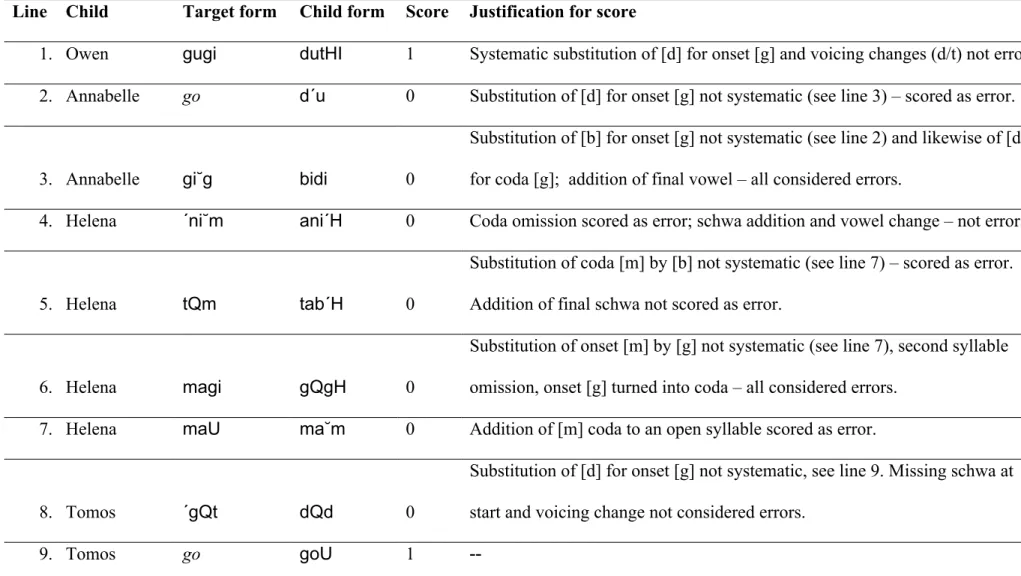
Nonword Repetition Test scoring. Each word was scored as either correct (1) or incorrect (0) (see Table 2 for examples of scores).3
[Insert Table 2 about here]
4Since codas were chosen randomly for these children, the decision to score their codas voicing contrast is not well controlled within the first year or two of word use (Macken, 1980). Scoring for vowels was very lenient, with vowels scored as errors only when the deviation from the target was radical. The rationale for this decision was that the transcription of vowels is much less reliable than that of consonants (see, for instance, Davis, MacNeilage, & Matyear, 2002, who report 76.8% inter-transcriber reliability for consonants and only 44.8% for vowels). Child forms were considered correct if the substituted vowel maintained backness and height of the target vowel, or was only a short distance away in the articulatory vowel space. As regards vowels, the following were not considered errors: substitutions among the low vowels, reduction of diphthongs to either subpart, reduction of any vowel to schwa, or substitution of a schwa by any lax vowel.
As regards consonants, substitutions of one consonant by another (e.g., [d] for [g]) were considered errors only if the child did not make systematic use of this substitution (see Table 2, lines 1-2). The following were considered errors, however: (1) substitution of a segment with different segments in different words or nonwords (See Table 2, lines 2-3, and 5-7); (2) phonological processes common at age two: deaffrication, substitution of /s/ for /S/ or vice versa, or affrication of stops, which was considered an imprecise release; (3)
substitutions for a segment that has been produced correctly in its target position (i.e., onset or coda) at least once, either in preceding sessions or in the test session itself (see Table 2 lines 5-7 and 8-9). The rationale was that if a child produced a segment appropriately even once, that segment was motorically available to the child, although its access or execution might still be difficult and memory for it instable. (4) Omission of a consonant, in either onset or coda position.
could, if anything, go against our hypotheses, and adds noise to the results.
Whole-word vs. segmental error analysis in the Nonword Repetition Test.Only productions which scored 0 in the Nonword Repetition Test were included in this second analysis. Any error which involved no greater change to the word than consonant substitution (whether systematic or not), coda omission, or changes to the vowels considered “lawful” by our scoring system was considered aSUBSTITUTION ERROR(scored 0). All other deviations from the target – changes in sequential order (metathesis), addition or elision of a syllable (apart from speech sounds preceding the word or addition of schwa at the end) or segment (apart from coda omission), major changes in the vowel – were consideredWHOLE-WORD
ERRORS(scored 1). Examples of substitution errors in Table 2 are [d´u]forgo(line 2) and [dQd] for [´gQt] (line 8; the schwa omission was not considered an error). Examples of whole word errors in Table 2 are [bidi] for [gi˘g] (line 3), [gQgH]for[magi](line 6), and [ma˘m]for [maU] (line 7).
Reliability of transcriptions and scoring.The naturalistic transcriptions were made by three experienced transcribers (including the first and fifth authors). Two minutes from each of five sessions from different children in the Longitudinal Sample, at three different
developmental stages (babble, 4-word-point and 25-word-point), were transcribed by each of the three main transcribers. Three pairwise comparisons were computed to calculate
reliability between each pair of transcribers. Percentage agreement on place and manner of each consonant (disregarding voicing) for all consonants transcribed by both transcribers ranged from .80 to .86.
5We did not compare performance on the Standard nonwords to that on any other part of the test, because the Standard nonwords are longer as well as phonotactically more complex than any other type of word (see Table 1), rendering the comparison uninteresting.
agreement on identity of vowels for all syllable nuclei transcribed by both transcribers, using the same lenient vowel scoring as for scoring the children’s responses, was .92.
All tests were scored by both the first and the second authors. Differences in the scoring were minor and were settled by consensus.
Results
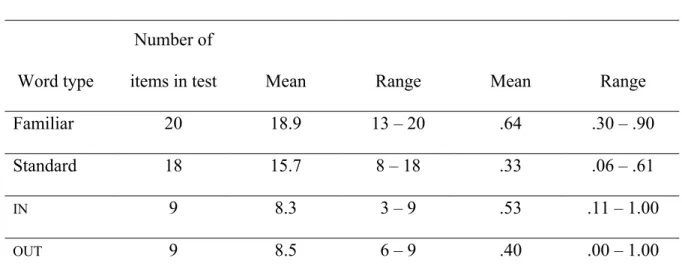
We began by comparing children’s performance on all four parts of the test (see Table 3), keeping in mind that only theINandOUTlists were balanced for phonotactic difficulty (see Table 1). Data from all 15 children was used. We ran a repeated-measures Friedman non parametric ANOVA, using the four parts of the test as independent measures and the score for each part as the dependent measure.
[Insert Table 3 about here]
I) TheLength of Experiencehypothesis
We predicted that babblers who showed early use of the response buffer through their early control of Vocal Motor Schemes would show better phonological working memory at a later age. For this hypothesis we could only use data from the Longitudinal Sample (N = 12). We correlated the children’s age at onset of acquiring two Vocal Motor Schemes with their scores on the Standard nonwords (see Figure 1).
[Insert Figure 1 about here]
A strong and significant relationship was found between the two measures: rs= -.73, p = .002 (one-tailed), supporting the idea that children who begin to show early consistent use of two Vocal Motor Schemes later achieve a high score on the Standard nonwords. This result supports our prediction that longer experience with consonant production supports phonological working memory.
II-a) TheFamiliarity with Specific Soundshypothesis
We predicted that nonwords consisting of sounds that are frequent in a child’s repertoire (IN) would be repeated more successfully than nonwords containing sounds infrequent in the child's repertoire (OUT). Data from all 15 children were used. The results support our prediction. Since Friedman’s Test (reported above) was significant, we ran a within-subject contrast, using the Wilcoxon Signed Ranks Test for paired samples (using the Bonferroni correction for multiple comparisons), between INandOUTwords (see Figure 2). The mean score forINwords (M = .53, SD = .28) is higher than that forOUTwords (M = .40, SD = .27) and the difference is significant: Z = -2.24, p = .0125 (one-tailed; after Bonferroni correction,
6Data from one child could not be used as she made no errors onINwords [Insert Figure 2 about here]
II-b)Whole-wordvs.segmental erroranalysis in the Nonword Repetition Test: To further explore the idea that memory for sequences made up of unfamiliar sounds is inferior to that for sequences made up of familiar sounds we conducted an analysis to determine whether errors inOUTwords tended to reflect whole-word processes more than did errors inINwords. Whole-word errors were contrasted with substitution errors. We compared theproportionof whole-word errors out of total errors inINvs.OUTwords, thus correcting for differences between the two types of nonwords in total number of errors. We analyzed data only from the children who performed better onINthan onOUTnonwords, for whom we could make a clear prediction regarding the distribution of whole-word errors (N = 8 out of 15, see II-a, above).6 The mean proportion of whole-word-errors onINwords (M = .26) was indeed lower than on
OUTwords (M = .44) (see Figure 3), with the difference marginally significant, Z = -1.52 p = .064 (one-tailed), using the Wilcoxon Signed Ranks Test.
[Insert Figure 3 about here]
Data from individual children showed that six out of the eight had a higher proportion of whole-word errors onOUTthan onINnonwords and only one had the reverse pattern. The results of the error analysis suggest that not only do words containingOUTsounds lead to more errors in the repetition test, but these errors are more likely to be whole-word errors than are errors made onINwords.
II-c)An advantage for familiarized wholes?We carried out an additional within-subject contrast (using Wilcoxon Signed Ranks Test with the Bonferroni correction for multiple comparisons), comparing performance on the Familiar words relative to theINwords.
7We use a two-tailed test as this is a post-hoc analysis. After Bonferroni correction, .
8We thank Jan Edwards for making this point.
(M = .53, SD = .28): Z = -2.35, p = .019, two-tailed7. Recall that performance was better on
INthan onOUTwords (see II-a, above). These results led us to further investigate the question of familiarity, and to ask whether familiarized whole units (such as words) have an advantage over units that are not familiar as wholes (such as nonwords).
Better performance on real words than on nonwords has been extensively reported in the past, for both adults (e.g., Hulme et al., 1991) and children (Roy & Chiat, 2004). Roy & Chiat (2004) found that children repeat words better than nonwords on their Nonword Repetition Test, even though the two sets included the same sounds in the same syllable positions, but with reordering in the word as a whole to create nonwords (e.g.,ladder[lQd´] vs. [dQl´]). But why should children be consistently better at repeating familiar words than nonwords, even when, as in our test, theINnonwords contain only highly familiar segments, whereas the Familiar words contain someOUTconsonants? This advantage of words over nonwords can be accounted for if one adopts the view that children learn words as whole unanalyzed patterns, as has long been claimed by some child phonologists (e.g., Beckman & Edwards, 2000; Ferguson & Farwell, 1975; for a brief history, see Vihman & Croft, 2007). The accuracy in pronunciation seems to depend not only on familiarity with segments, but on familiarity with the units in which the segments are embedded. In addition, repetition of novel words engages working memory in a different way than does the repetition of familiar words, which may already be stored in long-term memory.8
9The Standard nonwords were not used in this comparison as they are far more difficult. 10One word,shoe, was not used in this analysis, because the segment [S] was used as neither
INnorOUTin the study.
when embedded in real words than when part of nonwords. We therefore compared the proportion ofINconsonants produced witherrorand the proportion ofOUTconsonants producedcorrectlyin Familiar words to those same proportions in theINandOUTnonwords:9
relative to :
If performance is affected only by whether a consonant isINorOUTof repertoire, then the ratio between these two proportions should be similar for the Familiar words and the nonwords (i.e., the fraction on the right, above, should be similar to the one on the left). However, if performance is also affected by familiarity with the whole word or syllable, then the proportion of errors forINconsonants should be lower in repetitions of Familiar real words than inINnonwords, which are novel (making the numerator on the left smaller than that on the right) and the proportion of correct renditions ofOUTconsonants should be higher among the Familiar words than among theOUTwords (making the denominator on the left larger than that on the right). In such a case, the resulting ratio is expected to be lower for Familiar words than for nonwords:
To test this hypothesis we scored each consonant in each Familiar word as eitherINorOUT for each child, according to the child’s speech sound repertoire.10We considered only onsets, as some of the children had noINcodas. Each consonant was then scored as produced
words proved to be significantly lower than for nonwords (see Figure 4): Z = -1.99, p = .024 (one tailed). The data from individual children showed that for ten out of 15 the difference was in the predicted direction, with the opposite pattern for the other five. Note that by using a non-parametric test we have controlled for the fact that the ratio values for one child are dramatically different from those for the other children, as the comparison utilizes the ranks of the differences between the ratios rather than their absolute values.
[Insert Figure 4 about here]
Discussion
We set out to test the hypothesis that production experience affects phonological working memory and may aid in its construction. Our two specific hypotheses were that (a)
production affects phonological working memory through practice: The longer a child has been consistently producing consonants, the better his/her phonological working memory will be at 26 months and (b) the quality of phonological working memory depends on the actual material to be remembered: Sequences involving speech sounds with which a child has more experience will be better remembered and will be repeated more accurately.
We obtained strong evidence for a relationship between production practice and phonological working memory. We have shown that the age at which children start to control supraglottal consonants in a consistent and stable way (at around 12 months, on average) correlates with their scores on a Nonword Repetition Test administered a year later. We have also shown that children more successfully remember and produce nonwords constructed of frequently used consonants than phonotactically comparable nonwords constructed of infrequently used (but developmentally equally accessible) consonants. There is also
11It is not possible to systematically compare children’s earliest Vocal Motor Schemes to their laterIN-OUTinventory, as voicing contrasts are ignored in counting Vocal Motor Schemes but are used when categorizing sounds asINorOUT. Note, however, that Vihman and Greenlee (1987) failed to find any relationship between consonant classes used
frequently by individual infants at age one and accuracy in production of those consonant classes by the same children at age three.
12We thank Christophe dos Santos for suggesting this idea.
production familiarity with whole chunks enhances memory for sound sequences (word forms) containing unfamiliar as well as familiar consonants.
How should these results be interpreted? We showed that production practice affects phonological working memory in two ways, one general, the other specific. The correlation between the age at controlled production of consonants and performance on the Nonword Repetition Test suggests that phonological working memory is built through experience with use of categorized segments or syllables: the longer a child has been producing well-controlled consonants, the better developed is his/her phonological working memory. The evidence points to a general relationship: We have not looked at the specific sounds involved in the first Vocal Motor Schemes and how these relate to the sounds controlled later (by age two most of each child’s earliest Vocal Motor Scheme consonants have becomeINsounds by our definition).11It is possible that the causality actually operates in the opposite direction, or is bidirectional: Perhaps children who have good sensitivity to and memory for sound
elsewhere (Keren-Portnoy et al., 2005) that age at two Vocal Motor Schemes correlates with age at first word production. The superior performance on the Nonword Repetition Test of the children with early Vocal Motor Schemes may actually be due to their having larger vocabularies by the time of the test. Having a larger productive lexicon likely means having a larger variety ofINsyllables or segments at one’s disposal, leading to better performance on Nonword Repetition Tests (and specifically on the Standard nonwords), since a larger proportion of the words in the test would fit the definition of beingINwords. We did not compare lexicon size for the different children at the repertoire session, as the time lag between this session and the test was too variable for this to be a reliable comparative measure.
The other type of relation that we have demonstrated between production practice and phonological working memory is much more specific, and here bidirectional accounts are improbable: Children are better at repeating nonwords with well-practiced consonants than nonwords with less-well-practiced consonants. Similarly, they are better at producing familiar wordswith either well- or less-well-practiced sounds thannonwordscontaining these same sounds, probably because they are experienced at producing these very words but have had no previous experience at producing the nonwords. Clearly, then, Nonword
Repetition Test performance is affected by production practice.
We would like to consider some alternative interpretations of our findings, namely that our results (1) are broadly due to general development or maturation of articulatory skill rather than to practice; (2) merely show articulatory difficulty rather than problems with representation (or memory); (3) are due to difficulty in the planning of vocal gestures. We will discuss each of these in turn.
account for our finding of a difference betweenINandOUTnonwordswithinchild. A similar response applies to the suggested account based on maturation in articulation – namely, that
OUTsegments may be motorically available later thanINsegments: INvs.OUTdifferences obtainedwithinchild, with one child’sOUTnonwords serving asINfor another. In addition, the segments manipulated were mostly stops and nasals, which should be well within the articulatory capacity of any two year old.
(2) Is the difference betweenINvs.OUTnonwords not simply due to articulation rather than representation (memory)? In fact, the same vowels and syllable shapes were used in bothINandOUTnonwords, so differential skill in their use is an unlikely explanation for the weaker performance onOUTwords. Yet vowels and syllable shapes tended to undergo more extreme changes inOUTthan inINwords, as evidenced by the greater number of whole-word errors inOUTwords. This presumably reflects a spreading of the difficulty with the unfamiliar consonants to other parts of the word, leading to an inaccurate representation. Note also that we did not count as errors those cases where memory is most likely to be accurate and the difficulty simply motoric, such as systematic substitutions of one consonant for another. Thus the difficulties withOUT words must not be due to articulatory difficulty alone – though this may be part of the story,in addition tothe memory problems.
Furthermore, the fact that bothINandOUTconsonants were better produced in real words than in nonwords shows that pronunciation difficulty depends not on the identity of the specific segment but rather on experience with the entire sequence of sounds or vocal gestures. This is clear evidence for production practice playing a role in the accuracy of repetition.
production reflect, at least to some extent, difficulties in planning which lead to higher motoric variabililty, we do not think that it can explain the full range of our results.
Variability in timing can lead to segmental inaccuracies but it is much less likely to account for whole-word errors such as vowel changes, syllable deletions, metathesis, etc. The tendency towards more such errors inOUTthan inINwords cannot be solely due to motoric variability as we understand it.
Our findings point to a real memory effect: The entire sound sequence comprising the word is remembered and reproduced less accurately when the consonants (or syllables) involved have not become familiarized through practice. Words containing such sounds are harder to remember. This results in errors in the vowels, in the number and order of
segments, and in segmental identity, as evidenced by children replacing unfamiliar consonants with different consonants in different words.
The problem is probably not primarily perceptual, given the ample data about
children’s early competence at discriminating most phonetic contrasts (see Jusczyk, 1997, for a review). In addition, neither Edwards and Lahey (1998) nor Munson et al. (2005) found evidence of a relationship between auditory discrimination scores and Nonword Repetition Test performance in typically developing children. The problem facing the child performing the Nonword Repetition Test is not one of discriminating contrasts but of categorizing sound sequences well enough to be able to reproduce them. In order to categorize different
exemplars as similar, one mustoverlookperceptible differences. The challenge with
unfamiliar sounds is to decide what they are most similar to, and therefore how to categorize them and how they may be articulated.
13These and similar accounts have also been used to explain better performance on short than on long words or for older than for younger children.
unfamiliar/infrequent phonotactics (e.g, Hulme et al., 1991; Roy & Chiat , 2004, Thorn et al., 2005).13Some accounts focus on earlier stages in the task, namely, the representation or storage of stimuli to be remembered (Gathercole & Baddeley, 1993; Hulme et al., 1991, Thorn et al., 2005), others stress a later stage, that of retrieval (Hulme et al., 1991; Hulme, Newton, Cowan, Stuart, & Brown, 1999; Hulme, Surprenant, Bireta, Stuart, & Neath, 2004). In our view (as in that of Thorn et al., 2005), these can be seen as complementary rather than competing accounts, and we believe that our results most likely show effects of both early and late processes.
Thorn et al. (2005) analyzed both the extent and the quality (or severity) of errors, and concluded that long-term knowledge (referring to properties of the lexicon, such as word frequency and phonotactics) must affect Nonword Repetition Test accuracy not only at retrieval but also at representation. They show that traces left by nonwords with infrequent phonotactics in working memory are weaker from the start than those of nonwords with frequent phonotactics and of familiar words. Other accounts referring to early stages in the process explain the superiority of familiar over non-familiar items as a function of length or complexity. Some accounts (e.g., Hulme et al., 1991; but see Hulme et al., 1999, 2004) describe the phonological loop as being of limited capacity in terms of temporal duration: Items can be successfully remembered only if they can be articulated in a certain length of time (about 2 seconds: Schweickert & Boruff, 1986). Hulme et al. (1991) found that familiar words are articulated more quickly than unfamiliar words (or nonwords), which in effect makes the latter longer and therefore harder to remember. Hulme et al. (2004) see
It is likely that chunking is the common process behind both the speed and the complexity accounts, as described by Bybee (2006): “[A]rticulatory representation of words and sequences of words are [sic] made up of neuromotor routines. When sequences of neuromotor routines are repeated, their execution becomes more fluent. This increased fluency is the result of representing the repeated sequence at a higher level as a single unit” (p.715). Increased speed of articulation is therefore a consequence of heightened fluency – and a sign that the sequence forms a unit (or chunk) in Long-Term Memory. Looked at from a different perspective, a sequence of increased phonological complexity can be thought of as composed of a larger number of bits (or chunks) and therefore involving more items to remember, hence the inferior performance on longer or more complex sequences relative to shorter or less complex ones (both Gathercole, Willis, Emslie, & Baddeley, 1991, and Roy & Chiat, 2004, report superior repetition for shorter than longer nonwords in children).
In the current study chunking can explain the superior performance on real words vs. nonwords as well as the superior performance onINthan onOUTwords: If familiar sound combinations, such as words or syllables, are produced more quickly than unfamiliar ones, then words will be articulated more quickly than nonwords. Similarly,INwords, composed of familiar syllables and segments, will be articulated more quickly thanOUTwords. Looked at differently, although theINandOUTnonwords are comparable in terms of phonotactics and length in syllables, nonwords containing familiar sounds should be less phonologically complex in terms of the number of bits, or chunks, necessary for representing them, making them easier to remember. Real words will be stored as whole chunks, making them easier still.
14There is ample evidence that when starting to acquire a lexicon, children at first store words as wholes which are not broken up into units (e.g., Beckman & Edwards, 2000; Edwards & Lahey, 1998; Ferguson & Farwell, 1975; Munson et al., 2005).
would thus involve a larger number of sub-units14. While familiar words are already represented in long term memory as wholes andINnonwords can be successfully broken down into familiar subparts (syllables, perhaps), unfamiliar nonwords cannot be analysed into pre-existing units but must be perceived as sequences made up of unfamiliar stuff, not
translatable into a sequence of discrete units at all. In the most extreme case, they may very well be perceived as a whole – a complex hyper-detailed auditory percept (see Pierrehumbert, 2003). OUTstimuli are thus more complex, involving multiple bits of information – which, however, are not necessarily analogous to phonemes.
OUTwords, whose sub-units are not well represented. Such reformulation of a partially degraded trace using more familiar units sometimes results in both adults and children substituting real familiar words for unfamiliar words or nonwords (Edwards & Lahey, 1998; Fay & Cutler, 1977).
Our results can be explained by a combination of early and late effects in the Nonword Repetition Test performance: specifically, it is likely thatOUTwords are poorly represented from the start (as suggested by Thorn et al., 2005). The difficulty in breaking those words up and representing them as made up of familiar units probably results in a weakly activated representation, leading to more occurrences of severe or total loss of the memory trace and to more extreme need for redintegration. Redintegration forOUTnonwords is less likely to be successful than forINor familiar words and is more likely to lead to whole-word errors, since the ‘correct’ bits of information lost from the memory trace cannot be found in long term memory. This is in accord with our results, which show a tendency for more errors inOUTthan inINnonwords to be holistic.
Our results provide strong evidence for an impact of language production experience on phonological working memory. Such experience seems to affect performance on the Nonword Repetition Test at the various stages of perception, representation, storage and retrieval. This seemingly peripheral aspect of language use – the motoric action of speech production – is not so peripheral after all. Our results fit well within a framework of
References
Adams, A. M. & Gathercole, S. E. (1995). Phonological working memory and speech production in preschool children.Journal of Speech and Hearing Research, 38, 403-414.
Beckman, M. E. & Edwards, J. (2000). The ontogeny of phonological categories and the primacy of lexical learning in linguistic development.Child Development, 71,240-249.
Bybee, J. (2006). From usage to grammar: the mind’s response to repetition. Language, 82, 711-733.
Callan, D. E., Kent, R. D., Guenther, F. H., & Vorperian, H. K. (2000). An auditory-feedback-based neural network model of speech production that is robust to
developmental changes in the size and shape of the articulatory system.Journal of Speech, Language, and Hearing Research, 43,721-736.
Davis, B. L. & MacNeilage, P. F. (1995). The articulatory basis of babbling.Journal of Speech and Hearing Research, 38,1199-1211.
Davis, B. L., MacNeilage, P. F., & Matyear, C. L. (2002). Acquisition of serial complexity in speech production: A comparison of phonetic and phonological approaches to first word production.Phonetica, 59,75-107.
DePaolis, R. (2006).The influence of production on the perception of speech. In Bamman, D., Magnitskaia, T. & Zaller, C. (eds.),Proceedings of the 30th Boston University Conference on Language Development. Somerville, MA: Cascadilla Press (pp. 142-153).
Edwards, J. & Lahey, M. (1998). Nonword repetitions of children with specific language impairment: Exploration of some explanations for their inaccuracies.applied
Elbers, L. (2000). An output-as-input hypothesis in language acquisition. In P. Broeder & J. Murre (Eds.),Models of language acquisition: Inductive and deductive approaches (pp.244-271).Oxford:Oxford University Press.
Ellis, A. (1980). Errors in speech and short-term memory: The effects of Phonemic similarity and syllable position.Journal of Verbal Learning and Verbal Behavior, 19,624-634.
Fay, D. & Cutler, A. (1977). Malapropisms and the structure of the mental lexicon.Linguistic Inquiry, 8,505-520.
Ferguson, C. A. & Farwell, C. B. (1975). Words and sounds in early language acquisition. Language, 51,419-439.
Gathercole, S. E. (2006). Nonword repetition and word learning: The nature of the relationship. Applied Psycholinguistics, 27, 513-543.
Gathercole, S. E. & Baddeley, A. D. (1993).Working memory and language. Hillsdale: Laurence Erlbaum Associates.
Gathercole, S. E., Willis, C., Emslie, H., & Baddeley, A. D. (1991). The influence of number of syllables and wordlikeness on children’s repetition of nonwords.Applied Psycholinguistics, 12, 349-367.
Goffman, L., Gerken, L., & Lucchesi, J. (2007). Relations between segmental and motor variability in prosodically complex nonwords sequences.Journal of Speech,
Language, and Hearing Research, 50, 444-458.
Hulme, C., Maughan, S., & Brown, G. D. A. (1991). Memory for familiar and unfamiliar words: Evidence for a long-term memory contribution to short-term memory span.Journal of Memory and Language, 30,685-701.
Hulme, C., Surprenant, A. M., Bireta, T. J., Stuart, G., & Neath, I. (2004). Abolishing the word-length effect.Journal of Experimental Psychology: Learning, Memory, and Cognition, 30, 98-106.
Jones, D. M., Macken, W. J., Nicholls, A. P. (2004). The phonological store of working memory: Is it phonological and is it a store?Journal of Experimental Psychology: Learning, Memory, and Cognition, 656-674.
Jusczyk, P. W. (1997).The discovery of spoken language.Cambridge, Mass: The MIT Press. Keren-Portnoy, T., DePaolis, R. A., & Vihman, M. M. (2005, December).The articulatory filter
and the creation of sound-meaning links: A developmental study with implications for evolution.Paper presented at ELA (Emergence of Linguistic Abilities) 2005, Lyon, France. Klapp, S. T. (1976). Short-term memory as a response preparation state.Memory and Cognition,
4,721-729.
Klapp, S. T., Greim, D. M., & Marshburn, E. A. (1981). Buffer storage of programmed articulation and articulatory loop: Two names for the same mechanism or two distinct components of short-term memory? In J. Long & A. Baddeley (Eds.),Attention and performance IX(pp. 459-472). Hillsdale, NJ: Laurence Erlbaum Associates.
Levelt, W. J. M. & Wheeldon, L. (1994). Do speakers have access to a mental syllabary? Cognition, 50,239-269.
Macken, M. A. (1980). Aspects of the acquisition of stop systems: A cross-linguistic perspective. In G. Yeni-komshian, J. F. Kavanagh & C. A. Ferguson (eds.),Child Phonology, I:
Production. New York: Academic Press.
McCune, L. & Vihman, M. M. (2001). Early phonetic and lexical development: A productivity approach.Journal of Speech, Language, and Hearing Research, 44,670-684.
Munson, B., Edwards, J., & Beckman, M. E. (2005). Relationships between nonwords repetition accuracy and other measures of linguistic development in children with phonological
disorders. Journal of Speech, Language, and Hearing Research, 48,61-78.
Pierrehumbert, J. B. (2003). Phonetic diversity, statistical learning, and acquisition of phonology. Language and Speech, 46,115-154.
Roy, P. & Chiat, S. (2004). A prosdically controlled word and nonword repetition task for 2- to 4-year olds: Evidence from typically developing children.Journal of Speech, Language, and Hearing Research, 47, 223-234.
Schweickert, R. & Boruff, B. (1986). Short-term memory capacity: Magic number or magic spell?Journal of Experimental Psychology: Learning, Memory, and Cognition, 12, 419-425. Shallice, T. & Butterworth, B. (1977). Short-term memory impairment and spontaneous speech.
Neuropsychologia, 15,729-735.
Sternberg, S., Monsell, S., Knoll, R. L., & Wright, C. E. (1978). The latency and duration of rapid movement sequences: Comparisons of speech and typewriting. In G. E. Stelmach (Ed.), Information processing in motor control and learning(pp 117-152). New York: Academic Press.
Thelen, E. & Smith, L. (1994).A Dynamic Systems approach to the development of cognition and action. Cambridge, Mass: The MIT Press.
Thorn, A. S. C., Gathercole, S. E., & Frankish, C. R. (2005). Redintegration and the benefits of long-term knowledge in verbal short-term memory: An evaluation of Schweickert’s (1993) multinomial processing tree model.Cognitive Psychology, 50,133-158.
Vihman, M. M. & Croft, W. (2007). Phonological development: Toward a ‘radical’ templatic phonology.Linguistics, 45,683-725.
Vihman, M. M., Thierry, G., Lum, J. Keren-Portnoy, T., & Martin, P. (2007). Onset of word form recognition in English, Welsh and English-Welsh bilingual infants.Applied
Psycholinguistics, 28,475-493.
Table 1: Examples and frequencies of phonotactic structures of words and nonwords in the Nonword Repetition Test
CVV C1VC1 C1VC2 VC SW C1VC1V SW C1VC2V(C3) WS
(C1)VC2VC3
3 syllables Total
Familiar Words go
[4] [0] bed [6] [0] teddy [2] bottle [6] balloon [2] 20 Standard nonwords tŒ [2] [0] lÅm [2] çm [2] [0] »dZQmIk [3] l´»pis [3] »lÅdIheI [6] 18
INnonwords gaU
[1] mi˘m [1] gçIs [2] [0] mumi [1] k´Uni [3] ´mi˘n [1] 9
OUTnonwords maU
[1] gi˘g [1] kçIf [2] [0] nuni [1] g´Umi [3] ´ni˘m [1] 9
Table 2: Examples for systematic and unsystematic substitutions and scoring Line Child Target form Child form Score Justification for score
1. Owen gugi dutHI 1 Systematic substitution of [d] for onset [g] and voicing changes (d/t) not errors. 2. Annabelle go d´u 0 Substitution of [d] for onset [g] not systematic (see line 3) – scored as error.
3. Annabelle gi˘g bidi 0
Substitution of [b] for onset [g] not systematic (see line 2) and likewise of [d] for coda [g]; addition of final vowel – all considered errors.
4. Helena ´ni˘m ani´H 0 Coda omission scored as error; schwa addition and vowel change – not errors.
5. Helena tQm tab´H 0
Substitution of coda [m] by [b] not systematic (see line 7) – scored as error. Addition of final schwa not scored as error.
6. Helena magi gQgH 0
Substitution of onset [m] by [g] not systematic (see line 7), second syllable omission, onset [g] turned into coda – all considered errors.
7. Helena maU ma˘m 0 Addition of [m] coda to an open syllable scored as error.
8. Tomos ´gQt dQd 0
Substitution of [d] for onset [g] not systematic, see line 9. Missing schwa at start and voicing change not considered errors.
9. Tomos go goU 1
Table 3: Performance on the Nonword Repetition Test: Descriptive statistics
Number of items repeated
Proportion of correct responses
Word type
Number of
items in test Mean Range Mean Range
Familiar 20 18.9 13 – 20 .64 .30 – .90
Standard 18 15.7 8 – 18 .33 .06 – .61
IN 9 8.3 3 – 9 .53 .11 – 1.00
![Table 1: Examples and frequencies of phonotactic structures of words and nonwords in the Nonword Repetition Test CVV C 1 VC 1 C 1 VC 2 VC SW C 1 VC 1 V SW C 1 VC 2 V(C 3 ) WS (C 1 )VC 2 VC 3 3 syllables Total Familiar Words go [4] [0] bed[6] [0] teddy[2] b](https://thumb-us.123doks.com/thumbv2/123dok_us/8002583.209322/35.1263.100.1192.147.549/examples-frequencies-phonotactic-structures-nonwords-repetition-syllables-familiar.webp)