1
How Can Supply Management Really Improve Performance? A Knowledge-Based Model of Alignment Capabilities
Robert B. Handfield, Paul D. Cousins, Benn Lawson, and Kenneth J. Petersen Article information:
Robert B. Handfield, Paul D. Cousins, Benn Lawson, and Kenneth J. Petersen (2015). How can supply management really improve performance? A knowledge-based model of alignment capabilities. Journal of Supply Chain Management, Vol. 51.
Abstract
Prior research has underscored the importance of internal and external supply chain integration, but the growing role of the supply management organization in developing this capability is not well specified. In this research, we explore the concept of supply management alignment, defined as the behavioral characteristics and process requirements for understanding and explicitly outlining internal stakeholder needs, and linking these to supplier performance agreements. Using the lens of dynamic capabilities, we propose a theoretical model for creating supply management alignment. This model presents the synergistic effects derived through strong internal lines of communication combined with external supply relationships based on defined metrics and processes. The underlying set of requirements to achieve supply management alignment is proposed and tested in this model, thereby enhancing our understanding of the processes and behaviors required for integration of internal stakeholder needs with external suppliers, which can lead to improved performance. We explore the complementary effects of supply management alignment on network agility and supplier performance improvements. Data from 151 UK manufacturing firms are used to test the model. The results provide a unifying framework tying together many of the prescriptive elements of strategic sourcing into a more coherent theoretical model and establish the basis for future studies of supply management alignment capabilities.
2
INTRODUCTION
The literature on supply chain integration emphasizes the importance of enterprise alignment with suppliers (Cousins & Menguc, 2006c; Wong, Boon-itt, & Wong, 2011), but a major gap exists when it comes to the specific processes used to describe and communicate internal needs to those suppliers (Narasimhan & Das, 2001). Prior research suggests integration is hindered by functional disincentives but supported by improved internal alignment, procedural and information process quality (Oliva & Watson, 2011), and improved communication within the enterprise (Cousins & Menguc, 2006; Pagell, 2004). Cross-functional integration is believed to require specific incentives to be effective (Flynn, Huo, & Zao, 2010; Watson & Zheng, 2005). Much of the prior research has focused on internal relationships between manufacturing and marketing (Flynn et al., 2010; Malhotra & Sharma, 2002; O’Leary-Kelly & Flores, 2002). Narasimhan and Das (2001) do, however, identify the importance of purchasing integration on manufacturing performance but measure primarily outcome-based process measures. To some extent, the majority of internal integration research emphasizes cost savings achieved through strategic sourcing (Lawson, Cousins, Handfield, & Petersen, 2009; Terpend, Tyler, Krause, & Handfield, 2008).
3
into a coherent statement of need and effectively communicating them to the supply market (Narasimhan and Das, 2001; Pagell, 2004; Swink, Narasimhan, & Wong, 2007). We term this new capability ‘supply management alignment’ because it empowers procurement to link internal and external parties that are mutually dependent on one another. Supply managers play an important role in facilitating a match between internal stakeholder needs and the supplier’s interpretation of those needs. These strategies impact upon many value adding areas of the business, including the following: product innovation and technology development (Handfield, Ragatz, Monczka, & Petersen, 1999); knowledge sharing and new process capability development (Dyer & Nobeoka, 2000); multi-tier supplier integration (Choi, Wu, Ellram, & Koka, 2002); mitigation of supplier risk (Ellis, Shockley, and Henrey, 2011); supplier performance improvement and capability augmentation (Krause, Scannell, and Calantone, 2000; Krause, Handfield, & Tyler, 2007), supplier financial disruption avoidance (Wagner, Bode, & Koznol, 2009); and sustainable supply chain improvements (Wieland & Handfield, 2013). Yet the specific processes resulting in improved alignment of internal stakeholder requirements with an emerging and growing global supply base remain unclear (Chen, Paulraj, & Lado, 2004; Handfield, 2013; Kotabe, Martin, & Domoto, 2003; Monczka et al., 2010).
4
with the development of new knowledge that has the potential to influence behavior” (Hult 2003, p. 192). As supply managers are being asked to play a more strategic role in developing supply chain capabilities, they are called on to generate and disseminate information (from internal stakeholders), develop a shared knowledge of the information (through internal category teams), and filter shared understandings into degrees of potential value (through supplier management systems), in order to store valuable wisdom within the organization (Azadegan, 2011; Cousins et al., 2006b; Huber, 1991; Hult, Ketchen, & Slater, 2004). This transformation of information into knowledge requires an intelligent process that operates through shared understanding and filtering of information (Hult et al., 2003), often through mechanisms such as key performance measures (Azadegan, 2011).
We begin with a brief review of the relevant theoretical underpinnings for this research, followed by the development of our specific research hypotheses. This is followed by a description of the empirical analysis, discussion of results, and conclusions for future research.
THEORETICAL MODEL
5
Studies of supplier integration have emphasized how strong relational partnerships between buyers and suppliers can improve suppliers’ understanding of buyers’ needs, the ability to meet changing requirements, and performance (Crook & Esper, 2014; Flynn et al., 2010; Zimmerman et al., 2014). Further, synergies are proposed when knowledge resources provide opportunities and boundary conditions in both customer and supplier facing relationships (Malhotra & Mackelprang, 2012; Peng et al., 2013). Other research points to the importance of internal integration and its positive impact on both delivery and flexibility performance (Azadegan, 2011; Schoenherr & Swink, 2013). These studies, while hinting at the presence of some form of internal-external alignment, do not explicitly define or articulate the supply management capabilities required to lead to these outcomes. Schoenherr and Swink (2012, p. 100) refer to “information processing capability” as an important component, but this is in reference to a firm’s downstream external customers, not suppliers. Other research by Lawson et al. (2009) stresses the role of both formal and informal socialization as mechanisms for sharing information. The concept of supply management alignment in our study refers to the ability of procurement to formally define internal needs and ensure communication and understanding of these expectations by key suppliers. This is depicted as a “dynamic capability” consisting of organizational routines by which managers alter their resource base, which in this case, is the supply base (Eisenhardt & Martin, 2000; Peng et al., 2008).
6
and 2) suppliers. The knowledge-based view of the firm builds on tenets of the resource-based view’s unique abilities to create and exploit wisdom-enhancing outcomes (Grant, 1996; Hult et al., 2004). When applied to our model of alignment of internal needs with external supply execution against these needs, knowledge management theory provides a suitable model for explaining the role of supply management alignment as an enabler and boundary spanner between stakeholders and suppliers (Hult, 2003). Supply management alignment is also linked to performance based on the idea of routines as organizational processes that utilize clusters of resources (suppliers) to achieve desired outcomes (performance improvement) (Teece et al., 1997).
Internal and External Alignment
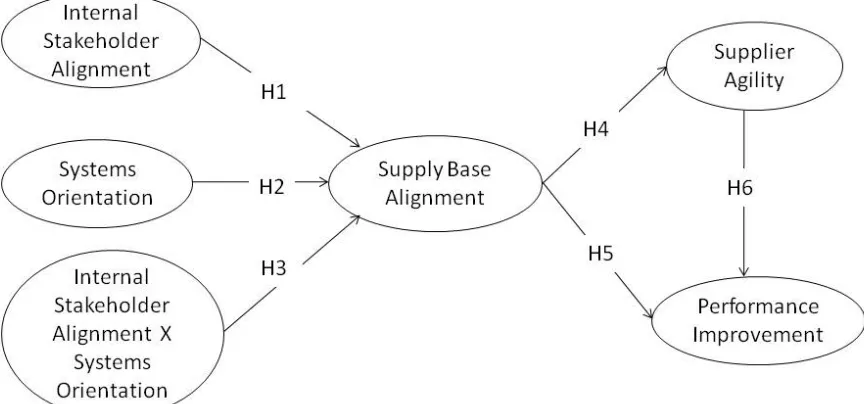
Our theoretical model is shown in Figure 1 and is introduced as follows. Alignment capability is driven by a routine initiated when (1) supply managers engage in knowledge acquisition to assess the needs of organizational stakeholders. Supply managers then apply this information (2) through strong process routines, (Hult et al., 2004; Peng et al., 2013), specifically using a well defined category strategy development process (Handfield, 2006). Category teams are able to (3) drive clear communication of these needs to suppliers through formal mechanisms (Azadegan, 2011), thereby driving supplier activity (4) that is consistent with stakeholder needs and long-term goals (Carr and Pearson, 2002). This dynamic capability is then posited to result in improved performance outcomes (Eisenhardt & Martin, 2000; Peng et al., 2008).
--- Insert Figure 1 Here ---
7
requirements for business that ensures the right goals are being pursued (Crook & Esper, 2014; Peng et al., 2013). We adopt the view that both components are needed to establish supply management alignment. Establishing a strong relationship with business unit stakeholders provides procurement executives the opportunity to establish supply management goals that are not only consistent with organizational goals, but also contribute directly to their success (Chen et al., 2004; Handfield, 2013). Secondly, supply managers at the category strategy level are able to communicate information between suppliers and stakeholders, thereby ensuring specific category strategies are aligned with stakeholder needs (Cousins et al., 2009; Lawson et al., 2009).
8
H1: Internal stakeholder alignment is positively related to external supply base alignment.
Systems Orientation and Supplier Alignment
Effective supply alignment necessitates a set of capabilities that may be unique to only a subset of organizations that have evolved procurement functions (Handfield, 2006, 2013). Organizations need to establish strategic resources in the form of capabilities that enable the engagement of internal stakeholders and creation of value (Wernerfelt, 1984). Learning is a complex concept encompassing both a process and a structure (Slater & Narver, 1998). The implication is that to be able to create strategic alignment, buying organizations must create mechanisms to guarantee that both internal stakeholders are able to learn the value of the new category management approach and behave accordingly (Hult, 2000). This is referred to in knowledge management research as a systems orientation, which requires prioritization of work, a deep understanding of stakeholder criteria, an ability to translate these needs into technical or performance requirements for suppliers, and a defined process clarifying to managers how these elements must be deployed (Hult et al., 2003; Monczka et al., 2014; Cousins et al., 2009).
The systems orientation concept was introduced by Hult (1998) and builds on the work of (Senge, 1990), and in our application measures alignment of procurement activities with the needs of individual business functions. Hult (2003, p. 544) defines systems orientation as “…the degree to which the corporate buying center and the SBU field manager in the focal sourcing unit stress the broad picture of activities in the strategic sourcing process, and is thus a reason certain activities exist.” Systems orientation is deemed an integral part of the organizational learning process because it helps to predict events, adjust processes, and facilitate the free flow of information from the environment.
9
inter and intra-organizational processes, joint new product development, and cost reduction. Information exchange can apply both formal and informal socialization mechanisms (Cousins & Menguc, 2006) and is vital to the relationship process. It has been suggested that procurement should have deep knowledge of the business function, and in some cases may have prior experience in that same function but in a business or marketing role. For instance, one executive who participated in our study noted, “…in my experience the best advertising campaign category managers formally worked in marketing, and the best IT category managers used to work in IT.”
The need for a structure and a process for internal alignment demands a different type of capability that concentrates on soft skills and a role as a trusted advisor to internal stakeholders. (Esper & Crook, 2014). A focus on internal stakeholder accountability defines procurement’s role as a ‘trusted advisor,’ in so much as the procurement executive understands the elements of value critical to the business and the capability of the external supply market to deliver them. Procurement’s true accountability is to build a strategy that resolves the need with an often broad and difficult set of market conditions.
10
Lado, Boyd, & Hanlon, 1997). For example, if manufacturing is underscoring delivery and quality, yet purchasing continues to pursue cost savings to the exclusion of these requirements when negotiating with suppliers, suppliers will interpret this behavior as meaning that price is most important, while delivery can suffer—a potentially disastrous outcome. While having an effective internal communication process is certainly one piece of the puzzle, the second piece (structure) is articulated in the form of the buying organization’s capability to transfer knowledge to suppliers (Hult, 2003). This is most often referred to as a ‘system orientation,’ defined as the degree to which the members of the focal supply management unit stress the interconnectedness and mutual dependence of the activities in the supply management process (Hult et al., 2003). Knowledge acquisition activities shape information distribution to suppliers when team members clearly understand their role and objectives in the process (Hult et al., 2004).
H2: Purchasing process structure (systems orientation) is positively related to supply base alignment.
Complementary Effects on Supplier Alignment
11
facilitate the flow of tacit knowledge not normally conveyed through conventional market mechanisms.
Consistent with the knowledge management view, our theoretical model proposes that supply management involves both a team orientation and a systems alignment (process structure). Learning occurs through the generation and dissemination of information in the form of stakeholder requirements, which are effectively translated via a strong routinized process capability (Peng et al., 2008). Both elements generate congruency outcomes. The combination of elements is often present in the form of category team leaders who engage stakeholders in a frank discourse on stakeholder needs, scans the external market, establishes a strategy for approaching the market, and builds relational contracts with suppliers (Handfield, 2006; Monczka et al., 2014). This approach is also consistent with the relational view of the firm, whereby investments made by buyers towards the development of key suppliers produce tangible benefits, such as cost reduction, improved quality, agility and joint product development (Dyer & Singh, 1998; Madhok & Tallman, 1998). As the category team leader builds a stronger relationship with the supplier, the relationship leads to increased information sharing, technical assistance, training, and aligned improvement efforts (Krause et al., 2007). In a sense, procurement takes on more of a role as both an internal consultant to the organization, and an external coach to the supplier (Handfield, 2013). Supply management alignment ensures that supply managers build a deep understanding of internal stakeholder requirements for success before establishing required performance criteria for suppliers (Handfield, Krause, Scannell, & Monczka, 2000; Krause et al., 2007).
12
purchasing does not have ready access to the decision forums where critical supply chain requirements are made, such as product development and strategic planning meetings. Procurement also has little ability to influence product design decisions in such cases (Handfield et al., 1999). Similarly, firms may have strong internal ties to the business, but lack the systems and capabilities to codify these needs into a set of relationships that are meaningful to suppliers. Sourcing and category team leaders who possess both a team and systems orientation have a much higher likelihood of successfully learning, interpreting, and communicating business needs to the supply base. This combination of internal alignment and purchasing process structure is proposed to have an interaction effect with external alignment:
H3: The interaction of internal stakeholder alignment and purchasing process structure has a positive effect on supply base alignment.
Aligned Suppliers are More Agile
By and large, the major outcome of ‘strategic purchasing’ has been focused on cost savings performance (Chen et al., 2004). Several other researchers have documented how improved collaboration between buyers and sellers can lead to the development of new technologies or products (Petersen, Handfield, & Ragatz, 2005), shared process and technical knowledge that produces tangible improvements (Dyer and Nobeoka (2000), improved supplier quality and delivery (Lawson et al., 2009), and can foster long-term and sustainable impacts on partner performance (Cousins et al., 2006a). In the words of one study participant, “…the majority of benefits accrue after the ink on the contract has dried, not through contracted savings, but through shared continuous improvement.”
13
America, Europe, Brazil, China, Russia, and the Middle East, the number one top logistics objective was ‘meeting customer expectations,’ followed by ‘on-time delivery.’ A majority of managers believe that customers can change delivery orders based on 10 days or less, and over 50% indicated that this window could be one day or less (Handfield et al., 2013). To achieve this ability to rapidly respond to changes in delivery and schedule volume, and to accept late mix changes, organizations have taken steps to invest in visibility systems, work with suppliers to improve communication, and have designed products with more modular product structures that enable quicker configuration to customer orders. Conversely, Chinese managers who were interviewed as part of our study emphasized how agile decision-making was especially problematic in their organizations, as procurement was often highly centralized, with poor alignment between stakeholders, procurement, and suppliers (Handfield et al., 2013). This cultural attribute is difficult to overcome given China’s roots in centralized planning. Results suggest that in a complex global supply chain network, network agility is even more important than low cost and requires a close working relationship, established performance priorities, and open lines of communication between buying companies and their suppliers. We posit a direct relationship between increased supplier alignment and network responsiveness (Flynn et al., 2010; Schoenherr & Swing, 2012).
H4: Supply base alignment is positively related to supplier agility.
Agility and Alignment Improves Supplier Performance
14
clear in depicting supply chain coordination as involving a meaningful level of knowledge transfer and learning within the context of buyer-seller interactions. A systems orientation within supply management ensures that input derived from stakeholders is properly coded and communicated to suppliers, enabling improved responsiveness to these requirements. In some cases, they are also able to learn to predict buyer requirements before they are communicated. Bundles of skills and accumulated knowledge enable both firms to coordinate activities more effectively, creating both marketing-related and technology-related capabilities (Day, 1994). This in turn leads to benefits that go beyond simple cost savings, but translate instead into formal performance benefits including improved product outcomes, process outcomes, and increased innovation (Terpend et al., 2008).
H5: Supply base alignment has a direct and positive effect on buyer performance improvement.
Secondly, we propose that heightened responsiveness in the supply base fosters knowledge and learning over time (Lawson et al., 2009). With this improved knowledge of customer requirements, suppliers learn to provide suggestions for improvement and approach the buyer with ideas for product, process, and product quality improvements (Dyer & Noboeka, 2000; Krause et al., 2000, 2007). Learning also takes place on the part of buyers who are open to supplier ideas and establish supplier suggestion programs through formal and informal channels of communication (Cousins et al., 2006a). Hence, our final hypothesis (H6) posits that:
H6: Supplier agility has a positive effect on the level of performance improvement.
In the following section, we describe the research methods employed to test these hypotheses. RESEARCH METHODS
15
The hypotheses were tested through a survey that collected information about a firm’s strategic supply practices. A sample of 800 United Kingdom manufacturing firms was surveyed, which included firms from a database provided by the Chartered Institute of Purchasing & Supply (CIPS). Each respondent in the sample was selected based on job function (purchasing manager or equivalent), plant size (at least 100 employees), and industry sector by SIC code. We received 172 responses, of which 21 were deemed unusable due to missing data. The effective response rate was thus 18.8% (151/800). This response rate compares favorably with other similar studies in the area (Carr & Pearson, 2002; Ragatz, Handfield, & Petersen, 2002; Rosenzweig, Roth, & Dean, 2003).
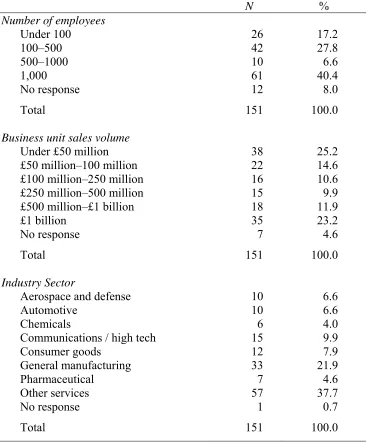
The characteristics of the sample organizations are shown in Appendix A, including the number of employees, business unit sales and industry sector. The response by position was managing director (3%), vice president/director (13%), purchasing manager (52%), senior buyer (8%), and junior manager (24%). No significant mean differences were detected between any pair of these groups. The average length of tenure with the company was 10.16 years, providing support that our informants were also knowledgeable about the issues under investigation. An important characteristic of systems and team orientation culture is that managers throughout the enterprise understand and buy in to the concept (Hult et al., 2003). As such, we sought a broad sample of respondent levels.
--- Insert Table 1 Here ---
Questionnaire Administration
16
survey to managers two weeks after the initial mailing and by offering respondents a composite summary of results (Forza, 2002). The survey was also pretested in two phases. The draft questionnaire was first sent to four academics, experts in the area, and four practitioners who were asked to comment on the content, clarity, and scaling of the instruments. A small number of minor changes were made as a result of this feedback.
In completing our research, we also conducted eight 30-minute phone interviews with supply management executives from a variety of different industries (oil and gas, electronics, medical devices, transportation and logistics, supply chain consulting, and others). These interviews explored many of the relationships posited in the survey and elicited several important insights that were woven into the analysis and discussion later in the paper.
Non-Response Bias
Tests for non-response bias were carried out by comparing early respondents (responses received within the first two weeks) and later respondents (responses received within the third week or later) (Armstrong & Overton, 1977). A t-test of difference was conducted on firm size (employees and sales), and mean responses to each variable. No statistically significant differences were identified at p < .05.
Operationalization of Variables
The items used to measure the theoretical constructs were derived from an extensive review of the extant literature. Each item was measured using a seven-point Likert scale, with the use of practices anchored at ‘‘not at all’’ (=1) and ‘‘a very great extent” (=7). All items used in the questionnaire are reported in the Appendix.
17
strategic goals, purchasing performance is measured in terms of its contribution to the firm’s success, and purchasing is included in the firm’s strategic planning process. These measures align the team orientation construct developed by Hult (1998), which evaluates cross-functional team work, commonality of purpose in purchasing, agreement on organization vision, and sharing of vision.
Systems Orientation This construct was measured using a four-item scale developed by Hult (1998). Respondents were asked to assess their understanding of how their activities fit within the purchasing process value chain, and how well defined these activities are.
Supply Base Alignment This construct was adapted from Krause, Scannell, and Calantone (2000). Respondents were asked the extent to which the organization measured the following: supplier performance through formal evaluation, using established guidelines and procedures; made use of a supplier certification program to verify supplier quality, thus making incoming inspection unnecessary; site visits by your firm to the supplier’s premises to help it improve its performance; invited the supplier’s personnel to your site to increase their awareness of how their product is used; and training/education of the supplier’s personnel.
Supplier Agility This construct was measured using a four-item scale developed by Lawson, Cousins, Petersen, and Handfield (2009) gauging the responsiveness of a firm’s suppliers, including their ability to undertake customization, responsiveness to schedule and volume changes, and degree of modularization leading to improved flexibility.
Performance Improvement This construct was evaluated using a three-item scale, adapted from Kotabe, Martin, and Domoto (2003), assessing the degree to which the relationship had, over the past two to three years, resulted in improved product design, product quality, and reduced lead times for the buyer firm.
18
Confirmatory factor analysis (CFA) and structural equation modeling (SEM) were adopted to test our proposed theoretical framework. AMOS 7.0 was employed for this purpose (Arbuckle, 2006). We assessed model fit using four indices: the chi-square test, the comparative fit index (CFI), the Tucker-Lewis Index (TLI), and the root-mean-square error of approximation index (RMSEA). Discussion of these indices may be found in Gerbing and Anderson (1992), Hu and Bentler (1999), and Marsh, Balla, and Hau (1996). Satisfactory model fits are indicated by non-significant χ2 tests, RMSEA values less than or equal to .08, and TLI and CFI values greater than or equal to .90.
The items were first validated via CFA, which provides a more stringent test of construct validity and unidimensionality using latent and manifest variables. Each construct was made scale-variant by fixing one of the loadings in each construct to a value of 1.0 (Jöreskog & Sörbom, 1993). Each indicator within the measurement model was then checked for low factor loadings (<.40), high residuals (i.e., normalized residuals > 2.58), and modification indices (>3.84). Appendix A provides the loadings and error terms of the manifest variables onto each latent variable.
19
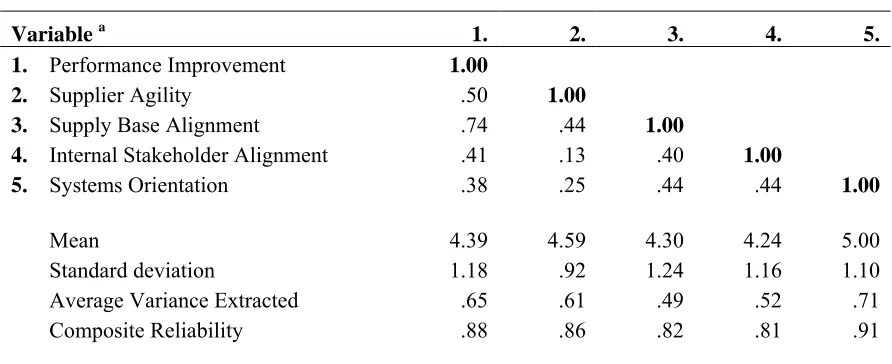
cutoff. Since all other AVE and CR results exceed the minimum levels, we consider the overall validity of the model to be acceptable. Composite reliability values were also calculated to provide a further assessment of internal consistency. A minimum value of 0.70 is recommended, as it indicates that around 0.50 of the item’s variance (the squared loading) can be attributed to the construct of interest (Fornell & Larcker, 1981). The lowest composite reliability was .81 for strategic purchasing, ranging to .91 for systems orientation.
All tests of discriminant validity were similarly supportive. That is, no confidence intervals of the correlations for the constructs ( values) included 1.0 (p < .05) (Anderson & Gerbing, 1988), and the square of the intercorrelations between two constructs, 2, was less than the AVE estimates of the two constructs. This was true for all pairs of constructs (Fornell & Larcker, 1981). The inter-item correlations, composite reliabilities (CR), and the values of AVE for the constructs operationalized in this study are shown in Table 2. We also carried out a test of convergent validity by correlating the buyer performance improvement construct with a self-reported objective scale of firm profit margins. The financial performance construct was correlated positively and significantly with profit margin (r = .44, p ≤ 0.01).
--- Insert Table 2 Here ---
Finally, the overall fit of the CFA measurement model to the data was satisfactory: [χ2(179) = 286.05, p = .00; TLI = .93; CFI = .94; and RMSEA = .063].
20
orientation were computed as product terms. The lambdas that represent the reflection of each of these interaction terms on its latent construct, and their associated error terms were calculated using the approach described by Ping (1995).
--- Insert Figure 2 Here ---
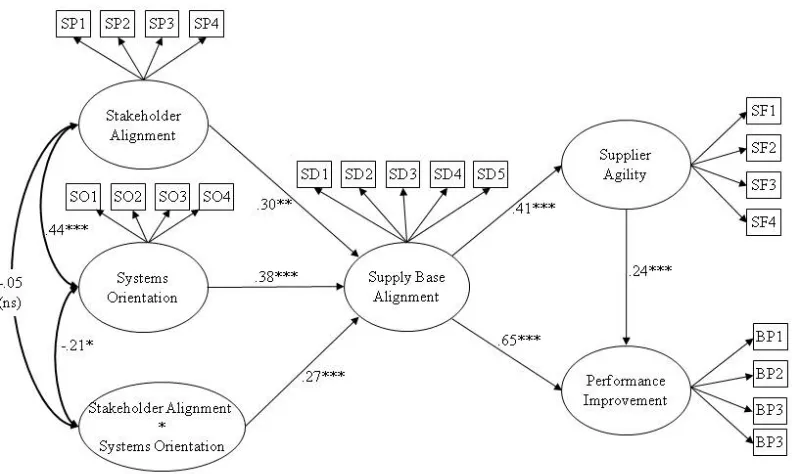
Figure 2 presents the results of the six hypothesized relationships and shows that the constructs are related in the theoretically predicted manner. Hypothesis 1 and 2, respectively, were supported, with internal stakeholder alignment ( = 0.30, p<.01) and purchasing process structure ( = 0.38, p<.001) significantly associated with supply base alignment. We also found a positive moderating effect between the interaction effect (Internal Stakeholder Alignment X Purchasing Process Structure) and supply base alignment ( = 0.27, p<.001). In turn, supply base alignment was significantly related to network agility ( = 0.41, p<0.001) and performance improvement ( = 0.65, p<.001), supporting Hypotheses 4 and 5, respectively. Finally, network agility was positively associated with performance improvement ( = 0.24, p<0.001), providing support for H6.
In the next section, we discuss the implications of these results. DISCUSSION
Our research set out to answer the question: “What are the characteristics of an effective supply management alignment process that results in improved outcomes?”. We next discuss the characteristics that are critical to alignment identified by our research project and go on to draw implications for theory and practice. As noted by one of the executives we interviewed:
21
impact on the top line and the bottom line of the company. We need to back away from the standard portfolio matrix approach, and recognize the importance and magnitude of the risk that needs to be documented in the supply chain. Procurement is the only platform in the company that has an end-to-end horizontal view of the supply chain. Marketing and IT see this to some extent, but not like procurement. Procurement must take this opportunity to exercise leadership and truly position procurement as a strategic contributor at the executive board level on organizational decisions. This means bringing the right level of ambition to the table.”
This statement provides a good jumping off point to discuss the implications of the results identified in this study and their contribution to our thinking. All of the hypothesized results were positive and significant, providing support for our supposition that procurement transformation requires both internal and external relationship management capabilities (Handfield, 2013). The research suggests a number of different implications that provide guidelines for on-going research in supply management.
First, the identification and development of ‘supply management alignment’ as a dynamic capability augments prior studies that found inbound supplier flexibility could complement outbound logistics flexibility (Malhotra & Mackelprang, 2012). Delivery performance is certainly one form of value, but our research extends this concept and identifies the specific forms of procurement behaviors and capabilities required to achieve this alignment. Other studies propose that synergies exist when improved integration occurs across customers and suppliers, but specific guidelines as it relates to procurement are not well understood (Schoenherr & Swink, 2013). Our results point to the importance of common goals, aligned metrics, and defined processes that occur in parallel between purchasing and stakeholders, purchasing and suppliers, and the combined synergistic effect of these performance measurement systems on network agility performance.
22
is through an approach identified as category management (Monczka et al., 2014). Traditional category management approaches have been largely focused on internal spending patterns and have targeted high spend areas for cost savings based on driving common specifications, part families, or services. However, category management may not be the only way to think about how to organize procurement effort. The strength of supplier relationships clearly demonstrates how both elements of internal and process structure are important.
23
category, but are focused on creating greater alignment between the internal and external environments they face.
LIMITATIONS AND CONCLUSIONS
No research is without its limitations, and there are some cautions in interpreting the results of our study. First, this study was based on a sample of companies in the CIPS database. Although a wide range of sectors was evident, the results may not be generalizable to all companies. Replication across other industries, including services, as well as international contexts would also increase our understanding of the pervasiveness of strategic purchasing. Informant bias can be an issue in self-reporting surveys (Kumar, Stern, & Anderson, 1993). We attempted to minimize the presence of any such bias through the selection of respondents with comparable roles, focusing on organizational and sub unit performance and avoiding questions of personal performance, as well as by assuring total anonymity and confidentiality such that individual responses could not be identified. In addition, the cross-sectional nature of our data means that we are not able to test causal inferences regarding the relationship between strategic purchasing, supplier development, and the outcomes on supply base agility and buyer performance improvement. Longitudinal data are required in order to assert causation. Future research based on case studies could provide rich data and would be particularly useful in substantiating the interaction effect of what we have termed ‘supply management alignment’ in the supplier development process.
24
synergistic effect for both the buyer and the supplier. It would be interesting to investigate this as a motivation for buyers and suppliers to become involved in supplier development activities.
Prior research on purchasing and supply management has largely assumed that sourcing activities occur in a vacuum and are vague in establishing the mechanisms for this alignment. There is also a need to explore the relative value of internal and external management, as managers often perceive that their companies are more accomplished in external integration efforts than they are in internal efforts. Our approach draws on the systems orientation developed by Hult et al. (2003), which identifies the importance of a systematic and team-based approach to carrying out congruency requirements and the importance of establishing both a deep knowledge of stakeholder requirements as well as a direct channel for communication of these needs to suppliers. Our research emphasizes the importance of employing congruent and aligned performance metrics between internal and external parties. Most importantly, the combination of these activities can create a distinctive competence and a synergistic effect. The synergistic benefits gained from these management processes are difficult to imitate and substitute, and they clearly add value; therefore, they conform to the tests of a strategic capability (Gulati et al., 2000).
25
alignment”. Prior to the 1980s, marketing was viewed as a mere sales order taking activity and has grown to be recognized as a critical function that links customer needs with internal business planning (Song et al., 2005; Slater & Narver, 1998). A similar strategic transformation is underway in procurement, as the same set of alignment capabilities required for effective marketing is also necessary for stakeholder-supplier communication. Both marketing and procurement talent pools can learn skills from one another as they develop applications in each of their respective areas. The merging of buy-side and sell-side capabilities was adopted by the International Association of Commercial and Contract Management (IACCM) and provides a natural basis for integration. Indeed several of the executives we spoke with explained the approach they used to create the right type of ‘blended skills’ needed to drive better internal alignment of procurement with the functional roles in the organization.
26 REFERENCES
Arbuckle, J. L. (2006). AMOS User’s Guide 7.0. Chicago, IL.: Amos Development Corporation. Armstrong, S. J., & Overton, T. S. (1977). Estimating non-response bias in mail surveys. Journal
of Marketing Research, 14 (3), 396-402.
Azadegan, A. (2011). Benefiting from supplier operational innovativeness: The influence of supplier evaluations and absorptive capacity. Journal of Supply Chain Management, 47 (2), 49-64.
Barney, J. B. (2012). Purchasing, supply chain management and sustained competitive advantage: The relevance of resource-based theory. Journal of Supply Chain Management, 48 (2), 3-6.
Bollen, K. A. (1989). Structural equations with latent variables. New York, NY: John Wiley. Carr, A. S., & Pearson, J. N. (2002). The impact of purchasing and supplier involvement on
strategic purchasing and its impact on firm's performance. International Journal of Operations & Production Management, 22 (9), 1032-1053.
Chen, I., Paulraj, A., & Lado, A. (2004). Strategic Purchasing, supply managmeent, and firm performance. Journal of Operations Management, 22, 505-523.
Choi, T., Wu, Z., Ellram, L., & Koka, B. (2002). Supplier–supplier relationships and their implications for buyer–supplier relationships. IEEE Transaction of Engineering Management, 49 (2), 119–130.
Cousins, P. D., Handfield, R., Lawson, B., & Peterson, K. (2006a). Creating supply chain relational capital: The impact of formal and informal socialization processes. Journal of Operations Management, 24 (6), 851-864.
Cousins, P., D, Lawson, B., & Squire, B. (2006b). An empirical taxonomy of purchasing
functions. International Journal of Operations & Production Management, 26 (7), 775-794.
Cousins, P. D., & Menguc, B. (2006c). The implications of socialization and integration in supply chain management. Journal of Operations Management, 24 (5), 604-620.
Crook, T., & Esper, T. (2014). Do resources aid in supply chain functioning and management? Yes, But more (and more precise) research is needed. Journal of Supply Chain
Management, 50 (3), 94-98.
Day, G. S. (1994). The capabilities of market-driven organizations. Journal of Marketing, 58 (4), 37-53.
Dyer, J. H., & Nobeoka, K. (2000). Creating and managing a high-performance knowledge-sharing network: The Toyota case. Strategic Management Journal, 21 (3), 345. Dyer, J. H., & Singh, H. (1998). The relational view: Cooperative strategy and sources of
interorganizational competitive advantage. Academy of Management Review, 23 (4), 660-679.
Eisenhardt, K. M., & Martin, J. A. (2000). Dynamic capabilities: What are they? Strategic Management Journal, 21 (10/11), 1105-1121.
Ellis, S. C., Shockley, J., & Henrey, R. M. (2011). Making sense of supply disruption risk research: A conceptual framework grounded in enactment theory. Journal of Supply Chain Management, 47 (2), 65-96.
27
Fearon, H. (1968). History of purchasing. Journal of Purchasing, February, 44-50.
Flynn, B., Huo, B. & Zhao, X. (2010). The impact of supply chain integration on performance: A contingency and configuration approach. Journal of Operations Management, 28 (1), 58-71.
Forza, C. (2002). Survey research in operations management: A process-based perspective. International Journal of Operations & Production Management, 22 (2), 152-194. Gerbing, D. W., & Anderson, J. C. (1992). Monte Carlo evaluations of goodness of fit indices for
structural equation models. Sociological Methods and Research, 21 (2), 132-160.
Grant, R. (1996). Prospering in dynamically-competitive environments: Organizational capability as knowledge integration. Organization Science, 7, 375-387.
Hair, J. F., Anderson, R. E., Tatham, R. L., & Black, W. C. (1998). Multivariate data analysis (5th ed.). New Jersey, USA: Prentice-Hall.
Handfield, R. (2006). Supply Market Intelligence. Florida, USA: Auerbach Publications. Handfield, R. (2013). Future buy: The future of procurement. Texas, USA: KPMG.
Handfield, R., Straube, F., Pfohl, H., &Wieland, A. (2013) Trends and Strategies in Logistics and Supply Chain Management. Berlin: BVL International.
Handfield, R., Krause, D., Scannell, T., & Monczka, R. (2000). Avoid the pitfalls in supplier development. Sloan Management Review, 41 (2), 37-42.
Handfield, R., Ragatz, G., Monczka, R., & Peterson, K. (1999). Involving suppliers in new product development. California Management Review, 42 (1), 59-82.
Holweg, M. & Pil, F.K., 2008. Theoretical perspectives on the coordination of supply chains. Journal of Operations Management 26 (3), 389–406.
Hu, L., & Bentler, P. (1999). Cutoff criteria for fit indexes in covariance structure analysis: Conventional criteria versus new alternatives. Structural Equation Modeling Journal, 66 (1), 1-55.
Huber, G. P. (1991). Organizational learning: The contributing processes and literatures. Organization Science, 2 (1), 88–115.
Hult, G. T. M. (1998). Managing the international strategic sourcing process as a market-driven organizational learning system. Decision Sciences, 29 (1), 193-216.
Hult, G. T. M. (2000). Global industrial marketing: A look to the future, Industrial Marketing Management, 29 (10), 479-481.
Hult, G. T. M. (2003). An integration of thoughts on knowledge management. Decision Sciences, 34 (2), 189-195.
Hult, G. T. M., Ketchen, D., & Nichols, E. (2003). Organizational learning as a strategic resource in supply management. Journal of Operations Management, 21 (2), 541-556.
Hult, G. T. M., Ketchen, D. J., & Slater, S. F. (2004). Information processing, knowledge development, and strategic supply chain performance. Acadamy of Management Journal, 47 (2), 241-253.
Jöreskog, K. G., & Sörbom, D. (1993). LISREL 8: Analysis of Linear Structural Relationships by Maximum Likelihood, Instrument Variables and Least Squares Methods (8th ed.). Morresville, IN: Scientific Software.
Kale, P., Singh, H., & Perlmutter, H. (2000). Learning and protection of proprietary assets in strategic alliances: Building relational capital. Strategic Management Journal, 21 (3), 217-237.
28
Kotabe, M., Martin, X., & Domoto, H. (2003). Gaining from vertical partnerships: Knowledge transfer, relationship duration, and supplier performance improvement in the U.S. and Japanese automotive industries. Strategic Management Journal, 24 (4), 293-316. Krause, D. R., Handfield, R. B., & Tyler, B. B. (2007). The relationships between supplier
development, commitment, social capital accumulation and performance improvement. Journal of Operations Management, 25 (2), 528-545.
Krause, D. R., Scannell, T. V., & Calantone, R. J. (2000). A structural analysis of the effectiveness of buying firms' strategies to improve supplier performance. Decision Sciences, 31 (1), 33-55.
Kumar, N., Stern, L. W., & Anderson, J. C. (1993). Conducting interorganizational research using key informants. Academy of Management Journal, 36 (6), 1633-1651.
Lado, A. A., Boyd, N. G., & Hanlon, S. C. (1997). Competition, cooperation, and the search for economic rents: A syncretic model. Academy of Management Review, 22 (1), 110-141. Lawson, B., Cousins, P. D., Handfield, R. B., & Petersen, K. J. (2009). Strategic purchasing,
supply management practices and buyer performance improvement: An empirical study of UK manufacturing organisations. International Journal of Production Research, 47 (10), 2649-2667.
Lorenzoni, G., & Lipparini, A. (1999). The leveraging of interfirm relationships as a distinctive organizational capability: A. Strategic Management Journal, 20 (4), 317.
Madhok, A., & Tallman, S. B. (1998). Resources, transactions and rents: Managing value through interfirm collaborative relationships. Organization Science, 9 (3), 326-339.
Malhotra, M., & Mackalprang, A. (2012). Are internal manufacturing and external supply chain flexibilities complementary capabilities? Journal of Operations Management, 30 (3), 180-200.
Malhotra, M., & Sharma, S. (2002). Spanning the continuum between marketing and operations. Journal of Operations Management, 20 (3), 209-219.
Marsh, H. W., Balla, J. R., & Hau, K.-T. (1996). An evaluation of incremental fit indices: A clarification of mathematical and empirical properties. In G. Marcoulides & R.
Schumacker (Eds.), Advanced Structural Equation Modelling: Issues and Techniques, (pp. 315-345). Mahwah, NJ: Lawrence Erlbaum Associates.
Monczka, R. M., Blascovich, J. D., Markham, W. J., Parker, L. M., & Slaight, T. H. (2010). Value focused supply: Linking supply to competitive business strategies: CAPS Research. Monczka, R. M., Handfield, R., Giunipero, L., & Patterson, J. (2014). Purchasing and supply
chain management (6th ed.). Cincinnati, OH: Southwestern Publishing, College Division. Narasimhan, R., & Das, A. 2001. An empirical investigation of purchasing integration and its
impact on manufacturing performance. Journal of Operations Management, 19 (5), 593-610.
O’Leary-Kelly, S. W., & Flores, B. E. (2002). The integration of manufacturing and
marketing/sales decisions: Impact on organizational performance. Journal of Operations Management, 20 (3), 221.
Oliva, R., & Watson, N. (2011). Cross-functional planning in supply chain planning: A case study of sales and operations planning. Journal of Operations Management, 29 (5), 434-448.
Pagell, M. (2004). Understanding the factors that enable and inhibit the integration of operations, purchasing, and logistics. Journal of Operations Management, 22 (5), 459-487.
29
Peng, D., Verghase, A., Shah, R., & Schroeder, R. (2013). The relationship between external integration and plant improvement and innovation capabilities: The moderation effect of product clockspeed. Journal of Supply Chain Management, 49 (3), 3-24.
Petersen, K. J., Handfield, R. B., & Ragatz, G. L. (2005). Supplier integration into new product development: Coordinating product, process, and supply chain design. Journal of Operations Management, 23 (3/4), 371-388.
Ping, R. A., Jr. (1995). A parsimonious estimating technique for interaction and quadratic latent variables. Journal of Marketing Research (JMR), 32 (3), 336-347.
Priem, R. L., & Swink, M. (2012). A demand-side perspective on supply chain management. Journal of Supply Chain Management, 48 (2), 7-13.
Ragatz, G. L., Handfield, R. B., & Petersen, K. J. (2002). Benefits associated with supplier integration into new product development under conditions of technology uncertainty. Journal of Business Research, 55 (5), 389-400.
Rosenzweig, E. D., Roth, A. V., & Dean, J. W., Jr. (2003). The influence of an integration strategy on competitive capabilities and business performance: An exploratory study of consumer products manufacturers. Journal of Operations Management, 21 (4), 437-456. Senge, P. M. (1990). The leader's new work: Building learning organizations. Sloan
Management Review, 32 (1), 7-23.
Slater, S. F., & Narver, J. C. (1998). Customer-led and market-oriented: Let's not confuse the two. Strategic Management Journal, 19 (10), 1001.
Swink, M., Narasimhan, R., & Wang, C., (2007). Managing beyond the factory walls: Effects of four types of strategic integration on manufacturing plant performance. Journal of Operations Management, 25 (1), 148-164.
Teece, D. J., Pisano, G., & Shuen, A. (1997). Dynamic capabilities and strategic management. Strategic Management Journal, 18 (7), 509-533.
Terpend, R., Tyler, B. B., Krause, D. R., & Handfield, R. B. (2008). Buyer-supplier relationships: Derived value over two decades. Journal of Supply Chain Management, 44 (2), 28-55. Wagner, S., Bode, C., & Koznol, P. (2009). Supplier default dependencies: Empirical evidence
from the automotive industry. European Journal of Operational Research, 199 (1), 150-161.
Watson, N., & Zheng, Y.-S. (2005). Decentralized serial supply chains subject to order delays and information distortion: Exploiting real time sales data. Manufacturing & Service Operations Management, 7, 152-168.
Wieland, A., & Handfield, R. (2013). The socially responsible supply chain: An imperative for global corporations. Supply Chain Management Review, September, 25-28.
Wong, C. Y., Boon-itt, S., & Wong, C. W. Y. (2011). The contingency effects of environmental uncertainty on the relationship between supply chain integration and operational
performance. Journal of Operations Management, 29 (6), 604-615.
Zimmermann, F., & Foerstl, K. (2014). A meta-analysis of the "purchasing and supply
31 FIGURE 2 SEM Results
32 TABLE 1 Profile of Respondents
N %
Number of employees
Under 100 26 17.2
100–500 42 27.8
500–1000 10 6.6
1,000 61 40.4
No response 12 8.0
Total 151 100.0
Business unit sales volume
Under £50 million 38 25.2
£50 million–100 million 22 14.6
£100 million–250 million 16 10.6
£250 million–500 million 15 9.9
£500 million–£1 billion 18 11.9
£1 billion 35 23.2
No response 7 4.6
Total 151 100.0
Industry Sector
Aerospace and defense 10 6.6
Automotive 10 6.6
Chemicals 6 4.0
Communications / high tech 15 9.9
Consumer goods 12 7.9
General manufacturing 33 21.9
Pharmaceutical 7 4.6
Other services 57 37.7
No response 1 0.7
33 TABLE 2
Correlation Matrix and Descriptive Statistics
Variable a 1. 2. 3. 4. 5.
1. Performance Improvement 1.00
2. Supplier Agility .50 1.00
3. Supply Base Alignment .74 .44 1.00
4. Internal Stakeholder Alignment .41 .13 .40 1.00
5. Systems Orientation .38 .25 .44 .44 1.00
Mean 4.39 4.59 4.30 4.24 5.00
Standard deviation 1.18 .92 1.24 1.16 1.10 Average Variance Extracted .65 .61 .49 .52 .71 Composite Reliability .88 .86 .82 .81 .91
34 APPENDIX A Constructs and Items
Each item was measured using a seven-point Likert scale, with the use of practices anchored at ‘‘not at all’’ (=1) and ‘‘a very great extent” (=7).
Internal Stakeholder Alignment
How well do you agree with the following about purchasing within your firm?
SP1: Purchasing professionals’ development focuses on the elements of the competitive strategy (=.74, =.17 , t=7.51)
SP2: The purchasing function has a good knowledge of the firm’s strategic goals (=.77, =.99, t=7.28)
SP3: Purchasing performance is measured in terms of its contribution to the firm’s success (=.68, =/15, t=6.82)
SP4: Purchasing is included in the firm’s strategic planning process (=.67) Systems Orientation
How well do you agree with the following about the purchasing process within your firm? SS1: All activities that take place in the purchasing process are clearly defined (=.73) SS2: We understand how our work fits into the value chain of the purchasing process (=.82,
=.09, t=10.06)
SS3: We have a good sense of the interconnectedness of all parts of the purchasing process (=.93, =.10, t=11.28)
SS4: We understand where all activities fit in the purchasing process (= .87, =.10, t=10.67) Supplier Agility
To what extent do the following describe characteristics of your key suppliers?
SBF1: Responsiveness to our schedule delivery changes without excessive cost penalties (=.93) SBF2: Responsiveness to our schedule volume changes without excessive cost penalties (=.94,
=.06, t=17.08)
SBF3: Ability to accept late ‘mix’ changes in orders (=.66, =.08, t=9.69) SBF4: Modularisation of supplier products (=.52, =.07, t=6.96)
Supply Base Alignment
To what extent does purchasing carry out the following with its key suppliers?
SD1: Assessment of supplier’s performance through formal evaluation, using established guidelines & procedures (=.74)
SD2: Use of a supplier certification program to certify supplier’s quality, thus making incoming inspection unnecessary (=.64, =.14, t=7.38)
SD3: Site visits by your firm to supplier’s premises to help supplier improve its performance (=.78, =.11, t=8.92)
SD4: Inviting supplier’s personnel to your site to increase its awareness of how its product is used (=.69, =.10, t=7.93)
35 Performance Improvement
How well do you agree with the following about the performance from your key suppliers in the last two years?
BPI1: Improved product design performance (=.84, =.13, t=9.56) BPI2: Improved process design (=.86, =.12, t=9.67)