Page 1 of 22
Global e-School and Communities Initiative, GeSCI - http://www.gesci.org
Organizational Capacity
Audit Tool
Prepared by
Esther Mwiyeria Wachira, GeSCI
Copyright notice
This document is provided under a Creative Commons License of Attribution-NonCommercial-ShareAlike. For more information on this license, please visit the Creative Commons website at http://creativecommons.org/licenses/by-nc-sa/3.0/
The latest version of this document is available from:
http://www.gesci.org/resources.html
Please send any comments and suggestions to the authors or GeSCI
(
[email protected]
).
Page 2 of 22
Global e-School and Communities Initiative, GeSCI - http://www.gesci.org
Table of Contents
Background...4
Objectives of the Organizational Capacity Audit tool...5
Target Audience ...5
Introduction...6
Definition of Organizational Capacity...6
CAPACITY AUDIT PROCESS ...9
STEP ONE: Plan for the Capacity Audit ...9
Assess organizational readiness ...9
Determine the objectives for the capacity audit ... 10
Map out the capacity audit process... 10
Determine who should conduct the audit ... 10
Identify who will use the results and the purpose the data will serve for each target audience... 11
STEP TWO: Determine Requirements... 12
STEP THREE: Establish Existing Capacity ... 14
Components of Organizational Capacity ... 14
STEP FOUR: Determine the Gaps/Issues... 19
STEP FIVE: Analyze Gaps and Propose Solutions... 21
Dissemination to the relevant parties ... 22
The capacity audit report... 22
List of Tables
Table 1-Establishing Resource Requirements ...12
Table 2 - Components of Organizational Capacity ...14
Table 3 - Determining Gaps ...19
Table 4 - Analyzing Gaps ...21
List of Figures
Figure 1- Levels of Capacity Development
: Adapted from IDRC, 2005
...8
Page 3 of 22
Global e-School and Communities Initiative, GeSCI - http://www.gesci.org
List of Abbreviations
IDRC - International Development Research Centre UNDP - United Nations Development Programme SIDA - Swedish International Development Agency
Page 4 of 22
Global e-School and Communities Initiative, GeSCI - http://www.gesci.org
Background
As GeSCI continues to engage with Ministries of Education in their bids to deploy ICTs in education, there has been an internal tendency to use the term capacity building and capacity development to mean different things. Before we can think about capacity building or development in relation to our partner organizations we may need to establish why we need to develop the capacity, whose capacity we need to develop, how this capacity will be developed,
what capacity exists within the organization, and how the capacity developed will be used once developed. This would help us identify specific gaps onto which our capacity building efforts should be focused. This formal systematic assessment of an organization’s ability to achieve stated objectives and execute its mandate will be referred to as the ‘capacity audit’ in the document. Whereas a capacity audit then is a necessary step to be carried out before any capacity development activities can commence the two activities are closely related in the sense that the latter should be dictated upon by the former.
Capacity development, which is normally targeted on an organization’s performance, has been defined by UNDP as an ongoing process to increase the abilities of organizations to perform core functions, solve problems and achieve objectives. In its definition it includes the ability of an organization to assess and react to future needs in order to maintain relevance and effectiveness over time. In particular it underscores its definition of capacity development as being a continuous, learning, and changing process (UNDP, 1997)1
. The changing aspect of an organization’s capacity is referred to by IDRC as an organization’s adaptive capacity (IDRC, 2005)2
.
Who then should develop an organization’s capacity? Oxfam notes that no one develops anyone else’s capacity.
“Organizations often develop their capacities in unplanned, spontaneous ways. While external organization’s resources may be used to support capacity development, organizations themselves must take ultimate responsibility for developing their own capacities. Without organizational will to dedicate resources to capacity development and a culture that is open to
1
http://mirror.undp.org/magnet/Docs/cap/Capdeven.pdf
2
Page 5 of 22
Global e-School and Communities Initiative, GeSCI - http://www.gesci.org
learning and change, organizational capacity development efforts will be of limited value” (Eade, 2007: pg 27)3.
Objectives of the Organizational Capacity Audit tool
This tool has been developed with the following objectives in mind:• To create a common understanding internally of what constitutes an organizations’ capacity • To provide structure for GeSCI’s staff in auditing the capacity of the organizations and units
it chooses to work with in order to offer targeted capacity building support
• To provide a tool to be used by GeSCI during the country selection process to audit the
capacities of MoE and subsequently help in developing appropriate engagement strategies.
Target Audience
This tool was developed out of an identified need from within the organization to create a common understanding of capacity building. On the one hand, the tool could be used by GeSCI staff in assessing its internal capacity to not only carry out its day-to-day operations but also in its capacity to offer strategic advice to its partner countries. On the other hand, the tool could be used by GeSCI while assessing the capacity of the Ministries of Education to carry out their day-to-day activities in relation to ICT4E or in executing a defined project in the same context.
Page 6 of 22
Global e-School and Communities Initiative, GeSCI - http://www.gesci.org
Introduction
Definition of Organizational Capacity
An organization’s capacity in simple terms is its potential to perform. Ker (2003)4
defines this more specifically as its ‘ability to successfully apply its skills and resources to accomplish its goals and satisfy its stakeholders’ expectations’. The skills and resources include staffing, infrastructure, technology, financial resources, strategic leadership, process management, networks and linkages with other organizations and groups.
IDRC5
identifies three ways of looking at organizational capacity in its development work which as GeSCI we should look for while carrying out organizational capacity audits:
1. It groups the elements that constitute organizational capacity under the categories of resources and management. Resources constitute the staff, the infrastructure, technology and financial ability whereas management includes strategic leadership, program and process management, networks and linkages. The resources and the management capacities make up the overall organizational capacity.
2. Another way of looking at organizational capacity is to distinguish between the capacities that an organization needs to carry out its day-to-day activities and the capacities needed for an organization to learn and change in response to changing circumstances. These have been referred to as adaptive capacities.
3. Organizational capacities have also been distinguished between individuals, groups and team capacities. Individuals possess capacities in the form of knowledge, skills and attitudes. These are usually made available to the organization but always lost when such individuals leave the organization. When knowledge, skills, and attitudes are shared with others, such capacities become embedded in processes and when these are widely shared in the entire organization then, they become incorporated in the organization’s culture.
4
Ker, A. 2003. Evaluating Capacity Development: Experiences from Canada, Chile, the Dominican Republic, South Africa and South Korea [Online]. Available from IDRC at: http://www.crdi.ca/en/ev-43616-201-1-DO_TOPIC.html [Accessed 6 February 2008]
5
http://www.crdi.ca/en/ev-43616-201-1-DO_TOPIC.html
The capacity of
an
organization
has been defined
as its ability to
successfully
apply its skills
and resources to
accomplish
its
goals and satisfy
its stakeholders’
expectations.
Page 7 of 22
Global e-School and Communities Initiative, GeSCI - http://www.gesci.org
Overall, the capacity of an organization cannot be taken in isolation as it is deeply embedded in the social, economic and political environment in which it operates6. In assessing the capacity of
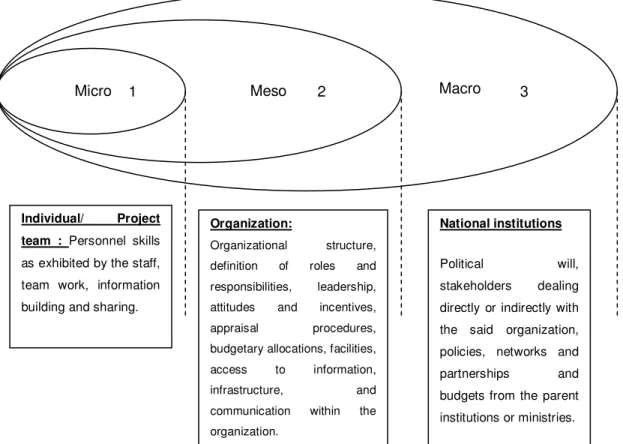
an organization, it is important to understand this external environment. This environment includes the administrative and legal systems, policies and laws, the cultural context and the general political stability of a country. The capacity of an organization has been seen to exist at three different levels: Micro, Meso, and Macro levels. DFID 20067
, Worldbank 20028
, and SIDA 20029, note that capacity development efforts can be targeted at these three levels.
At the micro level the efforts would address personnel skills as exhibited by the staff. It would equally focus on team work, information building and sharing.
At the meso level the focus would be on the organization. Factors to be considered in this include the organizational structure, definition of roles and responsibilities, leadership, attitudes and incentives, appraisal procedures, budgetary allocations for various tasks, facilities, access to information, infrastructure and technology, and communication within the organization.
The macro level focuses on the external factors and the environment within which the organization is situated. This includes the political will, stakeholders dealing directly or indirectly with the said organization, policies, networks and partnerships, and budgets from the parent institutions or ministries.
6
Eade D.,(2007), Capacity-building, An Approach to People Centered Development , Oxfam: UK and Ireland
7http://siteresources.worldbank.org/INTCDRC/Resources/Developing_Capacity_DFID_Report.pdf 8 http://info.worldbank.org/etools/docs/library/114227/CD-DFID-Where%20Do%20We%20Stand%20Final.doc 9 http://sida.se/sida/jsp/sida.jsp?d=118&a=2478&language=en_US The Capacity of an organization has been seen to exist at three different levels: Micro, Meso and Macro
Page 8 of 22
Global e-School and Communities Initiative, GeSCI - http://www.gesci.org
Figure 1- Levels of Capacity Development: Adapted from IDRC, 200510
These three levels are closely intertwined. Capacity in one of the levels cannot guarantee delivery of services without capacity in the other levels. Hence, while carrying out an organizational audit, it will be necessary to assess capacities at the three levels.
10
http://www.crdi.ca/en/ev-43616-201-1-DO_TOPIC.html
Micro Meso Macro
Individual/ Project team : Personnel skills as exhibited by the staff, team work, information building and sharing.
Organization:
Organizational structure,
definition of roles and
responsibilities, leadership,
attitudes and incentives,
appraisal procedures,
budgetary allocations, facilities,
access to information,
infrastructure, and
communication within the
organization.
National institutions
Political will,
stakeholders dealing directly or indirectly with the said organization, policies, networks and
partnerships and
budgets from the parent institutions or ministries.
Page 9 of 22
Global e-School and Communities Initiative, GeSCI - http://www.gesci.org
CAPACITY AUDIT PROCESS
The methodology is in three sections. The activities in Steps 1 and 2 would have to be carried out before the capacity audit, Step 3 during the audit, and Steps 4 and 5 after the audit.
The objective of this five step methodology is to help you determine whether a particular organization has the ability to execute a particular project as well as carry out its day-to-day activities. In this document, the term organization can be used to represent a department, a unit or a Ministry and the term project will be used to describe the task at hand.
STEP ONE: Plan for the Capacity Audit
Before you start with the audit, you need to establish whether you are auditing the capacity of the organization to carry out its day-to-day functions or to execute a defined project. Examples include; you might want to audit the ICT unit to carry out its day-to-day activities in the Ministry of Education or you might want to audit the capacity of the same unit to develop electronic content for schools.
Assess organizational readiness
Lusthaus, Anderson, and Murphy (1995)11 identify parameters that can be used to ascertain the
degree of an organization’s readiness for a capacity audit. These include:
• Cultural readiness – acceptance to provide suggestions for improvement
• Leadership readiness – support from the leadership to carry of the audit exemplified in
resource allocation in terms of time, personnel and goodwill. This will increase a sense of ownership especially during the implementation of change.
• Vision and strategy ownership – The organization should have a desire to achieve stated
objectives and execute its mandate.
11
http://books.google.co.ke/books?id=j5YIN21pN4IC&pg=PR9&lpg=PR9&dq=organizational+performance+%2B+1995+%2
Page 10 of 22
Global e-School and Communities Initiative, GeSCI - http://www.gesci.org
• People readiness – There is a need to identify a champion who will be ready to work with the
capacity audit team throughout the process
Determine the objectives for the capacity audit
Before the commencement of the audit exercise you need to define the objectives and clarify the needs of the participants. This should be done collaboratively with identified personnel in the target organization. The following questions are important; why are we doing this? How will we do it? Who will do it? These will help you determine the scope of the intervention, the depth of the data to be collected, the focus and the cost (DFID, 2006)12.
Map out the capacity audit process
As you embark on the capacity audit process, the following are activities that may be required:
• Define the scope of the capacity audit • Identify the main issues to be addressed
• Identify indicators to help you achieve your objectives
• Identify sources of data to maximize on the time and the available resources
• Identify data collection methods that are best suited to your questions and your objectives
(Questionnaire survey, face-to-face interviews, telephone interview, focus group, document review, observation)
• Develop the instruments for data collection.
Determine who should conduct the audit
After analyzing the objective and the scope of the audit, a team drawn from the target organization and GeSCI staff should be assembled with clear roles and responsibilities. This team should gather as much background information as possible in relation to the target organization. It might be necessary to identify a “champion” from within the partner organization in this team for coordination purposes. He/she might not necessarily attend all the interview sessions during the audit due to the sensitivity of some of the issues, but will be instrumental in coordinating the activities on the ground during the audit period.
12
Page 11 of 22
Global e-School and Communities Initiative, GeSCI - http://www.gesci.org
Identify who will use the results and the purpose the data will serve for
each target audience
The target audience needs to be identified. This audience could comprise of those inside the organization and outside the organization. Those inside the organization may use the data to improve decisions while those outside may use the data to support internal change. There are also stakeholders in the external environment who would be interested in the results of the audit. These may include the parent Ministries and other Ministries and departments within the organization’s sphere of influence or operation.
Page 12 of 22
Global e-School and Communities Initiative, GeSCI - http://www.gesci.org
STEP TWO: Determine Requirements
This step will provide a time of reflection to establish the requirements for the execution of a particular project or the anticipated improved performance of an organization to carry out its mandate on a day-to-day basis. During this stage analyze the project/ task at hand and break it down into its discrete constituent processes and activities.
The following are questions that could guide you through the process.
• What should be the mandate of the organization/department to undertake this project or to carry out its day-to-day tasks?
• How many people will be required to execute the tasks at hand?
• What skill-sets are necessary for this execution?
• What technology resources will be needed?
• What are the budgetary requirements?
• What kind of leadership is required e.g. Project Management
• What are the external factors that must be in place for the project or the tasks at hand to be executed successfully? (These might include partnerships, linkages, computers labs, trained teachers, e-content, electricity etc.)
• What is the proposed output?
• What is the operational cost required?
• Review the tasks to be carried out and find out what is involved. How will the task(s) be executed organizationally? (Think about the roles and responsibilities)
• What other resources (other than financial and technological) will be required?
• Develop the terms of reference for the capacity audit
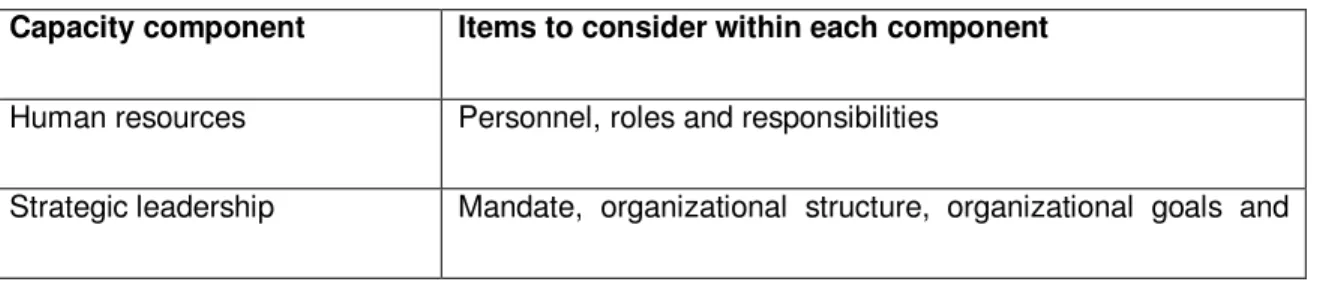
In establishing the required resources the following table can serve as a guide
Table 1-Establishing Resource Requirements
Capacity component Items to consider within each component
Human resources Personnel, roles and responsibilities
Page 13 of 22
Global e-School and Communities Initiative, GeSCI - http://www.gesci.org
Capacity component Items to consider within each component
objectives, strategic plans, leadership etc.
Financial resources Budgetary allocation within the organizations and from the parent Ministries, disbursement procedures etc.
Infrastructure and technology Electricity, telecommunications, transport, connectivity, human resource to support existing technology, skills to use the technology, space allocation etc
Process and programme management
Organizational processes relevant to the project at hand, documentation, knowledge management and sharing processes, criteria for selecting schools for deployment of computers etc.
External environment Legal and administrative environments, political will and stability, policies, networks and partnerships.
Page 14 of 22
Global e-School and Communities Initiative, GeSCI - http://www.gesci.org
STEP THREE: Establish Existing Capacity
Components of Organizational Capacity
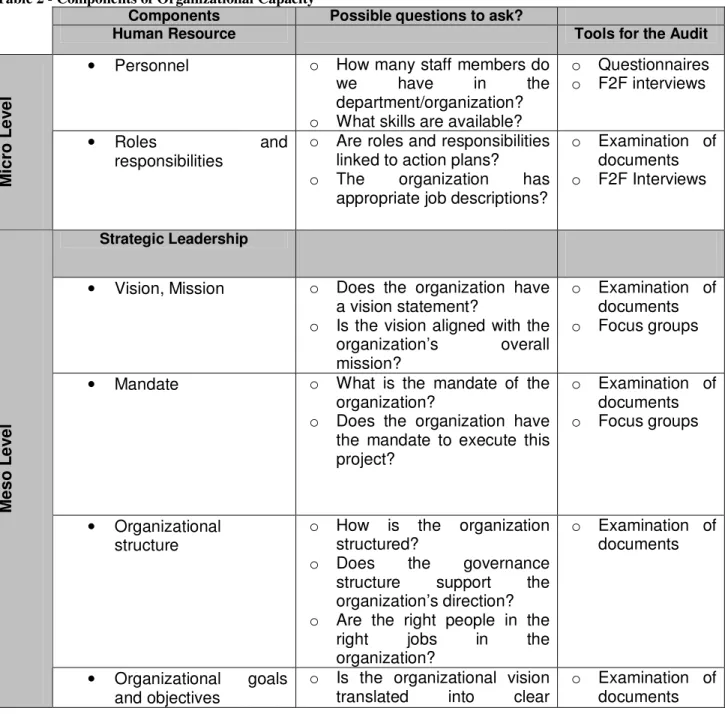
The competencies listed in this table are drawn from the three levels of organizational capacities. A list of questions has been proposed but these can be adjusted depending on the task at hand, the scope of the audit, and the intended users of the audit results. The data collection instruments will be developed by the selected audit team to address specific objectives.
Table 2 - Components of Organizational Capacity
Components Possible questions to ask?
Human Resource Tools for the Audit
• Personnel o How many staff members do
we have in the
department/organization?
o What skills are available?
o Questionnaires o F2F interviews M ic ro L e v e l • Roles and responsibilities
o Are roles and responsibilities
linked to action plans?
o The organization has
appropriate job descriptions?
o Examination of
documents
o F2F Interviews
Strategic Leadership
• Vision, Mission o Does the organization have
a vision statement?
o Is the vision aligned with the
organization’s overall
mission?
o Examination of
documents
o Focus groups
• Mandate o What is the mandate of the
organization?
o Does the organization have
the mandate to execute this project? o Examination of documents o Focus groups • Organizational structure
o How is the organization
structured?
o Does the governance
structure support the
organization’s direction?
o Are the right people in the
right jobs in the
organization? o Examination of documents M e s o L e v e l • Organizational goals and objectives
o Is the organizational vision
translated into clear
o Examination of
Page 15 of 22
Global e-School and Communities Initiative, GeSCI - http://www.gesci.org objectives and to its human resource planning?
• Motivation o What have been the
milestones, successes and moments of crises in the organization?
o Do the staff members
ascribe to the organizations mission and mandate?
o How would the staff rate
their morale?
o How would you rate the
attitude towards work in the organization? o Examination of documents o Observation o F2F interviews o Questionnaire o Focus groups
• Incentives o Are individual or/and team
efforts recognized in the organization?
o What incentives exist to
motivate the staff monetary or non-monetary?
o Is the staff adequately
compensated?
o F2F interviews o Questionnaires
• Appraisal procedures o What are the existing
appraisal procedures? o Examination of documents o Interviews o Questionnaires Financial Resources
• Budgetary allocations o Is there an adequate
budgetary allocation from the parent ministry?
o Is there a budgetary
allocation within the
organization for the specific tasks?
o Are there opportunities for
diversion of the allocated funds?
o How are the disbursements
carried out; on a priority basis or a first-come-first served basis?
o Is there a resource allocation
in the action plans to help the organization realize its vision?
o Examination of
documents
o Interviews
• o o
Infrastructure (facilities and technology)
Page 16 of 22
Global e-School and Communities Initiative, GeSCI - http://www.gesci.org
• Technology o Is there adequate physical
infrastructure (power,
telecommunication,
transport) in place to support the organization’s work?
o Does the government
system facilitate the
organization’s process for
acquiring needed
technology?
o Is the level of human
resource capacity in the
organization adequate to
support the existing or new technology?
o
o Observation o Interviews o Questionnaires
• Facilities o Do the facilities and internal
services adequately support staff?
o Is communication systems
functional to the levels required?
o Is there a budget for
infrastructural and technology maintenance? o Observation o Interviews o Questionnaires Processes Management
• Processes o What processes are in place
within the organization?
o Are these processes
documented? (These should be related to the activities of the project in question and the day-to-day operations of the said unit)
o Are there processes that are
currently being used in the organization that could be taken advantage of?
o Examination of
documents
o Interviews o Questionnaires
• Knowledge sharing and
building
o Are there any knowledge
sharing
mechanisms/practices/proce sses in place to build
organizational knowledge
and promote skill transfer?
o Examination of
documents
o Interviews o Questionnaires
Page 17 of 22
Global e-School and Communities Initiative, GeSCI - http://www.gesci.org
Components Possible questions to ask?
External Environment Tools for the Audit
Legal and administrative environments
o To what extent is the
organization influenced by the rules and regulations of other institutions?
o Are the objectives under the
influence of governments, donors and other institutions?
o To what extent do the laws
support the role played by the organization?
o Does the legal framework
support the organization’s autonomy?
o Examination of
documents
o Interviews
o Questionnaires
• Political will o Is the political environment
conducive for the execution of the said project?
o Is there political will to support
the execution?
o At what level is this political
will?
o Does the organization have
access to government funding?
o Examination of
documents
o Interviews
o Questionnaires
o Research
• Policies o Do the government policies and
programs support the organization
o What policies are in place in
support of the mandate of this organization?
o Are these policies at the
organizational level or at the ministerial level? o
M
a
c
ro
L
e
v
e
l
• Networks and partnershipso Does the government facilitate
collaborative arrangements?
o What are the networks and
partnerships in place?
o What are the mutual benefits
with each of the partners?
Page 18 of 22
Global e-School and Communities Initiative, GeSCI - http://www.gesci.org • Other Stakeholders o What are the administrative and
legal systems that might affect the execution of the project?
o What are the policies in the
other ministries that might have an influence in the execution of this project? E.g rural electrification, Tax waiver on all
ICT equipment, Telecommunication. o Stakeholder analysis o Targeted Focus groups
Page 19 of 22
Global e-School and Communities Initiative, GeSCI - http://www.gesci.org
STEP FOUR: Determine the Gaps/Issues
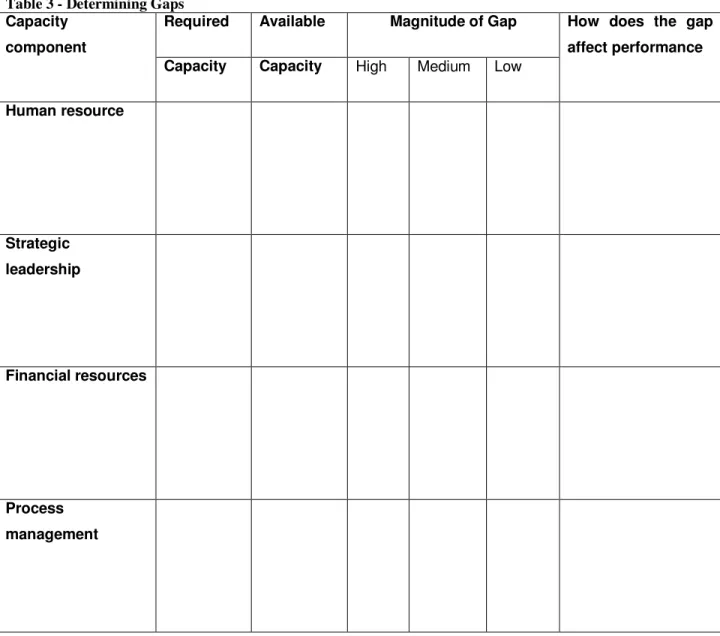
This will entail looking at the project requirements versus the resources and capacity that is available under the various subheadings. It will also be necessary to assess whether the organization has the capacity to execute the proposed project or to carry out the assigned tasks given the current capacities.
Using the table below as a guide, reflect on the capacities of the organization. Identify capacity gaps and how they affect the organization’s performance. Discuss the seriousness of these issues with the audit team and see if there is some consensus on the priority issues. There could be variations.
Table 3 - Determining Gaps
Required Available Magnitude of Gap
Capacity component
Capacity Capacity High Medium Low
How does the gap affect performance Human resource Strategic leadership Financial resources Process management
Page 20 of 22
Global e-School and Communities Initiative, GeSCI - http://www.gesci.org
Infrastructure
Monitoring and
Evaluation
External environment
Page 21 of 22
Global e-School and Communities Initiative, GeSCI - http://www.gesci.org
STEP FIVE: Analyze Gaps and Propose Solutions
Drawing from the gaps that may have been established in the preceding section the following questions may be considered in order to develop conclusions and recommendations
• Is the organization the right home for this project?
• What adjustments need to be effected for the proposed task to be executed in this organization?
• What additional resources are required to increase productivity?
• What adjustments need to be put in place to effectively use the available resources?
• Draw conclusions and recommendations on how to fill the gaps
In analyzing the data you may consider the following:
Table 4 - Analyzing Gaps
Page 22 of 22
Global e-School and Communities Initiative, GeSCI - http://www.gesci.org
Dissemination to the relevant parties
You need to decide how the various audiences will receive the findings from the audit. This may take the form of reports, presentations, email, or staff meetings. This will depend on the target audience.
The capacity audit report
• Include an executive summary that outlines the purpose, methods and findings of the audit
• Describe the purpose of the assessment and append the terms of reference
• Answer the questions posed in the terms of reference
• Describe the methods used to collect and analyze the data
• Indicate the limitation of the methodology