AN ITEM AND ORDER PROCESSING ANALYSIS OF WORD LENGTH, GENERATION AND PERCEPTUAL INTERFERENCE EFFECTS IN HUMAN MEMORY
Liam Hendry, B. Sc. (Psychology) (Hons.)
A Thesis Submitted in Fulfillment of the Requirements for the Degree of
Doctor of Philosophy at the University of Southern Queensland
STATEMENT OF ORIGINALITY
This thesis describes original research conducted by the author. I certify that the ideas, experimental work, results and analyses reported in this thesis are entirely my own effort, except where otherwise acknowledged. Data from Experiments 1 to 6 and Experiment 10 have been presented in poster form at the Quebec Short-term and working Memory Conference in July 2002, and published online in an article in the scientific journal
Memory, January 2004 (Hendry & Tehan). No part of this dissertation has been previously submitted for an academic award at this or any other university.
Candidate: Liam Hendry
CONTENTS
LIST OF TABLES vii
LIST OF FIGURES viii
LIST OF APPENDICES ix
ACKNOWLEDGEMENTS x
ABSTRACT xii
CHAPTER 1. INTRODUCTION 1
1.1 Background and History 2
1.2 The Working Memory Model 3
1.3 The Word Length Effect 4
1.4 Processing Accounts of Memory 4
1.5 Item and Order Information 5
1.6 Item and Order Tradeoffs: Generation and Perceptual Interference 6
1.7 Chapter Summary 7
CHAPTER 2. THE STANDARD MODEL AND THE WORD LENGTH EFFECT 10 2.1 Decay Vs. Rehearsal in the Original Account 10 2.2 The Baddeley, Thomson and Buchanan Study 11 2.3 Problems with decay and Rehearsal 14 2.4 Alternative Explanations of the Word Length Effect 16
2.4.1 Decay at Output 16
2.4.2 Linguistic Complexity 17
2.4.3 Compilation Errors 17
2.4.4 Localist Vs. Globalist Assumptions 18 2.4.5 Proactive Interference 19
2.5 Chapter Summary 20
CHAPTER 3. THE GENERATION EFFECT AND THE PERCEPTUAL INTERFERENCE EFFECT 23 3.1 Improved Recall from Generation 24
3.2 A Processing Account 25
3.3 Reversed Generation Effects 25 3.4 Item and Order Processing in Generation 26 3.5 The Perceptual Interference Effect 28 3.6 Processing Tradeoffs in Perceptual Interference 29
3.7 Chapter Summary 29
CHAPTER 4. SYNTHESIS AND HYPOTHESES 31 4.1 Processing Dissociations in Other Memory Effects 32 4.2 A Processing View of Word Length 32 4.3 Rationale for the Current Design 33 4.4 Modifications to the Nairne et al. (1991) Paradigm 34 4.5 Hypotheses of the Current Study 35 CHAPTER 5. WORD LENGTH EFFECT EXPERIMENTS 37 5.1 Introduction and Predictions 39
5.2 General Method 40
5.2.1 Participants 40
5.2.2 Materials 40
5.2.3 Procedure 41
5.3.1 Participants 42 5.3.2 Materials and Procedure 42
5.4 Experiment 1 Results 42
5.4.1 Rationale for Analysis 42
5.4.2 Individual Differences 43
5.4.3 Group Data 44
5.4.3.1 Immediate Serial Recall 45
5.4.3.2 Recognition 46
5.5 Experiment 1 Discussion 47
5.6 Experiment 2. Word Length & Delayed Recall 48
5.6.1 Participants 48
5.6.2 Materials and Procedure 48
5.7 Experiment 2 Results 48
5.7.1 Individual Differences 48
5.7.2 Group Data 49
5.7.2.1 Delayed Recall 50
5.7.2.2 Recognition 50
5.8 Experiment 2 Discussion 51
5.9 Experiment 3. Word Length & Irrelevant Speech 52
5.9.1 Participants 52
5.9.2 Materials and Procedure 52
5.10 Experiment 3 Results 52
5.10.1 Individual Differences 52
5.10.2 Group Data 53
5.10.2.1 Immediate Serial Recall 54
5.10.2.2 Recognition 54
5.11 Experiment 3 Discussion 55
5.12 Chapter Summary 56
5.12.1 Effect Size Estimates 56 CHAPTER 6. GENERATION EFFECT EXPERIMENTS 58 6.1 Rationale and Predictions 60
6.2 General Method 60
6.2.1 Participants 61
6.2.2 Materials 61
6.2.3 Procedure 62
6.2.4 Conditional Scoring 63
6.3 Experiment 4. Generation & Immediate Serial Recall 63
6.3.1 Participants 63
6.3.2 Materials and Procedure 63
6.4 Experiment 4 Results 63
6.4.1 Individual Differences 63
6.4.2 Group Data 64
6.4.2.1 Immediate Serial Recall 65
6.4.2.2 Recognition 65
6.5 Experiment 4 Discussion 66
6.6 Experiment 5. Generation & Delayed Recall 67
6.6.1 Participants 67
6.6.2 Materials and Procedure 67
6.7 Experiment 5 Results 67
6.7.1 Individual Differences 67
6.7.2.1 Delayed Recall 68
6.7.2.2 Recognition 69
6.8 Experiment 5 Discussion 70
6.9 Experiment 6. Generation & Irrelevant Speech 71
6.9.1 Participants 71
6.9.2 Materials and Procedure 71
6.10 Experiment 6 Results 71
6.10.1 Individual Differences 71
6.10.2 Group Data 72
6.10.2.1 Immediate Serial Recall 72
6.10.2.2 Recognition 73
6.11 Experiment 6 Discussion 74
6.12 Chapter Summary 75
CHAPTER 7. PERCEPTUAL INTERFERENCE EXPERIMENTS 77 7.1 Rationale and Predictions 79
7.2 General Method 79
7.2.1 Participants 79
7.2.2 Materials 80
7.2.3 Procedure 80
7.3 Experiment 7. Perceptual Interference & Immediate Serial Recall 81
7.3.1 Participants 81
7.3.2 Materials and Procedure 81
7.4 Experiment 7 Results 82
7.4.1 Individual Differences 82
7.4.2 Group Data 83
7.4.2.1 Immediate Serial Recall 83
7.4.2.2 Recognition 84
7.5 Experiment 7 Discussion 85
7.6 Experiment 8. Perceptual Interference & Delayed Recall 86
7.6.1 Participants 86
7.6.2 Materials and Procedure 86
7.7 Experiment 8 Results 86
7.7.1 Individual Differences 86
7.7.2 Group Data 87
7.7.2.1 Delayed Recall 87
7.7.2.2 Recognition 88
7.8 Experiment 8 Discussion 89
7.9 Experiment 9. Perceptual Interference & Irrelevant Speech 90
7.9.1 Participants 90
7.9.2 Materials and Procedure 90
7.10 Experiment 9 Results 90
7.10.1 Individual Differences 90
7.10.2 Group Data 91
7.10.2.1 Immediate Serial Recall 91
7.10.2.2 Recognition 92
7.11 Experiment 9 Discussion 93
7.12 Chapter Summary 93
8.2.1 Participants 97 8.2.2 Materials and Procedure 97
8.3 Experiment 10 Results 97
8.3.1 Individual Differences 97
8.3.2 Group Data 98
8.3.2.1 Immediate Serial Recall 98
8.3.2.2 Recognition 99
8.4 Experiment 10 Discussion 100 8.5 Experiment 11. Generation and Immediate Serial Recall 101
8.5.1 An Alternative Generation Manipulation 101
8.5.2 Participants 102
8.5.3 Materials and Procedure 102 8.6 Experiment 11 Results 103
8.6.1 Individual Differences 103
8.6.2 Group Data 103
8.6.2.1 Immediate Serial Recall 104
8.6.2.2 Recognition 105
8.7 Experiment 11 Discussion 105
8.8 Chapter Summary 106
CHAPTER 9. GENERAL DISCUSSION AND CONCLUSION. 108
9.1 Summary of Experiments 109
9.2 Item Manipulation Vs. Encoding Manipulation 110 9.3 Word Length and Word Frequency 110 9.4 Applying the Item/Order Account to Other Word Length Effects 112
9.5 Theoretical Implications 114
9.6 Problems and Limitations 117
9.7 Conclusion 117
REFERENCES 119
LIST OF TABLES
Table 1 Summary of group data from Experiment 1 45 Table 2 Summary of group data from Experiment 2 49 Table 3 Summary of group data from Experiment 3 53 Table 4 Summary of effect sizes from Experiments 1 to 3 57 Table 5 Summary of group data from Experiment 4 64 Table 6 Summary of group data from Experiment 5 68 Table 7 Summary of group data from Experiment 6 72 Table 8 Summary of effect sizes from Experiments 4 to 6 74 Table 9 Summary of group data from Experiment 7 82 Table 10 Summary of group data from Experiment 8 87 Table 11 Summary of group data from Experiment 9 91 Table 12 Summary of effect sizes from Experiments 7 to 9 94 Table 13 Summary of group data from Experiment 10 97
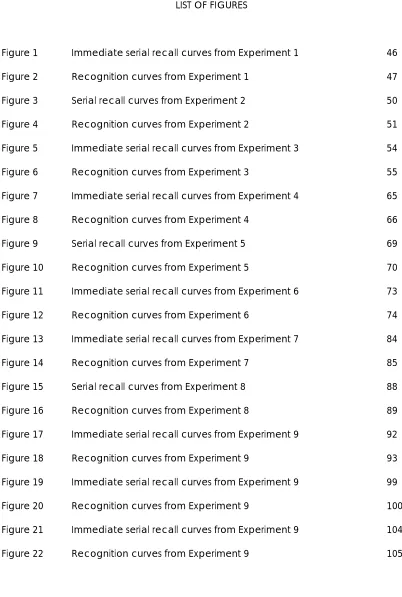
LIST OF FIGURES
[image:8.595.86.488.107.704.2]LIST OF APPENDICES
Appendix 1 Words used in Experiments involving Word Length Appendix 2 Words used in Experiments involving Generation
Acknowledgements
This dissertation represents the end point of an 8-year odyssey through the levels of degrees of Psychology at the University of Southern Queensland. In that time, I consider I have been most fortunate to have had around me, right from the very first day, friends, colleagues and teachers of the highest calibre. Like an actor receiving an Oscar, I have a long list of people to whom I wish to express my deepest gratitude, for without their help and support I would not be where I am now.
On that very first day of undergraduate Psychology, I met the group of people who would remain great friends and colleagues throughout the programme to this very day, and although we have all followed different paths through the various levels of academic endeavour and are now scattered across the globe, we remain linked by our common experiences at USQ. For their special friendship and support, my thanks go out to David Kocinski, Craig Smith, and Nancey Hoare, who have always been there for me through the ups and downs of all those years of study.
Much can happen in 8 years, David is now a psychologist at the Gold Coast, Craig is working in San Francisco, and Nancey is still at USQ, also in the Ph.D. programme. We still have a terrific study group, although the faces have changed, and I feel
privileged to have been working alongside my new colleagues in the Ph.D. room - Sharron, Geoff, Kerry, Sandra, Maxine, Coralie & Don to name but a few. The friendship and support of these wonderful people over the last few years has made a difficult task seem easy and fun. The social aspects of our time together have provided excellent relief from the rigours of research (special thanks to Maxine- the hostess with the mostest), and the intellectual benefit of having such a collection of keen minds close by has provided much discussion and food for thought over the years.
privilege to learn much from some of the finest teachers to be found anywhere, most notably Terry Carter, Christine Macdonald and Gerry Tehan. I have worked with Gerry since first year, and as a teacher, supervisor, friend and mentor, I could have asked for none better. From Gerry, I learned to think like a scientist, which to me is a gift beyond price. He has shown infinite patience over the years with an unruly student with a strange sense of humour, and even stranger work habits. All I can do when words fail is to paraphrase the old Eastern adage: ‘when the pupil is ready, a teacher will come.’
My thanks must also include some truly wonderful members of staff at USQ – from Toni, Leanne and the ladies at the coffee shop, thanks for the wonderful years of
cappuccinos, to Debbie O’Reilly for organising the Canada trip, to Simon, Rob, Ken, Ross and Susie for their timely and efficient technical assistance, and to Ruth and Christine at Research & Higher Degrees. For assistance with data collection, my thanks to Kerry Neale, Anne Tolan, Julie Wilson and Helen Waters.
The most deserving of my gratitude, however, is my wife Jen, who has for half of our married life endured housefuls of stressed-out students discussing exams, assignments and theories day and night while she made literally thousands of coffees, being faced daily with incomplete renovations and hastily-repaired vehicles – Jen, it’s nearly over, and with our son Rob we can soon get back to some semblance of normality.
I will always consider my years at USQ to be among the best of my life, and I thank you all for your friendship, love and support.
Abstract
When participants are presented with lists of items for immediate serial recall, tradition would suggest that a race begins – between the need to constantly refresh or recycle the memory trace of that list, and a tendency for the memory trace to decay. Standard models in the literature assumed a complex interaction of mental subsystems whereby a controlling attentional process strove to keep the memory of such a list alive for a sufficiently long period of time so it could be remembered and output in order, using a type of recirculating loop rehearsal and storage mechanism to offset the decay process. Evidence supporting such models stemmed from the observation that more short words could be remembered in order than long words (Baddeley, Thomson, & Buchanan, 1975). This word length effect, described in the second chapter, was a crucial piece of evidence for rehearsal and decay models, in the example given, the recirculating loop was seen as being time-based and extremely limited in capacity, such that memory was deemed equivalent to the amount of information which could be cycled through the rehearsal loop in about two seconds. A number of recent challenges to this model of remembering have cast doubt on the nature of the process as described in such models as that of Baddeley (1990; 1996).
were better remembered, information about their presentation order diminished. This observation (Nairne, Riegler, & Serra, 1991) was introduced as the item-order hypothesis.
The item-order hypothesis suggested that under certain conditions increased item processing could lead to deficits in order processing, and that this produced a
dissociation in performance between item and order memory tasks. The generation effect (Slamecka & Graf, 1978) was one such example, as was the perceptual
interference effect (Mulligan, 2000), and these were discussed in Chapter 3. The word length effect was seen as another instance where this tradeoff might be observed. A design incorporating elements of item and order tasks based upon Nairne et al. (1991) was detailed in the fourth chapter, leading on to empirical testing of the word length effect (Chapter 5), the generation effect (Chapter 6) and the perceptual interference effect (Chapter 7). This series of experiments compared word length and generation effects under serial recall and single item recognition tasks, using a range of test conditions designed to allow replication and extension of existing data from these separate streams of research.