Generation and storage of optical
entanglement in a solid state
spin-wave quantum memory
Katherine R. Ferguson
A thesis submitted for the degree of
Doctor of Philosophy of
The Australian National University
c
Declaration
This thesis is an account of research undertaken between February 2011 and May
2016 at the Laser Physics Centre, Research School of Physics and Engineering, The
Australian National University, Canberra, Australia.
Except where acknowledged in the customary manner, the material presented in
this thesis is, to the best of my knowledge, original and has not been submitted in
whole or in part for a degree in any university.
Katherine R. Ferguson
May 2016
v
For my beloved grandmother, Betty Ferguson, who did not get to see this thesis
Acknowledgments
First and foremost, I would like to thank my primary supervisor, Matt Sellars. His constant enthusiasm has been an inspiration, his support and guidance the foundation
upon which my research was built and his stories of all aspects of life a welcome
distraction at times. It has been a privilege and a rewarding experience being your student.
I would like to thank Jevon Longdell and Sarah Beavan for their expertise. Jevon’s
aid in computer programming for the analysis and Sarah’s experimental assistance and support, particularly at the start of my PhD, were invaluable.
I would like to thank my secondary supervisor, Neil Manson, for giving me the
opportunity to visit the ANU when I was looking for PhD positions. His encouragement and insistence that I return in the summer for a research scholarship, despite the fact
that I had missed the submission deadline, was a large factor in my decision to study
at the ANU.
I would like to thank the technical staff of the Laser Physics Centre, in particular
John Bottega and Craig MacLeod. I would like to acknowledge Craig for building the
cavity used in these experiments and for the subsequent modifications with minimal complaint after I changed my mind about the design, and John for all the work he did
modifying the bucket cryostat and sample rod and for constantly keeping me supplied with liquid helium.
I would also like to thank all my friends within the Research School of Physics and
Engineering for many fun times, especially the past and present PhD students and postdoctoral researchers in the Solid State Spectroscopy group: John, Rose, Sarah,
Sven, Morgan, Grace, Sara, Miloˇs and Michael. It has been great working with all of
you. A special thanks to John, Rose and Matt for proof reading this thesis. I would also like to thank my rock climbing friends for their aid in getting me out of the lab
and into the sunshine. A surprising number of physics and climbing friends overlapped,
resulting in many stimulating physics discussions while on a cliff.
Finally, I would like to thank my family for all the support and encouragement they
have given me over the duration of my studies.
Abstract
This thesis investigates an entangled light source with an in-built quantum memory
based on the protocol of rephased amplified spontaneous emission (RASE). RASE has promising applications as a building-block of a quantum repeater: a device essential
for extending the range of current quantum communication links. To be useful RASE
must be able to produce high fidelity non-classical light with high efficiency, and be able to store multimode entanglement for long times. This thesis characterises the
RASE source and determines to what degree these requirements can be met.
The experimental RASE demonstration was conducted in a rare-earth ion doped
crystal: Pr3+:Y2SiO5. Rare-earth ions provide a particularly promising platform for
developing quantum technologies as they possess long coherence times on both the
optical and hyperfine transitions.
In the RASE protocol an inverted ensemble of two-level atoms amplifies the vacuum
fluctuations resulting in amplified spontaneous emission (ASE). This results in entan-glement between the output optical field and the collective modes of the amplifying
ensemble. The collective atomic state dephases due to the inhomogeneous broadening
of the ensemble but this can be rephased with the application of a π-pulse. When the ensemble rephases, a second optical field, the rephased amplified spontaneous emission
(RASE), is emitted and is entangled with the ASE. In this thesis, a modified four-level rephasing scheme is used that allows the single photon signals to be spectrally
resolved from any coherent background emission associated with the bright driving
fields. In addition, four-level RASE incorporates storage on the long-lived hyperfine ground states.
Two experiments are described in this thesis. First, a free-space four-level RASE demonstration using continuous variable detection. In this experiment the different
sources of noise were characterised and low noise operation was shown to be possible. Entanglement of the ASE and RASE was confirmed by violating the inseparability
criterion with 98.6% confidence. In addition, entanglement was demonstrated after
storage of the collective atomic state on the spin states for up to 5 µs. Storage times of up to a second could be achieved in this material by applying RF π-pulses to reph-ase the inhomogeneity on the spin states and by applying specific magnetic fields to
desensitize the transition to fluctuating magnetic fields. RASE was shown to be tem-porally multimode, with almost perfect distinguishability between two temporal modes
demonstrated. The degree of entanglement between the ASE and RASE was limited by
the low rephasing efficiency, which saturated at 3%. It was determined that distortion
of the rephasing pulses as they propagate through the optically thick ensemble was the probable cause of the low efficiency.
The second experiment was a preliminary cavity-enhanced RASE demonstration.
Theoretically perfect rephasing efficiency can be obtained by placing the crystal in an impedance-matched optical cavity. The initial cavity design showed encouraging
evidence of an enhancement in the rephasing efficiency, with a 4-fold improvement over
the free-space experiment. Improvements to the cavity design were proposed to allow a further increase in the rephasing efficiency of RASE.
In summary, this thesis provides an extensive characterisation of an entangled light
source with an in-built quantum memory based on rephasing spontaneous emission from an ensemble of ions. Importantly, the RASE scheme allows generation and storage of
entanglement in a single protocol, which holds great promise for the development of
Contents
Acknowledgments vii
Abstract ix
1 Background 1
1.1 Motivation . . . 1
1.1.1 Quantum key distribution . . . 2
1.1.2 Difficulty implementing QKD . . . 3
1.2 A single photon . . . 4
1.2.1 What are single photons good for? . . . 4
1.2.2 Characteristics of an ideal single photon gun . . . 5
1.3 Single photon sources . . . 6
1.3.1 Faint laser pulses . . . 6
1.3.2 Probabilistic single photon sources . . . 7
1.3.3 Deterministic single photon sources . . . 8
1.4 Quantum memories . . . 11
1.5 Quantum repeaters . . . 12
1.5.1 DLCZ as a quantum repeater . . . 15
1.5.2 Experimental progress and limitations . . . 16
1.5.3 Multimode advantage . . . 17
1.6 Transition to solid state - rephasing spontaneous emission . . . 19
1.6.1 RASE . . . 21
1.7 Summary . . . 22
2 Solid state quantum technologies utilising rare-earth ions 23 2.1 Properties of rare earths . . . 23
2.1.1 Spectral properties . . . 24
2.1.2 Homogeneous broadening . . . 26
2.1.3 Inhomogeneous broadening . . . 28
2.1.4 Stark shifts . . . 29
2.2 Pr:YSO . . . 29
2.2.1 3H4 →1 D2 optical transition . . . 30
2.2.2 Hyperfine transitions . . . 32
2.3 High resolution spectroscopic techniques . . . 33
2.3.1 Engineering the absorption profile . . . 33
2.3.2 Photon echoes . . . 35
2.4 Echo-based quantum memory technologies . . . 41
2.4.1 Two-level photon echo . . . 41
2.4.2 Atomic frequency comb . . . 44
2.4.3 Controlled reversible inhomogeneous broadening . . . 48
2.4.4 Difficulty in implementing rare-earth quantum memories . . . 50
2.5 Summary . . . 51
3 Theory of rephased amplified spontaneous emission 53 3.1 Rephased amplified spontaneous emission . . . 53
3.1.1 Atom-field interaction Hamiltonian . . . 54
3.1.2 Two-level RASE . . . 56
3.1.3 Four-level RASE . . . 60
3.1.4 This RASE experiment . . . 60
3.2 Quantifying continuous variable correlations . . . 62
3.2.1 Cross-correlation . . . 63
3.2.2 Criteria for continuous variable entanglement . . . 63
3.3 Modelling the inseparability criterion . . . 65
3.3.1 Expected noise . . . 68
3.4 Optical depth model . . . 73
3.5 Summary . . . 76
4 Experimental setup 77 4.1 The cryogenic system . . . 77
4.1.1 Vibration damping . . . 80
4.2 Optics setup for excitation and detection used in the RASE experiments 82 4.3 RF sources used to drive probe and LO AOMs . . . 84
4.4 Detection . . . 85
4.4.1 Homodyne detection . . . 86
4.4.2 Heterodyne detection . . . 88
4.4.3 Experiment detection setup . . . 88
4.5 Ensemble preparation . . . 90
4.6 Phase correction . . . 92
Contents xiii
5 Free-space RASE experiment 99
5.1 Photon echo measurements . . . 101
5.1.1 Coherence and storage time measurements . . . 101
5.1.2 Echo efficiency measurements . . . 105
5.1.3 Summary . . . 108
5.2 Experiment pulse sequence and analysis . . . 109
5.3 Amplified spontaneous emission . . . 112
5.3.1 Gain measurements . . . 112
5.3.2 Characterisation of ASE . . . 114
5.3.3 Summary . . . 120
5.4 Four-level RASE experiment . . . 121
5.4.1 Characterisation of RASE . . . 122
5.4.2 Inseparability criterion . . . 126
5.4.3 Detailed investigation of the RASE efficiency . . . 130
5.4.4 Summary . . . 135
5.5 Quantum memory storage time . . . 136
5.6 Multimode capability of RASE . . . 139
5.7 Discussion and future experiments . . . 142
5.8 Summary . . . 145
6 Removing the limitation on the RASE rephasing efficiency 147 6.1 Tailoring the ensemble spectral density . . . 148
6.1.1 Switching optical depth . . . 148
6.1.2 Artificial mode matching . . . 149
6.2 Cavity-enhanced RASE . . . 151
6.3 Applicability to the Pr:YSO system . . . 152
6.3.1 Branching ratio enhancement of cRASE . . . 156
6.4 Summary . . . 156
7 Cavity-enhanced RASE 159 7.1 Properties of the cavity . . . 160
7.1.1 Control of the cavity mode . . . 163
7.2 Characterisation of the cavity . . . 164
7.2.1 Slow light . . . 165
7.2.2 Finesse measurements . . . 169
7.2.3 4LE optical decay measurements . . . 173
7.2.4 Summary . . . 176
7.3.1 Efficiency enhancement . . . 177
7.3.2 Cross-correlation . . . 179
7.3.3 Probing the bandwidth . . . 180
7.4 Discussion . . . 182
7.5 Designing the next cRASE experiment . . . 185
7.6 Summary . . . 187
8 Conclusion 189
Chapter 1
Background
1.1
Motivation
Many of the properties of quantum mechanics appear completely foreign considering our experience in the classical world around us. The concept that a system can exist in
multiple different states1 simultaneously, a quantum superposition, is hard to compre-hend. When measured, the superposition will collapse into one of the different possible
results, with a certain probability for each result. Even more abstruse, a superposition
can extend over multiple particles, which is called entanglement. This results in strong correlations between certain properties of entangled particles such as the position and
momentum, or the amplitude and phase. Measuring one particle collapses the
super-position of the other particle, allowing a prediction, with almost complete certainty, of the properties of the second particle due to correlations they share.
The theory of entanglement was highly contested [1], but a test devised by John
Bell in 1966 provided a means of determining whether entanglement could result in correlations that violate any local hidden variable theory [2]. Entanglement is now
widely accepted as one of the fundamental properties of quantum mechanics.
The properties of quantum superpositions and entanglement have some powerful
potential applications in the world of information processing. A computer consisting
of ‘quantum bits’ (qubits), which can exist in a superposition of ones and zeroes, is posited to be able to solve certain classes of problems much more efficiently than
conventional computers. These problems include integer factorisation and discrete
logarithms [3] as well as simulations of quantum systems themselves [4]. The field of quantum computation is still in its infancy and as yet there has been no system able
to demonstrate a computational advantage over a classical computer.
A more immediate goal of quantum technology is using entanglement for provably secure communication and encryption. Secure communication between two remote
1
These states could be any properties of the system, for example, different spatial positions, mo-menta or spins.
parties is usually achieved through public-key distribution. The security of this
en-cryption relies on certain problems being very computationally difficult - for example, finding the prime factors of a large number (the order of 10300). However, it has not been proven that an efficient algorithm for integer factorisation does not exist and, as
previously stated, this is a problem that a quantum computer could solve efficiently.
1.1.1 Quantum key distribution
A means of facilitating secure communication between two remote parties is
quantum-key distribution (QKD). In QKD, a private quantum-key is shared between two parties by
measuring the quantum properties of light. This shared key can then later be used for encryption. The security of QKD is guaranteed by one of the fundamental principles
of quantum mechanics, that measuring a quantum state will change the information it
carries. This change is detectable, providing absolute security rather than the assumed security of public-key distribution.
Quantum cryptographic schemes were originally discussed in discrete variable sys-tems [5, 6] where the resource of interest was either on-demand single photons or
entangled pairs of photons. Alternate quantum communication schemes based on
con-tinuous variable systems have been proposed, where the key resources are either coher-ent states [7, 8] or squeezed states [9]. Here only discrete variable QKD is examined.
There are several different protocols that have been proposed and demonstrated for generating a private key. QKD was originally proposed by Bennett and Brassard
in 1984: the BB84 protocol [5]. In this protocol the first party, Alice, generates single
photons in a particular state (in this case polarisation) and then transmits them to the second party, Bob, who measures them. This was first demonstrated in 1992 over a
distance of 1 km at the University of Geneva [10].
Another scheme, the Ekert protocol [6], uses entangled pairs of photons. One
photon in the pair is sent to Alice while the other is sent to Bob. Each measure some
property of the photons, for example, the polarisation as in the BB84 protocol. Due to the entanglement between the two photons there will be a correlation between the
measurement results Alice and Bob obtain. This was demonstrated in 1992 [11].
The security of QKD comes about from one of the fundamental properties of
quantum mechanics, namely the measurement principle: that measuring a quantum
state will disturb it. If an eavesdropper, Eve, intercepts the signal they will introduce perceptible errors in the results obtained by Alice and Bob. When they compare their
results they will know to disregard the key. For a more detailed discussion, see the
review [12].
§1.1 Motivation 3
network can compromise the security. For example, if an imperfect single photon
source is used, with a non-zero probability of multi-photon emissions, then this opens new possibilities for Eve to intercept information. In principle, Eve could perform a
photon number splitting attack whereby she blocks single photon pulses and selects two
photon pulses, storing one and sending the other on to Bob. When Alice and Bob publicly reveal how they made their measurements, Eve can correspondingly measure
her stored photons. In this way Eve can obtain full information of the shared key
without introducing any errors. However, if Alice uses an ideal single photon source, Eve has no choice but to measure the photon transmitted by Alice and then resend
one on to Bob, necessarily introducing detectable errors.
1.1.2 Difficulty implementing QKD
A number of high profile deployments of QKD have already occurred, including during
the 2007 Swiss federal election to securely transmit vote results and during the 2010
FIFA world cup competition to secure critical communications. However, the practic-ality of QKD is limited by the range over which communication can be achieved [13].
Currently QKD has been achieved over 144 km in free space [14] and 307 km in optical fibre [15]. The range is limited by transmission losses, such that the time required to
communicate increases exponentially with distance.
For quantum communication to become a global reality two components need to be developed. Firstly, ideal single photon sources are needed to guarantee the security
of the communication. The characteristics of single photons are discussed in §1.2 and
the current technologies for generating single photons are reviewed in §1.3.
The second requirement for implementing quantum communication is a means of
distributing the quantum information over large distances. Classically, the
transmis-sion losses are overcome by measuring, amplifying and retransmitting the information at intermediate repeater stations. In contrast, quantum signals cannot be measured
without disturbing the information they carry, so a different solution is required.
Entanglement can be established between two separate locations by breaking the distance between them into shorter links. Entanglement is initially generated between
each link before being built up across the entire channel. This is known as the quantum
repeater approach and is introduced in §1.5. However, entanglement generation is a probabilistic process, so if entanglement is successfully established across one link, it
must be stored until the neighbouring links have also succeeded. Without a means
of storing entanglement, successful communication is reliant on entanglement being established between all links simultaneously and the probability of this is increasingly
over large distances requires a means of storing quantum information and recalling it,
unchanged, at a later time. This can be achieved with a quantum memory, which is briefly outlined in§1.4.
One of the challenges to realising a quantum repeater network is the difficulty of
integrating the different components. Commonly quantum memories are implemented in atomic ensembles and only operate at specific wavelengths and bandwidths. Single
photon sources need to have the same properties in order to be compatible and this
can be challenging with current non-classical light sources. An elegant solution is to both generate and store non-classical light in the same material, ensuring perfect
compatibility of the source and memory. This was proposed in an atomic gas system
in 2001: the DLCZ protocol [16].
Most quantum repeater experiments have been conducted in atomic gas systems using the DLCZ protocol. However, utilising a solid state platform holds the promise
of being able to mass-produce quantum devices on chips to make integrated quantum
networks [17]. The motivation behind changing to a solid state system is discussed in §1.6 and the process used in this thesis, rephased amplified spontaneous emission
(RASE), is briefly introduced. Similar to DLCZ, RASE provides a means of generating a pair of entangled photons with an in-built quantum memory.
Two experimental RASE demonstrations have been conducted to date. While it
was shown that RASE could be used as an entangled light source [18], both
experi-ments suffered from high noise [18, 19]. This thesis aims to determine whether RASE, implemented in a rare-earth ion doped crystal, can operate as a low noise and high
efficiency non-classical light source and whether long storage times are possible.
1.2
A single photon
A photon is a single quantum of the electromagnetic field. The concept of quantisation
of the electromagnetic field was first introduced by Planck to explain blackbody radi-ation in 1900 [20, 21]. The photon was then introduced by Einstein in 1905 to explain
the photoelectric effect [22].
Detection of single photons has been possible for over 50 years, however generating single photons has proven a much more difficult task and is still an active area of
research.
1.2.1 What are single photons good for?
Apart from QKD, single photons also have potential applications as qubits for quantum
§1.2 A single photon 5
Photons have the advantage that they are extremely isolated from the environment,
minimising the disruption of the quantum information they carry. They can also be used as ‘flying qubits’ in the transportation of quantum information between processors.
Single photons also have uses outside of quantum information processing. For ex-ample, they can be used in the production of truly random numbers [25]. This is
significant because it is very difficult to generate random numbers. Most protocols are
only pseudo-random, with the numbers generated using complex numerical algorithms, which are still fundamentally deterministic. Many applications, such as cryptography,
computer simulation, statistical sampling and modelling require a high degree of
ran-domness and, given enough time, the sequence from a pseudo-random number generator will repeat itself. Single photons offer a solution because quantum noise is inherently
random. Single photons hitting a 50:50 beam splitter have an equal probability of
being transmitted or reflected. Their output direction provides a truly random source of ones and zeroes based on the intrinsic randomness of the quantum nature of light.
Another application of single photons is in the detection of weak absorption signals. Photon number fluctuations hamper the detection of low intensity signals. Using a
single photon state, with exactly one photon, greatly reduces the noise [26] allowing
arbitrarily weak signals to be detected.
In summary, there are a number of applications in quantum communication, quantum
information processing and spectroscopy awaiting the development a reliable single photon source. The benefit of using an ideal single photon source largely comes from
the reduced intensity noise due to having a well-defined number of photons in the state.
1.2.2 Characteristics of an ideal single photon gun
The key characteristic of an ideal single photon source is that it should emit one and only one photon every time it is triggered, i.e. a ‘single-photon gun’. The single
photon should be able to be emitted at any arbitrary time so that it is ‘on-demand’.
The individual photons should be produced at a high rate and there should be zero probability of multi-photon emissions.
Another important feature is that consecutive photons emitted by an ideal source should be completely identical. Such a source is said to be Fourier-transform limited
and any two photons that are emitted are indistinguishable.
Other characteristics a single photon source should possess depend on the
applic-ation the single photons will be used for. For example, for applications requiring
transmission through optical fibre, it is desirable to choose the photon wavelength to coincide with one of the windows of maximum transmission, occurring at 840, 1320,
efficiency. Silicon detectors can reach almost unity efficiency around 750 nm but this
drops off quickly for near-infrared wavelengths. Most current quantum memories use atoms or ions, the transitions of which occur at specific wavelengths that the single
photons may be chosen to coincide with.
Similarly, the bandwidth of the source depends on the application. To interface with atomic memories small bandwidths (of the order of MHz) are required, while
large bandwidths (of the order of 109 MHz) allow for large photon generation rates. To integrate components together, the source must produce photons at the same
wavelength and bandwidth to be compatible with the memory. This represents an
experimental challenge for many atomic-based quantum memory protocols but this difficulty was overcome in the DLCZ protocol, described in §1.3.3, where the memory
is built into the single photon source protocol. A similar approach is taken in the
photon source described in this thesis.
1.3
Single photon sources
There are many different methods used to generate single photons and they display
the ideal characteristics outlined in the previous section to different extents. The main different types of sources are detailed below. For a more extensive discussion see the
review papers [26, 27].
1.3.1 Faint laser pulses
One of the earliest methods to try to generate single photons was simply to attenuate a laser beam until it reached the single photon level. Lasers produce coherent states where
the number of photons in the state fluctuates according to a Poissonian distribution.
The probability of findingm photons in a state containing an average photon number of hni is
p(m) = hni
m
m! e
−hni
(1.1)
Following a Poissonian distribution means that a coherent state, no matter how
attenuated it is, will always have a non-zero probability of containing more than one photon. The probability of a non-empty pulse containing more than one photonpmulti
is given by
pmulti=
p>1
p>0
= 1−P(0)−P(1) 1−P(0) ≈
hni
2 (1.2)
§1.3 Single photon sources 7
probability of a pulse containing more than one photon.
It would appear that pmulti can be made arbitrarily small by reducing hni, which
would make faint laser pulses a very convenient approximation to a single photon
source. However, whenhniis small most pulses are empty. There is no way of knowing which pulses will be empty so the detectors must be active for all pulses. All single
photon detectors have some internal noise, where counts can be detected even when
no signal is applied. These are called dark counts. As hni is reduced the ratio of detector dark counts to detected photons will increase. The optimal value of hni is therefore a trade-off between optimal signal-to-noise of the detector and a tolerable
rate of multi-photon events. A typical value ishni ≈0.1.
Despite this drawback, weak laser pulses are still extremely convenient and are still
used in many quantum cryptography experiments.
1.3.2 Probabilistic single photon sources
While it can be hard to generate single photons on demand there are several physical
processes that probabilistically generate a correlated pair of photons. This allows an elegant way of creating pseudo-single photon sources, whereby the detection of one
photon in the pair is used to herald the companion, which can be used in single photon
experiments.
This allows a major advantage over faint laser pulse sources as only the heralding
detector needs to be on all the time. The experiment detector only needs to be activated when the heralding detector has registered a photon rather than every time a laser pulse
is applied, thus greatly reducing the detector dark count problem.
The first successful generation of single photons used an atomic cascade transition
in calcium [28]. In this process, each excited atom delivers a correlated pair of photons at different wavelengths. While atomic cascades were the first single photon sources,
they are no longer commonly used as the brightness was very low.
Probabilistic single photon sources often rely on excitation of a nonlinear
inter-action in an optical medium. The most common method is spontaneous parametric
down-conversion (SPDC) which requires a χ(2) nonlinearity to split an input pump photon into two simultaneous outputs [29]. Similarly, four-wave mixing (FWM) is a
χ(3) nonlinear process in which two pump photons are converted into a correlated pair of photons.
Spontaneous parametric down-conversion
SPDC is aχ(2) nonlinear process in which a high frequency pump photon is split into
process can either be degenerate, if the output photons are the same wavelength, or
non-degenerate, if they have different wavelengths. The three photons must satisfy the following energy-conservation and phase-matching conditions
ωp = ωs+ωi
kp = ks+ki (1.3)
where ω is the frequency,kis the wavevector and the subscriptsp,sand irefer to the pump, signal and idler photons respectively.
Phase-matching gives one a measure of control over the wavelength of the
down-converted photons. The wavelength of one photon could be chosen to coincide with a telecommunication band while the other can be made compatible with an atomic
system for later storage.
One limitation of SPDC sources is that the photon-pair creation process is very
inefficient (∼10−7−10−11). The number of photon pairs per mode follows a Poissonian distribution so the pump intensity cannot be increased to improve the pair rate without
multi-photon emissions becoming a concern.
As discussed in §1.1, a major driving force for the development of single photon sources is quantum communication, which requires a source that is compatible with a
quantum memory. SPDC sources typically have very large bandwidths (O(THz)) and
to be compatible with an atomic quantum memory the bandwidth needs to be reduced toO(MHz). One possibility is to reduce the bandwidth using cavity filtering, although
this is challenging [30]. To date, no photons produced using SPDC have been stored
in an on-demand quantum memory.
Despite these limitations, SPDC systems can make compact and robust devices and
as such are convenient to deploy in many quantum information experiments.
1.3.3 Deterministic single photon sources
An ideal single photon source is deterministic so that the single photons can be gen-erated on-demand. A variety of systems have been investigated as possible sources of
on-demand single photons. Many of these are single-emitter quantum systems. The
basic principle of operation is: when a single photon is desired some external control is used to place the system in an excited state. A single photon will then be released
when the system relaxes back to a lower energy state. This can be considered
‘on-demand’, with the uncertainty in time being given by the lifetime of the system. An alternate approach has also been realised using collective excitations in ensembles of
§1.3 Single photon sources 9
Single emitters
An obvious way to eliminate the possibility of multi-photon emissions is to use a single
‘two-level’ emitter, such as single atoms [31], single ions [32], single molecules [33, 34],
semi-conductor quantum dots [35], or colour centers such as the nitrogen-vacancy defect in diamond [36].
While single emitters conceptually seem like ideal single photon sources as they can
only produce at most one photon, it is challenging to efficiently collect that photon as it will be radiated over a large solid angle. To collect the emitted photon either the
detection field mode can be matched to the emitter or the emitter can be forced to
match the field mode.
For single atoms, initial experiments concentrated on strongly focusing the light to
maximise overlap with the absorption cross-section of the atomic transition [37]. A
diffraction limited spot can be made similar in size to the absorption cross-section of an atom using a high numerical aperture lens.
For single ions, the field can be optimally matched to the radiation mode by placing the ion at the focus of a deep parabolic mirror. A parabolic mirror with the depth
approximately 6 times the focal length potentially captures 94% of the mode emitted
[38].
Alternatively, an emitter can be coerced to emit into a particular spatial mode by
placing it in a cavity. Strongly coupled atom-resonator systems, forming the field of
‘cavity quantum electrodynamics’ (cavity QED), are perhaps the most experimentally advanced in terms of generating single photons from atoms [39]. Barros et al. used a
trapped calcium ion coupled to a high finesse optical cavity to create single photons
with an efficiency of 88±17% [40]. Similarly, quantum dots have been integrated into micropillar cavities to achieve extraction efficiencies as high as 66% [41].
Currently, the complexity of cavity QED experiments poses a significant barrier for
large-scale applications. Single atom emitters are compromised by a limited trapping time [42] and the numbers of atoms are hard to control. Ions can be trapped very
precisely, however strong cavity coupling is difficult with charged particles making it difficult to efficiently collect the light.
Quantum dots and colour centers both have the problem that each is unique,
emit-ting photons at slightly different frequencies. To be practical, the photons emitted from different sources have to be indistinguishable, limiting the use of these single-emitter
Ensemble-based schemes
A means of achieving single photons from an atomic ensemble was proposed in 2001 in
the seminal paper of Duan, Lukin, Cirac and Zoller: the ‘DLCZ’ protocol [16]. DLCZ
uses an atomic system with three energy levels, two metastable ground states |gi and
|si and an excited state|ei. ThisΛ-type configuration of levels is shown in Figure 1.1.
Figure 1.1: Process for generating a single photon from an atomic ensemble using the DLCZ scheme. (a) Initially all atoms are in ground state |gi. The write pulse off-resonantly excites the |gi → |ei transition causing an atom to end up in the |si state with some small probability and emit a Stokes photon. (b) The read pulse resonantly drives the |si → |ei transition, resulting in a single photon, the anti-Stokes photon, being emitted in a well defined spatial mode from the|ei → |gi transition.
All N atoms in the ensemble are initially in ground state |gi. A laser pulse, the write pulse, is applied off-resonantly to the |gi → |ei transition, which will result in the emission of a Raman photon, the Stokes photon, with some small probability. This
Raman-scattering process transfers an atom from |gi to |si. The write pulse is made to be weak to reduce the probability of multiple excitations in the selected mode.
Detecting the Stokes photon heralds a state of the ensemble with a single quanta
of excitation in state |si. As there is no information about which atom emitted the photon, an atomic state that is a superposition of N −1 atoms in state |gi and one atom in state|si is created. The collective excitation is given by
|ψi= √1
N
N
X
j=1
e(kw−kS)xj|g
1, g2. . . sj. . . gNi (1.4)
wherekis the wavevector, with subscriptwdenoting the write pulse andSreferring to the Stokes photon. xj corresponds to the position of thejth atom in the ensemble.
§1.4 Quantum memories 11
|si → |ei transition with a read pulse. This state will then collectively decay back to ground state|giresulting in the emission of an anti-Stokes photon. The phase-matching condition for constructive interference of all terms is
kw−kS =kr−kAS (1.5)
where subscriptr refers to the read pulse andAS to the anti-Stokes photon. If the size of the ensemble is large compared with the wavelength, emission in the constructive interference direction dominates, with only a small fraction of light emitted into other
spatial modes due to spontaneous emission. The anti-Stokes photon can therefore be
collected with very high efficiency.
DLCZ is a photon pair source somewhat similar to a SPDC source. The detection of one photon, the Stokes photon, implies the presence of the second, anti-Stokes, photon.
The key difference is that detecting the Stokes photon heralds a particular state of the
ensemble rather than the existence of the second photon, as in SPDC. The anti-Stokes photon can then be read out on-demand by choosing when to apply the read pulse.
The delay between detection of the Stokes photon and the recall of the anti-Stokes
photon is tunable. Delays on the order of a millisecond have been demonstrated [43]. The efficiency of the recall is limited by dephasing of the atomic state. For atomic gas
systems, such as Cs and Rb, the major decoherence mechanism is the atomic motion
taking the atoms out of the interaction region with the lasers.
As well as being a means of generating on-demand single photons, the DLCZ pro-tocol provided a method for using linear optics, atomic ensembles and single photon
counting to realise the basic operations of a quantum repeater. The purpose and
op-eration of a quantum repeater is the topic of§1.5.
1.4
Quantum memories
Equivalent to classical information processing, quantum information processing
re-quires the capability to temporally store data, i.e. a quantum memory. An ideal
quantum memory is capable of storing an arbitrary quantum state and recalling it, unchanged, after a tunable length of time.
Classical memories work by measuring the state to be stored and recording it to be
reproduced at a later time. Quantum memories cannot work in this way. By the same
principle from which QKD derives its security, the measurement process collapses a quantum state, changing the information. The no-cloning theorem also states that an
arbitrary quantum state cannot be copied, so backing up the data is not possible [44].
without measuring it. Photons provide an ideal way of transporting quantum
informa-tion long distances, so called ‘flying qubits’, however, they are hard to store directly as photons. In contrast, atoms are difficult to send from one location to another, but they
are ideal ‘stationary qubits’. A quantum memory requires a way to reversibly map
quantum information between photons and atoms, allowing the best of both worlds, flying and stationary.
A quantum memory would enable the implementation of deterministic single photon sources. Probabilistic photon pair sources such as SPDC could be made deterministic
by detecting one photon and storing the other in a quantum memory. Detecting a single photon heralds the fact that the memory is loaded, and the stored single photon
can be recalled on demand. To implement such an ‘on-demand’ single photon source,
the detection of the heralding photon needs to be near 100% and the quantum memory also needs to be near 100% efficient.
Another technology requiring a quantum memory is the quantum repeater (dis-cussed in §1.5 ), which provides a means of distributing entanglement over long
dis-tances.
The different quantum memory technologies, specifically those implemented in
rare-earth ion doped crystals, are discussed in §2.4.
1.5
Quantum repeaters
For quantum encryption to be useful on a large scale quantum information will need
to be transmitted over long distances. If the quantum state is encoded onto photons
the most likely communication channel is optical fibers. This poses a problem due to the fact that optical fibers have loss due to absorption. The low loss bands of
telecommunication fibers have losses around 0.2 dB/km and this becomes significant
over the distances needed to communicate between cities and countries. For example, using a 1 GHz source, the transmission rate through 1000 km of fiber would be 1 photon
every 3000 years.
Classically the losses due to absorption are overcome by amplifying the signal at
repeater stations that detect the signal and re-transmit it at a higher power. For
quantum signals this cannot be done as the no-cloning theorem forbids the creation of identical copies of an arbitrary quantum state [44]. The proposed solution is a quantum
repeater, first introduced by Breigelet al. in 1998 [45].
The quantum repeater protocol, in its simplest form, requires single photon sources
and quantum memories. The premise of the quantum repeater is to break the transmis-sion channel into smaller links. Entanglement is first established between neighbouring
§1.5 Quantum repeaters 13
build up entanglement across the entire channel. A schematic of how this protocol
can be performed is depicted in Figure 1.2. The quantum repeater protocol is briefly outlined below. For a more in-depth discussion see the review paper of Sangouard et
al. [46].
Entanglement is first created between neighbouring nodes as shown in Figure 1.2(a). Each quantum repeater node (for example, A and B) contains a quantum memory and
a source of entangled pair of photons. The photon sources at each node are triggered
simultaneously. The sources will emit a pair of photons with a very small probability, such that the likelihood of both sources emitting is negligible. When they emit, one
photon of the pair is sent into the local quantum memory and stored while the other
is transmitted to the input of a 50:50 beamsplitter. As there is a small probability of the sources emitting, most of the time there will be no light detected at either output
of the beamsplitter. When a photon is detected, the partner photon is indicated to be
stored in one of the quantum memories. However, there is no way of distinguishing which source emitted the photon, and hence, which memory contains a photon. This
projects the two systems into an entangled state using an interference effect [47] where the single quantum of excitation is now distributed across both memories, so-called
‘entanglement via indistinguishability’. The state of the system can be written as
|ψABi=
1
√
2(|1Ai|0Bi+|0Ai|1Bie
iφAB) (1.6)
where |1Niand |0Ni corresponds to the quantum memory at nodeN containing 1
or 0 photons respectively, and φAB is a phase factor that depends on factors such as
the transmission distances.
The generation of photon pairs, and thus the creation of entanglement between the
neighbouring nodes, is a probabilistic process. However, detection of a photon at the
output of the beamsplitter serves as a heralding event for the generation of entangle-ment. It is important that the entanglement can then be stored until entanglement has
also been created between the other nodes in the link and the entanglement swapping step can proceed, necessitating the quantum memories.
The entanglement swapping process is shown in Figure 1.2(b). Once entanglement
has been generated between two neighbouring, previously non-interacting, elementary links (for example, links A-B and C-D), a simultaneous read-out of one memory from
each link is performed. In this case, memories B and C are read out with the outputs
transmitted onto a 50:50 beamsplitter. As there is a single photon stored in memories A and B and a single photon stored in C and D there are three possible outcomes when B
click
(a) Generating entanglement between two neighbouring nodes
Photon pair source Quantum
memory
Photon pair source
Quantum memory
A B
Trigger Quantum
memory
Quantum memory
A Entangled B
click
Trigger Quantum
memory
A Entangled
Quantum memory D
Entangled Quantum
memory Quantum memory C B
(b) Entanglement swapping
Quantum memory
A
Quantum memory
D Entangled
A D E H S V W Z
A Z
[image:28.595.73.506.134.575.2](c) Distributing entanglement along the line
§1.5 Quantum repeaters 15
are detected then both A and D must contain stored photons2. If two photons are detected then both A and D must be empty. In both these situations the entanglement swapping has failed and entanglement generation between the elementary links must
be redone. If a single photon is detected then there is no way of distinguishing which
memory, B or C, the photon was recalled from. The remaining single quantum of excitation is therefore distributed across the memories in both A and D and once again
there is ‘entanglement via indistinguishability’.
The entangled link, A-D, is then stored until the other links (E-H,S-V,W-Z) are also entangled. A further level of entanglement swapping (shown in Figure 1.2(c)) is
then used to distribute the entanglement until the entire line, A-Z, is entangled.
The true power of the quantum repeater protocol comes about because it is scalable. The time taken to establish entanglement grows polynomially with distance whereas
direct transmission is not scalable, growing exponentially with distance.
1.5.1 DLCZ as a quantum repeater
The DLCZ protocol outlined in §1.3.3 functions as both a photon pair source and a
quantum memory, so a single DLCZ ensemble can form each node of a quantum re-peater. To build a quantum repeater channel, firstly, the write process is performed
on two remote ensembles simultaneously. If a single Stokes photon is detected with no ‘which-way’ information, a collective atomic state is shared across the two ensembles,
generating entanglement. Excitations can be stored in the atomic states of the
en-sembles until the neighbouring nodes have been prepared. Entanglement swapping is then performed by simultaneously applying the read pulses to one ensemble in each of
two elementary links and detecting a single anti-Stokes photon.
At the end of the protocol a single excitation is shared between the two ends of the channel. This limits the measurements that can be made to Fock state measurements,
detecting the presence of a photon and getting an answer of either zero or one. In a
practical implementation there will be losses due to both imperfect recall of the anti-Stokes photon and imperfect detection. There is no way to distinguish genuine zero
photon results from measurements where the photon was lost.
To conveniently perform a QKD scheme such as the Ekert Protocol (see §1.1.1) each end of the communication channel should contain one quantum. For the DLCZ
scheme this is achieved using the setup shown in Figure 1.3. Two independent DLCZ
links are established in parallel. The atomic excitations at each side (A and Z) are read out as the anti-Stokes photons and detected after a 50:50 beamsplitter. The results are
then post-selected for the situation in which there is one excitation at each location.
2
In this case the state is given by
|ψAZi=
1
√
2(a
†
1z
†
2+ei(φ2
−φ1)a†
2z
†
1)|0i, (1.7)
wherea†N(zN†) is the creation operator indicating a photon is created in the output mode of the memory at location AN(ZN) and φN is a phase factor for the different
channels, N ∈[1,2], depending on transmission distances etc.
A1 Quantum memory Quantum memory Z1 A2 Quantum memory Quantum memory Z2 Entangled Entangled 50:50 beamsplitter 50:50 beamsplitter
Figure 1.3: Setup to use DLCZ for entanglement-based communication schemes. Two independent DLCZ links are established in parallel. The collective excitations stored in each location are read out optically and detected after a 50:50 beamsplitter. Quantum communication can be used on a post-selected subset of the results where one photon was detected at each location, A and Z.
The state |ψAZi is analogous to the normal polarisation-entangled state
|ψi= √1
2(|H1, V2i+e
iφ|V
1, H2i), (1.8)
where HN(VN) indicates a horizontally(vertically) polarised photon at locationN.
The phaseφcan be adjusted to change the measurement basis.
Similarly for the DLCZ protocol, the measurement basis can be controlled by
chan-ging the phase factor and bit-values can be obtained when measurements at both locations are performed in the same basis.
1.5.2 Experimental progress and limitations
A first important step towards the realisation of a DLCZ quantum repeater was the observation of non-classical correlations between the Stokes and anti-Stokes photons.
§1.5 Quantum repeaters 17
experiment used an ensemble of cold Cs atoms in a magneto-optical trap (MOT). The
write and read pulses were separated by 400 ns. Non-classical correlations of the Stokes and anti-Stokes fields were verified through a violation of a Cauchy-Swartz inequality
in the single-photon regime. The Harvard experiment, using a hot Rb vapour, observed
strong intensity correlations between the Stokes and anti-Stokes fields.
Entanglement generation between two spatially separated ensembles was first
demon-strated by Chou et al. in 2005 [50]. A single spin-wave excitation was shared between two ensembles of cold Cs atoms and retrieved after 1 µs delay with 10% efficiency.
A follow-on experiment demonstrated a functional elementary segment of a quantum repeater with 2 parallel DLCZ links [51]. Each of the two nodes contained two DLCZ
sources 1 mm apart, implemented by addressing different parts of the ensemble.
Entan-glement could be obtained independently in the two links and then all the ensembles were simultaneously read out and the light recombined at each node. A two-photon
entangled state was then created by post-selecting for events where one photon was
present at each node.
The above experiments were all performed in gases of alkali atoms, Rb or Cs,
either at room temperature or cooled in a MOT. To achieve long coherence times the dephasing due to inhomogeneous broadening of the spin transition must be eliminated.
One solution is to use the magnetically insensitive ‘clock’ transitions for the quantum
memory (|gi → |siin Figure 1.1) [52].
Another important decoherence mechanism is the motion of the atoms and this
provides a fundamental limitation to the obtainable storage time for gaseous systems. Atomic motion causes two problems; the first is that if atoms diffuse out of the
ex-citation region during storage then the memory cannot be efficiently read out. This
effect can be reduced by using larger beams, colder atoms or confining the atoms in an optical lattice. Radnaev et al. were able to obtain quantum memory lifetimes longer
than 0.1 s using cold Rb atoms confined in a 1D optical lattice [53].
A more severe effect of atomic motion is that it impacts the phase of the collective
spin excitation, inducing dephasing that depends on the angle between the write beam
kw and the Stokes photon kS [52]. The dephasing is minimised as long as a collinear geometry is used, where kw = kS and kr = kAS. However, non-collinear geometries
can be highly advantageous, allowing very efficient spatial filtering of the bright driving
pulses from the single photon modes.
1.5.3 Multimode advantage
The generation of entanglement for a quantum repeater is a probabilistic process. If
determine if the entanglement generation attempt was successful. As the transmission
rate through the optical fibres is low, the resulting success probabilityP0 of generating
entanglement is typically very small, making entanglement generation the most
time-consuming step of the repeater process.
If we have an ideal photon pair source with a repetition rate much higher than
L0/c, the probability of successfully generating entanglement can be increased to
ap-proximately N P0 by sending N photon pairs per L0/c interval, corresponding to N
entanglement attempts [54]. For this to be of use in a quantum repeater protocol all
N modes must be stored in a multimode quantum memory (MQM), which has the capability to retrieve various temporal modes while preserving their distinguishability.
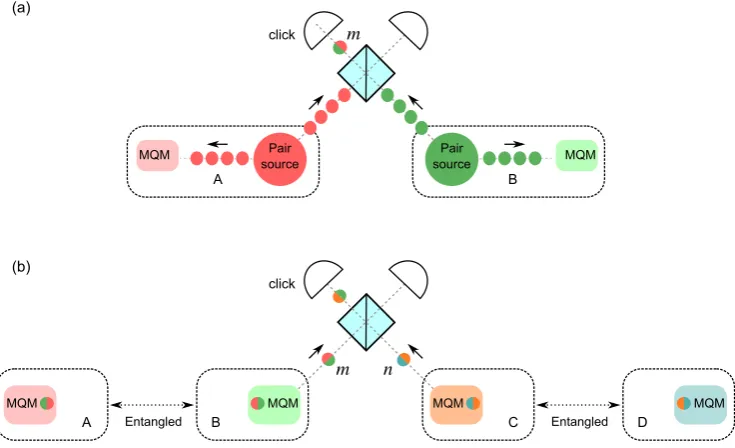
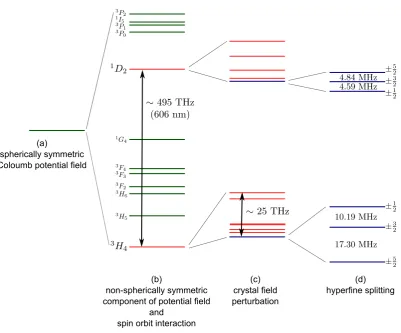
The entanglement generation step of a multimode repeater scheme is shown in
Fig-ure 1.4(a), where themth photon has been successfully detected, creating entanglement between memories A and B. If mode n was successfully stored between memories C and D, then to perform an entanglement swapping operation the two successful
tem-poral modes must be read out simultaneously and mixed on a beamsplitter as shown
in Figure 1.4(b).
click
Pair source MQM
A
Pair
source MQM
B
MQM B
click
MQM
A Entangled
MQM D
MQM
C Entangled (a)
[image:32.595.93.461.400.624.2](b)
Figure 1.4: Temporally multimode quantum repeater scheme. (a)N entangled pairs are sent perL0/ctransmission interval to increase the rate of entanglement generation.
Modemis successfully stored between memories A and B. (b) The different successful modes stored in each neighbouring link must be simultaneously recalled to perform an entanglement swapping operation.
tem-§1.6 Transition to solid state - rephasing spontaneous emission 19
poral multiplexing is considered here.
DLCZ is not an ideal photon pair source. The Stokes process is non-directional, so
the probability of a photon being emitted in the correct spatial mode is low for each
applied write pulse. This makes the situation worse. Now there is a low generation rate as well as a low transmission rate, further reducing the entanglement generation
probability.
Temporal multimode capability is difficult to achieve in the standard DLCZ protocol as all stored anti-Stokes photons are recalled at once when the read pulse is applied,
so distinguishability of the different modes is not preserved. The phase matching con-dition (Eqn. (1.5)) is only satisfied for the anti-Stokes photon for which entanglement
was generated. The anti-Stokes photons associated with the other write pulses will be
emitted non-directionally. Some will be emitted into the spatial mode of interest result-ing in uncorrelated noise. This limits the improvement of the entanglement generation
rate using a multimode approach to 2P0 for largeN instead ofN P0 [56].
Temporally multimode DLCZ
A modified DLCZ scheme was proposed in 2010 to allow temporal multiplexing in an
atomic vapour [56]. Reversible broadening is applied to the ensemble, for example with a magnetic field gradient. A write pulse is applied and a Stokes photon detected
while the field gradient is on. After time τ the field gradient is reversed and after an additional time τ the phase evolution caused by the field gradient will be canceled. If the read pulse is applied at this point the anti-Stokes photon will be recalled.
Now consider the situation where three write pulses are applied and a Stokes photon is detected in the mode of interest from the second one. The field is reversed at time
τ after the second write pulse. If a read pulse is applied after an additional time τ only one specific anti-Stokes photon will be in phase and will be emitted in the mode of interest. This is shown in Figure 1.5.
Recently, selective read-out of two separate time-bins was shown in cold Rb atomic ensemble [57]. The time-bins could be read out individually with selectivity of up to
92%. Non-classical correlations between the Stokes and anti-Stokes photons were not
shown.
1.6
Transition to solid state - rephasing spontaneous
emis-sion
The problems that arise from having a gaseous system with atomic motion can be
Field reversal
Figure 1.5: Active control of rephasing for DLCZ allowing distinguishability between different temporal modes. A field gradient is applied during the application of multiple write pulses. When the field gradient is reversed the total accumulated phase shift will be zero for only one applied read pulse allowing read out of one specific anti-Stokes photon.
solid state candidate is rare-earth ion doped crystals, which have the additional
ad-vantage of long coherence times on both the optical and hyperfine transitions, making
them particularly well suited to quantum applications (see Chapter 2).
Long optical coherence times allow an alternate scheme to DLCZ to be
imple-mented. The rephased amplified spontaneous emission (RASE) protocol, proposed by
Ledingham et al. in 2010 [58], can be considered a modified version of the DLCZ protocol that takes advantage of the properties of rare-earth ion doped crystals. A
collective atomic state is generated via the detection of amplified spontaneous emission (ASE) and rephased using photon echo techniques (§2.3.2). Similar to DLCZ, RASE
can act as both an on-demand single photon source and a source of entangled pairs of
photons with an in-built quantum memory that can be used as a quantum repeater node.
RASE uses resonant photon echo techniques, which have the advantage that the
bright driving fields are off when the signals are being detected, as opposed to the non-resonant Raman techniques used in DLCZ. This increases the possibility of low
noise operation. To use resonant techniques, long optical coherence times are required.
Because optical coherence times in atomic gas systems are short, such techniques cannot be applied in those systems.
In addition, solid state atomic ensembles are well suited to realising multimode
quantum memories. Temporally multimode quantum memories have been proposed [59, 60, 61] and demonstrated in the classical regime [62] in rare-earth ion doped
crys-tals. The key different quantum memory technologies implemented in rare-earth ions are discussed in more detail in§2.4.
§1.6 Transition to solid state - rephasing spontaneous emission 21
of the well-developed photonics industry to make integrated quantum devices using a
waveguide platform [17].
1.6.1 RASE
A simplified schematic of the RASE protocol is shown in Figure 1.6. Initially all the
atoms in an ensemble of two-level atoms are in the ground state |gi. An inversion pulse resonantly drives all the atoms into the excited state |ei. After some time an atom will spontaneously decay back the ground state, emitting a photon. Similarly
to the DLCZ protocol, detection of an amplified spontaneous emission (ASE) photon heralds a collective state of the ensemble. The collective excitation is then read out
by applying a resonant rephasing pulse and rephased amplified spontaneous emission
(RASE) is emitted time-symmetrically about the rephasing pulse. The RASE photon will be entangled with the initial spontaneous emission [58]. A detailed description of
the RASE protocol is given in §3.1.
Applied laser field
Detector signal
Inversion pulse
Rephasing pulse Spontaneous
emission
Rephased spontaneous
emission (a)
(b)
Figure 1.6: A simplified version of the scheme for rephasing spontaneous emission. (a) An inversion pulse is applied to an ensemble of ground state atoms to drive them into the excited state. Detection of spontaneous emission heralds a collective state of the ensemble. A rephasing pulse is applied to read out the collective excitation as a second optical field, rephased spontaneous emission, that will be entangled with the initial spontaneous emission. (b) The corresponding temporal pulse sequence.
The major experimental difficulty in implementing the RASE protocol is noise
by the pulse inverting the population. Two experimental demonstrations, undertaken
simultaneously, have been done to date, taking different approaches to eliminate this added noise. The first, undertaken by P. Ledingham et al., minimised the noise by
us-ing highly uniform drivus-ing pulses [18]. They violated the inseparability criterion with
98% confidence to show continuous variable entanglement between the ASE and the RASE in a two-level rare-earth system.
The second demonstration, by S. Beavan et al. [19], used a novel four-level
reph-asing sequence, such that the ASE and RASE fields could be spatially and spectrally distinguished from the noise. The four-level scheme includes storage of the atomic state
on the hyperfine ground states as a spin-wave, opening the door to much longer
stor-age times [63, 64]. Single photon detection was used and, while a clear correlation was shown between the ASE and RASE intensities, there was insufficient signal to noise to
show the correlation was non-classical.
It was unclear from these experiments whether RASE could function as a high fidelity, high efficiency non-classical light source incorporating a spin-wave quantum
memory, which is the question addressed in this thesis. The RASE protocol and the two previous experimental demonstrations are discussed in more detail in Chapter 3.
1.7
Summary
Quantum communication is a highly desirable application to come out of quantum mechanics. For a practical implementation two components are required, improved
single photon sources to guarantee security of the communication and a quantum
re-peater to extend the range of the communication.
Most experimental quantum repeater demonstrations have been based on the DLCZ
protocol, using an ensemble of atoms to generate on-demand single photons and store
them on the atomic transitions. Using linear optics and single photon detectors, en-tanglement can then be distributed across remote ensembles.
Atomic motion limits the achievable storage times in DLCZ-based quantum
memor-ies, so solid-state systems provide an attractive alternative, particularly rare-earth ion-doped crystals with long optical and hyperfine coherence times. The rephased amplified
spontaneous emission scheme used in this thesis can similarly be used as a source of entangled pairs of photons with an in-built quantum memory, paving the way for large,
Chapter 2
Solid state quantum technologies
utilising rare-earth ions
Rare-earth ions doped into solids have been extensively studied and are used for a
wide range of optical applications including solid state lasers, phosphors for lighting
and optical information storage [65]. In addition, rare-earths provide an attractive platform for developing quantum technologies due the their long coherence times and
potential for making scalable, integrated devices using waveguides.
This chapter looks at the general properties of rare-earth ion doped solids,
partic-ularly those relevant for quantum information processing (§2.1). This is followed by a
more in-depth characterisation of trivalent praseodymium-doped yttrium orthosilicate Pr3+:Y2SiO5 (Pr:YSO), the system used in the experiments described in this thesis
(§2.2). Some of the high resolution spectroscopic techniques used to characterise these
materials are introduced. Specifically, engineering the absorption profile using spectral holeburning and photon echo techniques (§2.3). Finally, the key different photon echo
based quantum memory technologies are introduced, especially those implemented in
rare-earth ion doped crystals (§2.4).
2.1
Properties of rare earths
The rare-earth ions consist of the lanthanide series as well as scandium and yttrium.
The most common oxidation state for rare-earth ions is 3+. The trivalent lanthan-ides are characterised by a partially filled 4f electron orbital, having the electronic configuration [Xe]4fn fornfrom 0 to 14.
The valence 4felectrons sit within filled 5sand 5porbitals because it is energetically favourable to fill these orbitals first. Figure 2.1 shows the radial distribution functions
of the orbitals of the rare-earth ion Gd+ [66]. The outer filled shells of electrons act as an effective Faraday cage, shielding the valence electrons from perturbations in the
crystal lattice. This shielding is responsible for many of the desirable properties of
rare-earth ion doped solids. The insensitivity to their crystal environment means that
[image:38.595.109.424.178.428.2]the spectra of rare-earth ion doped solids are similar to the free ion.
Figure 2.1: A theoretical prediction of the radial distribution functions of the orbitals of the rare-earth ion Gd+. Based on the data from [66]. The valence 4f electrons sit inside the filled 5sand 5porbitals, which shield the valence electons from perturbations in the crystal lattice.
Although the 4f electrons are well shielded from the environment they are not well shielded from the nucleus. This results in a gradual decrease in the radii of the
lanthanide ions called the lanthanide contraction. The radii of the lanthanide ions
decrease by 20% as the nuclear charge increases across the series [67].
2.1.1 Spectral properties
The strong shielding of the 4f valence electrons greatly simplifies the Hamiltonian of rare-earth ion doped crystals as the effect of the host can be treated as a perturbation
to the free-ion approximation. This section provides a brief overview of the different
interaction mechanisms that contribute to the energy level structure of rare-earth ion doped crystals. The different energy splittings associated with the interactions are
§2.1 Properties of rare earths 25
Interaction mechanism Frequency
Configuration splitting (4fN →4fN−15d) 1015 Hz
Non-central electrostatic field 100 THz
Spin-orbit interaction 10 THz
Crystal field interaction 1 THz
Hyperfine splitting 10 MHz - 1 GHz
Super-hyperfine splitting 1 MHz - 100 MHz
Table 2.1: Energy level scales for the different interaction mechanisms affecting rare-earth ions in crystals; tabulated by Liu [68].
In the central field approximation all n = 4 energy levels are degenerate. This degeneracy is lifted by the non-central part of the Coloumb repulsion. The degeneracy
of the 4f level is then lifted by the spin-orbit interaction, which mixes states with different orbital angular momentum L and spin angular momentum S but the same total angular momentum J =L+S. This results in (2J + 1)-degenerate states that are labelled according to the Russell-Sanders symbol
2S+1L
J
While the S and J values are specified numerically, the L values are specified as follows: L = S, P, D, F, G, H corresponds to L = 0, 1, 2, 3, 4, 5. The transition of interest in Pr:YSO is between the ground state 3H4 and 1D2.
The crystal field then acts as a perturbation on the free-ion levels, partially or
wholly lifting the 2J + 1 degeneracy depending on the crystal field symmetry. The higher energy 2J+ 1 levels of the manifold usually rapidly relax via phonon emission. As we are interested in states with long lifetimes, the only transitions considered here
are from the lowest level of the ground state to the lowest level of an optically excited state. When the energy gap between different multiplets is large enough, the lifetime
from the lowest level of the multiplet can be radiatively limited.
The magnetic properties of the transitions of rare-earth ions depend on whether
there is an even or odd number of 4f electrons. The ions with no unpaired electron (i.e. an even number of electrons) are referred to as non-Kramers ions while those with
sites, the 2J+ 1 degeneracy is fully lifted resulting in electronic singlet states1, which is the case for Pr in Pr:YSO. Additionally, these ions have no magnetic moment to first order, which makes them much less sensitive to magnetic fields than Kramers ions.
The crystal levels are further split into hyperfine levels by the second-order hyperfine
and quadrupole interactions. Pr has a nuclear spin of 52, resulting in three doubly-degenerate hyperfine ground and excited states in zero magnetic field with splittings of
the order of 10 MHz. The resulting energy level structure for Pr:YSO in zero magnetic
field is shown in Figure 2.2. The degeneracy of the hyperfine levels can be lifted by applying an external magnetic field.
2.1.2 Homogeneous broadening
The homogeneous linewidthΓhis the linewidth of an individual ion. The broadening is
due to dynamical processes and is the same for all ions in a crystal. The homogeneous linewidth is related to the coherence time T2 by
Γh =
1 πT2
= 1 2πT1
+Γφ. (2.1)
The first term on the right hand side of the equation describes the contribution
from the transition lifetime T1 and the second term describes the contribution of pure
dephasing processes. The lifetime depends on both radiative and non-radiative pro-cesses. The coherence time has an upper limit of T2 ≤2T1, with the transition being
‘lifetime-limited’ when the equality holds. Usually, additional decoherence methods
prevent T2 from reaching this limit.
The homogeneous linewidth is highly temperature dependent. At high temperature
coupling to phonons dominates the broadening. For liquid helium temperatures, i.e.
4.2 K, the contributions from phonon absorption and emission are negligible in Pr and linewidths of kHz or sub-kHz are obtainable for crystalline hosts.
The homogeneous linewidth can also be broadened by various Γφ contributions.
When the electric or magnetic field an ion is subjected to is perturbed due to the optical
excitation of another rare-earth ion, the resulting dephasing is known as instantaneous spectral diffusion2 (ISD) [72]. There are a number of mechanisms that can contribute to ISD with the dominant mechanism depending on the host and dopant. Usually for the singlet states in non-Kramers ions, ISD is attributed to electric dipole-dipole
interactions, for example, in Eu3+:Y2SiO5 [73]. An interesting exception is Pr3+-doped
materials, where non-equilibrium phonons are often the source of ISD. Spontaneous
1For sites with axial or higher symmetry non-Kramers doublets can occur due to the non-zero
angular momentum around the axis of symmetry.
2