This is a repository copy of Valorisation of rice husks using a TORBED® combustion
process.
White Rose Research Online URL for this paper:
http://eprints.whiterose.ac.uk/112946/
Version: Accepted Version
Article:
Blissett, R, Sommerville, R, Rowson, N et al. (2 more authors) (2017) Valorisation of rice
husks using a TORBED® combustion process. Fuel Processing Technology, 159. pp.
247-255. ISSN 0378-3820
https://doi.org/10.1016/j.fuproc.2017.01.046
(c) 2017 Elsevier B.V. This manuscript version is made available under the CC BY-NC-ND
4.0 license http://creativecommons.org/licenses/by-nc-nd/4.0/
[email protected] https://eprints.whiterose.ac.uk/
Reuse
Unless indicated otherwise, fulltext items are protected by copyright with all rights reserved. The copyright exception in section 29 of the Copyright, Designs and Patents Act 1988 allows the making of a single copy solely for the purpose of non-commercial research or private study within the limits of fair dealing. The publisher or other rights-holder may allow further reproduction and re-use of this version - refer to the White Rose Research Online record for this item. Where records identify the publisher as the copyright holder, users can verify any specific terms of use on the publisher’s website.
Takedown
If you consider content in White Rose Research Online to be in breach of UK law, please notify us by
Valorisation of rice husks using a TORBED®
combustion process
R Blissetta*, R Sommervilleb, N Rowsonb, J Jonesc, B Laughlind a Torftech R&D Ltd, 188 New Greenham Business Park, Thatcham, RG19 6HW, UK
b School of Chemical Engineering, University of Birmingham, Edgbaston, B15 2TT, UK
c Energy Research Institute, School of Chemical and Process Engineering, University of Leeds, Leeds LS2 9JT, UK dTorftech (Canada) Incorporated, Unit 11, 1155 North Service Road, Oakville, Ontario L6M 3E3, Canada
Abstract
World production of rice exceeds 750 million tonnes per year of which a fifth is removed in the form of rice husk during the milling process. The use of rice husks as a source of sustainable and renewable energy is often hindered by lack of capital and a poor understanding of rice husk combustion
characteristics. This results in the selection of poor quality technology which generates significant quantities of harmful crystalline silica waste. Despite previous work in the area, detailed
characterisation of the combustion of rice husk ash in a TORBED reactor across a wide temperature range has not yet been attempted and little effort has been directed towards assessing the economic viability of generating quality rice husk ashes. The use of a TORBED reactor enables low residual carbon after combustion without the generation of harmful crystalline material. Rice husk was combusted in a 400mm reactor at temperatures between 700-950°C. In the subsequent
characterisation studies the resulting materials were shown to be fully amorphous high purity silica (> 95%) and were readily digested in a series of alkaline digestion experiments. Complete silica
conversion was only possible using uneconomic Na2O/SiO2 ratios and further optimisation of the
combustion process to generate higher surface area material is necessary to increase the digestion rates further. Provisional economic analysis suggests that sales of the by-product enhance the returns from rice husk based power generation. TORBED reactors enable the combustion of rice husk with considerable operating flexibility and they generate products that could be used to displace resource intensive products and processes thus, added value from the by-products can be obtained by using TORBED reactor technology.
1. Introduction
Rice husk (RH) represents a globally significant source of biomass material that can be used to generate electricity in some of the world’s poorest regions. To be a truly sustainable method of energy generation the following points must be addressed: (1) there must be meaningful quantities available; (2) the biomass source must not compete with food sources for land usage; and (3) the energy generation process must not emit harmful substances to the environment.
The world paddy rice production has been estimated to be 750 MT in 2015. This will generate approximately 150 MT of RH. Each tonne of RH can produce approximately 800 kWh of electricity. For a country such as Cambodia, which generates 1.85 MT of RH each year, this is sufficient to meet almost half of the annual electricity consumption of 3.1 TWh [1, 2]. However, even for their more prosperous and energy hungry neighbour, Thailand, the RH generated each year has the potential to meet around 3% of the annual electricity demand.
addition to causing the debilitating lung condition silicosis [4]. RHA is generally generated in the form of a fine powder which is easily entrained into the air. The avoidance of the inhalation of this powder is a vital health and safety issue, not only to plant operators, but also to local inhabitants.
There is also an economic gain to be made from production of amorphous silica during a combustion process. Naturally occurring crystalline silica of high purity is plentiful in the form of sand. It is a low value product. When considering the valorisation of RH, the value of the residual ash is often
neglected. However, the inorganic fraction of the RH can comprise up to 20%. Significant quantities of it are generated during combustion. In crystalline form this RHA poses a potential hazard and has zero, or even negative residual value. However, amorphous silica is a highly desirable product for a wide range of applications [1]. It is also much easier to digest in alkaline medium than crystalline silica and this potentially represents a gentler route for the production of sodium silicates and/or synthetic zeolites [5].
Figure 1 Schematic of the 400mm pilot EBR reactor located in Ontario, Canada.
Although RH is easy to combust, the current technologies available for combustion do not control the temperature in the precise manner which is required to avoid the formation of crystalline silica. In recent years, a new reactor technology has been used to combust RH. In Cambodia a 2MWe TORBED combustor is operating in the service of controlled combustion of RH [6]. Although the technology has been demonstrated at a commercial scale, there has so far been little interest in the academic literature. A previous paper investigated the use of RHA generated by a TORBED reactor as an admixture in concrete [7]. Three different RHAs were produced but they only covered two temperature ranges. The current paper documents the use of a TORBED reactor to combust a parboiled RH from Arkansas, US at a series of six temperatures ranging from 700-950°C . The RHA generated at these temperatures is characterised and its susceptibility to digestion by alkaline medium at low temperatures and pressures is investigated.
2. Materials and Methods
2.1.
Combustion
Rice husk was obtained from Riceland Foods, Arkansas in the US. The rice husk provided was parboiled and dried prior to shipping. Trials of RH combustion were performed on a pilot scale at the Torftech pilot plant in Ontario, Canada configured as per Figure 1. Unlike some fluidised bed
400°C via modulation of the burner. The feeder was then started and was modulated to maintain the desired temperature set-point at T3.
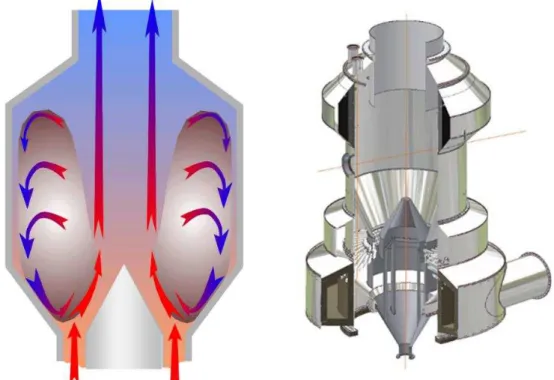
The test samples that were analysed in this study were produced at the conditions outlined in Table 1. The reactor used was 400mm in diameter and of the expanded bed type (EBR) as shown in Figure 2. The particles are introduced into a high velocity central vortex. The particles are entrained into this cyclonic gas stream and move radially from the centre of the reactor to the walls. The particles then detach from the central gas stream and are transferred downwards to the base of the reactor from where they are re-entrained into the central stream [8]. Because of the recirculating action of the EBR, the gas velocities that can be passed through are extremely high relative to a fluidised bed. This has several benefits but pertinent to RH combustion is the small load in the reactor, which enables a very fine temperature control. In addition to this, the high gas and particle velocities result in attrition of the particles, which increases the surface area for reaction, and so enables very efficient burning of the RH.
Figure 2 Circulating flow pattern (left) and 3d model (right).of the EBR .
Table 1 – Trial summary data. Average husk feed rate was 26.5 kg/hr and ash recovery was circa 15%
Sample Identifier
Duration
(mins)
Inlet Temp
(°C)
Target Temp
(°C)
Air Flow (kg/hr)
Approx Ash production rate
(kg/hr)
RHA700 15 500 700 580 2.8
RHA750 20 500 750 560 3.1
RHA800 20 500 800 580 3.5
RHA850 15 525 850 570 4.1
RHA900 20 575 900 560 3.8
2.2.
Characterisation
The particle size distribution was analysed using a Malvern Mastersizer 2000. Samples were
dispersed in distilled water using a Hydro 2000SM dispersion unit. Bulk solid phase chemical analysis was conducted using a Bruker S8 Tiger wavelength dispersive X-ray fluorescence (XRF)
spectrometer. Samples were formed into pressed pellets for XRF using 0.50 g of RHA and 0.10g of Chemplex SpectroBlend binder. Loss-on-ignition (LOI) was conducted on 2.00 g samples in a Carbolite ELF furnace for 2 hours at 900°C or for 4 hours at 500°C. Mineralogical analysis was conducted using a Bruker D8 reflection x-ray diffractometer (XRD). Samples were ground in a pestle and mortar and analysed for 1 hour each. Samples were coated with gold in an Emscope SC500 sputter coater and analysed with a Jeol JSM-6060LV scanning electron microscope (SEM). Liquid phase chemical analysis of alkaline leachate was conducted by atomic absorption spectroscopy (AAS) using a Perkin Elmer AAnalyst 800.
2.3.
Digestion
RHA samples were leached under reflux conditions in 2 M sodium hydroxide for 6 hours. 80 g of sodium hydroxide and 800 ml of distilled water were brought to boiling point in a 1L round bottomed borosilicate reaction flask with a heating mantle and coil condenser. The vessel was stirred at 300 rpm using a PTFE coated stirrer shaft via a stirrer gland. Upon reaching boiling point, 50 g of RHA was added to the sodium hydroxide solution and washed into the vessel with 200ml of distilled water. 25 ml samples were taken via a syringe and flexible tube. These samples were filtered using a 25-50
m sintered glass Büchner funnel, and the leachate retained for AAS analysis. This method was repeated with 8 M sodium hydroxide using 12.5 g RHA on the RHA700 sample for 1 hour. Two further experiments were conducted using 25 and 12.5 g of RHA700 with 2 M sodium hydroxide for 1 hour.
3. Results and Discussion
3.1.
Combustion
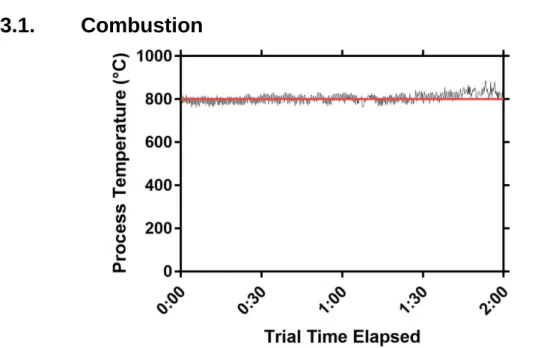
Figure 3 Stability of the TORBED processing chamber temperature over a pilot scale test of 2 hours.
In general, the combustion of the rice husk ash in the TORBED EBR reactor was quite well controlled. Figure 3 illustrates the process chamber temperature of a 2 hour trial with a target temperature of 800°C. Although the chamber temperature periodically cycles above and below the target
been tuned and so it is likely that further optimisation can be made in temperature control. It should also be noted that during short run trials, the reactor and its surrounding refractory does not have time to reach full steady state conditions; experience has shown on full scale operating plants that tight reactor temperature control is possible to ±2°C.
3.2.
Particle size
Figure 4 Particle size distribution of RHA generated at 700°C ( ), 750°C (), 800°C (), 850°C (), 900°C (), and 950°C ( ).
The feed rice husk particles are boat shaped particles that are 8-10 mm long and around 2 mm in width. It is clear from Figure 4 that there is a large amount of attrition occurring in the combustion process. The ashes that are obtained from all of the different combustion temperatures have median particle sizes in the range 30-35 µm. The particles are slightly finer than those reported by Nehdi et al. [7] of 44-46 µm who also used a TORBED combustor. However, the particles are considerably finer than those that are normally reported for fluidised beds of 107 µm [7] and < 375 µm [9]. This is likely to be caused by the relatively higher gas velocities employed in the TORBED combustor allied to the recirculating flow patterns compared to fluidised beds. This is of potential economic benefit in utilisation of the ash, as it minimises the grinding that might be required by a particular application.
Figure 4 indicates no definitive correlation between particle size and combustion temperature. The ash produced at 700°C contained the finest particles while the ash produced at 950°C produced th e coarsest. In the intermediate temperatures the particle sizes were very similar which makes it difficult to draw any meaningful conclusions from the data. It is possible that the reason the 950°C as h is the coarsest is that at this temperature some of the ash particles begin to adhere to each other. However, this conclusion is not fully borne out by the data and so further investigation is required to confirm its validity.
3.3.
Chemical Analysis
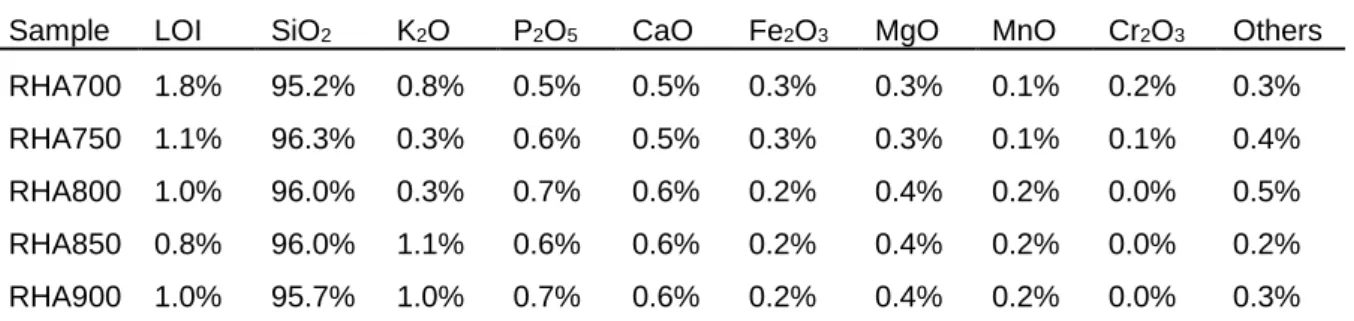
Table 2 Bulk chemical analysis of RHA generated at different processing temperature.
Sample LOI SiO2 K2O P2O5 CaO Fe2O3 MgO MnO Cr2O3 Others
RHA700 1.8% 95.2% 0.8% 0.5% 0.5% 0.3% 0.3% 0.1% 0.2% 0.3%
RHA750 1.1% 96.3% 0.3% 0.6% 0.5% 0.3% 0.3% 0.1% 0.1% 0.4%
RHA800 1.0% 96.0% 0.3% 0.7% 0.6% 0.2% 0.4% 0.2% 0.0% 0.5%
RHA850 0.8% 96.0% 1.1% 0.6% 0.6% 0.2% 0.4% 0.2% 0.0% 0.2%
RHA950 0.8% 96.7% 0.4% 0.7% 0.6% 0.2% 0.3% 0.2% 0.0% 0.1%
Combustion at all of the experimental temperatures yielded ash with a high purity of silica (95.2-96.7 wt%). The impurities present in the greatest quantity were oxides of potassium and phosphorous. These results are consistent with other studies in which the residual carbon in the ash reached similar levels [3, 7, 10]. The high purity of the ash in terms of silica makes the material very attractive for the purposes of silica extraction.
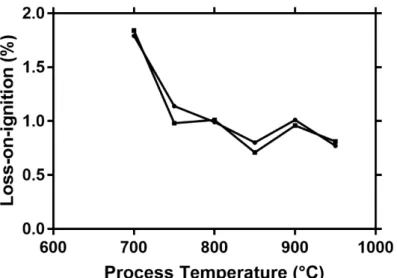
The residual carbon was measured by loss-on-ignition at two temperatures: 900°C and 550°C. The results are compared in Figure 5 which shows that there is no difference between the two
temperatures of analysis. This means that it is unlikely that any mineral carbonates are decomposing at the higher temperature and causing misleading results. The LOI data is very similar for
experimental combustion temperatures of 750-950°C. Values of < 1wt% indicate that extremely high combustion efficiencies are occurring in the TORBED reactor. The best value for LOI reported from a real world fluidised bed furnace in Brazil was 3 wt% [3].
Figure 5 Loss-on-ignition measurements performed at two analysis temperatures, 550°C () and 900°C ( ), of RHA generated at different TORBED processing temperatures.
3.4.
Mineralogy
The XRD patterns of the six RHA are displayed in Figure 6. Ashes obtained over the whole temperature range exhibit the broad band centred at 22° (2 ) that is typical of amorphous silica. Interestingly, the only evidence of cristoballite formation occurs when the ash is combusted at 950°C at which point some small sharp reflections are observed on top of the broad amorphous background.
Reported optimal temperatures for limiting the crystallisation of silica within the literature vary widely: < 725°C [10]; limited crystallisation at 700°C [11]; and < 900°C [12]. Crystal lisation is not merely a function of temperature. In reports cited by Nehdi et al., [7] silica remains amorphous up to 680°C provided the residence time is less than one minute. Alternatively, RHA silica can remain in amorphous form if temperature is < 900°C and residence time is < 1 hour or it crystallises if th e temperature > 1000°C and residence time is > 5 min.
to the fluidised bed and the entrained flow reactor. Although this is quite conceivable, it might also be due to the longer residence time of the moving grate system.
.
Figure 6 XRD patterns of RHA samples generated at different processing temperatures.
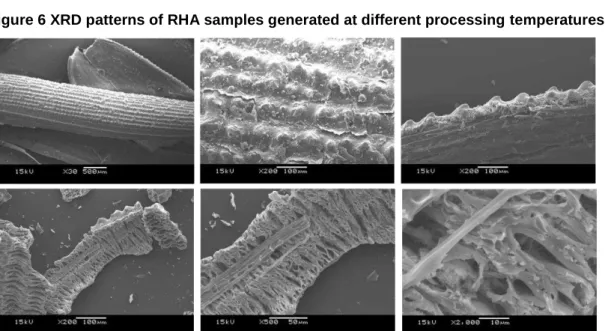
Figure 7 Morphology of raw rice husk by SEM imaging.
3.5.
Morphology
Figure 7 shows images of raw RH. The morphology of the surface of the raw RH exhibits all the characteristic features that have been observed previously [13]. The outer surface is highly ridged; the ridges are arranged in a near linear profile and are punctuated by prominent conical protrusions. Underlying the outer epidermis are layers of thick walled fibres which are evident in the images of the fractured hulls. Park et al., [13] performed elemental mapping and EDS analysis on RH specimens and concluded that the silica in the RH is concentrated in the outer layers of the epidermis and is especially concentrated in the dome like protrusions that are apparent. The fact that the silica is present at the surface of the RH is relevant to combustion in a TORBED reactor because it means that the silica particles are subject to attrition forces within the reactor ash as they are recirculated. This is the reason that the creation of much finer particles sizes than other technology is possible.
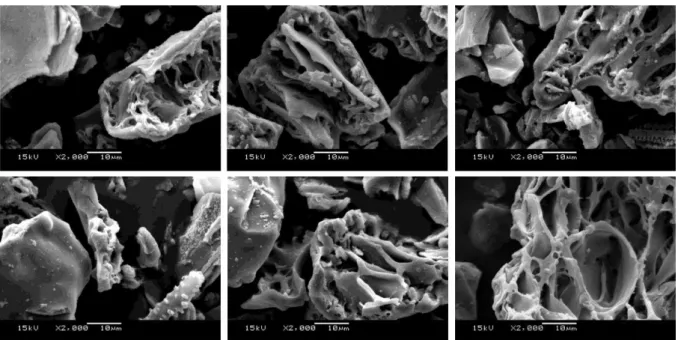
crystal structures in the images which provides secondary confirmation of the XRD results. The images suggest two things: (1) the silica in the parent RH has not melted into a structure of sufficiently low viscosity to form spherical ash particles as often observed in fly ash originating from coal [14]; and (2) the silica has instead fused together in its original morphological form to provide the network of very large pores (1-10 µm) that are dominant.
Contrary to images published by other researchers [15], there is no evidence of an extensive network of smaller pores (<1 µm). However, the major difference between the current work and that study, is that the smaller pore network was found in ash generated at 500°C which had a significant
component of carbon that did not combust (~12%). Under the conditions of combustion, this carbon is likely to have been activated to a certain extent which might explain the differences.
Figure 8 Morphology of RHA generated at different processing temperatures: 700°C (top le ft); 750°C (top centre); 800°C (top right); 850°C (bottom right); 900°C (bottom centre); and 95 0°C
(bottom right).
3.6.
Surface Area
The surface area of the ash is an important parameter for assessing suitable applications. Figure 9 shows the effect of the processing temperature on the BET surface area of the residual ash. The surface area is the highest at the lowest temperature and shows non-monotonic reduction with increasing temperature. Three potential explanations for this behaviour can be postulated: (1) at higher temperatures, gasification reactions explode the internal structure of the RH leading to a decrease in pore volume [16]; (2) the adhesion of the silica particles to each other increases as the temperature increases; and (3) that the carbon content of the lower temperature ashes is providing most of the porosity.
There is a slight suggestion in the particle size data of Figure 4 that some agglomeration occurs in the higher temperature material and this would support hypothesis (2). Additionally, the LOI data
presented in Figure 5 shows a trend of similar appearance to Figure 9 which would support hypothesis (3). However, if the carbon in the samples was hypothetically 500 m²/g across all
temperatures then a reduction from 1.8 to 0.8 wt% LOI would not adequately explain the reduction in surface area of 35 to 5 m²/g. In this case, it would require the residual carbon of the higher
radius pores. Given that all of the mechanisms are partially supported by the data, the current study provides no conclusive explanation for the observed relationship between temperature and surface area.
The surface area range (5-35 m²/g) is entirely consistent with some reports in the literature [3, 7] but is substantially lower than others; Liou [16], reported surface areas of up to 185-235 m²/g while Bie et al. [17] reported surface areas of 27-86 m²/g. These two specific examples are important because they are from low carbon ashes and so the effect of carbon is controlled for. In both these studies the higher temperature runs produced the lower surface area RHA. Indeed Bie et al. [17] reported surface areas of 27 m²/g for husk combusted at 700°C for 1 hour and 86 m²/g for husk combusted at 600 °C for one hour; the LOI for each sample was 1.5 and 3.2 wt% respectively. This would suggest that carbon content may not be the overriding factor and that ash adhesion is more important.
Potassium appears to play an important role in the development of the surface area of RHA. This has been shown by researchers who have treated RH samples with HCl prior to combustion and have found that surface areas of the RHA are dramatically increased relative to the RH that has been combusted without treatment [18, 19]. The melting point of the silica is governed by the extent of potassium component in the husk. The potassium decreases the melting point of the glass. Real, Alcalá [18] attributed this result to the fact that washing with HCl removes K+ cations from the ash which interact with the silica to form a potassium silicate or short range tridymite rather than a high surface area silica gel. The RH in the current study has been parboiled and so it is somewhat unexpected that the surface areas are relatively low. It might be expected that parboiling would remove the majority of potassium [20]; Table 2 shows that residual potassium is between 0.3-1.1 wt% and exhibits no trend with temperature. Although this value is relatively low, it is still considerably higher than that in the ash that resulted from the combustion of acid washed RH in the Real, Alcalá [18] study (0.01 wt%). It is possible, that at the temperatures used in the current study, that the potassium content was sufficient to react with silica locally to form potassium silicates which melt and cause particle adhesion and potentially fill pores.
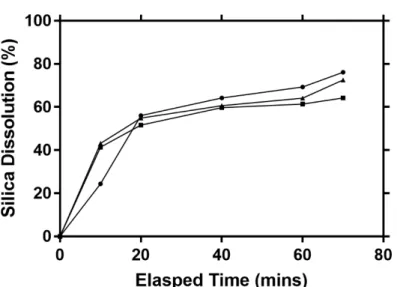
Figure 9 RHA silica dissolution in 2M NaOH at a solids loading rate of 50 g/L for RHA generated at 700°C (), 750°C (), 800°C (), and 950°C ( ).
Table 3 Surface area and pore size characteristics of raw RH and RHA generated at different processing temperatures.
Sample Husk 700 750 800 850 900 950
3.7.
Silica dissolution
The rate of silica dissolution for different ashes that have been processed at different temperatures is shown in Figure 10. It is apparent, that in the initial stages of reaction, the rate is in the order 700°C > 750°C > 800°C > 950°C. This is consistent with the measured BET surface areas of the samples which follow the same order. It is likely that the greater surface area of the samples produced at lower temperatures increases the silica exposure to the reacting sodium hydroxide. Also, to consider is the greater degree of ordering of the high temperature sample. XRD data has shown that a small amount of cristoballite is present in the sample 950°C which would confer greater resistance to attac k by alkaline solution. The effect of surface area and silica structure in this paper is in agreement with published literature using porous amorphous silicas [21].
However, once the conversion of silica reaches 60%, the rate for all samples slows significantly, and there is little difference between them. It is possible that this is an effect of the hydroxide ion
concentration decreasing as silica is converted to sodium silicate. Alternatively, as the reaction proceeds, the ash become less porous, and the surface available for reaction becomes limiting.
Jendoubi, Mgaidi [22] state that because the reaction between sodium hydroxide and silica is a surface reaction, only a small proportion of the solid is in contact with the liquid. Therefore, the OH is always in excess of the solids independently of the initial Na2O/SiO2 ration used. This is only true at
the beginning of the reaction and we may assume in this case that the reaction proceeds according to the following equation:
SiO2(s) + 2OH- H2SiO42-
The Na2O/SiO2 ratio for the experiments conducted in Figure 10 is 2.5 which means that on a global
basis, the OH is in excess of that required for stoichiometric conversion. However, as the reaction proceeds, OH is consumed and it is possible that the concentration of OH ions is not sufficient to maintain initial reaction rate.
Figure 10 RHA silica dissolution in 2M NaOH at a solids loading rate of 50 g/L for RHA generated at 700°C (), 750°C (), 800°C (), and 950°C ( ).
To assess the effect of the Na2O/SiO2 ratio the quantity of RHA in each batch reaction was varied.
Figure 11 highlights that the results to not conform to any distinct pattern. Initially, the lowest concentration of silica (12.5 g RHA /l) reacted the most slowly, however, after 20 minutes this then proceeded to react faster than both the 25 g/l and the 50 g/l sample. It is likely that, because the ratio of Na2O/SiO2 ratio increases at lower solids loadings, the OH ion concentration is not depleted as
Figure 11 RHA generated at 700°C silica dissolution in 2M NaOH at solids loading rates of 12.5 g/L ( ), 25 g/L () and 50 g/L ().
To test this, the effect of using a higher initial concentration of sodium hydroxide is shown in Figure 12. The reaction proceeds at a greater rate using 8M sodium hydroxide relative to 2M. The total extent of silica dissolution reaches almost 95% after 130 minutes of reaction. To obtain total conversion of the silica in the RHA, it appears that using 2M sodium hydroxide is insufficient at the reaction conditions studied herein. Other researchers have also documented that increasing the sodium hydroxide concentration increases the yield of silica extracted from RHA; however in that case the no improvement was seen on increasing the concentration to more than 1M sodium hydroxide [23]. The overall yield was 91% vs the 95% in the current study. These differences are likely to be a result of the relatively low surface areas of the material in this study.
Figure 12 RHA generated at 700°C silica dissolution at solids loading rates of 12.5 g/L in 2M NaOH () and 8M NaOH ( ).
3.8.
Process Economics
practice. The power price was set to $54/MWh which is equal to that of a recent decision by the Vietnamese government on feed-in-tariffs for biomass combined heat and power plants [25]. This price is low relative to the feed-in-tariff of another rice producing south east Asian country Thailand, for which the tariff is $110/MWh for biomass plants greater than 3MWe in capacity [26].
The ash sales value was varied between $0-200/T. These prices compare to values provided by Bergqvist et al. [24] of $40-160/T although they noted that high amounts of residual carbon in the ash reduced this to below $1/T. It is also useful to consider the prices of the potential products that the ash may replace. RHA can be used a supplementary cementitious material in cement if the LOI is low enough and fineness specifications are met. Cement is currently selling in the US for an average of $105.5/T [27]. RHA has been shown to improve the durability of concrete and has been used for high performance cement [12]. It is reasonable to suggest that this being the case, a price similar to concrete may be obtained. In the manufacture of sodium silicate, high purity silica sand is used as a raw material. Industrial sand is currently selling in the US for an average of $87/T [28]. Traditionally sodium silicate is made by fusing silica sand and sodium carbonate together at 1400°C which i s highly energy intensive. Another process route exists which relies on alkaline digestion which has a lower energy demand but higher raw material costs. However, this relies on digestion at high pressure in an autoclave. Use of the current material would remove the requirement to operate at temperatures above 100°C. It is again reasonable to suggest that a value of RHA would reach parity or excee d that of industrial sand.
Two different plant price regimes were considered: $0.5-1.5m per MWe was considered to be low cost technology not capable of generating ash of sufficiently good quality to sell, it operates for 5000 hours per year, and of low efficiency (1.4 tonne of feed per MWe) $1.75-3.5m per MWe is considered to be high performance technology, it is capable of generating high quality ash, it operates for 8000 hours per year, and is of high efficiency (1.1 tonne of feed per MWe). These values are broadly consistent with the techno economic analysis performed in 2008 [24].
Ignoring the effect of how the plant is financed, the post-tax project IRRs were calculated for a different range of ash sales values and the results are depicted in Figure 13. A nominal target of 10% is shown on the graph although this is only appropriate for an availability based project without significant mechanical or process risk. The hurdle rate IRR is project specific and would reflect the cost of the sovereign risk that investors were comfortable with taking e.g. a higher return would be expected in Vietnam than in the Unites States; returns in the range of 10-15% would probably indicate an economic project.
Figure 13 highlights how important the ash sale value is to any power project based on RH. For the low-cost technology options, good returns are only made when the cost of the plant is less than $0.9m per MWe. It must be noted that even if these conditions could be met, it is possible that in the future, the proper costing or capture of environmental externalities would not allow projects such as these to proceed. For the high-performance technology, the ash sales price is extremely important. With no residual value the projects are unlikely to be economic even for the lowest cost considered here. However, when applying a value of > 50 $/T, the projects become increasingly economically attractive.
Figure 14 depicts a one-way deterministic sensitivity analysis surrounding a plant of 10MWe that requires $20m of total investment to build with an ash price of $100/T. Investment cost and power price have significant impact on the profitability of the project. An increase in the power price that may come about via government intervention, market forces or geographical factors, will increase the return on investment significantly. The return on investment is also sensitive to the operating costs but it is insensitive to the fuel price because of the low cost of RH considered in the base case scenario.
can reasonably be expected to have a value somewhere in the region that would realise good economic returns.
Figure 13 Project economics of rice husk power generation using both low cost and high cost technology. Low cost technology is assumed to generate no ash of resale value and high sot
technology examines the economics for 5 different ash values.
Figure 14 One-way deterministic sensitivity analysis examining the effect of investment cost, operating expenditure, fuel price, and power price. Base case plant is 10MWe, $20m total
investment and an ash price of $100/T.
4. Conclusion
For the first time, it has been shown that it is possible to combust RH at the temperatures of 700-900°C using a TORBED reactor without generating crystalline silica. Even when com busting at the highest temperature studied (950°C), there is evidence of only a small amount of cristoballite i n the XRD pattern. In general, burn-out efficiency of the RH was good across all temperatures and silica purity of > 95% was achieved. In contrast to other technologies employed at pilot scale, fully amorphous RHA was generated with residual carbons of < 1wt%.
rate of reaction. When using a Na2O/SiO2 ratio of 2.5, digestion slowed at around 60% and did not
reach 100% conversion. Using higher Na2O/SiO2 ratios did allow for ~95% conversion in around 2
hours but these are unlikely to be economic. Further optimisation of the combustion process to generate higher surface area material might be necessary to increase the digestion rates further.
An economic analysis of an integrated energy generation RHA production facility showed that sales of the by-product enhance the returns from rice husk based power generation. The sales price range at which this occurs is comparative to both cement and industrial sand prices for which RHA could plausibly substitute.
We have shown in this paper that utilising a high performing technology for the generation of energy from RH can compete on an economic basis with cheaper technology, if the use of RHA in higher value applications can be established.
Acknowledgements
Funding: This work was supported by the Royal Commission for the Exhibition of 1851; Innovate UK (R Blissett KTP grant); and Torftech R&D Ltd.
References
1. Pode, R., Potential applications of rice husk ash waste from rice husk biomass power plant. Renewable and Sustainable Energy Reviews, 2016. 53: p. 1468-1485.
2. International Energy Agency, IEA Energy Atlas. [Accessed 01/11/2016 http://energyatlas.iea.org/#!/profile/WORLD/KHM], 2016.
3. Fernandes, I.J., et al., Characterization of rice husk ash produced using different biomass combustion techniques for energy. Fuel, 2016. 165: p. 351-359.
4. Crystalline Silica Exposure Health Hazard Information. 2002, Occupational Safety and Health Administration.
5. Roschat, W., et al., Rice husk-derived sodium silicate as a highly efficient and low-cost basic heterogeneous catalyst for biodiesel production. Energy Conversion and Management, 2016. 119: p. 453-462.
6. Saxton, A. The price is rice. Southeastern Globe Communications. [Accessed 13/10/2016 http://sea-globe.com/price-rice-torbed-cambodia-angkor-rice-southeast-asia-globe/], 2013.
7. Nehdi, M., J. Duquette, and A. El Damatty, Performance of rice husk ash produced using a new technology as a mineral admixture in concrete. Cement and Concrete Research, 2003. 33(8): p. 1203-1210.
8. Dodson, C.E. and V.I. Lakshmanan, An innovative gas-solid torbed reactor for the recycling industries. JOM, 1998. 50(7): p. 29-31.
9. Natarajan, E., A. Nordin, and A.N. Rao, Overview of combustion and gasification of rice husk in fluidized bed reactors. Biomass and Bioenergy, 1998. 14(5–6): p. 533-546.
10. Chen, G., et al., Production of amorphous rice husk ash in a 500 kW fluidized bed combustor. Fuel, 2015. 144: p. 214-221.
11. Della, V.P., I. Kühn, and D. Hotza, Rice husk ash as an alternate source for active silica production. Materials Letters, 2002. 57(4): p. 818-821.
12. Nair, D.G., et al., A structural investigation relating to the pozzolanic activity of rice husk ashes. Cement and Concrete Research, 2008. 38(6): p. 861-869.
13. Park, B.-D., et al., Characterization of anatomical features and silica distribution in rice husk using microscopic and micro-analytical techniques. Biomass and Bioenergy, 2003. 25(3): p. 319-327.
15. Chandrasekhar, S. and P.N. Pramada, Rice husk ash as an adsorbent for methylene blue— effect of ashing temperature. Adsorption, 2006. 12(1): p. 27-43.
16. Liou, T.-H., Evolution of chemistry and morphology during the carbonization and combustion of rice husk. Carbon, 2004. 42(4): p. 785-794.
17. Bie, R.-S., et al., Studies on effects of burning conditions and rice husk ash (RHA) blending amount on the mechanical behavior of cement. Cement and Concrete Composites, 2015. 55: p. 162-168.
18. Real, C., M.D. Alcalá, and J.M. Criado, Preparation of Silica from Rice Husks. Journal of the American Ceramic Society, 1996. 79(8): p. 2012-2016.
19. Yalçin, N. and V. Sevinç, Studies on silica obtained from rice husk. Ceramics International, 2001. 27(2): p. 219-224.
20. Deng, L., T. Zhang, and D. Che, Effect of water washing on fuel properties, pyrolysis and combustion characteristics, and ash fusibility of biomass. Fuel Processing Technology, 2013. 106: p. 712-720.
21. Greenberg, S.A., The Depolymerization of Silica in Sodium Hydroxide Solutions. The Journal of Physical Chemistry, 1957. 61(7): p. 960-965.
22. Jendoubi, F., A. Mgaidi, and M. El Maaoui, Kinetics of the dissolution of silica in aqueous sodium hydroxide solutions at high pressure and temperature. The Canadian Journal of Chemical Engineering, 1997. 75(4): p. 721-727.
23. Kalapathy, U., A. Proctor, and J. Shultz, An improved method for production of silica from rice hull ash. Bioresource Technology, 2002. 85(3): p. 285-289.
24. Bergqvist, M.M., et al., A techno-economic assessment of rice husk-based power generation in the Mekong River Delta of Vietnam. International Journal of Energy Research, 2008. 32(12): p. 1136-1150.
25. Decision on support mechanisms for the development of biomass power project in Vietnam (biomass feed-in tariff). Internation Energy Agency. [Accessed 07/10/2016
http://www.iea.org/policiesandmeasures/pams/vietnam/name-140476-en.php], 2014.
26. Tarrago, R. Understanding the Thai renewable energy market. [Accessed 09/11/2016 http://www.sunwindenergy.com/review/understanding-thai-renewable-energy-market], 2016.
27. Oss, H.G.v., Mineral Commodity Summaries. U.S Geological Survey, 2016: p. 44-45.