0022-538X/82/030868-09$02.00/0
Effect of Deletions in Adenovirus Early Region 1 Genes upon
Replication of Adeno-Associated
Virus
CATHERINEA.LAUGHLIN,1 NICHOLAS JONES,2ANDBARRIE J.CARTER'*
Laboratory ofExperimentalPathology, NationalInstitute ofArthritis, Diabetes, and Digestive and Kidney
Diseases, Bethesda, Maryland2020S,'and Departmentof Biological Sciences, Purdue University, West
Lafayette,Indiana 479072
Received 7 July1981/Accepted 13 October 1981
The growth of adeno-associated virus (AAV) is dependent upon helper
func-tions provided by adenovirus.We investigatedtherole ofadenovirusearly gene
region 1 in the AAV helperfunctionby using six adenovirus type 5 (AdS) host
range mutantshaving deletions inearlyregion 1. These mutants do not grow in
human KB cells but are complemented by and grow in a line of adenovirus-transformed human embryonic kidney cells (293 cells); 293 cells contain and
express the AdS early region 1 genes. Mutants having extensive deletions of
adenovirus early region la(d1312) or regions laand lb (d1313) helped AAV as
efficientlyaswild-type adenovirus in 293cells, butneithermutant helped in KB
cells. NoAAVDNA,RNA, orprotein synthesiswasdetected inKBcells in the
presenceof themutantadenoviruses. Quantitative blotting experiments showed
thatat20hafterinfection with AAV and either d1312ord1313 therewaslessthan
oneAAVgenome percell. InKBcellsinfected withAAValone, the unreplicated
AAV genomes were detected readily. Apparently, infection with adenovirus
mutant d1312 or d1313 results in degradation of most of the infecting AAV
genomes.Wesuggestthatatleastanadenovirus region lb product (and perhapsa
region la product also) is required forAAVDNAreplication. This putativeregion
lb function appears to protect AAV DNAfrom degradation by an
adenovirus-inducedDNase. Wealso testedadditional AdSmutants(d1311, d1314,sub315, and sub316). All ofthese mutantswere inefficienthelpers, and they showed varying degrees of multiplicity leakiness.d1312anddl313complemented each otherforthe AAVhelperfunction,and each was complemented byAd5tsl25at the
nonpermis-sivetemperature.Thedefect in region1mutantsforAAVhelperfunctionacts at a
different stage of theAAV growthcycle than the defect in the region2 mutant
ts125.
The replication of adeno-associated virus (AAV),adefective human parvovirus, is
depen-dentupon acoinfectingadenovirus. Theidentity
of the adenovirus genes required for the AAV helper function has not been elucidated fully. The evidence todate stronglyimplies that only adenovirus early genes are involved since
cer-tain adenovirus DNA-negative mutants which
do not express lategenes help AAV efficiently
(14, 15, 27, 39). Furthermore, recent
experi-ments (33) have demonstrated that
microinjec-tion of adenovirus early RNA into monkey (Vero) cells ortrausfection ofhuman cellswith
some adenovirus early region DNA fragments (17) is sufficienttoallow efficientAAVgrowth.
Adenovirus expresses early genes from at
least six separate regions. There have been
severalindications that more than oneof these
early regions of adenovirusmayberequiredfor theexpression of theAAVhelper function. One study presented kinetic evidence that separate
helper functions maybeinvolved in AAVDNA
synthesis and AAV RNA synthesis (7). Tem-perature-sensitive mutations in the adenovirus DNA-bindingprotein encoded by earlyregion 2a have adrastic effecton the growthof AAV. At thenonpermissivetemperature AAVreplicating form (RF) DNA replication occurs, but AAV capsidproteins,certain AAVsplicedRNAs,and
AAVprogenysingle-strandedDNAdonot
accu-mulate (19, 28, 29). However, in cells infected with AAV alone there is no evidence of any
AAV RF DNAreplicationorRNA
synthesis,
soaviableadenovirus-encodedDNA-binding
pro-teinis important for AAV
replication.
Certain DNA-negative, temperature-sensitiveadenovi-rus mutations (e.g., Ad5tsl49) have no effect
upon AAV growth (13, 29, 39). In addition,
adenovirus early region 3 is apparently not
re-quired for AAV since adenovirus-simian virus
40 hybrid viruses which do not express this region help AAV(Carter, unpublished data).
868
on November 10, 2019 by guest
http://jvi.asm.org/
Several lines ofevidence have suggested an
interaction between adenovirus early region 1
and AAV. This is the onlygeneregion which is
required for initiation and maintenance of
cellu-lar transformation by adenovirus (36). AAV is
known to inhibit the oncogenicity of
adenovir-usesin newborn hamsters (22). Recently, it has
been shown (L. de la Maza and B. Carter,
unpublished data) that purified AAV DNA in-jected into newborn hamsters also inhibits
ade-novirus oncogenicity. AAV doesnotreplicate in
adenovirus-transformed human orrodent cells.
However, when adenovirus type 12
(Adl2)-transformedratembryo cellswereinfected with
AAV and subsequently fused with uninfected
human KB cells, a low level ofAAV growth
(i.e., production of AAV capsid antigens) was
observed in theheterokaryons (14). These
trans-formedcells contained andexpressed only Adl2
earlyregion 1.
We have investigated the role of adenovirus
early region 1 in AAV growth by using host
range mutants having deletions in this region
(20). These mutants fail to transform hamster
embryo cells and do not grow on human KB
cells, but theygrowefficientlyon aline of
AdS-transformed human embryonic kidneycells(293
cells) which contain and express adenovirus
early region 1.
In thispaper weshow that deletionofmostof
AdS region la orlb results in a failure to help
AAV. With either of these deletions there isno
detectable synthesis of AAV DNA, RNA, or
protein. The defect in AAV helper function with
mutantshaving these deletionsappearstobeata
different (earlier) stage of AAV growth than
observed with the early region 2
temperature-sensitive mutant ts125 (19, 28, 29). Together
with the results ofour previous studies, these
observations provide supportfor the argument
thatthereareatleasttwohelper functions acting
at different stages of the AAV growth cycle.
Theseobservations also provide good evidence
foranadenovirus-induced DNase function.
MATERUILSAND METHODS
Cells and viruses. Both human KB cells and 293
cells, anadenovirus-transformed human cell line (12), were grown in monolayer cultures in Eagle minimal
essential medium supplementedwith10%fetal bovine
serum. Stocks of all of the deletionmutantsusedwere grownin293cells, and the titersweredetermined by
plaqueassay. Wild-type AdS (Ad5wt), Ad5ts125, and
AAV-2weregrownineitherspinnerormonolayer KB
cells, aspreviously described(24, 29).
Immunofluorescentstaining of viral antigens. KBor
293 cells weregrown on Lab-Tek eight-chamber
mi-croscope slidestoadensity of2 x 10i cellspercm2 and then coinfected with AAV andadenovirus. The cultures were fixedat30 hpostinfection and stained for AAVoradenovirusantigens by using the indirect
immunofluorescence procedure described previously
(8).
Fractionation of cells and extraction of RNA and
DNA.Cells werepartitioned into nuclear and
cytoplas-mic fractions by Nonidet P-40lysis, and RNA was
extracted asdescribedpreviously (18). NuclearRNA
preparations were further treated with DNase I that
had been tested for absence of RNaseactivity.
Intra-cellularviral DNAwas isolatedbythemodified Hirt
fractionation procedure described previously (8).
Whole cell DNA was isolated by lysis of cells in
phosphate-buffered saline (pH 7.2) containing 0.5%
sodium dodecyl sulfate, followedby treatment with
proteinase K andextraction withphenolandCHCl3,
asdescribedpreviously (18).
Solutionhybridization.The kinetics ofhybridization
of AAV RNAwereanalyzed by annealinginsolution
asdescribedpreviously (6). Briefly,excessRNAwas
annealed with an in vivo-labeled AAV [32P]DNA
probe (specificactivity, 5 x 10⁵cpm/jLg) forvarying
times. The amount of32P-labeled probe present in
hybrid molecules was determined by digestion with
endonuclease S1. The reciprocal of the fraction of
[32P]DNA remaining single stranded was plotted
against annealingtime. The relative concentrationof
AAV RNAwascalculated from theshapeof the line
and wasnormalizedtothe amount present incontrols.
AAV-specificRNAwasalsoanalyzed by
hybridiza-tionto in vivo-labeled AAV [32P]DNA, followedby
digestion with endonucleaseS1andelectrophoresisin
agarosegels,asdescribedpreviously (4, 25).
Northernblotting.Cellular DNAwasdigestedwith
endodeoxyribonuclease HincII (New England
Bio-labs) at 37°C and then heatedat65°Ctoinactivate the
enzymeandelectrophoresedina1.4%agarosegelin
neutralbuffer (0.04 M Tris, pH 7.8, 1 mMEDTA, 5
mMsodium acetate). The DNA in thegelwas
trans-ferredto ABM paper (1) (Schleicher& SchuellCo.)
accordingtothe instructions of the supplierandwas
hybridized with a nick-translated AAV [32P]DNA
probe. The blots were autoradiographed by using
Kodak SB-5 X-ray film withanintensifyingscreen.
RESULTS
Jones and Shenk (20, 21, 37) isolated and
described a series of Ad5 mutants that were
missing the endonuclease XbaI cleavage site locatedat4.0 Uonthegeneticmap. Growth of thesehost range mutantsisrestricted in KB or
HeLa cells but occurs readily in 293 cells, a
human cell line thatcontains andexpressesthe left 11%of theadenovirusgenome(12).This cell
lineexpresses adenovirus early regions la and
lb and thuscomplements the functionsmissing
in themutants. Thesemutantsare described in Fig. 1. Ad5dl309 hasatwo-base deletionatmap
position29.0butgrowsaswellasAdwtoneither
293 or KBcells.d1311 ismissing 58basepairsat
therightendofregion la,d1312 lacks 902base pairs in region la, and d1313 is missing 2,350 basepairs, which include the right end ofregion
la and most ofregion lb. Figure 1 shows the RNAspeciesthat areencodedinthisregionand the proteins derived from them. d1311
synthe-VOL.41, 1982
on November 10, 2019 by guest
http://jvi.asm.org/
I I I
0 1 2 3 4 5
a
Kb
dl 311
dl 312
dl313
sub 315
sub316
dl314
13S- >- (48,58K)
b 12SC -- X42,54K)
9SC---E (28K)
22SL 3- (55K,15K)
c 13S- ---- (15K)
9S (12K)
FIG. 1. Left region of theAd5genome. (a) Regions deleted in individual mutants are indicated by solid boxes.
Mutants sub315 andsub316 had additional insertions of 1.5 and 1.35 kb, respectively (V). (b and c) RNAs
transcribed from regions Ela and Elb, respectively, in permissivecells.Openboxes, exon; dashedlines,intron;
solidlines,untranslated portion of exon. The proteins potentially encoded by individual transcripts are indicated
inparentheses. The maps were derived from the data of Jones and Shenk (21), Chow et al. (9), Perricaudet et al.
(32), VanOrmondt et al. (42), Maat and Van Ormondt (26), and H. Van Ormondt (unpublished data).
sizes normalamountsandtypesofRNA fromall four early regions, except that the region la
species are all shortened after the splice by 58 nucleotides (21). This mutant is able to grow,
albeitpoorly,onKBcells and retains transform-ing ability(20). Human cells infected with d1312
at alow multiplicityof infection donot synthe-size virus-specific RNA or proteins (21, 35). d1313-infected cells synthesize region la RNA species which alsocontainthe 3' end ofregion lb. However, thesehybrid RNAs do permit the expressionof the otherearlyregionsof
adenovi-rus (21, 35) and therefore seem to function as
wild-type region la RNA.
Synthesis of viral antigens. The adenovirus
mutants were tested first for the ability to help
production of AAV capsid proteins, as
mea-sured bythefluorescent focusassay (Table 1). All of the adenoviruses tested were efficient helpers ofAAVcapsid antigen synthesis in293
cells. WhenAd5wtwas usedasthe helper, the maximum proportion of cell nuclei rendered positive for AAV was never more than 50 to
65%,evenwhen mostofthecellswerepositive
for adenovirus. Thereasonfor this isnotknown.
It is clear that Ad5wt and d1309 were equally
efficient helpers of AAV in both KB and 293
cells. Incontrast, AAVcapsidprotein synthesis
wasnot detected in KB cells when eitherd1312
ord1313 was the helper. A small proportion of
KB cells coinfected with AAV and d1311 did accumulate AAV antigens, which presumably reflected the fact that d1311 grew to a limited
extentinKBcells. Neither cellline reacted with
the AAV oradenovirus antiserum whenitwas
mock infectedorinfected withAAValone.
AAV RNAsynthesis. RNAsisolated from KB
cells coinfected with AAV and each of the
mutantswereanalyzed byhybridization in
solu-tiontoin vivo-labeled AAV
[32P]DNA.
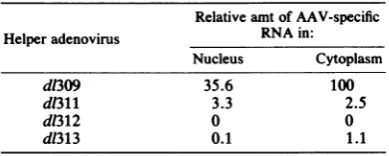
AsTable 2shows, therewas alargeamountofAAVRNA synthesizedin thecontrol d1309-infected cells. A small but significantamountof AAV RNAwasevident in the d1311-infected cells, which was
consistent with the fluorescentantigendata and confirmed that d1311 could help AAV, albeit inefficiently. d1312-infectedcellsshowedno evi-dence ofany AAV RNA. d1313-infected cells (Table 2) showedalow-levelreaction whichwas
closetothesensitivitylevel of theassayandwas not observedconsistently.
The presence ofindividual cytoplasmic
spe-cies of AAV RNAwasanalyzedbythe
endonu-cleaseS1mapping procedure of Berk and Sharp
(4). As Fig. 2 shows, both d1309- and d1311-infectedcells contained the expectedspecies of
AAV RNA (25), but there was no evidence of
any AAVspecies inthe RNAsfromd1312-and
d1313-infected cells. The decreases in the
amounts of AAV 2.6- and 2.3-kilobase (kb)
RNAs observedin thed1311-infectedcellswere
consistent withthereducedcapsid antigen
syn-thesis noted above. The2.3-kb RNA codes for
AAV capsid protein (19). Ford1311-or Ad5wt-helped cells, the amounts of the larger AAV RNAs(e.g., 3.6and 4.2kb)weresimilar. These observationswereconsistent withprevious find-ings with aregion 2a mutant, Ad5tsl25, which
on November 10, 2019 by guest
http://jvi.asm.org/
[image:3.491.107.395.70.259.2]REPLICATION OF AAV 871
TABLE 1. AAVantigen synthesis with different helper adenovirusesa
% of fluorescent nucleiin:
Ratio ofAAVyield
Adenovirus AAV-2 KB-3 cells 293 cells inKB-3 cells to
Adenovirusb AAVc Adenovirus AAV yield in 293cells
None - 0.5 0.5 0.5 0.5
+ 0.5 0.5 0.5 0.5
Ad5wt - 70 0.5 80 0.5
+ NDd 26.0 ND 39 0.67
d1309 - 95 0.5 95 0.5
+ ND 61 ND 58 1.05
d1311 - 0.5 0.5 35 0.5
+ ND 7 ND 55 0.13
d1312 - 0.5 0.5 95 0.5
+ ND 0.5 ND 39 0.01
d1313 - 0.5 0.5 75 0.5
+ ND 0.5 ND 53 0.01
a
Cells
weregrownin Lab-Tek eight-chamber culture slides and infected with AAV-2 and adenovirus(eachatamultiplicityof 10). Cultures were fixed 30 h after infection and stained as described in the text.
b
Cells
werestained withanti-AdS
antiserum.cCellswerestained with anti-AAV-2immunoglobulinG.
dND, Not done.
also indicated that the accumulation ofspliced 2.3-kb AAV RNA maybecontrolleddifferently
than theaccumulation ofthelargerAAVspliced
RNAs (29).
AAV DNAsynthesis. SinceAAV RNA
synthe-sis isdependentonpriorAAV DNAreplication
(7), wedetermined whetheranyof the
adenovi-rusmutantswasabletohelp AAV DNA
replica-tion. In preliminary experiments with cells
in-fectedwith AAVand the adenovirushelperata
multiplicity of 10, viral DNA was labeledwith
[3H]thymidine
from 16 to 20 h after infection, selectively extracted by using the Hirtproce-dure, and sedimented in neutral sucrose
gradi-ents. These experiments (data not shown)
re-vealed that all four mutants were equally
efficient helpers for normal AAV DNA
replica-tion in 293cells,as wasd1309 in KBcells. In the
KB cells there was no evidence ofAAV DNA
synthesis in a coinfection with either d1312 or
d1313. With d1311 AAV DNA synthesis was
minimal butdetectable.
Amore sensitivemeasure ofAAV DNA
syn-thesis was obtained in the blotting experiment
shown in Fig. 3. Electrophoresis and ethidium
bromide staining (Fig. 3A) showed that DNA
isolated from d1309-andAAV-infectedKBcells
contained theexpectedAAVHincIIDNA
frag-ments. Thesefragmentswerealsofaintlyvisible
inthe DNAfromd1311-helped cells. Therewas
noevidenceofAAVDNAwhen d1312andd1313
were helpers or when no helper was present.
The DNA in the gel shown in Fig. 3A was
blotted onto ABM paper and hybridized with
nick-translated AAV [32P]DNA. The results
(Fig. 3B) verified thepresenceofHincdl-cleaved
AAV DNA in d1309- and d1311-coinfected KB
cells, butno AAV DNAwasdetected in
d1312-ord1313-helpedcells.
Theexperiment shown in Fig. 3 was quantita-ted in thefollowing way. Samples of cell DNA equal to the amount in the infected cell samples (Fig. 3) were mixed with AAV-2 DNA to yield 10-2 to 106 genome copies of AAV DNA per diploid cell equivalent. These reconstructed mixtures were treated in the same way and analyzedin thesamegel slabasthepreparations used in the experiment shown in Fig. 3. The results of this single-copy blotcalibration (data not shown) indicated that one genome copy of AAV DNA per cell could be detected readily and thatthe limitof detection was 0.1 copy per cell. According to this calibration, d1309- and d1311-helpedcellscontained about 5 x10⁵and 2
x
104
AAV genomes, respectively. Itshould be noted that theautoradiographicexposure shownTABLE 2. AAV-specificRNAsynthesizedwith
differenthelperadenovirusesa
Relative amt ofAAV-specific Helperadenovirus RNA in:
Nucleus Cytoplasm
d1309 35.6 100
d1311 3.3 2.5
d1312 0 0
d1313 0.1 1.1
a RNA isolated from AAV- and
adenovirus-coin-fected KB cells was hybridized in solution to 32P_
labeledAAV DNA, and the relativeamountof AAV
RNA was determined as described in thetext. The
valueswere normalized to thed1309-infected
cytoplas-micfraction.
VOL.41,1982
on November 10, 2019 by guest
http://jvi.asm.org/
[image:4.491.248.443.539.617.2]309
3
11312
313 - n7#
4-,!
4.2
39
3,3.
3.3 [image:5.491.58.249.67.395.2]2.6
FIG. 2. AAV cytoplasmic RNA from
mutant-helped cells. Cytoplasmic RNA was extracted and
hybridized with denatured AAV [32P]DNAand then
digestedwithendonucleaseSi andelectrophoresedin
aneutralagarosegel,asdescribed in thetext.The size
(inkilobases) of each 32P-labeled digestion productis
indicated atthe left. The band at4.7 kb represents
reannealed 32P-labeled AAV DNA. The band which
sometimes occurred at 4.3 kbwas anartifact ofthe nucleaseS1procedure (29).The track marked witha
dash contained RNA from cells infected with AAV
alone. Track m contained 3.3- and 1.4-kb marker
fragments ofSall-digestedAAV-2 [32P]DNA.
in Fig. 3B was at a sensitivity ofonly 500 to
1,000 copiespercell.
When the same slab gel was examined at a
higher sensitivity level, as shown in Fig. 3C,
about100to200 AAVgenomesweredetectedin
the cells infected with AAV alone. This AAV
DNA, which was not cleaved by HincII and
migrated more slowly than AAV DNA HincIl
fragments,representedtheunreplicated parental
single-stranded genomes. These DNA strands
hadreannealed partially during 65°Cincubation
afterHincII digestion (C. Laughlinand C.
Mar-cus, unpublished data).It isunlikely that much
of this input AAV DNA represented genomes
integrated into cellularDNA because cleavage
withHpaI, which does not cut AAV, produced
the same pattern. The amount of AAV DNA
detected in the absence ofhelper was approxi-mately theamountexpectedat amultiplicityof
100infectiousunitsper cell, which was
equiva-lent to about 500 genomes per cell (8, 24), and
about one-quarter of thisreached the cell nuclei
(24, 34). In contrast, at 20 h after coinfection
with the adenovirus mutants d1312 and d1313
there was less than one intact AAV DNA
genome percell (Fig. 3C). Apparently,
coinfec-tion with the mutant adenoviruses resulted in
degradation of most ofthe infecting AAV ge-nomes.
Effect ofmultiplicity of infection. It has been reported previously that thehost range depen-dence of the adenovirus region 1 deletion
mu-tants is not absolute (37). Ifthe multiplicity of
dl311 ord1312is increased sufficiently, the
mu-tantsgrowin KBcells.To amuchlesserextent,
this is alsotrueford1313.Bothmutantd1311 and
mutant d1312 showed extensive
multiplicity-de-pendent leakiness for theAAV helperfunction, whereas d1313 showedlittle or noleakiness for
AAVgrowth (Fig. 4).
It waspossible that the AAV helperfunction
simply required a rare cellular gene product,
whoseefficiency was enhancedby an
adenovi-rus function and did not directly require any
adenovirusgeneexpression. This likelihoodwas
argued against by experiments in which the adenovirus multiplicity was maintained at 10 PFU/cell and the AAV multiplicitywas
progres-sively increasedto 500infectious units per cell. Neitherd1312 nor d1313 was able to help AAV under these conditions (data not shown), indi-cating that some adenovirus gene expression
wasdirectlyrequired for AAVreplication. Complementation for AAV helper function.
Mutants d1311 and d1312cancomplement d1313
for adenoviruslytic growth (35, 37). All of these deletion mutants are complemented at40°C by the early region2temperature-sensitive mutant
Ad5tsl25. However, Ad5tsl25 isitselfa
defec-tive helper of AAV atthe nonpermissive
tem-perature (19,28, 29).In KBcellsthe tworegion
la mutantsd1311 andd1312 didnotcomplement
each otherforthe AAVhelperfunction,butthey
were complemented by the region lb mutant
d1313; all three deletion mutants were able to
help AAVwhenthey were complementedwith
Ad5tsl25 at the nonpermissive temperature
(datanotshown).Theseresults indicatedthat at
least threeadenovirusgenes mustbefunctional
to provide helper activity for AAV replication
and that these genes are transacting.
Growth of AAV with additional adenovirus
region lb mutants. Theapparentrequirement of
on November 10, 2019 by guest
http://jvi.asm.org/
REPLICATION OF AAV 873
A 8 C
_ 309 311 312 313
51 86 0;31 31,51
86 100
- 309 311 312 313 - 312 313
DS
Ss
I
I
FIG. 3. Replication of AAV DNA in mutant-helpedcells.KBmonolayercellswereinfected with AAV-2 and
either noadded helper (tracks marked with a dash) ord1309 (track 309), d1311 (track 311), d1312 (track 312), or
d1313 (track 313) as helper. At 20 h after infection totalcell DNA was extracted, digested with HincII, and
electrophoresedin1.4%agarosegel. (A). DNAin the gel viewed by UVilluminationafterstaining with ethidium
bromide.The HincII fragments of AAV DNA are indicated by their map coordinates at the left. Fragments 0/31
and86/100wereresolved into two species because they are terminal fragments. (B) Gel in (A) blotted into ABM
paper,annealed with nick-translated AAV[132P]DNA,andautoradiographed. Each track contained 4 ,ug of DNA,
equivalenttoapproximately 6 x10⁴cells. Thesensitivity of detection was 500 to 1,000 AAV genome copies per
cell. (C)Same tracks as in (B), but exposed for a longer time to a sensitivity of 0.1 genome copies per cell, as
describedin the text. The positions of single-stranded parental genomes (SS) and reannealeddouble-stranded
parental genomes(DS) are indicated. The material migrating faster than the single-stranded parental genomes in
the left track was an artifact due to the very large amounts of AAVHincIl 51/86 and 0/31 fragments in the
neighboringtrack (track 309 of Fig. 3B).
AAVforanadenovirus early region lb function
wasexamined further by using three additional region lb mutants (AdSdl314, Ad5sub315, and Ad5sub316). Thesemutants(Fig. 1)have small-erdeletions than d1313. In addition, sub315 and
sub316 containsubstitutions of 1.5 and 1.35kb, respectively. As Table 3 shows, in KB cells d1314,sub315, and sub316atlowmultiplicitiesof infectionwerevery inefficient helpers for
accu-mulation of AAV antigens. Both sub315 and d1314 showed a low degree of multiplicity-de-pendent leakiness for AAV helper activity. sub316, which containsmoreofearly regionlb thansub315, showed a greaterdegree of
multi-plicity-dependent leakiness. Theseobservations
were reflected when AAV DNA synthesis was
examined (datanot shown).
DISCUSSION
Theexperiments describedhereclearly show
that AdS host range mutants having large
dele-tions inregionla(d1312)orregionlb(d1313)do
not help AAV when they are grown at a low multiplicity onnonpermissive (KB)cellsbut do help when they arecomplemented by 293 cells. The deletion in d1312 is confined to early region la and completely eliminates the gene
products of this region (20). However, the ade-novirus early region la products increase the efficiencyofexpressionofearlyregions lb,2, 3,
and4andappear tobenonessentialfor
adenovi-ruslyticgrowth at a high multiplicity (2, 21, 37).
When theinfecting adenovirusgenomedosage is
increased,the d1312 and dl311 mutantsgrow as
efficiently (21) and help AAV as efficiently as
wild-type adenovirus. Thedl311 mutant, which
hasamuch smallerdeletion,was aleakyhelper
inKBcellseven at alowmultiplicity. Thus,any
requirement by AAV for region la functions
may beindirect, althoughour resultsdonot rule
out a more direct involvement. Mutant d1314
complements d1313 andbehavesphenotypically
VOL.41, 1982
on November 10, 2019 by guest
http://jvi.asm.org/
[image:6.491.100.392.71.328.2]70
60
LL.
z
LU
( 50 :
0
u' 40
-J
z 30
-J
LU
0 2X
z
0
R 101
0~
55~~~
dl31320 40 60
ADENOVIRUS MULTIPLICITY(
FIG. 4. Effect of multiplicity of infect
AAVhelper ability ofadenovirusmutant
Cells wereinfected with AAV-2 (10 inf
per cell)and anadenovirus mutant atv
plicities. Cells were fixed at30 h afteri
assayed for thepresence of AAV antige
immunofluorescent staining, asdescribec
as aregion la mutant(35); thus, it help AAV.
Although d1313ismissingsomeof
complements d1312. Thus, the failure helpAAVindicatesarequirement fo
That the required region lb functioi 12,000-dalton protein IX was indic;
failure of sub315 and sub316tohelpA
latter two mutants also complemen
thus confirm the requirement for E
function for AAV.
Since this workwasdone, otherv
31) have described studies on the
AAVin whichtheAd5 hr pointmuta
by Harrisonetal. wereused(15). TI
mutants are analogous to the deleti whichweused inthattheydonotgrc
cells but dogrow on 293 cells. The
twocomplementationgroups. The n groupImutants(e.g.,hrl and hr3)m
la,andthesemutantsarephenotypi(
tod1312.ThemutationsofgroupIIn andhr7)mapinregion lb,andthese
complemented by d1312 but not by Liked1312,thehrl andhr3mutants AAVDNAreplication.Incontrasttc
withd1313,both hr6 andhr7help AAV efficient-ly (17, 31). However, these results are not
o inconsistent,sincehr6 and hr7are
phenotypical-ly DNA positive, whereas d1313 is DNA
nega-tive for adenovirus DNA replication in HeLaor
KBcells (23). However,someregion lbmutants
(e.g., hr7) mayincrease and others (e.g.,d1313
and sub315) maydecrease the level of
expres-sion of other adenovirus early regions (35). The hr6 and hr7 mutationsmapbetween 6.1 and 8.5 map units on the adenovirus genome, most
probably within theinterveningsequenceofthe
13S mRNA (11). This is the region bounded by the right ends of the deletions in sub316 and
sub315.
Which of the region lb proteins is involved in the putative AAV helper function is unclear since in moststudies of thesemutantsworkers have used only immunoprecipitationprocedures
312
-(3, 11,
35).
Thesimplest
model is that the15,000-dalton region lb protein is the required AAV helper function.
Several explanations for the
multiplicity-de-80 100 pendent leakiness of the adenovirus region 1
deletion mutantshave been proposed (37). Our Ip.f.u/cell) observations withAAVsuggest,particularlyfor
tionuponthe regionlb,amodelwhich is inparttheconverse
sin KB cells. oftheprevious (37). Somefunctionin
adenovi-.ectious units rus-infected cells may otherwise interfere with
,aryingmulti- AAV (or adenovirus) DNA replication but
be-infection and comeblockedorinactivatedafterexpressionof
n
inbythendtret
aregion
lbproduct.
Quantitative blotting
ex-periments showed that most of the input AAV
genomes werepresentinthe cellsat20 h after
alsofailsto infectionin the absence ofanyhelper. In
coin-fections with d1312 and d1313,mostof theinput region la, it AAV genomes were degraded. Apparently, an
of d1313to
srregionlb. TABLE 3. AAVantigen synthesisin cells infected
n isnot the withadenovirus earlyregion lb mutants'
ated by the
kAV.These
It d1312 and
a region lb
yorkers (17,
growth of mnts isolated hese Ad5hr
ion mutants )wonHeLa
jy comprise
nutationsof
tapinregion
callysimilar
nutants(hr6
mutantsare
d1313 (11).
donothelp
)ourresults
Proportion ofnuclei
Multiplicity fluorescent for AAV
Helperadenovirus (PFU/cell) antigenin:
293cells KBcells
sub316 8 60 1
20 60 10
80 58 22
sub315 10 57 0.5
25 60 0.5
100 60 5
dl314 8 50 0.5
20 50 0.5
80 27 2.0
aCellswereinfected with AAV-2atamultiplicityof
10infectious units per cell and withadenovirusatthe
indicatedmultiplicity.Then the cellswereassayedfor
nuclear accumulation of AAVantigenasdescribed in
Table1, footnotea.
on November 10, 2019 by guest
http://jvi.asm.org/
[image:7.491.56.247.55.332.2] [image:7.491.256.449.482.628.2]875
adenovirus region lb product protects AAV
DNA against this degradation. Whether this
DNA degradation function is normally present
inthe cells, is inducedoractivated by
adenovi-rus infection, or is contained in the infecting
adenovirus virions isnotclear.Our resultsargue
against the first of these hypotheses. The impor-tant concept which arises from our studies is
that some adenovirus helper function for AAV
may be required to counteract the inhibitory
effects of a second adenovirus-induced or
-activated(DNase) function.
There is other evidence for an
adenovirus-induced DNase which is prevented by
expres-sion of region lb. R. Lai Fatt and S. Mak
(personal
communication) have demonstrated thatbothAdl2cyt and Ad5dl313mutants,whichdonotcomplement each other, induce degrada-tionofnewlysynthesized cellularoradenovirus
DNA. One report has ascribed inhibition of
DNase to the region 2a protein (30), whereas
another reporthas suggested that inhibition of
DNA degradation is controlled by a gene in a
complementation regiondifferent fromregion2a andregion5(10).
However, there is an interesting possibility.
The apparent phenotype ofthe adenovirus
re-gion lbmutantswithrespect toDNasefunction,
as shown here and by the inability of some
mutants torescueintegratedAAVgenomes(31),
suggests that adenovirus might induce or
acti-vate a recombination system. One intriguing possibility is that AAV might integrate and
ex-ciseduring lyticreplication.Such recombination
eventscouldprovideanalternativeexplanation
for thegeneratonofaterminalsequenceflip-flop
inAAVDNAindependent oftheproposed
self-priming DNA replication mechanism (5, 40, 41).
There are several possible reasons for the
failureofAAVtogrowin293cellsexceptinthe
absenceofsuperinfection byadenovirus. These
includequantitative (i.e.,genedosage)and
qual-itative changes in the expression of region 1.
Although the region 1 RNAs in 293 cells have been reported to be similar to those in lytic infections (2), Spector et al. (38) recently
de-scribedsomequantitativedifferences.However,
the mostlikelypossibilityisthat AAVrequires
adenovirushelperfunctions in additiontothose
encodedbyregion 1.
Temperature-sensitive mutations in the ade-novirus region 2a 72,000-dalton DNA-binding proteinresult in afailureto translate the AAV
mRNA thatcodes for AAVcapsid proteins (19).
Thisleads inturntoafailuretosynthesizeAAV
capsidsorprogenysingle-strandedgenomesand
resultsinanaccumulation ofRF DNA(26).We
alsohave found(19)thatsomeof the effects of
mutations in region 2a upon AAV may be
through effectsontheexpressionorfunctionof
adenovirus early region 4. Other evidence for the involvement ofadenovirus early regions2a and 4 and the VA gene in the AAV helper function has been reported recently (17; W.
Richardson, personalcommunication).
Since the d1313 (and d1312) mutants prevent AAV RF DNAsynthesis, they affect a different stage of the AAV growth cycle than the region 2a mutants. Our findings support the previous suggestion (7) of at least two levels of AAV helper function.
ACKNOWLEDGMENTS
Wethank Bruce Kelderforexcellenttechnicalassistance, Tom Shenkfor hisinterest and criticalreviewof the manu-script,ArnoldLevine foruseful discussions, and Joan Mokfor typing the manuscript. We also thank Stanley Mak and Bill Richardsonforcommunicatingunpublisheddata.
LITERATURECITED
1. Alwine,J. C., D. I. Kemp, B. A. Parker, J. Reiser,J. Renart, G. R. Stark, and G. M. Wahl. 1979.Detection of specificRNAs orspecific fragnents ofDNAby fraction-ationingels and transfer todiazobenzyloxymethylpaper. MethodsEnzymol.68:220-242.
2. Berk,A. J., F. Lee, T.Harrison,J.Willams,andP. A. Sharp. 1979. Pre-earlyadenovirus5geneproduct regu-lates synthesis of early viral messenger RNAs. Celi 17:935-944.
3. Berk, A. J., F. Lee, T.Harrison,J.Wilam,and P. A. Sharp. 1980. Phenotypeof adenovirus5 hostrange
mu-tants for early mRNA synthesis. Cold Spring Harbor Symp. Quant. Biol. 44:367-375.
4. Berk, A. J., and P. A.Sharp. 1977. Sizingandmapping of early adenovirus mRNAs by gel electrophoresis ofS1 endonuclease-digestedhybrids. Cell12:721-732. 5. Berns, K. I., W. W.Hauswirth,K. H.Fife,and E.Lusby.
1979. Adeno-associated virus DNA replication. Cold SpringHarborSymp. Quant.Biol. 43:781-787. 6. Carter, B. J., G.Khoury,andJ. A.Rome.1972.
Adenovi-rus-associated virusmultiplication. Analysisof the in vivo transcriptioninducedby complete orpartial helper virus-es.J.Virol. 10:1118-1125.
7. Carter,B.J.,F.J.Koczot,J.Garrison,J.A.Rose,andR. Dolin.1973.Separatehelperfunctionsprovided by adeno-virus for adenoadeno-virus-associatedvirusmultiplication. Na-ture(London)NewBiol.244:71-73.
8. Carter, B. J., C. A.LaugbHn,L. M. de laMaza, and M. W. Myers. 1979. Adeno-associated virus interference. Virology 92:449-462.
9. Chow,L.T., J. B.Lewis,andT. R. Broker.1980. RNA
transcriptionandsplicingatearlyandintermediate times afteradenovirus-2 infection. ColdSpringHarborSymp. Quant. Biol. 44:401-414.
10. D'Halluin,J.-C., C.Allart, C.Cousin, P.A.Boulanger,
andG. R. Martin. 1979. Adenovirus early function re-quiredforprotectionof viral and cellular DNA. J. Virol. 32:61-71.
11. Galos,R. S., J.Wiliams,T.Shenk,and N.Jones. 1980. Physical location ofhost-range mutants of adenovirus type 5; deletion and marker-rescue mapping. Virology 104:510-513.
12. Graham,F. L., J. SmUey, W. C. Russell, and R. Nadva.
1977.Characteristics ofahumancelllinetransformedby DNA from human adenovirus type 5. J. Gen. Virol. 36:59-72.
13. Hands, H., K. Shiroki, and H.Shimojo. 1975.
Comple-mentation of adeno-associated virus growth with tempera-ture-sensitive mutants of humanadenovirustypes 12 and 5.J. Gen.Virol.29:239-242.
VOL. 41,1982
on November 10, 2019 by guest
http://jvi.asm.org/
14. Handa, H., K.Shiroki, and H.Shimojo. 1978. Expression of helper function for adeno-associated virus in adenovi-rus-transformedcells, p. 99-107. In D. C. Ward and P. Tattersall(ed.),Replication of mammalian parvoviruses. Cold Spring Harbor Laboratory, Cold Spring Harbor, N.Y.
15. Harrison, T., F. Graham, and J. Williams. 1977. Host range mutantsof adenovirus type 5 defective for growth in HeLa cells. Virology77:319-329.
16. Ito, M., and E. Suzuki. 1970.Adeno-associated satellite virus growth supported by atemperature-sensitive mutant of human adenovirus. J. Gen. Virol. 9:243-245. 17. Janik, J. E., M. M. Huston, and J. A. Rose. 1981.
Locations ofadenovirus genesrequired for the replication ofadenovirus-associated virus. Proc. Natl. Acad. Sci. U.S.A. 78:1925-1929.
18. Jay, F. T., L. M. de la Maza, and B. J. Carter. 1979. Parvovirus RNA transcripts containing sequences not present in mature mRNA: a method for isolation of putative mRNA precursor sequences. Proc. Natl. Acad. Sci. U.S.A. 76:625-629.
19. Jay, F. T., C. A. Laughlin, and B. J. Carter. 1981. Eukaryotic translation control: adeno-associated virus protein synthesis isaffected by a mutation in the adenovi-rus DNAbinding protein. Proc. Natl. Acad. Sci. U.S.A. 78:2927-2931.
20. Jones, N., and T. Shenk. 1979.Isolation of AdS host range deletionmutantsdefective fortransformation ofrat
em-bryocells.Cell17:683-689.
21. Jones, N., andT. Shenk. 1979. An adenovirus type 5 early genefunction regulates expression of other early viral genes. Proc. Natl.Acad.Sci.U.S.A. 76:3665-3669. 22. Kirschstein, R. L., K.0.Smith, and E. A. Peters. 1968.
Inhibition of adenovirus 12 oncogenicity by adeno-associ-atedvirus. Proc.Soc.Exp.Biol.Med. 128:670. 23. Lassam, N. J., S. T. Bayley, and F. L. Graham. 1978.
Synthesis ofDNA, latepolypeptidesandinfectious virus by host-range mutants of adenovirus 5 innon-permissive cells.Virology 87:463-467.
24. Laughlin, C. A., M. W. Myers, D. L. Risin,and B. J. Carter. 1979.Defective-interfering particlesof the human parvovirus adeno-associated virus.Virology94:162-174. 25. Laughlin, C. A., H. Westphal, and B. J. Carter. 1979.
Splicedadeno-associated virus RNA. Proc. Natl. Acad. Sci.U.S.A.76:5567-5571.
26. Maat, J., and H. Van Ormondt. 1979. The nucleotide sequenceofthetransforming HindIII-Gfragmentof ade-novirus type 5 DNA. Theregion betweenmappositions 4.5(HpaI site)and 8.0(HindIIl site).Gene 6:75-90. 27. Mayor, H., and J. F. Young. 1978.Complementationof
adeno-associatedvirusbytemperature-sensitive mutants
of human adenovirus andherpesvirus,p. 109-118. In D. C. Ward and P. Tattersall(ed.),Replicationof mammalian parvoviruses. Cold Spring Harbor Laboratory, Cold Spring Harbor,N.Y.
28. Myers, M. W., and B. J. Carter. 1981. Adeno-associated virus replication. TheeffectofL-canavanineor ahelper
virus mutation on accumulation of viral capsids and progenysingle-stranded DNA. J. Biol. Chem. 256:567-570.
29. Myers, M. W., C. A. Laughlin, F. T. Jay, and B. J. Carter. 1980. Adenovirus helper function for growth of adeno-associated virus. Effect of temperature-sensitive
muta-tions in adenovirusearly gene region 2. J. Virol. 35:65-75. 30. Nass, K., and G. D. Frenkel.1978. Adenovirus-induced
inhibition ofcellular DNase. J. Virol. 26:540-543. 31. Ostrove, J., and K. J. Berns. 1980. Adenovirus early
region lb gene function required for rescue of latent adeno-associated virus.Virology104:502-505.
32. Perricaudet, M., G. Akusjarvi,A.Virtanen, and U. Pet-tersson.1980.Analysis of cloned mRNA sequences from the transforming region of adenovirus 2. Cold Spring HarborSymp. Quant. Biol. 44:471 476.
33. Richardson, W. D., B. J. Carter, and H. Westphal. 1980. Vero cellsinjected with adenovirus type 2 mRNA produce authentic viral polypeptide patterns: early mRNA pro-motes thegrowth of adeno-associated virus. Proc. Natl. Acad.Sci.U.S.A. 77:931-935.
34. Rose, J. A., and F.Koczot. 1972. Adenovirus-associated virus multiplication. VII. Helper requirement for viral deoxyribonucleic acid and ribonucleic acid synthesis. J. Virol. 10:1-8.
35. Ross, S. R., A. J. Levine, R. S. Galos, J.Williams, and T. Shenk.1980. Early viral proteins in HeLa cells infected with adenovirus type 5 host range mutants. Virology 103:475492.
36. Sambrook, J., M. Botchan, P.Galiimore,B.Ozanne, U. Pettersson, J.Williams, and P. A. Sharp. 1974. Viral DNA sequences incellstransformedbySV40,adenovirustype 2, and adenovirus type 5. Cold Spring Harbor Symp. Quant. Biol. 39:615-632.
37. Shenk, T., N. Jones, W. Colby, and D. Fowlkes. 1980. Functional analysis of adenovirus 5 host-range deletion mutantsdefectivefortransformation of rat embryo cells. ColdSpring HarborSymp.Quant. Biol. 44:367-375. 38. Spector, D. J., D. N. Halbert, and H. Raskas. 1980.
Regulation of integrated adenovirus sequences during adenovirus infection of transformed cells. J. Virol. 36:860-871.
39. Straw, S. E.,H. S.Ginsberg, and J. A. Rose. 1976. DNA-minustemperature-sensitive mutantsofadenovirus type 5 help adenovirus-associated virus replication. J. Virol. 17:140-148.
40. Straus, S. E., E. D. Sebring, and J. A. Rose. 1976. Concatemers ofalternating plusand minus strands are
intermediates inadenovirus-associated virus DNA syn-thesis.Proc. Natl. Acad. Sci. U.S.A. 73:743-746. 41. Tattersall,P., and D. C. Ward. 1976. Therollinghairpin: a
modelfor replicationofparvovirus andlinear chromo-somal DNA. Nature(London)263:106-109.
42. VanOrmondt, H., J.Maat,A. deWaard, andA.J. Van
der Eb.1978. The nucleotide sequence of thetransforming HpaI-E fragmentof adenovirus type S DNA. Gene 4:309-328.
on November 10, 2019 by guest
http://jvi.asm.org/