1 Online Peer Mentoring, First Year Student Transition, Problem Solving Skills, and Academic Success.
Refereed Paper.
The Impact of Online Peer Mentoring on First Year Student Transition,
Problem Solving Skills, and Academic Success
Heather Smith & Lorelle Burton
University of Southern Queensland, Toowoomba QLD 4350 Australia
Abstract
Transition to higher education is challenging, and first year students need support to facilitate a positive experience. Key issues include positive transition; problem solving perceptions; and support from peers. This study examined relationships among student transition, problem-solving ability, and academic success. Student transition was measured using Lizzio’s (2006) Student Transition Scale. problem-solving skills were measured by Beccaria and Machin’s (2011) Problem-Solving Inventory-12-Item. Academic success was measured using grade point average and overall course grade. The current study (N = 171) involved foundation psychology students who received online peer mentoring from 34 third year students at the University of Southern Queensland (USQ) in Semester 1, 2012. Results indicated Mentees achieved higher academic success and adjusted to university better than did Non-Mentees. Mentees also became more self-aware of their problem solving ability, identifying strategies to improve overall university experience, including maximising opportunities for academic success. These findings indicate that peer support can facilitate student transition and enhance the first year student experience.
Introduction
The world today is digital—online communities, professional networking, and social media are the norm. Universities in this digital age consist of students from different countries, socio-economic groups, and diverse backgrounds (McIntyre, Todd, Huijser, & Tehan, 2012; McMillan, 2008). For many students, the first year at university is filled with anticipation and apprehension (Briggs, Clark, & Hall, 2012; Tinto, 2009). Accordingly, many students experience stress due to unmet expectations (James, Krause, & Jennings, 2010), loneliness (Bryce, Anderson, Frigo, & McKenzie, 2007), and the need to develop a new ‘student’ identity (Smailes & Gannon-Leary, 2011). Research demonstrates the first year is important to form social, academic, and community networks (Bryce et al., 2007; Dyson & Renk, 2006; Harvey, Drew, & Smith, 2006). Thus, the first year is one of the most important in the academic journey, where future directions are decided (Lodge, 2012). It is important that educators establish support strategies for first year students (Bradley, Noonan, Nugent, & Scales, 2008), and one such strategy is peer mentoring.
Relevant Concepts
Peer Mentoring
2 Online Peer Mentoring, First Year Student Transition, Problem Solving Skills, and Academic Success.
Refereed Paper.
undergraduate and graduate level (Power, Miles, Peruzzi, & Voerman, 2011). Today’s students benefit from support using digital technology, with peer support now available online (Kasraie & Kasraie, 2010). Like face-to-face delivery, online peer mentoring can facilitate a positive student transitional experience, supporting students to overcome problems and achieve success (Henderson, Noble, & De George-Walker, 2009). Important variables emerging from the peer mentoring literature include studenttransition and problem-solving.
Student Transition
The first year typically entails new circumstances and challenges arising in the students’ journey and adaptation to university (Bradley et al., 2008). The Student Transition Scale (STS) developed by Lizzio (2006) measures the Five Senses of Success to gauge students’ perceptions of their transition to university: Connectedness, Capability, Purpose, Resourcefulness, and Academic Culture. The STS is shown to be a reliable measure of student transition (Box, Callan, Geddes, Kemp, & Wojcieszek, 2012). Student transition involves successfully navigating aspects of university life (Lodge, 2012), including students’ problem solving capabilities. The ability to problem solve in a positive manner can enhance the student learning journey, and enable a positive transition into higher education (Burnett & Lamar, 2011).
Problem Solving
Problem solving reflects students’ perceptions of their problem solving capabilities. A reliable measure is the Problem Solving Inventory (PSI) by Heppner and Petersen (1982). This current study utilised a shortened version of the PSI, the PSI-12, by Beccaria and Machin (2011). The four subscales of the PSI-12 are: problem solving self-efficacy (PSSE), impulsive/haphazard problem solving (IHPS), planned/rational problem solving (PRPS), and overwhelmed problem solving (OPS).
Aims and Hypotheses
There is a gap in the literature regarding the impact of online peer mentoring on student transition. The question of how peer mentoring facilitates the problem solving capabilities of first year students and influences their overall academic success, requires further attention. To this end, the current study examined the impact of an online peer mentoring program on student transition, specifically examining the relationships between students’ problem solving capabilities and overall academic success, as measured by grade point average (GPA) and final course results (Course Grade). It was hypothesised that Mentees would score higher than Non-Mentees on the five senses of success measured by the STS (Lizzio, 2006). It was also hypothesised that Mentees would show stronger problem solving capabilities than Non-Mentees across the four problem solving subscales of the PSI-12 scale (Beccaria & Machin, 2011). Additionally, it was hypothesised that Mentees would achieve better academic success than Non-Mentees. The relationships among problem solving ability, student transition, and academic success were also examined. It was hypothesised that significant negative correlations would be evident between the four problem solving measures and academic success, as measured by GPA and Course Grade, respectively.
3 Online Peer Mentoring, First Year Student Transition, Problem Solving Skills, and Academic Success.
Refereed Paper.
The current study reports on findings from a large-scale study and only those variables relevant to the current research aims are discussed here.
Participants
A convenience sample total of 171 participants (Mentees - n = 45; Non-Mentees - n = 126) completed online surveys giving a 37% response rate. The sample comprised two groups: 45 Mentees (pre survey n = 16; post survey n = 29), whose ages ranged from 23 to 60 years (M = 40.75, SD = 8). The Mentee sample comprised 32 females (13 did not supply gender); 9 (20%) were oncampus and 36 (80%) were external. The second group were Non-Mentees (pre survey n = 51; post survey n = 75), whose ages range from 16 to 58 years (M = 31.95, SD = 11.48). The Non-Mentee sample comprised 52 females and 11 males (63 did not supply gender); 54 (43%) were oncampus and 72 (57%) were external. A total of 16 Mentees and 11 Non-Mentees completed both surveys.
Student Transition Scale
Student transition was measured using the STS (Lizzio, 2006). This 73-item self-report scale used a 5-point Likert-type scale ranging from 1 (strongly disagree) to 5 (strongly agree). The psychometric properties of the five subscales show satisfactory internal reliability estimates ranging from .80 to .92, respectively (Sharrock, 2011).
The 16-item Connectedness subscale examines students’ perceptions of fitting in with situations and making connections with people in university life, examining students’ relationships with other students, lecturers, staff members, and members of the university community (Lizzio, 2006). An example item is “Felt a sense of fellowship with the students in your year level”. Scores could theoretically range from 16 to 80, with high scores indicating a high sense of connection and low scores indicating a low sense of connection. For this study, internal reliability for this subscale was strong (α = .91).
The 21-item Capability subscale captures students’ perception of their preparedness for study, examining students’ strengths in task and role clarity, academic competence, community participation and contribution (Lizzio, 2006). An example item is “Have been given consistent messages on important issues across all your courses”. Scores could theoretically range from 21 to 105, with high scores indicating a high sense of capability, and low scores indicating a low sense of capability. For this study, internal reliability for this subscale was strong (α = .93).
The 12-item Purpose subscale examines whether students believe their study is worthwhile, and their discipline and engagement in their chosen program. It also captures students’ capability and progression in setting goals, vocational direction, and personal development (Lizzio, 2006). An example item is “Can see the relevance of what you are studying to your current life/career”. Scores could theoretically range from 12 to 60, with high scores indicating a high sense of purpose, and low scores indicating a low sense of purpose. For this study, internal reliability for this subscale was strong (α = .89).
4 Online Peer Mentoring, First Year Student Transition, Problem Solving Skills, and Academic Success.
Refereed Paper.
managing the everyday activities of ‘being a student’”. Scores could theoretically range from 19 to 95; high scores indicate a high sense of resourcefulness, and low scores indicate a low sense of resourcefulness. For this study, internal reliability was strong (α = .93).
Finally, the 5-item Academic Culture subscale captures students’ understanding of acceptable cultural behaviour, students’ knowledge of ‘who’ their university is, what it stands for, understanding principles the university employs, and why they are important to know (Lizzio, 2006). An example is “Come to see critical thinking and inquiry as being important to you”. Scores could theoretically range from 5 to 25, with high scores indicating a high sense of academic culture, and low scores indicating a low sense of academic culture. For this study, internal reliability was acceptable (α = .75).
Problem Solving Inventory
The 12-item PSI-12 (Beccaria & Machin, 2011) uses a 6-point Likert-type scale ranging from 1 (strongly agree) to 6 (strongly disagree). The four subscales each comprise three items. The PSSE measures individuals’ capability of acting in a manner that is competent and efficient in relation to solving problems. The IHPS subscale captures individuals’ impulsiveness when faced with problems. The PRPS subscale captures individuals’ ability to be reasonable and plan their actions carefully in relation to problem solving. The OPS subscale captures individuals’ feelings of being weighed down, or overwhelmed by the prospect of problems. The PSI-12 is a relatively new revision and therefore reliability and validity data is not comprehensive. However, Beccaria and Machin (2011) have ascertained that the structural and criterion validity were supported, with internal validity of the four subscales as follows—PSSE (α = .86), IHPS (α = .74), PRPS (α = .70), and OPS (α = .65). Each subscale is interpreted individually; generally, lower scores indicate a problem solving strength (Beccaria & Machin, 2011). These subscales are discussed in turn.
5 Online Peer Mentoring, First Year Student Transition, Problem Solving Skills, and Academic Success.
Refereed Paper. Academic Success
Students’ academic success was measured by GPA and overall Course Grade, respectively. For GPA, scores ranged from 7 (at least 85%, HD), 6 (at least 75 but less than 85, A), 5 (at least 65% but less than 75%, B), 4 (at least 50% but less than 65%, C), to 1.5 (less than 50%, F - fail, FNP - did not participate, FNS - did not sit, FNC - did not complete, FLW - late withdrawal). Low scores indicate poor academic success, and high scores indicate high academic success (Wood, 2012). The overall Course Grade was expressed as a final percentage.
Procedure
Ethics approval was given from USQ Human Research Ethics Committee (HREC). Students enrolled in a foundation psychology course (n = 461) in Semester 1, 2012, at USQ, were invited to participate in the online peer mentoring program for course credit. Those students who chose to engage in the program as mentees had access to 1 hr. weekly peer support from third year peer mentors over an 8-week period during Semester 1 of the university year. They received a certificate at the end of the program. Students who chose not to participate in the peer mentoring program had access to support from the course examiner throughout the course of the semester, but did not participate in additional peer mentoring sessions. Additionally, emails sent at the beginning of semester invited all first year psychology students to complete a survey comprising measures of student transition and problem solving abilities in the first 4 weeks of the semester (pre-survey), prior to the commencement of the online mentoring program in week 5 of the semester. All students were again invited to complete the same survey again in the final 4 weeks of the semester (post-survey). Both pre- and post-surveys took participants around 20 minutes to complete, on average. Participants were offered course credit for survey participation.
Results
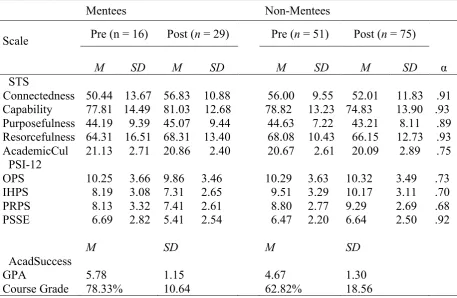
Analysis of the data using Pearson’s product moment correlation, and analysis of variance (ANOVA) was conducted using IBM SPSS (v20). Data was screened and there were no missing or out of range data relevant to this study. Duplicate data was removed—first entry retained. Five participants recorded a deferred exam and were coded as such for GPA and Final Course grade. Assumptions of normality were carried out, with no meaningful violations detected. Univariate or multivariate outliers detected were meaningful for the analysis and therefore retained. Reliability analyses revealed that STS (α ranging from .75 to .93), and PSI-12 (α ranging from .68 to .92) demonstrated adequate internal consistency (Cohens, 1992). Table 1 provides summary statistics for key variables for both Mentees and Non-Mentees.
An ANOVA for the STS revealed that Connectedness showed no statistically significant difference between Mentees and Non-Mentees pre-survey F(1, 65) = 3.33 (p = .073), or post-survey F(1, 102) = 3.62 (p = .060). Capability showed no statistically significant difference between Mentees and Non-Mentees pre-survey F(1, 65) = .07 (p = .795), however showed a statistically significant difference post-survey F(1, 102) = 4.38 (p = .039) with a small to medium effect size, ŋ2 = .04 (Cohen, 1988). Purposefulness showed no statistically
6 Online Peer Mentoring, First Year Student Transition, Problem Solving Skills, and Academic Success.
Refereed Paper.
Mentees Non-Mentees
Scale Pre (n = 16) Post (n = 29) Pre (n = 51) Post (n = 75)
M SD M SD M SD M SD α
STS
Connectedness 50.44 13.67 56.83 10.88 56.00 9.55 52.01 11.83 .91 Capability 77.81 14.49 81.03 12.68 78.82 13.23 74.83 13.90 .93 Purposefulness 44.19 9.39 45.07 9.44 44.63 7.22 43.21 8.11 .89 Resorcefulness 64.31 16.51 68.31 13.40 68.08 10.43 66.15 12.73 .93 AcademicCul 21.13 2.71 20.86 2.40 20.67 2.61 20.09 2.89 .75 PSI-12
OPS 10.25 3.66 9.86 3.46 10.29 3.63 10.32 3.49 .73
IHPS 8.19 3.08 7.31 2.65 9.51 3.29 10.17 3.11 .70
PRPS 8.13 3.32 7.41 2.61 8.80 2.77 9.29 2.69 .68
PSSE 6.69 2.82 5.41 2.54 6.47 2.20 6.64 2.50 .92
M SD M SD
AcadSuccess
GPA 5.78 1.15 4.67 1.30
Course Grade 78.33% 10.64 62.82% 18.56
[image:6.595.70.528.73.371.2]Note. STS = Student Transition Scale; AcademicCul = Academic Culture; PSI-12 = Problem Solving Inventory 12-item; OPS = Overwhelmed Problem Solving; IHPS = Impulsive/Haphazard Problem Solving; PRPS = Planned Rational Problem Solving; PSSE = Problem Solving Self Efficiency; AcadSuccess = Academic Success; GPA = Grade Point Average; Course Grade = final percentage for first year psychology course.
Table 1: Summary statistics for key variables (N=171)
significant difference between Mentees and Non-Mentees pre-survey F(1, 65) = 1.18 (p = .282, or post-survey F(1, 102) = .59 (p = .445). Academic Culture showed no statistically significant difference between Mentees and Non-Mentees pre-survey F(1, 65) = .37 (p = .545), or post-survey F(1, 102) = 1.62 (p = .206).
An ANOVA for the four problem solving abilities revealed OPS showed no statistically significant difference between Mentees and Non-Mentees pre-survey F(1, 65) = .002 (p = .966), or post-survey F(1, 102) = .36 (p = .549). IHPS showed no statistically significant difference between Mentees and Non-Mentees pre-survey F(1, 65) = 2.03 (p = .159), a statistically significant difference was evident at post-survey F(1, 102) = 19.19, p < .001, with a large effect size ŋ2 = .16 (Cohen, 1988). PRPS showed no statistically significant difference between Mentees and Non-Mentees pre-survey F(1, 65) = .66 (p = .418), however, a statistically significant difference between Mentees and Non-Mentees was observed at post-survey F(1, 102) = 10.37, p = .002, with a medium effect size ŋ2 = .09 (Cohen, 1988). PSSE showed no statistically significant difference between Mentees and Non-Mentees pre-survey F(1, 65) = .10 (p = .749), however a statistically significant difference between Mentees and Non-Mentees was evident at post-survey F(1, 102) = 4.99, p = .028, with a small to medium effect size ŋ2 = .04 (Cohen, 1988).
7 Online Peer Mentoring, First Year Student Transition, Problem Solving Skills, and Academic Success.
Refereed Paper.
Grade was a distinction level (A) for Mentees, and a pass (C) for Non-Mentees. These differences were also significant at the p < .001 level, F(1, 164) = 27.94 with a large effect size, ŋ2 = .14 (Cohen, 1988).
Pearson’s product moment correlations were then computed to examine the relationships among problem solving ability, student transition, and academic success (see Table 2). As shown in Table 2, significant positive correlation was found between GPA and Course Grade (r = .79, p < .001) associating a high GPA with high Course Grade.
Scale 1 2 3 4 5 6 7 8 9 10 11
1 GPA 1.00
2 Course Grade .79** 1.00 3 Connectedness .10 .04 1.00 4 Capability .11 .08 .78** 1.00
5 Purposefulness .06 .06 .77** .74** 1.00
6 Resourcefulness .03 .03 .79** .82** .76** 1.00
7 Academic Culture .14 .14 .60** .70** .60** .67** 1.00
8 OPS -.03 -.03 -.02 .06 .06 .09 .19 1.00
9 IHPS -.13 -.13 -.11 -.09 -.04 .00 .02 .52** 1.00
10 PRPS .01 .01 .07 .11 -.01 .00 -.04 -.13 .19* 1.00
11 PSSE -.07 -.07 -.23* -.31** -.33** -.27** -.19 .41** .30** .19 1.00 Note. GPA = Grade Point Average; Course Grade = overall percentage for first year psychology course; OPS = Overwhelmed Problem Solving; IHPS = Impulsive/Haphazard Problem Solving; PRPS = Planned/Rational Problem Solving; PSSE = Problem Solving Self Efficacy.
*p < .05, **p < .01
Table 2: Correlation matrix: GPA, Course Grade, STS, and PSI-12
A significant positive correlation (p < .001), was found between Connectedness and Capability (r = .78), Purposefulness (r =.77), Resourcefulness (r = .79), and Academic Culture (r = .60), respectively. Therefore, as students had a strong sense of Connectedness, they also had a strong sense of Capability, Purposefulness, Resourcefulness and Academic Culture. A large significant positive relationship was found between Capability and Purposefulness (r = .74, p < .001), with a large significant positive relationship found between Resourcefulness (r = .82, p < .001), and Academic Culture (r = .70, p < .001). Therefore, as students had a strong sense of Capability, they also had a strong sense of Resourcefulness, and Academic Culture. A large significant positive relationship was found between Purposefulness and Resourcefulness (r = .76, p < .001) and Academic Culture (r = .60, p < .001), which associates a strong sense of Purposefulness with a strong sense of Resourcefulness, and a strong sense of Academic Culture. A large significant positive relationship between Resourcefulness and Academic Culture (r = .67, p < .001), associates a strong sense of Resourcefulness with a strong sense of Academic Culture.
8 Online Peer Mentoring, First Year Student Transition, Problem Solving Skills, and Academic Success.
Refereed Paper.
.001). As a low score on PSSE identifies strength in this variable, the result equates to a sense of Purposefulness associated with the ability to act in a manner that is competent and efficient in relation to solving problems. A small significant negative relationship was found between Resourcefulness and PSSE (r = -.27, p = .006). As a low score on PSSE identifies strength in this variable, the result equates to a sense of Resourcefulness associated acting in a manner that is competent and efficient in relation to solving problems.
A large significant positive relationship (p < .001) was found between OPS and IHPS (r = .52). Therefore, those who feel overwhelmed when problem solving are likely to demonstrate impulsive or haphazard problem solving approaches. A medium significant positive association was found with OPS and PSSE (r = .41). Therefore those who indicate a tendency to feel overwhelmed when problem solving, will show an inability to act in a manner that is competent and efficient in relation to solving problems. A small significant positive relationship was found between IHPS and PRPS (r = .19, p = .048), therefore, those who are inclined to be impulsive or haphazard are likely to have an inability to be reasonable and plan when facing problems. A medium significant positive relationship was found between IHPS and PSSE (r = .30, p =.002), therefore, those who are inclined to be impulsive or haphazard are likely to have an inability to act in a manner that is competent and efficient when facing problems.
Discussion
The current data shows that peer mentoring is an effective support mechanism in higher education (Crisp & Cruz, 2009; Hall & Jaugietis 2011; Power, Miles, Peruzzi, & Voerman, 2011). Current technological trends in higher education advocate merging technology and peer mentoring to enable online peer support (Kasraie & Kasraie, 2010). The current data support the notion that online peer mentoring can facilitate a positive student transition to university. The current online peer mentoring program was offered as an additional online support for first year psychology students. Those students who chose to engage in the program had access to weekly peer support from third year psychology students. The mentors encouraged the mentees to think for themselves, challenged the first year students to engage intellectually, and helped to create a positive learning experience. In the current sample, the Mentees achieved significantly higher academic success than did the Non-Mentees, thus supporting the hypothesis that online peer mentoring facilitates academic achievement.
This study also examined first year students’ problem solving abilities and their transition to university. Transitioning to higher education incorporates a students’ sense of Capability, which is central to achieving academic success. This study revealed the online peer mentoring program assisted Mentees to clearly understand their task and role better than did Non-Mentees. Explicitly, a student with a strong sense of Capability feels secure in their academic position and ability to contribute to the university community.
9 Online Peer Mentoring, First Year Student Transition, Problem Solving Skills, and Academic Success.
Refereed Paper.
Limitations of this research include a small sample size and the voluntary nature of the mentoring program. Further research would be beneficial with larger sample sizes to see if findings can be replicated. Regarding the voluntary nature of the program, it may be that students who seek mentors are those more prone to utilise methods to help them succeed, and no matter what is offered, would learn new skills and experience success. Further research is warranted.
In conclusion, there were significant differences on three of four problem solving subscales between Mentees and Non-Mentee, providing support for the efficacy of the mentoring program. The Mentees became more self-aware of their problem solving ability, and identified strategies to improve their overall university experience, including maximising opportunities for academic success. Peer mentoring was shown to contribute to students’ overall university experience – the Mentees showed a more positive transition and achieved higher academic success than did their Non-Mentee counterparts. Future research could further investigate the specific merits of applying problem solving strategies to support student transition, tracking student progress over time.
References
Beccaria, G. J., & Machin, M. A. (2011). Examining the psychometric properties of the Problem Solving Inventory Short Form in Australia (Unpublished article). University of Southern Queensland, Toowoomba, Australia.
Box, G., Callan, N., Geddes, T., Kemp, H. & Wojcieszek, J. (2012). University First Year Advisors: A network approach for first year student transition and retention. A Practice Report. The International Journal of the First Year in Higher Education, 3(1). 91-100. doi:10.5204/intjfyhe.v3i1 .107
Bradley, D., Noonan, P., Nugent, H., & Scales, B. (2008). Review of Australian higher education. Final report. Canberra, Australia: Commonwealth of Australia. Retrieved from www.deewr.gov.au/he_ review_finalreport
Briggs, A. R. J., Clark, J., & Hall, I. (2012). Building bridges: Understanding student transition to university. Quality in Higher Education, 18(1), 3-21. doi: 10.1080/13538322.2011.614468
Bryce, J., Anderson, M., Frigo, T., & McKenzie, P. (2007, May). Australian young people: Their stories, their families and post school plans. Retrieved from http://research.acer.edu.au/ transitions_misc /2
Burnett, L. & Larmar, S. (2011). Improving the first year through an institution-wide approach: The role of first year advisors. The International Journal of the First Year in Higher Education, 2(1). 21–35. doi:10.5204/intjfyhe.v2i1.40
Cohen, J. (1988). Statistical power analysis for the behavioral sciences (2nd ed.). New York: Academic Press.
Cohen, J. (1992). Statistical power analysis for the behavioral sciences (3rd ed.). Hillsdale, NJ: Erlbaum.
Crisp, G., & Cruz, I. (2009). Mentoring college students: A critical review of the literature between 1990 and 2007. Research in Higher Education, 50(6), 525-545. doi: 10.1007/s11162-009-9130-2
10 Online Peer Mentoring, First Year Student Transition, Problem Solving Skills, and Academic Success.
Refereed Paper.
Geytenbeek, D. (2011). Investigation of the psychometric properties of the problem-solving Inventory as a 12-item measure in an Australian population. (Unpublished honours thesis). University of Southern Queensland, Toowoomba, Queensland, Australia.
Hall, R. & Jaugietis, Z. (2011). Developing peer mentoring through evaluation. Innovative Higher Education, 36(1), 41-52. doi: 10.1007/s10755-010-9156-6
Harvey, L., Drew, S., & Smith, M. (2006). The first-year experience: A review of literature for the Higher Education Academy. Sheffield, United Kingdom: Sheffield Hallam University.
Henderson, R., Noble, K., & De George-Walker, L. (2009). Transitioning into university: ‘Interrupted’ first year students’ problem-solving their way into study. Studies in Learning, Evaluation Innovation and Development, 6(1), 51-64. Retrieved from http://sleid.cqu.edu.au
James, R., Krause K-L. & Jennings, C. (2010). The first year experience in Australian universities: Findings from 1994 to 2009. Melbourne, Australia: Centre for Studies in Higher Education, The University of Melbourne.
Kasraie, N., & Kasraie, E. (2010). Economies of elearning in the 21st century. Contemporary Issues in Education Research, 3(10), 57-62. Retrieved from http://www.journals.cluteonline.com/index.php/CIER/article/view/240
Lizzio, A. (2006). Designing an orientation and transition strategy for commencing students: Applying the five senses model. Griffith University: First Year Experience Project. Queensland, Australia: Griffith University. Retrieved from http://www.griffith.edu.au/ data/assets/pdf_file/0008/51875/Alfs-5-Senors-Paper-FYE-Project,-2006.pdf
Lodge, J. (2012). Implementing a Principal Tutor to increase student engagement and retention within the first year of a professional program. The International Journal of the First Year in Higher Education, 3(1). 9-20. doi:10.5204/intjfyhe.v3i1.101
McIntyre, J., Todd, N., Huijser, H. & Tehan, G. (2012). Building pathways to academic success. A Practice Report. The International Journal of the First Year in Higher Education, 3(1). 109-118. doi:10.5204/ intjfyhe.v3i1.110
McMillan, J. (2008, October). University study in Australia: Persistence, completion and beyond. (LSAY Issue Brief No. 18). Retrieved from http://research.acer.edu.au/ lsay_briefs/16
Power, R. K., Miles, B. B., Peruzzi, A., & Voerman, A. (2011). Building bridges: A practical guide to developing and implementing a subject-specific peer-to-peer academic mentoring program for first-year higher education students. Asian Social Science, 7(11), 75-80. doi: 10.5539/ass.v7n11p75
Sharrock, P. (2011). The relationships between personality, learning approaches, academic self efficacy, student transition, and academic success (Unpublished honours dissertation). University of Southern Queensland, Toowoomba, Australia.
Smailes, J., & Gannon-Leary, P. (2011). Peer mentoring-is a virtual form of support a viable alternative? Research in Learning Technology, 19(2), 129-142. doi: 10.1080/21567069.2011.586675
Tinto, V. (2009, February). Taking student retention seriously: Rethinking the first year of university. Keynote address presented at the ALTC FYE Curriculum Design Symposium, Queensland University of Technology, Brisbane, Australia.