Abstract: Mobile cloud computing is a rapidly evolving technology these days and it faces major problems of load imbalance due to the high demand for mobile applications. There are many techniques to solve the problem, but the user can improve load by using a more optimized solution. This research deals with the VM allocation and migration by means of location awareness. The research paper also presents a user authentication and server load management system to reduce the overload of the server. A captcha based authentication mechanism is also presented for user verification. The concept of Feedback is also introduced for the mobile servers. This concept makes the selection of mobile server for the job list. ANN (Artificial neural network) is used for location awareness judgment. ANN is a machine learning approach, which is used to minimize the human effort and also minimize the processing time to allocate job to an accurate server with minimum SLA violation. MBFD (Mobile best fit decreasing) algorithm is used for the VM allocation and selection policy. This research has considered SLA (Service level agreement) violation and energy consumption to compute the performance of the work with an aim of reducing energy consumption with maximized resource efficiency. The proposed work model is also compared with the work presented by Xiong in the same area.
Keywords : Mobile Cloud, VM migration, VM allocation, Location Awareness, Neural Network, MBFD, Energy
I.INTRODUCTION
A
ccording to the concept of cloud computing, mobile cloud is termed as the model for the provision of varied IT resources and the information services within mobile network as per on-demand self-service Dinh et al. (2013). It is defined as the application of cloud with the integration of mobile devices and let the composite data processing and the huge data storage executed in the cloud. Accordingly, the burden of computation and storage on the equipment’s on mobile is diminished.According to the existing network, the mobile network enhances the network node and executive way of users according to the mobility Fernando et al. (2013).
The network nodes are expanded to the mobile devices with the tablets, smart phones, PCs etc. The mobile devices could execute the network in different ways, for instance, the
Revised Manuscript Received on October 05, 2019.
* Correspondence Author
Vishal*, Research scholar at I.K.G. Punjab Technical University, Kapurthala, Punjab, India. Email:[email protected]
Prof. Bikrampal Kaur, Professor in the Department. of Computer Science & Engineering in Chandigarh Engineering College, Landran, Mohali,India. Email:- [email protected]
Dr.Surender Jangra, Assistant Professor, Department of Computer
Science, GTB College, Bhawanigarh, (Sangrur), India.
Email:[email protected].
users of smart phones may utilize SMS (Short messaging services), phone services and another internet service via 3G network. Additionally, varied smart phones can execute the network via Bluetooth and Wi-Fi Rahimi et al. (2014).
Figure1 describes the architecture of mobile cloud computing with three main components such as the cloud,
mobile network, and mobile terminal Zhang
etal.(2017).Cloud consists of infrastructure centers with the servers with the provision of IT or information resources like IaaS (Infrastructure as a service), PaaS (Platform as a service) and SaaS (Software as a service).The services of the mobile cloud are provided by the mobile network. The mobile network is required for consistent information transmission between the cloud and the mobile terminal.
The mobile terminal is the mobile device for accessing the cloud like tablets, notebook, smart phones, and PDAs. The aim of the mobile cloud is the usage of resources and data processing flexibly. MCN (Mobile computing node) gathers the information from the user and transfers it to the network. CD (Computation device) is a device that manages the demands of the user as the nearest node Buibas et al. (2017).
Fig.1 Mobile Cloud Computing Architecture MCN attains the resources from the CD and distributes it with the demanding CD. A unique solution has been presented in this research for sharing the load via VMs with the allocation of each VM to the appropriate CD using location-based MBFD Quang-Hung et al. (2013). The allocation policy is only based on the feature and properties of the Host and Virtual Machine. The milestone allocation scheme is MBFD but Figure 2 illustrates the issue of MBFD that MBFD is not suitable for mobile VMs as illustrated by Buvya et al. (2010). In the given fig.1 H1, H2, and H3 represents the host.
Location-Aware Mobile Cloud using Artificial
Intelligence
Fig.2 Mobile VMs
VMs are created to support the physical machine in order to speed up the execution process. When a VM is associated to a Physical Machine(PM) , an unsaid bond is created which includes the following
a) PM will support the needs and requirements of VM b) VM should not be overloaded
c) VM should not be under-loaded
When a PM does not satisfy the bond conditions, it violets the service agreement and leads to VM migration due to which the power consumption will increase. In other words, the Service Level Agreements will be violated and is termed as SLA-V(violations). In such a way, SLA-V becomes a major factor in cloud computing. Less SLA-V will lead to high Quality of Service(QoS).
A. Principle for Artificial NN
The basic principle of ANN is inspired by the human brain. ANN is the appropriate for solving problems in cloud that are complex, ill-defined, extremely nonlinear and stochastic. Such problems are abundant in cloud during the VM allocation. If we train the ANN once then we can use it for VM allocation during the simulation of network.
ANN is consisted of number of nodes that reproduces the human brain biological neurons. The connectivity of neurons is with the links and they operate accordingly. The nodes consider input data and execute easy operations on the data. The outcome of the operations is transferred to other neurons. Outcome of every node takes it node value or activation value Javed et al. (2017).
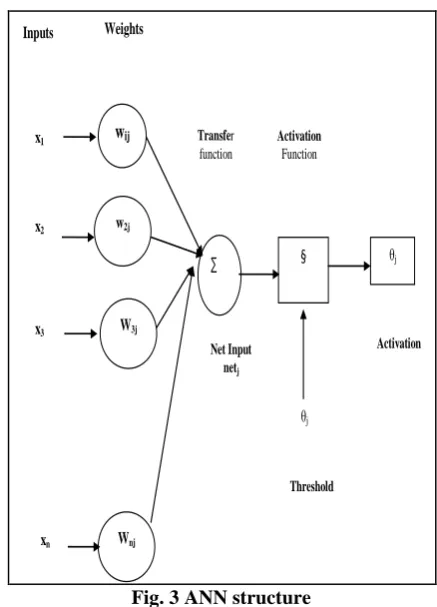
Every link is linked with the weight. ANNs are competent of learning which can be utilized by changing the weightvalues. Representation of ANN is shown in Figure 3. A neuron would be transferred a message to some other neuron between the interfaces if the sum of the weighted Input signal from Input signal from one to another neuron that is summation for causing the message transmission. This is known as activation function when the threshold is surpassed and the message is transferred alongside the subsequent neuron Li et al. (2018).
The summation procedure could be scientifically composite. The input signal of neuron is a weighted combination of number of input signals with the input weight which could have dissimilar influence on computation and eventually on the last outcome of the whole network Buibas et al. (2017). ANN is consisted of three layers, that is Input layer, Hidden layer and Output layer. Input layer receives input as the value of the descriptive attribute of the
observation. Generally, the amount of input nodes is equivalent to the amount of explanatory variables Ghodsi et al. (2017).
wij
w2j
W3j
Wnj
∑ § θj
x1
x2
x3
xn
θj
Inputs Weights
Transfer function
Activation Function
Threshold
Activation
x1
x2
x3
xn
Inputs Weights
Transfer function
Net Input netj
Activation
Function
Threshold
[image:2.595.315.534.90.394.2]Activation
Fig. 3 ANN structure
Input shows the network patterns that communicate to number of hidden layers. The processing is executed by system of weighted connections. There can be more than one hidden layers. Those values are stored in the program that enters the hidden layer and are multiplied with weights and the set of pre-programmed number. The weighted inputs are further used for producing a number. The hidden layers are then connected to the output layer that takes the links from the hidden layer/ input layer (Satyanarayanan, 2017).
It returns the output value which matches with the response variable prediction. Output layer has active nodes that integrates and modify the data for producing the output values. ANN has the ability to offer the manipulations of useful data for weight proper selection. There are two ANN topologies, namely, Feed forward and feedback He etal. (2017).
B. Feed Forward ANN
Fig.4 Feed Forward ANN
C. Feedback ANN
[image:3.595.55.277.45.251.2]The feedback loops are applicable in Feedback ANN and are utilized in content addressable memories Yang et al. (2017). The diagrammatical representation of feedback ANN is shown below in figure 5:
Fig. 5 Feedback ANN
A. ANN Framework
Below a framework has been defined in which ANN usually works Zhang et al. (2017):
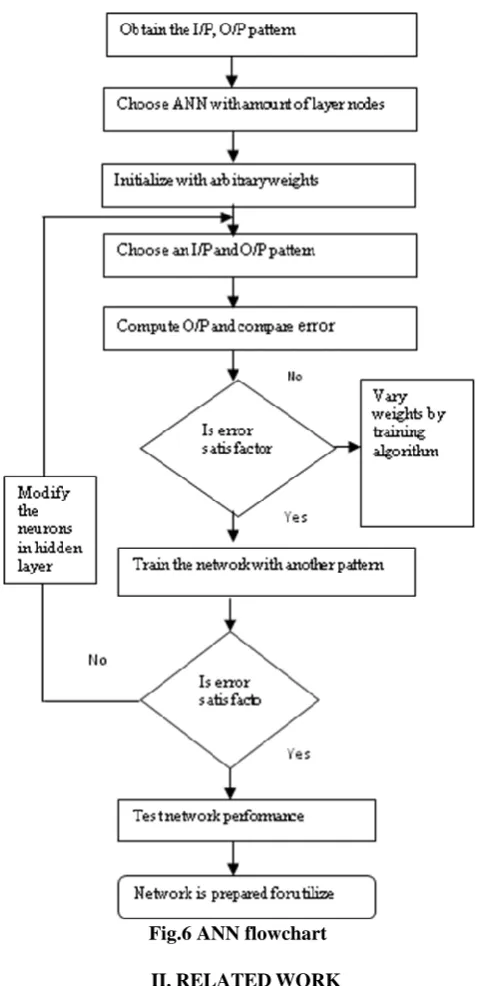
Step 1: Allocate arbitrary weights to each linkage to initialize the algorithm.
Step 2: Utilizing the input or the input-> Hidden layers link to predict the hidden node activation rate.
Step 3: Utilizing the activation rate for hidden nodes and associations to output, and discover the output nodes activation rate.
Step 4: Discover the error rate at the output node and amend each link among hidden nodes with the output nodes. Step 5: Utilizing the error and the weights found at the output
nodes and cascade the bugs towards the hidden nodes. Step 6: Amend the weights among hidden nodes and the input
nodes.
Step 7: Iterate the procedure till the completion of convergence criteria.
Step 8: Utilizing the final linkage weight score.
Fig.6 ANN flowchart
II.RELATEDWORK
Nguyen Quang-Hung et al. (2013) has proposed a GAPA (genetic algorithm for power-aware) in the resource allocation scheduling for solving the SVMAP (Static Virtual machine allocation problem). Because of less resource for the execution, a workload has been created with a sample. The authors have evaluated GAPA and BFD (Baseline Scheduling algorithm) for sorting lists of VM (Virtual machine) in the initial tome (Earliest start time first) and the usage of best fit decreasing (less increased power consumption) for the solution of similar SVMAP. Therefore, the GAPA algorithm has obtained total energy consumption less as compared to the baseline algorithm.
Buyyaetal. (2010) have presented the challenges, vision with the architectural elements for the management of energy efficiency of cloud computing. The author has focused on dynamic resource development provisioning with the allocation algorithms with the different data centers infrastructure involving the
[image:3.595.51.282.312.484.2]boosting the energy efficiency of data centers. Particularly, the research has presented the architectural principals for the management of efficient energy of the cloud with the efficient energy resource allocation policies and the scheduling algorithms with QoS. CLOUDS simulation tool has been used for the validation of approach by using a number of parameters evaluations. The result has shown that the cloud computing model has huge potential for the best performance that gains cost and response time with dynamic workload scenario.
Researchers have proposed a dynamic VM (virtual machine) consolidation concept for the elimination of the VMM (virtual machine migration) which is not required as per Farahnakian et al. (2015). The utilized approach has lessened the SLA with a utilization prediction model. The proposed approach has migrated few of the VMs from the physical hosts being overloaded or assumed to be overloaded. The proposed approach has assigned the VMs to the host as per the existing and the future needs. As compared to another VM consolidation algorithm, proposed work optimizes the energy consumption and the SLA Violation.
Tian et al. (2015)have been motivated with the simulation problem of the scheduling algorithm by means of cloud data centers for the evaluation of varied parameters performance. The research has proposed CloudSched for resource scheduling dynamically in the cloud data centers. This research has dealt with presenting a simulation system of cloud computing modeling with the execution of varied resource scheduling algorithms and policies. The focus has been given to IaaS (Infrastructure as a Service) layer for the simulation scheduling.
Nguyen Quang-Hung et al. (2014) has studied the VM allocation problem to improviseQoS that is the resource and performance availability in HPC (vector bin-packing norm-based greedy) cloud. The author has presented EPOBF (Energy-aware and Performance-per-watt oriented Best-fit) that is the power aware allocation heuristic for the VMs in the HPC cloud. The HPC cloud scheduler uses the performance-per-watt for the allocation of VMs to the hosts for the enhanced efficient energy. The experiments have depicted the reduced energy consumption in comparison to existing power aware heuristics. The EPOBF-ST and EPOBF-FT heuristics are considered as novel VM allocation solution in the cloud data centre with multi-core PM (physical machine). EPOBF-FT and EPOBF-ST are considered to the better as compared to PABFD (Power-Aware Best-fit Decreasing) and VBP (vector bin-packing norm-based greedy) L1/L2/L30 allocation heuristics.
Mann et al. (2015) has investigated the performance that guarantees to be rigorously shown for the heuristics. Particularly, the author has established that MM ((Minimization of Migrations) is better as compared to a number of selected VMs (Virtual machines) for the over-utilized host. It has been shown that the outcome of MBFD could be significantly far from the better. In addition, the author has shown that MM as well as MBFD can provided optimal results.
Xiong et al. (2014) utilized the concept of swarm intelligence in order to optimize the current performance of the MBFD architecture. This paper compares its results with the evaluated results of Xiong for SLA violation parameter after implementing it.
Bisio et al. (2016) proposes a Radio Frequency Identification (RFID) based applications for which main advantages are to maximize the output using enhance battery lifetime, with high probability. This paper demonstrates an original architectural design that focuses on asset tracking. The main components are RFID, Bluetooth Low Energy labels and smartphones. In addition, nuclear functions are carried out with two Android programs that monitor and search for assets. The basic work of architecture is the ability to maximize battery life, reaching a shift that runs all around the BLE label-smartphone distance estimated with constructional labels, as well as short-term aging.
Sciarrone et al. (2016) developed Smart PFP based computation model using the distributed algorithm. The proposed work helps the researchers to save the power and enhance the efficiency with effective results. Furthermore, researchers focused on Indoor navigation and localization considered as a fundamental services nowadays. WiFi-based solutions such as Finger-Printing (FP) are the prominent and widely used methods for positioning and better results. Researchers want to compare WiFi Received Signal Strength (RSS) with pre-computed radio map called fingerprint. The recently-proposed Smart Probabilistic Finger-Printing (P-FP) algorithm reduces the computational complexity of the traditional FP approach without any accuracy detriment. If we talk about the fog computing, it has emerged as a new promising paradigm in recent years, which extends traditional mobile cloud computing capabilities to the edge of the network and enables location-aware services. An offload and Smart P-FP computing over a fog platform has been considered which exploits a novel distributed algorithm. Performance evaluation validates the effectiveness of the proposed process. The effectiveness increases as the number of devices surges. In addition, power saving computed more than 80%, if we compared with the local computation.
Botta et al. (2019) develops arobotic based complementary architecture which is different and fast moving from isolated systems. Cloud Robotics has truly become a new major trend in this research field. In this paper, scholars focus on the robotics systems. Such systems have really been very peculiar to meet traditional applications that have progressively exploited Cloud infrastructure. Cloud is an important addition, but robots still require important computations to be performed, such as critical decisions involving human interaction. This motivates the work, in which researchers delve into the Cloud Robotics, considering Fog- and Dew-computing as well as next generation applications. Furthermore, researchers describe these complementary but alternative architectures and how they match the robotics applications and identify the Dew Robotics as the most promising architecture and motivate the choice. Finally, research has been concluded with meaningful and robust results.
Kehoe et al. (2013) use the Internet resources and the rapid expansion of the wireless network. These resources have the potential for free movement of robots and automation systems which restricts the complex networking calculations for memory and software. Cloud Robotics includes an approach that recognizes the broad network's capability and includes open-source elements to greatly
consider how cloud-based data and calculation can contribute to the 3D robot's temptation. Further, they also present system architecture, prototype, and preliminary experimental data for a cloud-based robot graphic system which includes the Willow Garage PR2 robot with color and depth cameras, Google's proprietary object recognition engine, Point Cloud Library (PCL) Columbia University Grasp using toolkit and Open RAVE with the 3D graph. The initial approach to the sampling analysis and addresses the uncertainty. In addition, reported experimental data (80% recovery for the test collection objects), appraisal score (less than 14%) which encourages (failure rate up to 23%) and preliminary results of return and false positives within larger data bounds.
Hinze et al. (2019) proposes acurrent robotic control based system which is a fairly static, monolithic program where the application data should be programmed before the actual process begins. For more automated tasks, additional real-time control loops are required for process control and more flexible robots control. Consequently, this document represents a robot management architecture for real-time and individual communication, which can build real-time locksmiths as well as massive cloud computing components. In the proof of the concept, the robot and controller's diverse dynamic modeling are virtual components. The real-time architecture's reliability is assessed relatively which is non-validated and compared to the monolithic version of the same application.
Benzekki et al. (2018) proposes a contextual recognition validation systems which are becoming more and more interesting because of the usage of mobile devices. The widespread usage of the computing environments validate the system which can be implemented in different ways and provide secure validation using user behavior from their device. Contextual Notification Systems add an additional layer of security when executed with password-based validation methods. Additionally, they can replace conventional validation methods in some scenarios. In this article, scholars propose a practical system of authenticity that is costly and easy to implement. Environmental information is sent only when a user performs an identification request that enhance the system in a more practical and lightweight.
III.PROPOSEDARCHITECTURE
The proposed research work is divided into two segments. The user authentication and location aware broadcast to provide user a quick response with fast allocation and also to distribute the load equally.
A. User Authentication
The user authentication process is a combination of a user id and password cross validation with a match of system generated 8 bits captcha. If the user-id and password matches the user provided id and passwords then cloud server generates a 8 bit captcha code which changes every time a user tries to authenticate himself. In addition to this, if the user is idol for more than 5 minutes, the cloud server performs a session expire mechanism considering that the user is no longer active at server.
Algorithm 1: Validate User (Uid,Upass) 1. ForeachUserIdentity in DBUser
2. DBUid= UserIdentity.Uid; // taking the user identity
3. DBUpass=UserIdentity.Upass; // getting user password
4. If Isequal(DBUid,Uid) // If the user id is equal to the database id
5. If Isequal(DBUpass,Upass) // Then the password will be compared
6. System-Captcha=Get CaptchFromSystem( ); // The system will generate a captcha for the user
7. If UserEntry.Matches(System-Captcha) // If the captcha is verified
8. UserValidated(); // User is verified 9. Else
10. User_Not_Validated( ); // In case the captcha is not verified , the regeneration of //
11. // captcha will be done
12. Regenerate Captcha and Validate( ); 13. End If
14. Else
15. User Password is Wrong(); 16. Re take the password from User(); 17. End If
18. Else
19. Wrong User ID or ID does not exits in System Server; 20. Re take User Id from User( );
21. End If;
22. End Algorithm
The authentication mechanism is inspired from Google authentication mechanism in which the user id and password is checked separately. The separation mechanism provides an ease to the user to understand exactly where the user is making a mistake.
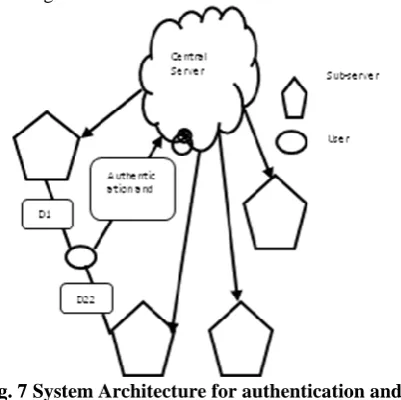
Once the user is validated, the server part comes into play. Figure 6 represents the proposed architecture.
There is a Central Server (CS) which takes the request from the user to remove the bar between the service provider and service demander. The CS has mobile users termed as Sub Servers or Mobile Servers. Now it is the responsibility of the CS to select appropriate MS for the user. There are mainly two constraints for the selection of the MS for the user.
D(U,MS) < (U.x->20, U_Y->20) MS. Resources >Urequirements
Condition ‘a’ checks the user location is feasible for the sub-server or not. A 20% range bar is applied that ensures that the SS should lie within the 20% of x and y location of the user. Condition ‘b’ ensures that if the SS is available in the range then they must satisfy the needs of user requirement. The MS must have resources more than User-> U requirement. There proposed algorithm manages the server side configuration also. When the MS is overloaded then proposed research work utilizes the concept of VM allocation and migration with location awareness to it. The judgment of the location-aware service is judged by ANN. The virtual machines, in this case, are considered to be mobile. The VM allocation and selection policy have a base named Modified Best Fit Decreasing Algorithm developed by Anton. The base structure of MBFD is presented in Algorithm 1.
Algorithm 2: Modified_Best_Fit_Decreasing 1. Allocation of VMs
2. SortVms as Decreasing utilization ( ) 3. For each in VM list do
5. Input:PRESENT_HOST_list, Vm list Output:
6. minPower←max // Assigning maximum value initially
7. allocated PRESENT_HOST←null /// No
PRESENT_HOST is allocated
8. for each PRESENT_HOST in PRESENT_HOST list do // For every PRESENT_HOST in the list
9. if PRESENT_HOST has enough resource for VM then // Checking feasibility
10. power←PowerEstimation (MC,Vm) // Estimating power 11. If power<manpower then
12. Allocate PRESENT_HOST←host
13. MinimumPower←power
14. if Allocated PRESENT_HOST≠nullthen 15. Allocate VM to allocated PRESENT_HOST 16. ifbestFitUtil =Max then
17. bestVM_ValueVM break 18. HutilHutil –bestFitVm.getUtil() 19. migrationlist.add (bestFitVM) 20. VmList.remove (best VM_Value) 21. End Algorithm
[image:6.595.71.272.331.531.2]Based on above mentioned algorithm, system architecture has been designed as shown in Fig. 7, which represents the authentication and distance management process by central server during the simulation of model.
Fig. 7 System Architecture for authentication and distance management by central server
Algorithm 1 presents the base architecture of VM allocation. The VM properties are analyzed and it is evaluated whether the Host analyzed resources for the Virtual machine then the power is evaluated and the utilization factor changes after every allocation. When the Virtual Machines are movable then the power consumption also increases. It is very important to check the allocation policy as the mobility of VMs utilizes more power. Also the network needs a tracker to monitor the range of the VM so that if it going too far from the Host machine, the host machine or the VM or for an instance both gets an alarm of location. In such a scenario, get proposed research work utilizes ANN to sort this out. The ANN takes the location of the VMs and the Host machine for the training. A timer checks the difference in the movement of the Machine and as soon as the error rate starts increasing at the AI model, the buzzer rings and the VM stops and gets back to the region where it was before to maintain the range aspect of the proposed structure. Algorithm 3 depicts the working of the proposed technique.
Algorithm 3: AI Range Sensor (VM, HOST)
1. For each allocated VM in VM for Host
2. Training Data(VMcounter,1)=VM.
Allocation(x,y).
3. TrainingData(VMcounter,2)=Host.Allocation(x,y); 4. GroupValue(Vmcounter,1)=Vm.Id;
5. End For
6. TrainAI(TrainingData,GroupValue,X) //X is the total number of hidden Neurons
7. Timer.ticks++
8. Locationvalue=UpdateLocationValue; 9. ErrValue=Simulate(UpdatedLocation); 10. If ErrValue>.20
11. Rearrange Location Value( ); 12. End If
13. End Algorithm
Once a job is complete by the MS, the CS aims to update the feedback of the MS so that when similar kind of instruction set is supplied by the user to the CS, it will not have to broadcast the requirement of the user. The CS will only have to look whether the MS is available in the area or not.
Algorithm 4: Update Feedback (MSID,ToC,MIPSS) 1. ToC Time_(of_Completion )
2. MIPSS Supplied_MIPS
3. MSIDMobile_Server Identity_Number 4. // The proposed structure uses evaluates the rating
as following
5. R1= MPSS/ToC ; // Taking the ratio of MPSS and ToC
6. IF( 1000<R1<2000) // If the value of the R lies between 1000 to 2000 then the rating would be 2 7. R=2;
8. ELSE-IF (2000<R1<3000) // Here the rating would be 3
9. R=3;
10. ELSE-IF(3000<R1<4000) //Here the rating would be 4
11. R=4; 12. ELSE 13. R=5; 14. END IF 15. NewRating=R;
16. D=Lookout(FeedbackList.ID==MSID); Searching MSID in the FeedbackList
17. IF D is not Empty // There is already a registration of the MS in the FeedbackList 18. CurrentRating= FeedbackList.MSID.Rating; //
Getting the previous rating of the MS
19. NewRating= (CurrentRating + NewRating)/2; // The new rating is the average of old and new rating
20. UpdateRating(FeedbackQueue.MSID. 21. END IF
Algorithm 4 is applicable when there is already a registration of the MS in the Feed backlist. When the MS is new, it is obvious that there would not be any registration in the Feed backlist. Once a MS has feedback; the CS will select the MS based on the feedback if two or more than two MS are available at the same time. The proposed algorithm has provision of registration of a new user in the list. Algorithm 4 checks the feasibility of a
Algorithm 5: Check FeasibilityOf Addition of New
Mobile Server (Server_Configuration,
Job_(Completion_Rate ))
1. Server_Configuration (SC) What resources are available
with the applied Sub Server
2. Job_(Completion_Rate (JCR) )-Ratio of Total Completed jobs at any other Completion
Environment to Total number of Supplied Jobs 3. IF SC >= ASC AND JCR>=AEJCR
4. (/)/ If the applied server has greater or equal configuration setting of the resources as compared to the average //resources of all the MCs (ASC) in the current server till now and the JCR is greater than that of Average //Environment JCR that is the Average JCR of all existing MCs in the current computing environment then //server application will be selected.
5. Add_Server_To_List as MC // Adding MC to the Computing Environment List
6. Add MC to FeedbackList. // Add MC to the FeedbackList
7. END IF
8. END ALGORITHM
Algorithm 5 checks the feasibility of addition of a new server which might have been a part of previous system architecture. In such a case the proposed solution checks whether the applicant server is able to join our network or not. The monitoring server checks the server configuration which includes the ram, cpu utilization and memory capacity. If the applicant server has more configuration as compared to the average configuration of our network then the applicants checked with JCR. The same condition is applied for this parameter as well.
Algorithm 4 takes the Host and VM location as the training parameter and a timer is placed in the network which is synchronized with both the Host and VM. At the time of simulation, if the error goes more than .20 then the VM and the Host both get a buzzer distance aware alarm.
IV. RESULTANDDISCUSSION
This section explains the results obtained after the simulation of the proposed work. For the simulation, parameters, such as energy consumption and SLA violation are computed.
A.Energy consumption
It is defined as the energy consumed by each server within the system. Mathematically, it can be represented as:
(1) Signifies the energy of VM
- Signifies the energy of host B.SLA violation
SLA is an assurance to serve the ice provider to the user. SLA can be known as violation e.g. if the job ought to be scheduled and it is non-scheduled.
(2)
Table 1. Evaluation of energy consumption PM
To VM Ratio
PM s
VM
s Proposed MBF
D Xiong Ahmed Ghodsi
0.66 10 15 28 40 37 39.4 41.2
0.75 15 20 30 42 39 41.2 42.2
0.8 20 25 33 45.12 41 43.5 44.1
0.83
3 25 30 31 45.15 43 44 46.3
0.85 30 35 35 49.63 46 47 47.9
[image:7.595.323.524.334.495.2]The energy consumption of scenario is taken keeping the x axis as PM to VM Ratio (PVR) and y axis being the energy consumption itself. The proposed algorithm is compared with MBFD and Xiong’s proposed architecture with included optimization of MBFD with PSO (Particle Swarm Optimization). PSO is a swarm based algorithm which has performance issues when the load over the server is increased. In the provided scenario as shown in Figure 8, the consumption of energy for Xiong model increases with the increase in PVR. The need to increase the PVR is only due to increase in the laod. Although the performance of the Xiaog is better as compared to MBFD but still it is way to behind from the proposed work model. This is due to the recursive analysis of Neural Network in the proposed work model. For a PVR value of .85, Xiong consumed 46 mJ whereas for the same scenario, the proposed algorithm consumes 35 Mj. A total of . The proposed algorithm is also compared to Ahmed et al.[1] and Ghodsi et al.[8]. The situation is no different when it comes to SLA violation.
[image:7.595.313.546.529.829.2]Fig.8 Energy Consumption Proposed, MBFD, Xiong,Ahmed,Ghodsi
Table 2. Evaluation of SLA violation
PV R
P
Ms VMs
Propos ed
MB FD
Xi on g
Ahmed Ghod
si
0.6
6 10 15 35 68 48 49 48.2
0.7
5 15 20 32 65 49 53 53.4
0.8 20 25 40 70 51 55 55.9
0.8
33 25 30 34 72 53 56 57.8
0.8
Fig. 9 SLA Proposed, MBFD, Xiong,Ahmed Ghodsi The comparison of SLA violation is represented by Fig.9. The SLA Violation for Xiong for PVR=.85 is 55 whereas it has a 37 unit value for the proposed algorithm in the same scenario. The percentage improvement of the proposed work in contrast
to Xiong is .
V. CONCLUSION
This research work focused on the development of a load aware scheduling algorithm based on the location aware services of Mobile Computing. The proposed architecture considered the VM consolidation and load management at the same time. The proposed work enhances the current allocation process MBFD. Although an enhancement in MBFD is also proposed by Xiong who utilized Swarm Based PSO. PSO had its own limitations for this scenario which is reflected in the performance. The performance of the Xiong is better than the MBFD but it is way to behind when compared to the proposed algorithm. The proposed algorithm is also compared to Ahmed and Ghodsi architecture. The proposed algorithm used FeedForward Back Propagation Neural Network for the enhancement of MBFD. In addition to that, a user authentication mechanism, Feedback architecture is also integrated to make the proposed algorithm more precise and accurate to the demand. The feedback mechanism helps in selecting the appropriate server for the execution of the task. The performance of the proposed algorithm is done on the basis of Energy Consumption and SLA violation. For both the parameters, the proposed algorithm demonstrates an improvement of 23.91 and 32 % has been attained due to the utilization of feed forward back propagation network along with MBFD. Here, proposed algorithm is used to reduce the time complexity of system which is a major cause of reduction of energy consumption rate. Feed forward back propagation has been utilized to find the appropriate VMs according to job, which helps to minimize the SLA violation. The proposed work has a wide scope of improvement. Combination of natural computing with Feed Forward Network may produce interesting results.
REFERENCES
1. E. H. Miller, “A note on reflector arrays (Periodical style—Accepted
for publication),” IEEE Trans. Antennas Propagat., to be published.
2. Ahmad, I., Raja, M. A. Z., Bilal, M., Ashraf, F.,2017.Neural network
methods to solve the Lane–Emden type equations arising in thermodynamic studies of the spherical gas cloud model. Neural Comp. and Applic. 28(1),929-944.
3. Ahmed, E, Rehmani, M. H. Mobile edge computing: opportunities, solutions, and challenges.
4. Buibas, M., Izhikevich, E. M., Szatmary, B., Polonichko, V.
2017. U.S. Patent No. 9,613,310. Washington, DC: U.S. Patent and Trademark Office.
5. Buyya, R., Beloglazov, A and Abawajy, J.,2010.Energy-efficient
management of data center resources for cloud computing: a vision, architectural elements, and open challenges.
6. Dinh, H. T., Lee, C., Niyato, D, Wang, P.2013.A survey of mobile cloud computing: architecture, applications, and approaches. Wire. commun. and mob. comp., 13(18),1587-1611.
7. Farahnakian, F., Pahikkala, T., Liljeberg, P., Plosila, J, Tenhunen, H.2015.Utilization prediction aware vm consolidation approach for green cloud computing. In Cloud Computing (CLOUD), 2015 IEEE 8th International Conference on IEEE. (pp. 381-388).
8. Fernando, N., Loke, S. W and Rahayu, W., 2013.Mobile cloud
computing: A survey. Future generation computer systems, 29 (1),84-106.
9. Ghodsi, Z., Gu, T., Garg, S.,2017.Safetynets: Verifiable execution of deep neural networks on an untrusted cloud. In Advances in Neural Information Processing Systems pp. 4672-4681.
10. Ghribi, C., Hadji, M and Zeghlache, D.,2013.Energy efficient vm scheduling for cloud data centers: Exact allocation and migration algorithms. In Cluster, Cloud and Grid Computing (CCGrid), 2013 13th IEEE/ACM International Symposium on IEEE. pp. 671-678.
11. He, Y., Yu, F. R., Zhao, N., Leung, V. C, Yin,
H.2017.Software-defined networks with mobile edge computing and caching for smart cities: A big data deep reinforcement learning approach. IEEE Comm. Mag., 55(12),31-37.
12. Javed, A., Larijani, H., Ahmadinia, A, Gibson, D.2017.Smart Random
Neural Network Controller for HVAC Using Cloud Computing Technology, IEEE Trans. Industrial Informatics, 13(1),351-360. 13. Li, L., Feng, M., Jin, L., Chen, S., Ma, L., and Gao, J., 2018. Domain
Knowledge Embedding Regularization Neural Networks for Workload Prediction and Analysis in Cloud Computing. Journal of Information Technology Research (JITR),11(4),137-154.
14. Li, Y., Chen, M., Dai, W and Qiu, M. 2017.Energy optimization with
dynamic task scheduling mobile cloud computing. IEEE Sys. Jour.,11(1),96-105.
15. Mann, Z. Á. 2015.Rigorous results on the effectiveness of some heuristics for the consolidation of virtual machines in a cloud data center. Future Gener. Comp. Sys.,51,1-6.
16. Mao, Y., You, C., Zhang, J., Huang, K, Letaief, K. B.2017.A survey on mobile edge computing: The communication perspective. IEEE Commun. Surveys & Tutorials,19 (4), 2322-2358.
17. Quang-Hung, N., Nien, P. D., Nam, N. H., Tuong, N. H,Thai, N.2013.A genetic algorithm for power-aware virtual machine allocation in private cloud. In Information and Communication Technology-EurAsia Conference Springer, Berlin, Heidelberg. pp. 183-191.
18. Quang-Hung, N., Thoai, N, Son, N. T.,2014. EPOBF: energy efficient
allocation of virtual Knowmachines in high performance computing cloud. In Transactions on Large-Scale Data-and ledge-Centered Systems XVI Springer Berlin Heidelberg, pp. 71-86.
19. Rahimi, M. R., Ren, J., Liu, C. H., Vasilakos, A. V.,
Venkatasubramanian, N.2014. Mobile cloud computing: A survey, state of art and future directions” , Mobile Networks and Applications,19(2),133-143.
20. Raju, R., Amudhavel, J., Kannan, N and Monisha, M., 2014. A bio inspired Energy-Aware Multi objective Chiropteran Algorithm (EAMOCA) for hybrid cloud computing environment, In Green Computing Communication and Electrical Engineering (ICGCCEE), International Conference on IEEE, pp. 1-5.
21. Satyanarayanan, M.2017. The emergence of edge computing.
Computer, 50(1),30- 39.
22. Xiong, A. P., Xu, C. X., 2014. Energy efficient multiresource allocation of virtual machine based on PSO in cloud data center. Mathematical Probl. in Engin.,1(2), 44-56.
23. Tian, W., Zhao, Y., Xu, M., Zhong, Y, Sun, X. 2015. A toolkit for modeling and simulation of real-time virtual machine allocation in a cloud data center, IEEE Trans. on Autom. Sci. and Engine. 12(1),153-161.
24. Yang, C., Huang, Q., Li, Z., Liu, K., Hu, F.2017.Big Data and cloud
computing: innovation
25. Yuan, J and Yu, S., 2014. Privacy preserving back-propagation neural network learning made practical with cloud computing, IEEE Trans. on Parallel and Distrib. Sys., 25(1), 212-221.
26. Zhang, P., Guo, Q., Zhang, S., Wang, H. H., 2017.Pattern mining model based on improved neural network and modified genetic algorithm for cloud mobile networks, Cluster Computing,1-10. 27. Zhang, Y., Chen, X., Li, J., Wong, D. S., Li, H., You, I.2017.Ensuring
attribute privacy protection and fast decryption for outsourced data security in mobile cloud computing, Infor. Sci., 379, 42-61.
28. Bisio, I., Sciarrone, A., Zappatore S., 2016. A new asset tracking architecture integrating RFID, Bluetooth Low Energy tags and ad hoc smartphone applications. Pervasive and Mobile Computing, Elsevier. 29. Sciarrone, C. Fiandrino, I. Bisio, F. Lavagetto, D. Kliazovich and P.
Bouvry, 2016. Smart Probabilistic Fingerprinting for Indoor Localization over Fog Computing Platforms. 5th IEEE International Conference on Cloud Networking, 3-5 October 2016, Pisa, Italy, DOI:10.1109/CloudNet.2016.43.
30. Botta, A., Gallo, L., Ventre, G., 2019. Cloud, Fog, and Dew Robotics: architectures for next generation applications. In 2019 7th IEEE International Conference on Mobile Cloud Computing, Services, and Engineering (MobileCloud), pp. 16-23.
31. Kehoe, B., Matsukawa, A., Candido, S. Kuffner, J. K. Goldberg, K.,
2013. Cloud-based robot grasping with the google object recognition engine, Proc. Int. Conf. Robot. Autom. (ICRA), 42634270.
32. Hinze, C., Tomzik, D.A., Lechler, A., Xu, X.W. Verl, A., 2019. Control Architecture for Industrial Robotics based on Container Virtualization.
In Tagungsband des 4. Kongresses Montage Handhabung
Industrieroboter (pp. 64-73). Springer Vieweg, Berlin, Heidelberg.
33. Benzekki, K., El Fergougui, A. and ElAlaoui, A.E., 2018. A
Context-Aware Authentication System for Mobile Cloud
Computing. Procedia Computer Science, 127,379-387.
AUTHORS PROFILE
Vishal, is an Assistant Professor at the Department of computer Science and Engineering, Jai Parkash Mukand Lal Innovative Engineering and Technology Institute, Radaur. He is Bachelors of Technology in Computer Engineering field from Kurukshetra University and Master of Technology in Software Engineering from Kurukshetra University. His research interest is in the area of security concepts in cloud computing and mobile devices, System Security and Cryptography etc. At Punjab Technical University he is doing research work on field of security in mobile cloud computing. Author has published around 20 research papers in International Journals and conferences. Mr.Vishal is member of international & professional bodies CSI, IAASSE, IAENG, IAOIP, and ICAICR.
Dr.Bikram Pal Kaur is Professor in the
Department. of Computer Science & Engineering and was also HOD of Deptt. Of
Computer Application in Chandigarh Engineering College, Landran, Mohali.She holds the degrees of B.Tech., M.Tech, M.Phil., PhD in the Computer Engineering from Punjabi University, Patiala. She has more than 22 years of teaching experience and served many academic institutions. She is an Active Researcher who has supervised many B.Tech. Projects, M.Tech / Research Projects, guided/ guiding M.Tech. Dissertations / Thesis and also guiding PhD to seven scholars . She has contributed more than 28 articles in various national/ international conferences and 43 papers in research Journals. Her areas of interest are Information System, ERP, Parallel Computing, AI, Fuzzy . Dr.Kaur is member of many professional societies such as ICGST, IAENG.
Dr. Surender Jangra completed his M.Tech degree in Computer Science and Engineering from Ch. Devi Lal University Sirsa(Hry) in 2006, M.Phil in Computer Science from Alagappa University, Karaikuri (T.N) in 2008, Ph.D in Computer Science and Application from Kurukshetra University, Kurukshetra in 2011 and also qualified UGC-NET in Computer Science and Applications in Oct. 2013. He has more than 10 years teaching experience to teach B.Tech, M.Tech., BCA and MCA Classes and recently working as an Assistant Professor, Department of Computer Science, GTB College, Bhawanigarh (Sangrur), Punjab, India. He has