Abstract: In stubborn courtesy, CFD codes became established and executed with water based SiO2, TiC and MgO nanofluids to
envision the thermal alarms of ICs. The convective governing equalities of mass, force and drive are computed for envisaging the thermal issues of ICs. The time pace selected throughout the intact computation is 0.0001 s. The soundings affect CFD forecasts of temperature curve, temperature arena plus fluid-solid boundary temperature of IC. Corresponding fluid-solid boundaries temperatures of IC are viewed as 349, 310 and 328 K for water based SiO2, TiC and MgO nanofluids, respectively. The
temperature of water-TiC nanofluid stands peak contiguous to the IC locality as it stands far less than the chancy temperature limit of 356 K. Further, the temperature of water-TiC nanofluid gently drops with improvement in aloofness from IC. Afterwards, this becomes surrounding temperature in the distant arena precinct. The analogous tinted temperature curve stands accessible. Besides, the harmonizing graph of temperature against distance from IC remains revealed. The realization of CFD indulgent endure proximate to the services of miens.
Index Terms: CFD Codes, Thermal Control, SiO2, TiC and
MgO Nanofluids.
I. INTRODUCTION
[image:1.595.302.541.454.702.2]An arrow of high temperature tolerances in some devices from interconnects to server remain hardened in figure 1. Electronics thermal control caught numerous routines for illustration.The standard thermal control arrayed heretofore for instance, atmospheric convection is inappropriate for extreme thermal flux treatments. In the preceding years the strange way of thermal control has compelled the researchers for the tiresome of nanofluid temperature control.
Figure 1. Continuous evolution of electronic devices
Revised Manuscript Received on August 05, 2019.
N. K. Kund, Department of Production Engineering, Veer Surendra Sai University of Technology, Burla (Sambalpur), Odisha, India.
The nanofluid temperature control is definitely vigorous as ambient thermal control is poor to deliver the drive as well. Numerical and experimental reviews on heat spreading over rectangular domain are existent in texts [1-7]. Computational and experimental work with solidification remain visible as well [8-20].
Nonetheless of the proofs that the nanofluid cooling equivocates the issues about the extreme heat battle as to ambient thermal control and hence, the treatment of nanofluid remains the significant drive of the extant exploration. Here, the thermal control of electronics through water based SiO2,
TiC and MgO nanofluids remain sneaked scientifically.
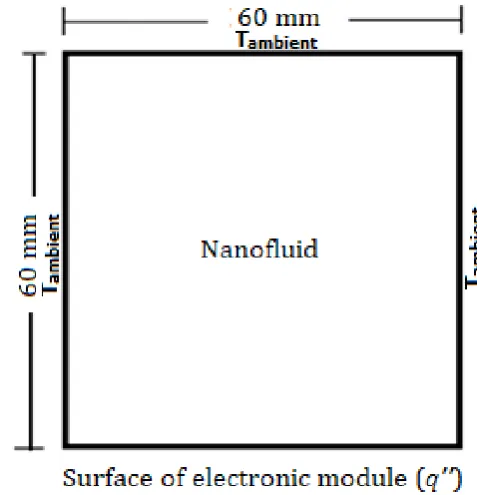
II. ILLUSTRATIONOFPHYSICALISSUE Figure 2 shows the physical challenge concerning the heat evolution from integrated circuit (IC) indicating the foot edge. Rest three edges are signposted through ambient situations. Here, the thermal controls of electronics is done through water based SiO2, TiC and MgO nanofluids. Besides, the
[image:1.595.48.288.551.722.2]thermophysical and model data of nanoparticles reflected in the existent analysis plus the ambient situation involved in the current path simulations, are very well-run in Table 1.
Figure 2. Pictorial depiction of IC computational zone
Modeling and Simulation on IC Cooling using
Water Centered SiO
2
, TiC and MgO Nanofluids
Table 1. Thermophysical properties and model data.
Nanoparticle Properties SiO2 TiC MgO
Density, ρ (Kg/m3) 2649 4932 3561
Specific heat, CP (J/kg.K) 746 712 966
Heat conductivity, k (W/m.K) 11 331 46
Model Data Values
Cavity size 60 mm
IC size 60 mm
Ambient temperature 300 K
IC heat transfer rate/area 70 W/cm2
III. NUMERICALPRACTICE
As accepted above, the figure 2 releases the CFD workbench aimed at computing the physical topic course. To facilitate the CFD forecasts the binding stages such as constructing geometry and purview, meshing and initialization are followed to run the simulation. Here, the prevailing equalities (as termed below through equalities 1-4) of mass, force and drive beside the edge states are chosen. Linearized equalities are computed through the CFD codes. After the development of computations, CFD codes form the shapes and curls through that numerous graphs stand strained to amalgam the CFD forecasts through the prognoses. With the later dispensation the forecasts are scrupulously explored meant for accommodating extravagant infiltrations.
Continuity: (1)
X-momentum:
(2)
Y-momentum:
βΔT (3)
Energy:
(4)
In the contemporaneous examination, CFD codes are developed and executed with water based SiO2, TiC and MgO
nanofluids to visualize the thermal concerns of ICs. The convective governing equalities of mass, force and drive are computed for envisaging the thermal issues of ICs. The time step preferred throughout the entire simulation is 0.0001 s.
IV. RESULTSANDDISCUSSIONS
CFD codes became recognized and accomplished with water based SiO2, TiC and MgO nanofluids. It envisages the
impacts on thermal control of ICs. The soundings affect CFD forecasts of temperature fields, temperature contours and fluid-solid boundaries temperatures of ICs.
Impact of Water-SiO2 Nanofluid on IC Cooling
Figure 3 uncovers the CFD outcrop of temperature field besides the tinted measuring scale screening the temperature values over K. It stands viewed at the documented archetype statuses bearing in mind the water-SiO2 nanofluid for IC
thermal control. The fluid-solid boundary temperature of IC is viewed as 349 K. This stands far less than the chancy limit of 356 K temperature wished for the objective of outwitting thermal cataclysm of IC. The temperature of water-SiO2
[image:2.595.47.292.385.598.2]nanofluid looks maximum close to the IC locality.
Figure 3. Temperature field with water-SiO2 nanofluid
[image:2.595.307.546.465.684.2]Also, the temperature of water-SiO2 nanofluid smoothly
drops with improvement in aloofness from IC. Afterwards, this becomes surrounding temperature in the aloof arena precinct. The equivalent tinted temperature contour remains available in figure 4 as well.
Impact of Water-TiC Nanofluid on IC Cooling
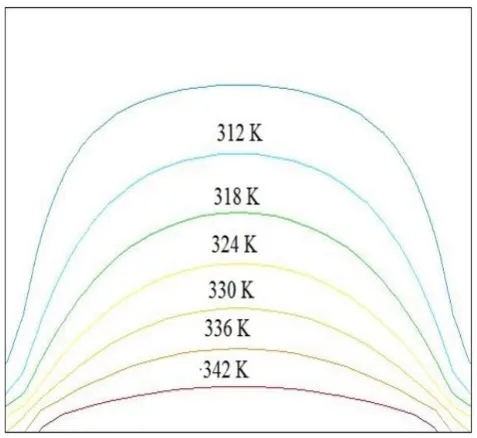
[image:3.595.312.541.163.397.2]Figure 5 uncovers the CFD outcrop of temperature field besides the tinted measuring scale screening the temperature values over K. It stands viewed at the documented archetype statuses bearing in mind the water-TiC nanofluid for IC thermal control. The fluid-solid boundary temperature of IC is viewed as 310 K. This stands far less than the chancy limit of 356 K temperature wished for the objective of outsmarting heat upheaval of IC.
Figure 5. Temperature field with water-TiC nanofluid
Figure 6. Temperature contour with water-TiC nanofluid The temperature of water-TiC nanofluid remains maximum neighboring to the IC vicinity. Further, the temperature of water-TiC nanofluid gently drops with improvement in aloofness from IC. Afterwards, this becomes surrounding
temperature in the aloof arena precinct. The equivalent tinted temperature contour remains available in figure 6 as well.
Impact of Water-MgO Nanofluid on IC Cooling
[image:3.595.53.287.232.469.2]Figure 7 uncovers the CFD prediction of temperature field besides the tinted measuring scale screening the temperature values over K.
[image:3.595.309.547.432.644.2]Figure 7. Temperature field with water-MgO nanofluid
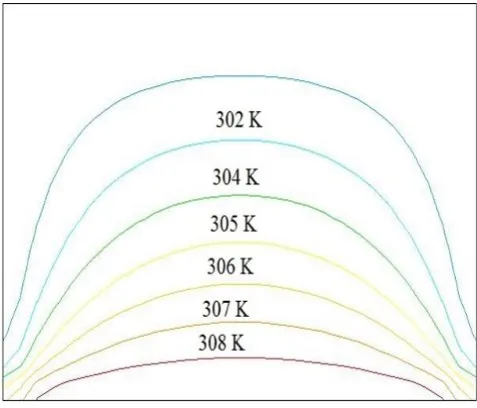
Figure 8. Temperature contour with water-MgO nanofluid
It keeps pragmatic at the foreseeable essence eminences bearing in mind the water-MgO nanofluid for IC thermal control. The fluid-solid boundary temperature of IC is viewed as 328 K. This stands far less than the chancy limit of 356 K temperature wished for the objective of outwitting thermal cataclysm of IC. Tritely, the
[image:3.595.49.288.502.706.2]Further, the temperature of water-MgO nanofluid gently drops with improvement in aloofness from IC. Afterwards, this becomes surrounding temperature in the distant arena precinct. The consistent tinted temperature plot stays accessible in figure 8.
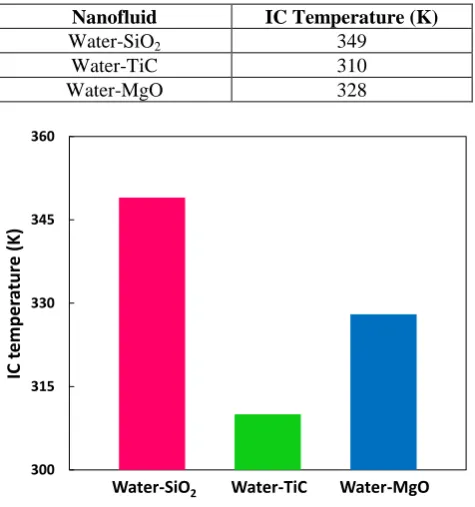
Table 2 recapitulates the fluid-solid boundaries temperatures of ICs witnessed with water based SiO2, TiC and
[image:4.595.51.289.234.488.2]MgO nanofluids. Though the trends of fields/contours results are similar, however, the discrepancies are owing to the variations in the thermophysical properties of the related nanoparticles as agglomerated in table 1. Figure 9 displays the equivalent plot of IC temperature against nanofluid.
Table 2. Summary of IC temperatures along with nanofluids.
Nanofluid IC Temperature (K)
Water-SiO2 349
Water-TiC 310
Water-MgO 328
300 315 330 345 360 IC tem per at ur e (K)
Water-SiO2 Water-TiC Water-MgO
Figure 9. IC temperature vs. nanofluid
V. CONCLUSION
In dogged identifications, CFD codes remain established and employed with water based SiO2, TiC and MgO
nanofluids to envision the thermal alarms of ICs. The convective governing equalities of mass, force and drive are computed for envisaging the thermal issues of ICs. The time pace selected throughout the intact computation is 0.0001 s. The soundings affect CFD forecasts of temperature field, temperature contour and fluid-solid boundary temperature of IC. Corresponding fluid-solid boundaries temperatures of IC are viewed as 349, 310 and 328 K for water based SiO2, TiC
and MgO nanofluids, respectively. The temperature of water-TiC nanofluid remains top neighboring to the IC neighborhood, nevertheless, it remains quite less than the hazardous temperature limit of 356 K. Further, the temperature of water-TiC nanofluid gently drops with improvement in aloofness from IC. Afterwards, this becomes surrounding temperature in the distant arena precinct. The analogous tinted temperature curve stands accessible. Besides, the harmonizing graph of temperature against distance from IC stays exposed. The establishment of CFD
examination stay in common with the tastes of demeanors.
ACKNOWLEDGMENT
The essential support from VSSUT Burla for realizing this investigation is greatly acknowledged. Indeed, the author is grateful to the reviewers and journal editorial board for their meticulous and insightful reviews to this article.
REFERENCES
1. N. K. Kund, P. Dutta, 2010, Numerical simulation of solidification of liquid aluminium alloy flowing on cooling slope, Trans. Nonferrous Met. Soc. China, Vol. 20, pp. s898-s905.
2. N. K. Kund, P. Dutta, 2012, Scaling analysis of solidification of liquid aluminium alloy flowing on cooling slope, Trans. Indian Institute of Metals, Vol. 65, pp. 587-594.
3. N. K. Kund, 2014, Influence of melt pouring temperature and plate inclination on solidification and microstructure of A356 aluminum alloy produced using oblique plate, Trans. Nonferrous Met. Soc. China, Vol. 24, pp. 3465−3476.
4. N. K. Kund, 2015, Influence of plate length and plate cooling rate on solidification and microstructure of A356 alloy produced by oblique plate, Trans. Nonferrous Met. Soc. China, Vol. 25, pp. 61−71. 5. N. K. Kund, P. Dutta, 2015. Numerical study of solidification of A356
aluminum alloy flowing on an oblique plate with experimental validation, J Taiwan Inst. Chem. Ers., Vol. 51, pp. 159−170.
6. N. K. Kund, P. Dutta, 2016, Numerical study of influence of oblique plate length and cooling rate on solidification and macrosegregation of A356 aluminum alloy melt with experimental comparison, J. Alloys Compd., Vol. 678, pp. 343−354.
7. N. K. Kund, 2018, Effect of tilted plate vibration on solidification and microstructural and mechanical properties of semisolid cast and heat-treated A356 Al alloy, Int. J. Adv. Manufacturing Technol., Vol. 97, pp. 1617−1626.
8. N. K. Kund, 2019, EMS route designed for SSM processing, International Journal of Engineering and Advanced Technology, Vol. 8, pp. 382−384.
9. N. K. Kund, 2019, Cooling slope practice for SSF technology, International Journal of Engineering and Advanced Technology, Vol. 8, pp. 410−413.
10. N. K. Kund, 2019, Comparative ways and means for production of nondendritic microstructures, International Journal of Innovative Technology and Exploring Engineering, Vol. 8, pp. 534−537. 11. N. K. Kund, 2019, Simulation of electronics cooling deploying
water-zinc oxide nanofluid, International Journal of Recent Technology and Engineering, Vol. 7, pp. 1076−1078.
12. N. K. Kund, 2019, Numerical studies on fuel cell cooling introducing water-copper nanofluid, International Journal of Recent Technology and Engineering, Vol. 7, pp. 1079−1081.
13. N. K. Kund, 2019, Computational modeling of fuel cell expending water-zinc oxide nanofluid, International Journal of Innovative Technology and Exploring Engineering, Vol. 8, pp. 424−426. 14. N. K. Kund, 2019, Investigations on modeling and simulation of
electronics cooling exhausting water-aluminum nanofluid, International Journal of Innovative Technology and Exploring Engineering, Vol. 8, pp. 660−663.
15. N. K. Kund, 2019, Numerical study on effect of nozzle size for jet impingement cooling with water-Al2O3 nanofluid, International Journal
of Engineering and Advanced Technology, Vol. 8, pp. 736−739. 16. N. K. Kund, 2019, Experimental investigations on impacts of nozzle
diameter on heat transfer behaviors with water jet impingement, International Journal of Engineering and Advanced Technology, Vol. 8, pp. 745−748.
17. N. K. Kund, 2019, Comparative CFD studies on jet impingement cooling using water and water-Al2O3 nanofluid as coolants,
International Journal of Innovative Technology and Exploring Engineering, Vol. 8, pp. 545−548.
19. N. K. Kund, D. Singh, 2019, CFD studies on heat transfer and solidification progress of A356 al alloy matrix and Al2 O3 nanoparticles melt for engineering usages, International Journal of Innovative Technology and Exploring Engineering, Vol. 8, pp. 2043−2046. 20. N. K. Kund, S. Patra, 2019, Simulation of thermal and solidification
evolution of molten aluminum alloy and SiC nanoparticles for engineering practices, International Journal of Innovative Technology and Exploring Engineering, Vol. 8, pp. 2047−2050.
AUTHORS PROFILE