Dimension Reduction and Visualization of Large
High-dimensional Data via Interpolation
Seung-Hee Bae
School of Informatics andComputing
Pervasive Technology Institute Indiana University Bloomington IN, 47408, USA
[email protected]
Jong Youl Choi
School of Informatics andComputing
Pervasive Technology Institute Indiana University Bloomington IN, 47408, USA
[email protected]
Judy Qiu
Pervasive Technology Institute Indiana University Bloomington IN, 47408, USA
[email protected]
Geoffrey C. Fox
School of Informatics andComputing
Pervasive Technology Institute Indiana University Bloomington IN, 47408, USA
[email protected]
ABSTRACT
The recent explosion of publicly available biology gene se-quences and chemical compounds offers an unprecedented opportunity for data mining. To make data analysis feasible for such vast volume and high-dimensional scientific data, we apply high performance dimension reduction algorithms. It facilitates the investigation of unknown structures in a three dimensional visualization. Among the known dimension re-duction algorithms, we utilize the multidimensional scaling and generative topographic mapping algorithms to configure the given high-dimensional data into the target dimension. However, both algorithms require large physical memory as well as computational resources. Thus, the authors propose an interpolated approach to utilizing the mapping of only a subset of the given data. This approach effectively reduces computational complexity. With minor trade-off of approx-imation, interpolation method makes it possible to process millions of data points with modest amounts of computation and memory requirement. Since huge amount of data are dealt, we represent how to parallelize proposed interpolation algorithms, as well. For the evaluation of the interpolated MDS by STRESS criteria, it is necessary to compute sym-metric all pairwise computation with only subset of required data per process, so we also propose a simple but efficient parallel mechanism for the symmetric all pairwise computa-tion when only a subset of data is available to each process. Our experimental results illustrate that the quality of in-terpolated mapping results are comparable to the mapping
Permission to make digital or hard copies of all or part of this work for personal or classroom use is granted without fee provided that copies are not made or distributed for profit or commercial advantage and that copies bear this notice and the full citation on the first page. To copy otherwise, to republish, to post on servers or to redistribute to lists, requires prior specific permission and/or a fee.
HPDC ’10 Chicago, Illinois USA
Copyright 2010 ACM X-XXXXX-XX-X/XX/XX ...$10.00.
results of original algorithm only. In parallel performance as-pect, those interpolation methods are well parallelized with high efficiency. With the proposed interpolation method, we construct a configuration of two-million out-of-sampledata into the target dimension, and the number ofout-of-sample
data can be increased further.
Categories and Subject Descriptors
I.5 [Pattern Recognition]: MiscellaneousGeneral Terms
Algorithms, PerformanceKeywords
MDS, GTM, Interpolation
1.
INTRODUCTION
Due to the advancements in science and technologies for last several decades, every scientific and technical fields gen-erates a huge amount of data in every minute in the world. We are really in the data deluge era. In reflection of data deluge era, data-intensive scientific computing [12] has been emerging in the scientific computing fields and getting more interested by many people. To analyze those incredible amount of data, many data mining and machine learning algorithms have been developed. Among many data mining and machine learning algorithms that have been invented, we focus on dimension reduction algorithms, which reduce data dimensionality from original high dimension to target dimension, in this paper.
to utilize multicore clusters and to increase the computa-tional capability with minimal overhead for the purpose of investigating large data, such as 100k data [7]. However, par-allelization of those algorithms, whose computational com-plexity and memory requirement is uptoO(N2) where N is the number of points, is still limited by the memory re-quirement for huge data, e.g. millions of points, although it utilize distributed memory environments, such as clusters, for acquiring more memory and computational resources. In this paper, we try to solve the memory-bound problem by interpolation based on pre-configured mappings of the sam-ple data for both MDS and GTM algorithms, so that we can provide configuration of millions points in the target space. In this paper, first we will briefly discuss about existed methods ofout-of-sampleproblem in various dimension re-duction algorithms in Section 2. Then, the proposed in-terpolation methods and how to parallelize them for MDS and GTM algorithms are described in Section 3 and Sec-tion 4, correspondingly. The quality comparison between interpolated results and full MDS or GTM running results and parallel performance evaluation of those algorithms are shown in Section 5 followed by our conclusion and future works in Section 6.
2.
RELATED WORK
Embedding new points with respect to previously config-ured points, or known asout-of-sample problem, has been actively researched for recent years, aimed at extending the capability of various dimension reduction algorithms, such as LLE, Isomap, multidimensional scaling (MDS), generative topographic mapping (GTM), to name a few. Among many efforts, a recent study by S. Xiang et. all in [23] provides a generalized out-of-sample solutions for non-linear dimension reduction problems by using coodinate propagation. In [6], M. Carreira-Perpi˜n´asn and Z. Lu provides an out-of-sample extension for the algorithms based on the latent variable model, such as generative topographic mapping (GTM), by adapting spectral methods used for Laplacian Eigenmaps.
In sensor network localization field, when there are only a subset of pairwise distances between sensors and a subset of anchor locations are available, people try to find out the lo-cations of the remaining sensors. For instance, semi-definite programming relaxation approaches and its extended ap-proaches has been proposed to solve it [22]. [2] and [20] proposed out-of-sample extension for the classical multidi-mensional scaling (CMDS) [19], which is based on spectral decomposition of a symmetric positive semidefinite matrix (or the approximation of positive semidefinite matrix), and the embeddings in the configured space are represented in terms of eigenvalues and eigenvectors of it. [2] projected the new pointxonto the principal components, and [20] extends the CMDS algorithm itself to the out-of-sample problem.
In contrast to applying out-of-sample problem to CMDS, we extends out-of-sample problem to general MDS results with STRESS criteria in Eq. (1), which finds embeddings of approximating to the distance (or dissimilarity) rather than the inner product as in CMDS, with an EM-like optimization method, called iterative majorizing. The proposed iterative majorizing interpolation approach for the MDS problem will be explained in Section 3.1.
3.
MULTIDIMENSIONAL SCALING (MDS)
Multidimensional scaling(MDS) [5, 17] is a general term for the techniques of configuration of the given high dimen-sional data into target dimendimen-sional space based on the pair-wise proximity information of the data, while each Euclidean distance between two points becomes as similar to the corre-sponding pairwise dissimilarity as possible. In other words, MDS is a non-linear optimization problem with respect to mapping in the target dimension and original proximity in-formation.
Formally, the pairwise proximity information is given as an N×N matrix (Δ = [δij]), where N is the number of
points andδijis the given dissimilarity value of the original
data space between pointiandj. (1) Symmetric (δij=δji),
(2) non-negative (δij ≥0), and (3) zero diagonal (δii = 0)
are the constraints of the dissimilarity matrixΔ. By MDS algorithm, the generated mapping could be also represented as an N ×L matrix (X), and each data point xi ∈ RL
(i= 1, . . . , N) resides ini-th rows ofX.
The evaluation of the constructed configuration is done with respect to the well-known objective functions of MDS, namely STRESS [16] or SSTRESS [18]. Below equations are the definition of STRESS (1) and SSTRESS (2):
σ(X) =
i<j≤N
wij(dij(X)−δij)2 (1)
σ2(X) =
i<j≤N
wij[(dij(X))2−(δij)2]2 (2)
where 1≤i < j≤N andwij is a weight value, sowij≥0.
3.1
Majorizing Interpolation MDS
One of the main limitation of most MDS applications is that it requires O(N2) memory as well as O(N2) com-putation. Thus, though it is possible to run them with small data size without any trouble, it is impossible to ex-ecute it with large number of data due to memory limi-tation, so it could be considered as memory-bound prob-lem. For instance, Scaling by MAjorizing of COmplicated Function (SMACOF) [9, 10], a well-known MDS application via Expectation-Maximization (EM) [11] approach, uses six N×N matrices. IfN = 100,000, then oneN×N matrix of 8-byte double-precision numbers requires 80 GB of main memory, so the algorithm needs to acquire at least 480 GB of memory to store six N×N matrices. It is possible to run parallel version of SMACOF with MPI in Cluster-II in Table 1 withN = 100,000. If the data size is increased only twice, however, then SMACOF algorithm should have 1.92 TB of memory, which is bigger than total memory of Cluster-IIin Table 1 (1.536 TB), so it is impossible to run it within the cluster. Increasing memory size will not be a solution, even though it could increase the runnable number of points. It will encounter the same problem as the data size increases.
in below. The algorithm proposed in this section is called Majorizing Interpolation MDS (MI-MDS).
The proposed algorithm is implemented as follows. We are given N data in high-dimensional space, sayD-dimension, and proximity information (Δ = [δij]) of those data as in
Section 3. AmongNdata, the configuration of thensample points inL-dimensional space, x1, . . . ,xn ∈ RL, calledX,
are already constructed by an MDS algorithm, here we use SMACOF algorithm. Then, we selectk nearest neighbors, p1, . . . ,pk∈P, of the given new point amongnpre-mapped
points with respect to correspondingδix, wherexrepresents
the new point. Finally, the new mapping of the given new pointx∈RLis calculated based on the pre-mapped position of selected k-NN and corresponding proximity information δix. The finding new mapping position is considered as a
minimization problem of STRESS (1) as similar as normal MDS problem withm points, wherem =k+ 1. However, only one point x is movable among m points, so we can summarize STRESS (1) as belows, and we setwij = 1, for ∀i, j in order to simplify.
σ(X) =
i<j≤N
(dij(X)−δij)2 (3)
= C+
k
i=1
d2ix−2 k
i=1
δixdix (4)
whereδix is the original dissimilarity value betweenpiand x,dixis the Euclidean distance inL-dimension betweenpi
andx, andC is constant part. The second term of Eq. (4) can be deployed as following:
k
i=1
d2ix = x−p12+· · ·+x−pk2 (5)
= kx2+
k
i=1
pi2−2x t
q (6)
whereqt= (k
i=1pi1, . . . ,
k
i=1piL) andpijrepresentsj-th
element of pi. In order to establish majorizing inequality,
we applyCauchy-Schwarz inequality to −dix of the third
term of Eq. (4). Please, refer to chapter 8 in [5] for details of how to applyCauchy-Schwarzinequality to−dix. Since dix=pi−x,−dix could have following inequality based
onCauchy-Schwarzinequality:
−dix ≤
L
a=1(pia−xa)(pia−za) diz
(7)
= (pi−x)
t(
pi−z) diz
(8)
wherezt= (z
i, . . . , zL) anddiz=pi−z. The equality in
Eq. (7) occurs ifxandz are equal. If we apply Eq. (8) to the third term of Eq. (4), then we obtain
− k
i=1
δixdix ≤ − k
i=1 δix diz
(pi−x)t(pi−z) (9)
= −xt
k
i=1
δix diz
(z−pi) +Cρ (10)
where Cρis a constant. If Eq. (6) and Eq. (10) are applied
to Eq. (4), then it could be like following:
σ(X) =C+
k
i=1
d2ix−2 k
i=1
δixdix (11)
≤ C+kx2−2xtq+
k
i=1 pi2
−xt
k
i=1
δix diz
(z−pi) +Cρ (12)
=τ(x,z) (13)
where bothC andCρare constants. In the Eq. (13),τ(x,z),
a quadratic function ofx, is a majorization function of the STRESS. Through setting the derivative ofτ(x,z) equal to zero, we can obtain minimum of it; that is
∇τ(x,z) = 2kx−2q−2
k
i=1
δix diz
(z−pi) = 0 (14)
x=q+ k
i=1δdixiz(z−pi)
k (15)
whereqt= (k
i=1pi1, . . . ,
k
i=1piL),pij representsj-th
el-ement of pi, and k is the number of nearest neighbor we
selected.
The advantage of the iterative majorization algorithm is that it guarantees to produce a series of mapping with non-increasing STRESS value as proceeds, which results in lo-cal minima. It is good enough to find lolo-cal minima, since the proposed MI algorithm simplifies the complicated non-linear optimization problem as a small non-non-linear optimiza-tion problem, such ask+ 1 points non-linear optimization problem, where k N. Finally, if we substitute z with x[t−1]in Eq. (15), then we generate an iterative majorizing equation like following:
x[t]=q+ k
i=1δdixiz(x
[t−1]−p
i)
k (16)
x[t]=p+1 k k i=1 δix diz
(x[t−1]−pi) (17)
where diz =pi−x[t−1] and p is the average of k-NN’s
mapping results. Eq. (17) is an iterative equation used to embed newly added point into target-dimensional space, based on pre-mapped positions ofk-NN. The iteration stop condition is essentially same as that of SMACOF algorithm, which is
Δσ(S[t]) =σ(S[t−1])−σ(S[t])< ε, (18)
whereS=P∪ {x}andεis the given threshold value. Process of the out-of-sample MDS could be summarized as following steps: (1) Sampling, (2) Running MDS with sample data, and (3) Interpolating the remain data points based on the mapping results of the sample data.
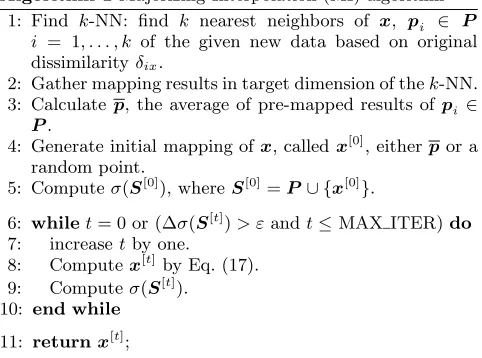
Algorithm 1Majorizing Interpolation (MI) algorithm 1: Find k-NN: find k nearest neighbors of x, pi ∈ P
i = 1, . . . , k of the given new data based on original dissimilarity δix.
2: Gather mapping results in target dimension of thek-NN. 3: Calculatep, the average of pre-mapped results of pi ∈
P.
4: Generate initial mapping ofx, calledx[0], eitherpor a random point.
5: Computeσ(S[0]), whereS[0]=P∪ {x[0]}.
6: whilet= 0 or (Δσ(S[t])> εandt≤MAX ITER)do 7: increasetby one.
8: Computex[t]by Eq. (17). 9: Computeσ(S[t]).
10: end while
11: returnx[t];
initialization withp makes dix = 0, since the mapping is
based on thek-NN. Ifpmakesdix= 0 (i= 1, . . . , k), then
we use a random generated point as an initial position of x[0].
3.2
Parallel MI-MDS Algorithm
Suppose that, amongNpoints, mapping results ofn sam-ple points in the target dimension, say L-dimension, are given so that we could use those pre-mapped results of n points via MI algorithm which is described above to em-bed the remaining points (M =N −n). Though interpo-lation approach is much faster than full running MDS algo-rithm, i.e. O(Mn+n2) vs. O(N2), implementing parallel MI algorithm is essential, since M can be still huge, like millions. In addition, most of clusters are now in forms of multicore-clusters after multicore-chip invented, so we are using hybrid-model parallelism, which combine processes and threads together.
In contrast to the original MDS algorithm that the map-ping of a point is influenced by the other points, interpo-lated points are totally independent one another, except se-lectedk-NN in the MI-MDS algorithm, and independency of among interpolated points let the MI-MDS algorithm to be pleasingly-parallel. In other words, there must be minimum communication overhead and load-balance can be achieved by using modular calculation to assign interpolated points to each parallel unit, either between processes or between threads, as the number of assigned points are different at most one each other.
Although interpolation approach itself is inO(Mn), if we want to evaluate the quality of the interpolated results by STRESS criteria in Eq. (1) of overall N points, it requires O(N2) computation. Note that we implement our hybrid-parallel MI-MDS algorithm as each process has access to only a subset ofM interpolated points, without loss of gen-erality M/p points, as well as the information of all pre-mapped n points. It is natural way of using distributed-memory system, such as cluster systems, to access only sub-set of huge data which spread to over the clusters, so that each process needs to communicate each other for the pur-pose of accessing all necessary data to compute STRESS.
3.3
Parallel Pairwise Computation with
Sub-set of Data
p1
p5
p4
p3
p2
p5
p4
p3
p2
p1
p1
p2
p3
p4
p5
p1
p2
p3
p4
p5
Figure 1: Message passing pattern and
paral-lel symmetric pairwise computation for calculating STRESS value of whole mapping results.
In this section, we illustrate how to calculate symmet-ric pairwise computation in parallel efficiently with the case that only subset of data is available for each process. In fact, general MDS algorithm utilize pairwise dissimilarity information, but suppose we are given N original vectors in D-dimension, yi, . . . ,yN ∈Y and yi ∈ RD, instead of
given dissimilarity matrix, as PubChem finger print data that we used for our experiments. Thus, In order to calcu-lateδij=yi−yjin Eq. (1), it is necessary to
communi-cate messages between each process to get required original vector, say yi and yj. Here, we used the proposed
[image:4.612.54.295.63.242.2]pair-wise computation to measure STRESS criteria in Eq. (1), but the proposed parallel pairwise computation will be used for general parallel pairwise computation whose computing components are independent, such as generating distance (or dissimilarity) matrix of all data, in condition that each process can access only a subset of required data.
Fig. 1 describes the proposed scheme when the number of processes (p) is 5, odd numbers. The proposed scheme is an iterative two-step approach, rolling and computing, and the iteration number is(1 +· · ·+p−1)/p=(p−1)/2. Note that iteration ZERO is calculating the upper triangular part of the corresponding diagonal block, which does not requires message passing. After iteration ZERO is done, each process pi sends the originally assigned data block to the previous
process pi−1 and receives a data block from the next pro-cess pi+1 in cyclic way. For instance, processp0 sends its
Algorithm 2Parallel Pairwise Computation 1: input: Y = a subset of data;
2: input: p= the number of process; 3: rank⇐the rank of process; 4: sendT o⇐(rank−1)modp 5: recvF rom⇐(rank+ 1)modp 6: k⇐0;
7: Compute upper triangle in the diagonal blocks in Fig. 1; 8: MAX IT ER⇐ (p−1)/2
9: whilek < MAX IT ERdo 10: k⇐k+ 1;
11: if k= 1then
12: MPI_SENDRECV(Y, sendT o,Yr, recvF rom);
13: else
14: Ys⇐Yr;
15: MPI_SENDRECV(Ys, sendT o,Yr, recvF rom);
16: end if
17: Do Computation(); 18: end while
the calculated blocks by the corresponding named process at iteration 1. From iteration 2 to iteration(p−1)/2, the above two-steps are done repeatedly and the only difference is nothing but sending received data block instead of the originally assigned data block. The green blocks and dotted blue arrows show the iteration 2 which is the last iteration for the case ofp= 5.
Also, for the case that the number of processes is even, the above two-step scheme works in high efficiency. The only difference between odd number case and even number case is that two processes are assigned to one block at the last iteration of even number case, but not in odd number case. Though two processes are assigned to single block, it is easy to achieve load balance by dividing two section of the block and assign them to each process. Therefore, both odd number processes and even number processes cases are parallelized well using the above rolling-computing scheme, with minimal message passing overhead. The summary of the above parallel pairwise computation is shown in Alg. 2.
4.
GENERATIVE TOPOGRAPHIC MAPPING
The Generative Topographic Mapping (GTM) algorithm has been developed to find an optimal representation of high-dimensional data in the low-dimensional space, or also known as latent space. Unlike the well-known PCA-based dimension reduction which finds linear embeddings in the target space, the GTM algorithm seeks a non-linear map-pings in order to provide more improved separations than PCA [4]. Also, in contrast to Self-Organized Map (SOM) which finds lower dimensional representations in a heuristic approach with no explicit density model for data, the GTM algorithm finds a specific probability density based on Gaus-sian noise model. For this reason, GTM is often called as a principled alternative to SOM [3].
In GTM algorithm, one seeks a non-linear mapping of user-definedKpoints{zi}Ki=1in the latent space to the
orig-inal data space for N data points in a wayK data points can optimally representN data points{xj}Nj=1in the high-dimensional space. More specifically, the GTM algorithm finds a non-linear mappingf(zi;W) with a weight
parame-ter setW and a coefficientβwhich maximize the following log-likelihood:
L(W, β) =
N
j=1 ln
1 K
K
i=1
N(xj|f(zi;W), β)
, (19)
whereN(xj|yi, β) represents Gaussian probability centered
onyiwith varianceβ−1 (known as precision).
This problem is a variant of well-knownK-clustering prob-lem which is NP-hard [1]. To solve the probem, GTM algo-rithm uses Expectation-Maximized (EM) method to find a local optimal solution. Since the details of GTM algorithm is out of this paper’s scope, we recommend readers to refer to the original GTM papers [3, 4] for more details.
Once found an optimal parameter set in the GTM algo-rithm, we can draw a GTM map (also known as posterior mean projection plot) forN data points in the latent space by using the following equation:
xj = K
i=1
rijzi (20)
where rij is the posterior probabilities, called
responsibili-ties, defined by
rij = N
(xj|yi, β)
K
i=1N(xj|yi, β)
. (21)
foryi=f(zi;W)
4.1
GTM Interpolation
The core of GTM algorithm is to find the bestK repre-sentations forNdata points, which makes the problem com-plexity isO(KN). Since in generalKN, the problem is subO(N2) which is the case in MDS problem. However, for large N the computations in GTM algorithm is still chal-lenging. For example, to draw a GTM map for 0.1 million 166-dimensional data points in a 20x20x20 latent grid space, in our rough estimation it took about 30 hours by using 64 cores.
To reduce such computational burden, we can use inter-polation approach in GTM algorithm, in which one can find the bestKrepresentations from a portion ofNdata points, known as samples, instead of processing fullN data points and continue to process remaining orout-of-sampledata by using the information learned from previous samples. Typi-cally, since the latter (interpolation process) doesn’t involve computationally expensive learning processes, one can re-duce overall execution time compared to the time spent for the full data processing approach.
Although many researches have been performed to solve various non-linear manifold embeddings, including GTM al-gorithm, with this out-of-sample approach, we have chosen a simple approach since it works well for our dataset used in this paper. For more sophisticated and complexed data, one can see [6, 14, 23].
With a simple interpolation approach, we can perform the GTM process as follows:
1. Sampling– randomly select a sample setS={sk}N
k=1
of size N from the full dataset {xj}Nj=1 of size N, wheresk,xj∈RD.
R
11R
21R
12R
13R
23R
22X
1X
2X
3Y
1
[image:6.612.99.237.53.156.2]Y
2
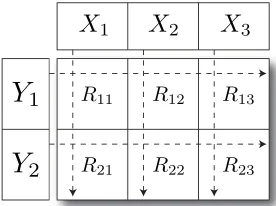
Figure 2: An example of decomposition in GTM
interpolation for computing responsibility matrix R in parallel by using a 2x3 virtual processor grid.
the sample set S. LetY ∈RK×D denote the matrix representation of K centers, where i-th row contains yi∈RD.
3. Compute responsibility– for the remaining dataset {tn}Mn=1 of sizeM=N−N, denoted byT, compute a K×M pairwise distance matrix D where (i, j)-th element dij is a Gaussian probability betweentj and
yiwith varianceβ−1, which was learned from the
sam-ples, such as dij =N(tj|yi, β). Compute a
responsi-bility matrixRby , as follows:
R=D(eetD) (22)
where a vectore = (1, ...,1)t ∈RK and represents element-wise division.
4. Interpolated map – by using Eq. (20), an interpo-lated GTM mapZ¯, known as posterior mean plot, can be computed by the following equation:
¯
Z=RtZ (23)
where Z denotes the matrix represents of the latent points{zk}Kk=1.
In the GTM interpolation, computing responsibility ma-trixR(step 3) is the most time and memory consuming step. This step can be parallelized by decomposing the problem into P-by-Q sub blocks such that total P Qprocesses can concurrently process each block which approximately holds 1/P Qelements ofR. This is the same method used in par-allel GTM implementation discussed in [7]. More detailed algorithm and analysis will be discussed in Section 4.2
4.2
Parallel GTM Interpolation
The core of parallel GTM interpolation is how to paral-lelize the computations for the responsibility matrix R as in (22) since its computation is the most time and memory consuming task. This can be done by the same approach for the general parallel matrix multiplication methods known as Fox algorithm [13] and SUMMA [21] but with extra tasks.
Assuming that we haveP×Qvirtual compute grids with totalp=P Qprocesses, we can decompose the responsibility matrixRintoP×Qsub blocks so that (u, v)-th sub block ofR, denoted byRuv foru= 1, ..., P andv= 1, ..., Q, can
be computed by one process. For this computation, we also need to decompose the matrixY forK cluster centers into P sub blocks such that each block contains approximately K/P cluster centers and divide the M out-of-sample data T intoQsub blocks that one block contains approximately
M/Q out-of-sample data. Then, we can compute (i, n)-th sub block ofRas follows:
Ruv = resp(Yu,Tv) (24)
where resp(·,·) is a function for computing responsibility and YuandTvare inputs, denoted byu-th andv-th sub block
ofY andT respectively.
A sketch of parallel GTM interpolation is as follows:
1. Broadcast sub-block{Yu}Pu=1and{Zu}Pu=1toP
rank-one node in rows and{Tv}Qv=1 to each rank-one node in columns of theP×Qgrid respectively.
2. The rank-one node broadcast sub-block{Yu}Pu=1and {Zu}Pu=1 to row members and{Tv}Qv=1 to its column members respectively.
3. (u, v)-th node computes sub distance matrixDuv by
usingYuandTv.
4. Collect P vectors {du}Pu=1 contains column sum of Duv from column members and computeRuv by
Ruv = Duve P
u
(du)t (25)
where a vectore= (1, ...,1)t∈RK/Pandrepresents
element-wise division.
5. (u, v)-th node computes the following sub block for the posterior meanZ¯uv
¯
Zuv= (Ruv)tZuv (26)
and send to the rank-one node in columns. Then, v-th sub block of GTM mapZ˜forN/Qdata points is
˜
Zv= P
u ¯
Zuv (27)
In our parallel GTM interpolation algorithm, main com-putation time is spent in computing K/P×N/Q distance matrix Duv which requires approximately O(KN/P Q)τC
computation time, where τC represents a unit time for
ba-sic operations such as multiplication and summation. Re-garding the time spent for communication, our algorithm consumes time due to the network bandwidth, denote τB,
which increases as the size of data to send and receive. As-suming a minimum spanning tree broadcasting and collect-ing operations, our algorithm will spend O(logP(KD/Q+ N/Q+KN/P Q) + logP(KD/P+KL/P))τB. Also, as we
increaseP orQ, an overhead can occur due to the network latency, denoteτL, which mainly occurs due to the number
of communications. In our parallel GTM interpolation, we have O(2P+Q) communications. Since generally L D and those are constant, we can formulate the total comput-ing timeT(K, N, P, Q) in our algorithm, with respect toK latent points,Ndata points, andP×Qprocesses, as follows:
O
KN P Q
τC+O(2P+Q)τL
+O
logP
N Q +
KN P Q
+ logQ
KD P
τB(28)
whereτC,τB, andτLrepresents unit time for computation,
Since the running time with no parallelizationT1=O(KN), we can expect the speed up asS(K, N, P, Q) =T1/T(K, N, P, Q) and its corresponding efficiencyE(K, N, P, Q) =S(K, N, P, Q)/P Q as follows.
1 +O
logP KP Q2 +
logP P2Q2+
logQ NP2Q
τB+O
2P+Q
P Q
τL −1
(29)
The above equation implies the following: in the case where P and Qare large enough but network latency due toτL is negligibly small, we can achieve an ideal efficiency E(K, N, P, Q) = 1. However, as we increase the number of cores, the efficiency of our algorithm will be hurt due to the increase number of communications. Our experiment results support this expectation.
5.
ANALYSIS OF EXPERIMENTAL RESULTS
[image:7.612.334.537.58.264.2]To measure the quality and parallel performance of our MDS and GTM with interpolation approach discussed in this paper, we have used 166-dimensional chemical dataset obtained from PubChem project database1, which is a NIH-funded repository for over 60 million chemical molecules and provides their chemical structures and biological activities, for the purpose of chemical information mining and explo-ration. In this paper we have used randomly selected up to 4 million chemical subsets for our testing. The computing clusters we have used in our experiments are summarized in Table 1.
In the following, we will mainly show i) the quality of our interpolation approaches in performing MDS and GTM algo-rithms, with respect to various sample sizes – 12.5k, 25k, and 75k randomly selected from 100k dataset as a basis, and ii) performance measurement of our parallelized interpolation algorithms on our clustering systems as listed in Table 1, and finally, iii) our results on processing up to 4 million MDS and GTM maps based on the trained result from 100K dataset.
5.1
Mapping Quality Comparison
5.1.1
MDS vs. MI-MDS
Generally, the quality of k-NN (k-nearest neighbor) clas-sification (or regression) is related to the number of neigh-bors. For instance, if we choose larger number for the k, then the algorithm shows higher bias but lower variance. On the other hands, thek-NN algorithms show lower bias but higher variance with respect to smaller number of neigh-bors. The purpose of the MI algorithm is to find appropriate embeddings for the new points based on the given mappings of the sample data, so it is better to be sensitive to the map-pings of thek-NN of the new point than to be stable with respect to the mappings of whole sample points. Thus, in this paper, the authors use 2-NN for the MI algorithm.
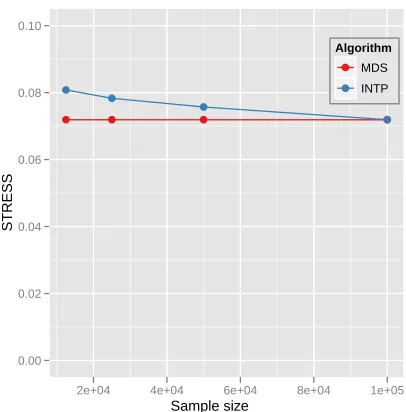
Fig. 3 shows the comparison of quality between interpo-lated results upto 100K data with different sample size data by using 2-NN and MDS (SMACOF) only result with 100k pubchem data. The y-axis of the plot is STRESS (1) nor-malized withi<jδ2ij, and the difference between MDS only
results and interpolated with 50k is only around 0.004. Even with small portion of sample data (12.5k data is only 1/8 of 100k), the proposed MI algorithm produces good enough mapping in target dimension using very smaller amount of time than when we run MDS with full 100k data. Fig. 4 1PubChem,http://pubchem.ncbi.nlm.nih.gov/
Sample size
STRESS
0.00 0.02 0.04 0.06 0.08 0.10
2e+04 4e+04 6e+04 8e+04 1e+05
Algorithm
MDS INTP
Figure 3: Quality comparison between Interpolated result upto 100k based on the sample data and 100k MDS result
Sample size
Elapsed time (sec)
0 5 10 15 20
12.5k 25k 50k
Algorithm
INTP
Figure 4: Elapsed time of parallel MI-MDS running time upto 100k data with respect to the sample size using 16 nodes of the Cluster-II in Table 1. Note that the computational time complexity of MI-MDS isO(Mn) wheren is the sample size andM =N−n.
shows the MI-MDS running time with respect to the sample data using 16 nodes of the Cluster-II in Table 1. Note that the full MDS running time with 100k using 16 nodes of the Cluster-II in Table 1 is around 27006 sec.
[image:7.612.333.536.330.534.2]algo-Table 1: Compute cluster systems used for the performance analysis
Features Cluster-I Cluster-II
# Nodes 8 32
CPU AMD Opteron 8356 2.3GHz Intel Xeon E7450 2.4 GHz # CPU / # Cores per node 4 / 16 4 / 24
Total Cores 128 768
Memory per node 16 GB 48 GB
Network Giga bit Ethernet 20 Gbps Infiniband Operating System Windows Server 2008 HPC Edition
(Ser-vice Pack 2) - 64 bit
Windows Server 2008 HPC Edition (Ser-vice Pack 2) - 64 bit
Total size
STRESS
0.00 0.02 0.04 0.06 0.08 0.10
[image:8.612.84.525.73.167.2]500000 1000000 1500000 2000000
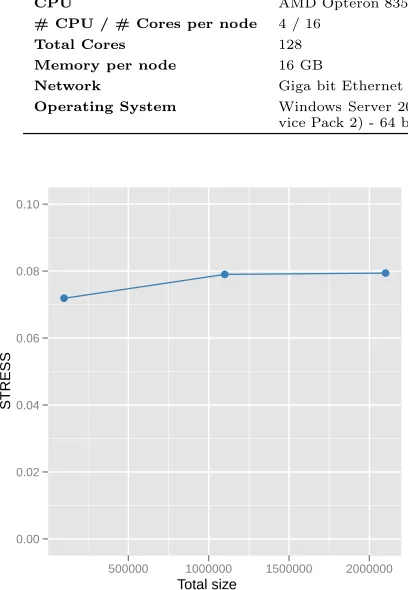
Figure 5: STRESS value change of Interpolation
larger data, such as 1M and 2M data points, with 100k sample data. The initial STRESS value of MDS result of 100k data is0.0719.
rithm, is performed as following: we fix the sample data size to 100k, and the interpolated data size is increased from one millions (1M) to four millions (4M). Then, the STRESS value is measured for each running result of total data, i.e. 1M + 100k, 2M + 100k, and so on. The measured STRESS value is shown in Fig. 5. There are some quality lost between the full MDS running result with 100k data and the 1M interpolated results based on that 100k map-ping, which is about 0.007 difference in normalized STRESS criteria. However, there is no much difference between the 1M interpolated result and 2M interpolated result, although the sample size is quite small portion of total data and the out-of-sample data size increases as twice. From the above result, we could consider that the proposed MI-MDS algo-rithm works well and scalable if we are given a good enough pre-configured result which represents well the structure of the given data. Note that it is not possible to run SMACOF algorithm with only 200k data points due to memory bound, within the systems in Table 1.
5.1.2
GTM vs. Interpolated-GTM
To measure the quality of GTM interpolation algorithm, we have compared quality of GTM maps, generated by
us-Sample Size
Negativ
e log−lik
elihood per point
32 33 34 35 36
12.5k 25k 50k 100k
Algorithm
GTM INTP
Figure 6: Comparison of maximum log-likelihood
from GTM with full-dataset processing without in-terpolation (GTM) and the GTM with interpola-tion approach (INTP) with various sampling sizes – 12.5k, 25k, and 50k – for 100k PubChem dataset. As the sample size increases, INTP finds very close results with GTM.
ing the full GTM processing with no interpolation (hereafter GTM for short) versus maps by using the interpolation ap-proach (hereafter INTP for short) with various sample sizes (12.5k, 25k, and 50k) in terms of maximum log-likelihood (a large maximum log-likelihood implies better quality of map), as defined in (19). Our test result is shown in Fig. 6 where negative log-likelihood values are plotted for each test case and thus points in lower area represent the better qual-ity. Our results show that the interpolation approach has produced almost the same quality of maps with the map generated by using the full dataset. Also the result shows that the interpolation with small sample sizes (12.5k) is the worst performance case, while others ˜O results are quite close to the out of full data processing case. This is the common case that small sample size can lead skewed interpretation of the full data.
[image:8.612.72.276.98.393.2] [image:8.612.332.534.185.348.2]number of iterations for processing for the 100k dataset and use this average to project GTM running time for process-ing 12.5k, 25k, and 50k dataset. By addprocess-ing interpolation running time as we measured in the previous experiment, we have projected the total running time for using GTM interpolation with various sampling sizes as shown in Fig. 7. As we expected, the interpolation process does ˜Ot involve computing-intensive training processes and thus processing time is very short, compared with the approach of using full dataset. By combining the results shown in Fig. 6 and Fig. 7, we show that GTM interpolation can be used to produce the same quality of GTM maps with less computing time.
5.2
Parallel Performance
5.2.1
Parallel MI-MDS
In the above section, we discussed about the quality of constructed configuration of MI-MDS based on the STRESS value of the interpolated configuration. Here, we would like to investigate the MPI communication overhead and parallel performance of the proposed parallel MI-MDS implementa-tion in terms of efficiency with respect to the running results within Cluster-I and Cluster-II in Table 1.
First of all, we prefer to investigate the parallel overhead, specially MPI communication overhead which could be ma-jor parallel overhead for the parallel MI-MDS in Section 3.2. Parallel MI-MDS consists of two different computations, MI part and STRESS calculation part. MI part is pleasingly parallel and its computational complexity isO(M), where M=N−n, if the sample sizenis considered as a constant. Since the MI part uses only two MPI primitives,MPI_GATHER andMPI_BROADCAST, at the end of interpolation to gather all the interpolated mapping results and spread out the com-bined interpolated mapping result to all the processes for the further computation. Thus, the communicated message amount through MPI primitives isO(M), so it is not depen-dent on the number of processes but the number of whole out-of-sample points.
For the STRESS calculation part, that applied to the pro-posed symmetric pairwise computation in Section 3.3, each process usesMPI_SENDRECV k times to send assigned block or rolled block, whose size isM/p, wherek =(p−1)/2 for communicating required data andMPI_REDUCEtwice for calculatingi<j(dij−δij)2 and
i<jδij2. Thus, the MPI
communicated data size is O(M/p×p) = O(M) without regard to the number of processes.
The MPI overhead during MI part and STRESS calculat-ing part at Cluster-I and Cluster-II in Table 1 are shown in Fig. 7 and Fig. 8, correspondingly. Note that the x-axis of both figures is the sample size (n) but notM =N−n. In the figures, the model is generated as O(M) starting with the smallest sample size, here 12.5k. Both Fig. 7 and Fig. 8 show that the actual overhead measurement follows the MPI communication overhead model.
Fig. 9 and Fig. 10 illustrate the efficiency of Interpola-tion part and STRESS calculaInterpola-tion part of the parallel MI-MDS running results with different sample size - 12.5k, 25k, and 50k - with respect to the number of parallel units using Cluster-I and Cluster-II, correspondingly. Equations for the efficiency is following:
f= pT(p)−T(1)
T(1) (30)
Sample size
MPI o
v
erhead time (sec)
0.5 1.0 1.5 2.0 2.5
15000 20000 25000 30000 35000 40000 45000 50000
Type
[image:9.612.334.536.60.264.2]INTP_model INTP_Ovhd STR_model STR_Ovhd
Figure 7: Parallel overhead modeled as due to MPI communication in terms of sample data size (m) us-ing Cluster-I in Table 1 and message passus-ing over-head model.
Sample size
MPI o
v
erhead time (sec)
0.4 0.6 0.8 1.0
15000 20000 25000 30000 35000 40000 45000 50000
Type
[image:9.612.333.535.343.546.2]INTP_model INTP_Ovhd STR_model STR_Ovhd
Figure 8: Parallel overhead modeled as due to MPI communication in terms of sample data size (m) us-ing Cluster-II in Table 1 and message passus-ing over-head model.
ε= 1
1 +f (31)
wherepis the number of parallel units,T(p) is the running time withpparallel units, andT(1) is the sequential running time. In practice, Eq. (30) can be replaced with following:
f=αT(p1)−T(p2)
Number of cores
Efficiency
0.0 0.2 0.4 0.6 0.8 1.0 1.2
24 24.5 25 25.5 26 26.5 27
Type
INTP_12.5k INTP_25k INTP_50k STR_12.5k STR_25k STR_50k
Figure 9: Efficiency of Interpolation part and
STRESS evaluation part runtime in parallel MI-MDS application with respect to different sample data size using Cluster-I in Table 1. Total data size is 100K.
whereα=p1/p2andp2is the smallest number of used cores for the experiment, soalpha≥1. We use Eq. (32) for the overhead calculation.
In Fig. 9, 16 to 128 cores are used to measure parallel performance with 8 processes, and 32 to 384 cores are used to evaluate the parallel performance of the proposed parallel MI-MDS with 16 processes in Fig. 10. Processes communi-cate via MPI primitives and each process is also parallelized in thread level. Both Fig. 9 and Fig. 10 show very good efficiency with appropriate degree of parallelism. Since both MI part and STRESS calcualtion part are pleasingly paral-lel within a process, the major overhead portion is the MPI message communicating overhead unless load balance is not achieved in thread-level parallelization within each process. In above, the MPI communicating overhead is investigated and the MPI communicating overhead showsO(M) relation. Thus, the MPI overhead is constant if we examine with the same number of process and the same out-of-sample data size. Since the parallel computation time is decreased as more cores are used, but the overhead time is constant, it lowers the efficiency as the number of cores is increased, as we expected. Note that the number of processes which lowers the efficiency dramatically is different between the Cluster-I and Cluster-II. The reason is that the MPI over-head time of Cluster-I is bigger than that of Cluster-II due to different network environment, i.e. Giga bit ethernet and 20Gbps Infiniband. The difference is easily found by com-paring Fig. 7 and Fig. 8.
5.2.2
Parallel GTM Interpolation
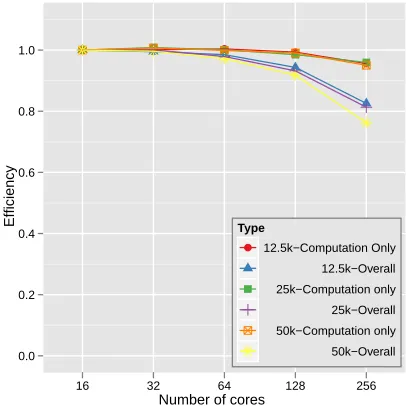
We have measured performance of our parallel GTM in-terpolation algorithm discussed in 4.2 by using 16 nodes of the Cluster-II shown in Table 1, as we increase the number of cores from 16 to 256.
As shown in (29), the ideal efficiency of our parallel GTM
Number of cores
Efficiency
0.0 0.2 0.4 0.6 0.8 1.0 1.2
25 25.5 26 26.5 27 27.5 28 28.5
Type
[image:10.612.73.274.58.263.2]INTP_12.5k INTP_25k INTP_50k STR_12.5k STR_25k STR_50k
Figure 10: Efficiency of Interpolation part and
STRESS evaluation part runtime in parallel MI-MDS application with respect to different sample data size using Cluster-II in Table 1. Total data size is 100K.
Number of cores
Efficiency
0.0 0.2 0.4 0.6 0.8 1.0
16 32 64 128 256
Type
12.5k−Computation Only 12.5k−Overall 25k−Computation only 25k−Overall 50k−Computation only 50k−Overall
Figure 11: Efficiency of parallel GTM interpolation with respect to various sample sizes (12.5k, 25k, and 50k) and number of cores (from 32 up to 256 cores)
interpolation algorithm is constant as 1.0 with respect to the number of PQ processes and can be degraded due to the net-work latency which is mainly caused by the high number of communications. As we increase the number of cores (more decompositions), the communications between sub blocks are increasing and thus the network latency can affect the efficiencies.
[image:10.612.335.537.60.263.2] [image:10.612.333.536.352.555.2]Sample size
Elapsed time (sec)
6 8 10 12 14
12.5k 25k 50k
Algorithm
[image:11.612.71.273.61.221.2]INTP
Figure 12: Projected elapsed time of GTM with in-terpolation for processing 100k PubChem data with various sample sizes, assuming that the number of average iteration is 1,000. The time for interpola-tion process is barely noticeable.
1 as we using the small number of cores but degraded as we have increased the number of processes(cores) for all data sizes (12.5k, 25k, and 50k) we used in our test. Also note that the efficiency for 12.5 dataset (means we have process 87.5k dataset for interpolation based on 12.5k random sam-ples from the full 100k dataset and thus largest payload size in our test) is slightly better than one ˜Os from 50k dataset (means 50k data processed based on 50k samples of 100k dataset and thus smallest data size), as we increase the num-ber of cores. We think this is also due to the network latency in which small data size is affected more.
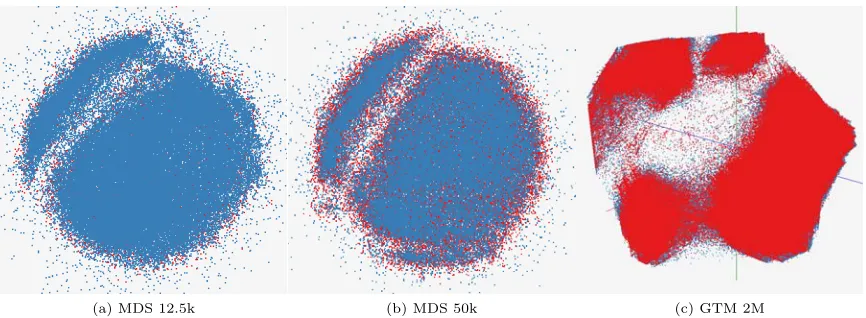
With our parallel interpolation algorithms for MDS and GTM, we have also processed the large volume of Pub- Chem data by using our Cluster-II and the results are shown in Fig. 13. We used 100k PubChem dataset as a training set, we performed parallel MDS and GTM interpolation to process 12.5k, 50k, and 2 million dataset. The interpolated points are colored in red, while the training points are blue. As one can see, our interpolation algorithms produced a map closed to the training dataset.
6.
CONCLUSION AND FUTURE WORK
We have proposed and tested interpolation algorithms for extending MDS and GTM dimension reduction approaches to very large datasets. We have shown that our interpola-tion approach gives results of good quality with high par-allel performance. Future research includes application of these ideas to different areas including metagenomics and other DNA sequence visualization. We will study present more detailed parallel performance results for basic MDS and GTM algorithms in both traditional and deterministi-cally annealed variations.
7.
REFERENCES
[1] D. Aloise, A. Deshpande, P. Hansen, and P. Popat. NP-hardness of Euclidean sum-of-squares clustering.
Machine Learning, 75(2):245–248, 2009.
[2] Y. Bengio, J.-F. Paiement, P. Vincent, O. Delalleau, N. L. Roux, and M. Ouimet. Out-of-sample extensions for lle, isomap, mds, eigenmaps, and spectral
clustering. In Advances in Neural Information Processing Systems, pages 177–184. MIT Press, 2004. [3] C. Bishop, M. Svens´en, and C. Williams. GTM: A
principled alternative to the self-organizing map.
Advances in neural information processing systems, pages 354–360, 1997.
[4] C. Bishop, M. Svens´en, and C. Williams. GTM: The generative topographic mapping.Neural computation, 10(1):215–234, 1998.
[5] I. Borg and P. J. Groenen.Modern Multidimensional Scaling: Theory and Applications. Springer, New York, NY, U.S.A., 2005.
[6] M. Carreira-Perpin´an and Z. Lu. The laplacian eigenmaps latent variable model. InProc. of the 11th Int. Workshop on Artificial Intelligence and Statistics (AISTATS 2007). Citeseer, 2007.
[7] J. Y. Choi, S.-H. Bae, X. Qiu, and G. Fox. High performance dimension reduction and visualization for large high-dimensional data analysis. InTo be
published in the proceedings of CCGRID 2010, 2010. [8] T. M. Cover and P. E. Hart. Nearest neighbor pattern
classification.IEEE Transaction on Information Theory, 13(1):21–27, 1967.
[9] J. de Leeuw. Applications of convex analysis to multidimensional scaling.Recent Developments in Statistics, pages 133–145, 1977.
[10] J. de Leeuw. Convergence of the majorization method for multidimensional scaling.Journal of Classification, 5(2):163–180, 1988.
[11] A. Dempster, N. Laird, and D. Rubin. Maximum likelihood from incomplete data via the em algorithm.
Journal of the Royal Statistical Society. Series B, pages 1–38, 1977.
[12] G. Fox, S. Bae, J. Ekanayake, X. Qiu, and H. Yuan. Parallel data mining from multicore to cloudy grids. InProceedings of HPC 2008 High Performance Computing and Grids workshop, Cetraro, Italy, July 2008.
[13] G. Fox, S. Otto, and A. Hey. Matrix algorithms on a hypercube I: Matrix multiplication.Parallel
computing, 4(1):17–31, 1987.
[14] A. Kaban. A scalable generative topographic mapping for sparse data sequences. InProceedings of the International Conference on Information Technology: Coding and Computing (ITCC’05)-Volume I, pages 51–56. Citeseer, 2005.
[15] T. Kohonen. The self-organizing map.
Neurocomputing, 21(1-3):1–6, 1998.
[16] J. B. Kruskal. Multidimensional scaling by optimizing goodness of fit to a nonmetric hypothesis.
Psychometrika, 29(1):1–27, 1964.
[17] J. B. Kruskal and M. Wish.Multidimensional Scaling. Sage Publications Inc., Beverly Hills, CA, U.S.A., 1978.
(a) MDS 12.5k (b) MDS 50k (c) GTM 2M
Figure 13: Interpolated MDS results based on 12.5k and 50k trained samples upto 100k data, and GTM map for 2M PubChem data based on the trained information from 100k samples. Points in red are trained data and others are interpolated points.
[19] W. S. Torgerson. Multidimensional scaling: I. theory and method.Psychometrika, 17(4):401–419, 1952. [20] M. W. Trosset and C. E. Priebe. The out-of-sample
problem for classical multidimensional scaling.
Computational Statistics and Data Analysis, 52(10):4635–4642, 2008.
[21] R. Van De Geijn and J. Watts. SUMMA: Scalable universal matrix multiplication algorithm.
Concurrency Practice and Experience, 9(4):255–274, 1997.
[22] Z. Wang, S. Zheng, Y. Ye, and S. Boyd. Further relaxations of the semidefinite programming approach to sensor network localization.SIAM Journal on Optimization, 19(2):655–673, 2008.