A Low–Level Communication Library for Java
HPC
Sang Boem Lim1
, Bryan Carpenter2
, Geoffrey Fox3 and Han-Ku Lee4⋆
1
Korea Institute of Science and Technology Information (KISTI) Daejeon, Korea
OMII, University of Southampton Southampton SO17 1BJ, UK
Pervasive Technology Labs at Indiana University Bloomington, IN 47404-3730
School of Internet and Multimedia Engineering, Konkuk University Seoul, Korea
Abstract. Designing a simple but powerful low-level communication li-brary for Java HPC environments is an important task. We introduce new low-level communication library for Java HPC, calledmpjdev. The mpjdev API is designed with the goal that it can be implementedportably
on network platforms and efficientlyon parallel hardware. Unlike MPI which is intended for the application developer, mpjdev is meant for li-brary developers. Application level communication may be implemented on top of mpjdev. The mpjdev API itself might be implemented on top of Java sockets in a portable network implementation, or-on HPC platforms-through a JNI (Java Native Interface) to a subset of MPI.
1
Introduction
HPJava [1] is an environment for scientific and parallel programming using Java. It is based on an extended version of the Java language. HPJava incorporates all of the Java language as a subset. This means any ordinary Java class can be invoked from an HPJava program without recompilation. Moreover, a translated and compiled HPJava program is a standard Java class file that can be executed by a distributed collection of Java Virtual Machines.
Locally held elements ofmultiarrays and distributed arrayscan be accessed using some special syntax provided by HPJava. HPJava does not provide any special syntax for accessing non-local elements. Non-local elements can only be accessed by making explicit library calls. This policy in the HPJava language,
⋆Correspondence to: Han-ku Lee, School of Internet and Multimedia Engineering,
attempts to leverage successful library-based approaches to SPMD parallel com-puting. This idea is in very much in the spirit of MPI, with its explicit point-to-point and collective communications. HPJava raises the level of abstraction a notch, and adds excellent support for development of libraries that manipulate distributed arrays. But it still exposes a multi-threaded, non-shared-memory, execution model to programmer. Advantages of this approach include flexibility for the programmer, and ease of compilation, because the compiler does not have to analyze and optimize communication patterns.
Java version of Adlib APIsOther application−level
mpjdev
Pure Java
MPJ and
(e.g. IBM SP3, Sun HPC) Parallel Hardware
Native MPI
[image:2.612.187.427.185.277.2]Networks of PCs SMPs or
Fig. 1.An HPJava communication stack
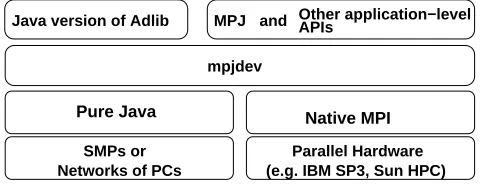
The mpjdev [2] [3] API is designed with the goal that it can be implemented portably on network platforms andefficientlyon parallel hardware. Unlike MPI which is intended for the application developer, mpjdev is meant for library developers. Application level communication libraries like the Java version of Adlib (or MPJ [1]) may be implemented on top of mpjdev. The mpjdev API itself might be implemented on top of Java sockets in a portable network imple-mentation, or-on HPC platforms-through JNI (Java Native Interface) to a subset of MPI. The positioning of the mpjdev API is illustrated in Figure 1. Currently not all the communication stack in this figure is implemented. The Java version of Adlib, the pure Java implementation on SMPs, and native the MPI implemen-tation are developed and included in the current HPJava or mpiJava releases. The rest of the stack may be filled in the future.
2
Communications API
In MPI there is a rich set of communication modes. Point-to-point communica-tion and collective communicacommunica-tion are two main communicacommunica-tion modes of MPI. Point-to-point communication support blocking and non-blocking communica-tion modes. Blocking communicacommunica-tion mode includes one blocking mode receive,
MPI RECV, and four different send communication modes. Blocking send communication modes include standard mode,MPI SEND, synchronous mode,
public class Comm {
public void size() { ... } public void id() { ... } public void dup() { ... }
public void create(int [] ids) { ... } public void free() { ... }
public void send(Buffer buf, int dest, int tag) { ... } public Status recv(Buffer buf, int src, int tag) { ... } public Request isend(Buffer buf, int dest, int tag) { ... } public Request irecv(Buffer buf, int dest, int tag) { ... }
public static String [] init(String[] args) { ... } public static void finish() { ... }
. . . }
Fig. 2.The public interface of mpjdevCommclass.
MPI ISSEND, ready,MPI IRSEND, and buffered,MPI IBSEND. Collec-tive communication also includes various communication modes. It has charac-teristic collective modes like broadcast,MPI BCAST, gather,MPI GATHER, and scatter,MPI SCATER. Global reduction operations are also included in collective communication.
The mpjdev API is much simpler. It only includes point-to-point communi-cations. Currently the only messaging modes for mpjdev are standard blocking mode (likeMPI SEND,MPI RECV) and standard non-blocking mode (like
MPI ISEND,MPI IRECV), together with a couple of ”wait” primitives. The communicator class,Comm, is very similar to the one in MPI but it has a reduced number of functionalities. It has communication methods likesend(),
recv(), isend(), and irecv(), and defines constants ANY SOURCE, and
ANY TAG as static variables. Figure 2 shows the public interface ofComm
class.
We can get the number of processes that are spanned by this communicator by callingsize()(similar toMPI COMM SIZE). Current id of process relative to this communicator is returned byid()(similar toMPI COMM RANK).
The two methods send() and recv() are blocking communication modes. These two methods block until the communication finishes. The methodsend()
sends a message containing the contents of bufto the destination described by
destand message tag valuetag.
The methodrecv() receives a message from matching source described by
src with matching tag valuetagand copies contents of message to the receive buffer,buf. The receiver may use wildcard valueANY SOURCE forsrc and
public class Request {
public Status iwait() { ... }
public Status iwaitany(Request [] reqs) { ... } . . .
}
Fig. 3.The public interface ofRequestclass.
a receiver accepts any source and/or tag of send. The Comm class also has the initial communicator,WORLD, likeMPI COMM WORLDin MPI and other utility methods. The capacity of receive buffer must be large enough to accept these contents. It initializes the source and tag fields of the returned
Statusclass which describes a completed communication.
The functionalities of send() and recv() methods are same as standard mode point–to–point communication of MPI (MPI SENDandMPI RECV). Arecv()will be blocked until the send if posted. Asend()will be blocked until the message have been safely stored away. Internal buffering is not guaranteed in send(), and the message may be copied directly into the matching receive buffer. If norecv()is posted,send()is allowed to block indefinitely, depending on the availability of internal buffering in the implementation. The programmer must allow for this–this is a low-level API for experts.
The other two communication methodsisend()andirecv()are non-blocking versions of send() and recv(). These are equivalent to MPI ISEND and
MPI IRECVin MPI. Unlike blocking send, a non-blocking send returns imme-diately after its call and does not wait for completion. To complete the commu-nication a separate send complete call (like iwait() and iwaitany() methods in the Request class) is needed. A non-blocking receive also work similarly. Thewait()operations block exactly as for the blocking versions ofsend()and
recv()(e.g. thewait()operation for anisend()is allowed to block indefinitely if no matching receive is posted). The method dup()creates a new communi-cator the spanning the same set of processes, but with a distinct communica-tion context. We can also create a new communicator spanning a selected set of processes selected using the create()method. The ids of array ids contain a list of ids relative to this communicator. Processes that are outside of the group will get a null result. The new communicator has a distinct communica-tion context. By calling thefree() method, we can destroy this communicator (likeMPI COMM FREE in MPI). This method is called usually when this communicator is no longer in use. It frees any resources that used by this com-municator.
The other important class is Request (Figure 3). This class is used for non-blocking communications to ensure completion of non-non-blocking send and receive. We wait for a single non-blocking communication to complete by callingiwait()
method. This method returns when the operation identified by the current class is complete. The other methodiwaitany() waits for one non-blocking commu-nication from a set of requestsreqsto complete. This method returns when one of the operations associated with the active requests in the arrayreqshas com-pleted. After completion ofiwait()oriwaitany()call, the source and tag fields of the returned status object are initialized. One more field, index, is initialized foriwaitway()method. This field indicates the index of the selected request in thereqsarray.
3
Message Format
This section describes the message format used by mpjdev. The specification here doesn’t define how a message vector which contained in theBufferobject is stored internally-for example it may be as a Javabyte [] array or it may be as a C char [] array, accessed through native methods. But this section does define the organization of data in the buffer. It is the responsibility of the user to ensure that sufficient space is available in the buffer to hold the desired message. Trying to write too much data to a buffer causes an exception to be thrown. Likewise, trying to receive a message into a buffer that is too small will cause an exception to be thrown. These features are (arguably) in the spirit of MPI.
A message is divided into two main parts. Theprimary payload is used to store message elements of primitive type.The secondary payload is intended to hold the data from object elements in the message (although other uses for the secondary payload are conceivable). The size of the primary payload is limited by the fixed capacity of the buffer, as discussed above. The size of the secondary payload, if it is non-empty, is likely to be determined ”dynamically”-for example as objects are written to the buffer.
The message starts with a shortprimary header, defining anencoding scheme used in headers and primary payload, and the total number of data bytes in the primary payload. Only one byte is allocated in the message to describe the encoding scheme: currently the only encoding schemes supported or envisaged are big-endian andlittle-endian. This is to allow for native implementations of the buffer operations, which (unlike standard Java read/write operations) may use either byte order. A message is divided into zero or more sections. Each section contains a fixed number of elements of homogeneous type. The elements in a section will all have identical primitive Java type, or they will all have
Object type (in the latter case the exact classes of the objects need not be homogeneous within the section).
payload–the actual data will go in the secondary payload. After the primary payload there is asecondary header. The secondary header defines the number of bytes of data in the secondary payload. The secondary header is followed in the logical message by the secondary payload. The mpjdev specification says nothing about the layout of the secondary payload. In practice this layout will be determined by the Java Object Serialization specification.
4
Discussion
We have explored enabling parallel, high-performance computation–in particular development of scientific software in the network-aware programming language, Java. Traditionally, this kind of computing was done in Fortran. Arguably, For-tran is becoming a marginalized language, with limited economic incentive for vendors to produce modern development environments, optimizing compilers for new hardware, or other kinds of associated software expected by today’s pro-grammers. Java looks like a promising alternative for the future.
Java introduces implementation issues for message-passing APIs that do not occur in conventional programming languages. One important issue is how to transfer data between the Java program and the network while reducing over-heads of the Java Native Interface. As contribution toward new low-level APIs, we developed a low-level Java API for HPC message passing, called mpjdev. The mpjdev API is a device level communication library. This library is developed with HPJava in mind, but it is a standalone library and could be used by other systems. We discussed message buffer and communication APIs of mpjdev and also format of a message. To evaluate current communication libraries, we did various performance tests. We developed small kernel level applications and a full application for performance test. We got reasonable performance on simple ap-plications without any serious optimization. We also evaluated a communication performance of the high- and low-level libraries for future optimization.
References
1. HPJava project home page. www.hpjava.org.
2. Sang Boem Lim.Platforms for HPJava: Runtime Support for Scalable Programming in Java. PhD thesis, Florida State University, June 2003.