https://doi.org/10.5194/bg-15-1-2018
© Author(s) 2018. This work is distributed under the Creative Commons Attribution 3.0 License.
Effect of light on N
2
fixation and net nitrogen release of
Trichodesmium
in a field study
Yangyang Lu1,2, Zuozhu Wen1,3, Dalin Shi1,3, Mingming Chen1,2, Yao Zhang1,2, Sophie Bonnet4, Yuhang Li5, Jiwei Tian6, and Shuh-Ji Kao1,2
1State Key Laboratory of Marine Environmental Science, Xiamen University, Xiamen, China 2College of Ocean and Earth Sciences, Xiamen University, Xiamen, China
3College of Environment and Ecology, Xiamen University, Xiamen, China
4IRD, Aix Marseille Université, CNRS/INSU, Université de Toulon, Mediterranean Institute of Oceanography (MIO), New Caledonia, France
5Institute of Oceanology, Chinese Academy of Sciences, Qingdao, China 6Physical Oceanography Laboratory, Ocean University of China, Qingdao, China Correspondence:Shuh-Ji Kao ([email protected])
Received: 17 May 2017 – Discussion started: 20 June 2017
Revised: 27 October 2017 – Accepted: 1 November 2017 – Published: 2 January 2018
Abstract.Dinitrogen fixation (NF) by marine cyanobacteria is an important pathway to replenish the oceanic bioavail-able nitrogen inventory. Light is the key to modulating NF; however, field studies investigating the light response curve (NF-I curve) of NF rate and the effect of light on diazotroph-derived nitrogen (DDN) net release are relatively sparse in the literature, hampering prediction using models. A disso-lution method was applied using uncontaminated15N2 gas to examine how the light changes may influence the NF in-tensity and DDN net release in the oligotrophic ocean. Ex-periments were conducted at stations with diazotrophs dom-inated by filamentous cyanobacterium Trichodesmiumspp. in the western Pacific and the South China Sea. The ef-fect of light on carbon fixation (CF) was measured in par-allel using the 13C tracer method specifically for a station characterized byTrichodesmiumbloom. Both NF-I and CF-I curves showed a Ik (light saturation coefficient) range of 193 to 315 µE m−2s−1, with light saturation at around 400 µE m−2s−1. The proportion of DDN net release ranged from ∼6 to ∼50 %, suggesting an increasing trend as the light intensity decreased. At theTrichodesmiumbloom sta-tion, we found that the CF/NF ratio was light-dependent and the ratio started to increase as light was lower than the car-bon compensation point of 200 µE m−2s−1. Under low-light stress, Trichodesmiumphysiologically preferred to allocate more energy for CF to alleviate the intensive carbon
con-sumption by respiration; thus, there is a metabolism tradeoff between CF and NF pathways. Results showed that short-term (<24 h) light change modulates the physiological state, which subsequently determined the C/N metabolism and DDN net release byTrichodesmium. Reallocation of energy associated with the variation in light intensity would be help-ful for prediction of the global biogeochemical cycle of N by models involvingTrichodesmiumblooms.
1 Introduction
The bioavailable nitrogen introduced via nitrogen fixation (NF) by cyanobacteria is important to fertilize the tropical and subtropical oligotrophic surface ocean (Karl et al., 1997). In such environments, nitrate supplied from the subsurface is generally limited by thermostructure-induced stratification and NF can directly input bioavailable nitrogen to the eu-photic zone (Capone et al., 2005). Among the variety of dia-zotrophs, the filamentous non-heterocystous cyanobacterium
al., 1988; Carpenter and Roenneberg, 1995). By using the C2H2 reduction method, Carpenter et al. (1993) investi-gated the light response of nitrogenase activity for the field-towed Trichodesmium, which showed a response pattern as a function of irradiance and resembling the PI curve. Sim-ilarly, by using 13C/15N isotope labeling techniques, Holl et al. (2007) found that NF and CF rates of field-towed Tri-chodesmiumwere attenuated as light intensity decreased. In controlled laboratory experiments, Breitbarth et al. (2008) suggested that both nitrogenase activity and growth rates of Trichodesmium (IMS-101) are light-dependent (15 to 1100 µE m−2s−1), and Bell and Fu (2005) observed increas-ing NF rates with the increase in light intensity (PAR 10– 160 µE m−2s−1), and the cellular concentrations of Chl a and phycobiliproteins (PBPs) increased under low-light con-ditions.
Meanwhile, statistical analysis performed on the global dataset of field NF suggests that light is an important envi-ronmental factor explaining most of the spatial variance in NF on the global scale (Luo et al., 2014). However, it has to be noted that some of the NF rate measurements available in this global database might be questionable due to previ-ously unrealized technical problems, e.g., incomplete 15N2 dissolution in the 15N2 bubble tracer method (Mohr et al., 2010), bioavailable15N forms contamination in some com-mercial 15N2 gas (Dabundo et al., 2014) and inconsidera-tion of diazotroph-derived N (DDN) release in the filtrate fraction (Konno et al., 2010). Nevertheless, the abovemen-tioned experiments and global analysis support the idea of a light control on NF activity, CF and oxygen evolution of Tri-chodesmium; however, limited field experiments have been conducted on studying the effect of light on CF and NF of bulk seawater, particularly during naturally occurring Tri-chodesmiumblooms. Moreover, to our knowledge, no study using the improved15N2dissolution tracer method (Mohr et al., 2010) has been implemented yet.
During the NF process,Trichodesmiumrelease 10 to 50 % of the DD15N in the dissolved pool (Glibert and Bronk, 1994; Konno et al., 2010), primarily as dissolved organic N (DON, such as dissolved free amino acid) and NH+4 (Capone et al., 1994; Mulholland et al., 2004). High DON and NH+4 concen-trations are often measured within Trichodesmium blooms (Karl et al., 1992; Lenes et al., 2001), being supportive of DDN release. As most NF rate measurements were via
in-Trichodesmiumblooms. A mesocosm experiment performed in the western tropical South Pacific (VAHINE) revealed an incommensurately high contribution of NF to export produc-tion (>50 %; Knapp et al., 2016) during a bloom of UCYN-C bloom. The contribution of NF to export can be up to 92 % in some studies (Kumar et al., 2017). However, the effect of NF on export was largely indirect, i.e., attributable to quick recycling processes of DDN transfer to non-diazotrophs that were subsequently exported (Bonnet et al., 2016b, c; Knapp et al., 2016). In spite of the importance of DDN release in C and N cycles, the factors controllingTrichodesmiumDDN release remained unclear. In particular, the effect of light on DDN release has been poorly studied. To date, only one Tri-chodesmiumculture study has reported a significant release of DDN and DOC after a rapid shift from low-light to high-light regimes to protect the photosynthetic apparatus (Wan-nicke et al., 2009).
Here we investigated the effect of light on DDN re-lease and C/N fixation stoichiometry of Trichodesmium
in the field under contrasting situations, i.e. during a Tri-chodesmiumbloom in the western equatorial Pacific and in a non-bloom area in the South China Sea.
2 Material and methods
This study was performed onboard the R/VDong Fang Hong
2 during two cruises to the western equatorial Pacific Ocean (6 December 2015 to 12 January 2016) and the South China Sea (15 May to 7 June 2016). Experiments were conducted at three stations (Supplement Fig. S1), among which one of them was characterized by the presence of aTrichodesmium
bloom (western equatorial Pacific Ocean station S0320); the other two were located in the South China Sea (A3, D5). 2.1 Seawater sampling and experimental procedures
and 1 % of surface irradiance) were created by using neutral density and blue (061 Mist Blue; 172 Lagoon Blue) filters to adjust the light level (Fernandez et al., 2013; Rijkenberg et al., 2011; Mourino-Carballido et al., 2011). During the incu-bation period, the light intensity was monitored on deck with a flat 2π photosynthetically available radiation (PAR) sen-sor (PQS 1 PAR Quantum sensen-sor, Kipp & Zonen) at 1 min intervals. We took the average light intensity of the incuba-tion light period (>1 µE m−2s−1)as the surface irradiance to calculate light intensities of the six light gradients.
2.2 Nutrients, Chlaand abundance ofTrichodesmium
Nutrient samples were collected in 100 mL high-density polyethylene (HDPE) bottles and kept frozen at−20◦C until analysis. Nanomolar levels of soluble reactive phosphorous (SRP) were determined according to Ma et al. (2008) with a detection limit of 1.4 nM and relative precision of±2.5 %. Nanomolar levels of nitrate were analyzed using the chemi-luminescent method (Garside, 1982) with a detection limit of 2 nM.
For Chl a concentration determination, 1 L of seawa-ter was filseawa-tered on GF/F filseawa-ters, wrapped in aluminum foil and stored at −20◦C until analysis onshore. Chl a was extracted in 90 % acetone, refrozen for 24 h and ana-lyzed fluorometrically according to the method described by Welschmeyer (1994).
ForTrichodesmiumabundance determination, 1 L of sea-water was sampled in HDPE bottles and immediately fixed with 10 mL Lugol’s solution. Onshore, subsamples were settled for 48 h, the supernatant was removed and Tri-chodesmiumfilaments (trichomes) were counted on a Nikon Eclipse 50i optical microscope.
2.3 Molecular assessment of diazotrophs
For DNA analysis, 4 L of seawater was filtered through 0.2 µm pore-sized membrane filters (Supor 200, Pall Gelman, NY, USA), which were stored in liquid nitrogen until analy-sis. DNA was extracted according to Massana et al. (1997) with some modifications. Briefly, each filter was cut into pieces and placed into a 2 mL sterile screw cap micro-tube containing 0.2 g autoclaved glass beads and 0.8 mL GTE buffer (100 mM EDTA, 50 mM tris, 0.75 M sucrose). The tubes were agitated three times for 40 s in a homogenizer (FastPrep-24, MP Bio, USA) at 4.5 m s−1, and they were then frozen and thawed three times in liquid nitrogen. The next steps followed the protocol of Massana et al. (1997).
Four published quantitative polymerase chain reaction (qPCR) probe–primer sets (Church et al., 2005a, b) were used for qPCR analysis. Relevantly, the nifH genes of four photoautotrophic diazotroph groups were targeted: Tri-chodesmium spp.,Richelia spp. associated with Rhizosole-nia spp. (het-1), and the unicellular groups A (UCYN-A) and B (UCYN-B). We used the thermal cycling conditions
and reaction mixtures as described previously by Zhang et al. (2011) with slight modifications. Triplicate 20 µL qPCR mixtures were used for each sample and standard, reac-tion mixes contained 10 µL Premix Ex Taq (probe qPCR) (RR390A, Takara Bio Inc., Dalian, China), 400 nM each of forward and reverse primer, 400 nM of fluorogenic probe, and 1 µL of environmental DNA or plasmid standards. We used dilution series of four linearized plasmids as standards, which contained inserts matching four primer–probe sets. The real-time quantitative PCR was performed on a CFX96 real-time system (Bio-Rad Laboratories, USA) with the fol-lowing thermal cycling conditions: 50◦C for 2 min, 95◦C for 2 min and 45 cycles of 95◦C for 15 s, followed by 60◦C for 1 min. The quantification limit was determined empirically to be one copy per reaction. The amplification efficiency var-ied between 90 and 100 %. The negative controls contained complete reaction ingredients except environmental DNA or standards; no amplification was found in the negative con-trols.
2.4 N2and carbon fixation rate measurements
NF rates were determined according to the dissolution method: the15N2-enriched seawater was prepared follow-ing the same device and procedure as described in Sh-iozaki et al. (2015) and 200 mL15N2-enriched seawater was added into each 4.5 L PC incubation bottle (at bloom sta-tion S0320, 1.2 L PC bottles were used) triplicated. The 15N
2gas (98.9 %) from Cambridge Isotope Laboratories was used. We conducted a blank check for15N2gas (contamina-tion of bioavailable non-N215N) as mentioned in Dabundo et al. (2014). Briefly, triplicate 2 mL15N2gas and 10 mL natu-ral seawater were injected into 20 mL headspace vials, sealed with a septum stopper and then shaken overnight. Theδ15N of total dissolved nitrogen (TDN) was measured and com-pared with theδ15N of natural seawater samples. Values of δ15N TDN of the blank seawater and test seawater groups were 4.7 and 5.0 ‰, respectively, suggesting no contamina-tion of the15N2gas.
At station S0320, theTrichodesmiumbloom station,13 C-labeled sodium bicarbonate (99 atom%13C; Cambridge Iso-tope Laboratories) was added in parallel with15N2to each bottle at a final tracer concentration of 70 µmol L−1 to si-multaneously measure the CF and NF rates. At each irradi-ance level, triplicate water samples (4.5 L or 1.2 L PC bottle) were incubated on deck in incubators with surface seawater flow through. The surface-cooling seawater was connected with incubators in parallel to keep the temperature variations synchronous in six incubators. Thus, temperature was not a variable parameter that could influence the variability of final rates.
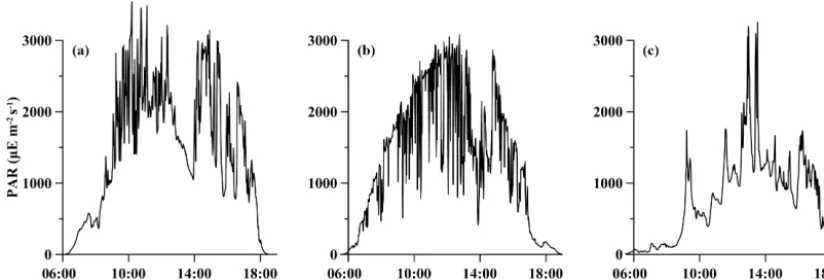
or-Figure 1.Temporal variations in photosynthetically active radiation (PAR µE m−2s−1)obtained on deck during the experiment periods,
(a)for station S0320,(b)for station A3 and(c)for station D5.
ganic C (POC)/PON concentrations and isotopic values were analyzed on a Flash EA (Thermo Fisher Flash HT 2000) IRMS (Thermo Fisher Delta V plus). International reference material (USGS40) with a different amount of C/N and cer-tifiedδ15N and δ13C values of −4.5 and −26.2 ‰, respec-tively, was inserted every eight samples to check the drift and ensure the accuracy of the measurements. The reproducibil-ity for δ15N andδ13C measurements were both better than 0.3 ‰. The NF and CF rates were calculated by using simi-lar equations proposed by Montoya et al. (1996) and Hama et al. (1983), respectively.
2.5 Light response curves for N2fixation and carbon fixation
We follow the photosynthetic model by Webb et al. (1974):
N =Nm(1−exp(−αI /Nm))+Nd, (1)
whereNmis the maximum rate of NF at light-saturating irra-diance,Ndis the rate measured in darkness,I is the natural irradiance andαis the light affinity coefficient for NF rate, to construct the irradiance curves for NF. Similarly, the light response curve of CF was obtained. The light saturation co-efficientIkwas defined asNm/α.
2.6 DDN net release to the dissolved pool
To determine the TDN concentration andδ15N TDN accord-ing to Knapp et al. (2005), 40 mL of the filtrate (passed through precombusted GF/F filters) of each NF incubation bottle was collected and preserved at−20◦C. Briefly, TDN
was oxidized to nitrate by a persulphate oxidation reagent (purified by recrystallization three to four times) and the con-centration was measured using the chemiluminescent method (Garside, 1982). The δ15N TDN-derived nitrate was ana-lyzed by using the denitrifier method (Sigman et al., 2001). The reproducibility for δ15N TDN measurements was bet-ter than 0.5 ‰. The DDN released to the dissolved pool
was calculated following the equation proposed by Bonnet et al. (2016a).
2.7 Transfer of DDN into non-diazotrophic plankton
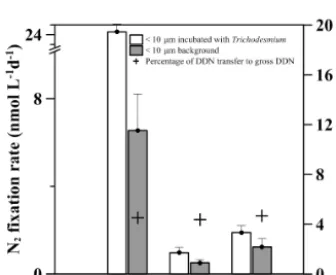
To evaluate the short time (24 h) DDN transfer to non-diazotrophic plankton, we followed the method by Adam et al. (2015). Briefly, for the control group, a 10 µm sieve was used to remove mostTrichodesmiumcolonies and the remaining community was incubated for 24 h with 15N2 -enriched seawater. In another group, the whole community was incubated for 24 h andTrichodesmiumcolonies were re-moved after incubation was terminated. Each experiment was performed in triplicate. Theδ15N difference between the two treatments was considered to be a proxy of the DDN transfer to non-diazotrophic plankton.
3 Results
3.1 Environmental conditions
The temporal patterns of PAR were shown in Fig. 1. The sun rose at ∼06:00 and set at ∼18:00 (all measurements at the S0320 station were made in local time and all mea-surements at the other two stations were made in Beijing time). The value of PAR (sampling at 10 s intervals) var-ied rapidly in a wide range from 0 to 3000 µE m−2s−1, which is the typical range of values observed at low lat-itudes, yet much higher than those generally used in lab-oratory culture experiments (Bell and Fu, 2005; Wannicke et al., 2009). Although incubations were conducted for 24 h, average PAR during the incubation period (light inten-sity>1 µE m−2s−1)was applied for discussion. The average PAR values were 1464±888 (61 %), 1293±903 (70 %) and 743±619, (83 %) µE m−2s−1 for stations S0320, A3 and D5, respectively.
[image:4.612.93.505.68.208.2]Table 1.Environmental conditions of the three stations’ surface water. nd: not determined.
Station Salinity Temperature Chla SRP Nitrate DON Trichodesmiumcolonies (◦C) (µg L−1) (nM) (nM) (µM) (trichomes L−1)
S0320 34.5 29.7 1.2 100 6 9.8 (1.2) 4227±679 (n=6)thiebautii
A3 34.6 27.6 0.39 13 7 7.2 (0.5) nd
[image:5.612.49.543.232.372.2]D5 34.6 29.3 0.25 24 11 8.4 (0.3) 190±50 (n=6)thiebautii
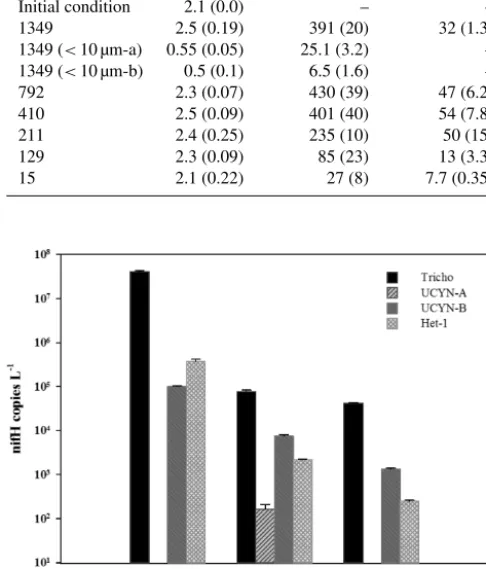
Table 2.Synthesis of PON, POC, and DON concentrations, C/N, carbon consumption and the corresponding NF and CF rates, and NF/CF at station S0320. The “<10 µm-a” represents a NF rate of<10 µm community incubated with>10 µmTrichodesmiumcolonies, “<10 µm-b” represents the background NF rate of<10 µm community, and carbon consumption was calculated using POC concentration variation from each irradiance point final concentration to initial POC concentration minus the carbon fixation rate at the corresponding irradiance point.
Irradiance PON Particulate Dissolved POC Particulate NF/CF C/N Carbon
(µE m−2s−1) (µM L−1) NF rate NF rate (µM L−1) CF rate consumption
(nM L−1d−1) (nM L−1d−1) (µM L−1d−1) (µM L−1)
Initial condition 2.1 (0.0) – – 13.4 (0.1) – – 6.4 (0) –
1349 2.5 (0.19) 391 (20) 32 (1.3) 17.3 (1.2) 3.6 (0.19) 9.3 (1.0) 7.0 (0.1) −0.29 (1.0) 1349 (<10 µm-a) 0.55 (0.05) 25.1 (3.2) – 4.1 (0.2) 0.28 (0.03) 11.6 (1.0) 7.5 (0.1) –
1349 (<10 µm-b) 0.5 (0.1) 6.5 (1.6) – – – – – –
792 2.3 (0.07) 430 (39) 47 (6.2) 15.7 (0.13) 3.4 (0.1) 7.8 (0.7) 6.8 (0.2) 1.04 (0.12) 410 2.5 (0.09) 401 (40) 54 (7.8) 15.8 (0.87) 2.9 (0.08) 7.4 (0.6) 6.3 (0.1) 0.53 (0.79) 211 2.4 (0.25) 235 (10) 50 (15) 13.9 (0.93) 2.0 (0.07) 8.6 (0.5) 5.9 (0.3) 1.53 (0.90) 129 2.3 (0.09) 85 (23) 13 (3.3) 12.6 (0.28) 0.98 (0.26) 11.6 (0.5) 5.6 (0.4) 1.80 (0.53) 15 2.1 (0.22) 27 (8) 7.7 (0.35) 10.9 (1.0) 0.44 (0.08) 16.8 (3.2) 5.3 (0.1) 2.88 (0.97)
Figure 2. Cyanobacteria diazotroph nifH phylotype abundances (nifH gene copies L−1). Tricho:Trichodesmiumspp.; UCYN: uni-cellular N2-fixing cyanobacteria from Group A, B; Het-1:
hetero-cystous cyanobacteria from Group 1. Error bars represent the stan-dard deviation for triplicate natural samples.
low nutrient concentrations (NO−3 6 to 11 nM, PO34− 13 to 100 nM), relatively high salinity (34.5–34.6) and high sea surface temperature (27.6–29.7◦C). At the Trichodesmium
bloom station (station S0320), Chl a concentrations were 1.2 mg m−3, much higher than those measured at the other
stations (0.25 and 0.39 mg m−3). Results from thenifH phy-lotype abundances showed that Trichodesmium accounted for >98.8, 88.6 and 96.4 % of the diazotrophic commu-nity at stations S0320, A3 and D5, respectively (Fig. 2). The dominant Trichodesmium species was Trichodesmium thiebautiifor stations S0320 and D5, with an abundance of 4227±679 (n=6) and 190±50 (n=6) trichomes L−1, re-spectively. POC/N concentration of the <10 µm fraction represented<25 % of the bulk POC/N (see Table 2 and be-low), supporting thatTrichodesmiumwas the dominant phy-toplankton community at the blooming station.
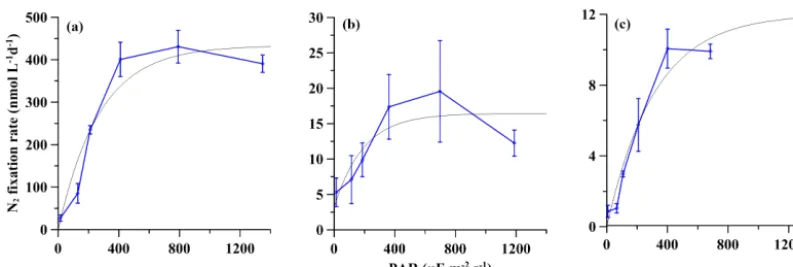
The net NF rates in the surface light intensity were 390.6±20.4, 12.2±1.8 and 9.9±0.4 nM N d−1at stations S0320, A3 and D5, respectively. The NF rate at the bloom-ing station was 30–40 times higher than that of the two non-bloom stations. Detailed experimental data, includ-ing concentrations and isotopic values, for initial and fi-nal time points are listed in Tables S1–S3 in the Sup-plement. However, trichome-normalized rates were 92 and 52 pM N trichomes−1d−1, respectively, for stations S0320 and D5, revealing a more consistent rate per trichome.
3.2 Light response of net (particulate) N2fixation
[image:5.612.48.291.283.567.2]Figure 3.Net (particulate) NF versus irradiance. The gray curves represent the fitted NF-I curves. The error bar represents the standard deviation of triplicate incubations.(a)Station S0320;(b)station A3;(c)station D5.
of fitted NF-I curves were 0.92, 0.71 and 0.95 at stations S0320, A3 and D5, respectively (allpvalues<0.0001) and then saturated at around 400 µE m−2s−1. The simulatedIk values for NF were 271, 193 and 315 µE m−2s−1, respec-tively, for stations S0320, A3 and D5, with an average value of 260±51 µE m−2s−1.
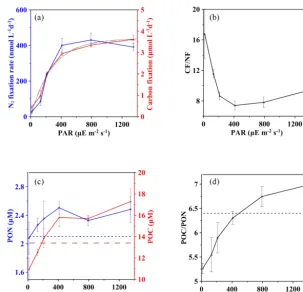
Results of CF for stations S0320 showed a traditional PI curve pattern without apparent light inhibition (solid curve in Fig. 4a). The fitted curve of CF showed a pattern consistent with those of NF (dashed curve in Fig. 4a), giving anIkvalue of 292 µE m−2s−1 falling within the Ik range of the three NF-I curves, and the R2 of the fitted CF-I curve was 0.90 (pvalue<0.0001).
3.3 Particulate C/N metabolism ofTrichodesmium bloom
The ratio of CF to NF was variable as light varied (Fig. 4b). The values of CF/NF ranged from 7.4±0.6 to 9.3±1.0 when light intensities were saturated, while the ratios in-creased significantly from 7.4±0.6 to 16.8±3.2 as light in-tensities decreased from 410 to 15 µE m−2s−1.
The initial concentrations (n=3) of POC and PON were 13.4±0.1 and 2.1±0.0 µM, respectively, with a mean C : N molar ratio of 6.4 (horizontal lines in Fig. 4c and d), which is almost identical to the Redfield C/N ratio of 6.6. After incu-bations under various light intensities, the final POC concen-trations showed a decreasing trend (pvalue<0.0001) rang-ing from 17.3±1.2 to 10.9±1.0 µM as the irradiance de-creased. Below∼200 µE m−2s−1, the final POC concentra-tion was even lower than the initial POC concentraconcentra-tion (red dashed line in Fig. 4c), suggesting that the light compen-sation point (Ic)is around 200 µE m−2s−1. A similar light-dependent pattern was found for PON. However, final PON concentrations, varying from 2.1±0.2 to 2.5±0.2 µM, were always higher than the initial concentration (blue dashed line in Fig. 4c) without a compensation point.
The observed C : N ratio of bulk particulate matter (5.3– 7.0; Fig. 4d) is consistent with previously reported ranges
forTrichodesmium(LaRoche and Breitbarth, 2005; Mulhol-land, 2007). However, a strong light dependency was also observed for the final C/N after incubation. The saturated irradiance of∼400 µE m−2s−1was likely a threshold; below the saturation light the final C/N tended to be lower than the initial C/N of 6.4 (dashed horizontal line in Fig. 4d). 3.4 DDN net release to the dissolved pool
The rate of DD15N net release in the TDN pool ranged from 7.7±0.4 to 54.1±7.8 nM N d−1 for station S0320, from 0.7±0.2 to 1.0±0.1 nM N d−1 for D5 and from 1.9±1.5 to 5.0±1.6 nM N d−1for A3. The contribution of DDN net release to gross NF ranged from 8±0 to 25±6, 6±6 to 45±14 and 14±11 to 50±5 % for stations S0320, D5 and A3, respectively (Fig. 5). The overall range agrees well with previous field studies (Glibert and Bronk, 1994; Mulholland et al., 2006; Bonnet et al., 2016a; Konno et al., 2010; Bena-vides et al., 2013; Berthelot et al., 2015). Our data revealed that the fraction of DDN release to gross NF increased as light decreased (allpvalues<0.05).
3.5 DDN transfer to non-diazotroph biomass
After 24 h of incubation, the DDN transfer rates (transferred to the non-diazotrophic plankton) were 18.6±3.6, 0.5±0.3 and 0.7±0.5 nM N d−1 corresponding to 5 %±1 %, 4 %±3 % and 5 %±4 % of total NF (net plus dissolved), respectively, for stations S0320, D5 and A3 (Fig. 6). Our fractions are consistent with previous reports by Bonnet et al. (2016a), in which 6 %±1 % of DD15N was transferred to non-diazotrophic plankton in naturally occurring Tri-chodesmium blooms. Our fractions are slightly lower than the DD15N transfer (∼12 %) by Berthelot et al. (2016), who inoculated Trichodesmium erythraeum into natural surface oligotrophic seawater. Our results confirm that
Figure 4.Effect of light on the carbon and nitrogen budget at station S0320 with aTrichodesmium thiebautiibloom.(a)Carbon (red solid line) and nitrogen (blue solid line) fixation at different light intensities with fitted light response curves (black solid line for CF and black dotted line for NF). (b)The CF/NF ratios at different light intensities.(c)The final concentrations of POC (red solid line) and PON (blue solid line) after incubations under different light intensities and initial values of POC (red dashed line) and PON (blue dashed line) concentration.(d)C/N ratios after incubation in different light conditions. Error bars represent the standard deviation of triplicates.
4 Discussions
4.1 High light demand forTrichodesmiumN2fixation
The simulatedIkvalues in this field study forTrichodesmium fell within the high end of the reportedIk values for photo-synthesis (LaRoche and Breitbarth, 2005). These values sug-gest a high light demand forTrichodesmiumNF. The high en-ergy requirement ofTrichodesmiumis not only for breaking the strong triple bond of the N2molecule but also for numer-ous strategies, such as high respiration rates and the Mehler reaction, to protect the sensitive nitrogenase against the oxy-gen evolved by photosynthesis during daytime (Kana, 1993). Thus,Trichodesmiumgenerally dwells in the upper euphotic zone of the tropical and subtropical ocean to meet the high light demands (Capone et al., 1997; Gandhi et al., 2011).
Generally, in the tropical and subtropical regions, aver-age surface light intensities are around 1000 µE m−2s−1on sunny days. By taking into account the light extinction coef-ficient of seawater, the maximum depth for Trichodesmium
to perform NF would be shallower than 15–40 m. This re-sult matches well with many field observations that most NF occurs in the well-lit (0–45 m) region of the euphotic zone
(Capone et al., 1997; Böttjer et al., 2016). This also agrees well with the observation that maximumTrichodesmium den-sities often appear at around 15 m depth and typically form blooms at the surface (Carpenter and Price 1977; Capone et al., 1997; Gandhi et al., 2011).
Figure 5.DDN net release rate (bar charters) and percentage of total NF (red lines) under different light intensities for stations S0320, A3 and D5. Error bars represent the standard deviation of triplicates.
Figure 6. The NF and DDN transfer measured in two treatment
groups for stations S0320, D5 and A3. The black bars represent a background NF rate of<10 µm community. White bars repre-sent a NF rate of<10 µm community incubated with>10 µm Tri-chodesmiumcolonies. The error bar represents the standard devia-tion of the triplicate. Crosses stand for the percentage of DDN trans-ferred to the<10 µm community to total N2fixation.
4.2 Metabolism tradeoff between carbon and nitrogen fixation under light stress
In our field incubations, bulk C/N molar ratios were always lower than the corresponding net CF : NF ratios at all light intensities (Fig. 4b, d). As reported in both culture and field studies,Trichodesmiumusually exhibits a higher CF : NF ra-tio than the expected stoichiometric value of 6.6 (Mulhol-land, 2007). Several hypotheses have been proposed: (1) the underestimation of gross NF rates by overlooking the 15N signal in the dissolved pool (Glibert and Bronk, 1994; Mul-holland et al., 2004); (2) the underestimation of N assimila-tion rates if there is uptake of other N sources such as nitrate or ammonium (Mulholland et al., 1999); (3) high carbon re-quirements to synthesize carbohydrate as a ballast for verti-cal migration (Villareal and Carpenter, 1990); (4) the support of the high energy cost, high respiration and Mehler reaction
pathways (Carpenter and Roenneberg, 1995); and (5) the CF by non-diazotrophic phytoplankton.
Here, the low DDN net release rate is not supportive of the first hypothesis. As the incubation experiments were used the same bulk water and only light intensity was manipu-lated, the initial bioavailable nitrogen concentration between different treatments was almost the same. Thus, no appar-ent evidence supports the second hypothesis. Meanwhile, the third and fourth hypotheses could not explain the in-creased CF : NF ratio trend with the decrease in light inten-sity over the low-light condition (p value was 0.0005). In fact, the contribution from non-diazotrophic phytoplankton to CF cannot be excluded from bulk water incubation; how-ever, the contribution is limited even at low light after assess-ment (see Suppleassess-ment). As aforeassess-mentioned,Trichodesmium
was the dominant phytoplankton species; thus, the variation pattern of CF rates and POC concentrations against differ-ent light intensities mainly reflects the carbon metabolism of
Trichodesmium.
In fact, in unialgal culture experiments (Berthelot et al., 2015), CF : NF ratios (1.8–5.6) were quite close to the POC : PON ratio (3.8–5.5) of a variety of diazotrophs in-cluding Trichodesmium. In our field study, the abundance of Trichodesmium was up to 4227 trichomes L−1, and the measured CF : NF ratios (9.3) at in situ light were close to the initial POC : PON ratio (6.4). Similarly, in a sur-face bloom of Trichodesmiumin the Arabian Sea, Gandhi et al. (2011) also observed a low CF : NF ratio of∼4 (NF rate of 1125 nM N h−1and CF rate of 4594 nM C h−1), even lower than the Redfield ratio. Consistency among aforemen-tioned laboratory and field studies suggested that CF : NF ra-tios ofTrichodesmiumshould not be particularly high.
[image:8.612.83.251.261.398.2]Tri-chodesmiumiron limitation metabolism, of which photosyn-thesis takes priority over NF to get iron (Shi et al., 2007). Since the short-term (<24 h) light manipulation in our ex-periments resembles the natural variation in irradiance, such a metabolism tradeoff between CF and NF under low light for Trichodesmium may happen frequently and widespread in the field, for example, on cloudy days and rainy days.
The proper allocation and utilization of energy (ATP) and reductant (NADPH) among various cellular processes deter-mines the growth rate of Trichodesmium. Light-dependent reactions of photosynthesis are the major pathways to pro-duce these molecules. In cyanobacteria, both respiratory and photosynthetic electron transport occur in the thy-lakoid membrane and compete for the electron transport chain (Oliver et al., 2012). When light intensity decreases, the light-dependent reactions of photosynthetic activity de-crease concurrently, resulting in reduced production of ATP and NADPH and increased respiration activity. The nega-tive feedback of POC consumption lead to more ATP and NADPH being reallocated to CF process, and in turn, the NF process was down-regulated.
4.3 Light modulation of DDN net release fraction
A previous study found thatTrichodesmiumtrichomes con-tain only 15–20 % of diazocyte cells capable of NF (Kranz et al., 2011, and references therein). The remaining non-diazocyte cells rely on the release of bioavailable N, mainly the form of ammonium or amino acid, from diazocytes (Mul-holland et al., 2004; Kranz et al., 2011). This process is di-rectly proved by15N labeling and the NanoSIMS method in which the 15N signal is rapidly distributed into the major-ity cells ofTrichodesmiumtrichomes and even the15N label signal is relatively lower in the center cells, which is prob-ably a zone of diazocytes (Finzi-Hart et al., 2009; Bergman et al., 2013). Our results demonstrated that light does not di-rectly regulate the absolute amount of DDN release. How-ever, to discuss the physiological status for DDN distribu-tion in the dissolved pool and particulate pool (mainly Tri-chodesmium), the proportion of DDN released into the dis-solved pool is a proper indicator. In this study, the propor-tion of DDN in the dissolved pool increases with the light intensity decrease. This suggests that the physiology status of diazotrophs was modulated by light and could then take control of the DDN release process. At station A0320 high light intensities (>400 µE m−2s−1), the final POC and PON concentrations increased significantly, also implying an ac-tive physiology status ofTrichodesmium, and the fraction of DD15N release in the dissolved pool ranged from 6 %±6 % to 23 %±5 %. Actually, several unialgal culture studies, in-cludingTrichodesmiumand UCYN-B and UCYN-C, showed less than 2 % DD15N release in the dissolved pool (Berth-elot et al., 2015; Benavides et al., 2013). These low values were attributable to the exponential growth phase and op-timal growth conditions and a lack of exogenous factor
in-fluence such as viral lysis (Hewson et al., 2004) and sloppy feeding (O’Neil et al., 1996). Nevertheless, our values at high light are congruent with the field study (7–17 %) by Berthelot et al. (2016). Similar to their findings, we suggested that the active cell status and exposure to the exogenous factor may only lead to a slightly higher proportion of DDN net release. Under the light limitation stress, the inactive physiology state condition ofTrichodesmium was reflected by the decrease in POC concentrations and activity of the CF and NF; thus, the DDN fixed by diazocytes was likely not efficiently trans-ferred to other cells along the trichomes, therefore accumu-lating in the dissolved pool. Furthermore, a number of cells could breakdown and directly release intracellular bioavail-able nitrogen. The fraction of DD15N release in the dissolved pool ranged from 17 %±4 % to 50 %±5 % at low-light con-ditions (400 µE m−2s−1). This conclusion is also consistent with Bonnet et al. (2016a) for two naturalTrichodesmium
bloom studies that in the decaying bloom case, high am-monium concentration accumulation (3.4 µmol L−1) and a high proportion of DDN release (20±5 to 48±5 %) were observed, while in the exponentially growing bloom case, the proportion of DDN release only ranged from 13±2 to 28±6 % and without apparent accumulation of ammonium. As summarized in Berthelot et al. (2015), most of the higher end of reported DDN net release values were esti-mated using the difference between gross NF rates measured with acetylene reduction assays (ARAs) and the net NF mea-sured using the15N2bubble labeling technique (Montoya et al., 1996). The known uncertainty of the conversion factor for acetylene to N2 for the ARA method (Montoya et al., 1996; Shiozaki et al., 2010) may bias the DDN release es-timate, while potential underestimation of net NF from the 15N
2bubble method may result in a higher DDN net release. In this study the direct measurement of the DD15N in the dissolved pool using the improved dissolution15N2-enriched seawater method (Mohr et al., 2010) was applied to assess the DDN net release; thus, our data were quite reliable.
5 Conclusions
In this study, we provide quantitative information on the effect of light on NF and DDN net release of field Tri-chodesmiumand found that the NF was a function of light in-tensity and biomass. The light requirement ofTrichodesmium
from the corresponding author upon request.
Supplement. The supplement related to this article is available online at: https://doi.org/10.5194/bg-15-1-2018-supplement.
Competing interests. The authors declare that they have no conflict of interest.
Acknowledgements. We sincerely thank Guanghe Shao, Wen-fang Lin, and Jian Pang at the State Key Laboratory of Marine Environmental Science (Xiamen University, China) for their valuable help with the water sampling and pretreatment during cruises. Ting-Chang Hsu from the Department of Geology at the National Taiwan University in Taiwan is thanked for his valuable discussion on and suggestions for the paper. This research was funded by the National Natural Science Foundation of China (NSFC 2014CB953702, 91328207, 2015CB954003). This is MEL contribution number #melpublication2017225.
Edited by: Manmohan Sarin
Reviewed by: three anonymous referees
References
Adam, B., Klawonn, I., Svedén, J. B., Bergkvist, J., Na-har, N., Walve, J., Littmann, S., Whitehouse, M. J., Lavik, G., and Kuypers, M. M.: N2-fixation, ammonium release and N-transfer to the microbial and classical food web within a plankton community, ISME J., 10, 450–459, https://doi.org/10.1038/ismej.2015.126, 2015.
Bell, P. R. and Fu, F.-X.: Effect of light on growth, pigmen-tation and N2 fixation of cultured Trichodesmium sp. from
the Great Barrier Reef lagoon, Hydrobiologia, 543, 25–35, https://doi.org/10.1007/s10750-004-5713-2, 2005.
Benavides, M., Bronk, D. A., Agawin, N. S., Pérez-Hernández, M. D., Hernández-Guerra, A., and Arístegui, J.: Longitudinal vari-ability of size-fractionated N2 fixation and DON release rates
along 24.5◦N in the subtropical North Atlantic, J. Geophys. Res., 118, 3406–3415, https://doi.org/10.1002/jgrc.20253, 2013. Bergman, B., Sandh, G., Lin, S., Larsson, J., and Carpenter, E.
J.:Trichodesmium– a widespread marine cyanobacterium with unusual nitrogen fixation properties, FEMS Microbiol. Rev.,
https://doi.org/10.5194/bg-13-4005-2016, 2016.
Bonnet, S., Berthelot, H., Turk-Kubo, K., Cornet-Barthaux, V., Fawcett, S., Berman-Frank, I., Barani, A., Grégori, G., Dekaezemacker, J., and Benavides, M.: Diazotroph derived nitro-gen supports diatom growth in the South West Pacific: a quantita-tive study using nanoSIMS, Limnol. Oceanogr., 61, 1549–1562, https://doi.org/10.1002/lno.10300, 2016a.
Bonnet, S., Baklouti, M., Gimenez, A., Berthelot, H., and Berman-Frank, I.: Biogeochemical and biological impacts of diazotroph blooms in a low-nutrient, low-chlorophyll ecosystem: synthe-sis from the VAHINE mesocosm experiment (New Caledonia), Biogeosciences, 13, 4461–4479, https://doi.org/10.5194/bg-13-4461-2016, 2016b.
Bonnet, S., Berthelot, H., Turk-Kubo, K., Fawcett, S., Rahav, E., L’Helguen, S., and Berman-Frank, I.: Dynamics of N2
fixa-tion and fate of diazotroph-derived nitrogen in a low-nutrient, low-chlorophyll ecosystem: results from the VAHINE mesocosm experiment (New Caledonia), Biogeosciences, 13, 2653–2673, https://doi.org/10.5194/bg-13-2653-2016, 2016c.
Böttjer, D., Dore, J. E., Karl, D. M., Letelier, R. M., Mahaf-fey, C., Wilson, S. T., Zehr, J., and Church, M. J.: Tem-poral variability of nitrogen fixation and particulate nitrogen export at Station ALOHA, Limnol. Oceanogr., 62, 200–216, https://doi.org/10.1002/lno.10386, 2016.
Breitbarth, E., Wohlers, J., Kläs, J., LaRoche, J., and Peeken, I.: Nitrogen fixation and growth rates ofTrichodesmiumIMS-101 as a function of light intensity, Mar. Ecol.-Prog. Ser, 359, 25–36, https://doi.org/10.3354/meps07241, 2008.
Capone, D. G., Ferrier, M. D., and Carpenter, E. J.: Amino acid cycling in colonies of the planktonic marine cyanobacterium Tri-chodesmium thiebautii, Appl. Environ. Microb., 60, 3989–3995, 1994.
Capone, D. G., Zehr, J. P., Paerl, H. W., Bergman, B., and Carpenter, E. J.: Trichodesmium, a globally signif-icant marine cyanobacterium, Science, 276, 1221–1229, https://doi.org/10.1126/science.276.5316.1221, 1997.
Capone, D. G., Burns, J. A., Montoya, J. P., Subramaniam, A., Mahaffey, C., Gunderson, T., Michaels, A. F., and Carpen-ter, E. J.: Nitrogen fixation by Trichodesmium spp.: An im-portant source of new nitrogen to the tropical and subtropical North Atlantic Ocean, Global BIogeochem. Cy., 19, GB2024, https://doi.org/10.1029/2004GB002331, 2005.
Carpenter, E. J. and Roenneberg, T.: The marine planktonic cyanobacteriaTrichodesmiumspp.: photosynthetic rate measure-ments in the SW Atlantic Ocean, Mar. Ecol.-Prog. Ser., 118, 267– 273, https://doi.org/10.3354/meps118267, 1995.
Carpenter, E. J., ONeil, J. M., Dawson, R., Capone, D. G., Sid-diqui, P. J. A., Roenneberg, T., and Bergman, B.: The tropical diazotrophic phytoplankterTrichodesmium: biological character-istics of two common species, Mar. Ecol.-Prog. Ser, 95, 295–304, https://doi.org/10.3354/meps095295, 1993.
Church, M. J., Jenkins, B. D., Karl, D. M., and Zehr, J. P.: Vertical distributions of nitrogen-fixing phylotypes at Stn ALOHA in the oligotrophic North Pacific Ocean, Aquat. Microb. Ecol., 38, 3– 14, https://doi.org/10.3354/ame038003, 2005a.
Church, M. J., Short, C. M., Jenkins, B. D., Karl, D. M., and Zehr, J. P.: Temporal patterns of nitrogenase gene (nifH) expression in the oligotrophic North Pacific Ocean, Appl. Environ. Microb., 71, 5362–5370, https://doi.org/10.1128/AEM.71.9.5362-5370.2005, 2005b.
Dabundo, R., Lehmann, M. F., Treibergs, L., Tobias, C. R., Altabet, M. A., Moisander, P. H., and Granger, J.: The Contamination of Commercial 15N2 Gas Stocks with 15N–Labeled Nitrate and Ammonium and Consequences for
Nitrogen Fixation Measurements, PloS one, 9, e110335, https://doi.org/10.1371/journal.pone.0110335, 2014.
Devassy, V. P., Bhattathiri, P. M. A., and Qasim, S. Z.: Tri-chodesmiumphenomenon, Indian J. Mar. Sci., 7, 168–186, 1978. Fennel, K., Spitz, Y. H., Letelier, R. M., Abbott, M. R., and Karl, D. M.: A deterministic model for N2fixation at stn. ALOHA in the subtropical North Pacific Ocean, Deep-Sea Res. Pt. II, 49, 149– 174, https://doi.org/10.1016/S0967-0645(01)00098-4, 2001. Fernández, A., Graña, R., Mourino-Carballido, B., Bode, A.,
Varela, M., Domínguez-Yanes, J. F., Escánez, J., de Armas, D., and Marañón, E.: Community N2fixation andTrichodesmium
spp. abundance along longitudinal gradients in the eastern subtropical North Atlantic, ICES J. Mar. Sci., 70, 223–231, https://doi.org/10.1093/icesjms/fss142, 2013.
Finzi-Hart, J. A., Pett-Ridge, J., Weber, P. K., Popa, R., Fallon, S. J., Gunderson, T., Hutcheon, I. D., Nealson, K. H., and Capone, D. G.: Fixation and fate of C and N in the cyanobac-terium Trichodesmium using nanometer-scale secondary ion mass spectrometry, P. Natl. Acad. Sci. USA, 106, 6345–6350, https://doi.org/10.1073/pnas.0810547106, 2009.
Gandhi, N., Singh, A., Prakash, S., Ramesh, R., Raman, M., Sheshshayee, M., and Shetye, S.: First direct measurements of N2 fixation during a Trichodesmium bloom in the
east-ern Arabian Sea, Global Biogeochem. Cy., 25, GB4014, https://doi.org/10.1029/2010GB003970, 2011.
Garside, C.: A chemiluminescent technique for the determina-tion of nanomolar concentradetermina-tions of nitrate and nitrite in sea-water, Mar. Chem., 11, 159–167, https://doi.org/10.1016/0304-4203(82)90039-1, 1982.
Glibert, P. M. and Bronk, D. A.: Release of dissolved or-ganic nitrogen by marine diazotrophic cyanobacteria, Tri-chodesmium spp., Appl. Environ. Microb., 60, 3996–4000, https://doi.org/10.3354/ame01621, 1994.
Hama, T., Miyazaki, T., Ogawa, Y., Iwakuma, T., Takahashi, M., Otsuki, A., and Ichimura, S.: Measurement of pho-tosynthetic production of a marine phytoplankton
popula-tion using a stable 13C isotope, Mar. Biol., 73, 31–36, https://doi.org/10.1007/BF00396282, 1983.
Hewson, I., Govil, S. R., Capone, D. G., Carpenter, E. J., and Fuhrman, J. A.: Evidence of Trichodesmium viral ly-sis and potential significance for biogeochemical cycling in the oligotrophic ocean, Aquat. Microb. Ecol., 36, 1–8, https://doi.org/10.3354/ame036001, 2004.
Holl, C. M., Villareal, T. A., Payne, C. D., Clayton, T. D., Hart, C., and Montoya, J. P.: Trichodesmium in the west-ern Gulf of Mexico: 15N2-fixation and natural abundance
stable isotopic evidence, Limnol. Oceanogr., 52, 2249–2259, https://doi.org/10.4319/lo.2007.52.5.2249, 2007.
Hood, R. R., Bates, N. R., Capone, D. G., and Olson, D. B.: Modeling the effect of nitrogen fixation on carbon and ni-trogen fluxes at BATS, Deep-Sea Res. Pt. II, 48, 1609–1648, https://doi.org/10.1016/S0967-0645(00)00160-0, 2001. Kana, T. M.: Rapid oxygen cycling in
Tri-chodesmium thiebautii, Limnol. Oceanogr., 38, 18–24, https://doi.org/10.4319/lo.1993.38.1.0018, 1993.
Karl, D., Letelier, R., Tupas, L., Dore, J., Christian, J., and Hebel, D. V.: The role of nitrogen fixation in biogeochemical cycling in the subtropical North Pacific Ocean, Nature, 388, 533–538, 1997. Karl, D. M., Letelier, R., Hebel, D. V., Bird, D. F., and Winn, C.
D.:Trichodesmiumblooms and new nitrogen in the North Pacific Gyre, Kluwer Academic Publishers, Dordrecht, 1992.
Knapp, A. N., Sigman, D. M., and Lipschultz, F.: N isotopic com-position of dissolved organic nitrogen and nitrate at the Bermuda Atlantic Time-series Study site, Global Biogeochem. Cy., 19, GB1018, https://doi.org/10.1029/2004GB002320, 2005. Knapp, A. N., Fawcett, S. E., Martínez-Garcia, A., Leblond, N.,
Moutin, T., and Bonnet, S.: Nitrogen isotopic evidence for a shift from nitrate- to diazotroph-fueled export production in the VAHINE mesocosm experiments, Biogeosciences, 13, 4645– 4657, https://doi.org/10.5194/bg-13-4645-2016, 2016.
Konno, U., Tsunogai, U., Komatsu, D. D., Daita, S., Nakagawa, F., Tsuda, A., Matsui, T., Eum, Y.-J., and Suzuki, K.: Determination of total N2fixation rates in the ocean taking into account both the particulate and filtrate fractions, Biogeosciences, 7, 2369–2377, https://doi.org/10.5194/bg-7-2369-2010, 2010.
Kranz, S. A., Eichner, M., and Rost, B.: Interactions between CCM and N2fixation inTrichodesmium, Photosynth. Res., 109, 73–84,
2011.
Kumar, P. K., Singh, A., Ramesh, R., and Nallathambi, T.: N2 Fixation in the Eastern Arabian Sea: Probable Role of Heterotrophic Diazotrophs, Front. Mar. Sci., 4, 80, https://doi.org/10.3389/fmars.2017.00080, 2017.
LaRoche, J. and Breitbarth, E.: Importance of the diazotrophs as a source of new nitrogen in the ocean, J. Sea Res., 53, 67–91, https://doi.org/10.1016/j.seares.2004.05.005, 2005.
Lenes, J. M., Darrow, B. P., Cattrall, C., Heil, C. A., Callahan, M., Vargo, G. A., Byrne, R. H., Prospero, J. M., Bates, D. E., and Fanning, K. A.: Iron fertilization and theTrichodesmium re-sponse on the West Florida shelf, Limnol. Oceanogr., 46, 1261– 1277, https://doi.org/10.4319/lo.2001.46.6.1261, 2001.
Lewis, M. R., Ulloa, O., and Platt, T.: Photosynthetic action, ab-sorption, and quantum yield spectra for a natural population of
in the marine nitrogen cycle, Nat. Microbiol., 1, 16163, https://doi.org/10.1038/NMICROBIOL.2016.163, 2016. Massana, R., Murray, A. E., Preston, C. M., and DeLong, E. F.:
Vertical distribution and phylogenetic characterization of marine planktonic Archaea in the Santa Barbara Channel, Appl. Environ. Microb., 63, 50–56, 1997.
Mohr, W., Grosskopf, T., Wallace, D. W. R., and LaRoche, J.: Methodological underestimation of oceanic nitrogen fixation rates, PloS one, 5, e12583, https://doi.org/10.1371/journal.pone.0012583, 2010.
Montoya, J. P., Voss, M., Kahler, P., and Capone, D. G.: A Simple, High-Precision, High-Sensitivity Tracer Assay for N2Fixation,
Appl. Environ. Microb., 62, 986–993, 1996.
Mourino-Carballido, B., Graña, R., Fernández, A., Bode, A., Varela, M., Domínguez, J., Escánez, J., de Ar-mas, D., and Marañón, E.: Importance of N2 fixation vs. nitrate eddy diffusion along a latitudinal transect in the Atlantic Ocean, Limnol. Oceanogr., 56, 999–1007, https://doi.org/10.4319/lo.2011.56.3.0999, 2011.
Mulholland, M. R.: The fate of nitrogen fixed by diazotrophs in the ocean, Biogeosciences, 4, 37–51, https://doi.org/10.5194/bg-4-37-2007, 2007.
Mulholland, M. R., Ohki, K., and Capone, D. G.: Nitrogen uti-lization and metabolism relative to patterns of N2 fixation in
cultures ofTrichodesmiumNIBB1067, J. Phycol, 35, 977–988, https://doi.org/10.1046/j.1529-8817.1999.3550977.x, 1999. Mulholland, M. R., Bronk, D. A., and Capone, D. G.: Dinitrogen
fixation and release of ammonium and dissolved organic nitro-gen byTrichodesmiumIMS101, Aquat. Microb. Ecol., 37, 85– 94, https://doi.org/10.3354/ame037085, 2004.
Mulholland, M. R., Bernhardt, P. W., Heil, C. A., Bronk, D. A., and O’Neil, J. M.: Nitrogen fixation and release of fixed nitrogen by
Trichodesmiumspp. in the Gulf of Mexico, Limnol. Oceanogr., 51, 1762–1776, https://doi.org/10.4319/lo.2006.51.4.1762, 2006.
O’Neil, J. M., Metzler, P. M., and Glibert, P. M.: Ingestion of15N2
-labelledTrichodesmiumspp. and ammonium regeneration by the harpacticoid copepodMacrosetella gracilis, Mar. Biol., 125, 89– 96, https://doi.org/10.1007/BF00350763, 1996.
Oliver, R. L., Hamilton, D. P., Brookes, J. D., and Ganf, G. G.: Phys-iology, blooms and prediction of planktonic cyanobacteria, in: Ecology of cyanobacteria II, Springer, the Netherlands, 155–194, 2012.
2
fixation in the western and central Pacific Ocean and its marginal seas, Global Biogeochem. Cy., 24, GB1015, https://doi.org/10.1029/2009GB003620, 2010.
Shiozaki, T., Nagata, T., Ijichi, M., and Furuya, K.: Nitrogen fix-ation and the diazotroph community in the temperate coastal region of the northwestern North Pacific, Biogeosciences, 12, 4751–4764, https://doi.org/10.5194/bg-12-4751-2015, 2015. Sigman, D., Casciotti, K., Andreani, M., Barford, C., Galanter, M.,
and Böhlke, J.: A bacterial method for the nitrogen isotopic analysis of nitrate in seawater and freshwater, Anal. Chem., 73, 4145–4153, https://doi.org/10.1021/ac010088e, 2001.
Villareal, T. A. and Carpenter, E. J.: Diel buoyancy reg-ulation in the marine diazotrophic cyanobacterium Tri-chodesmium thiebautii, Limnol. Oceanogr., 35, 1832–1837, https://doi.org/10.4319/lo.1990.35.8.1832, 1990.
Wannicke, N., Koch, B. P., and Voss, M.: Release of fixed N2 and C as dissolved compounds byTrichodesmium erythreum
and Nodularia spumigena under the influence of high light and high nutrient (P), Aquat. Microb. Ecol., 57, 175–189, https://doi.org/10.3354/ame01343, 2009.
Webb, W. L., Newton, M., and Starr, D.: Carbon dioxide exchange ofAlnus rubra: a mathmatical model, Oecologia, 17, 281–291, https://doi.org/10.1007/BF00345747, 1974.
Welschmeyer, N. A.: Fluorometric analysis of chlorophyllain the presence of chlorophyllband pheopigments, Limnol. Oceanogr., 39, 1985–1992, https://doi.org/10.1007/BF02026767, 1994. Zehr, J. P.: Nitrogen fixation by marine cyanobacteria, Trends
Mi-crobiol., 19, 162–173, https://doi.org/10.1016/j.tim.2010.12.004, 2011.
Zehr, J. P., Shilova, I. N., Farnelid, H. M., del Carmen Muñoz-MarínCarmen, M., and Turk-Kubo, K. A.: Un-usual marine unicellular symbiosis with the nitrogen-fixing cyanobacterium UCYN-A, Nat. Microbiol., 2, 16214, https://doi.org/10.1038/nmicrobiol.2016.214, 2016.